Get 50% OFF All Premium 3D & STL Models!

In the expansive landscape of digital creation, the demand for realism, precision, and efficiency has never been higher. From breathtaking cinematic sequences and immersive virtual reality experiences to high-octane game environments and cutting-edge automotive visualizations, the foundational element often lies in the quality of its assets. A meticulously crafted 3D model isn’t just an object; it’s a critical component that breathes life into digital worlds, ensuring consistency, performance, and visual integrity.
For professionals in fields ranging from architectural visualization to game development and advertising, acquiring ready-to-use, production-ready assets can be a game-changer. It frees up invaluable time, allowing artists and developers to focus on creativity and innovation rather than the laborious process of building common elements from scratch. This is where specialized marketplaces like 88cars3d.com provide immense value, offering a curated selection of high-quality assets engineered to meet rigorous industry standards.
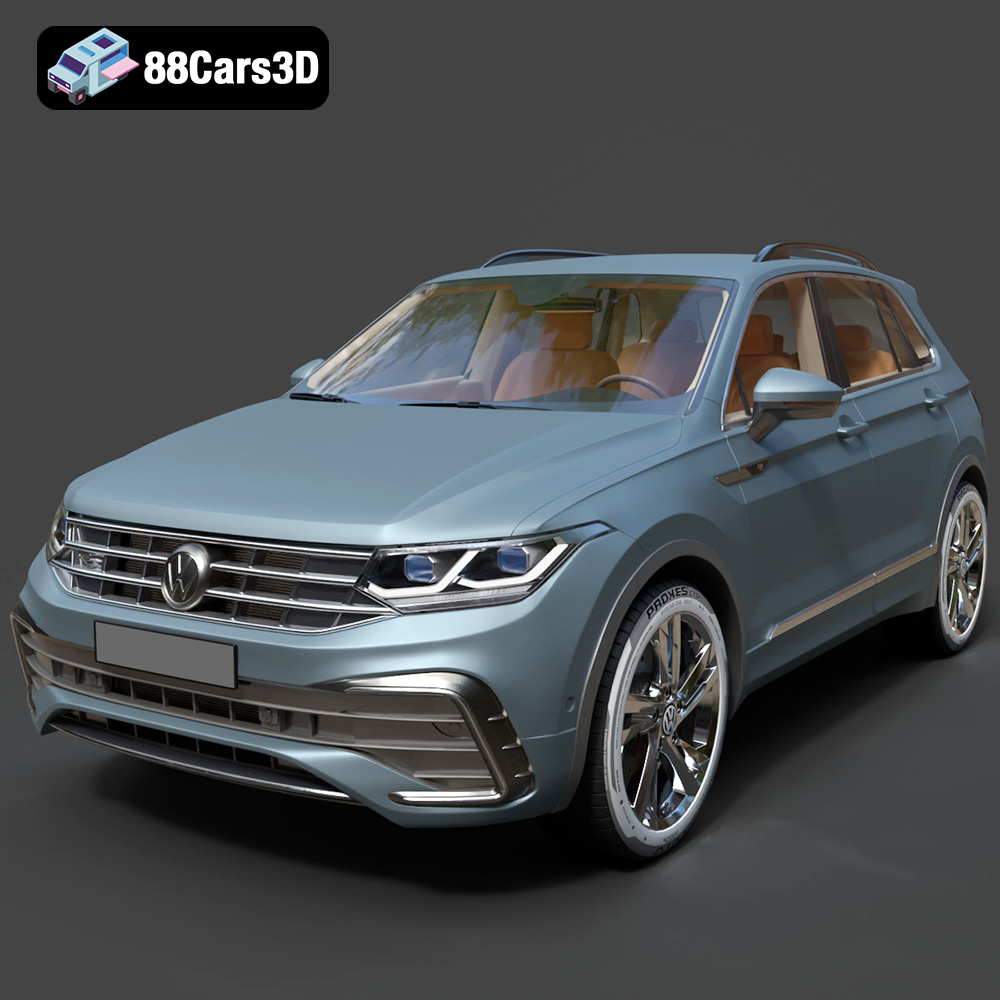
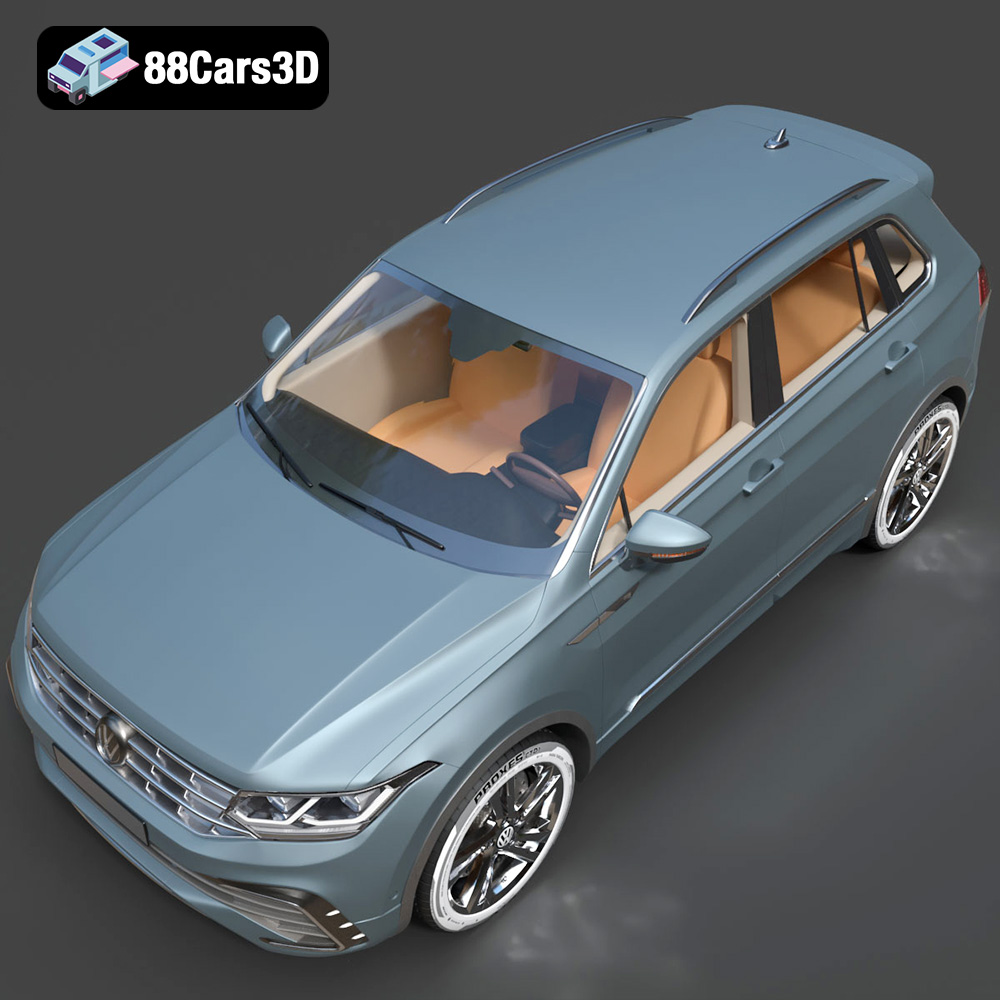
Today, we’re delving into the technical intricacies and profound utility of such assets, exemplified by the Volkswagen Tiguan 2021 3D Model. This particular model stands as a testament to the blend of artistic fidelity and technical robustness required in today’s digital pipelines. It perfectly captures the modern styling, dynamic stance, and sophisticated details of the popular SUV, providing an exceptional asset for a diverse array of digital projects. Its clean geometry, accurate proportions, and realistic materials make it a cornerstone for anyone seeking to elevate their automotive rendering or simulation projects.
The journey of a 3D model from concept to a rendered scene or an interactive environment often involves navigating a diverse ecosystem of file formats. Each format serves a specific purpose, optimized for different stages of the production pipeline, software compatibility, or end-use application. Understanding these distinctions is crucial for seamless workflow integration and achieving optimal results with assets like the Volkswagen Tiguan 2021 3D Model.
The .blend format is the native file type for Blender, the powerful open-source 3D creation suite. A .blend file typically encapsulates an entire scene, including the 3D mesh, materials, textures, lighting setups, cameras, animations, and even physics simulations. Its primary advantage is its comprehensive nature, allowing for full editability within Blender. For users working primarily in Blender, this format provides the most flexibility for modifications, retargeting animations, or simply diving deep into how the model was constructed. The Volkswagen Tiguan 2021 3D Model in .blend format offers an editable Blender file with materials and a lighting setup, making it immediately usable for rendering or further customization within the software.
The .fbx (Filmbox) format is an Autodesk proprietary format that has become an industry standard for interchange between various 3D applications, particularly strong in game development. It’s excellent at storing animated 3D models, complete with meshes, materials, textures, bones, and animation data. Its robust support for skeletal animations and blend shapes makes it a go-to for character and vehicle assets in game engines like Unreal Engine and Unity. The .fbx variant of the Tiguan model is game-engine ready, prepped for efficient import and integration into real-time environments, often with optimized poly counts and properly configured UVs for performance.
The .obj (Wavefront Object) format is one of the oldest and most universally supported 3D file formats. It’s a simple, human-readable text-based format that primarily stores geometric data: vertices, normals, UV coordinates, and faces. While it doesn’t typically embed animation or advanced material properties, it’s incredibly reliable for transferring static mesh data between almost any 3D software package, making it a truly universal format for cross-software compatibility. It’s often accompanied by an .mtl file (Material Template Library) that defines basic material properties. The .obj version of the Volkswagen Tiguan 2021 3D Model serves as a foundational asset, ensuring it can be opened and worked with in virtually any professional 3D application.
The .glb (GL Transmission Format Binary) is the binary version of glTF, a royalty-free specification for the efficient transmission and loading of 3D scenes and models by applications. It’s increasingly popular for web-based 3D, augmented reality (AR), and virtual reality (VR) applications due to its compact file size and efficient loading capabilities. A .glb file packages everything into a single binary, including geometry, materials, textures, and animations, making it highly portable and ideal for real-time display in browsers or mobile AR apps. The Tiguan model’s .glb format is specifically optimized for these performance-sensitive environments.
The .stl (Stereolithography) format is the de facto standard for 3D printing. It represents a 3D model as a series of connected triangles (a triangulated surface), defining only the surface geometry without any color, texture, or material information. For precise manufacturing and prototyping, .stl is indispensable. While not visually rich, its importance lies in its ability to translate a digital model into a physical object. The Volkswagen Tiguan 2021 3D Model offered in .stl format can be invaluable for creating physical prototypes, scale models, or even custom parts using a 3D printer.
The .ply (Polygon File Format, or Stanford Triangle Format) is another format primarily used for storing 3D data, particularly from 3D scanners. It’s capable of storing a wide range of properties, including color, transparency, surface normals, texture coordinates, and scalar data. While less common for general interchange than .obj or .fbx, it’s highly valued in scientific and engineering fields for its precision and ability to carry detailed mesh data for analysis, CAD, or reverse engineering applications. The .ply version of the Tiguan model would be suitable for those needing a detailed polygon mesh for specific analytical or industrial visualization tasks.
The .unreal designation (or often a .uasset bundle) refers to assets specifically configured and optimized for direct import and use within Unreal Engine. This isn’t a standalone file format in the same way .fbx or .obj is, but rather an indication that the asset package includes all necessary files (meshes, materials, textures, blueprints, collision) pre-arranged for seamless integration into an Unreal Engine project. This saves significant setup time and ensures that the model, such as the Volkswagen Tiguan 2021 3D Model, functions correctly within Unreal’s PBR rendering pipeline, with proper scaling, collision, and material instances.
The .max format is the native file type for Autodesk 3ds Max, a leading software for 3D modeling, animation, rendering, and visualization, especially prominent in architectural visualization and product design. Like .blend, a .max file contains the complete scene data, offering full editability. It’s ideal for users who rely on 3ds Max for their primary workflow, enabling them to leverage all of the software’s powerful tools for advanced rendering (e.g., V-Ray, Corona), complex animations, and detailed scene compositions. The .max file for the Tiguan model ensures that 3ds Max users can fully customize and integrate it into their high-fidelity rendering and animation projects.
The availability of the Volkswagen Tiguan 2021 3D Model in such a comprehensive array of formats underscores its versatility and professional readiness, catering to virtually any professional pipeline.
Beyond simply having a model in the right format, the underlying construction determines its true value. A truly professional 3D car model, like those found on 88cars3d.com, is characterized by several key technical attributes that ensure its utility across diverse applications.
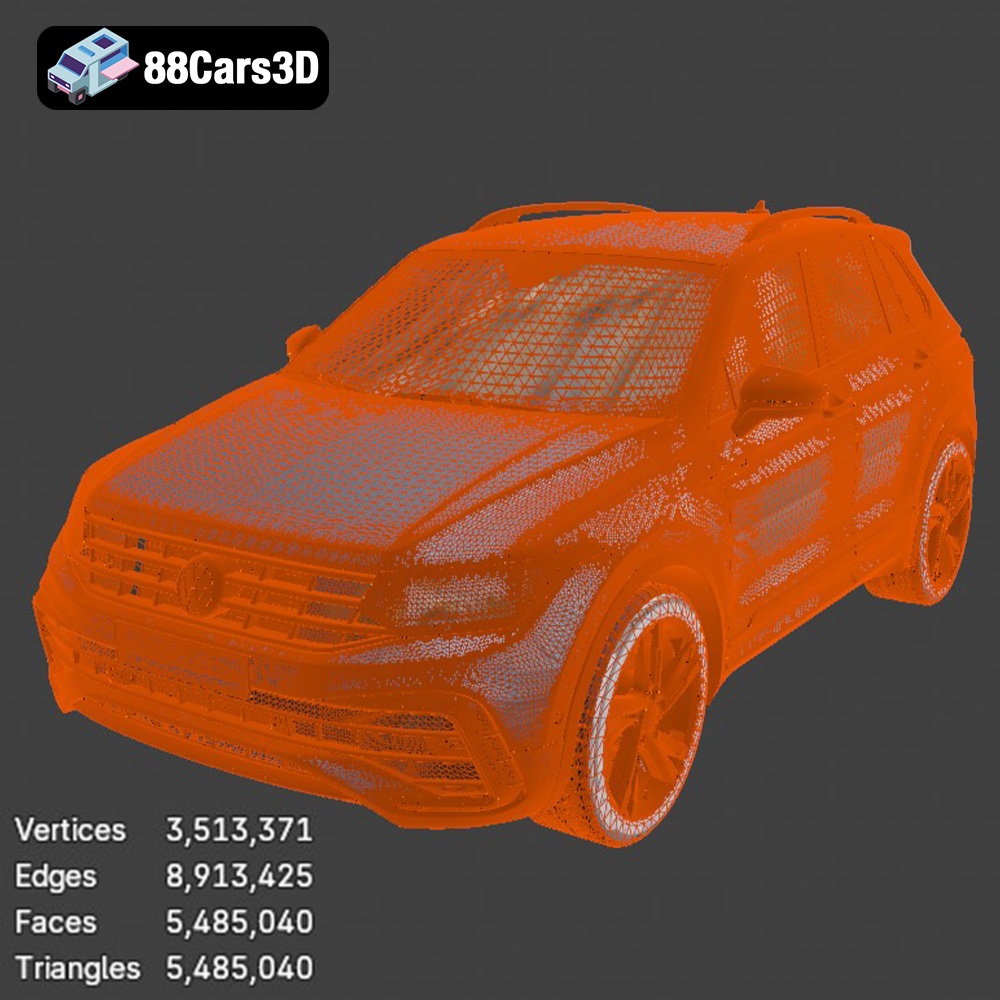
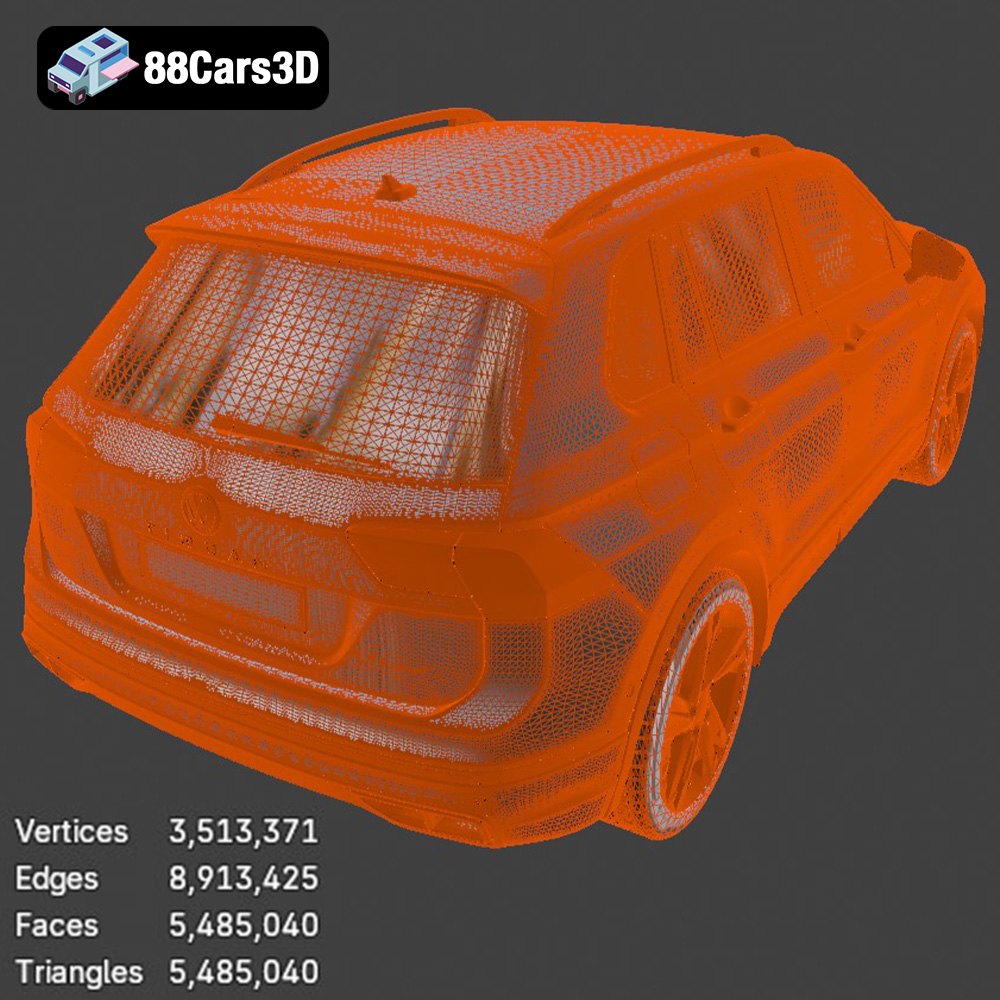
At the heart of any high-quality 3D model is its topology. This refers to the arrangement of faces, edges, and vertices that make up the mesh. Clean topology typically means an all-quad mesh (faces with four sides), as opposed to triangles or N-gons (faces with more than four sides). Quads allow for smoother subdivision, easier UV mapping, and more predictable deformation, which is crucial for animations or complex rendering. A well-structured topology with optimized edge loops ensures that reflections on curved surfaces appear smooth and natural, a critical detail for automotive rendering. The Volkswagen Tiguan 2021 3D Model boasts well-structured topology, making it adaptable for both static renders and dynamic simulations without artifacts.
Visual fidelity largely hinges on the quality of materials and textures. Professional models utilize Physically Based Rendering (PBR) workflows, where materials are defined by properties like albedo (base color), roughness, metallic, normal maps, and sometimes ambient occlusion. Each of these texture maps contributes to how light interacts with the surface, resulting in highly realistic appearances. Accurate UV mapping is also paramount; it’s the process of flattening the 3D surface into a 2D space to apply textures without distortion. High-resolution, tileable textures and strategically placed unique textures (e.g., for badges, headlights) contribute to the overall realism. The Tiguan model’s realistic materials are a direct result of these meticulous texturing practices.
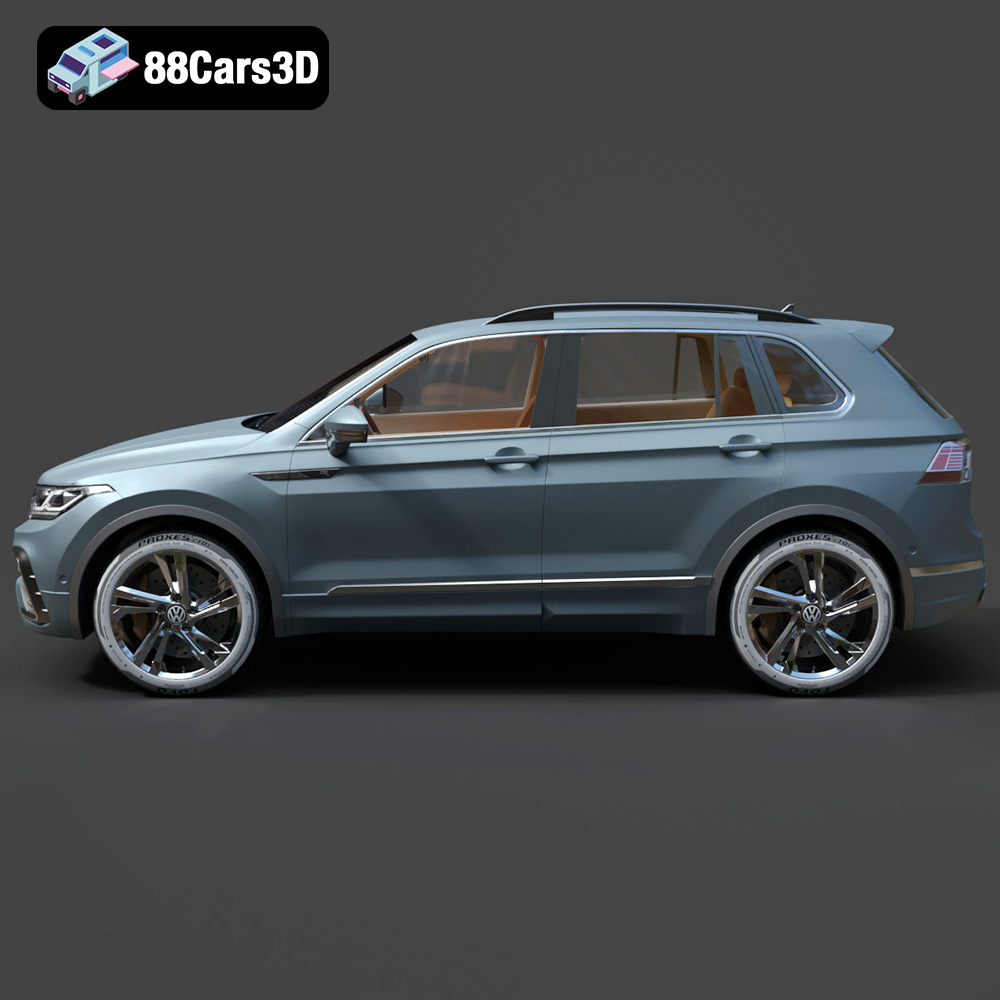
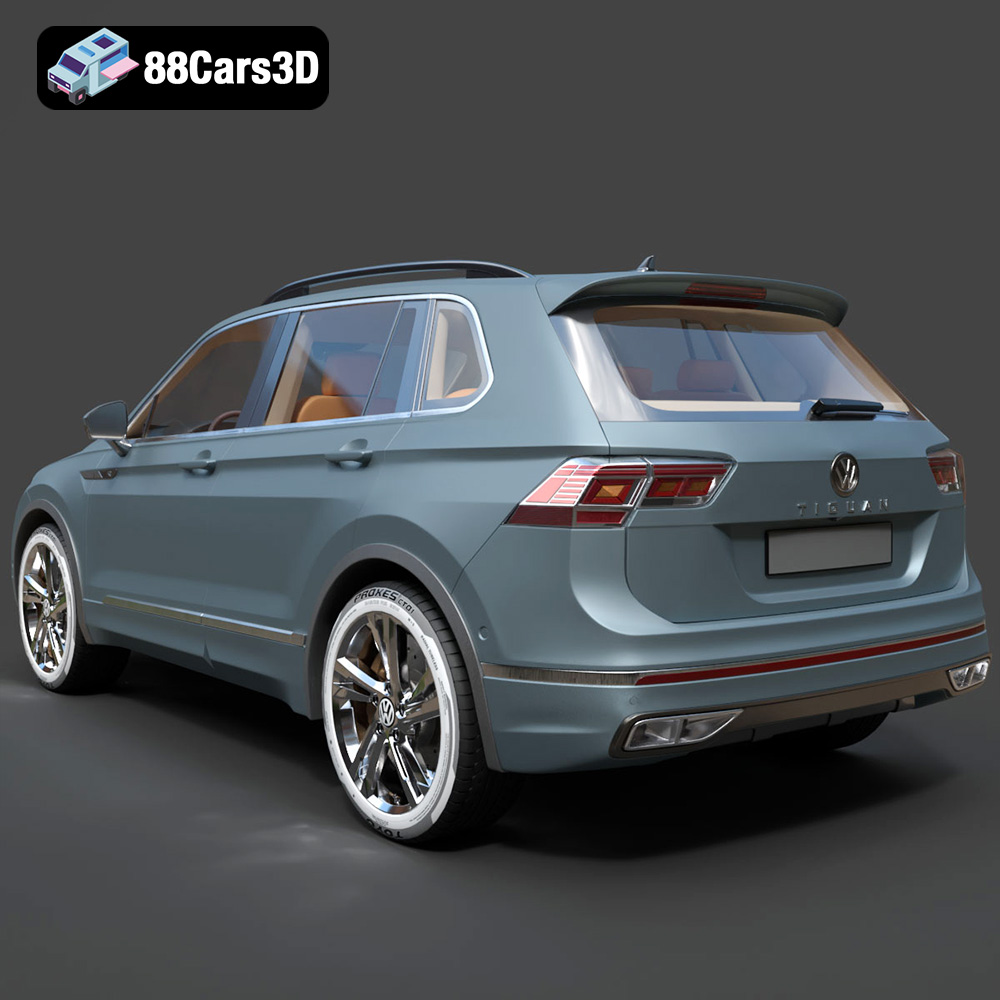
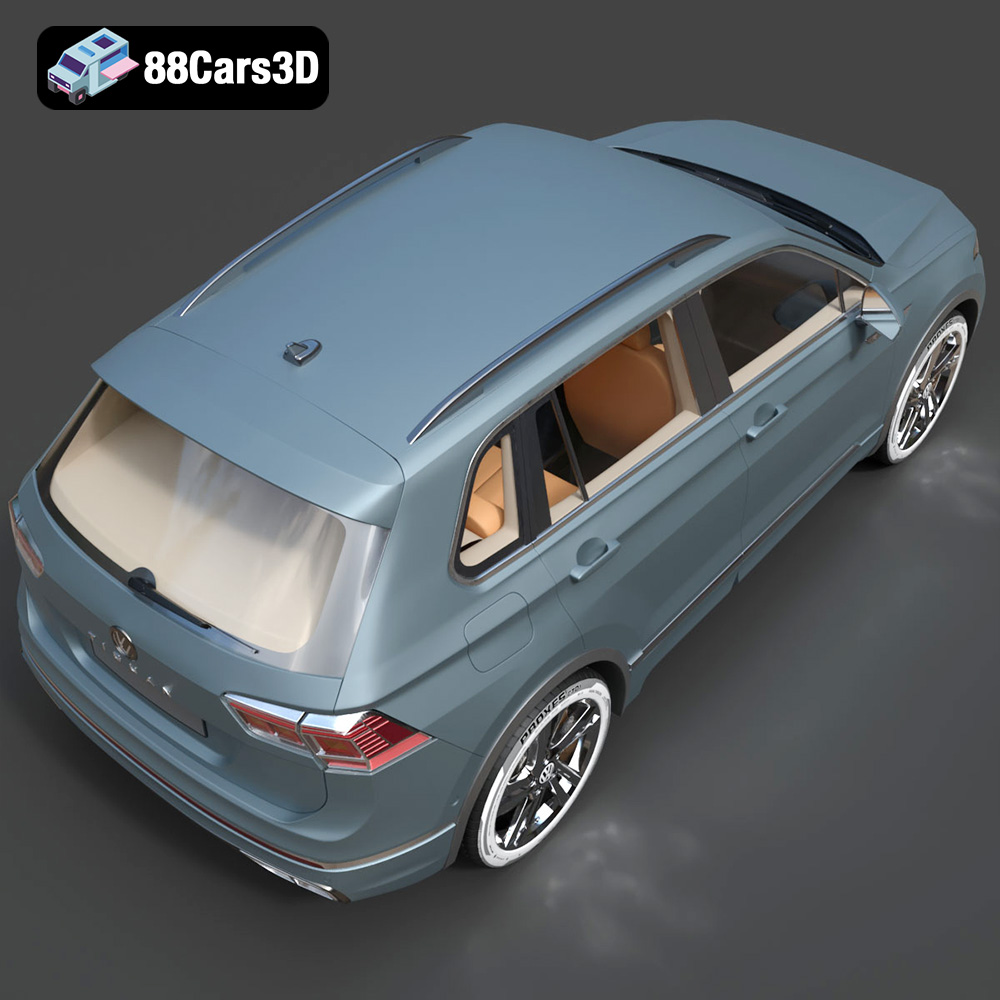
For an automotive model, accuracy is non-negotiable. This means not only adhering to the real-world dimensions and proportions of the vehicle but also meticulously recreating intricate details. This includes the design of headlights and taillights, the subtle curves of the body panels, the specifics of the wheel design, and even the interior dashboard elements for models designed for close-up shots. Professional models are often built from engineering blueprints and photographic references to ensure every detail, no matter how small, contributes to an authentic representation. The Volkswagen Tiguan 2021 3D Model excels in this area, capturing the sophisticated details of the popular SUV.
The true value of a versatile 3D asset like the Volkswagen Tiguan 2021 3D Model lies in its seamless integration into diverse professional pipelines. Its multi-format availability ensures adaptability, making it a powerful tool for various creative and technical endeavors.
For high-end marketing, product showcases, or design reviews, automotive rendering demands photorealism. Artists often import the 3D car model into software like 3ds Max (using the .max file) or Blender (using the .blend file), then set up studio lighting environments, reflective backdrops, and realistic camera angles. Using advanced rendering engines like V-Ray, Corona Renderer, or Blender’s Cycles/Eevee, they can simulate complex light interactions, creating stunning images and animations. The clean geometry and PBR materials of the Tiguan model streamline this process, allowing for quick setup and iteration of various finishes, colors, and environments to produce compelling visuals.
In game development, performance is as critical as fidelity. When integrating a 3D car model into game engines like Unreal Engine or Unity, efficiency is key. The .fbx and .unreal formats of the Volkswagen Tiguan 2021 3D Model are specifically designed for this. Developers will typically import the model, apply appropriate materials, set up collision meshes (simplified geometry for physics interactions), and create Levels of Detail (LODs) to ensure the model performs well at varying distances from the camera. The Tiguan model’s optimization for demanding applications makes it an excellent choice for game development, ensuring smooth frame rates without sacrificing visual quality.
Augmented Reality (AR) and Virtual Reality (VR) push the boundaries of immersion, requiring models that are both visually rich and incredibly lightweight. For these applications, the .glb format of the Volkswagen Tiguan 2021 3D Model becomes invaluable. It’s optimized for rapid loading and display on mobile devices or VR headsets, where computational resources are often limited. Integrating the model involves placing it within the AR/VR scene, configuring its scale and orientation, and adding any interactive elements. The accuracy of the Tiguan model ensures a believable presence in these immersive environments, whether for virtual showrooms, interactive product guides, or training simulations.
The utility of a high-quality 3D car model extends far beyond simple imagery, impacting numerous industries with its versatility and precision. The Volkswagen Tiguan 2021 3D Model exemplifies how a single asset can power diverse professional needs.
Automotive manufacturers and advertising agencies constantly seek innovative ways to showcase new vehicles. Instead of costly physical photoshoots and video productions, 3D models offer unparalleled flexibility. Imagine a virtual commercial for the Volkswagen Tiguan 2021, where the car seamlessly drives through various photorealistic environments – from bustling cityscapes to serene mountain roads – all rendered digitally. Artists can dynamically change paint colors, wheel designs, or even environmental conditions with a few clicks, producing a vast library of marketing assets. Furthermore, interactive 3D configurators on websites allow potential buyers to customize their Tiguan in real-time, significantly enhancing the online shopping experience.
Before a single physical prototype is built, automotive designers rely heavily on 3D models for visualization and iteration. The Volkswagen Tiguan 2021 3D Model, in its .max or .blend format, could serve as a base for design reviews, allowing engineers and designers to examine every curve and detail in a virtual space. They can conduct aerodynamic simulations, evaluate material finishes, and assess ergonomic factors long before committing to expensive physical prototypes. This iterative digital process significantly reduces development costs and speeds up the design cycle, making the transition from concept to production much smoother.
Beyond visual appeal, 3D car models are crucial for functional applications like simulations. Imagine a driving simulator used for training new drivers or testing autonomous vehicle algorithms. The Volkswagen Tiguan 2021 3D Model, integrated into an Unreal Engine or Unity environment via .fbx or .unreal formats, can provide a realistic vehicle model for these scenarios. This allows for rigorous testing of vehicle dynamics, sensor placement, and control systems in a safe, repeatable virtual environment. Similarly, emergency services can use these models in virtual training exercises to simulate rescue scenarios involving specific car types, enhancing preparedness and operational efficiency.
Achieving a perfect balance between visual realism and efficient performance is a constant challenge in 3D production. A professional-grade asset like the Volkswagen Tiguan 2021 3D Model is engineered with this balance in mind, ensuring it performs optimally across a spectrum of applications.
Poly count, the number of polygons (faces) in a mesh, directly impacts performance. While high poly counts allow for intricate details, they can cripple real-time applications. Professional 3D car models are meticulously optimized to provide maximum visual fidelity with the lowest possible poly count. This involves strategic mesh reduction techniques where detail is maintained in visible areas and simplified in less noticeable ones. For game assets, multiple Levels of Detail (LODs) are created – progressively lower poly versions of the model that swap out as the camera moves further away, ensuring performance without a noticeable drop in quality at a distance.
Effective UV mapping and texture application are critical for both visual quality and rendering efficiency. A clean UV layout minimizes texture stretching and allows for optimal use of texture space. Furthermore, modern pipelines often employ texture atlases, which combine multiple smaller textures into one larger image. This reduces the number of draw calls a graphics card needs to make, significantly improving real-time performance. PBR texture sets (Albedo, Normal, Roughness, Metallic, AO) are typically used, ensuring consistent and realistic material responses under various lighting conditions. The Volkswagen Tiguan 2021 3D Model features optimized UVs and materials, ready for high-performance rendering.
In large-scale projects, managing numerous 3D assets efficiently is paramount. Professional workflows establish robust asset pipelines that enable scalability and ease of updates. This includes standardized naming conventions, consistent folder structures, and modular asset creation where components (e.g., wheels, interior elements) can be easily swapped or updated. Version control systems ensure that changes are tracked and can be rolled back if necessary. The structured nature of the Volkswagen Tiguan 2021 3D Model, offered across multiple formats, exemplifies an asset designed for seamless integration into such well-defined pipelines, supporting both individual artists and large studios.
In a world overflowing with digital assets, discerning the truly professional from the merely passable is paramount. Investing in high-quality 3D car models isn’t just a preference; it’s a strategic decision that impacts the quality, efficiency, and future-proofing of your projects.
Creating a detailed 3D vehicle from scratch is an incredibly time-consuming and skill-intensive process. From initial blueprint modeling to complex UV unwrapping, texturing, and material setup, it can take hundreds of hours for an experienced artist. By acquiring a production-ready asset like the Volkswagen Tiguan 2021 3D Model from 88cars3d.com, artists and studios can save a monumental amount of development time. This allows them to allocate resources to more creative aspects of a project, meet tighter deadlines, and ultimately deliver higher-quality results within budget.
Low-quality 3D assets often come with a host of issues: messy topology, stretched UVs, unrealistic materials, and inaccurate proportions. These flaws are immediately noticeable in high-fidelity renders or real-time applications and can significantly detract from the professionalism of a project. A model engineered with an emphasis on performance and visual fidelity, featuring clean geometry and accurate proportions, ensures that your final output maintains a consistent level of quality. It speaks volumes about the attention to detail and commitment to excellence in your work.
The digital landscape is constantly evolving, with new rendering technologies, game engines, and AR/VR platforms emerging regularly. High-quality 3D models, built with clean topology and standard PBR materials, are inherently more adaptable to these changes. They are easier to re-texture, re-optimize, or convert to new formats as technologies advance. The Volkswagen Tiguan 2021 3D Model, with its comprehensive format support and adherence to professional standards, ensures that your investment remains valuable and usable across future iterations of your projects, preventing costly rework down the line.
The journey from a digital concept to a compelling visual or interactive experience is paved with countless technical decisions. At the core of many successful projects lies the strategic selection of high-quality assets. We’ve explored how a meticulously crafted 3D car model, such as the Volkswagen Tiguan 2021 3D Model, serves as an indispensable tool across diverse professional pipelines, from automotive rendering and game development to AR/VR experiences and industrial simulations.
From understanding the nuanced utility of various file formats like .blend, .fbx, and .max, to appreciating the critical importance of clean topology, PBR materials, and accurate detailing, the technical backbone of a professional asset is clear. Such models are not just static representations; they are versatile building blocks designed to save time, ensure consistency, and future-proof your creative endeavors.
Whether you’re an automotive designer visualizing the next concept, a game developer populating an open world, or an architect integrating vehicles into a scene, the right 3D asset empowers you to achieve unparalleled realism and efficiency. The Volkswagen Tiguan 2021 3D Model, available on 88cars3d.com, is a prime example of an asset engineered to meet these demanding standards, ready to elevate your projects and drive your digital vision forward. Explore its capabilities and unlock new possibilities for your next masterpiece.
Experience the precision of the Volkswagen Tiguan 2021 3D Model, a realistic digital replica designed to meet professional standards. This model perfectly captures the modern styling, dynamic stance, and sophisticated details of the popular SUV, providing an exceptional asset for a diverse array of digital projects.
Engineered with an emphasis on performance and visual fidelity, this 3D vehicle features clean geometry, accurate proportions, and realistic materials. The well-structured topology allows for seamless workflow integration, ensuring outstanding results in both tight studio close-ups and expansive dynamic environments.
This versatile model is optimized for demanding applications, making it an excellent choice for game development, cinematic rendering, augmented and virtual reality (AR/VR) experiences, and architectural visualization. The comprehensive package is structured to integrate flawlessly into your preferred professional pipeline.
Available file formats include:
Tags: .volkswagen, .tiguan, .suv, .crossover, .car3dmodel, .rendering, .simulation, .gameasset, .arvr, .blend, .fbx, .obj, .glb, .stl, .ply, .unreal, .max
$19.99
.arvr
.blend
.car3dmodel
.crossover
.fbx
.gameasset
.glb
.max
.obj
.ply
.rendering
.simulation
.stl
.tiguan
.unreal
.volkswagen
SUV