Unlocking Creative Potential: The Versatility of High-Quality 3D Car Models
In the dynamic worlds of automotive design, architectural visualization, game development, and immersive AR/VR experiences, the demand for high-fidelity 3D assets is constant. Professionals across these industries understand that the quality of their 3D models directly impacts the realism, performance, and overall impact of their projects. From a finely tuned sports car glistening under studio lights to an everyday utility vehicle populating a bustling street scene, each 3D car model plays a critical role in crafting compelling digital narratives and simulations.
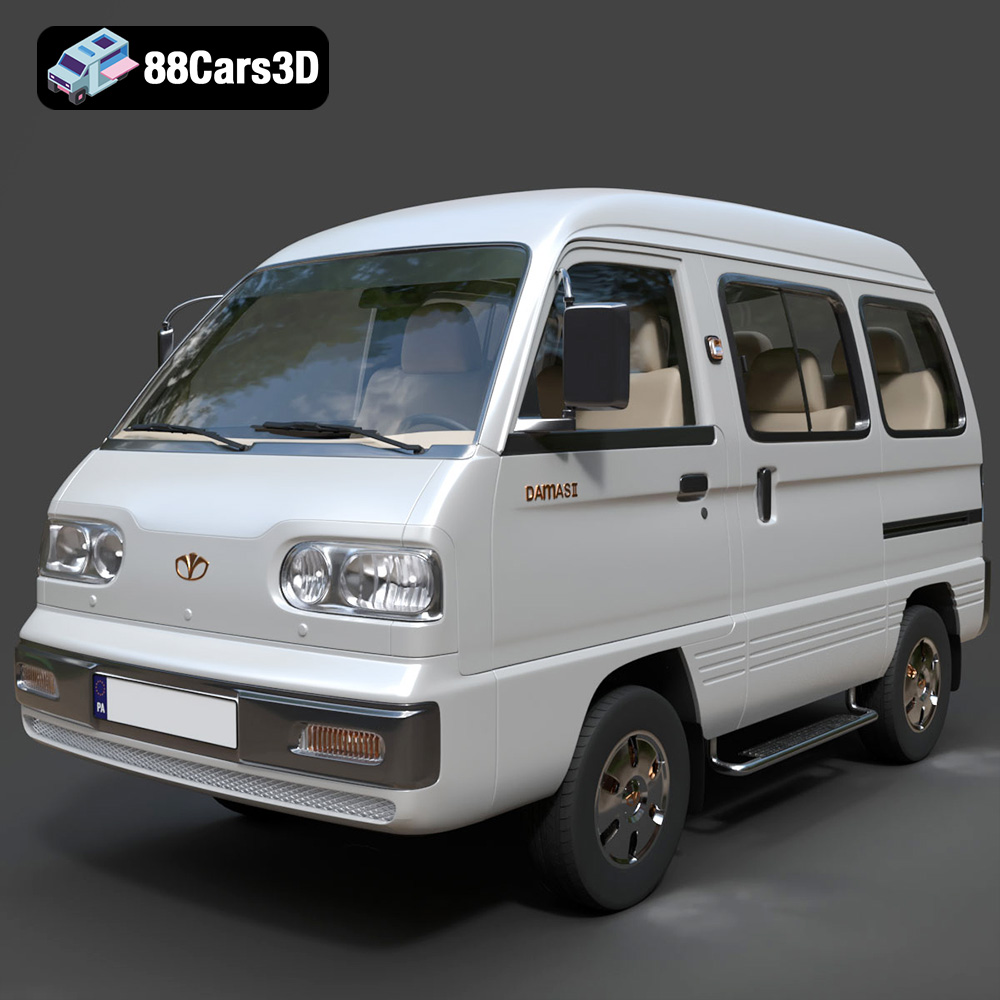
At 88cars3d.com, we specialize in providing meticulously crafted 3D car models that meet these exacting standards. Our extensive library caters to a broad spectrum of needs, ensuring that whether you’re looking for a vintage classic, a modern supercar, or an authentic workhorse, you’ll find assets designed for seamless integration and stunning results. One such example that perfectly embodies versatility and real-world utility is the Daewoo Damas 2 Microvan 3D Model. This model, far from a glamorous showpiece, captures the essence of a practical, ubiquitous vehicle, making it an invaluable asset for projects demanding authenticity and a touch of global character.
This comprehensive guide will explore the technical nuances behind professional-grade 3D car models, delve into various file formats, discuss integration into popular workflows like 3ds Max, Blender, and Unreal Engine, and highlight how a model like the Daewoo Damas 2 Microvan can elevate diverse creative and commercial endeavors.
Understanding 3D Model File Formats: Choosing the Right Tool for the Job
The journey of any 3D model, from creation to deployment, often involves navigating a landscape of diverse file formats. Each format is designed with specific use cases, software compatibilities, and data retention capabilities in mind. Understanding these distinctions is paramount for ensuring smooth workflows, maintaining asset integrity, and achieving optimal performance across different platforms. The Daewoo Damas 2 Microvan 3D Model is a prime example of an asset offered in a wide array of formats, providing unparalleled flexibility for various projects.
.blend – The Native Blender Ecosystem
The .blend file format is Blender’s native format, offering a complete snapshot of a Blender project. This isn’t just a mesh; it includes all scene data: objects, meshes, materials, textures, animations, lighting, cameras, rigging, modifiers, and even custom scripts. For artists primarily working within Blender, or those intending to modify the asset extensively, the .blend file provides the most flexibility and editable parameters. It’s ideal for deep customization, creating new animations, or integrating the model into a larger Blender-centric scene with full control over every aspect of the asset.
.fbx – The Industry Standard for Interchange
Autodesk’s .fbx (Filmbox) format is arguably the most widely adopted interchange format in the 3D industry, particularly for game development and animation pipelines. It excels at transferring geometry, materials, textures, skeletal animations, and blend shapes between different 3D applications like 3ds Max, Maya, Blender, and game engines such as Unreal Engine and Unity. Its robust support for animation data makes it indispensable for animated 3D car models and characters. When importing into Unreal, .fbx is often the go-to for its reliability in bringing in meshes with their associated data.
.obj – The Universal Mesh Foundation
The .obj (Wavefront OBJ) format is a simple, universal geometry definition file. It primarily stores 3D geometry information, including vertices, UV coordinates, vertex normals, and faces. While it can reference external material files (.mtl), it doesn’t embed them, nor does it support animation or rigging. Its strength lies in its widespread compatibility; almost every 3D software can import and export .obj files. It’s an excellent choice for transferring static meshes when clean geometry is the priority, or as a fallback when more complex formats fail.
.glb – Optimized for AR, VR, and Web
Developed by the Khronos Group, .glb (GL Transmission Format Binary) is the binary version of .glTF, designed for efficient transmission and loading of 3D scenes and models by web applications and AR/VR platforms. It bundles all assets—geometry, materials, textures, animations—into a single, compact file, making it incredibly fast to load and ideal for real-time applications, interactive web viewers, and augmented/virtual reality experiences. For showcasing the Daewoo Damas 2 Microvan 3D Model in a browser-based configurator or a mobile AR app, .glb is the format of choice.
.stl – The Gateway to 3D Printing
The .stl (STereoLithography) format is the de facto standard for 3D printing. It represents a 3D model as a series of connected triangles, describing only the surface geometry of an object without color, texture, or other CAD attributes. For a model like the Daewoo Damas 2, providing an .stl means it’s immediately ready for physical production. For successful 3D printing, the mesh must be “manifold,” meaning it has no holes or inverted faces, forming a completely sealed volume. This ensures the printer can correctly interpret the object’s solid structure.
.ply – Precision Mesh for Analysis and CAD
The .ply (Polygon File Format, or Stanford Triangle Format) is often used for storing 3D scanner data. It can store not only geometry but also color, transparency, texture coordinates, and even normal vectors per vertex or face. While not as universally supported as .obj, it’s frequently used in scientific, engineering, and CAD applications for precise mesh representation and analysis. For highly accurate reproductions or digital archiving, .ply offers a robust data structure.
.unreal – Engine-Ready for Real-Time Environments
While not a standalone file extension in the same vein as .fbx or .obj, the inclusion of .unreal typically signifies that the asset has been specifically prepared or even pre-imported into an Unreal Engine project. This means it might come as an asset pack (.uasset files) or a complete project file, with materials, textures, collision meshes, LODs (Levels of Detail), and pivot points already optimized and configured for Unreal Engine’s real-time rendering pipeline. This dramatically speeds up development for game assets by eliminating much of the initial setup work.
.max – The 3ds Max Project Hub
Similar to .blend for Blender, .max is the native file format for Autodesk 3ds Max. It contains all the scene information, including geometry, materials, textures, lights, cameras, modifiers, and animation data, specific to the 3ds Max environment. For artists working in 3ds Max, this format provides full editability and access to all native features, making it ideal for rendering complex scenes, animation production, and high-quality visualizations. The inclusion of the .max file for the Daewoo Damas 2 Microvan 3D Model ensures that 3ds Max users can seamlessly integrate and customize the asset within their preferred software.
By offering the Daewoo Damas 2 Microvan in these diverse formats, 88cars3d.com ensures that professionals can pick the optimal file for their specific software, workflow, and project requirements, maximizing efficiency and creative control.
The Daewoo Damas 2 Microvan: A Digital Workhorse for Diverse Projects
While many 3D car models on the market focus on sleek sports cars or luxurious sedans, there’s a significant demand for everyday vehicles that lend authenticity to a scene. The Daewoo Damas 2 Microvan 3D Model fills this niche perfectly, embodying the spirit of a practical, resilient compact commercial vehicle. This model is a digital recreation of a legendary workhorse, meticulously crafted for scenarios where realism and utility are paramount.
Authentic Exterior Detailing and Proportions
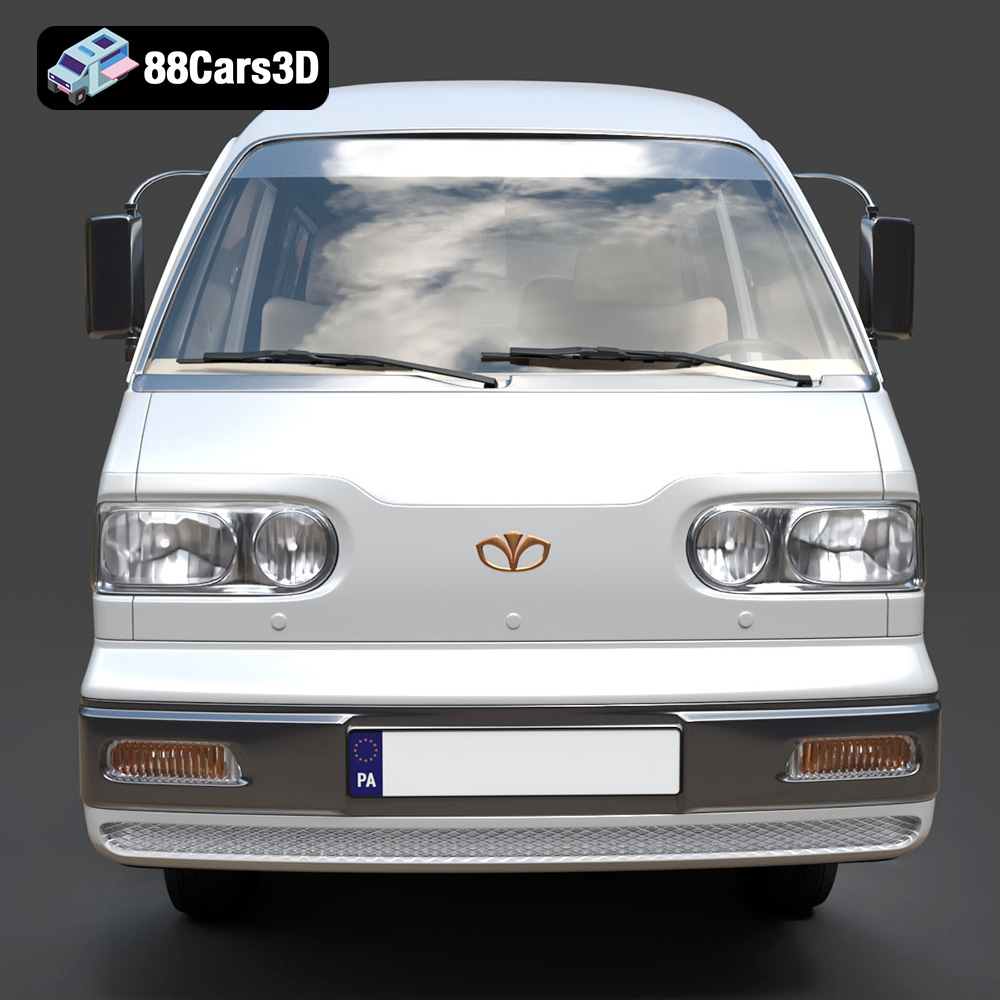
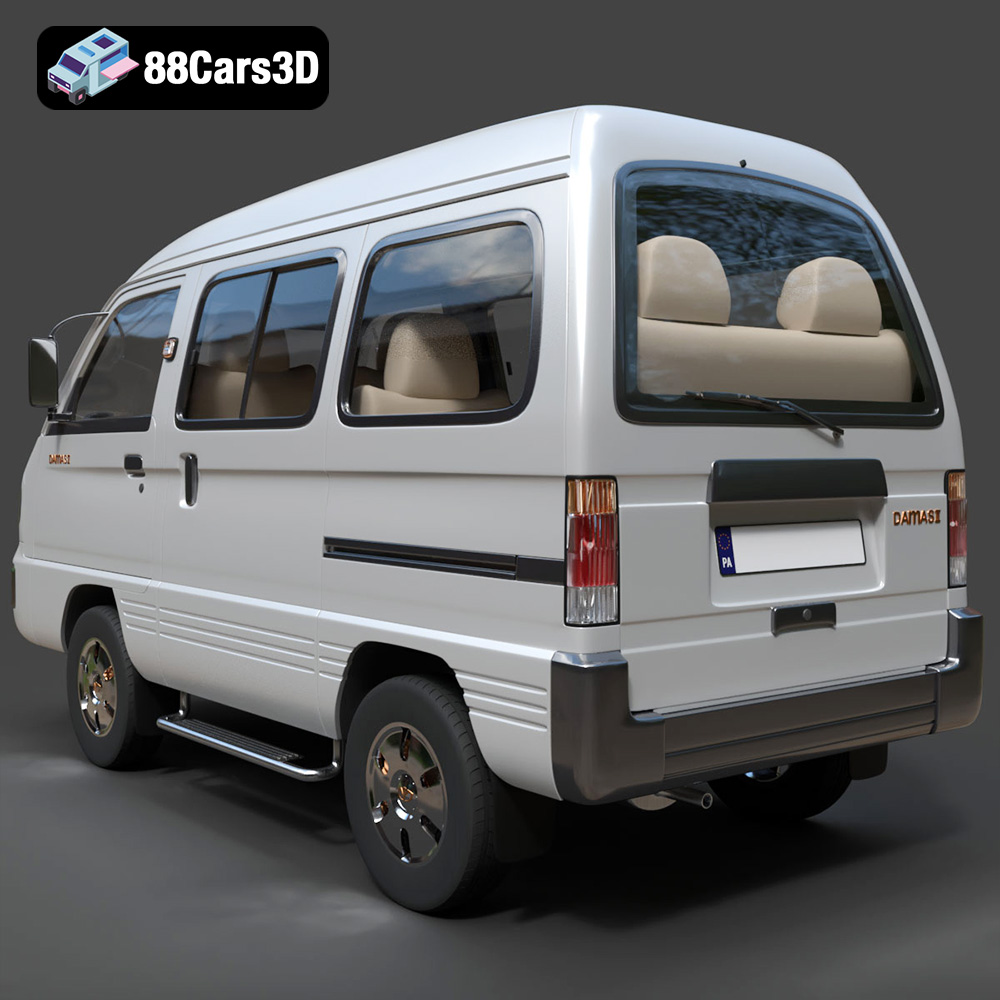
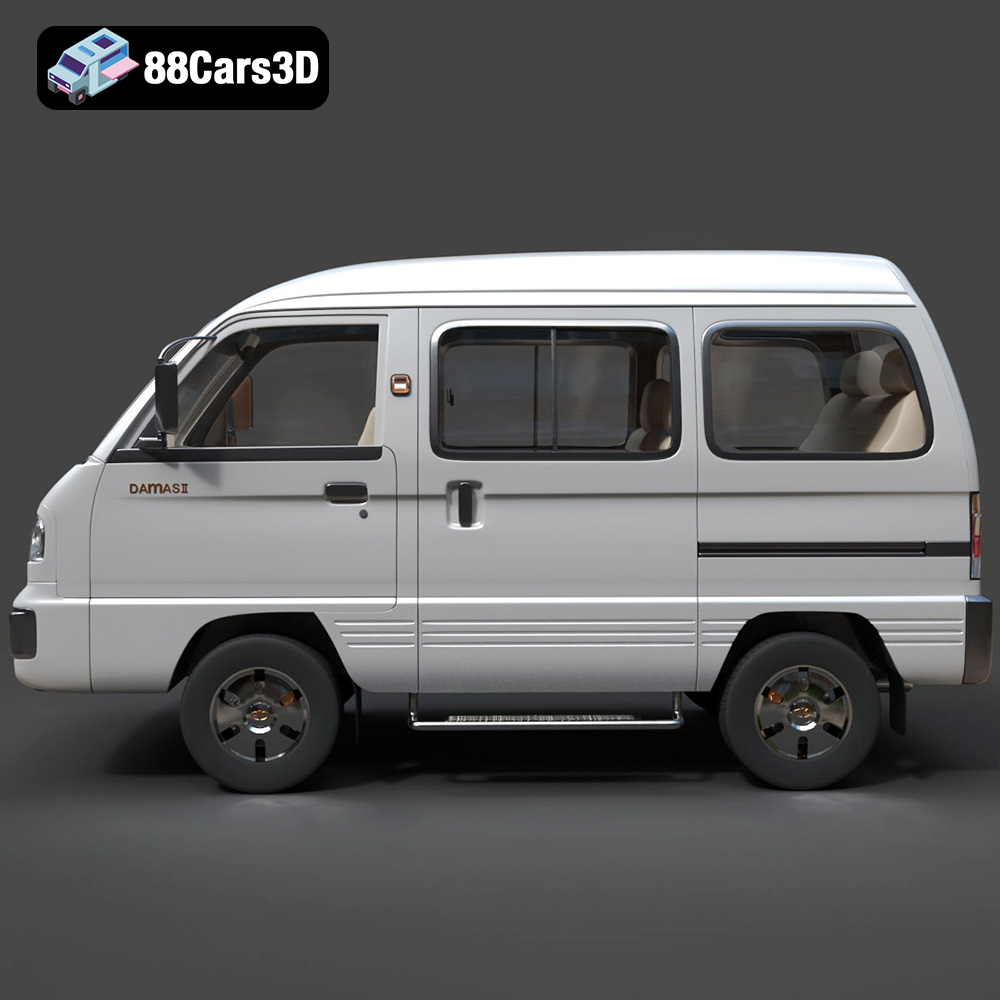
The model captures the essence of the facelifted Daewoo Damas 2, a vehicle renowned for its maneuverability and space efficiency. The exterior features are accurately represented, from its distinct curved headlight and indicator clusters to its classic cabover/semi-cabover design. This specific architecture allows for maximum interior space within a minimal footprint, a design philosophy brilliantly translated into the 3D model. Details like the dual sliding rear doors and the functional rear liftgate are not merely cosmetic; they are built with proper pivot setups, ready for animation and interactive experiences. The utilitarian 12-inch steel wheels and authentic black plastic trim further enhance its realism, making it ideal for populating automotive rendering projects that aim for genuine street credibility.
Practical and Customizable Interior
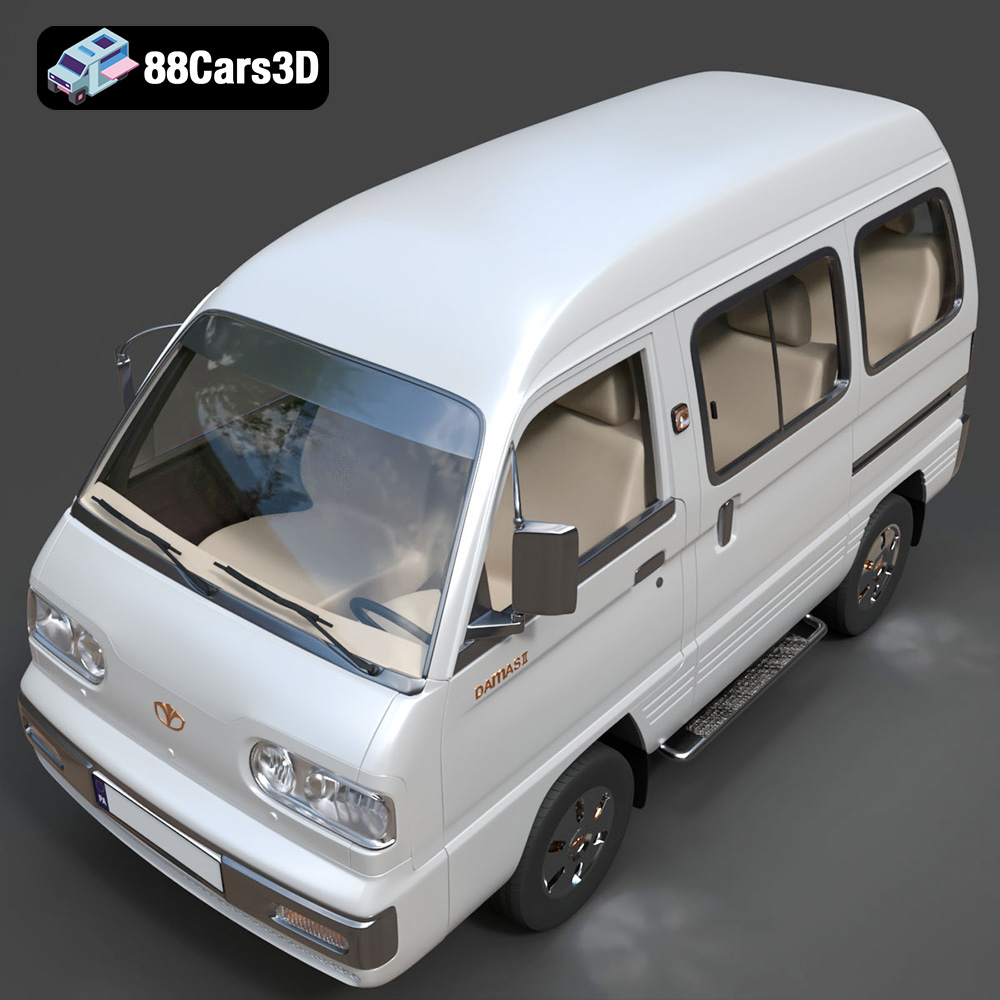
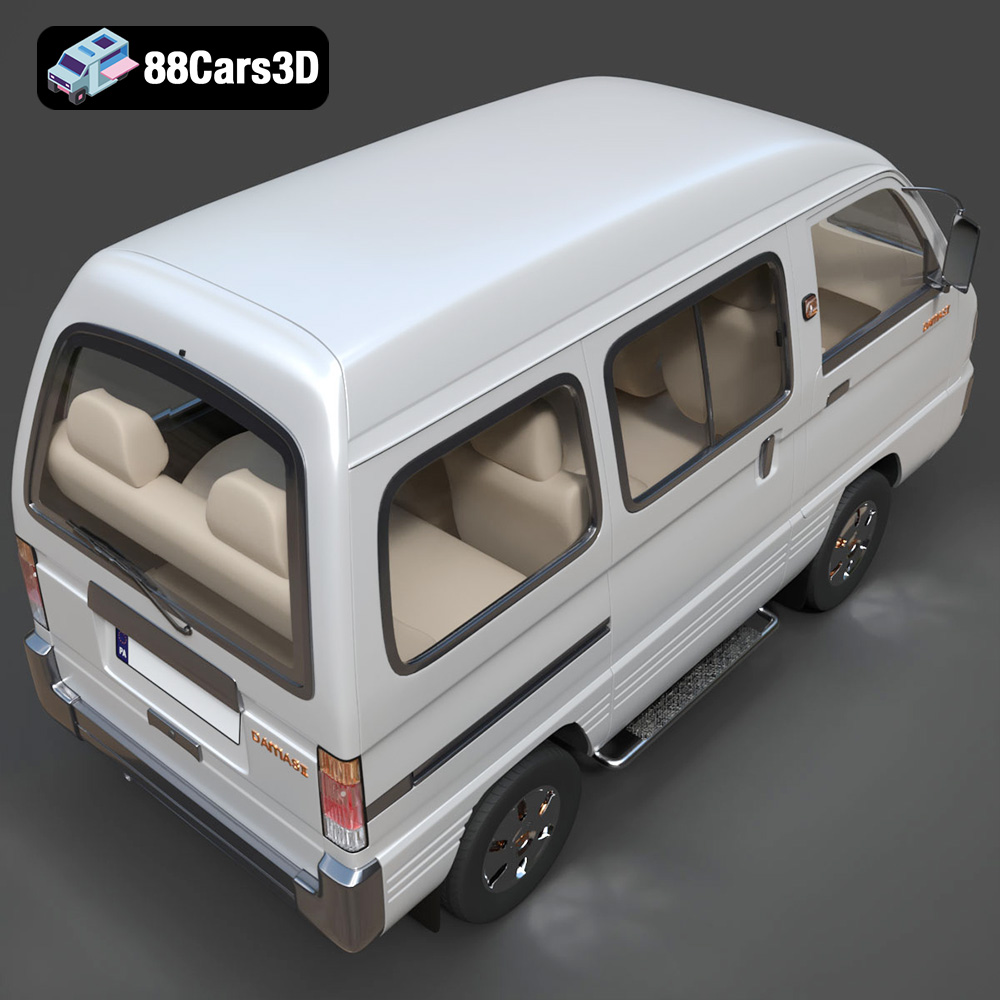
Beyond the exterior, the Daewoo Damas 2 Microvan 3D Model features a highly practical and customizable interior. The cab-over layout, with front seats mounted over the engine, is accurately depicted, showcasing the vehicle’s minimalist and functional design. The rear space offers flexibility, capable of being configured as an empty cargo bay for delivery simulations or with folding passenger benches for compact transport scenarios. The spartan dashboard, simple two-spoke steering wheel, and analog instrument cluster reflect the vehicle’s affordable commercial nature, providing an authentic backdrop for interior close-ups or virtual reality walk-throughs. The optimized geometry ensures that even these seemingly simple details hold up under scrutiny, making the model suitable for a range of visualization tasks.
Integrating the Damas 2 into Professional Workflows
A high-quality 3D model is only as valuable as its ability to seamlessly integrate into professional pipelines. The Daewoo Damas 2 Microvan 3D Model, with its clean topology, real-world scale, and multiple file formats, is designed to be a versatile asset across various industry applications.
Automotive Rendering with 3ds Max and Blender
For automotive rendering specialists, accuracy and visual fidelity are non-negotiable. Using the .max or .blend file, artists can leverage the native capabilities of 3ds Max or Blender for photorealistic results. In 3ds Max, workflows typically involve applying advanced V-Ray or Corona Renderer materials, setting up complex studio lighting, and utilizing environmental backplates to embed the Damas 2 into a realistic scene. The high-poly count and well-organized mesh provide ample detail for close-up shots without loss of fidelity. Similarly, Blender users can harness Cycles or Eevee, utilizing its node-based material system to create convincing paint shaders, realistic glass, and appropriate interior textures. The real-world scale ensures that the model interacts correctly with physically based lighting systems, yielding accurate shadows and reflections.
Game Asset Development in Unreal Engine
When developing game assets for open-world titles or simulation games, optimization and performance are critical. The inclusion of an .fbx and potentially an .unreal (asset pack) version of the Daewoo Damas 2 is invaluable. For Unreal Engine, developers can import the .fbx, which often includes embedded materials and UVs, reducing setup time. The model’s separate components (wheels, doors, steering) are crucial for implementing vehicle physics, interactive elements, and destruction systems. Furthermore, developers can create multiple Levels of Detail (LODs) from the high-poly mesh to ensure efficient rendering performance across varying distances, from close-up player views to distant traffic. Custom collision meshes can be generated to ensure accurate interactions with the game world, making it a robust asset for in-game traffic, delivery missions, or detailed environment dressing.
AR/VR and Web Visualization
The emerging fields of Augmented Reality (AR), Virtual Reality (VR), and web-based 3D experiences demand assets that are both visually rich and highly optimized for real-time performance on diverse hardware. The .glb format, a compact and efficient choice, is perfectly suited for these applications. Imagine a commercial fleet manager using an AR app to visualize how a virtual Daewoo Damas 2 would fit into a tight parking space, or a prospective buyer exploring its interior in a web browser. The efficient bundling of geometry, textures, and materials in .glb ensures quick loading times and smooth interactive experiences, vital for engaging users in immersive environments.
Technical Specifications for Peak Performance
The true measure of a professional-grade 3D model lies in its technical foundation. The Daewoo Damas 2 Microvan 3D Model is built to exacting standards, ensuring both visual excellence and practical utility across various applications.
Optimized Mesh Topology and Real-World Accuracy
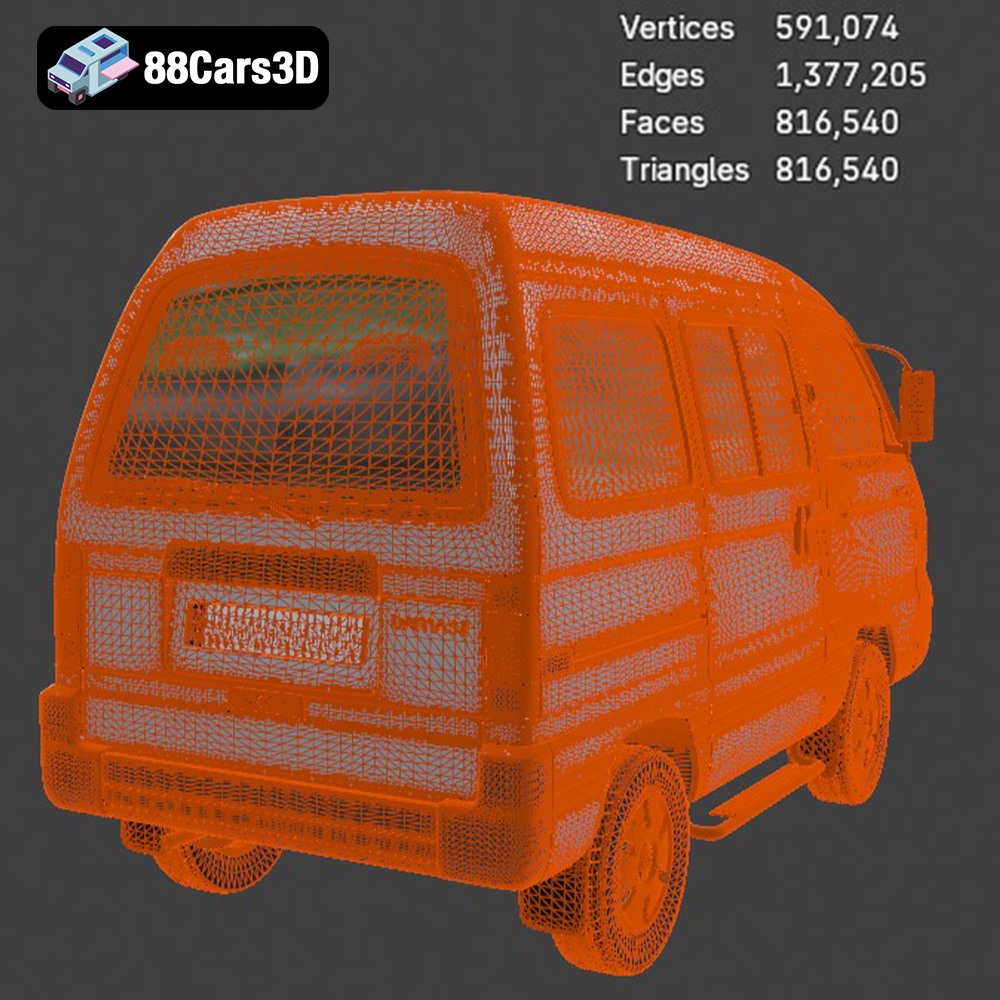
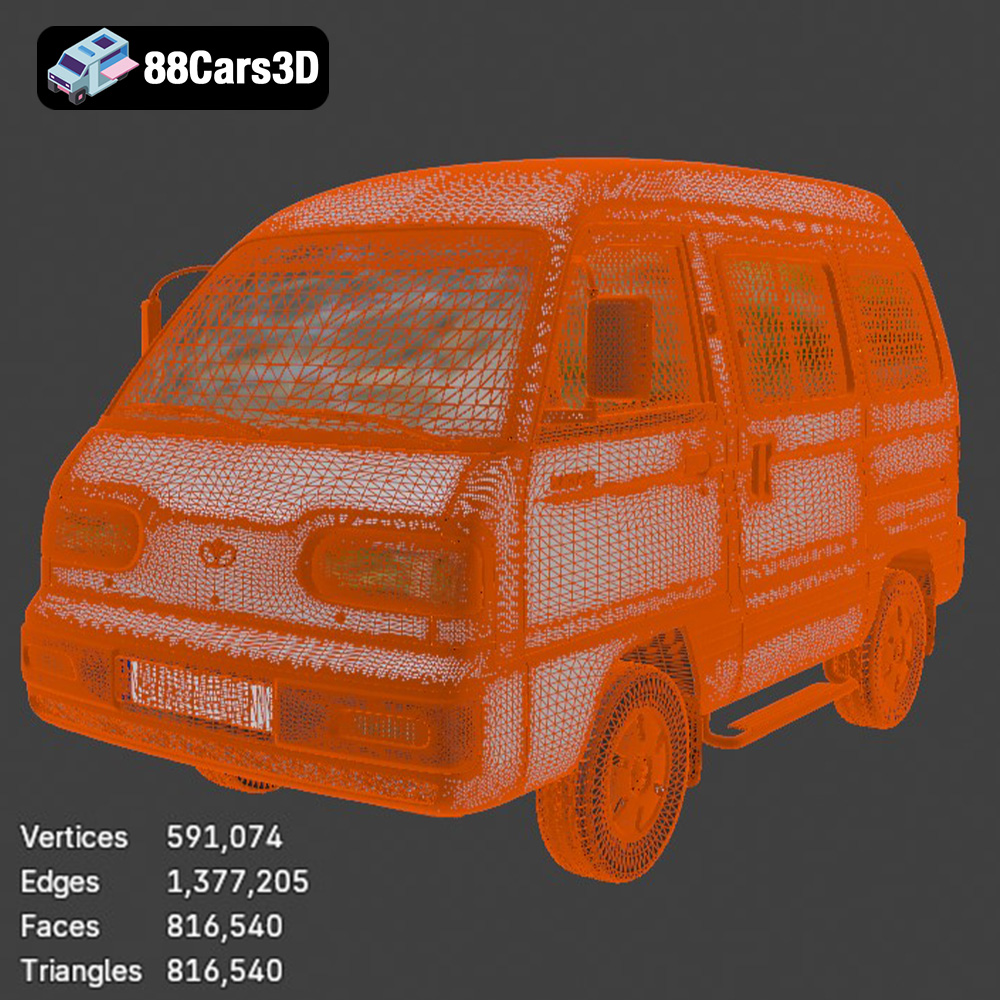
With Vertices: 954,200, Edges: 1,890,500, Faces / Polygons: 935,600, and Triangles: 935,600, this model boasts a high-poly, well-organized mesh structure. This density is crucial for achieving maximum realism, particularly in high-resolution renders and close-up views where subtle curves and surface details are paramount. The clean topology ensures smooth deformations for animation and allows for easy subdivision if even finer detail is required. Furthermore, the model’s real-world scale accuracy, based on factory dimensions, is vital for realistic integration into architectural visualizations, urban planning simulations, and physically accurate automotive rendering scenarios. It ensures that the vehicle will look correctly proportioned alongside other assets and within real-world environments.
Animation-Ready Assets
A key advantage of this model is its preparation for animation. Separate wheels, steering components, and doors, coupled with proper pivot setups, allow for dynamic and realistic motion. Animators can effortlessly rig the steering for turns, rotate the wheels for driving sequences, and animate the dual sliding rear doors or the rear liftgate for cargo loading or passenger entry/exit scenes. This level of articulation transforms a static model into a dynamic asset, perfect for cinematic sequences, interactive simulations, or game assets that demand functional vehicle components. Whether it’s a bustling city animation or a detailed product demonstration of the microvan’s utility, the animation-ready structure saves countless hours in production.
Bringing the Microvan to Life: 3D Printing and Physical Models
The versatility of a well-constructed 3D model extends beyond the digital realm. The inclusion of the .stl format for the Daewoo Damas 2 Microvan 3D Model opens up exciting possibilities for physical creation, transforming the digital asset into a tangible collectible or a functional prototype.
From Digital Mesh to Tangible Miniature
The .stl file provided is specifically prepared for 3D printing, enabling enthusiasts and professionals to create physical scale models of this iconic microvan. The recommended scales (1:24, 1:32, 1:43) cater to various display preferences, from larger, more detailed models to smaller, more compact collectibles. With a recommended layer height of 0.04–0.12 mm, particularly with resin printing for finer details, the model’s intricate exterior features—like the curved headlights and side mirrors—can be faithfully reproduced. The advice to print the body angled for a smooth surface finish and wheels separately highlights best practices for achieving high-quality results from desktop FDM or resin printers.
Customizing Your Physical Damas 2 Model
The journey from a raw 3D print to a display-worthy model involves thoughtful post-processing. Sanding, applying primer, and then painting are crucial steps. The product description suggests classic commercial paint finishes like white or light blue, or even specific colors for taxi variants, allowing for a personalized touch. This process not only enhances the visual appeal but also protects the print. Beyond mere aesthetics, these physical models can serve as tangible prototypes for industrial design, educational tools, or unique automotive collectibles, allowing for a different kind of interaction with the Daewoo Damas 2 beyond the digital screen.
Conclusion: The Enduring Value of Versatile 3D Car Models
The world of 3D modeling thrives on detail, accuracy, and adaptability. The Daewoo Damas 2 Microvan 3D Model is a testament to how even the most utilitarian vehicles can become indispensable assets in a professional 3D artist’s toolkit. From its robust technical specifications, including a high-poly count and animation-ready components, to its availability across a comprehensive suite of file formats, this model is engineered for peak performance and seamless integration.
Whether you’re developing realistic automotive rendering scenes, populating vast game worlds with authentic game assets, creating immersive AR/VR experiences, or fabricating tangible models through 3D printing, the Daewoo Damas 2 offers a level of detail and flexibility that streamlines workflows and elevates final outputs. Its authentic representation of a global workhorse makes it a unique and valuable addition for any project seeking a touch of real-world character and utility.
At 88cars3d.com, we pride ourselves on curating a collection of such high-quality 3D car models, ensuring that our clients have access to the best tools for their creative and commercial ambitions. Explore the Daewoo Damas 2 Microvan and many other exceptional models to unlock the full potential of your next project.
Featured 3D Model
Daewoo Damas 2 Microvan 3D Model
The Daewoo Damas 2 Microvan 3D Model is a highly detailed digital recreation of the ubiquitous and practical compact commercial vehicle. Based heavily on the classic kei-van architecture but refined with a modernized, slightly more rounded front fascia, the Damas 2 became a legendary workhorse across South Korea, Central Asia (particularly Uzbekistan), and Eastern Europe. Known for its incredible maneuverability and space efficiency, it serves as the ultimate urban delivery van and compact passenger transport. This 3D model accurately represents the facelifted exterior styling, including the distinct curved headlight and indicator clusters, cabover proportions, dual sliding rear doors, and functional rear liftgate. Built with dense, clean topology for premium visual fidelity and real-world scale accuracy, it is ideal for close-up rendering, urban environment visualization, animation, game development, and AR/VR commercial fleet showcases. Perfect for realistic street scenes, delivery logistics simulations, architectural visualizations, and indie game projects needing authentic everyday traffic. Features a highly practical cabin layout, configurable rear space, and optimized geometry suitable for interior close-up rendering.
$9.99
View This Model
Related Tags
.automotive
.blend
.daewoo
.damas
.fbx
.obj
.rendering
.stl
3d printing
car-3d-model
chevrolet-damas
commercial-vehicle
damas-2
game asset
high poly
kei-van
microvan
utility-van
uzauto