Get 50% OFF All Premium 3D & STL Models!

In the rapidly evolving landscape of digital media, the demand for exceptionally detailed and accurate 3D assets has never been higher. From breathtaking cinematic sequences and immersive game worlds to advanced AR/VR experiences and industrial visualizations, the quality of a 3D model can significantly impact the final output and project efficiency. Automotive design, in particular, thrives on precision and photorealism, where every curve, material, and reflection must convey authenticity.
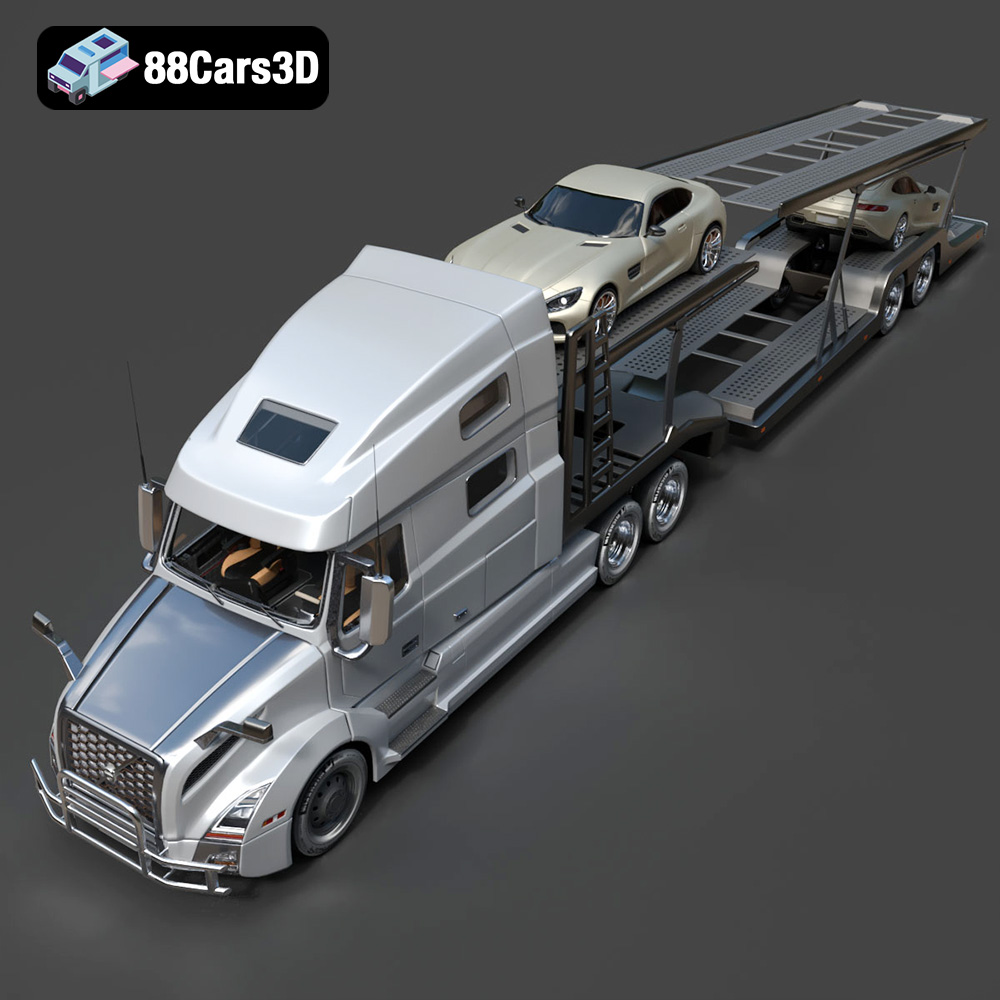
Today, we delve into the intricate world of professional 3D car models, exploring the technical considerations and creative possibilities they unlock. We’ll examine how expertly crafted assets integrate into complex pipelines, enhance visual fidelity, and streamline production. To illustrate these concepts, we’ll feature an exemplary asset: the Volvo Trucks Benz GT-001 3D Model, a testament to exceptional digital realism and versatile design available at 88cars3d.com.
This model, capturing the robust presence and intricate aesthetic of a premium truck concept, is engineered with clean geometry, authentic proportions, and realistic materials. It serves as an ideal case study for understanding the crucial elements that define a high-quality 3D asset in the automotive sector.
The choice of a 3D model file format is far more than a simple preference; it dictates compatibility, data integrity, and efficiency across various professional workflows. A high-quality asset, such as the Volvo Trucks Benz GT-001 3D Model, is often provided in multiple formats to ensure seamless integration into any digital pipeline. Understanding these formats is crucial for any 3D professional.
The .blend file is Blender’s native format, encapsulating an entire scene with all its components: meshes, materials, textures, lighting, cameras, animations, physics simulations, and even custom scripts. When you acquire a .blend file, you’re not just getting a model, but a fully editable project, often with a pre-configured lighting and rendering setup. This makes it ideal for Blender users who need to dive deep into customization, tweak every parameter, or expand upon the existing scene. The Volvo Trucks Benz GT-001 in .blend format offers complete artistic freedom within the Blender ecosystem, allowing for detailed modifications to topology, UVs, or material nodes with ease.
Developed by Autodesk, the .fbx (Filmbox) format is arguably the most prevalent interchange format in the 3D industry, particularly favored for game development and real-time applications. It supports geometry, materials, textures, animations, rigging, and even blend shapes, making it incredibly versatile. Engines like Unreal Engine and Unity rely heavily on .fbx for importing complex assets. When using an .fbx file for the Volvo Trucks Benz GT-001, professionals can expect excellent preservation of hierarchical data, crucial for animated parts or vehicle rigging. While robust, careful attention must be paid to export/import settings (e.g., scale, axis conventions) to ensure data integrity across different software.
The .obj (Wavefront OBJ) format is a fundamental, universally supported standard for transferring pure 3D geometry. It stores vertex positions, UV coordinates, normals, and material group information, often accompanied by a separate .mtl (material) file for basic color and texture references. Its simplicity is its strength: nearly every 3D application can open and save .obj files. While it doesn’t support animation or complex material setups, it’s an excellent choice for basic mesh transfer, ensuring maximum compatibility. The .obj version of the Volvo Trucks Benz GT-001 is perfect for foundational use in any software, providing a clean mesh for a fresh start or quick integration.
.glb is the binary version of glTF (Graphics Language Transmission Format), designed as an efficient, self-contained format for the web and real-time applications, especially AR/VR. It bundles models, textures, and animations into a single file, optimizing for fast loading and rendering in browsers and mobile environments. Its compactness and comprehensive data storage make it ideal for interactive web experiences, product configurators, and mobile AR apps. For visualizing the Volvo Trucks Benz GT-001 in a browser-based showroom or an AR overlay, the .glb format is indispensable due to its streamlined nature.
The .stl (Stereolithography) format is the standard for 3D printing. It represents a 3D model as a series of connected triangles, describing only the surface geometry without color, texture, or material information. The primary concern with .stl files is ensuring they are “watertight” – meaning the mesh is completely enclosed without gaps or overlapping polygons – to ensure successful slicing and printing. For prototyping physical models of the Volvo Trucks Benz GT-001 or creating scale replicas, the .stl format provides the essential geometry for additive manufacturing.
The .ply (Polygon File Format) is another popular format, often used for storing 3D scanner data, scientific visualization, and CAD/CAM applications. Unlike .stl, .ply can store a wider range of properties, including color, transparency, normals, and even confidence values, for each vertex or face. This makes it particularly useful for models derived from real-world scans or for applications requiring precise mesh analysis. The .ply version of the Volvo Trucks Benz GT-001 would be valuable for engineers or designers performing detailed surface analyses or integrating it into specific CAD workflows.
The .unreal format, or more accurately, assets packaged for Unreal Engine, are typically .uasset files or entire Unreal project folders containing pre-configured assets. These go beyond simple .fbx imports by including optimized materials, collision meshes, LODs (Level of Detail), and potentially even blueprints or animation sequences specifically set up for Unreal Engine. This level of pre-configuration significantly streamlines integration, saving developers hours of setup time. For users developing with Unreal Engine, having the Volvo Trucks Benz GT-001 pre-configured as an .unreal asset from 88cars3d.com means immediate plug-and-play functionality in their projects.
The .max file is the native format for Autodesk 3ds Max, one of the leading software packages for 3D modeling, animation, and rendering in professional visualization and game development. Similar to .blend, a .max file contains the complete 3ds Max scene, including all geometry, modifiers, materials (especially V-Ray or Corona setups), lighting, cameras, and animation data. It offers full editability and access to 3ds Max’s powerful toolset. For those deep in the Autodesk ecosystem, the .max version of the Volvo Trucks Benz GT-001 provides the ultimate flexibility for high-fidelity rendering and complex scene management.
Achieving photorealism in automotive rendering is a nuanced art that blends technical mastery with an artistic eye. A premium 3D car model, such as the Volvo Trucks Benz GT-001, provides the perfect foundation, but the magic truly happens with sophisticated material definition and expert lighting.
The “realistic materials” mentioned in the Volvo Trucks Benz GT-001’s description are critical. Modern automotive rendering relies heavily on Physically Based Rendering (PBR) workflows. This involves using texture maps (Albedo/Base Color, Metallic, Roughness, Normal, Ambient Occlusion, etc.) that accurately mimic how light interacts with real-world surfaces. For a truck model, this means convincing paint shaders with metallic flakes and clear coat effects, realistic glass that refracts and reflects light appropriately, and worn rubber tires with subtle displacement. The cleanliness of the model’s UV unwrapping is paramount here, ensuring textures can be applied without stretching or distortion. When materials are accurately represented, the Volvo Trucks Benz GT-001 transforms from a mere digital mesh into a tangible, believable vehicle.
Even the most detailed 3D car models will fall flat without proper lighting. Automotive rendering frequently employs High Dynamic Range Images (HDRIs) to simulate realistic environmental lighting, capturing both the intensity and color of light from a specific location. Supplementing HDRIs with virtual studio lights or targeted spotlights can highlight specific design features, emphasize chrome accents, or create dramatic reflections on bodywork. In software like 3ds Max, Blender, or Unreal Engine, artists meticulously position these light sources, adjust their intensity, color temperature, and falloff to sculpt the form of the vehicle. Renderers like V-Ray, Corona Renderer, Cycles, or Arnold then process this information to produce stunning, lifelike images that showcase the Volvo Trucks Benz GT-001 in its best light, whether it’s under a dramatic sunset or a pristine studio backdrop.
Game development demands a unique blend of visual fidelity and performance optimization. A high-quality 3D car model must not only look good but also run efficiently in real-time environments. The Volvo Trucks Benz GT-001 3D Model, designed with “optimal performance across various platforms” in mind, is well-suited for this challenging domain.
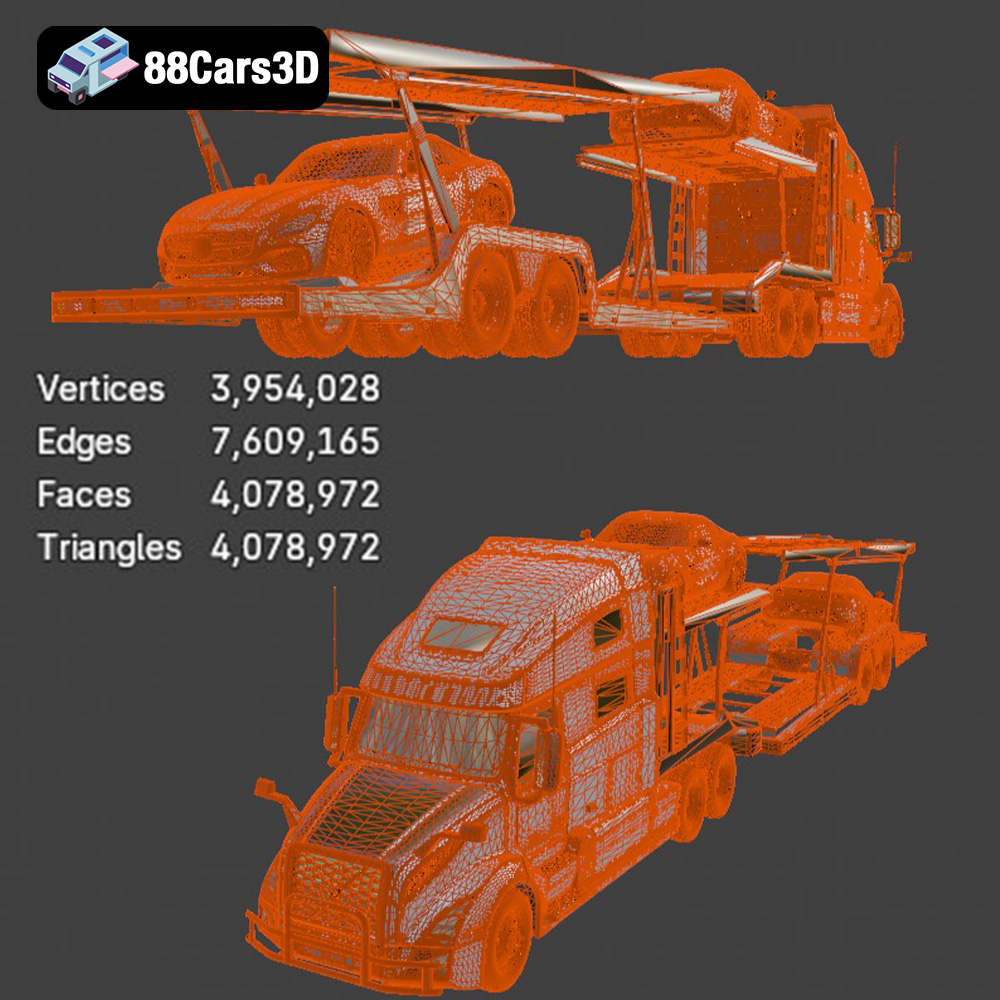
Unlike pre-rendered cinematic sequences, game engines must render frames in milliseconds. This necessitates meticulous optimization. “Clean geometry” is a key aspect here; it means the model is built with an efficient polygon count and well-structured topology, predominantly quads, which simplifies deformation and keeps poly counts manageable. Developers also implement Level of Detail (LOD) systems, creating multiple versions of the model with progressively lower polygon counts that swap in based on distance from the camera. Furthermore, custom collision meshes, simpler than the visual mesh, are essential for accurate physics interactions without taxing the CPU. The Volvo Trucks Benz GT-001, with its professional construction, minimizes the effort required for these crucial optimization steps.
Integrating a 3D car model into game engines like Unreal Engine or Unity is a multi-step process. The .fbx format is commonly used for initial import, bringing in the mesh, materials, and sometimes even a basic skeletal rig for suspension or wheel rotation. For assets like the Volvo Trucks Benz GT-001 from 88cars3d.com, the inclusion of a dedicated .unreal file takes this a step further. This often means the asset is already configured with appropriate material instances, collision primitives, and even basic physics assets or blueprints for immediate interaction. Developers can then focus on implementing advanced vehicle physics, creating realistic driving dynamics, adding interactive elements like opening doors (facilitated by the “fully modeled interior”), and setting up camera systems for an immersive player experience. This pre-configuration significantly accelerates the development cycle, letting teams achieve high-quality results faster.
The utility of high-quality 3D car models extends far beyond traditional rendering and game development. They are foundational assets for cutting-edge technologies like Augmented Reality (AR), Virtual Reality (VR), detailed simulations, and even physical prototyping through 3D printing. The versatility of the Volvo Trucks Benz GT-001 3D Model, with its diverse file formats, makes it an ideal candidate for these advanced applications.
AR and VR offer unprecedented opportunities for immersive interaction with 3D models. Imagine customers exploring the interior and exterior of the Volvo Trucks Benz GT-001 in a virtual showroom, or mechanics training on a holographic projection of its engine. The .glb format is particularly crucial here, enabling efficient streaming and display of the model in web-based AR/VR viewers or mobile applications. Its compact, self-contained nature ensures quick loading times and smooth performance, critical for maintaining user presence and avoiding motion sickness in VR. For interactive experiences, the “fully modeled interior” of the Volvo Trucks Benz GT-001 becomes a significant asset, allowing users to virtually sit inside the cab and interact with controls, greatly enhancing the sense of realism and utility in simulation or demonstration scenarios.
In industrial design and engineering, 3D models are invaluable tools for visualization, analysis, and rapid prototyping. Engineers can use precise models like the Volvo Trucks Benz GT-001 to visualize design iterations, conduct virtual ergonomic studies, or perform aerodynamic simulations. The .ply format, with its ability to store detailed mesh data, can be used for advanced surface analysis. For physical prototyping, the .stl format comes into play. Design teams can quickly 3D print scale models of concept vehicles, test their physical presence, and identify potential design flaws before committing to expensive manufacturing processes. This capability to transition seamlessly from digital concept to tangible prototype showcases the immense practical value of meticulously crafted 3D assets in the automotive industry.
The true measure of a 3D asset lies in its practical application across various professional scenarios. The Volvo Trucks Benz GT-001 3D Model exemplifies how a single, well-constructed asset can serve a multitude of high-demand projects, becoming an indispensable tool for designers, developers, and artists alike.
When professionals acquire a 3D model, they seek more than just aesthetics; they need functional integrity. The Volvo Trucks Benz GT-001 delivers on this by featuring “clean geometry” and “authentic proportions.” Clean geometry means the mesh is free of errors, overlapping polygons, or excessive triangles, which translates to easier editing, smooth subdivision, and reliable performance. Authentic proportions ensure the model looks correct from all angles, adhering to real-world scale and design intent. The “fully modeled interior” is another testament to its professional standard, adding significant value for close-up shots, interior renders, or first-person simulation setups. Artists save countless hours by not having to fix geometry, re-unwrap UVs, or rebuild basic material setups, allowing them to focus on creative refinements rather than technical corrections. This level of quality is a hallmark of the premium 3D car models available on 88cars3d.com.
Consider the expansive applications of the Volvo Trucks Benz GT-001. A visual effects studio might use it for a high-budget cinematic advertisement, leveraging the .max file for intricate animation and V-Ray rendering to produce photorealistic shots of the truck driving through a futuristic cityscape. A game studio could integrate the .fbx or .unreal asset into a cutting-edge simulation game, utilizing its optimized geometry and interior for an immersive driving experience. An automotive design firm might employ the .blend file for concept development, making iterative design changes and showcasing them in real-time with Blender’s Cycles or Eevee renderer. Furthermore, an innovative marketing campaign could deploy the .glb version for an interactive AR experience, allowing potential customers to view the concept truck in their driveway via a smartphone app. Each scenario leverages a different aspect and file format of the model, demonstrating its remarkable versatility and the thoughtful planning that goes into its creation.
The world of 3D modeling for automotive design, game development, and visualization is driven by the quality and versatility of its assets. A robust, meticulously crafted 3D car model is not just a digital sculpture; it’s a foundation upon which entire projects are built, enabling professionals to push the boundaries of realism and immersion. As we’ve explored with the Volvo Trucks Benz GT-001 3D Model, the combination of clean geometry, authentic materials, and a comprehensive suite of file formats makes it an invaluable resource for diverse applications.
From the precise polygon data for 3D printing to the game-engine-ready configurations, understanding the technical specifications and use cases of each format empowers creators to choose the right tools for their vision. Investing in high-quality 3D assets, like those found at 88cars3d.com, streamlines workflows, reduces production costs, and ultimately elevates the standard of digital content across the industry. Whether your project demands stunning photorealism, real-time performance, or immersive interactivity, the right 3D car model is your ultimate accelerator.
Discover exceptional digital realism with the Volvo Trucks Benz GT-001 3D Model, crafted for professionals seeking precision and accuracy in vehicle design. This model captures the robust presence and intricate aesthetic of the original vehicle, providing an incredible asset for your digital environment. Engineered with clean geometry, authentic proportions, and realistic materials, this model delivers a professional standard without unnecessary polygon overhead. Every detail is meticulously constructed to ensure optimal performance across various platforms. It perfectly highlights the modern design elements and functional features synonymous with premium truck concepts. Whether you are working on game development, creating cinematic rendering sequences, building interactive AR/VR experiences, or producing industrial visualizations, this versatile model provides the foundation you need. The inclusion of a fully modeled interior expands its utility for both external showcase shots and immersive first-person simulation setups. The package includes a comprehensive set of industry-standard file formats to guarantee seamless integration into any pipeline: .blend – Editable Blender file with materials and lighting setup, .fbx – Game-engine ready format for Unreal Engine and Unity, .obj – Standard 3D model format compatible with all major software, .glb – Optimized for AR/VR and web-based visualization, .stl – Suitable for 3D printing and prototyping, .ply – Detailed polygon mesh for analysis and visualization, .unreal – Pre-configured for Unreal Engine use, .max – Editable 3ds Max file for rendering and animation.
$29.99
.arvr
.benz
.blend
.car3dmodel
.commercialvehicle
.concepttruck
.fbx
.gameasset
.glb
.gt001
.max
.obj
.ply
.rendering
.simulation
.stl
.truck
.unreal
.volvo
.volvotrucks