Get 50% OFF All Premium 3D & STL Models!

In the vibrant world of 3D visualization and interactive experiences, the demand for exceptionally detailed and meticulously optimized digital assets is constantly growing. Whether you’re a game developer crafting immersive open worlds, an automotive designer visualizing future concepts, or an architect integrating lifestyle elements into renderings, the quality of your 3D models is paramount. It’s not just about aesthetics; it’s about performance, versatility, and the ability to integrate seamlessly into diverse pipelines.
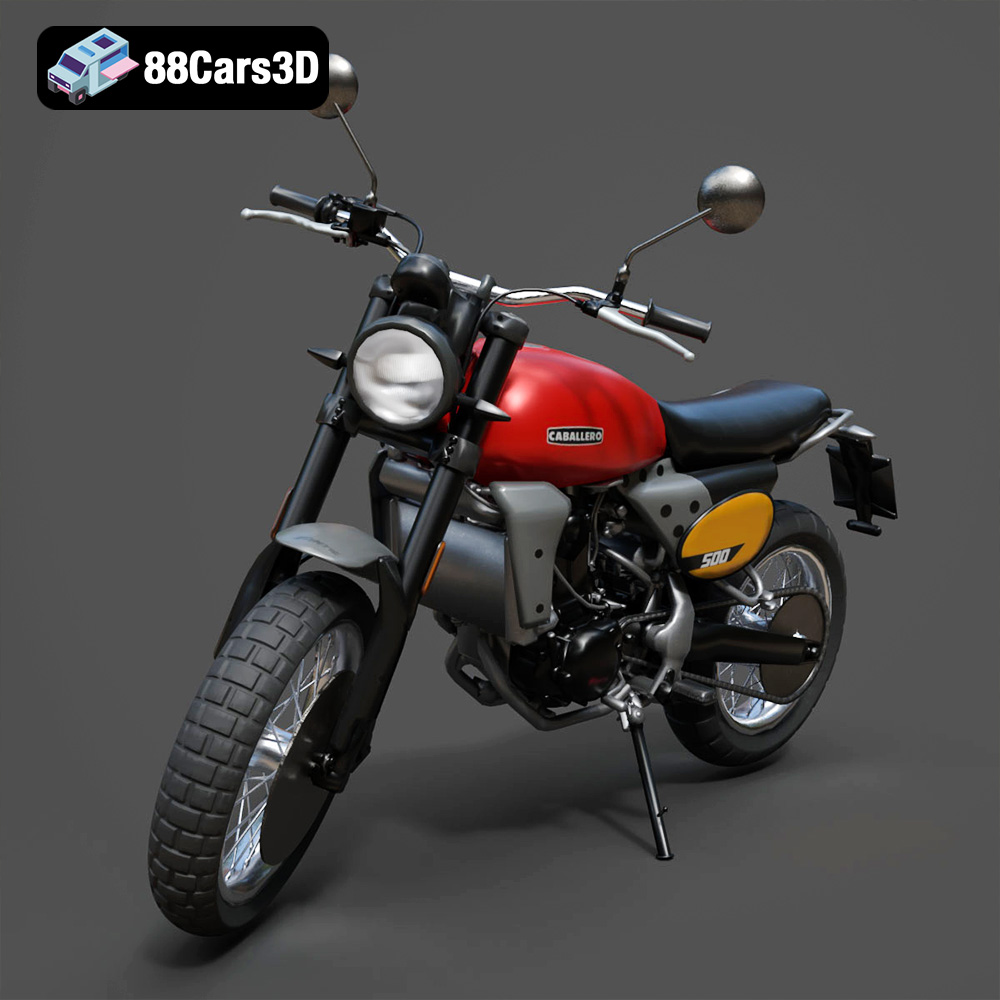
Today, we’re diving deep into a remarkable example of such an asset: the Fantic Caballero 500 Scrambler 3D Model. This digital masterpiece isn’t just a pretty face; it’s a powerhouse of technical precision, designed to bring the iconic Italian modern-classic motorcycle to life across a multitude of applications. From its 1970s retro dirt-track aesthetics to its contemporary engineering, every curve and component of the real Caballero 500 has been faithfully recreated. This model, available on 88cars3d.com, encapsulates the rugged off-road stance, punchy single-cylinder engine, signature dual Arrow exhaust, and aggressive knobby tires that make the physical bike so distinctive. Its game-ready topology and wide range of included file formats make it an indispensable asset for any professional aiming for visual fidelity and technical excellence.
The journey of a 3D model, from creation to its final application, often involves a complex ecosystem of software and engines. The ability to move models between these environments seamlessly is critical, and this is where understanding various 3D file formats becomes essential. The Fantic Caballero 500 Scrambler 3D Model exemplifies versatility by being available in a comprehensive suite of formats, ensuring compatibility for virtually any project. Let’s break down each one and its ideal use cases.
The .blend format is Blender’s native file type. It’s a powerhouse for artists and studios heavily invested in Blender’s ecosystem. A .blend file typically contains everything related to a scene: the 3D model geometry, materials, textures, lighting, cameras, animations, physics simulations, and even scene settings. For the Fantic Caballero 500 Scrambler, the .blend file provides a fully editable scene, allowing artists to delve deep into its construction, modify materials, adjust lighting, or even create custom animations directly within Blender. This format is perfect for those who want maximum flexibility and control over the asset’s finer details, offering a robust foundation for further artistic refinement.
.fbx (Filmbox) is arguably one of the most widely supported and adopted 3D file formats in the industry, developed by Autodesk. It excels at transferring data between different 3D applications and game engines like Unreal Engine and Unity. An .fbx file can encapsulate not just geometry, but also materials, textures, animations, skinning, and more. For the Fantic Caballero 500 Scrambler 3D Model, the .fbx format is ideal for real-time pipelines, ensuring that the model’s structure, pivots, and any pre-baked animations (like wheel rotation points) translate accurately. Its robust support for hierarchies and animation data makes it indispensable for game development and cinematics.
The .obj (Wavefront OBJ) format is a simple, universal 3D data format that supports geometry (vertices, normals, texture coordinates, and faces) and material references. While it doesn’t typically store animations or advanced scene data, its widespread compatibility makes it a go-to for cross-software transfers. If you need a clean mesh of the Fantic Caballero 500 Scrambler for import into almost any 3D software – from ZBrush for sculpting details to CAD software for technical analysis – .obj is an excellent choice. It’s a reliable workhorse for geometry exchange when complex scene data isn’t a primary concern.
.glb (GLB format, or Binary glTF) is a relatively newer format that has rapidly gained traction, especially in the realms of Augmented Reality (AR), Virtual Reality (VR), and browser-based 3D applications. It’s a binary version of the glTF (Graphics Language Transmission Format) format, designed for efficient transmission and loading of 3D scenes and models. A .glb file packages geometry, materials, textures, and even animations into a single, self-contained file. For the Fantic Caballero 500 Scrambler, the .glb format is perfect for showcasing the model in a web viewer, integrating it into mobile AR experiences, or deploying it in VR environments with optimal performance and quick load times.
.stl (STereoLithography) is the de facto standard file format for 3D printing. It represents a 3D model as a series of connected triangles, defining only the surface geometry of an object without color, texture, or other CAD attributes. The Fantic Caballero 500 Scrambler 3D Model, with its “3D Printable STL” designation, highlights its suitability for physical replication. The .stl format is precisely what you need to feed into a slicer program for your FDM or resin 3D printer. While it requires the model to be manifold (watertight), the inclusion of this format means the digital scrambler can seamlessly transition into a tangible display piece or prototype.
The .ply (Polygon File Format, or Stanford Triangle Format) is a versatile format capable of storing a wide range of properties, including color, transparency, normals, texture coordinates, and more, for each vertex and face. It’s often used for scanned 3D data and is particularly robust for applications requiring precision mesh representation, such as CAD, scientific visualization, or 3D scanning workflows. For the Fantic Caballero 500 Scrambler, the .ply format offers an alternative for users needing detailed mesh information beyond what .obj provides, particularly useful in specific engineering or analysis pipelines.
The .unreal format (often referring to assets specifically prepared and optimized for Unreal Engine’s native asset pipeline, which typically involves .fbx imports that are then converted internally) signifies a model that is tailored for the Unreal Engine environment. This means the Fantic Caballero 500 Scrambler has likely been imported, checked, and potentially configured within Unreal Engine, ensuring proper material setup, collision geometry, and skeletal mesh (if applicable for physics and animation). This format, or its implied optimized state, guarantees that the model will perform exceptionally well within Unreal, making it a true “game-ready” asset for real-time interactive experiences and high-fidelity cinematics.
Similar to .blend for Blender, the .max format is the native file type for Autodesk 3ds Max, a leading software in architectural visualization, product design, and animation. A .max file contains a complete 3ds Max scene, including geometry, materials, textures, lighting, cameras, and animation data. The inclusion of the .max file for the Fantic Caballero 500 Scrambler provides users of 3ds Max with the full project file, allowing for native editing, rendering with V-Ray or Corona, and seamless integration into existing 3ds Max projects. This offers maximum flexibility for professional studios and individual artists who rely on 3ds Max for their automotive rendering and animation needs.
The availability of the Fantic Caballero 500 Scrambler in these diverse formats underscores its value as a truly universal 3D asset, ready for any creative endeavor.
Beyond file formats, the true measure of a high-quality 3D model lies in its meticulous construction and technical specifications. The Fantic Caballero 500 Scrambler 3D Model sets a benchmark for balancing visual realism with optimization, a crucial consideration for any professional 3D asset. This model isn’t just a generic motorcycle; it’s a specific, highly detailed digital replica that understands the demands of modern 3D pipelines.
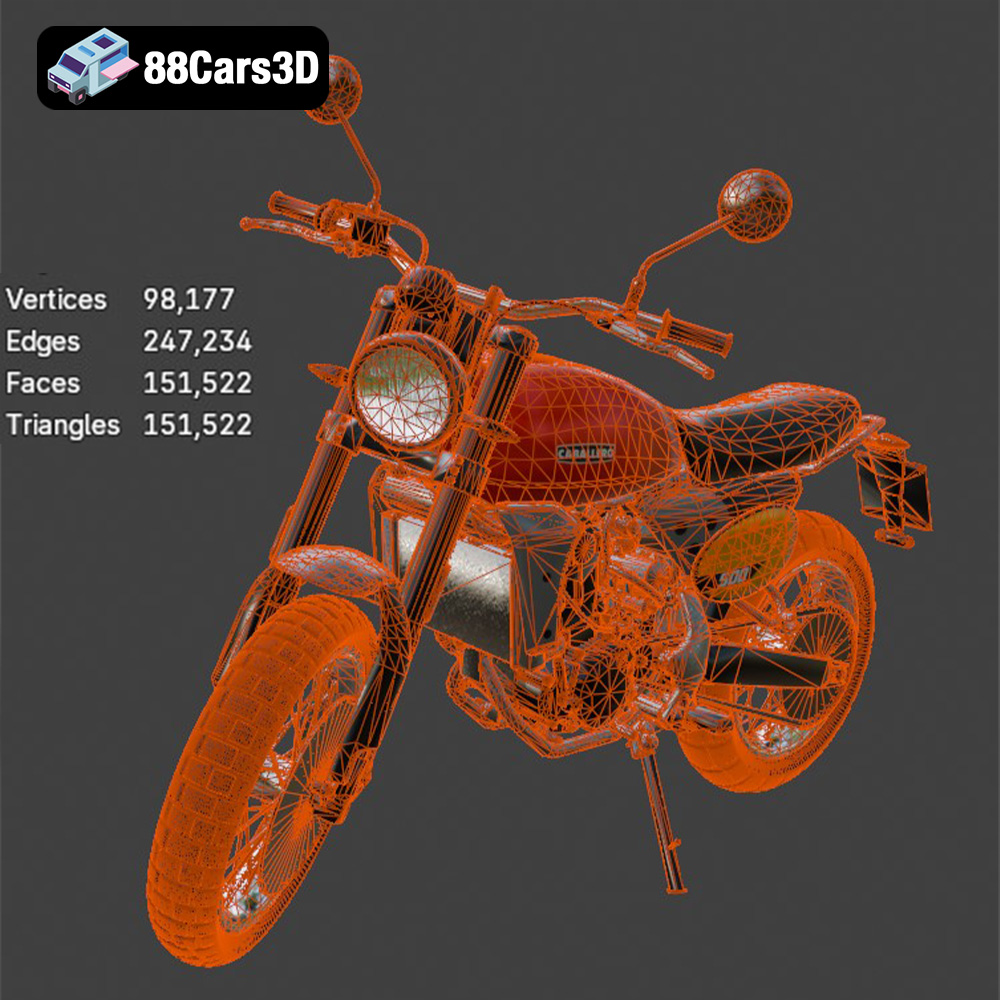
One of the most impressive technical aspects of this model is its topology. With a triangle count of just over 150,000 (151,522 triangles, to be precise), it achieves “game-ready” status without compromising on visual fidelity. This polycount is a sweet spot: low enough for real-time engines like Unreal and Unity to render smoothly at high frame rates, yet detailed enough to withstand close-up shots in high-resolution renders. The clean mesh ensures efficient UV mapping for texture application and avoids artifacts often associated with poorly constructed models. This level of optimization is crucial for open-world games, AR/VR experiences, and even complex visualization scenes where multiple detailed assets are present.
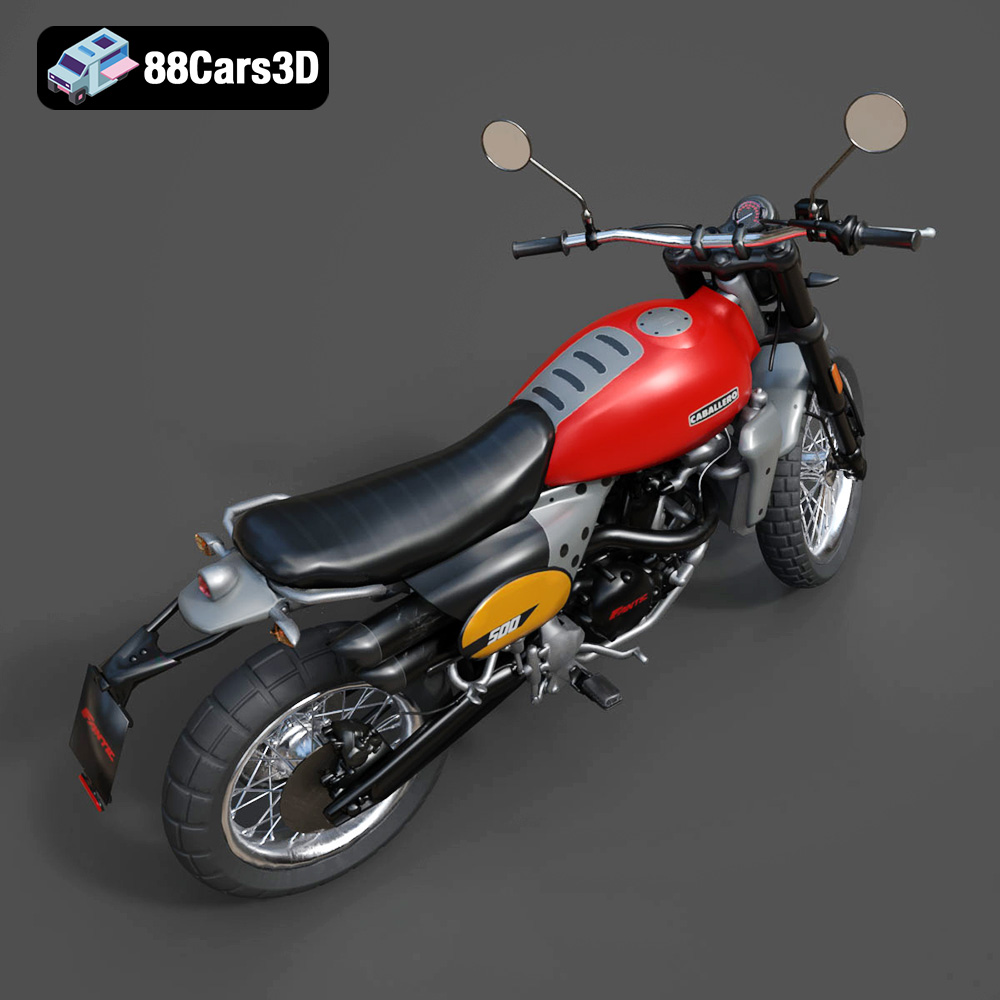
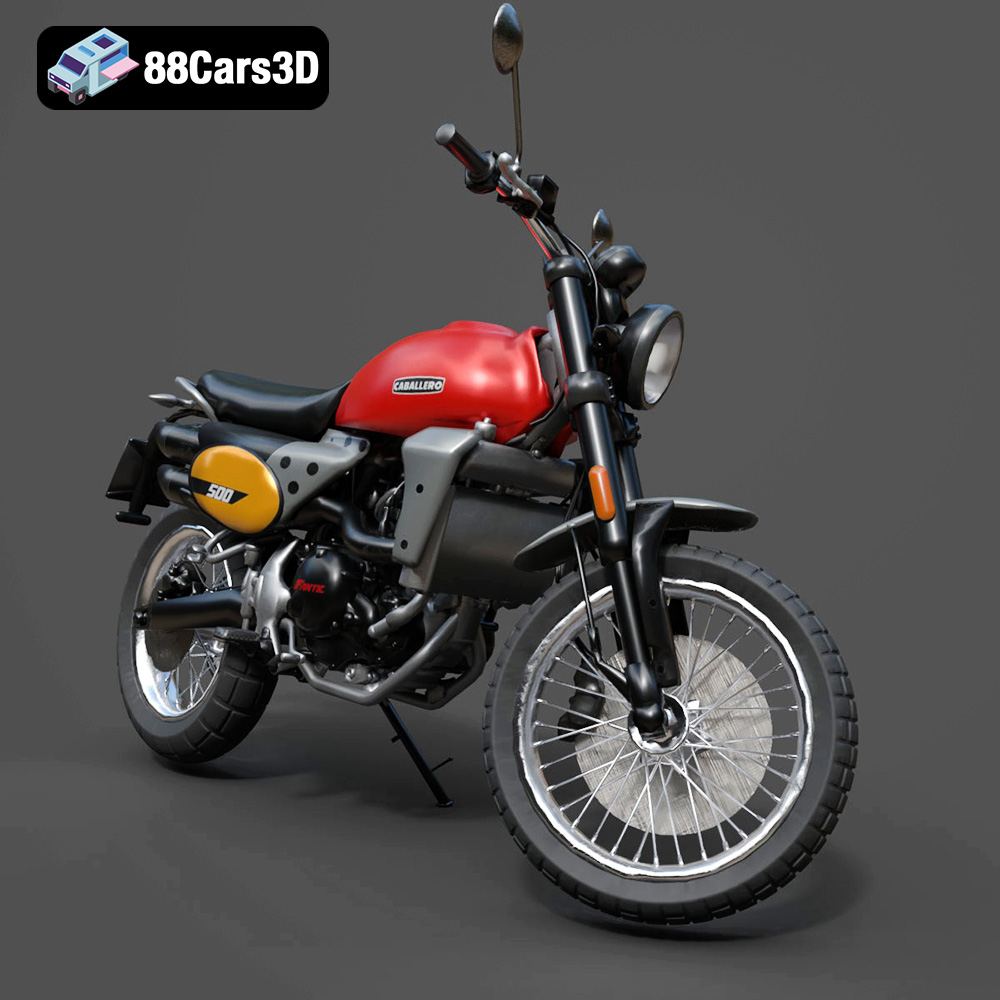
The model’s attention to detail is evident in every feature, meticulously recreated from the real Fantic Caballero 500. On the exterior, you’ll find accurate frame geometry, exposed 450cc/500cc single-cylinder engine block with its radiator, and the unmistakable high-mount dual-exit Arrow exhaust system. The classic round LED headlight, minimalist taillight assembly, spoked wheels wrapped in aggressive knobby tires, and rugged USD (upside-down) front forks all contribute to its authentic look. Crucially, components like the wheels, suspension forks, and steering are separated, enabling dynamic animation and realistic physics simulation.
The cockpit and rider interface are equally impressive. The flat retro-style ribbed saddle, wide dirt-track handlebars with detailed grips and levers, and minimalist round digital instrument cluster are all accurately represented. Authentic footpeg and pedal placement ensure that any virtual rider interaction feels natural. This optimized geometry is specifically tailored for seamless first-person POV in gaming, making the experience truly immersive.
Technical advantages extend to practical implementation. The Fantic Caballero 500 Scrambler 3D Model boasts real-world scale accuracy, based on the actual Fantic Caballero chassis. This is not a trivial detail; maintaining real-world scale ensures that the model integrates correctly into scenes without needing constant resizing, which can introduce scaling inconsistencies or visual glitches. Furthermore, the model comes with a proper pivot setup for crucial components such as steering, wheel rotation, and suspension travel. This pre-configured pivot information is invaluable for animators and game developers, saving countless hours of rigging and ensuring that any movement applied to the motorcycle behaves realistically from the outset. This level of preparation elevates the model from a static object to a dynamic, functional asset ready for action.
The versatility of a well-crafted 3D model like the Fantic Caballero 500 Scrambler 3D Model truly shines when integrated into diverse professional workflows. Its balanced polycount, detailed geometry, and multi-format availability make it suitable for a spectrum of applications, from interactive entertainment to high-end cinematic visualization.
For game developers, performance and visual fidelity are often a tightrope walk. The Fantic Caballero 500 Scrambler, with its 151k triangle count, hits the sweet spot for modern game engines. Its “game-ready” optimization means it can be dropped into Unreal Engine or Unity projects with minimal fuss. Developers can leverage its clean topology for efficient UV unwrapping and texture baking, creating stunning PBR (Physically Based Rendering) materials that react realistically to in-game lighting. The separated components and proper pivot setup are crucial for implementing vehicle physics, rider animations, and dynamic gameplay elements. Imagine this scrambler roaring through an open-world environment, its knobby tires kicking up dust, or a player performing stunts with its finely articulated suspension – this model makes such scenarios feasible and visually compelling. Its optimization is particularly beneficial for console and PC games where framerate stability is paramount, and even mobile game development where asset budgets are tighter.
For automotive rendering specialists, the Fantic Caballero 500 Scrambler provides an excellent foundation for creating stunning lifestyle imagery and advertisements. In software like 3ds Max or Blender, artists can take advantage of the model’s detailed geometry to produce photorealistic renders. Using advanced renderers such as V-Ray, Corona Renderer, or Blender’s Cycles and Eevee, designers can apply complex material shaders, high-resolution textures, and sophisticated lighting setups. Picture the scrambler bathed in the golden hour light of a rugged landscape, or presented in a sleek studio environment with dramatic reflections on its tank and exhaust. The ability to customize fuel tank colors, tire textures, and seat materials allows for endless creative variations, perfectly suiting brand campaigns, product launches, or architectural visualization projects seeking a lifestyle touch.
The rise of AR and VR technologies presents new frontiers for 3D models. The Fantic Caballero 500 Scrambler is perfectly suited for these immersive experiences, thanks to its optimized geometry and the inclusion of the .glb format. Imagine a virtual showroom where potential buyers can walk around, inspect, and even customize the motorcycle in real-time, perhaps swapping out tire types or paint schemes with a mere gesture. For AR applications, the model can be projected into real-world environments via a smartphone or tablet, allowing users to see the scrambler parked in their driveway or office. These applications are invaluable for marketing, product configurators, and training simulations, providing an unparalleled level of interaction and engagement that static images simply cannot match. The seamless first-person POV optimization further enhances the feeling of presence in VR, putting the user right in the rider’s seat.
While digital applications dominate the realm of 3D models, the ability to transcend the screen and create a tangible, physical object offers a unique dimension of utility. The Fantic Caballero 500 Scrambler 3D Model stands out not only for its digital prowess but also for its explicit suitability for 3D printing, making it a valuable asset for hobbyists, collectors, and prototyping enthusiasts.
The inclusion of the .stl format, specifically tailored for 3D printing, means the Fantic Caballero 500 Scrambler is ready for fabrication. However, preparing a digital model for a physical output involves several considerations. The underlying mesh must be “manifold,” meaning it has no holes or inverted faces, ensuring a watertight volume that a slicer can process. While the model is optimized for digital rendering, details like the delicate spokes of the wheels or fine engine fins require careful scaling and printing techniques to retain fidelity. For optimal results, it’s often advisable to check the model’s integrity in a dedicated 3D printing preparation software, ensuring all parts are connected and free of errors before slicing.
To truly capture the essence of this retro-scrambler in a physical form, specific 3D print settings are recommended. For miniature scales like 1:12, 1:10, or 1:8, a layer height between 0.04mm and 0.12mm is advised, with resin printing (SLA/DLP) being highly recommended. Resin printers excel at reproducing fine details such as the engine fins, exhaust pipes, and intricate spoked wheels that FDM printers might struggle with. Wall thickness of 1.2mm–2.0mm ensures structural integrity without excessive material usage. Infill between 20-30% provides a good balance of strength and material economy. Supports will be essential for overhangs like the handlebars, high-mount exhaust, kickstand, and footpegs. Proper print orientation, with the frame angled for structural integrity and wheels printed separately, also significantly improves the final quality.
Post-processing is where the model truly comes to life. Sanding, priming, and then applying paint can elevate a raw print into a display-worthy replica. Imagine painting the fuel tank in classic Fantic Red, giving the frame a matte black finish, and meticulously applying metallic paints to the Arrow exhaust and engine components. This hands-on process allows enthusiasts to create a unique, personalized physical representation of their favorite modern-classic motorcycle, bridging the gap between digital asset and tangible collectible.
A truly versatile 3D model offers more than just out-of-the-box utility; it provides a canvas for creative expression and adaptation. The Fantic Caballero 500 Scrambler 3D Model is designed with customization in mind, allowing artists and developers to tailor its appearance and functionality to meet specific project demands.
The most direct way to customize the Fantic Caballero 500 is through its materials and textures. The product description highlights several possibilities: changing fuel tank colors to classic Fantic Red, Stealth Black, or Matte Olive Green immediately alters the bike’s character. Beyond this, modifying tire textures offers a significant transformation; swapping the aggressive knobby off-road tires for smooth street tires can convert the scrambler into a “Flat Track” variant, ideal for urban races or different terrain types. Adjusting seat materials, from classic black ribbed vinyl to distressed brown leather, further enhances the retro aesthetic or introduces a more rugged, worn-in look. These material adjustments are straightforward in any major 3D software or game engine, utilizing the model’s clean UV mapping to apply new PBR textures and shaders.
The model’s design with separate components for wheels, suspension forks, and steering, along with a proper pivot setup, makes it inherently animation-ready. This crucial technical advantage means animators can easily rig the motorcycle for realistic movement. Imagine dynamic sequences where the front forks compress over bumps, the rear suspension articulates, and the wheels spin naturally. For game development, this enables responsive vehicle controls and believable physics interactions. In cinematics, it allows for elaborate stunts, expressive camera angles, and dynamic motion blur, all contributing to a more immersive and engaging visual narrative. Even subtle animations, like the kickstand deploying or the handlebars subtly turning, add layers of realism that are highly valued in professional productions.
The Fantic Caballero 500 Scrambler is more than just a motorcycle; it’s a statement, a blend of vintage soul and modern spirit. Its digital counterpart, the Fantic Caballero 500 Scrambler 3D Model, embodies this philosophy in the virtual realm. From its meticulously optimized geometry and real-world scale to its comprehensive suite of file formats, this model is engineered for excellence across diverse creative and technical pipelines. Whether you’re crafting an open-world game, designing an immersive AR/VR experience, rendering stunning automotive visualizations, or even 3D printing a physical collectible, this asset provides the foundation for unparalleled fidelity and performance.
It stands as a testament to the fact that high-quality 3D car models (or in this case, a truly iconic motorcycle) are indispensable game assets and tools for automotive rendering. The Fantic Caballero 500 Scrambler 3D Model empowers professionals to push the boundaries of digital content creation, offering both technical robustness and boundless creative potential. Explore this exceptional model and countless other premium 3D assets at 88cars3d.com, your go-to marketplace for high-quality digital vehicles that drive innovation.
The Fantic Caballero 500 Scrambler 3D Model is a highly detailed, optimized digital recreation of the iconic Italian modern-classic motorcycle. Blends 1970s retro dirt-track aesthetics with contemporary engineering, the Caballero 500 is famous for its rugged off-road stance, punchy single-cylinder engine, signature dual Arrow exhaust, and aggressive knobby tires. This 3D model accurately captures the essence of the scrambler lifestyle, featuring the classic round LED headlight, teardrop fuel tank with authentic badging, exposed steel tube frame, and flat dirt-style saddle. Built with incredibly clean, game-ready topology (just over 150k triangles), it delivers premium visual fidelity without bogging down real-time engines. It is the perfect asset for game development, AR/VR experiences, animation, and lifestyle automotive visualization.
$9.99
.blend
.fbx
.obj
.rendering
.scrambler
caballero-500
dirt-bike
fantic
flat-tracker
game asset
game-ready
low-poly
motorcycle-3d-model
optimized
retro-motorcycle
VR/AR