Get 50% OFF All Premium 3D & STL Models!

In the dynamic realm of 3D visualization, the demand for photorealistic automotive assets continues to accelerate. From breathtaking commercial renders that define luxury to immersive virtual experiences, artists and developers constantly seek models that push the boundaries of detail and accuracy. At the heart of this pursuit lies the meticulous craft of creating ultra-high-poly 3D car models – assets engineered not just for representation, but for absolute fidelity under the closest scrutiny.
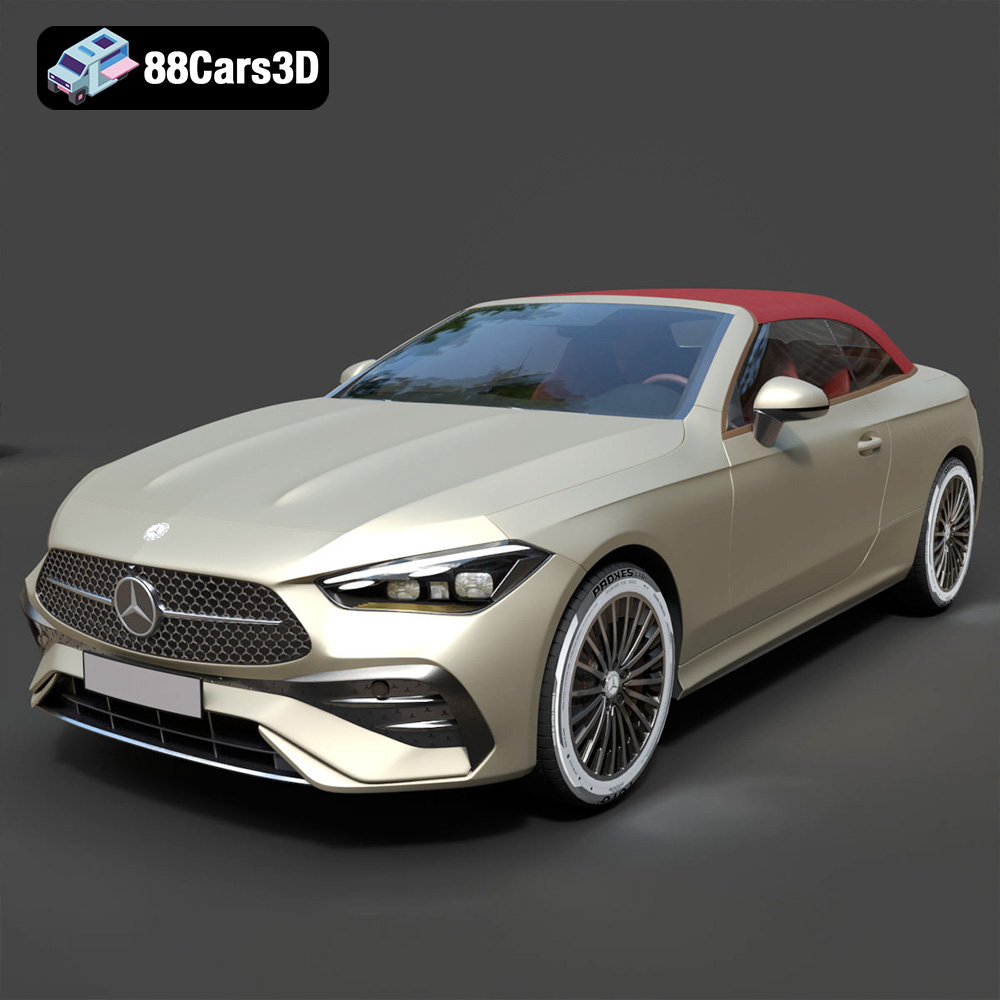
Today, we delve into the world of professional automotive 3D modeling by showcasing a prime example of this commitment to detail: the Mercedes-Benz CLE Cabriolet (2024) Ultra High-Poly 3D Model. This digital masterpiece, available on 88cars3d.com, is more than just a model; it’s a testament to the power of high-density geometry and thoughtful design, built to elevate any project it touches. We’ll explore its technical intricacies, its place in diverse professional workflows, and how such premium assets empower creators to achieve previously unattainable levels of realism across industries.
The versatility of a high-quality 3D model like the Mercedes-Benz CLE Cabriolet isn’t just in its geometry; it’s also in its accessibility across various software and platforms. This is where understanding different 3D file formats becomes critical. Each format serves a specific purpose, offering unique advantages for particular workflows, from initial modeling to final rendering, real-time deployment, or even physical fabrication. Let’s break down the core formats included with this exceptional model and explain their strategic uses.
The .blend format is the native file type for Blender, the powerful open-source 3D creation suite. When you receive a .blend file, you’re getting a complete Blender scene, often including cameras, lighting, and fully configured materials specific to Blender’s Cycles or Eevee renderers. This format is ideal for artists who primarily work in Blender, offering maximum flexibility for editing, re-texturing, animating, and integrating the model seamlessly into existing Blender projects. Its greatest advantage is preserving all native Blender data, modifiers, and node setups, allowing for deep customization and iteration.
FBX (Filmbox) is arguably the most widely adopted interchange format in the 3D industry, particularly for game development and real-time applications. Developed by Autodesk, it efficiently stores 3D models, animation data, cameras, and lights. For assets destined for game engines like Unreal Engine or Unity, .fbx is the go-to choice due to its robust support for mesh data, materials (though often simplified upon import), and especially animation rigs. The Mercedes-Benz CLE Cabriolet’s .fbx file would be structured to facilitate easy import, with separate components like wheels and doors ready for rigging and interaction.
The OBJ (Object) format is a universal, open standard that has been around for decades. It’s renowned for its simplicity and near-ubiquitous compatibility across almost all 3D software. An .obj file primarily stores geometric data (vertices, faces, UV coordinates) and can reference external .mtl (material library) files for basic material properties. While it doesn’t support advanced features like rigging or animation, its strength lies in its ability to transfer pure mesh data reliably between disparate applications, making it an excellent fallback or starting point for cross-platform projects.
GLB (GL Transmission Format Binary) is a modern, compact file format designed for efficient transmission and loading of 3D scenes and models in web and immersive applications. It’s the binary version of glTF, embedding all assets (geometry, textures, animations, shaders) into a single file. This self-contained nature makes .glb perfect for AR/VR experiences, online 3D viewers, and any scenario where quick loading and broad compatibility are paramount. For the CLE Cabriolet, a .glb file would provide a web-ready, optimized version for interactive product showcases or metaverse integrations.
STL (Stereolithography) is the standard file format for 3D printing. It represents a 3D model as a collection of unconnected triangular facets, defining only the surface geometry without color, texture, or other CAD attributes. While simple, its strength is its universality in additive manufacturing workflows. When preparing the Mercedes-Benz CLE Cabriolet for a physical print, the .stl file ensures that the model’s complex geometry is accurately translated into a format readable by 3D printers and slicing software, making it possible to produce a tangible replica.
PLY (Polygon File Format or Stanford Triangle Format) is another format for storing 3D data, particularly useful for scanned data, CAD, and scientific applications where precision and additional data per vertex (like color, normal, or confidence values) are important. While less common for general 3D model distribution than .fbx or .obj, its inclusion signifies a commitment to providing raw, precise mesh data that might be valuable for engineers, reverse engineering, or detailed structural analysis of the model.
The “.unreal” extension typically refers to assets prepared specifically for Unreal Engine, often as part of an Unreal project package or a direct export from the engine itself. This format is optimized for Unreal’s rendering pipeline, including specific material setups, LODs (Levels of Detail), and collision meshes that are ready to be dropped into a scene. For a model as dense as the CLE Cabriolet, an .unreal asset would likely be configured to leverage features like Nanite, Unreal Engine 5’s virtualized micro-polygon geometry system, to handle its extreme poly count efficiently within real-time environments.
The .max format is the native file type for Autodesk 3ds Max, a long-standing industry standard for 3D modeling, animation, and rendering, particularly strong in architectural visualization and product design. Like .blend for Blender, a .max file contains the complete scene, including lights, cameras, materials (often V-Ray, Corona, or Arnold specific), and any modifiers or rigs. This format offers full editability and preserves all proprietary 3ds Max features, making it ideal for professionals who rely on Autodesk’s ecosystem for their high-end rendering and animation projects.
By providing such a comprehensive suite of file formats, 88cars3d.com ensures that the Mercedes-Benz CLE Cabriolet model is not only highly detailed but also incredibly versatile, catering to the diverse technical needs of professionals across the 3D industry.
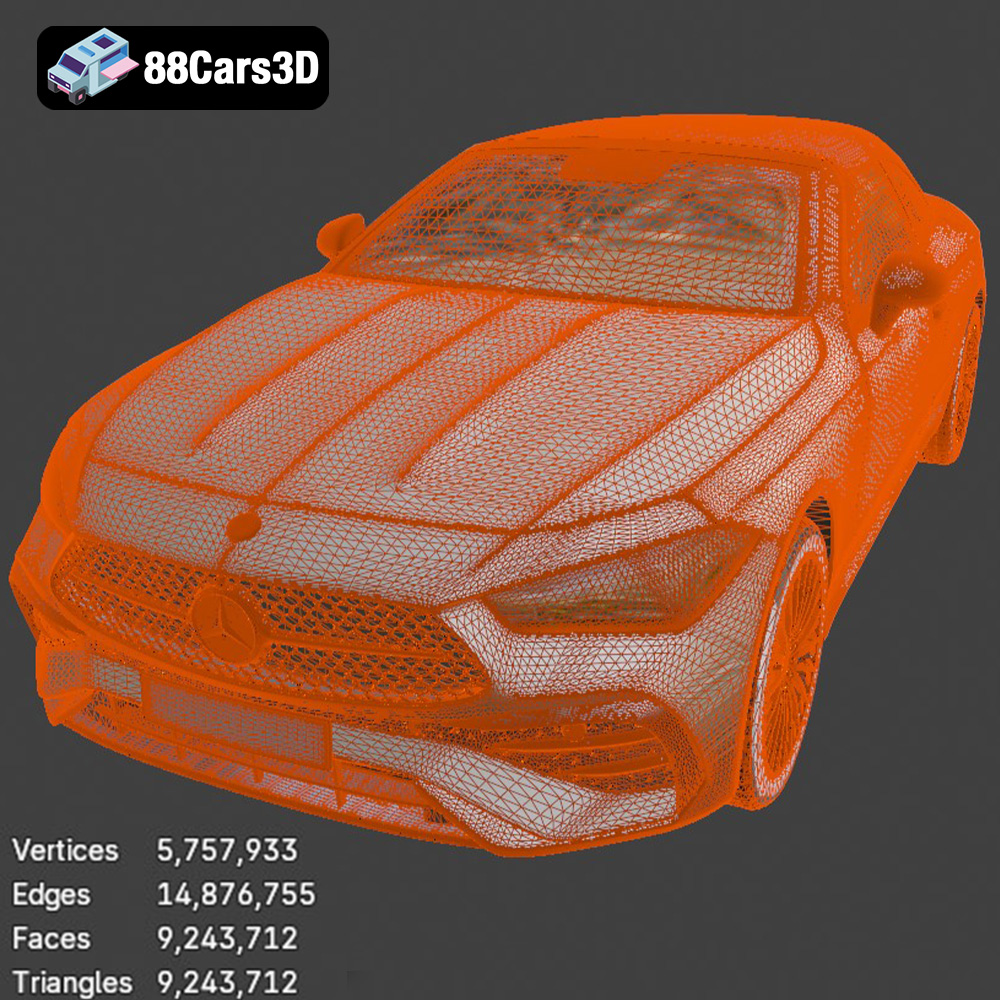
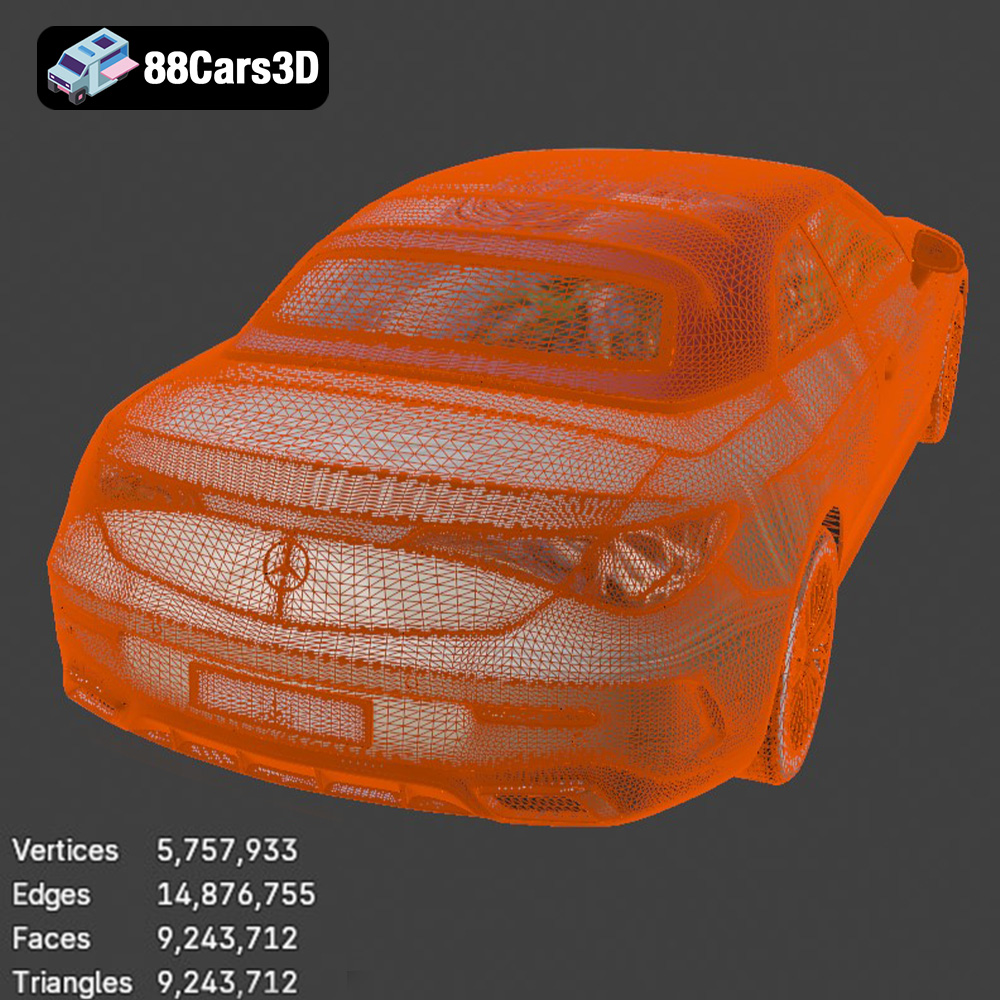
The Mercedes-Benz CLE Cabriolet (2024) Ultra High-Poly 3D Model stands out with its staggering 9.24 million triangles. This isn’t merely an arbitrary number; it’s a strategic design choice that unlocks an unparalleled level of visual fidelity. In the world of premium automotive rendering, every curve, every reflection, and every subtle imperfection contributes to the illusion of reality. A convertible, by its very nature, demands even greater attention to detail, as its interior is fully exposed and becomes as crucial as its exterior for compelling visuals.
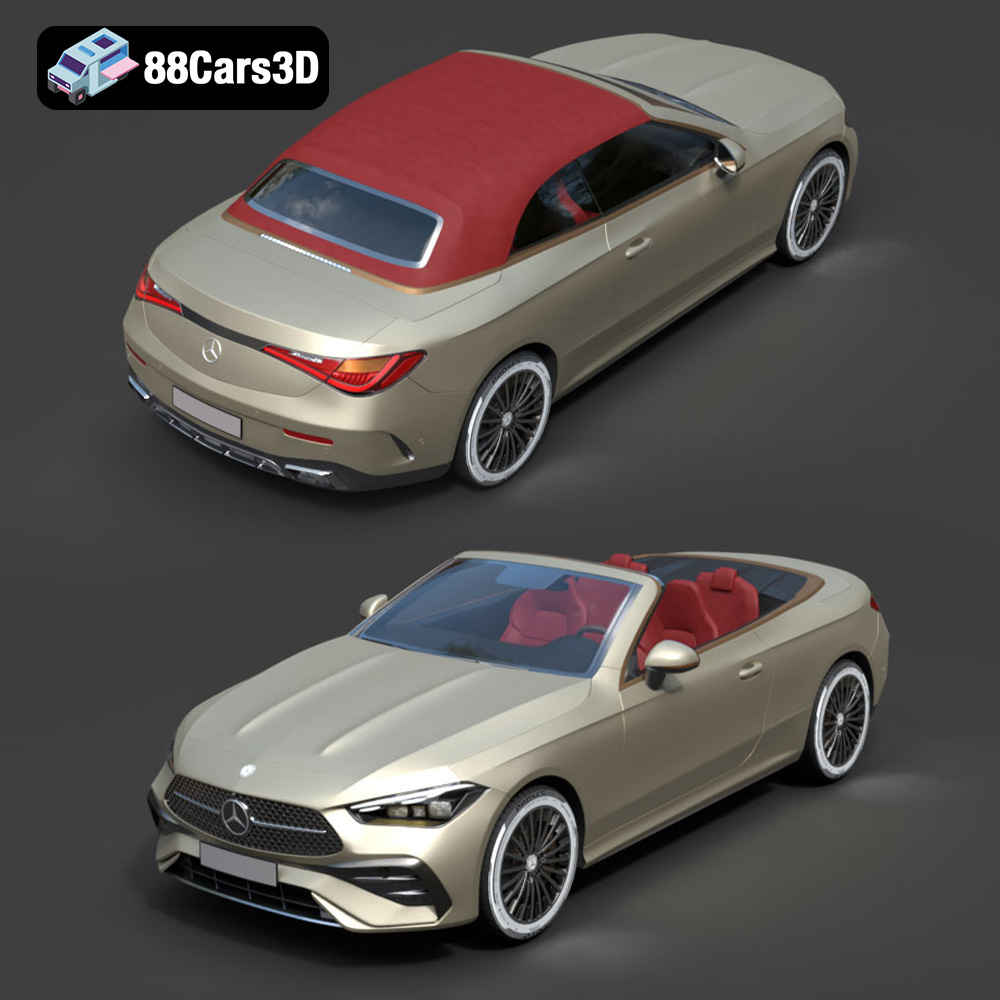
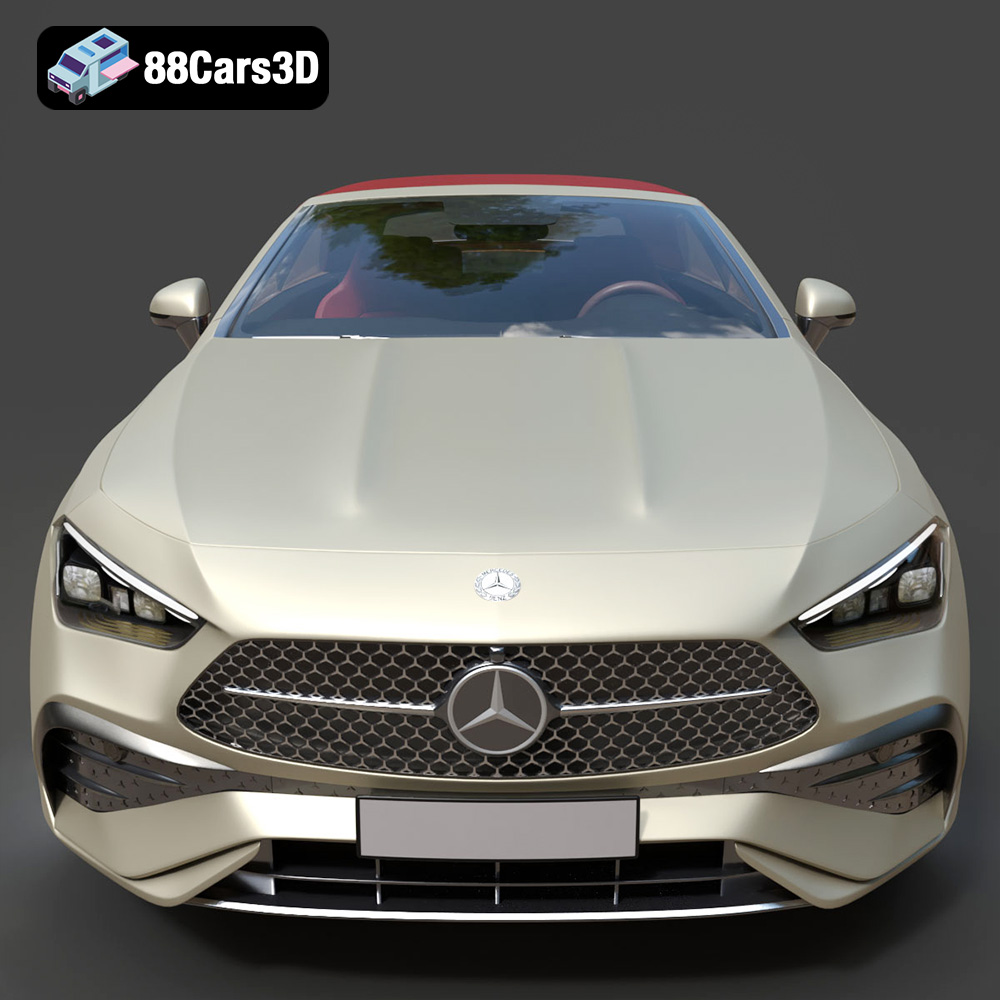
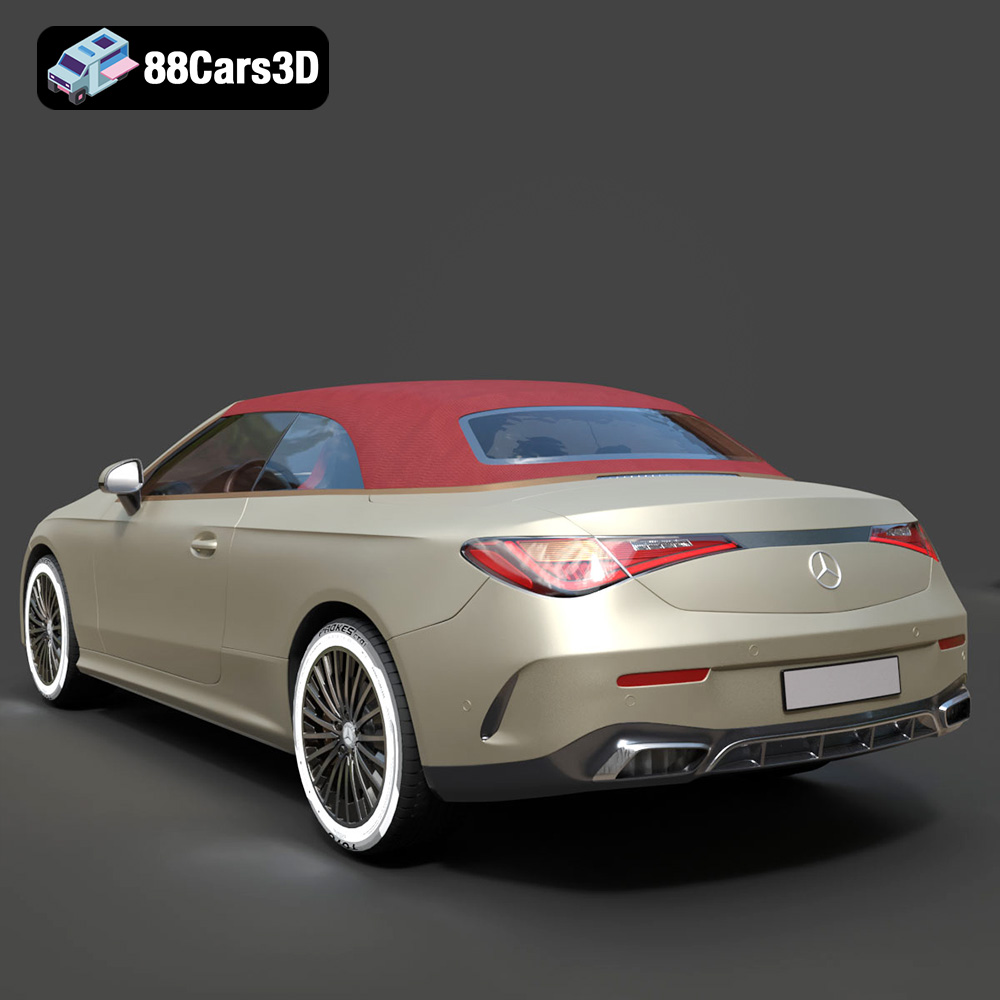
The exterior of this CLE Cabriolet model is a masterclass in automotive surfacing. The “extreme ultra-high-poly topology” ensures that the sleek lines and complex curves of the bodywork are rendered with immaculate precision. This is crucial for capturing the car’s aggressive “shark nose” front fascia, the star-patterned radiator grille, and the seamlessly integrated LED taillights. Under close-up shots, often required for high-end automotive commercials or detailed product showcases, lower-poly models quickly reveal faceting and compromise the illusion. This model, however, is engineered for zero faceting, providing flawless reflections and smooth surfaces that stand up to macro magnification. The intricate aerodynamic AMG alloy wheels, revealing detailed brake calipers, further exemplify this commitment, adding depth and realism to every angle.
What truly sets a convertible 3D model apart is its interior. With the soft top down, the cabin becomes an integral part of the visual narrative. The Mercedes-Benz CLE Cabriolet model delivers a “sumptuous, fully modeled luxury open-air cabin layout—flawlessly detailed to be viewed from the outside.” This includes the precisely modeled MBUX Infotainment System, with its free-standing 12.3-inch digital instrument cluster and the 11.9-inch central touchscreen. Crucially, the highly detailed front seats feature the signature AIRSCARF® neck-level heating vents built into the headrests – details that are easy to overlook but vital for authenticity. The dense topology extends to these interior elements, ensuring that even the subtle textures of leather seating, ambient lighting geometry, and dynamic interior trim are rendered perfectly smooth and realistic, even in ultra-high-resolution first-person POV renders.
Beyond static beauty, professional automotive models require functional integrity. The CLE Cabriolet model is built with separate wheels, steering components, doors, and soft-top mechanisms. This forethought in modeling simplifies the rigging process for animators. With proper pivot setup for steering, wheel rotation, door articulation, and convertible top retraction, the model is prepared for dynamic simulations, cinematic sequences, or interactive configurators. This modularity not only saves significant time in production but also ensures mechanical accuracy, allowing for believable motion and complex scene interactions.
A 3D asset of this caliber is a versatile tool, capable of driving diverse professional workflows. Its ultra-high-poly nature positions it as a “premium cinematic ‘hero’ asset,” designed to be the star of any visual production.
For cinematic production and high-end visualization, rendering engines like V-Ray, Corona Renderer, and Arnold are industry staples. The Mercedes-Benz CLE Cabriolet model is explicitly designed to leverage these powerful tools. Its immense polygon count translates directly into smooth surfaces and accurate reflections, crucial for materials like automotive paint, chrome, and glass. When paired with advanced Physically Based Rendering (PBR) materials, realistic HDRI lighting, and global illumination, artists can achieve renders that are virtually indistinguishable from photographs. This makes it the “absolute gold standard for high-end coastal ArchViz, luxury real estate marketing, and premium lifestyle campaigns where an open-top cruiser elevates the entire scene,” providing a focal point of sophistication and realism.
In commercial VFX and film projects, the demand for primary hero vehicles that can withstand extreme close-ups is immense. The CLE Cabriolet model, with its uncompromised interior and exterior detailing, fits this role perfectly. VFX artists can integrate this model into live-action plates, using it for tracking shots, complex camera moves, or even digital stunt sequences. The separate components allow for precise rigging and animation, whether it’s for an opening and closing soft top, dynamic wheel articulation, or subtle suspension movements. Its high fidelity ensures that it seamlessly blends with real-world elements, making it an invaluable asset for creating believable automotive spectacles.
The product description astutely notes the model’s heavy triangle count (9.24M) and its implications for real-time applications: “It is strictly intended for pre-rendered VFX or Unreal Engine 5 Nanite environments. It will require heavy manual retopology and baking to be used efficiently in standard real-time mobile or VR applications.” This highlights a critical distinction in modern game development. While traditional real-time engines struggle with such dense meshes, Unreal Engine 5’s Nanite virtualized micro-polygon geometry system is a game-changer. Nanite intelligently streams and processes only the necessary polygons, allowing creators to import film-quality assets directly. This means the Mercedes-Benz CLE Cabriolet model, despite its ultra-high poly count, can be a stunning real-time asset within UE5, perfect for next-generation virtual showrooms, cutting-edge driving simulators, or high-fidelity AR/VR experiences where visual realism is paramount and system resources allow for Nanite implementation.
Beyond purely digital applications, high-fidelity 3D car models like the Mercedes-Benz CLE Cabriolet also serve as excellent foundations for physical creation through 3D printing. The intricate detail captured in its digital form translates directly into the potential for highly accurate physical replicas, perfect for hobbyists, collectors, or even professional prototyping.
The technical specifications recommend scales of 1:18, 1:12, or 1:8, suggesting that this model is ideal for producing large, collector-grade physical models. At these larger scales, the “intricate interior screens, steering wheel buttons, and seat perforations” become clearly visible and reproducible. Material choice is equally critical: “Resin printing is strictly recommended to capture the intricate interior screens, steering wheel buttons, and seat perforations.” FDM printing, while more accessible, often lacks the resolution needed to reproduce such fine details. Resin (SLA/DLP) printers, with their ability to cure liquid resin with UV light layer by layer, can achieve the necessary precision for a truly high-fidelity print.
Successful 3D printing from a complex model requires careful preparation. The recommended wall thickness of 1.5–2.5 mm provides structural integrity without excessive material usage. An infill of 15–25% offers a good balance between strength and print time. Crucially, the model’s design with “separate wheels, steering components, doors, and soft-top mechanisms” not only aids rigging but also simplifies printing. “Print orientation: Body printed angled for a smooth surface finish; wheels and interior tub printed separately” is a standard best practice for minimizing layer lines and optimizing detail. Given the complex overhangs of an automotive body, “Extensively required for the side mirrors, windshield frame, steering column, and wheel spokes” highlights the necessity of support structures, which are vital for preventing print failures and ensuring fidelity.
The journey from a raw 3D print to a display-ready model involves meticulous post-processing. The recommendation for “Sanding, primer, and modern Mercedes-Benz paint finishes (e.g., MANUFAKTUR Graphite Grey Magno, Alpine Grey, or Spectral Blue) with highly detailed interior painting” emphasizes the commitment to realism. Achieving a factory-fresh appearance requires careful sanding to remove layer lines, priming for an even surface, and then applying automotive-grade paints. The interior, with its “sumptuous, fully modeled luxury open-air cabin layout,” demands equally detailed painting to bring out the MBUX screens, AIRSCARF vents, and ambient lighting geometry, resulting in a physical model that truly mirrors its digital counterpart and the real vehicle.
A premium 3D model offers more than just static beauty; it provides a canvas for creative expression and strategic customization. The Mercedes-Benz CLE Cabriolet model is designed with flexibility in mind, allowing artists to adapt it to a multitude of narrative and visual contexts.
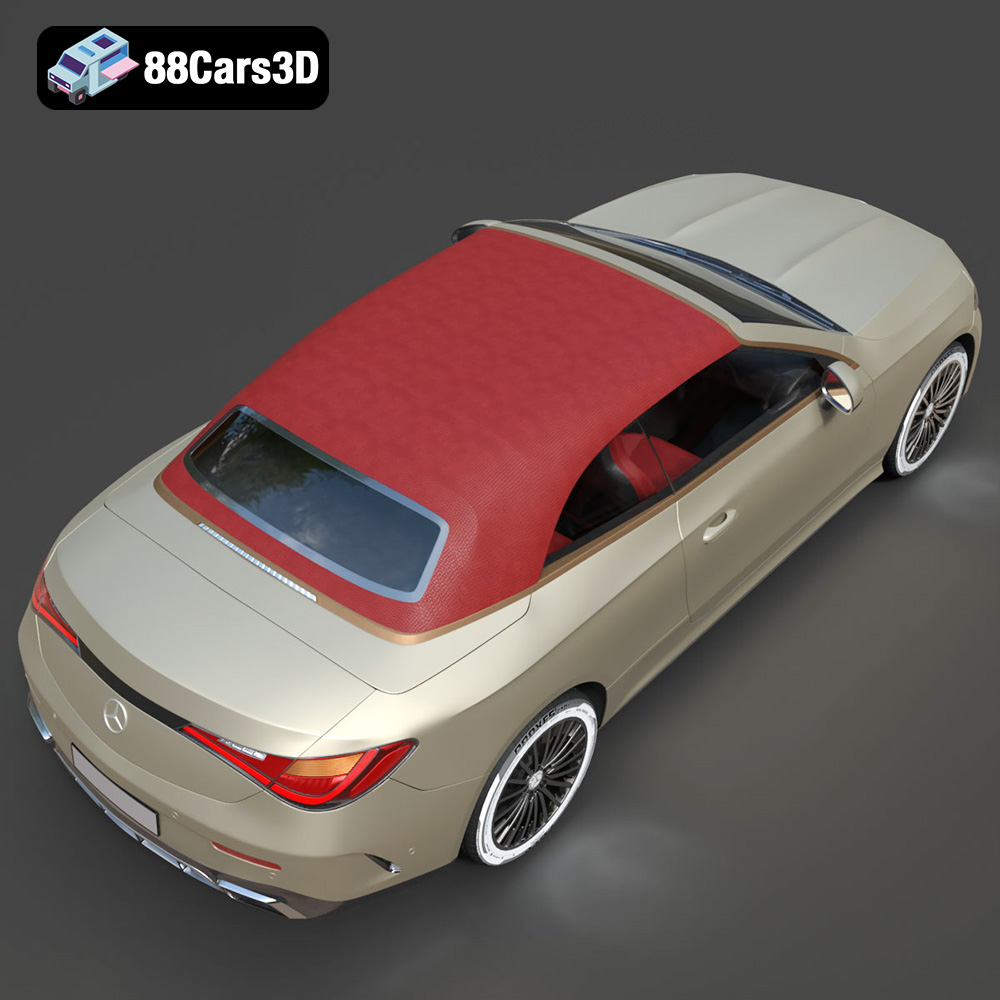
One of the most appealing features of a cabriolet is its dual personality: sleek coupe when the top is up, and luxurious open-air cruiser when it’s down. This model fully embraces that versatility. Artists can “Render with the acoustic fabric soft top fully raised for a sleek coupe profile, or completely stowed to show off the luxurious cabin.” This dynamic capability allows for diverse storytelling, from a cozy drive on a chilly evening to a sun-drenched coastal cruise. The ability to switch between these configurations within the scene adds immense value and replayability to the asset, catering to different client needs or artistic visions.
Customization extends to the vehicle’s finishes. The option to “Apply standard leather or premium Nappa leather material maps to the seats” allows for subtle yet significant changes in perceived luxury and texture. Similarly, configuring the “interior ambient lighting to emit signature Mercedes hues (e.g., vibrant pink, deep blue, or warm gold)” can drastically alter the mood and sophistication of the interior shots. These material and lighting adjustments, combined with the ability to “Adapt HDRIs for dramatic studio reflections or bright, sun-drenched Pacific Coast Highway environments,” provide an incredible range of aesthetic possibilities. Whether portraying a high-fashion photoshoot in a moody urban setting or a relaxed drive through scenic landscapes, the model can be tailored to fit the exact emotional and visual tone required.
Ultimately, the true power of a highly customizable 3D model lies in its ability to facilitate compelling narratives. The Mercedes-Benz CLE Cabriolet isn’t just a car; it’s a lifestyle statement. Integrating it into architectural visualizations, for instance, can elevate a luxury property render, suggesting an affluent lifestyle. In advertising, its presence immediately conveys sophistication and aspiration. By leveraging its customizable features—soft top position, interior finishes, and dynamic lighting—artists can craft stories that resonate deeply with their audience, making the digital car feel as real and aspirational as its physical counterpart. This level of detail and flexibility ensures that the model from 88cars3d.com is not merely a prop but a central character in any visual story.
In the fast-paced world of 3D production, efficiency and quality are paramount. Building highly detailed assets from scratch is a time-consuming and costly endeavor. This is where professional-grade 3D car models, such as the Mercedes-Benz CLE Cabriolet (2024) Ultra High-Poly 3D Model, prove invaluable, acting as critical components in optimizing a studio’s pipeline.
Acquiring a meticulously pre-modeled asset significantly streamlines the production process. Instead of dedicating hundreds of hours to modeling, UV mapping, and initial texturing, artists can immediately jump to scene assembly, lighting, and rendering. For a complex vehicle like a convertible, where both exterior and interior must be flawless, the time saved is immense. The quality assurance that comes with a professionally crafted model means fewer errors, clean topology, and consistent scale, allowing artists to focus on creative direction rather than technical fixes. This immediate access to a high-fidelity asset fundamentally shifts resources from creation to refinement and innovation.
Meeting tight project deadlines without compromising on visual quality is a constant challenge. Pre-built, ultra-high-poly models are a direct solution. For clients demanding photorealism in automotive rendering, architectural visualization, or cinematic VFX, these assets provide an instant boost in quality that would be difficult to achieve within typical production schedules otherwise. The Mercedes-Benz CLE Cabriolet model, with its 9.24 million triangles, is ready to be a “hero” asset right out of the box, ensuring that the visual output matches or exceeds client expectations. This capability to deliver high-quality results rapidly gives studios a competitive edge and allows them to take on more ambitious projects.
Platforms like 88cars3d.com play a crucial role in empowering 3D professionals by curating and providing access to such premium assets. By specializing in high-quality 3D car models, 88cars3d.com ensures that artists and studios have a reliable source for assets that meet industry standards for realism and technical integrity. The detailed product descriptions, including technical specifications, file formats, and application guidelines, help users make informed decisions, ensuring the purchased model is perfectly suited for their specific project needs. Investing in such professional resources is not just a purchase; it’s a strategic decision that enhances workflow efficiency, elevates visual output, and ultimately contributes to the success of diverse 3D projects.
The pursuit of photorealism in 3D visualization is a journey of meticulous detail, technical expertise, and an unwavering commitment to quality. The Mercedes-Benz CLE Cabriolet (2024) Ultra High-Poly 3D Model exemplifies this journey, offering an unparalleled level of digital fidelity that redefines what’s possible in automotive rendering, cinematic VFX, and advanced real-time applications.
From its staggering 9.24 million triangles capturing every subtle curve and reflection, to its meticulously recreated interior designed for open-air scrutiny, this model is built to be a “hero” asset. Its availability in a comprehensive suite of file formats—from .blend and .max for native editing, to .fbx and .unreal for game engines, and even .stl for precise 3D printing—underscores its versatility and adaptability to any professional pipeline. Whether you’re crafting a luxury architectural visualization, a high-octane commercial, or a next-generation virtual showroom leveraging Nanite, this model provides the foundation for truly breathtaking visuals.
For those who refuse to compromise on realism and efficiency, the 88cars3d.com marketplace stands as a testament to quality, offering assets like the Mercedes-Benz CLE Cabriolet that empower creators to bring their most ambitious visions to life. Embrace the future of automotive visualization and elevate your projects with models engineered for excellence.
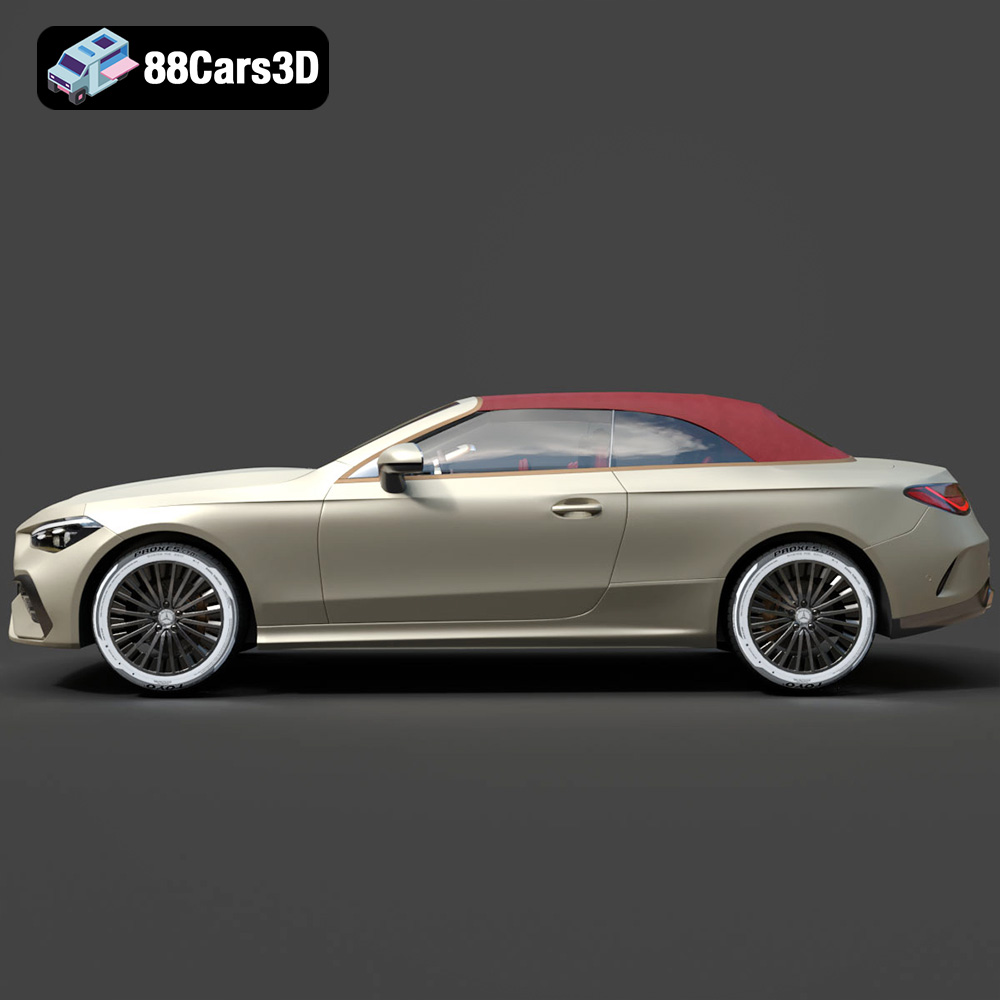
The Mercedes-Benz CLE Cabriolet 3D Model is an uncompromising, ultra-high-detail digital recreation of the brand’s newest luxury open-top cruiser. Engineered to seamlessly replace both the C-Class and E-Class convertibles, the CLE Cabriolet represents a new era of open-air elegance, combining a commanding, athletic stance with sophisticated aerodynamics and uncompromised everyday comfort. This 3D model meticulously captures the flowing, dynamic aesthetic of the modern CLE. It features the aggressive “shark nose” front fascia, the star-patterned radiator grille, the beautifully integrated acoustic fabric soft top, and the sculpted rear design with seamless LED taillights. Because this is a convertible, the interior is fully exposed to the elements and the camera—and this model does not disappoint. Built with a staggering, ultra-dense topology (over 9.24 million triangles), it delivers absolute photorealism. This model is engineered to hold up to the most extreme macro shots of both the exterior body and the meticulously crafted open-air cabin.
$29.99
.archviz
.automotive
.blend
.cabriolet
.cle
.convertible
.fbx
.mercedes
.obj
.rendering
2024-mercedes
car-3d-model
cle-cabriolet
hero-car
high poly
luxury car
mercedes-benz
vfx