Get 20% OFF All Premium 3D & STL Models!

The digital frontier has revolutionized how industries conceptualize, create, and interact with physical products. Nowhere is this more evident than in the automotive sector, where sophisticated 3D car models have become indispensable tools for everything from design and engineering to marketing, game development, and even virtual reality experiences. These meticulously crafted digital replicas are not merely static images; they are dynamic assets, brimming with technical detail and ready to be integrated into a myriad of professional workflows.
In this comprehensive guide, we’ll delve deep into the technical intricacies and vast applications of premium 3D car models, using the Mercedes-Benz GLB-Class Mk1 AMG Line 2019 3D Model as our prime example. This particular model, available on 88cars3d.com, embodies the perfect blend of aesthetic fidelity and technical optimization, making it an ideal asset for game developers, architectural visualizers, AR/VR creators, and rendering artists alike. We’ll explore the critical role of file formats, dissect the art of automotive digital craftsmanship, examine professional integration techniques, and even touch upon the burgeoning field of 3D printing.
The versatility of a 3D model, especially one as complex and detailed as an automotive asset, largely hinges on the array of file formats it supports. Each format serves a specific purpose, offering different levels of data retention, compatibility, and optimization for various applications. Understanding these formats is crucial for any professional working with 3D car models, ensuring seamless integration into diverse pipelines.
The .blend format is native to Blender, a powerful open-source 3D creation suite. When you download a .blend file, you’re getting a complete Blender project, which includes not just the mesh data for the Mercedes-Benz GLB-Class but also its materials, textures, lighting, cameras, and even animation data if present. This format is ideal for users who primarily work in Blender and require full editability. Artists can easily modify topology, adjust PBR material parameters, re-rig components, or integrate the car into complex scenes with Blender’s extensive toolset. It offers the most flexibility for customization and further development within the Blender ecosystem.
The .fbx (Filmbox) format is an industry-standard proprietary file format developed by Autodesk, widely used for exchanging 3D data between different software applications. Its strength lies in its ability to store not only geometry and UVs but also materials, textures, animations, and skeletal data in a single file. For game development, .fbx is often the go-to choice for importing 3D car models like the GLB-Class into engines like Unreal Engine and Unity. It ensures that mesh, materials (often as placeholders that need re-linking), and crucial animation pivots (for wheels, steering) are transferred reliably, making it excellent for real-time applications requiring dynamic elements.
The .obj (Wavefront OBJ) format is one of the oldest and most widely supported 3D file formats, making it a universal choice for basic mesh transfer. It primarily stores geometry (vertices, normals, texture coordinates, faces) and can reference external material files (.mtl) for basic shading information. While .obj does not support animation or skeletal data, its widespread compatibility across virtually all 3D software makes it invaluable. For the Mercedes-Benz GLB-Class, an .obj file is perfect for situations where you need to import the raw geometry into a software that might not support .fbx or .blend directly, ensuring maximum reach for rendering and visualization tasks.
The .glb (GL Transmission Format Binary) is the binary version of glTF, an open standard for 3D scenes and models. It’s specifically designed for efficient transmission and loading of 3D assets in web-based applications, augmented reality (AR), and virtual reality (VR) environments. A .glb file packages all necessary data—geometry, materials, textures, and even animations—into a single, compact binary file, making it incredibly fast to load and ideal for interactive experiences. For the GLB-Class model, this format is perfect for embedding a 3D car configurator directly into a website or deploying it into a mobile AR application, offering seamless, real-time interactivity.
The .stl (STereoLithography) format is the standard file type used for 3D printing. It represents a 3D model as a series of connected triangles, essentially describing the surface geometry without any color, texture, or material information. When preparing the Mercedes-Benz GLB-Class for physical reproduction, the .stl file acts as the blueprint for the 3D printer. It’s crucial for hobbyists and professionals looking to create physical scale models or prototypes, necessitating proper preparation for successful printing.
The .ply (Polygon File Format) is another common format for storing 3D data, particularly useful for scanned data, CAD, and scientific applications where precision and detailed vertex properties are paramount. It can store not only geometry but also color, transparency, and normal vectors for each vertex or face. While less common for everyday artistic exchange than .fbx or .obj, the .ply format for the GLB-Class model ensures that the precise structural proportions and mesh integrity are preserved for any analytical or engineering-focused workflows.
The .unreal format refers to assets specifically packaged or optimized for direct use within Unreal Engine. While often derived from .fbx imports, a dedicated .unreal asset implies a higher level of engine-specific preparation, including proper material setup, collision geometry, LODs (Levels of Detail), and possibly Blueprints for interactive functionalities. For game developers, this format can significantly streamline the integration of the GLB-Class, reducing setup time and ensuring optimal performance within the engine’s ecosystem.
The .max format is the native file type for Autodesk 3ds Max, a leading software for 3D modeling, animation, rendering, and visualization. Similar to .blend, a .max file contains a complete 3ds Max scene, including the Mercedes-Benz GLB-Class model’s geometry, materials, textures, lighting, cameras, and any animations or modifiers applied within the software. It provides full editability for professionals who use 3ds Max for high-end automotive rendering, architectural visualization, or complex animation sequences.
This comprehensive suite of file formats ensures that the Mercedes-Benz GLB-Class Mk1 AMG Line 2019 3D Model from 88cars3d.com offers unparalleled flexibility, ready to slot into virtually any professional 3D pipeline.
Creating a truly exceptional 3D car model is a delicate balance between artistic vision and rigorous technical execution. It requires a deep understanding of automotive design, precise measurement, and advanced 3D modeling techniques. The Mercedes-Benz GLB-Class Mk1 AMG Line 2019 3D Model exemplifies this synergy, delivering both visual splendor and practical utility.
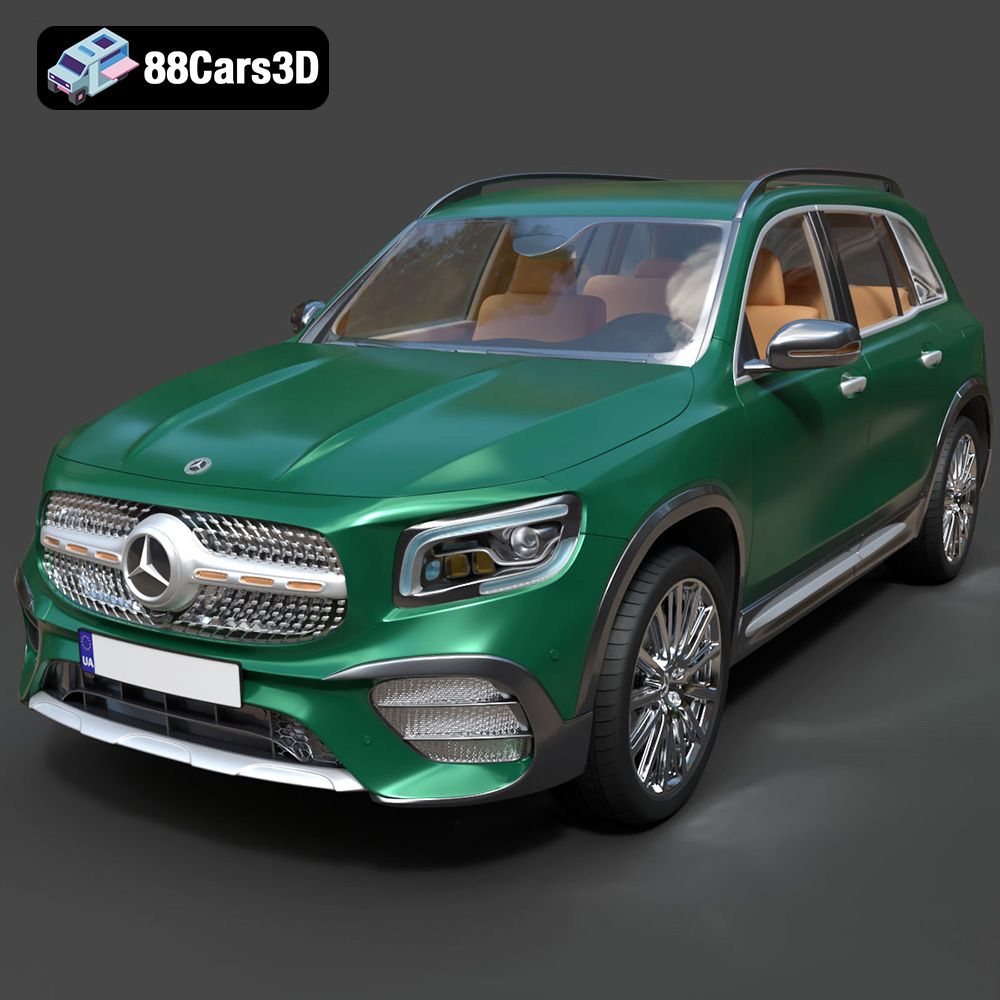
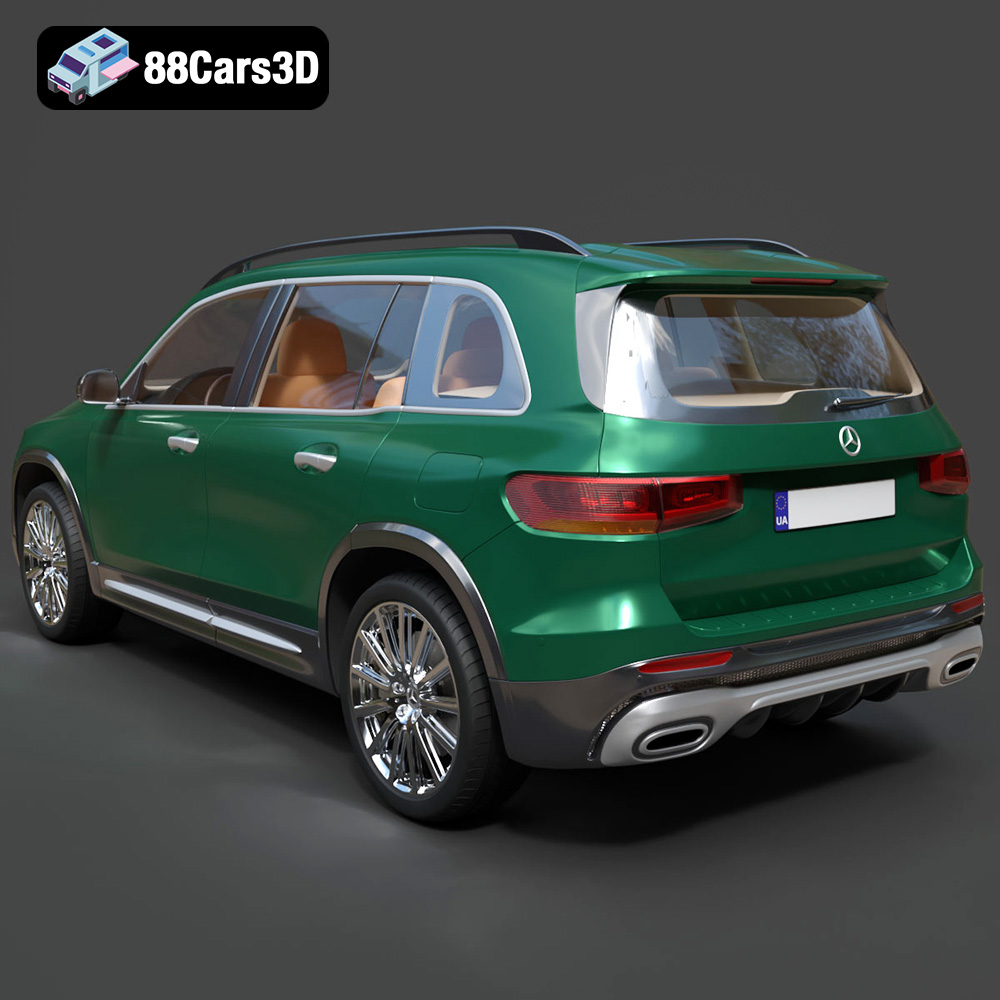
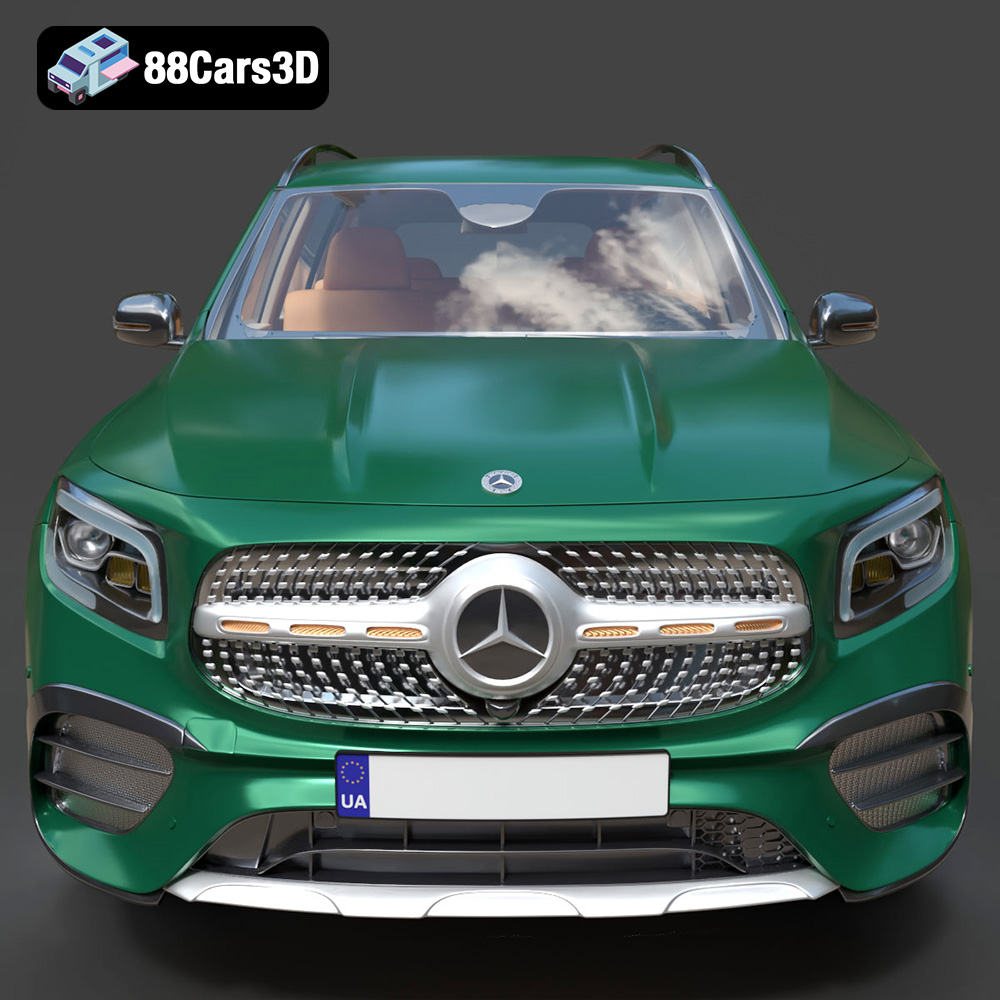
The first impression of any vehicle is its exterior, and capturing this digitally demands meticulous attention to detail. The GLB-Class model accurately replicates the distinctive boxy silhouette and commanding stance of the real vehicle. This includes the precise frame geometry and proportions, ensuring that the digital model is a faithful replica. The aggressive AMG Line styling cues are clearly visible, from the signature diamond radiator grille to the sporty front aprons and the prominent dual exhaust system, all contributing to the vehicle’s muscular heritage. High-detail LED High Performance headlamps and distinctive taillight clusters are modeled with precision, vital for realistic lighting setups. Even the authentic AMG 5-twin-spoke light-alloy wheels and performance tires are accurately rendered, complete with sport-tuned suspension detailing. Critical for animators and game developers, separate components for wheels, suspension, and steering ensure seamless animation, allowing for realistic driving simulations and cinematic sequences.
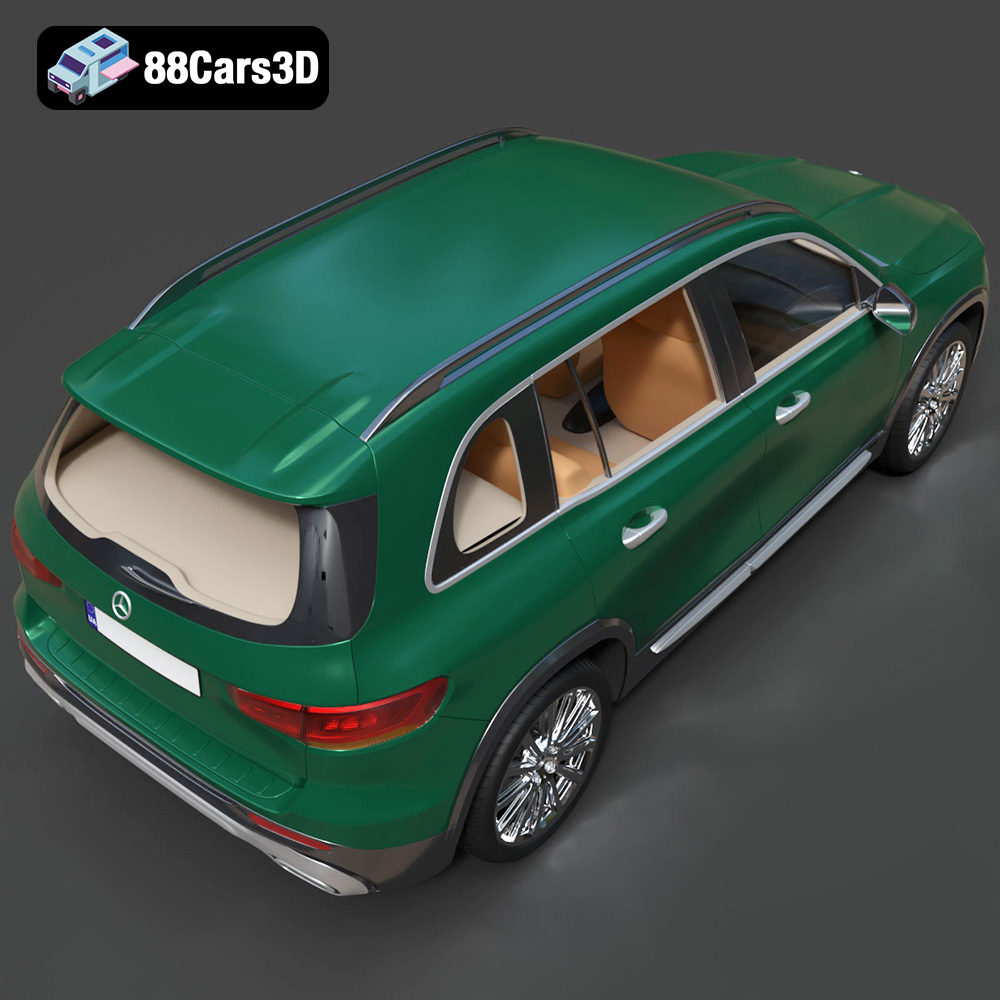
Beyond the gleaming exterior lies a meticulously recreated interior, crucial for close-up renders, first-person gaming, and virtual reality experiences. The model features detailed sport seating with intricate stitching and contouring, mirroring the luxury and comfort of the actual GLB-Class. The Nappa leather multifunction sports steering wheel, complete with precise switchgear, is fully modeled, providing an authentic tactile feel even in a digital space. An accurate MBUX dual-screen digital instrument cluster and infotainment system, alongside a detailed central console with touch controls, air vents, and pedals, are all carefully crafted. This optimized geometry is essential for first-person POV in gaming and VR simulations, allowing users to feel truly immersed within the vehicle’s luxurious cabin.
One of the most significant technical achievements of a high-quality 3D car model like the GLB-Class is its optimization for performance without sacrificing visual fidelity. With approximately 250,000 triangles, the model strikes an impeccable balance. This polycount is considered “game-ready,” meaning it’s efficient enough for real-time engines like Unreal and Unity to render smoothly at high frame rates, yet detailed enough to withstand close-up shots and high-end rendering. The use of PBR (Physically Based Rendering) texturing further enhances visual realism, allowing materials to react to light in a physically accurate manner. Real-world scale accuracy, based on actual vehicle chassis measurements, ensures that the model fits seamlessly into architectural visualizations or realistic environments. Furthermore, proper pivot setup for steering, wheel rotation, and suspension travel is foundational for any animation or interactive control, making this model truly versatile.
The true value of a premium 3D car model like the Mercedes-Benz GLB-Class lies in its seamless integration into various professional pipelines. From the fast-paced world of game development to the exacting standards of architectural visualization and the cutting-edge realm of AR/VR, these assets drive innovation.
For game developers, efficiency and realism are paramount. The GLB-Class model, offered in .fbx and .unreal formats, is perfectly suited for engines like Unreal Engine and Unity. The workflow typically involves importing the .fbx file, which brings in the mesh, UVs, and often basic material assignments. Artists then set up PBR materials, linking the provided textures (Albedo, Normal, Roughness, Metallic, etc.) to the engine’s material system. Collision meshes are created or generated to ensure the car interacts realistically with the game environment. LODs (Levels of Detail) are crucial for performance optimization, allowing the engine to display simpler versions of the model when it’s further away from the camera. The pre-set pivot points for wheels, steering, and suspension enable developers to quickly implement animation blueprints for realistic driving dynamics. This makes the Mercedes-Benz GLB-Class 3D Model an invaluable asset for urban racing games, open-world environments, and even automotive simulators, saving countless hours of modeling and optimization.
In the world of visualization, photorealism is the ultimate goal. Professionals using 3ds Max (with the .max format) or Blender (with the .blend format) can leverage the GLB-Class model for stunning renders. The workflow often involves placing the vehicle within an architectural scene, perhaps a luxury garage, a modern driveway, or an urban streetscape. Studio lighting setups are crucial for showcasing the vehicle’s form and finishes, often using HDRI (High Dynamic Range Image) environments for realistic reflections and ambient light. Camera angles are carefully composed to highlight design features, and often, backplate photography is used to seamlessly integrate the 3D car into real-world backgrounds. The detailed exterior and interior features, combined with PBR materials, ensure that the Mercedes-Benz GLB-Class appears indistinguishable from a photograph, making it perfect for brand campaigns, lifestyle scenes, and marketing materials.
Augmented Reality (AR) and Virtual Reality (VR) are transforming how consumers interact with products. The .glb format of the GLB-Class model is specifically optimized for these immersive applications. For virtual showrooms, users can explore the car in a VR environment, opening doors, examining the interior, and even changing colors in real-time. In AR, the model can be “placed” in a user’s real-world environment via a smartphone, allowing them to visualize the car in their driveway or living room. The optimized geometry and single-file nature of .glb ensure fast loading times and smooth interaction, which are critical for engaging AR/VR experiences, providing potential customers with an unparalleled digital configurator or a virtual test drive.
While most 3D models live in the digital realm, some are destined for the physical world. The Mercedes-Benz GLB-Class Mk1 AMG Line 2019 3D Model also serves this purpose, with its .stl format enabling the creation of tangible objects through 3D printing.
Converting a high-detail digital model into a printable object requires careful consideration. The recommended scales for printing the GLB-Class are 1:12, 1:18, or 1:24, offering a good balance between size and detail. For optimal results, especially with fine details like grilles, mirrors, and interior elements, resin printing (SLA/DLP) is highly recommended over FDM, allowing for much finer layer heights (0.04–0.12 mm). Wall thickness is crucial for structural integrity, with 1.2–2.0 mm being a good guideline. Infill settings (20–30%) provide internal support without excessive material use. Supports are almost always required for overhangs and delicate parts like the exhaust system, mirrors, and the steering wheel. Proper print orientation, such as printing the frame at an angle and wheels separately, further ensures structural soundness and minimizes support material. Post-processing, including sanding, priming, and painting with authentic factory colors, often with metallic finishes, brings the physical model to life.
The ability to 3D print the Mercedes-Benz GLB-Class model opens up several practical applications. For hobbyists, it provides an opportunity to create highly detailed display models, allowing for hands-on customization and painting that rivals traditional model kits. In design and engineering, 3D printed models can serve as rapid prototypes, offering a tangible representation of the vehicle for design reviews, ergonomic studies, or promotional displays. While not suitable for full-scale functional parts, these scaled models provide invaluable physical feedback during the conceptualization and development phases of automotive design, bridging the gap between digital ideation and physical realization.
A high-quality 3D asset is not just about its inherent detail; it’s also about its adaptability. The Mercedes-Benz GLB-Class Mk1 AMG Line 2019 3D Model offers extensive customization options, allowing users to tailor its appearance to perfectly suit their project’s unique narrative and visual requirements.
The digital nature of the GLB-Class model allows for unparalleled flexibility in its appearance. Users can easily change body colors, experimenting with a palette ranging from classic Mercedes-Benz hues like Mountain Grey and Cosmos Black to custom finishes. This is critical for configurator tools or marketing campaigns targeting different demographics. Beyond paint, tire textures can be modified to reflect various conditions, switching between sleek street variants for urban scenes and rugged winter treads for off-road scenarios. Material finishes, such as matte, gloss, metallic, or the addition of carbon fiber accents, can be adjusted to convey different levels of luxury or performance. Adapting lighting is also key, allowing the car to shine under bright daytime environments, moody twilight settings, or dramatic night-time cityscapes. These customization options empower artists to create unique visual narratives with a single, versatile asset.
Integrating the Mercedes-Benz GLB-Class 3D Model into diverse scenes goes beyond simple placement; it’s about crafting compelling stories. Whether it’s showcasing the vehicle navigating a bustling urban street, parked elegantly in front of a modern architectural masterpiece, or poised dynamically in a studio light setup, the model serves as a central element in visual storytelling. For advertisers, this means creating aspirational lifestyle imagery; for game developers, it means building believable and engaging worlds; and for AR/VR creators, it means delivering interactive, lifelike experiences. The technical fidelity and customization options of this model ensure it can adapt to these varied contexts, always delivering a premium visual impact and enhancing the overall narrative.
The role of high-fidelity 3D car models in today’s digital landscape cannot be overstated. From powering immersive game worlds and compelling visualizations to facilitating innovative AR/VR experiences and even enabling physical prototyping, assets like the Mercedes-Benz GLB-Class Mk1 AMG Line 2019 3D Model are at the forefront of technological advancement. Its meticulous design, optimized geometry, and comprehensive file format support make it an exceptionally versatile and powerful tool for professionals across numerous industries.
Understanding the nuances of each file format, appreciating the intricate balance between detail and performance, and mastering the workflows for integration are crucial for leveraging these assets to their full potential. Whether you’re an automotive renderer aiming for photorealism, a game developer crafting engaging experiences, or an innovator exploring the frontiers of AR/VR, investing in high-quality 3D car models like this GLB-Class is an investment in efficiency, realism, and creative possibility. Explore this and other premium automotive rendering and game assets today at 88cars3d.com and drive your projects forward with unparalleled digital craftsmanship.
Experience the perfect blend of rugged versatility and premium luxury with our meticulous 3D model of the Mercedes-Benz GLB-Class (Mk1) AMG Line 2019. This compact crossover SUV stands out with its distinctive boxy silhouette, commanding stance, and aggressive AMG Line styling cues, including the signature diamond radiator grille, sporty front aprons, and prominent dual exhaust system. Designed to encapsulate the modern elegance and muscular heritage of the Mercedes-Benz brand, this digital replica captures every striking curve and sophisticated detail.
This high-fidelity, game-ready 3D model is meticulously crafted with optimized topology (~250,000 triangles), striking an impeccable balance between exceptional visual realism and efficient real-time performance. Designed for maximum versatility, the model features PBR texturing and precise structural proportions, making it a premium asset for game engines, high-end rendering, and immersive interactive media.
Perfect for urban racing games, luxury vehicle configurators, architectural visualizations, and mobile AR experiences.
.blend, .fbx, .obj, .glb, .stl, .ply, .unreal, .max
Tags:
mercedes-benz, glb-class, amg-line, 2019, compact-suv, luxury-suv, game-ready, low-poly, optimized, car-3d-model, game-asset, rendering, vr-ar, blend, fbx, obj, glb, stl, ply, unreal, maxVespa VNB 125-B 3D Model 3D Printable STL
$19.99
.2019
.blend
.fbx
.glb
.luxury suv
.max
.obj
.ply
.rendering
.stl
.unreal
amg-line
car-3d-model
compact-suv
game asset
game-ready
glb-class
low-poly
mercedes-benz
optimized
VR/AR