Get 20% OFF All Premium 3D & STL Models!

The world of 3D design is constantly evolving, with automotive models serving as a cornerstone for everything from AAA video games to hyper-realistic architectural visualizations and interactive AR/VR experiences. At the heart of creating these immersive digital environments lies the need for exceptionally crafted 3D car models. These aren’t just static objects; they are complex assemblies of geometry, textures, and materials designed to perform flawlessly across diverse platforms.
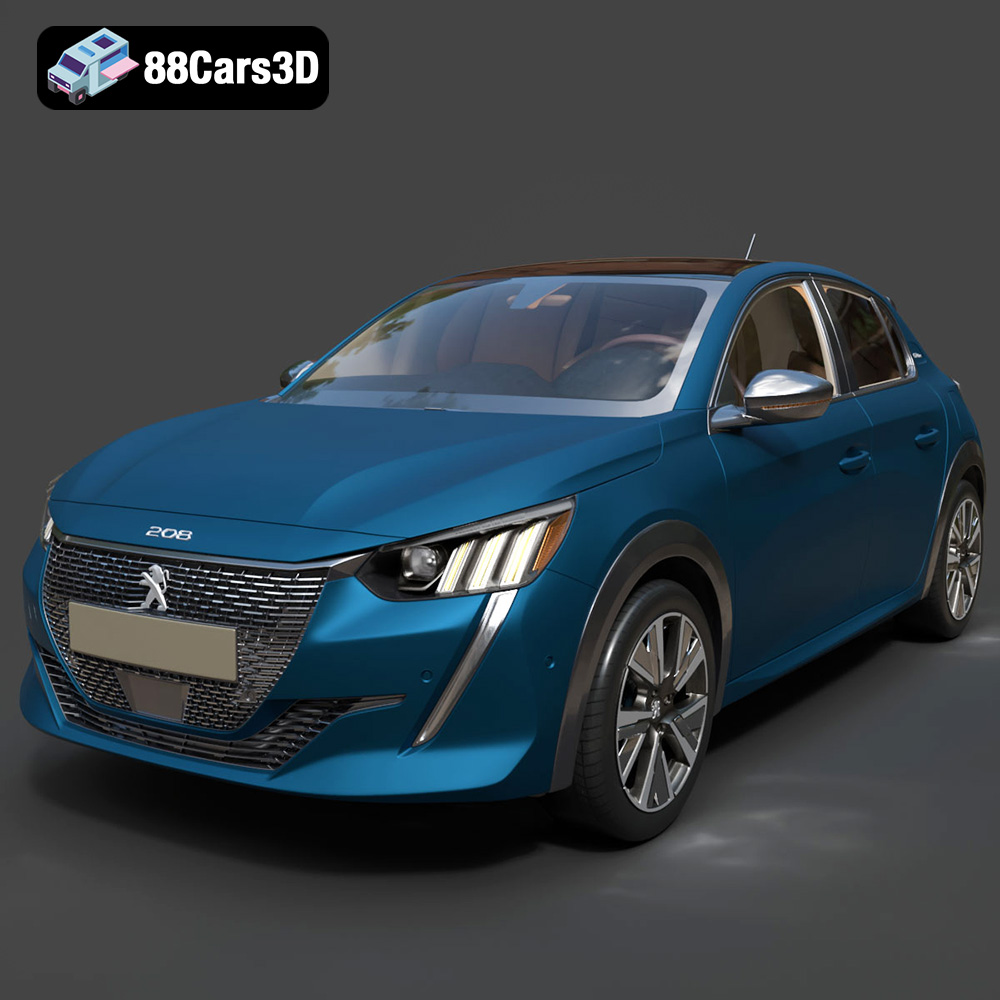
In this comprehensive guide, we’ll delve into the intricate details of what makes a high-quality 3D automotive asset indispensable for modern creative pipelines. We’ll explore the technical specifications that define excellence, common professional workflows, and real-world applications. Our journey will center around a prime example of digital craftsmanship: the 2020 Peugeot 208 3D model, a product that beautifully encapsulates the fusion of aesthetic appeal and technical optimization. With its bold, aggressive styling, distinctive ‘saber-tooth’ LED daytime running lights, and dynamic stance, the real-world Peugeot 208 redefined the modern compact hatchback. Its digital counterpart, available on 88cars3d.com, is engineered to bring that same level of striking detail and performance to your projects.
When working with 3D assets, especially complex ones like automotive models, understanding the various file formats is paramount. Each format serves a specific purpose, offering different levels of compatibility, feature support, and optimization for particular workflows. The Peugeot 208 2020 3D model stands out by offering a comprehensive suite of formats, ensuring maximum flexibility for any project. Let’s break down these essential file types:
The .blend file is the native format for Blender, a powerful and increasingly popular open-source 3D creation suite. A .blend file typically contains an entire scene, including all mesh data, materials, textures, lighting setups, cameras, animations, and even physics simulations. For artists working primarily in Blender, this format offers the highest degree of editability and preserves all the intricate details and non-destructive modifiers used during the model’s creation. It’s ideal for those who wish to deeply customize the Peugeot 208, modify its topology, or integrate it seamlessly into an existing Blender project with all its original material nodes intact.
.fbx (Filmbox) is arguably the most widely adopted proprietary file format for 3D data exchange, especially in the game development and animation industries. Developed by Autodesk, FBX is excellent for transferring models, animations, rigs, and even some material definitions between different 3D software packages (like 3ds Max, Maya, Blender, Cinema 4D) and real-time engines (Unreal Engine, Unity). For a 3D car model like the Peugeot 208, an FBX file will typically include the mesh geometry, UV mapping, skeletal data (if rigged for animation like wheels and suspension), and basic material assignments. Its robust support for hierarchical structures makes it ideal for game assets that require movement and interaction.
.obj (Wavefront OBJ) is one of the oldest and most universal 3D file formats. While it doesn’t support animation or rigging, it excels at storing pure geometric data – vertices, normals, UV coordinates, and faces. It’s highly compatible across virtually all 3D software, making it a reliable choice for simple mesh transfer. For the Peugeot 208, an OBJ file ensures that the core mesh data is accessible to any 3D artist, regardless of their preferred software. It’s often accompanied by an .mtl (material library) file that describes basic material properties and references texture maps.
.glb (GLB, a binary version of glTF) is a relatively newer format gaining significant traction, particularly for web-based 3D, augmented reality (AR), and virtual reality (VR) applications. It’s designed to be a compact, single-file format that bundles geometry, materials, textures, and even animation data into one efficient package. GLB is optimized for quick loading and rendering in real-time environments, making the Peugeot 208 model in this format perfect for immersive virtual showrooms, mobile AR experiences, or interactive product configurators directly within a web browser.
.stl (Stereolithography) is the de facto standard file format for 3D printing. Unlike other formats that store color and texture information, STL represents a 3D model as a series of interconnected triangles, defining only the surface geometry. It’s a “dumb” format in that it doesn’t carry scale or unit information, but its simplicity makes it universally accepted by 3D slicing software. The Peugeot 208 3D model’s availability in STL format means hobbyists and professionals can bring the digital vehicle into the physical world, creating tangible scale models for display or prototyping.
.ply (Polygon File Format) is another format for storing 3D data, often used in scientific, CAD, and 3D scanning applications. It can store a wider range of properties than OBJ or STL, including color, transparency, and even normal vectors per vertex or face. While less common for general game assets, its precision and ability to carry detailed attribute information make it valuable for specific engineering, analysis, or very high-fidelity visualization tasks where the Peugeot 208’s detailed surface needs to be accurately represented beyond basic geometry.
The .unreal format refers to assets specifically packaged or directly integrated for use within the Unreal Engine ecosystem. This could mean a .uasset file or a direct project integration ready for Unreal Engine projects. Such assets are typically optimized for Unreal’s rendering pipeline, often pre-configured with PBR (Physically Based Rendering) materials, LODs (Levels of Detail), and collision meshes. For the Peugeot 208, an Unreal-ready asset significantly streamlines the integration process, saving developers countless hours of setup time and ensuring optimal performance within the engine.
Similar to .blend for Blender, .max is the native file format for Autodesk 3ds Max, another industry-leading 3D modeling, animation, and rendering software. A .max file contains a complete 3ds Max scene, including geometry, materials, lighting, cameras, and any animation data. For users of 3ds Max, the .max version of the Peugeot 208 offers full editability, allowing for complex scene setups, advanced rendering using V-Ray or Corona, and intricate animation sequences, leveraging all the features of the software.
The provision of such a diverse array of formats for the Peugeot 208 2020 3D model underscores its versatility and the commitment of 88cars3d.com to provide assets that cater to every professional need. This extensive compatibility ensures that designers, developers, and artists can integrate this stunning vehicle into their projects with minimal friction, regardless of their chosen software or end application.
The allure of a high-quality 3D car model lies not just in its availability in multiple formats, but in the meticulous attention to detail and optimization that goes into its creation. The 2020 Peugeot 208 3D model is a testament to this principle, meticulously crafted to capture the essence of its real-world counterpart while being engineered for peak performance in digital environments.
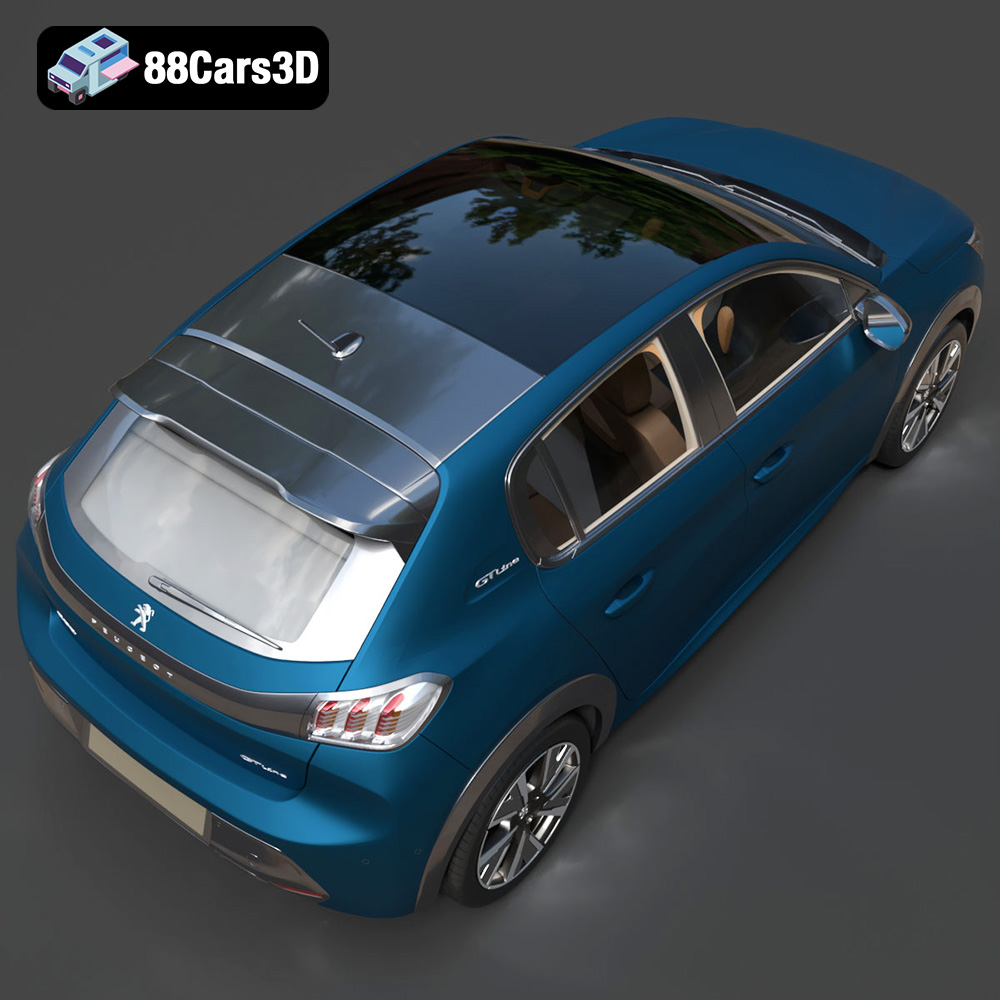
The real Peugeot 208 2020 redefined its segment with a bold, aggressive styling that demanded attention. Its digital twin mirrors this precision with an accurate frame geometry and sporty hatchback proportions that are instantly recognizable. Key exterior features are not merely present but rendered with remarkable fidelity:
This level of external detail makes the Peugeot 208 model perfect for brand campaigns and studio lighting setups, where every curve and chrome accent needs to shine.
The interior of the Peugeot 208, particularly its distinctive i-Cockpit, is a hallmark of modern European design. The 3D model brings this sophisticated interior to life, ensuring that the experience from a first-person perspective in a game or a detailed visualization is utterly convincing:
Such comprehensive interior detailing ensures that the Peugeot 208 2020 3D model isn’t just a shell, but a complete, immersive environment.
The true value of a professional 3D car model lies in its technical foundation – the delicate balance between visual fidelity and performance optimization. The Peugeot 208 2020 3D model exemplifies this mastery, designed to excel in both high-end rendering and demanding real-time environments.
For game developers, performance is paramount. The Peugeot 208 model boasts an optimized topology of approximately 120,000 triangles. This specific polycount is not arbitrary; it represents a carefully calculated “sweet spot” for real-time engines like Unreal and Unity. It’s high enough to maintain excellent visual realism and smooth surface curvature for close-up cinematic shots, yet low enough to ensure flawless game-ready performance, preventing framerate drops even when multiple instances of the car are present in a scene.
Key technical advantages include:
These elements make it an ideal game asset, drastically reducing the integration time and effort for development teams.
Modern rendering relies heavily on Physically Based Rendering (PBR) workflows, which simulate how light interacts with surfaces in the real world. The Peugeot 208 3D model is designed with this in mind, delivering crisp reflections, accurate ambient occlusion, and materials that respond realistically to various lighting conditions.
The model’s material system is also built for extensive customization, empowering artists to achieve diverse aesthetic outcomes:
This deep level of material control and optimization positions the Peugeot 208 2020 3D model as a robust and adaptable asset for any professional rendering or real-time project.
The versatility of the Peugeot 208 2020 3D model extends across a wide spectrum of creative and technical industries. Its robust design and multiple file formats ensure seamless integration into various professional workflows, from cinematic rendering to interactive simulations.
For automotive studios, marketing agencies, and architectural visualization firms, photorealistic rendering is key to showcasing concepts and products. The Peugeot 208 3D model is an exceptional tool for this purpose:
The “game-ready” nature of the Peugeot 208 3D model makes it invaluable for interactive applications, where performance and visual quality must coexist.
Beyond screen-based applications, the Peugeot 208 3D model offers the exciting possibility of physical creation through 3D printing. The inclusion of the .stl format enables hobbyists and professionals to convert the digital design into a tangible, display-scale model.
The diverse applications of the Peugeot 208 2020 3D model underscore its value as a versatile asset, catering to the exacting demands of various creative and technical professionals. Whether for game development, architectural visualization, or 3D printing, 88cars3d.com provides the tools for digital excellence.
A high-quality 3D asset is not just about its initial fidelity; it’s also about its longevity and adaptability. The Peugeot 208 2020 3D model from 88cars3d.com is designed with customization and future-proofing in mind, ensuring it remains a valuable tool in evolving creative landscapes.
The ability to customize a 3D model significantly extends its utility and lifespan. The Peugeot 208 model offers several key customization options that empower artists and designers to tailor the asset to their specific creative needs:
These customization capabilities ensure that the Peugeot 208 model is not a static purchase but a dynamic tool that can evolve with project requirements and artistic vision.
Sourcing high-quality 3D car models can be a time-consuming and expensive endeavor, often requiring specialized skills in modeling and optimization. This is where marketplaces like 88cars3d.com provide immense value. The Peugeot 208 2020 3D model is a prime example of the caliber of assets available, offering immediate access to a professionally crafted, optimized, and versatile resource.
In essence, investing in premium 3D car models like the Peugeot 208 2020 from 88cars3d.com means investing in efficiency, quality, and creative freedom, allowing digital artists to push the boundaries of realism and immersion in their work.
The digital realm of 3D modeling demands precision, performance, and unparalleled realism. As we’ve explored, a truly exceptional 3D car model, such as the Peugeot 208 2020 from 88cars3d.com, encapsulates these requirements with sophisticated design, meticulous optimization, and expansive compatibility. From its signature ‘saber-tooth’ DRLs to its detailed i-Cockpit, every aspect is crafted to deliver visual fidelity without compromising performance.
Whether you are a game developer striving for immersive open-world environments, an architect enhancing a visualization with lifelike street scenes, an AR/VR designer building interactive showrooms, or a hobbyist eager to bring a favorite car to life through 3D printing, this model provides an invaluable foundation. Its comprehensive technical specifications – from the balanced 120k triangle count to the proper pivot setups and PBR materials – ensure seamless integration and professional-grade results across diverse software and engines like 3ds Max, Blender, Unreal Engine, and Unity. The wide array of included file formats further solidifies its position as a versatile and future-proof asset.
The Peugeot 208 2020 3D model is more than just a digital representation; it’s a testament to expert craftsmanship, offering endless customization possibilities and empowering creators to realize their most ambitious visions. For those seeking to elevate their projects with high-quality 3D car models, 88cars3d.com remains a premier destination for assets that truly drive digital innovation.
The 2020 Peugeot 208 redefined the modern compact hatchback segment with its bold, aggressive styling and sporty proportions. Featuring the striking ‘saber-tooth’ LED daytime running lights, a muscular sculpted hood, and an elegant gloss-black rear light cluster fascia, this vehicle stands out in any urban setting. Its dynamic stance and streamlined profile perfectly capture the essence of contemporary European car design. This meticulously crafted 3D model boasts an optimized topology of approximately 120k triangles, ensuring flawless game-ready performance without compromising visual fidelity. Designed for high-end rendering and real-time engines, it delivers crisp reflections, accurate ambient occlusion, and an immaculate flow of polygons tailored for both performance and close-up cinematic shots. Perfect for modern city driving games, architectural visualization street scenes, VR automotive showrooms, and commercial lifestyle rendering.
$19.99
.2020
.208
.blend
.fbx
.glb
.hatchback
.max
.obj
.peugeot
.ply
.rendering
.stl
.unreal
car-3d-model
city-car
compact-car
game asset
game-ready
low-poly
optimized
VR/AR