Get 20% OFF All Premium 3D & STL Models!

The world of 3D modeling is a fascinating intersection of art and engineering, particularly when it comes to recreating iconic vehicles. From the sleek lines of a modern supercar to the nostalgic charm of a classic two-wheeler, every detail matters in bringing these machines to life in a digital realm. High-quality 3D models are indispensable tools for a multitude of industries, including game development, **automotive rendering**, film production, architectural visualization, and even **3D printing**. They provide the foundation for immersive experiences, photorealistic marketing materials, and interactive simulations.
Today, we delve into the meticulous craft behind creating such assets, using an exemplary case: the Vintage Vespa 3D Model available at 88cars3d.com. This model isn’t just a digital representation; it’s a testament to preserving design heritage through technical precision, offering unparalleled versatility for creators across various platforms. Its optimization for real-time engines, fidelity for high-resolution renders, and adaptability for different applications make it a standout asset in the competitive landscape of **3D car models**. Let’s explore the intricacies that make models like this not just visually stunning, but also robust and functionally superior for professional workflows.
In the realm of 3D modeling, the choice of file format is as crucial as the model itself. Each format is designed with specific applications and technical advantages in mind, enabling seamless integration into various software pipelines and end-user experiences. The Vintage Vespa 3D Model from 88cars3d.com exemplifies this versatility by offering a comprehensive suite of formats, ensuring it’s ready for any project. Understanding these formats is key to maximizing efficiency and maintaining asset integrity.
The `.blend` file format is native to Blender, the powerful open-source 3D creation suite. It’s renowned for being an all-encompassing package, storing not just the mesh data, but also materials, textures, lighting setups, animation data, scene configurations, and even custom scripts. For artists working primarily in Blender, the `.blend` file is the most robust option, offering full editability of every aspect of the model. This allows for in-depth customization, material adjustments, animation tweaks, and scene staging, making it ideal for detailed **automotive rendering** projects or complex animated sequences within Blender’s ecosystem. Its comprehensive nature ensures that all original design intent and asset relationships are preserved.
The Filmbox (`.fbx`) format, developed by Autodesk, has become the de facto standard for exchanging 3D data between various software applications and game engines like Unreal Engine and Unity. It’s particularly strong in preserving complex scenes, including geometry, materials, textures, animations (skeletal and vertex), cameras, and lights. For assets intended for real-time pipelines, `.fbx` is invaluable. The Vintage Vespa model, being game-ready, benefits immensely from the `.fbx` format, ensuring that its optimized topology, proper pivot setups for animation, and material assignments translate accurately into demanding real-time environments. It acts as a bridge, allowing the model to flow effortlessly between different stages of a production pipeline.
The Wavefront OBJ (`.obj`) format is a widely supported, universal format primarily focused on representing 3D geometry. It’s a simpler format compared to `.fbx`, often storing vertex positions, UV coordinates, normals, and material group information. While it doesn’t typically embed animations or complex scene data, its widespread compatibility makes it an excellent choice for basic model exchange across virtually any 3D software. When an artist needs to import the Vintage Vespa’s core mesh into a new application for re-texturing, retopology, or a fresh rendering setup, `.obj` provides a clean, reliable foundation. It’s a testament to cross-software compatibility.
The GL Transmission Format (`.glb`) is a binary version of `.gltf` and is quickly gaining traction as the “JPEG of 3D.” It’s designed for efficient transmission and loading of 3D scenes and models in web, augmented reality (AR), and virtual reality (VR) applications. `.glb` files package all necessary assets (geometry, materials, textures, animations) into a single, self-contained file, making them highly portable and optimized for fast display in browsers and mobile devices. For interactive virtual showrooms or mobile AR experiences featuring the Vintage Vespa, the `.glb` format offers superior performance and ease of integration, crucial for delivering smooth, immersive experiences.
Stereolithography (`.stl`) is the most common file format for **3D printing**. It represents a 3D model as a series of connected triangles, essentially describing the surface geometry of an object without color or texture information. While simple, its ubiquity ensures compatibility with nearly every 3D printer and slicing software. The Vintage Vespa 3D Model’s availability in `.stl` format opens up possibilities for physical fabrication, allowing enthusiasts and designers to bring the digital model into the tangible world. Precise `.stl` output, coupled with recommended print settings, ensures a successful physical replica.
The Polygon File Format (`.ply`), also known as the Stanford Triangle Format, is primarily used to store 3D data from 3D scanners, CAD applications, and for scientific analysis. It can store a wider range of properties than `.stl`, including color, transparency, surface normals, and various confidence levels for each vertex or face. For highly precise engineering, reverse engineering, or detailed structural analysis of the Vintage Vespa’s components, the `.ply` format can be invaluable, offering a more robust data set for specific technical applications.
The `.unreal` format, often referring to a cooked asset or an asset pack specifically configured for Unreal Engine, signifies a model that is truly “engine-ready.” This isn’t a single file like `.fbx`, but rather a collection of optimized assets (meshes, materials, textures, animations, collision data) packaged to drop directly into an Unreal Engine project. This format provides maximum efficiency for Unreal developers, ensuring that the Vintage Vespa model comes with pre-configured materials, LODs (Levels of Detail), and collision meshes, significantly reducing setup time and streamlining the development of **game assets**.
Similar to `.blend` for Blender, the `.max` file is the native project format for Autodesk 3ds Max, a leading software for 3D modeling, animation, and **automotive rendering**. A `.max` file contains the complete scene, including geometry, materials, lighting, cameras, animations, modifiers, and plugin-specific data. It allows for full control and editing within 3ds Max, making it the preferred choice for artists who wish to integrate the Vintage Vespa into their 3ds Max-centric workflows for high-end visualizations, architectural walkthroughs, or cinematic productions.
By providing such a diverse array of formats, 88cars3d.com ensures that the Vintage Vespa 3D Model is not just a high-quality asset, but a highly adaptable one, ready for any professional challenge across different software and platforms.
The creation of a truly exceptional 3D vehicle model like the Vintage Vespa is an endeavor rooted in deep respect for original design and meticulous attention to detail. It’s about more than just replicating shapes; it’s about understanding the ethos of the original design and translating that into a digital format that evokes the same emotions and recognition. This approach is fundamental for any high-quality **3D car model**, regardless of its specific type.
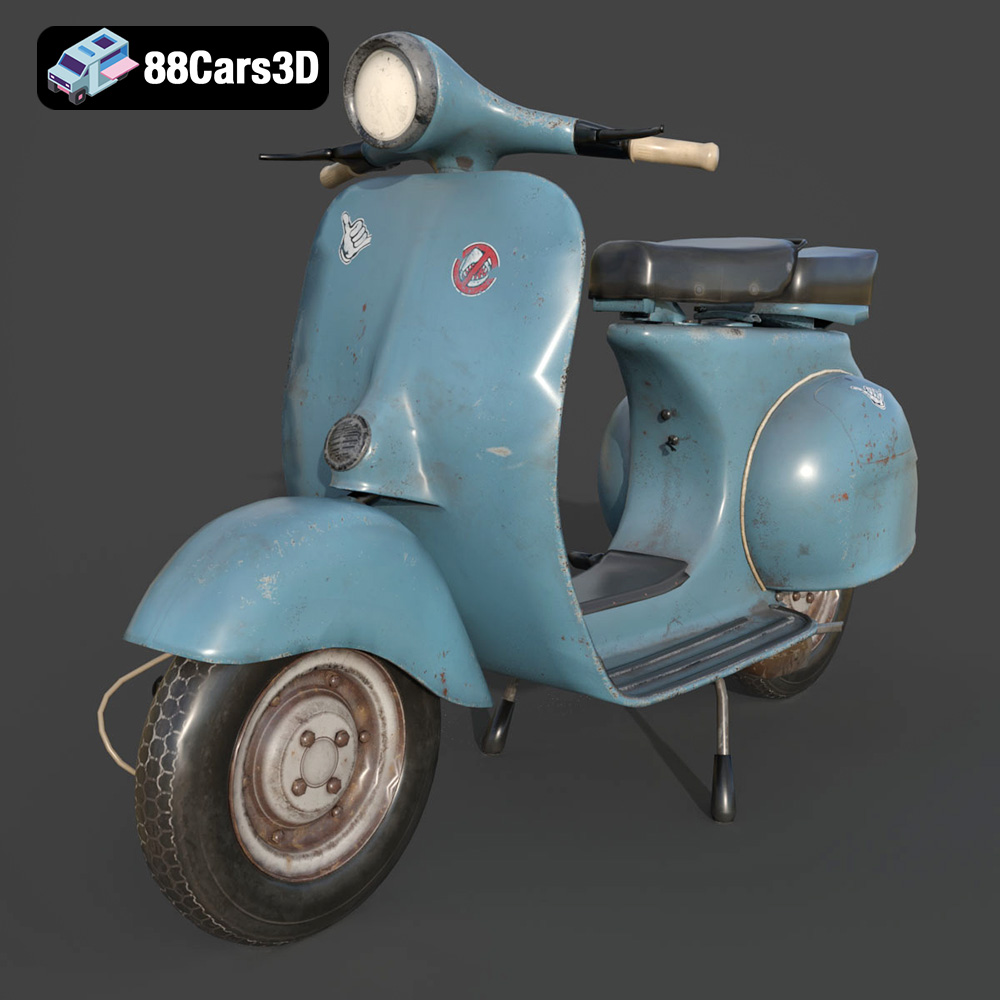
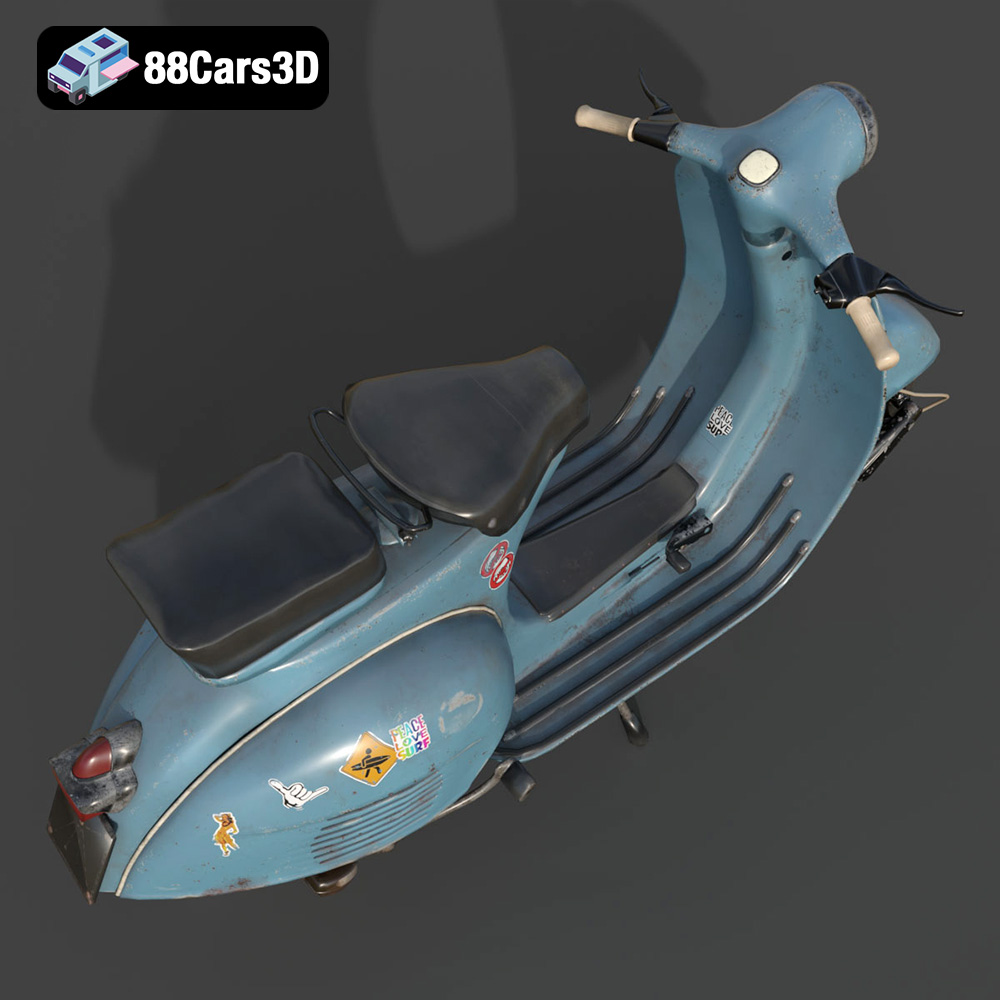
The Vintage Vespa is instantly recognizable, not just by its silhouette, but by a collection of distinct features that have defined it for decades. The model meticulously captures these elements: the pressed steel monocoque chassis, the beautifully sweeping side cowls, the signature step-through frame, and the authentic retro headlamp. Every curve, every weld line (implied or explicit), and every panel gap has been considered. The detailed 2-stroke engine casing with its characteristic cooling fins and the classic curved exhaust system are not merely suggested but faithfully recreated. Even smaller components like the vintage stamped steel wheels with classic tread tires and the signature single-sided trailing-link front suspension are modeled with accuracy, ensuring that the essence of the original is preserved. This level of detail is crucial for achieving photorealism in **automotive rendering**.
Beyond individual features, the overall scale and proportions are paramount. The Vintage Vespa 3D Model is built with real-world scale accuracy, based on actual vehicle chassis measurements. This ensures that when the model is imported into a scene, it fits seamlessly alongside other real-world assets without requiring tedious scaling adjustments. Correct proportions are not only visually pleasing but also critical for technical applications such as architectural visualizations where space and dimensions are key, or for creating believable **game assets** where players expect consistent world scaling. This adherence to real-world data forms the bedrock of its visual fidelity.
One of the most significant challenges in 3D modeling for modern applications is striking the delicate balance between visual fidelity and real-time performance. A stunning model is only truly valuable if it can be rendered smoothly in interactive experiences like video games or VR. The Vintage Vespa 3D Model excels in this regard, engineered to be “game-ready” without sacrificing its high-end visual appeal.
The model features highly optimized topology with approximately 150,000 triangles. This polycount is a critical sweet spot: it’s high enough to deliver stunning visual fidelity, capturing all the nuanced curves and details of the Vespa, yet low enough to ensure smooth real-time performance in demanding engines like Unreal and Unity. This optimization means that developers can populate open-world games, racing titles, or even intricate VR scenes with multiple instances of the Vespa without significant performance overhead. The careful distribution of polygons ensures that detail is concentrated where it matters most, like the engine block or dashboard, while maintaining efficiency elsewhere.
A static model, however beautiful, has limited utility in dynamic environments. The Vintage Vespa comes with proper pivot setups for steering, wheel rotation, and suspension travel. This pre-configured “rigging” is invaluable for animators and game developers, allowing for immediate integration into physics systems or animation sequences. Separate components like wheels, suspension, and steering can be easily manipulated, enabling realistic movement for driving simulations, interactive sequences, or cinematic cutscenes. This foresight in preparation significantly accelerates development timelines for **game assets**.
While not explicitly detailed in the original product description, a high-quality game-ready asset for modern engines typically relies on Physically Based Rendering (PBR) materials. These materials, combined with precise UV mapping, allow for incredibly realistic surface properties like metallic sheens, paint gloss, and tire rubber textures. The optimized topology and proper UVs ensure that textures can be applied without stretching or distortion, faithfully representing scratches, dirt, or pristine factory finishes. This attention to material definition elevates the **automotive rendering** quality, making the Vintage Vespa look authentic under various lighting conditions, from a sunny Italian street to a moody studio setup.
The true measure of a high-quality 3D asset lies in its adaptability and ease of integration into diverse professional pipelines. The Vintage Vespa 3D Model, with its comprehensive file format support and careful optimization, is designed to be a versatile tool for professionals using industry-standard software.
For artists specializing in **automotive rendering** and cinematic visualization, the `.max` and `.blend` formats are indispensable. In 3ds Max, the `.max` file provides a fully editable project, allowing artists to leverage powerful rendering engines like V-Ray or Corona. Imagine setting up a vintage street scene: the Vespa can be positioned, lit with custom studio lights, and animated to drive through a picturesque European town. Similarly, Blender users can open the `.blend` file and harness the capabilities of Cycles or Eevee, experimenting with different material finishes—from a glossy factory paint job to a weathered patina—and custom camera angles to create breathtaking renders for marketing campaigns or visual effects sequences. The ability to directly access and modify the original project files saves countless hours of re-importing and setup.
For game developers and real-time visualization specialists, the `.fbx` and `.unreal` formats are crucial. Importing the Vintage Vespa into Unreal Engine via `.fbx` allows for swift material setup, automatic collision generation, and integration into existing blueprints. The “game-ready” nature, with its optimized polycount and pre-set pivots, means it can be immediately placed into a level as a static prop, a drivable vehicle, or an AI-controlled element. With the `.unreal` package, even more setup is streamlined, offering a direct, engine-optimized asset. Consider an open-world game set in a bustling city: dozens of Vespas could populate the streets, contributing to a vibrant, authentic atmosphere without taxing system resources. Its role as a dynamic **game asset** is amplified by its readiness for interaction.
The `.glb` format positions the Vintage Vespa perfectly for the burgeoning fields of AR, VR, and web-based 3D. Imagine a virtual showroom where potential customers can interact with the Vespa, changing its colors, rotating it, and even “sitting” on it in a VR headset. Or a mobile AR app that projects the Vespa onto a real-world street, allowing users to admire its design in their own environment. The `.glb` format’s efficiency ensures fast loading times and smooth performance on diverse devices, making immersive experiences featuring this classic scooter accessible to a broad audience. This is crucial for **3D car models** in expanding digital frontiers.
While 3D models are primarily digital assets, their utility often extends into the physical world through **3D printing**. The Vintage Vespa 3D Model is not merely designed for screens; it’s also crafted with physical fabrication in mind, offering a tangible connection to its digital counterpart.
The availability of the Vintage Vespa in `.stl` format, a universal standard for **3D printing**, is a significant advantage. This ensures compatibility with virtually all 3D printers and slicing software. For precision, the `.ply` format can also be considered for complex analyses before printing. The product description provides highly specific recommendations for successful prints: recommended scales (1:12, 1:18, 1:24), layer height (0.04–0.12 mm), and wall thickness (1.2–2.0 mm). These details guide hobbyists and professionals alike in achieving optimal results. The recommendation for resin printing over FDM for fine details, coupled with the necessity for supports for intricate parts like the exhaust, mirrors, and handlebars, indicates a deep understanding of the practicalities of physical production. Print orientation suggestions, like printing the frame angled for structural integrity, further highlight the thought put into this aspect.
Achieving a museum-quality physical model from a 3D print often requires diligent post-processing. The provided guidelines touch upon essential steps: sanding to smooth layer lines, applying primer for an even base, and painting with authentic factory colors, often with metallic finishes, to truly bring the miniature Vespa to life. This extends the creative workflow from digital design to tangible craftsmanship, allowing enthusiasts to hold a faithful replica of this iconic vehicle. Whether for display, prototyping, or educational purposes, the Vintage Vespa 3D Model provides a robust starting point for physical creation, bridging the gap between the virtual and the real.
A truly valuable 3D asset offers more than just fidelity; it provides a canvas for creativity. The Vintage Vespa 3D Model is designed with customization in mind, empowering artists and developers to tailor its appearance to fit specific project needs and artistic visions.
The ability to change body and tank colors is fundamental for any vehicle model. With the Vintage Vespa, users can easily apply authentic factory colors, recreate historical liveries, or experiment with custom finishes to suit modern aesthetics. Imagine a sleek, matte black Vespa for a contemporary fashion shoot, or a vibrant red one for a nostalgic film scene set in 1960s Rome. Furthermore, modifying tire textures—from classic street variants to even hypothetical off-road options—can dramatically alter the vehicle’s context and narrative, making it suitable for a wider range of scenarios in **automotive rendering** or game environments. This flexibility ensures the model remains relevant across diverse creative outputs.
Beyond color, adjusting material finishes is key to achieving photorealism and desired visual effects. The Vintage Vespa allows for adaptation of material properties, such as matte, gloss, or metallic finishes. A highly polished, chrome-accented Vespa exudes luxury, while a matte-finish model might suggest a custom build or a more subdued presence. These material adjustments, combined with the ability to adapt lighting for different environments, provide unparalleled control over the model’s appearance. Whether the Vespa is basking in the warm glow of a sunset or illuminated by harsh studio lights, artists can fine-tune its visual properties to perfectly match the mood and requirements of their project, enhancing its impact as a versatile **3D car model**.
The creation of high-quality **3D car models** is a blend of artistry, technical expertise, and a deep appreciation for the subject matter. The Vintage Vespa 3D Model, as detailed throughout this discussion, stands as a prime example of an asset that not only captures the essence of an iconic design but also provides immense practical value across numerous professional applications.
From its comprehensive range of file formats catering to every conceivable workflow—be it in 3ds Max for intricate **automotive rendering**, Blender for open-source creativity, Unreal for dynamic **game assets**, or even `.stl` for tangible **3D printing**—this model is built for versatility. Its optimized topology ensures seamless integration into real-time environments, while its meticulous detail elevates the realism of any cinematic or visualization project. The pre-configured pivots and separated components streamline animation processes, making it a truly game-ready and animation-friendly asset. Moreover, the thoughtful provision of 3D printing guidelines extends its utility beyond the digital realm, allowing for physical embodiment of this classic two-wheeler.
In a rapidly evolving digital landscape, access to expertly crafted assets can be the difference between a good project and a truly exceptional one. The Vintage Vespa 3D Model from 88cars3d.com offers creators a powerful tool, combining historical accuracy with modern technical excellence. It’s more than just a model; it’s an investment in quality, efficiency, and creative potential, ready to accelerate your next project, whether you’re designing virtual worlds, crafting stunning visualizations, or bringing a piece of history to life through 3D printing. Explore this and other premium **3D car models** on 88cars3d.com to elevate your digital creations.
Capture the essence of Italian La Dolce Vita with this meticulously crafted Vintage Vespa 3D model. Celebrating decades of iconic design heritage, this classic scooter is immediately recognizable by its pressed steel monocoque chassis, beautifully sweeping side cowls, and signature step-through frame. From the authentic retro headlamp to the detailed engine side casing and vintage exhaust system, every element has been faithfully recreated to preserve the timeless elegance of this two-wheeled legend. Engineered for maximum versatility, this model features highly optimized topology with a balanced triangle count (~150,000 triangles), delivering stunning visual fidelity without compromising real-time performance. Whether you are building an interactive environment, rendering a highly realistic cinematic, or designing an immersive VR experience, this game-ready asset provides exceptional detail right out of the box. Perfect for urban environments, European street scenes, retro dioramas, and lifestyle visualizations.
$19.99
.blend
.fbx
.glb
.max
.obj
.ply
.rendering
.scooter
.stl
.unreal
.vespa
classic-scooter
game asset
game-ready
low-poly
motorcycle-3d-model
optimized
retro-vehicle
vintage-vespa
VR/AR