Get 20% OFF All Premium 3D & STL Models!

In the dynamic world of digital design, the quality of your assets can make or break a project. From breathtaking cinematic sequences to immersive real-time experiences, the demand for photorealistic and technically robust 3D models has never been higher. For automotive enthusiasts, game developers, architects, and visualizers, a high-fidelity vehicle model isn’t just an object; it’s a critical component that brings authenticity, style, and precision to their work.
Imagine needing to showcase a luxury SUV in a captivating advertisement, integrate it into a cutting-edge video game, or use it for an interactive AR presentation. The challenge often lies in finding a model that not only looks stunning but is also meticulously crafted for optimal performance across diverse platforms. This is where premium 3D car models, such as the Infiniti QX50 2019 3D Model, truly shine. Developed with exceptional realism and precision, this digital asset encapsulates the sophisticated design and stunning aesthetics of its real-world counterpart, offering a powerful foundation for any professional endeavor.
The versatility of a 3D model often hinges on the range and quality of its supported file formats. Each format serves a specific purpose, offering unique advantages for different stages of a production pipeline, from initial modeling and animation to real-time deployment and even physical manufacturing. Understanding these distinctions is crucial for seamless integration and optimal performance, ensuring your investment, like the Infiniti QX50 2019 3D Model, delivers its full potential across all your projects.
The .blend format is the native file type for Blender, a popular open-source 3D creation suite. When a model is provided in .blend format, it means you’re getting a fully editable Blender scene. This typically includes the raw mesh data, all materials, lighting setups, cameras, and even animation rigs if present. For artists working in Blender, this offers unparalleled flexibility for customization, allowing them to dissect the model, modify its topology, adjust materials using Cycles or Eevee, or re-render it within their existing Blender scenes. The Infiniti QX50 2019 3D Model’s .blend file is ready for direct use, offering a fantastic starting point for Blender-centric workflows.
.fbx (Filmbox) is a proprietary file format owned by Autodesk and is widely considered an industry standard for exchanging 3D data between various software applications. It’s particularly ideal for game engines like Unreal Engine and Unity, as well as real-time pipelines. FBX can store comprehensive scene data, including geometry, materials, textures, animations, bones, and even camera and light information. Its robustness makes it excellent for transferring complex animated models while preserving most of their attributes, making it a cornerstone for game assets and animated sequences.
The .obj (Wavefront OBJ) format is a universal 3D model format renowned for its cross-software compatibility. It primarily stores geometry (vertices, normals, texture coordinates, and faces) and can reference external material files (.mtl). While it doesn’t typically store advanced scene data like animation or rigging, its simplicity and widespread support make it a reliable choice for importing static meshes into virtually any 3D software. For simple asset transfer, .obj remains a highly dependable option.
.glb (GL Transmission Format Binary) is the binary version of the glTF format, designed for efficient transmission and loading of 3D scenes and models by applications. It’s highly optimized for AR (Augmented Reality), VR (Virtual Reality), and browser-based display. .glb files are self-contained, embedding all necessary data like geometry, materials, textures, and animations into a single file, making them perfect for lightweight, interactive web experiences and mobile AR/VR applications where quick loading and low file size are critical.
The .stl (Stereolithography) format is the de facto standard for 3D printing. It represents a 3D model as a collection of triangular facets, defining the surface geometry without any color, texture, or material information. While simple, its ubiquity in manufacturing workflows means that any model provided in .stl format, such as the Infiniti QX50 2019 3D Model, is immediately ready for prototyping or direct additive manufacturing processes.
.ply (Polygon File Format) is another format for storing 3D data, particularly useful for scanned data and models requiring high precision. It can store not only geometry but also properties like color, transparency, and even normal vectors per vertex or face. It’s often employed in scientific visualization, CAD applications, and for representing detailed polygon meshes that might undergo further analysis or reverse engineering. Its ability to store complex attribute data makes it valuable in specific technical workflows.
The inclusion of an .unreal file often indicates a model that has been specifically prepared and configured for Unreal Engine. This typically means the asset has been imported, had its materials set up using Unreal’s PBR system, LODs (Levels of Detail) potentially generated, and collision meshes created. This pre-configuration significantly streamlines the workflow for Unreal Engine developers, saving hours of setup time and ensuring the model is optimized for real-time environments right out of the box, offering a truly game-engine ready asset.
Similar to .blend for Blender, the .max format is the native file type for Autodesk 3ds Max. Providing a .max file means you receive the original project file, complete with the editable mesh, materials, lighting, cameras, and any animation or rigging present within the 3ds Max scene. For users of 3ds Max, this provides maximum control for modifications, high-end rendering with V-Ray or Corona, and complex animation sequences.
The Infiniti QX50 2019 3D Model, by offering this extensive range of formats, ensures unparalleled versatility. Whether your project demands high-fidelity rendering in 3ds Max, real-time integration into Unreal Engine, or even 3D printing, this single asset provides the necessary foundation.
The journey of a high-quality 3D car model from a digital asset to a core component of a professional project involves various sophisticated workflows. The Infiniti QX50 2019 3D Model, with its clean geometry and diverse file formats, is engineered to seamlessly integrate into these pipelines, empowering artists and developers to achieve stunning results.
For automotive studios, marketing agencies, and architectural visualization firms, photorealistic rendering is paramount. Using software like 3ds Max or Blender, artists leverage advanced rendering engines such as V-Ray, Corona Renderer, or Cycles to produce images indistinguishable from reality. The Infiniti QX50 2019 3D Model’s high-fidelity mesh and realistic PBR (Physically Based Rendering) materials are crucial here. In a 3ds Max workflow, the included .max file allows artists to open the scene directly, apply studio-grade lighting, adjust material properties like metallic sheen or paint reflectivity, and compose dynamic camera angles to highlight the vehicle’s luxurious design. Similarly, Blender users can utilize the .blend file to tweak materials in Cycles, set up complex lighting scenarios, and render high-resolution stills or animations for commercials and brochures. The clean topology of the QX50 model ensures smooth subdivision for close-up shots without artifacts, which is critical for achieving that coveted showroom finish.
In the realm of game development, AR/VR experiences, and real-time simulations, performance is as vital as visual fidelity. The Infiniti QX50 2019 3D Model is game-engine ready, particularly with its .fbx and .unreal formats. For Unreal Engine, importing the pre-configured .unreal asset drastically reduces setup time. Developers can immediately integrate it into their levels, confident that materials, UVs, and potential LODs (Levels of Detail) are optimized. This means the model will render efficiently at various distances, maintaining frame rates while delivering visual quality. Similarly, Unity users benefit from the robust .fbx file, which imports with all necessary data for PBR material setup and potential animation. Building immersive AR/VR experiences demands models optimized for mobile and standalone headsets; here, the .glb format becomes invaluable, offering a lightweight, self-contained asset ideal for real-time interaction and smooth performance.
Beyond final renders and game assets, 3D car models serve as powerful tools for pre-visualization and prototyping. Architects might integrate the Infiniti QX50 into a proposed building site render to illustrate scale and parking solutions. Urban planners could use it in simulations of traffic flow. For product designers, the .stl format allows for rapid prototyping through 3D printing, enabling a physical review of scale and form factor. Even filmmakers use these models in pre-visualization stages to plan complex camera movements and scene blocking involving vehicles, ensuring a streamlined production process. The versatility offered by 88cars3d.com through models like the Infiniti QX50 2019 allows professionals to explore concepts and test theories long before committing to physical production.
The mark of a truly professional 3D model lies not just in its visual appeal but in the meticulous technical specifications and rigorous quality assurance behind its creation. The Infiniti QX50 2019 3D Model exemplifies this commitment to excellence, crafted to meet the strictest industry standards.
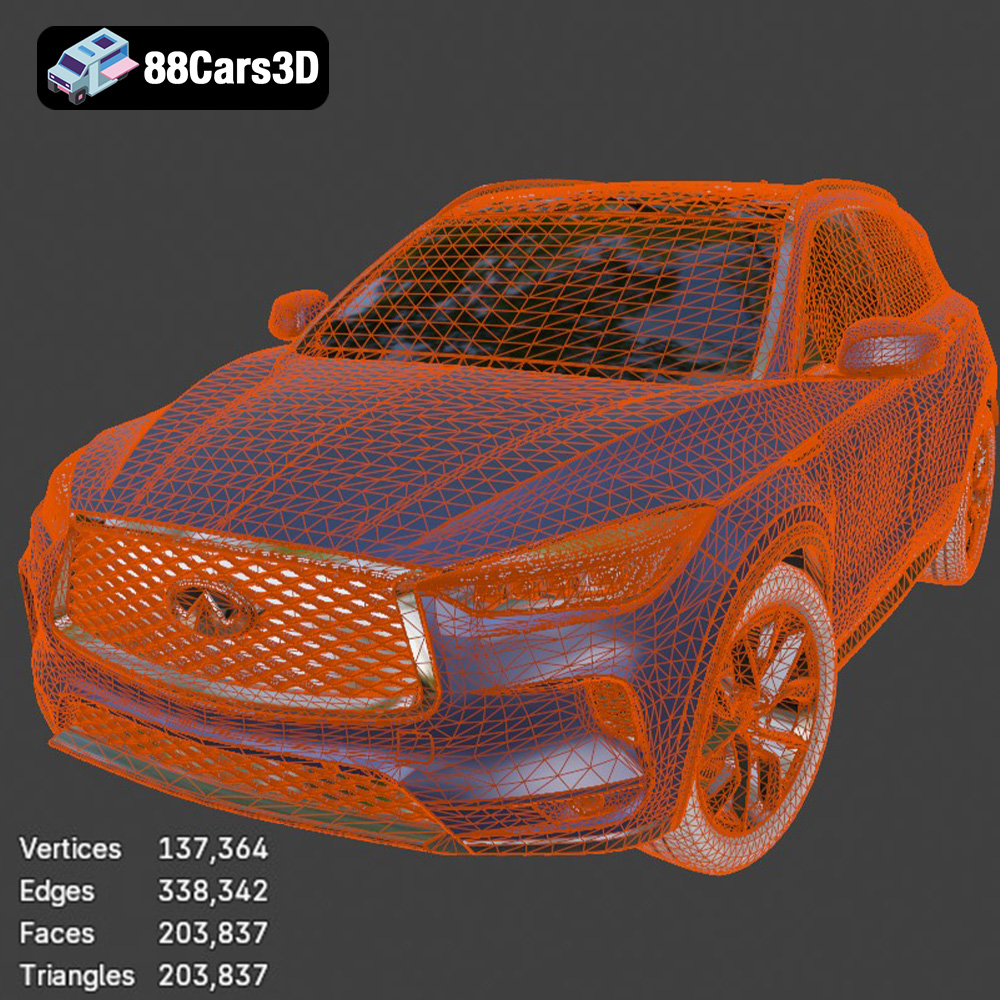
At the core of any high-quality 3D model is its geometry. The Infiniti QX50 2019 model boasts exceptionally clean geometry, meaning it avoids common issues like non-manifold edges, co-planar faces, or isolated vertices. More importantly, it features professional-grade topology. This refers to the intelligent arrangement of polygons (primarily quads) that define the mesh. Good topology ensures smooth subdivision for high-resolution rendering, facilitates clean deformations for animation, and provides efficient polygon distribution for real-time performance. This meticulous construction is vital for preventing shading artifacts and enabling seamless integration into various pipelines.
Beyond the mesh itself, realistic materials are what bring a model to life. The Infiniti QX50 2019 3D Model includes professional PBR (Physically Based Rendering) materials. These materials accurately simulate how light interacts with surfaces in the real world, accounting for properties like albedo (base color), metallicness, roughness, normal mapping, and ambient occlusion. This ensures the model performs outstandingly under varied lighting conditions, from soft studio lighting to harsh outdoor sun. Critical to these materials is well-executed UV mapping. The model features professional UV unwraps, meaning its 3D surfaces are efficiently flattened into 2D space without stretching or overlapping. This allows for precise texture application, making it easy to swap out paint colors, adjust reflections, or even apply custom decals while maintaining high visual integrity.
A single 3D model often needs to serve multiple masters – a high-poly version for cinematic rendering, and a low-poly version with LODs for real-time applications. While specific poly counts can vary per format, a premium model like the Infiniti QX50 2019 is designed with optimization in mind. For high-end rendering, the model provides enough detail to hold up under extreme close-ups. For game engines, developers can expect efficient polygon distribution that can be easily optimized further with built-in LOD systems or by using the various provided formats. This balance ensures that whether you’re aiming for absolute realism or fluid interactivity, the model provides a solid, optimized foundation.
High-quality 3D car models are not just digital art pieces; they are indispensable tools driving innovation across numerous industries. The versatility and precision of the Infiniti QX50 2019 3D Model make it suitable for a wide array of professional real-world applications.
Modern automotive marketing increasingly relies on stunning 3D renders and animations. Car manufacturers often produce promotional materials long before physical vehicles are available. With a model like the Infiniti QX50 2019, marketing teams can create photorealistic images and captivating video advertisements showcasing the vehicle’s features, interior, and exterior design in various environments – from cityscapes to rugged landscapes – without the need for expensive photoshoots or physical prototypes. This dramatically reduces costs and speeds up time-to-market for new models or redesigned vehicles. Imagine a virtual showroom experience where customers can explore every detail of the QX50’s interior and exterior, customized to their specifications, all powered by a high-fidelity 3D asset.
For game studios, realistic vehicles are essential for creating believable open worlds, racing simulations, and interactive experiences. The Infiniti QX50 2019 3D Model, with its game-engine ready formats like .fbx and .unreal, is a perfect asset for populating virtual cities, featuring in driving games, or even serving as a hero vehicle in narrative-driven titles. Beyond traditional gaming, models like this are crucial for developing immersive AR/VR applications. Architectural firms might use it to visualize how a luxury SUV would look parked in front of a proposed building, allowing clients to experience the scale and aesthetic in a truly interactive way. Educational simulations for driver training or urban planning can also leverage these detailed models for enhanced realism.
Architects and urban planners frequently incorporate vehicles into their visualizations to add realism, scale, and context to their projects. Placing a detailed 3D car model, such as the Infiniti QX50 2019, within an architectural render transforms a static image into a vibrant scene. It helps clients envision how a building or urban space will function in a real-world setting. For example, visualizing a new residential development with accurately scaled cars in driveways and parking lots provides a far more complete picture than an empty render. The model’s clean topology and realistic materials ensure it blends seamlessly into even the most high-end architectural renders, enhancing the overall presentation and adding a touch of luxury.
Selecting the ideal 3D model for your project is a critical decision that impacts workflow efficiency, visual quality, and overall project success. With a marketplace like 88cars3d.com, the focus is on providing high-quality 3D car models that meet professional standards across a spectrum of applications.
When evaluating 3D car models, prioritize quality and fidelity. Look for detailed descriptions that specify clean geometry, professional topology, and PBR materials – all hallmarks of a premium asset. The Infiniti QX50 2019 3D Model, for instance, explicitly states its meticulous attention to detail and construction to meet strict industry standards. This level of transparency ensures you’re investing in an asset that won’t cause headaches with broken meshes or unrealistic shaders down the line. High fidelity means the model accurately reflects its real-world counterpart, crucial for photorealistic rendering and believable simulations.
The versatility of a 3D model is often defined by the range of file formats it supports. As discussed earlier, different formats cater to specific software and pipelines. A model like the Infiniti QX50 2019, which includes .blend, .fbx, .obj, .glb, .stl, .ply, .unreal, and .max, offers unparalleled flexibility. This extensive support means you’re not locked into a single software or workflow. Whether you’re a 3ds Max user needing an editable project file, a game developer requiring an Unreal-ready asset, or an AR/VR creator looking for an optimized .glb, having these options readily available saves significant time and effort in conversion and preparation.
Before purchasing, clearly define your primary usage scenario. Are you focused on high-end cinematic rendering where polygon count is less of an issue than material accuracy? Or are you building a real-time game environment where poly count, optimized UVs, and LODs are paramount? For 3D printing, an .stl format is essential. The product description for the Infiniti QX50 2019 3D Model explicitly outlines its suitability for “advanced game development, creating photorealistic architectural renders, building immersive AR/VR experiences, or producing cinematic visual effects,” indicating its broad utility. By aligning the model’s capabilities with your project’s demands, you ensure a smooth workflow and a successful outcome. 88cars3d.com strives to provide detailed product information to help you make informed decisions, ensuring you get the perfect 3D car models for your specific needs.
The world of 3D modeling continues to push the boundaries of visual realism and interactive experiences. At the heart of this evolution are meticulously crafted 3D assets that serve as the building blocks for professional projects across diverse industries. From the intricacies of automotive rendering and visualization to the demanding requirements of game development and immersive AR/VR applications, the foundation of success lies in the quality and versatility of your digital models.
The Infiniti QX50 2019 3D Model stands as a prime example of such an asset. Its exceptional realism, clean geometry, professional topology, and inclusion of PBR materials ensure it performs outstandingly, whether you’re aiming for a photorealistic architectural render or a smooth, high-frame-rate game environment. By offering a comprehensive suite of file formats – including .blend, .fbx, .obj, .glb, .stl, .ply, .unreal, and .max – this model guarantees seamless integration into virtually any professional workflow. This commitment to quality and flexibility is what sets premium 3D car models apart, empowering creators to bring their most ambitious visions to life.
For designers, developers, and visualizers seeking reliable, visually striking, and technically sound 3D car models, exploring reputable marketplaces like 88cars3d.com is a crucial step. Investing in assets such as the Infiniti QX50 2019 3D Model not only streamlines your production process but elevates the overall quality and impact of your final output, proving that precision and realism truly make all the difference.
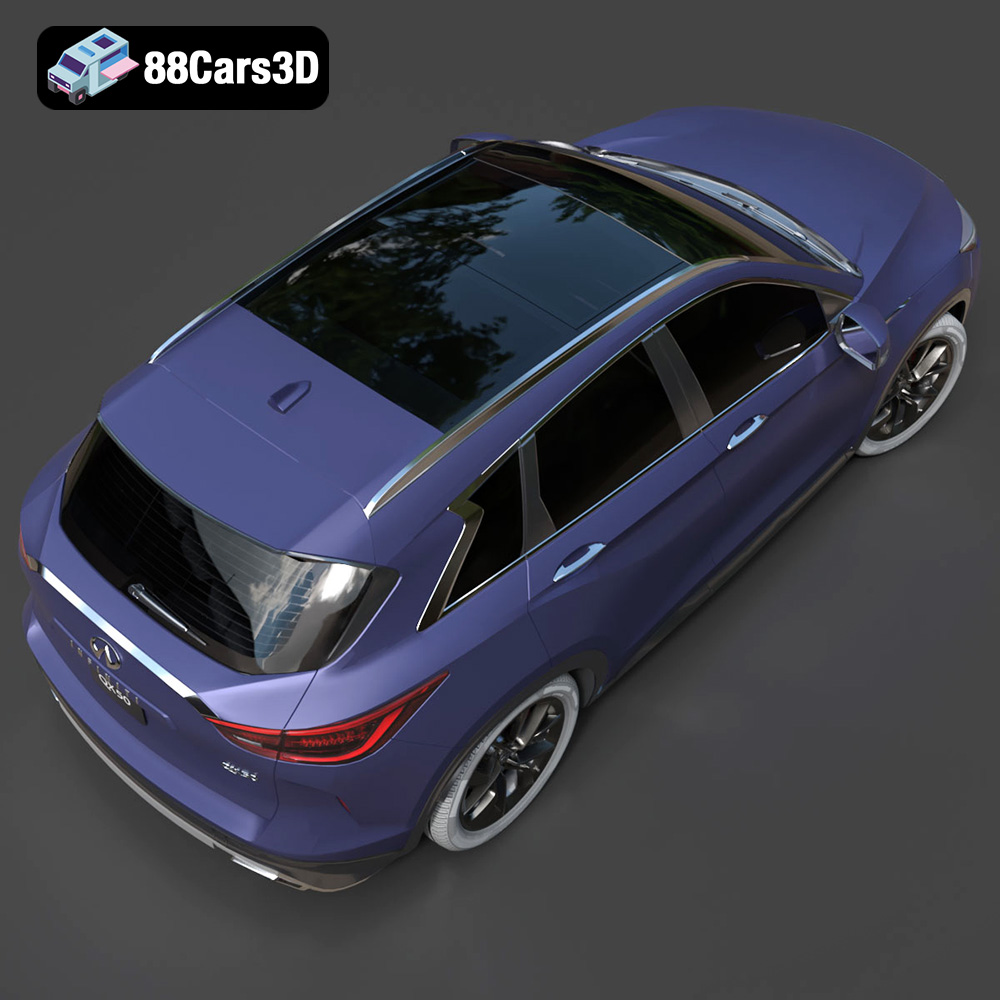
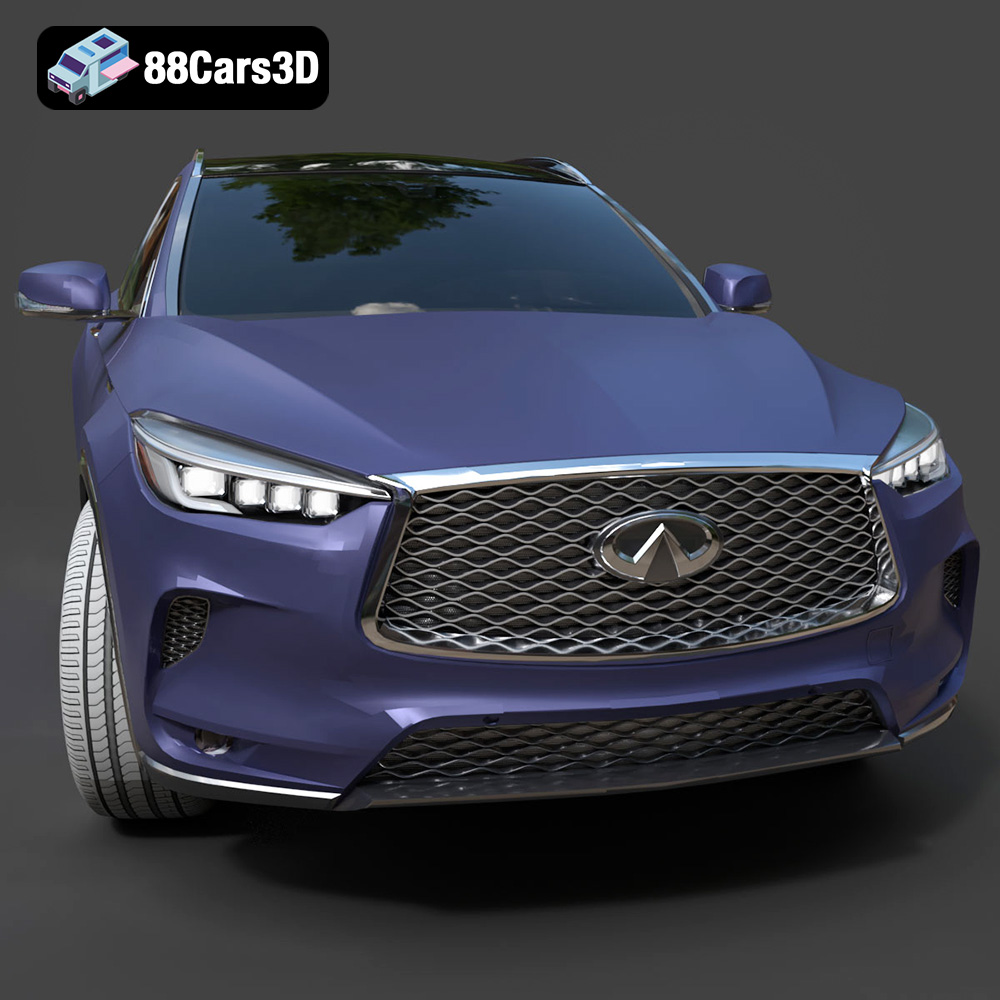
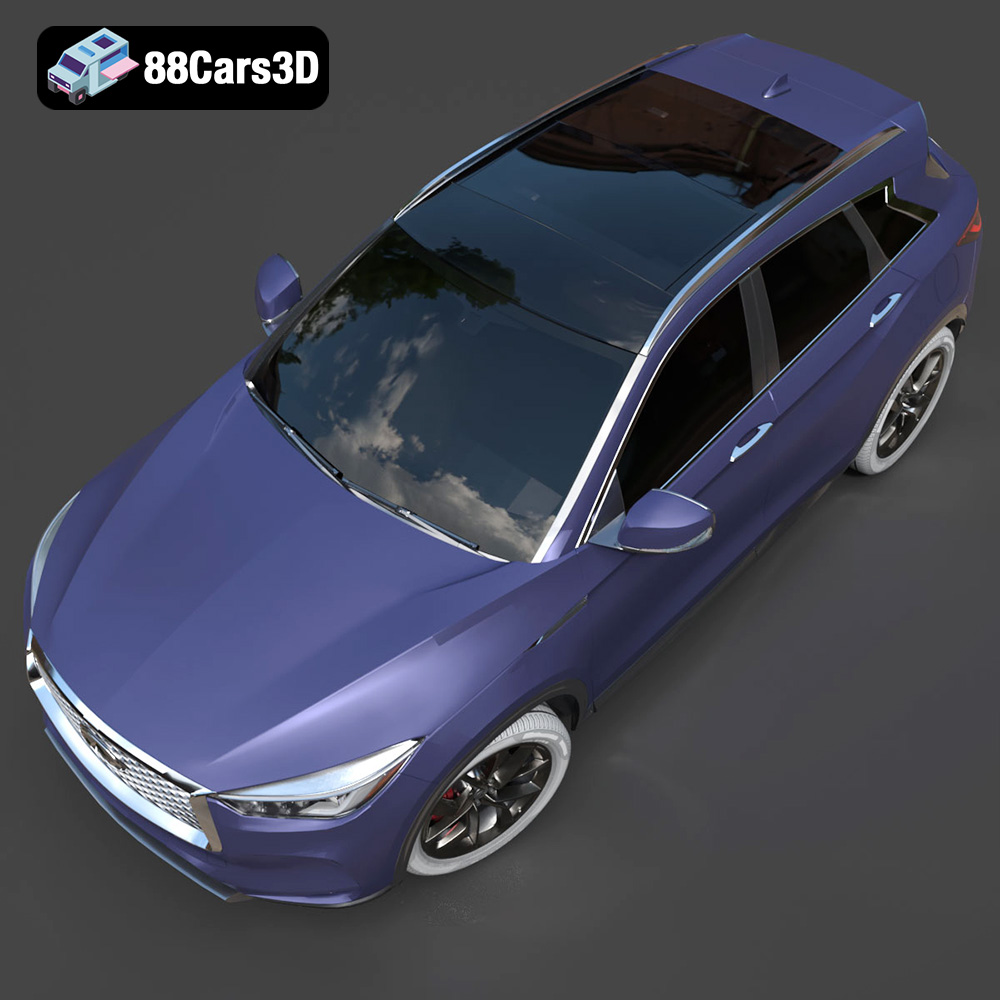
Discover the exceptional realism and precision of the Infiniti QX50 2019 3D Model. Crafted with meticulous attention to detail, this premium digital asset accurately reflects the stunning aesthetics and sophisticated design of the renowned luxury crossover SUV. This model features exceptionally clean geometry, professional-grade topology, and realistic materials that ensure outstanding performance under varied lighting conditions. Every element, from its bold exterior curves to its fully modeled interior, has been constructed to meet the strictest industry standards for professional 3D design. Designed for unparalleled versatility, this 3D vehicle is ready to be integrated seamlessly into a wide range of professional applications. Whether you are working on advanced game development, creating photorealistic architectural renders, building immersive AR/VR experiences, or producing cinematic visual effects, this asset delivers reliable and visually striking results. Included File Formats: .blend, .fbx, .obj, .glb, .stl, .ply, .unreal, .max.
$19.99
.2019
.arvr
.blend
.car3dmodel
.crossover
.fbx
.gameasset
.glb
.infiniti
.max
.obj
.ply
.qx50
.rendering
.simulation
.stl
.unreal
SUV