Get 20% OFF All Premium 3D & STL Models!

In the dynamic world of 3D visualization, automotive design, and game development, the demand for high-quality, technically precise 3D car models is ever-present. From crafting immersive virtual realities to rendering breathtaking marketing visuals, the fidelity and versatility of these digital assets are paramount. Today, we’re taking a closer look at a prime example of such an asset: the Lexus RX350 2010 3D Model, a digital twin that perfectly embodies the luxury crossover SUV segment.
The 2010 Lexus RX350, in its physical form, defined an era of refined elegance and robust versatility, blending the ruggedness of an SUV with the smooth styling of a premium sedan. This iconic vehicle, showcasing Lexus’s signature L-finesse design philosophy, featured sweeping lines, a distinctive front grille, and an aerodynamic profile. Translating such an intricate piece of engineering into a digital asset requires meticulous attention to detail, optimization for diverse applications, and a deep understanding of professional 3D workflows. This specific 3D model, available on 88cars3d.com, is not just a visual representation; it’s a meticulously crafted tool engineered for performance, realism, and seamless integration into various pipelines.
Whether your goal is photorealistic automotive rendering, an engaging game environment, or an interactive AR/VR experience, understanding the technical underpinnings and practical applications of a high-quality 3D car model like the Lexus RX350 2010 is crucial. Let’s delve into the specific details that make this model an invaluable asset for professionals across industries.
Creating a compelling 3D model of a real-world vehicle like the Lexus RX350 2010 is an intricate blend of artistic interpretation and technical precision. It’s about more than just replicating shapes; it’s about capturing the essence, the engineering, and the tactile feel of the original. This particular model stands out due to its commitment to accuracy and its thoughtful optimization.
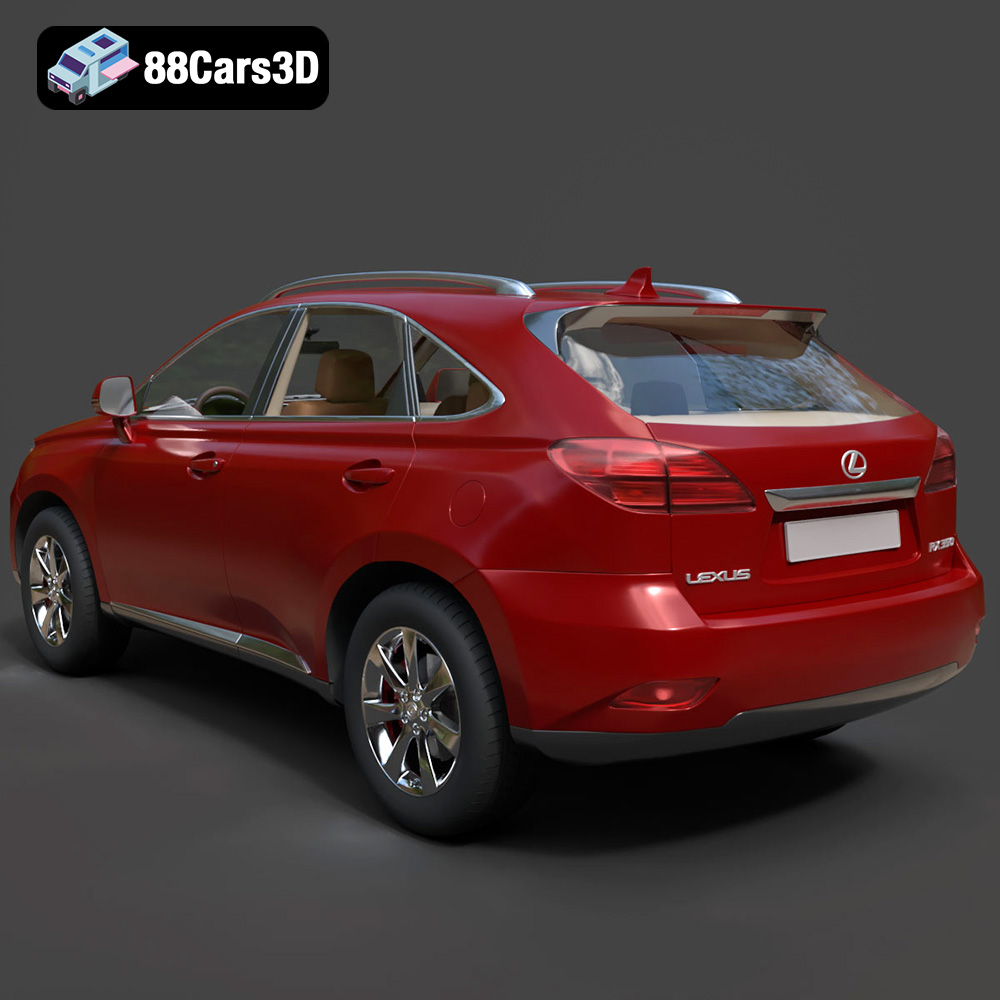
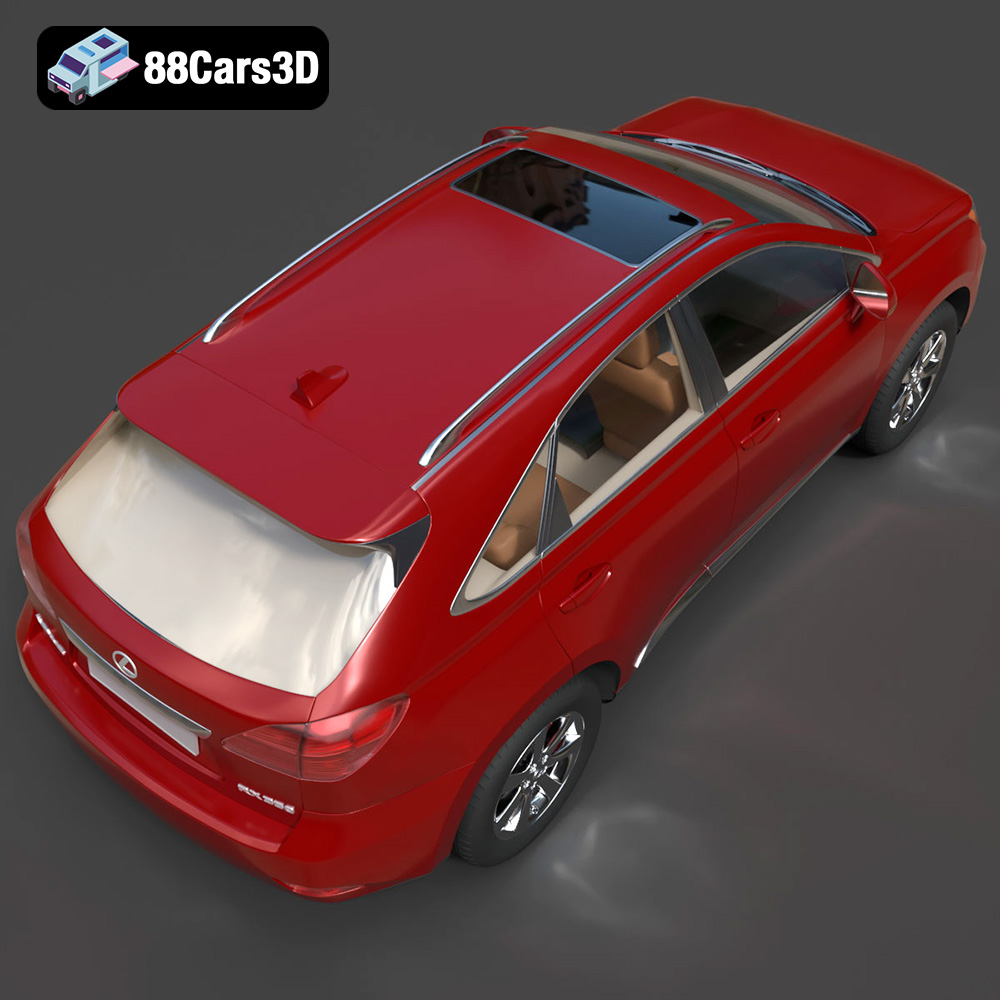
The Lexus RX350 2010 is characterized by its sophisticated L-finesse design, which emphasizes smooth transitions, bold lines, and an understated luxury. The 3D model meticulously recreates these elements. From the subtle curves of the body panels to the distinctive grille that anchors its front fascia, every detail is considered. The projector-beam headlamps and clear-lens LED taillights are not merely textures but modeled geometry, ensuring they catch light realistically in any rendering environment. The integrated dual exhaust outlets, complete with realistic chrome finishing, further enhance the visual fidelity, crucial for close-up shots or cinematic sequences. Even the alloy wheels are detailed with high-resolution tire tread patterns, contributing significantly to overall realism and ground contact.
Beyond the primary bodywork, the model includes a detailed V6 engine bay representation, a feature often overlooked in models optimized for real-time but vital for specific visualization projects or detailed showcases. This level of external fidelity ensures that the model holds up under intense scrutiny, from wide shots to focused hero renders, making it an excellent asset for automotive rendering and marketing campaigns.
The exterior is only half the story. For truly immersive applications like virtual showrooms, AR/VR experiences, or first-person game perspectives, a detailed interior is indispensable. The Lexus RX350 2010 3D Model delivers on this front with a meticulously crafted cockpit and interior. Plush leather-appointed seating details and luxury upholstery are rendered with careful attention to material properties. The multifunction steering wheel and precise steering column setup are accurately modeled, as is the detailed driver instrument cluster with realistic gauge placement.
The center console, a hub of interaction, features an infotainment screen, shifter, and control knobs, all modeled to provide a convincing experience. This optimized interior geometry is specifically tailored for first-person POV scenarios, meaning it looks great and performs efficiently in gaming and virtual reality environments without bogging down rendering performance. This comprehensive interior detailing is a testament to the model’s versatility, enabling users to create rich, interactive experiences that go beyond static visuals.
When working with 3D car models or any complex digital asset, selecting the correct file format is crucial for workflow efficiency, compatibility, and achieving desired results. The Lexus RX350 2010 3D Model, available on 88cars3d.com, comes with a comprehensive suite of file formats, each serving distinct purposes and catering to different software environments and applications. Understanding these formats is key to maximizing the utility of your purchase.
The .blend format is the native file type for Blender, the popular open-source 3D creation suite. When you receive a .blend file, you’re getting a fully editable Blender scene. This means all the original geometry, materials, textures, lighting, cameras, and even animation data (if present) are packaged within a single file. For users primarily working in Blender, this format offers the most flexibility. You can easily modify the mesh, adjust materials, rig components, or set up custom renders without any conversion overhead. It’s ideal for artists who want to delve deep into the model’s structure, make extensive edits, or integrate it into complex Blender projects.
.fbx (Filmbox) is arguably the most widely adopted proprietary 3D file format for exchanging data between various 3D applications and game engines. Developed by Autodesk, it excels at storing not just geometry, but also materials, textures, animations, skinning information, and even camera data. Its strength lies in its robustness and wide support, making it ideal for pipelines involving Unreal Engine, Unity, 3ds Max, Maya, and more. For game developers and those building real-time environments, .fbx is often the go-to choice due to its efficient handling of animation and hierarchical data, ensuring that components like separate wheels and suspension for the Lexus RX350 2010 retain their pivot points and parent-child relationships when imported.
The .obj (Wavefront OBJ) format is a simple, universal geometry definition file. It stores vertex positions, UV coordinates, normals, and face information. While it doesn’t typically embed animations or complex material nodes directly (it often references a separate .mtl file for basic material properties), its simplicity makes it highly compatible across virtually all 3D software. It’s an excellent choice when you primarily need the raw mesh data and plan to re-assign materials and textures within your target application. For artists seeking a clean mesh to start with, .obj offers a reliable foundation for cross-software compatibility.
.glb (GL Transmission Format Binary) is the binary version of glTF, a royalty-free specification for the efficient transmission and loading of 3D scenes and models by applications. It’s specifically optimized for AR, VR, and browser-based display, making it perfect for interactive web experiences, mobile AR applications, and digital product configurators. A .glb file packages geometry, materials, textures, and animation into a single compact file, ensuring fast loading times and efficient rendering on various devices. For the Lexus RX350 2010, this format would be ideal for creating an immersive virtual showroom on a website or a mobile AR app.
.stl (STereoLithography) is the most common file format used for 3D printing. It represents a 3D model as a series of connected triangles, describing only the surface geometry of an object without color, texture, or other CAD attributes. While not ideal for rendering or animation, its widespread adoption by 3D printing software makes it indispensable for bringing digital models into the physical world. The Lexus RX350 2010 3D Model, provided in .stl, allows hobbyists and professionals to physically manifest this detailed vehicle at various scales, leveraging the model’s robust topology for accurate physical reproduction.
The .ply (Polygon File Format, or Stanford Triangle Format) is primarily used for storing 3D data from 3D scanners, CAD applications, or scientific data visualization. It can store a wider range of properties than .obj, including color, transparency, surface normals, and even confidence values for scan data, making it useful for precision mesh applications, reverse engineering, or detailed analysis. For advanced users working with CAD or needing highly precise geometric data for manufacturing or analysis, the .ply format offers a robust solution for the Lexus RX350 2010 model.
The .unreal format signifies an asset specifically prepared and optimized for direct integration into Unreal Engine projects. This isn’t a standard public file format but rather an indication that the model has undergone the necessary setup within Unreal Engine itself. This typically means it has correct pivot points, collision meshes, LODs (Levels of Detail), materials, and potentially blueprints or animations already configured for the engine’s ecosystem. Using an .unreal-ready asset like the Lexus RX350 2010 significantly reduces setup time, allowing developers to drop the car directly into their scenes and begin working immediately with a functional, optimized asset.
Similar to .blend for Blender, .max is the native project file format for Autodesk 3ds Max, a leading software for 3D modeling, animation, and rendering in the architectural visualization and design industries. A .max file contains the complete scene data, including geometry, materials, textures, lighting, cameras, and animation keyframes. This format offers maximum flexibility for 3ds Max users, allowing them to fully interact with and modify the original scene, making it perfect for complex architectural visualization projects or high-end cinematic rendering where 3ds Max’s robust toolset is often preferred.
The inclusion of these diverse file formats for the Lexus RX350 2010 3D Model on 88cars3d.com underscores its adaptability and value, ensuring that professionals across various disciplines can seamlessly integrate and utilize this high-quality asset within their preferred software and pipelines.
The transition from high-poly concept models to production-ready assets, especially for real-time environments, demands a sophisticated balance between visual fidelity and performance efficiency. The Lexus RX350 2010 3D Model excels in this regard, engineered to meet the stringent demands of game development and interactive visualization.
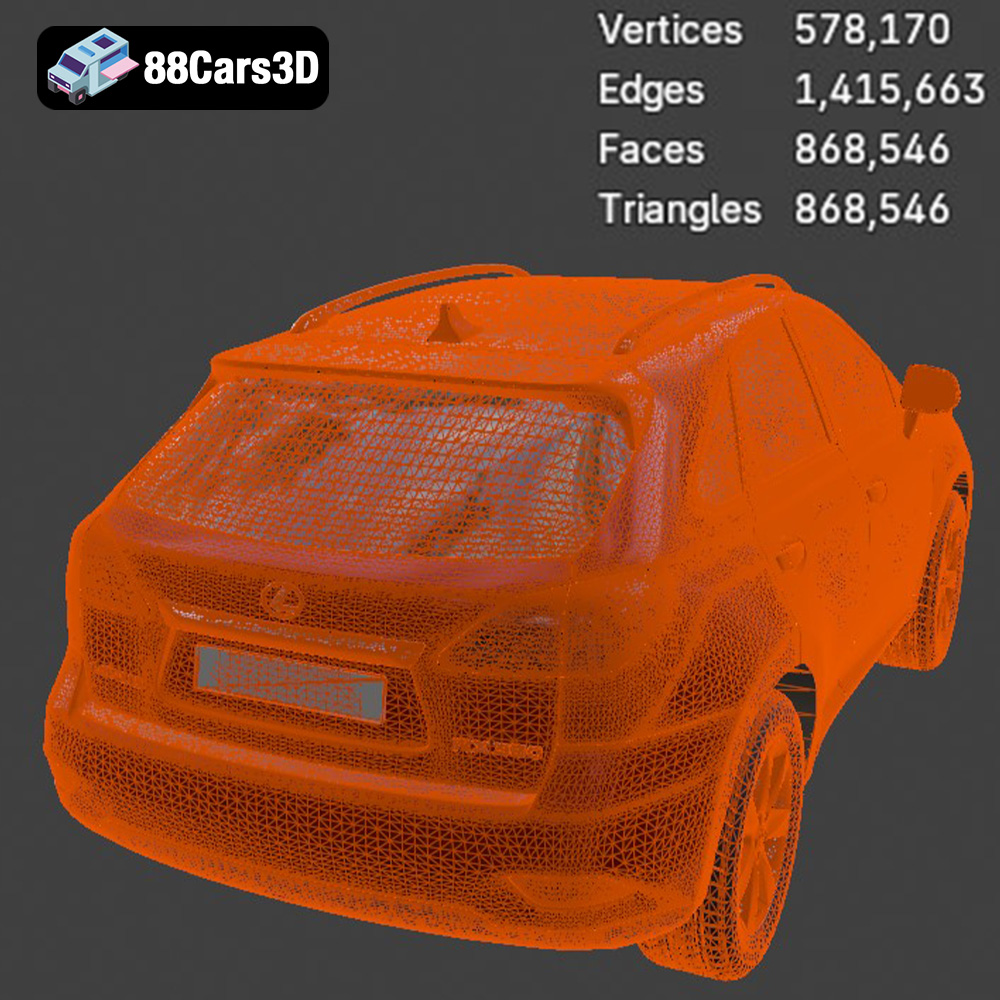
A critical technical specification of this model is its optimized topology of approximately 200,000 triangles. This polycount strikes an impressive balance, delivering high-end visual realism without compromising frame rates or rendering speeds in demanding real-time engines like Unreal and Unity. Achieving this involves careful polygon budgeting, strategic use of normal maps to convey fine surface details without adding actual geometry, and efficient UV mapping for texture application. For game assets, maintaining a consistent frame rate is paramount, and a judiciously optimized mesh ensures that the car model performs smoothly even when many instances are present in a scene or when viewed up close.
Furthermore, the model boasts real-world scale accuracy, based on actual vehicle chassis dimensions. This attention to scale is not just for aesthetic accuracy; it’s vital for physics simulations in games, accurate placement in architectural visualizations, and proper camera lensing in cinematic renders. Incorrect scale can lead to disproportionate interactions, unrealistic movement, or an uncanny valley effect in immersive experiences.
Beyond static representation, the Lexus RX350 2010 3D Model is designed for dynamic interactions. It features a proper pivot setup for steering, wheel rotation, and suspension travel. This is crucial for any interactive application or animation sequence where the vehicle needs to move realistically. The separate wheels, suspension, and steering components mean that animators and game developers can easily rig and animate these parts independently, simulating bumps, turns, and other real-world physics accurately. This modularity not only simplifies the animation process but also enables complex vehicle dynamics to be implemented efficiently within game engines, making it an invaluable asset for racing titles, open-world games, and vehicle simulators.
The true value of a versatile 3D asset lies in its seamless integration into various professional pipelines. The Lexus RX350 2010 3D Model is designed with this in mind, providing compatibility with major 3D software and real-time rendering engines.
For game developers and real-time visualization artists, the .fbx and .unreal formats are game-changers. Importing the Lexus RX350 2010 into Unreal Engine or Unity is a straightforward process. The optimized polycount and proper pivot setups mean less time spent on optimization and more on creative implementation. Developers can easily set up physically based rendering (PBR) materials using textures provided or by creating new ones, leveraging the engine’s advanced lighting capabilities for stunning visual results. For automotive rendering within a real-time context, this allows for dynamic lighting changes, interactive paint shaders, and real-time reflections, perfect for virtual configurators or interactive product showcases. The game-ready nature of this asset from 88cars3d.com significantly accelerates development cycles.
Architectural visualization (ArchViz) often requires realistic vehicle assets to populate scenes and provide a sense of scale and lifestyle. The .max, .blend, and .obj formats make the Lexus RX350 2010 an excellent choice for ArchViz artists. In 3ds Max, for instance, artists can import the .max file, easily integrate it into complex scene compositions, and then leverage powerful rendering engines like V-Ray or Corona Renderer. The detailed exterior and interior allow for close-up shots of the vehicle parked in a driveway or integrated into an urban street scene. Similarly, Blender users can utilize the .blend file, set up Cycles or Eevee renders, and benefit from the model’s clean topology and detailed features to create photorealistic images. The ability to modify body colors and material finishes offers immense creative control to match any architectural aesthetic.
The immersive capabilities of AR/VR are constantly expanding, and high-quality 3D car models are central to this evolution. The .glb format, specifically optimized for web, AR, and VR, makes the Lexus RX350 2010 ideal for creating virtual showrooms or interactive configurators. Users can explore the vehicle in a virtual space, walk around it, step inside, and even change its color or wheel options in real-time. For mobile AR experiences, the optimized geometry ensures smooth performance on smartphones and tablets, allowing users to place a virtual Lexus RX350 in their driveway or living room. This bridges the gap between digital representation and tangible interaction, offering a powerful tool for marketing and sales.
The utility of a robust 3D model extends far beyond digital screens. The Lexus RX350 2010 3D Model’s inclusion of the .stl format opens up avenues for physical creation, while its inherent design allows for extensive digital customization.
For hobbyists, collectors, or designers requiring a physical prototype, the .stl format provided is invaluable. The detailed product description includes specific 3D print settings, which is a significant advantage. Recommended scales (1:12, 1:18, 1:24) ensure that the model can be printed at a practical size while retaining detail. The advice to use resin printing for fine details and specific layer heights (0.04–0.12 mm) guides users towards optimal results. Furthermore, critical details like wall thickness, infill recommendations, and the necessity of supports for delicate parts (mirrors, exhaust, undercarriage) are clearly outlined. Even print orientation is addressed, with the frame printed angled for structural integrity and wheels separately. This level of guidance simplifies the process of transforming the digital Lexus RX350 2010 into a tangible, display-scale model, ready for post-processing, painting, and authentic finishing.
The Lexus RX350 2010 3D Model offers significant customization options within its digital format. Artists can easily change body colors to match specific branding or personal preferences, from classic Starfire Pearl or Obsidian to custom wraps. Modifying tire textures to represent all-season versus winter variants adds another layer of realism and context. Adjusting material finishes—whether to achieve a matte, gloss, or metallic effect—allows for endless creative exploration. The adaptability of lighting for different environments further enhances its versatility. This flexibility ensures that the model isn’t just a static representation but a dynamic canvas for creative expression, making it a powerful tool for branding, advertising, and artistic projects.
To illustrate the practical impact of such a high-quality 3D car model, consider these real-world scenarios:
Imagine a new car launch. Instead of just static images, a virtual dealership powered by an optimized model like the Lexus RX350 2010 allows potential buyers to explore every angle, open doors, change colors, and even “sit” inside through VR. This interactive experience, whether on a website (using .glb) or a dedicated VR app (using .fbx or .unreal), provides a deeper level of engagement and brand immersion that traditional media cannot match. High-fidelity automotive rendering showcasing the car in various environments can also be generated for marketing materials, ensuring consistent visual quality across all platforms.
For commercials, films, or even architectural fly-throughs, a detailed 3D car model is indispensable. A film studio could use the Lexus RX350 2010 3D Model to populate a virtual city street, create dynamic chase scenes, or render a pristine car beauty shot without the logistical complexities and costs of physical vehicles. The animation-ready components (separate wheels, suspension) are crucial here, allowing for realistic driving sequences, dramatic braking, and subtle suspension shifts that elevate the visual storytelling. Workflows in 3ds Max or Blender, leveraging advanced renderers, would bring these scenes to life with unparalleled realism.
Game developers creating open-world environments or realistic driving simulators require vehicle assets that are both visually appealing and performant. The ~200k triangle count of the Lexus RX350 2010 is perfectly suited for this. Its optimized topology ensures multiple vehicles can be rendered simultaneously without performance dips. Proper pivot setups and separate components facilitate realistic physics integration, allowing players to experience believable handling, suspension, and collisions. This model provides a robust foundation for building engaging and believable virtual worlds where the automotive elements feel truly authentic.
The Lexus RX350 2010 3D Model stands as a testament to what meticulously crafted 3D car models can achieve in today’s demanding digital landscape. From its accurate recreation of the luxury SUV’s elegant design and detailed interior to its game-ready optimization and extensive file format support, this asset is built for versatility and performance.
Whether you are an architect visualizing a luxurious property, a game developer populating an urban landscape, an AR/VR designer creating immersive experiences, or a product marketer seeking stunning automotive rendering, the technical prowess and thoughtful design of this model make it an invaluable tool. It simplifies complex workflows, accelerates production, and provides a foundation for creating visually stunning and technically sound projects.
Investing in high-quality 3D assets like the Lexus RX350 2010 3D Model from reputable sources like 88cars3d.com is not just about acquiring a digital file; it’s about empowering your creative process with precision-engineered tools that unlock new possibilities across all facets of 3D visualization and interaction. Explore this model and elevate your next project to new levels of realism and immersion.
The Lexus RX350 2010 is a definitive representation of the luxury crossover SUV segment, bringing together refined elegance, advanced comfort, and robust versatility. Showcasing Lexus’s signature L-finesse design philosophy, this model features sweeping lines, a distinctive front grille, and an aerodynamic profile that masterfully blends the ruggedness of an SUV with the smooth styling of a premium sedan. This 3D model is meticulously crafted to deliver exceptional visual fidelity while maintaining an optimized topology of approximately 200k triangles. Engineered for game-ready performance, it is perfectly suited for real-time applications such as game development, AR/VR experiences, and high-end automotive visualization without compromising on frame rates or rendering speeds. Perfect for urban driving simulations, luxury lifestyle architectural visualizations, virtual dealership showrooms, and cinematic renders.
$19.99
.2010
.blend
.crossover
.fbx
.glb
.lexus
.luxury suv
.max
.obj
.ply
.rendering
.stl
.unreal
car-3d-model
game asset
game-ready
low-poly
optimized
rx350
SUV
vehicle-3d-model
VR/AR