Get 20% OFF All Premium 3D & STL Models!

In the demanding world of 3D visualization, the quest for highly detailed, performant, and versatile assets is constant. Whether you’re crafting a hyper-realistic military simulation, an immersive AR/VR experience, or a cinematic masterpiece, the quality of your 3D models forms the bedrock of your project’s success. This is particularly true for complex machinery like aircraft, where precision and optimization must go hand-in-hand. Today, we delve into an exemplary asset that meets these rigorous standards: the Mil Mi-8MT Helicopter 3D Model.
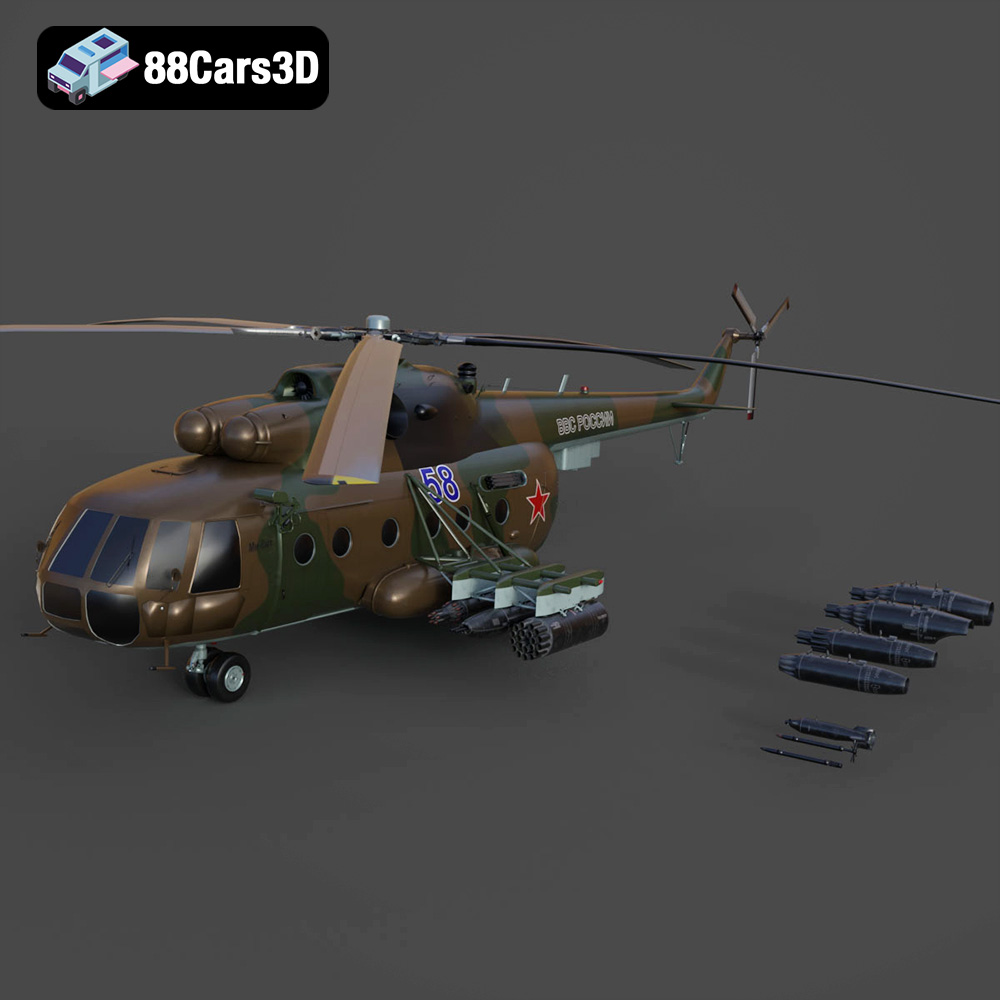
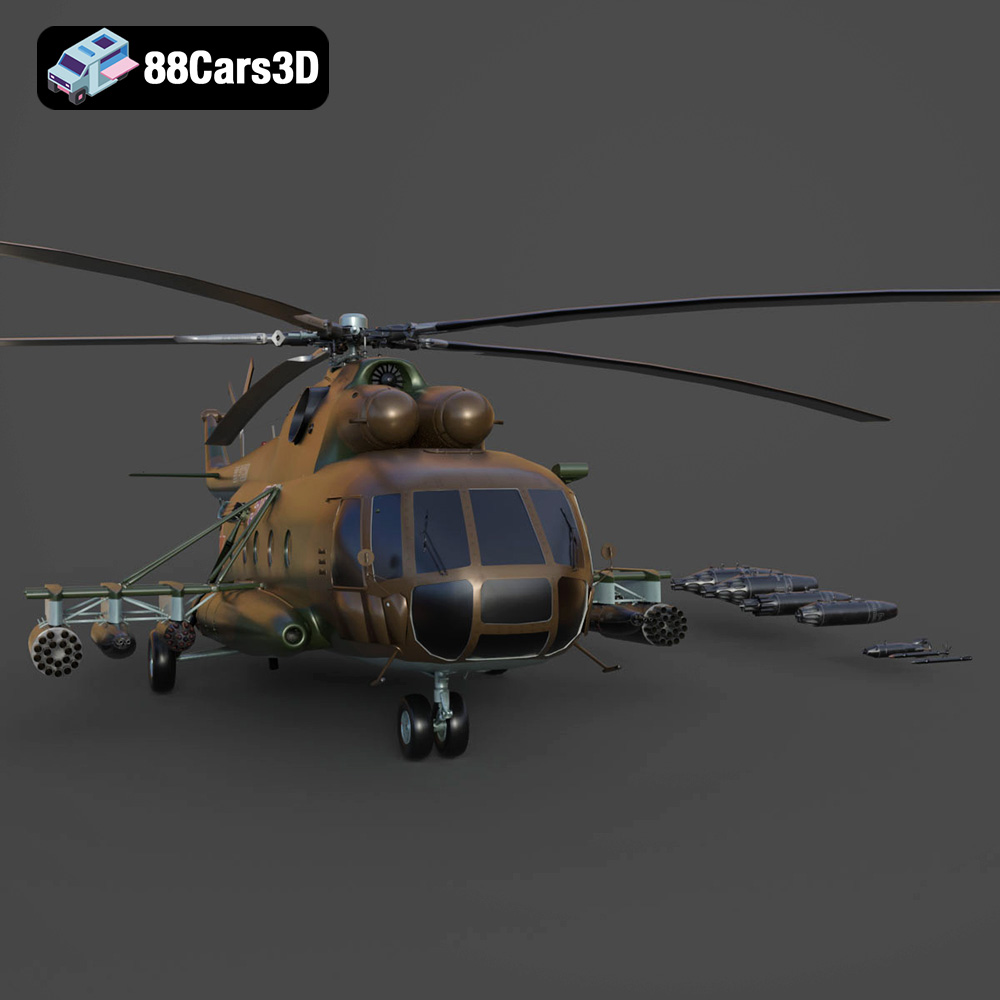
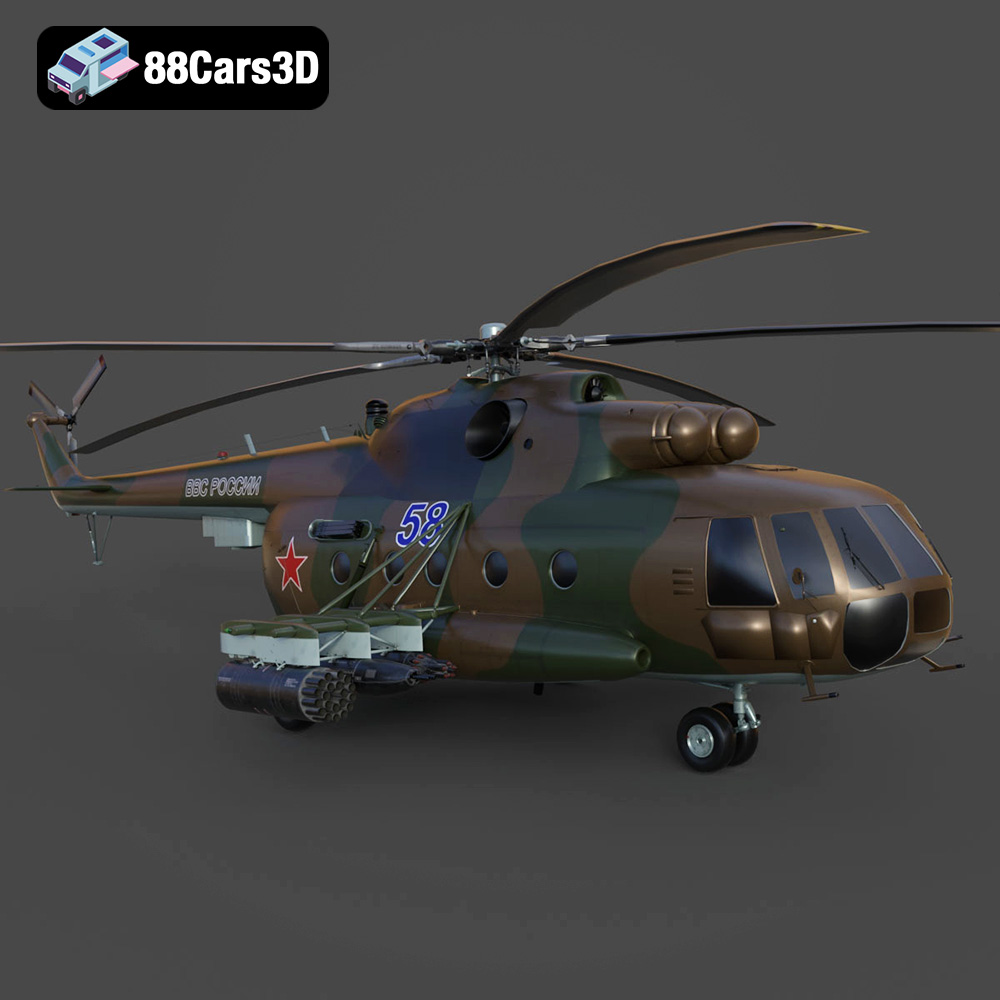
The Mil Mi-8MT, a legendary medium twin-turbine transport helicopter, boasts a formidable presence in the real world, known for its ruggedness and versatility across countless military and civilian operations. Translating such an iconic machine into a digital asset requires meticulous attention to detail and a deep understanding of 3D modeling principles. This particular 3D model captures the essence of the Mi-8MT with exceptional topological flow and a balanced ~120,000 triangle count, making it a true game-changer for professionals. From its distinctive top-mounted TV3-117MT turboshaft engines to its intricate exhaust system and five-blade main rotor, every element has been carefully reconstructed to deliver top-tier performance for game development, AR/VR simulations, animation, and high-end cinematic visualization.
This article will explore the technical advantages, diverse applications, and workflow integrations facilitated by such a high-caliber asset, demonstrating how it can elevate your projects across various industries. We’ll look at the importance of file formats, the level of detail, optimization strategies, and even how to prepare it for 3D printing. If you’re serious about high-quality 3D assets, understanding the nuances of models like this Mil Mi-8MT is crucial.
When acquiring 3D models, especially complex ones like the Mil Mi-8MT helicopter, understanding the various file formats included is paramount. Each format serves a specific purpose, catering to different software, workflows, and end applications. The Mil Mi-8MT Helicopter 3D Model comes packed with a comprehensive set of formats, ensuring maximum compatibility and flexibility for any professional pipeline. Let’s break down these essential formats:
The .blend format is the native file type for Blender, a powerful open-source 3D creation suite. When you download a .blend file, you’re getting a complete Blender scene, often including the original mesh data, materials, textures, lighting setups, cameras, and sometimes even animation rigs. This offers the highest level of editability, allowing artists to dissect the model, understand its construction, modify UVs, adjust materials, or even re-rig components. For the Mil Mi-8MT, the .blend file would provide full access to its meticulously crafted topology and material nodes, making it ideal for artists who use Blender as their primary DCC (Digital Content Creation) tool and require deep customization.
FBX (Filmbox) is a proprietary file format owned by Autodesk, widely recognized as the industry standard for interoperability between 3D software applications and game engines. It’s excellent for transferring models, textures, animations, and even basic rigging information. For real-time applications like Unreal Engine and Unity, .fbx is often the go-to format due to its robust support for game engine requirements, including embedded textures, proper scale, and hierarchical transformations. The Mil Mi-8MT as an .fbx asset is immediately ready for import into these engines, preserving its pivot points, material assignments, and overall structure, making it a truly game-ready asset.
OBJ (Object) is one of the oldest and most universally supported 3D file formats. It’s a simple, text-based format that defines geometry (vertices, normals, UVs, faces) and can reference external material (.mtl) files for basic shading information. While .obj typically doesn’t support animation or complex material setups like PBR (Physically Based Rendering) directly, its widespread compatibility makes it invaluable for cross-software transfers. If you need to bring the Mil Mi-8MT into an obscure rendering engine or a niche CAD program, .obj is your safest bet, ensuring the core geometry is preserved.
GLB (GL Transmission Format Binary) is the binary version of glTF, a royalty-free specification for 3D scenes and models. GLB is specifically designed for efficient transmission and loading of 3D content on the web and in AR/VR applications. It’s a self-contained format that bundles the model, textures, and animation into a single file, making it incredibly easy to integrate into web viewers, mobile AR experiences, and light VR setups. For the Mil Mi-8MT, a .glb file means it can be quickly deployed for immersive virtual hangars, training simulations, or even mobile AR showcases without extensive optimization or conversion.
STL (STereoLithography) is the most common file format for 3D printing. It represents a 3D model as a series of connected triangles (a triangulated surface mesh) without color, texture, or other advanced attributes. Its simplicity makes it ideal for defining the surface geometry that 3D printers understand. While the Mil Mi-8MT 3D model is highly detailed, converting it to .stl allows hobbyists and professionals alike to produce physical replicas at various scales. The product description provides recommended print settings, highlighting its practical application beyond digital screens.
PLY (Polygon File Format) is another format that stores 3D data, often used for scanned 3D objects. It can store a wider range of properties than .obj, including color, transparency, and even properties per vertex or face. While less common for general asset distribution, .ply is valuable in scientific, engineering, and CAD applications where precise mesh data and additional attributes are crucial for analysis or manufacturing processes. For the Mil Mi-8MT, a .ply version could be useful for specific reverse engineering, measurement, or high-precision simulation scenarios.
While not a traditional open format like FBX, the inclusion of an “.unreal” file or specifically prepared assets implies a direct integration or optimized package for Unreal Engine. This often means the asset has been properly scaled, had its materials set up with PBR shaders within Unreal, and potentially includes pre-configured blueprints or levels. For the Mil Mi-8MT, this signifies a streamlined workflow for Unreal Engine users, potentially saving hours of setup time and ensuring optimal performance within the engine’s real-time rendering environment.
Similar to .blend for Blender, .max is the native file format for Autodesk 3ds Max, a leading software for 3D modeling, animation, rendering, and compositing. A .max file provides full access to the original project, including mesh data, modifiers, materials (V-Ray, Corona, Arnold, etc.), lighting, cameras, and animation curves. For those utilizing 3ds Max for cinematic rendering or complex animation sequences, having the Mil Mi-8MT in its native .max format ensures maximum flexibility for integration into existing scenes, shader adjustments, or custom rigging.
The provision of this wide array of formats by 88cars3d.com underscores a commitment to flexibility and professional workflow integration, ensuring that the Mil Mi-8MT is a truly versatile asset, ready for any challenge you throw at it.
The true value of a premium 3D model lies in its ability to convincingly replicate real-world objects. The Mil Mi-8MT Helicopter 3D Model excels in this regard, offering a level of detail that satisfies both visual fidelity requirements and technical optimization needs. Every curve, panel line, and mechanical component has been meticulously crafted to ensure authenticity.
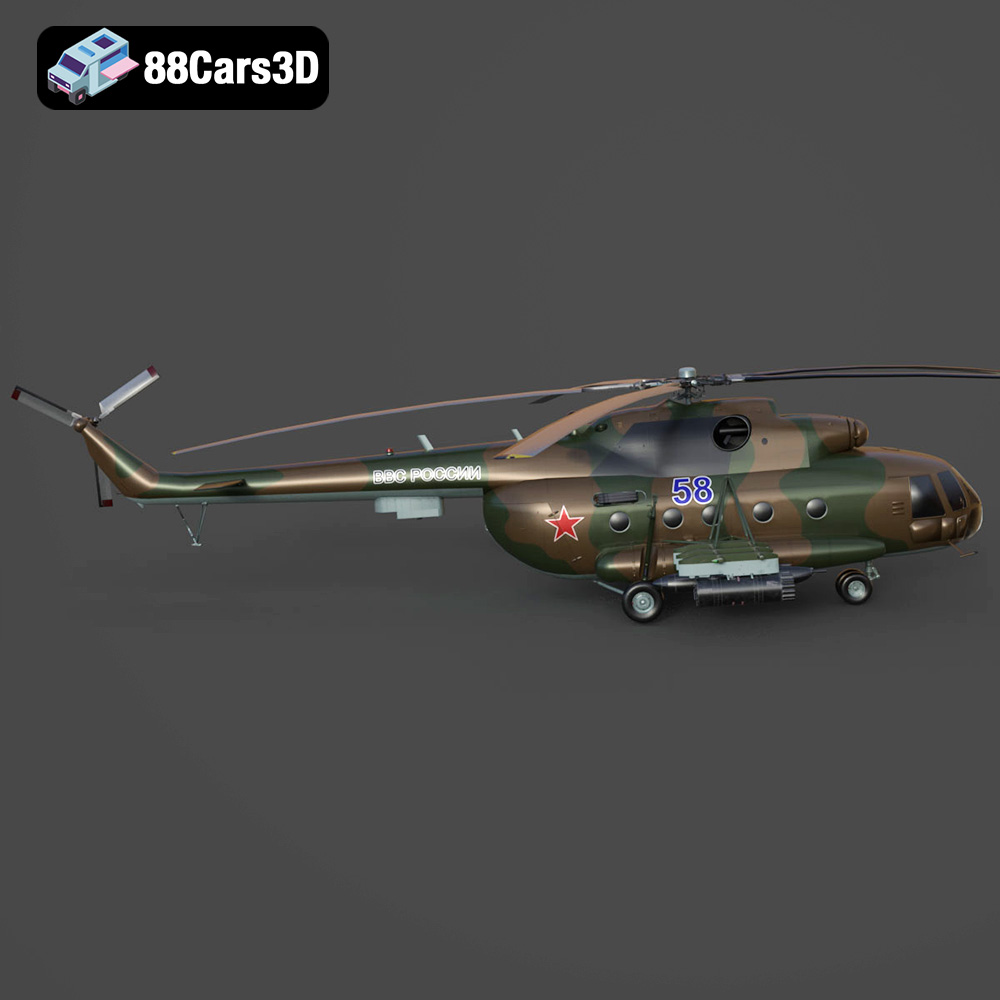
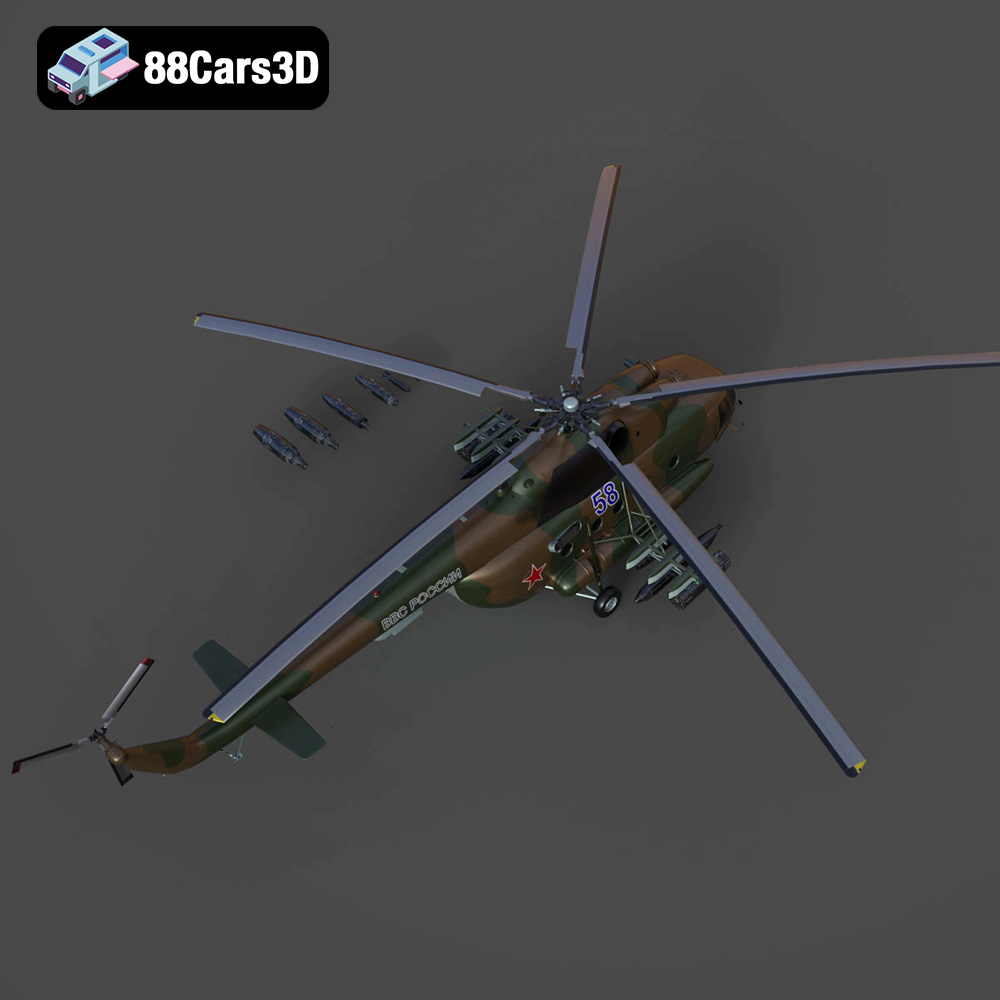
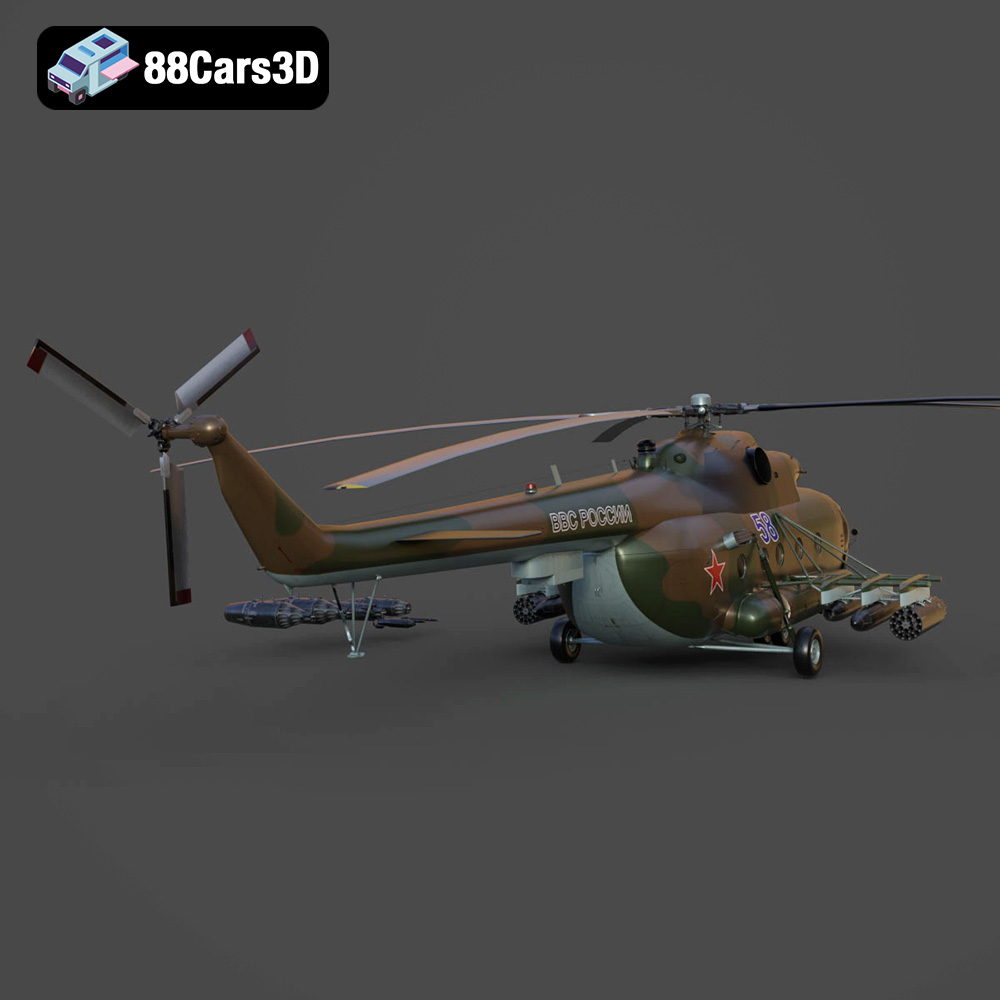
The exterior of the Mil Mi-8MT is immediately recognizable, and this 3D model captures its distinctive features with remarkable accuracy. The fuselage geometry and proportions are faithfully recreated, adhering to actual airframe blueprints. This isn’t just about looking good; accurate scale and geometry are crucial for realistic simulations, particularly in flight training or architectural visualization. The detailed TV3-117MT turboshaft engine housings, often a focal point on the real helicopter, are precisely modeled, including exhaust deflectors and ventilation grids. These small details contribute significantly to the overall realism, especially under close scrutiny or dynamic lighting conditions. Furthermore, the authentic navigation lights and exterior landing beacons are in place, ready to be animated for night operations. The landing gear is not merely a static element; it’s detailed with realistic tires and strut compression, allowing for believable ground interaction and suspension travel in animations. The heart of any helicopter – its rotors – are also given due attention, with a detailed five-blade main rotor and a three-blade tail rotor assembly. Crucially, separate rotor heads, doors, and landing gear components are provided, enabling seamless animation and individual control, which is indispensable for any professional animation or game development project.
Beyond the impressive exterior, the Mil Mi-8MT 3D model offers a rich and functional interior. The cockpit is a particular highlight, designed with an eye towards first-person perspective, making it ideal for flight simulators and immersive VR experiences. Detailed pilot and co-pilot seating with authentic harnesses are present, setting the scene for human interaction. The complex flight control systems, including the cyclic, collective, and anti-torque pedals, are accurately modeled, providing a realistic visual interface for virtual pilots. One of the most challenging aspects of cockpit modeling is the instrument panel, and this model delivers with an accurately mapped analog instrument cluster and overhead panels. Every switch, lever, and avionics bay is detailed, offering a level of realism that can significantly enhance immersion. This optimized geometry, tailored specifically for first-person POV, ensures that while the detail is high, performance remains excellent, avoiding unnecessary polygon overhead in areas not typically seen up close.
High detail is important, but without proper optimization, even the most beautiful 3D model can cripple a project. The Mil Mi-8MT Helicopter 3D Model achieves a remarkable balance between visual fidelity and performance, making it suitable for an extremely broad range of applications from real-time engines to high-fidelity cinematics.
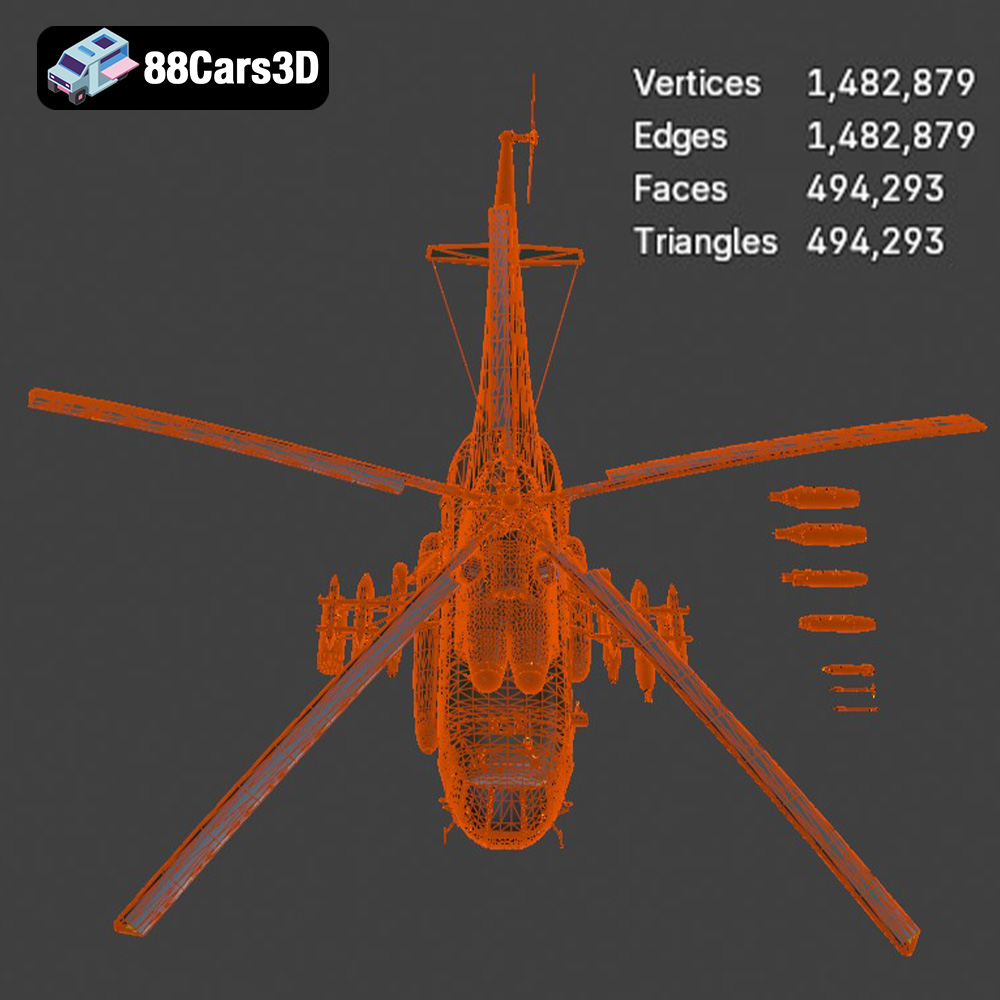
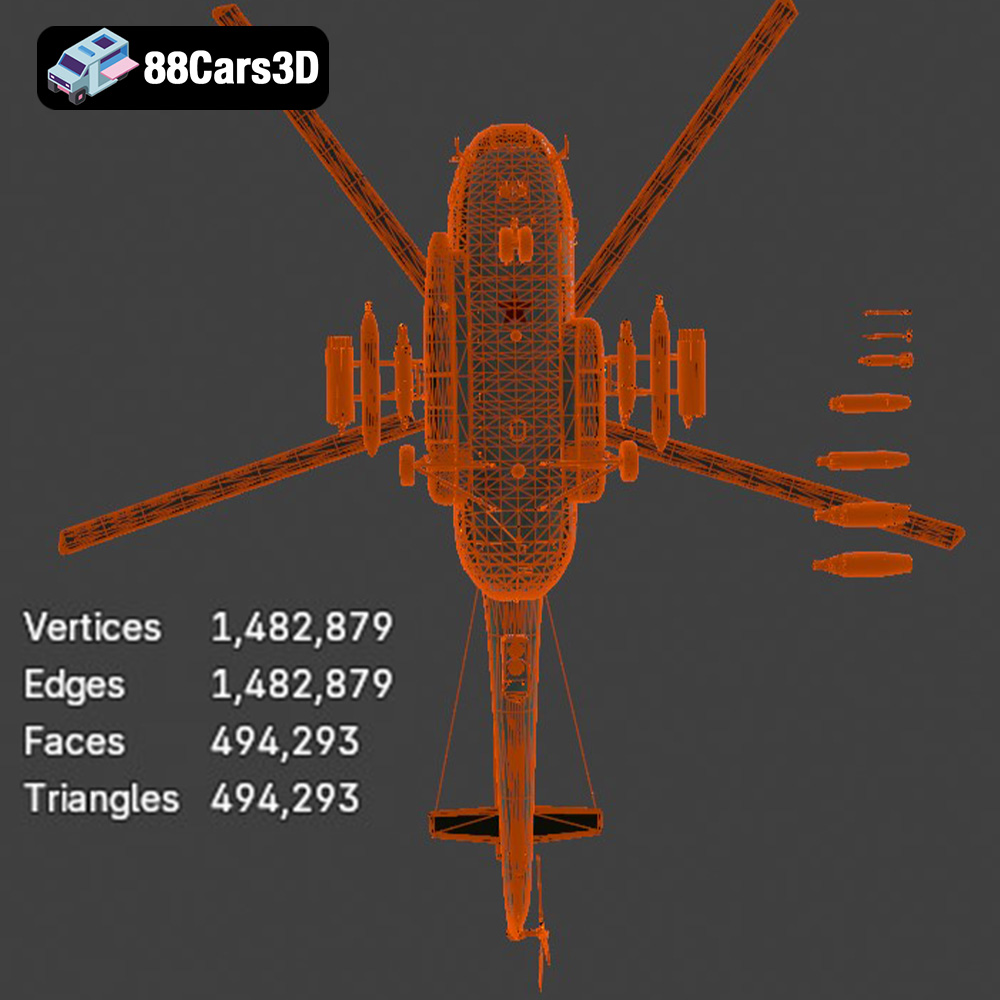
The cornerstone of this model’s technical advantage is its game-ready and optimized nature. With approximately 120,000 triangles, it strikes a perfect balance. For game developers working with demanding real-time engines like Unreal Engine and Unity, this polycount ensures smooth framerates without sacrificing the visual realism expected from a modern title. Many “high-poly” models can reach millions of triangles, rendering them unsuitable for interactive experiences without extensive decimation or retopology. This Mil Mi-8MT model bypasses that hurdle, providing a robust base that looks fantastic up close while maintaining performance at a distance. Furthermore, the model is built to real-world scale accuracy, based on actual airframe blueprints. This is not just a cosmetic feature; accurate scaling is vital for consistent integration into existing scenes, physics simulations, and realistic camera setups. Imagine placing this helicopter alongside other 3D car models or buildings from 88cars3d.com – the consistent scale ensures everything looks cohesive and believable.
Beyond its static beauty, this model is designed for dynamic interaction. Proper pivot setups are crucial for animation, and the Mil Mi-8MT includes them for key components. The main and tail rotor rotations are correctly configured, allowing for realistic spin animations. Door hinges are set up for seamless opening and closing, and the suspension travel for the landing gear can be animated to react to terrain or impact. This foresight in preparation saves animators and technical artists countless hours of setup time, allowing them to focus on creative storytelling rather than wrestling with asset preparation. For game development, these pre-configured pivots can directly translate into game engine animations and physics interactions. For cinematic rendering, it means less time spent preparing the asset and more time spent on perfecting the shot and overall scene.
The versatility of the Mil Mi-8MT Helicopter 3D Model is truly its defining characteristic. Engineered for diverse real-time and offline applications, its high quality and thoughtful optimization allow it to seamlessly integrate into various professional workflows, from the adrenaline-pumping world of video games to the immersive landscapes of virtual reality and the stunning visuals of cinematic productions.
For game developers, the Mil Mi-8MT Helicopter 3D Model is an ideal asset. Its optimized ~120,000 triangle count strikes the perfect balance for real-time engines like Unreal and Unity, ensuring exceptional visual fidelity without compromising frame rates. This makes it perfect for open-world games where performance is critical, combat flight simulators demanding accurate representation, and tactical shooters requiring detailed vehicles for immersion. Developers can easily integrate this model, animate its rotors, open its doors for troop deployment, and even simulate battle damage. The accurate cockpit geometry, optimized for first-person POV, means players can experience the thrill of piloting this legendary aircraft from a truly immersive perspective. Whether it’s a mission objective, a player-controlled vehicle, or part of a dynamic environment, this asset reduces development time and boosts visual quality right out of the box.
The burgeoning fields of Augmented Reality (AR) and Virtual Reality (VR) demand highly optimized, yet realistic, 3D models. The Mil Mi-8MT is perfect for immersive virtual hangars, allowing users to explore the helicopter up close in a VR environment, inspecting its engines, landing gear, and rotors as if it were physically present. For training simulations, particularly in military or aviation contexts, the accurate cockpit and exterior features provide an invaluable tool for familiarization and procedural training without the costs or risks associated with real-world equipment. Imagine a pilot-in-training walking around the virtual Mi-8MT, pointing out components, or even going through pre-flight checks within a VR environment. Its .glb format, optimized for AR/VR, ensures smooth performance on mobile AR experiences or dedicated VR headsets, opening up new possibilities for educational and operational applications.
When it comes to high-end cinematic rendering and visualization, the Mil Mi-8MT 3D model truly shines. Its detailed geometry, accurate proportions, and robust construction make it an excellent choice for military campaign art, dramatic cinematic flyovers, and studio lighting setups. Animators can leverage the properly set up pivots for rotors, doors, and landing gear to create dynamic and believable sequences. Picture a wide shot of the Mi-8MT sweeping over a landscape, its rotors blurring convincingly, or a close-up of its landing gear absorbing impact. With its full editability in .max and .blend formats, artists have the freedom to craft custom materials, add complex particle effects for dust and exhaust, and integrate it into highly detailed environments. The quality of this asset provides a solid foundation for achieving photo-realistic results, making it suitable for commercials, film pre-visualization, documentaries, and marketing materials that demand the highest visual standards.
The utility of high-quality 3D assets extends beyond purely digital realms. For hobbyists, collectors, and even professional designers, the ability to transform a digital model into a tangible object through 3D printing is a significant advantage. The Mil Mi-8MT Helicopter 3D Model is designed with this versatility in mind, offering conversion to .stl format, making it suitable for creating physical replicas.
When preparing the Mil Mi-8MT for 3D printing, scale is one of the first and most critical decisions. The product recommends scales of 1:35, 1:48, or 1:72, which are standard for military vehicle models, allowing for easy integration with existing model collections. These scales balance detail retention with manageable print times and material usage. For optimal results, especially for fine details like antennas, rotor blades, and cockpit intricacies, resin printing is highly recommended over FDM (Fused Deposition Modeling). Resin printers (SLA/DLP/LCD) offer significantly higher resolution and smoother surfaces, which are essential for capturing the nuances of the helicopter’s design. FDM printers can work for larger, less detailed parts, but will require more post-processing to achieve a smooth finish.
Technical parameters are also important: a layer height between 0.04–0.12 mm for resin ensures excellent detail. Wall thickness should be between 1.2–2.0 mm to provide structural integrity to printed parts, preventing fragility. An infill of 20–30% is typically sufficient to provide strength without excessive material use, but for load-bearing or extremely delicate parts, a higher infill or even solid print might be considered.
3D printing is often just the first step. For a model as detailed as the Mil Mi-8MT, post-processing is where the model truly comes to life. Supports are almost certainly required for intricate parts like the rotors, landing gear, and small exterior antennas. Strategic print orientation, such as printing the fuselage angled, helps maintain structural integrity and minimize support marks in visible areas. Once printed and supports are removed, sanding is often necessary to smooth out layer lines (especially for FDM prints) or nubs left by supports. Applying a primer creates a uniform surface for painting and helps reveal any remaining imperfections.
The real fun begins with customization. The Mil Mi-8MT offers immense potential for finishes: applying authentic military camouflage patterns, a pristine UN white livery for peacekeeping operations, or a civilian transport scheme. Weathering effects can be added to simulate a battle-damaged veteran or a well-used workhorse. The ability to bring these digital creations from 88cars3d.com into the physical world adds another layer of value, bridging the gap between virtual and tangible artistry.
Beyond its inherent quality, the Mil Mi-8MT Helicopter 3D Model offers significant customization opportunities and seamless integration into professional pipelines. The ability to modify and adapt assets is critical for any project, ensuring that the model fits specific creative visions and technical requirements.
The Mil Mi-8MT model provides robust foundations for personalization. Artists can easily change the fuselage livery, transforming it from a standard military camouflage to a distinct UN white, a vibrant civilian transport paint scheme, or even a custom fantasy design. This flexibility is invaluable for different narrative contexts or project themes. Furthermore, the model allows for modifications to texture wear and tear. You can render it as a factory-fresh helicopter, meticulously maintained, or depict it as battle-damaged, weathered by years of harsh operations. Adjusting material finishes—from matte military paint to glossy civilian surfaces or metallic accents—can dramatically alter its visual character. This level of control over textures and materials ensures that the helicopter can serve a wide range of aesthetic purposes, from a pristine museum piece to a gritty, operational vehicle. The included .blend and .max files provide the ideal environment for deep material editing, allowing artists to leverage advanced PBR workflows and custom shader networks.
The comprehensive set of included file formats (.blend, .fbx, .obj, .glb, .stl, .ply, .unreal, .max) makes the Mil Mi-8MT Helicopter 3D Model a universal asset. This versatility is key for studios and individual artists who work across multiple software platforms and game engines. For instance, an artist could use the .max file for high-fidelity rendering, then pass the .fbx to a game developer for Unreal Engine integration, and later convert it to .glb for an AR marketing campaign. This prevents the need for time-consuming format conversions or geometry adjustments, saving valuable production time and resources. As a high-quality game asset, its optimized polycount means it drops into engines like Unreal or Unity with minimal fuss, ready for immediate use. For companies like 88cars3d.com, providing such well-prepared and versatile 3D models means their customers can focus on creativity and project execution rather than asset preparation, whether they are working on new 3D car models or complex aircraft simulations. The professional-grade nature of this model significantly streamlines workflows, making it an indispensable tool for serious 3D professionals.
The Mil Mi-8MT Helicopter 3D Model stands as a testament to the power of meticulous 3D craftsmanship and thoughtful optimization. From its breathtaking exterior and interior detail to its robust technical specifications, this asset is built to excel across the most demanding professional applications. We’ve explored how its diverse file formats cater to every imaginable workflow, enabling seamless integration into game development, AR/VR simulations, cinematic rendering, and even physical 3D printing. Its balanced polycount ensures game-ready performance without compromising visual fidelity, while its animation-ready components unlock dynamic storytelling possibilities.
For anyone seeking to elevate their projects with a high-quality, versatile, and expertly optimized helicopter model, the Mil Mi-8MT is an exceptional choice. It’s more than just a model; it’s a foundation for creating immersive experiences, stunning visualizations, and impactful simulations. Exploring assets like this on platforms like 88cars3d.com gives you access to a world of meticulously crafted 3D models, whether you need 3D car models for an automotive advertisement or a military helicopter for a flight simulator. Invest in quality assets, and watch your creative visions take flight.
The Mil Mi-8MT is a legendary medium twin-turbine transport helicopter, renowned for its ruggedness, versatility, and widespread military and civilian use across the globe. This iconic rotorcraft features distinctive top-mounted TV3-117MT turboshaft engines, a robust airframe, an intricate exhaust system, and its recognizable five-blade main rotor. This high-quality 3D model boasts exceptional topological flow and a balanced ~120,000 triangle count, ensuring game-ready optimization without sacrificing visual fidelity. Engineered for diverse real-time and offline applications, it is built to deliver top-tier performance for game development, AR/VR simulations, animation, and high-end cinematic visualization. Perfect for military flight simulators, action-adventure game environments, cinematic rendering, and historical aviation visualizations.
$19.99
.blend
.fbx
.glb
.helicopter
.max
.obj
.ply
.rendering
.stl
.unreal
game asset
game-ready
helicopter-3d-model
low-poly
mi-8mt
mil
military-helicopter
optimized
transport-helicopter
VR/AR