Get 20% OFF All Premium 3D & STL Models!

In the rapidly evolving landscape of digital media, the demand for immersive and realistic content has never been higher. From blockbuster video games to cinematic automotive visualizations, and from augmented reality experiences to precision engineering simulations, the backbone of success lies in the quality of your 3D assets. Creating highly detailed, geometrically clean, and perfectly optimized 3D car models from scratch is a monumental task, demanding significant time, skill, and resources. This is where pre-fabricated, professional-grade models become an invaluable accelerator for any project.
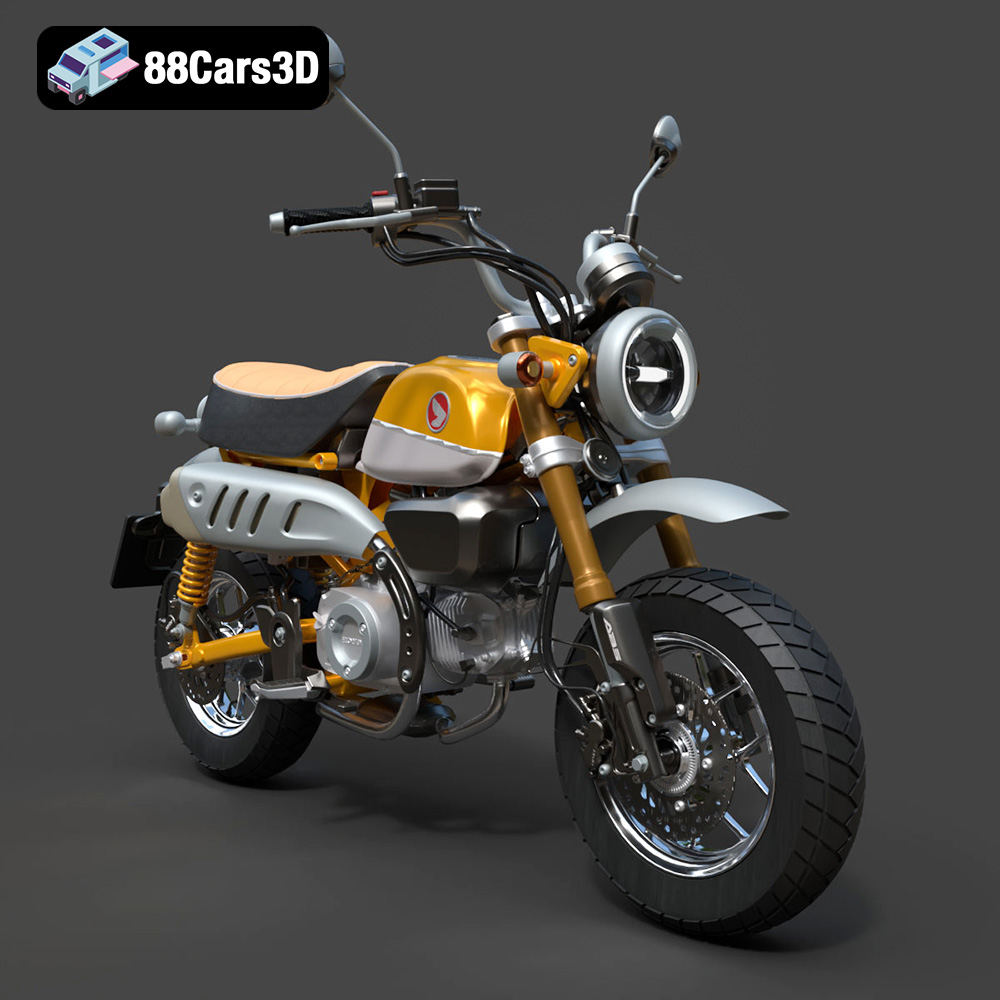
Imagine needing to bring the distinct charm and engineering prowess of a classic yet modern mini-bike into your next project. Rather than embarking on weeks of modeling, texturing, and rigging, you could seamlessly integrate a meticulously crafted asset. This article delves into the technical intricacies and professional applications of high-quality 3D models, showcasing how an asset like the Honda Monkey 125 2019 3D Model can revolutionize your workflow. We’ll explore everything from file formats to rendering pipelines, game engine integration, and even 3D printing, highlighting how such a versatile model serves as a cornerstone for diverse digital endeavors.
The journey of a 3D model, especially complex automotive rendering assets like the Honda Monkey 125 2019 3D Model, often involves multiple software packages and diverse end-use scenarios. Understanding the various file formats is paramount to ensuring compatibility, maintaining data integrity, and optimizing your workflow. Each format serves a specific purpose, offering unique advantages depending on whether you’re animating, rendering, developing for games, or even 3D printing.
The .blend format is native to Blender, the popular open-source 3D creation suite. A .blend file is more than just a mesh; it’s a complete scene package, containing all aspects of a project: models, textures, materials, lighting setups, cameras, animations, physics simulations, and even user interface layouts. For the Honda Monkey 125 2019 3D Model, this means you receive an immediately editable Blender scene, complete with pre-configured PBR materials and lighting that allows for instant high-quality rendering using Cycles or Eevee. It offers unparalleled flexibility for artists who want to tweak every parameter, re-animate components, or integrate the model into a larger Blender-native scene without any conversion losses.
.fbx (Filmbox) is a proprietary file format developed by Autodesk, widely recognized as the industry standard for interoperability between different 3D software applications and game engines like Unreal Engine and Unity. It’s excellent at preserving geometry, animation data (skeletal animation, morph targets), cameras, lights, and PBR material assignments during export and import. When you’re transitioning the Honda Monkey 125 3D model from a DCC (Digital Content Creation) application to a real-time environment, .fbx is often the go-to choice due to its robust support for crucial game asset features. Its ability to encapsulate complex hierarchies and animation curves makes it ideal for dynamic automotive scenes.
The .obj (Wavefront OBJ) format is one of the oldest and most widely supported 3D file formats. It’s a simple, text-based format primarily used for exchanging raw geometry data – vertices, normals, UV coordinates, and faces. While it doesn’t store animation or advanced material properties directly (materials are often referenced via an accompanying .mtl file), its universality ensures that virtually any 3D software can open and work with an .obj file. For the Honda Monkey 125, the .obj provides a clean, baseline mesh that can be imported into any application for fresh material setups or further modeling, making it incredibly versatile for cross-software compatibility.
.glb (GL Transmission Format Binary) is an increasingly vital format, especially for web-based 3D, augmented reality (AR), and virtual reality (VR) applications. It’s a binary version of the glTF format, designed for efficient transmission and loading of 3D scenes and models. A .glb file packs geometry, materials, textures, animations, and scene graph information into a single, self-contained file. Its optimization for real-time rendering and small file size makes it perfect for displaying the Honda Monkey 125 2019 3D Model interactively in a browser, integrating it into mobile AR experiences, or developing lightweight VR showrooms where performance is critical.
.stl (Stereolithography) is the de facto standard file format for 3D printing. It represents a 3D model as a series of connected triangles (a tessellated surface) without color, texture, or other advanced attributes. The primary characteristic of an .stl file is its geometric integrity, ensuring a manifold mesh suitable for physical fabrication. If you plan to 3D print a scale replica of the Honda Monkey 125 2019 3D Model for prototyping, collectibles, or educational purposes, the .stl format is precisely what you need to feed into your slicing software.
.ply (Polygon File Format or Stanford Triangle Format) is another format for storing 3D data, particularly useful for scanned data, CAD applications, and scientific visualization. It can store a wider range of properties than .obj or .stl, including color, transparency, surface normals, and even data reliability for each vertex. For highly detailed analysis or when precision mesh data is critical, perhaps for reverse engineering or integrating the Honda Monkey 125 into an engineering simulation, the .ply format offers robust data retention.
The .unreal format signifies an asset specifically packaged and pre-configured for direct import and optimal performance within Unreal Engine. This isn’t a universal interchange format but rather a streamlined pipeline for Unreal users. For the Honda Monkey 125 2019 3D Model, an .unreal file means materials, textures, collision meshes, LODs, and possibly even basic blueprints are already set up within an Unreal project structure, saving significant time and effort in the integration process. This dramatically accelerates development for game assets or real-time architectural visualization projects.
Finally, the .max format is the native file type for Autodesk 3ds Max, a leading software in architectural visualization, rendering, and animation. Like .blend, a .max file contains the complete scene, including geometry, materials (with complex V-Ray or Corona setups), lighting, cameras, animation, and modifiers. Having the Honda Monkey 125 2019 3D Model in .max format ensures that 3ds Max users can immediately access the original scene, make intricate modifications, and leverage advanced rendering features without any import-related issues or loss of fidelity, perfect for high-end cinematic rendering or product advertising.
Achieving photorealistic results in automotive rendering is an art form, demanding a meticulous approach to every element, from the smallest bolt to the broadest reflection. The pursuit of realism is what differentiates good renders from truly exceptional ones, and it’s heavily reliant on the quality of the base 3D car models you use. The Honda Monkey 125 2019 3D Model, with its “superior realism” and “exceptional detailing,” provides an excellent foundation for such endeavors.
Photorealism begins with precise geometry and extends through sophisticated material definitions and intelligent lighting. High-quality 3D car models, like those available on 88cars3d.com, ensure that the foundational mesh is accurate, clean, and optimized. This means having proper topology, consistent polygon density, and smooth surface normals, which are critical for reflections and refractions. For the Honda Monkey 125, this attention to detail captures the iconic essence of the real vehicle, ensuring every curve and component looks authentic.
Professional rendering studios often leverage a combination of powerful DCC applications and dedicated render engines. Two popular choices, each with their own strengths, are 3ds Max and Blender.
Game development presents a unique set of challenges for 3D assets, primarily focused on performance and interactivity. While visual fidelity is crucial, it must be balanced with strict optimization requirements to ensure smooth frame rates in real-time environments. A game-ready asset like the Honda Monkey 125 2019 3D Model is invaluable for game developers, providing a head start on asset integration.
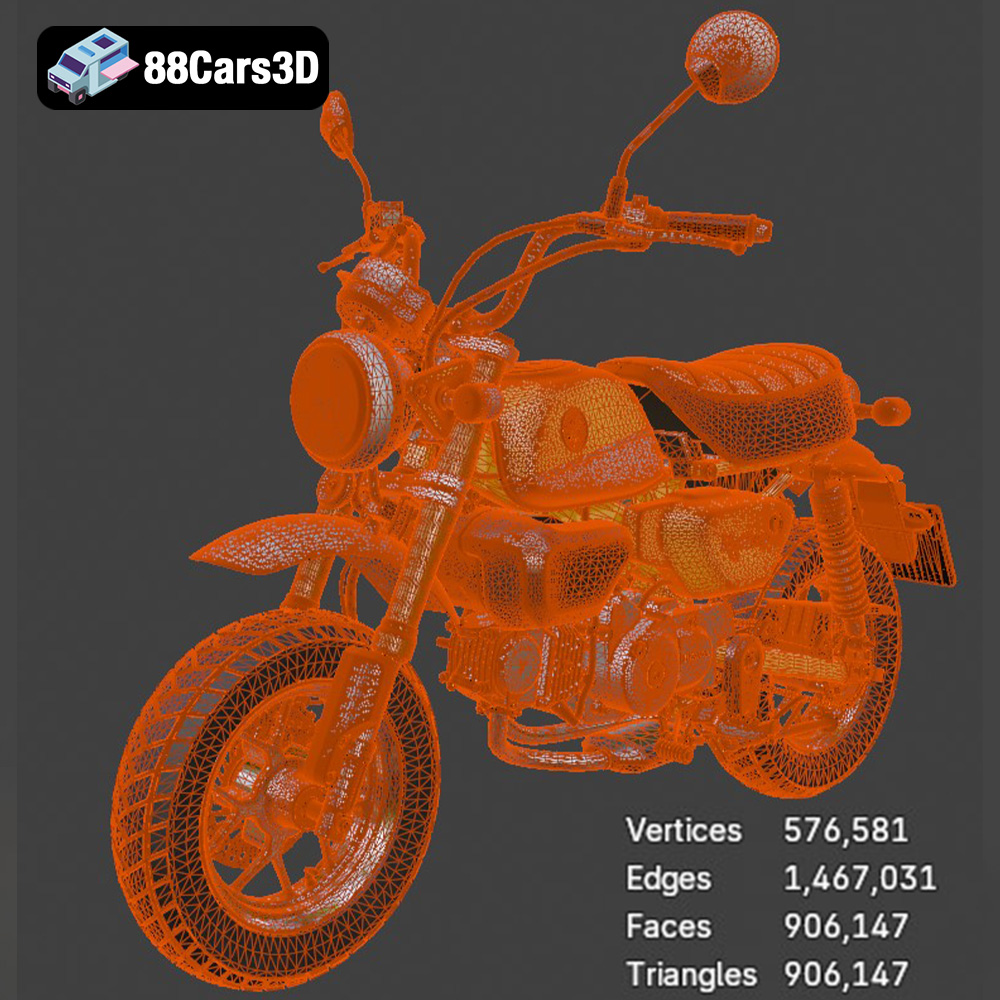
For 3D car models to function effectively as game assets, they must undergo rigorous optimization processes. The description of the Honda Monkey 125 3D Model mentions an “optimized polygon count,” which is a critical feature for game development.
Unreal Engine and Unity are the two dominant platforms for game development, each offering robust tools for integrating and manipulating 3D car models.
The utility of high-quality 3D car models extends far beyond static renders or traditional game environments. Emerging technologies like Augmented Reality (AR), Virtual Reality (VR), and 3D printing are opening up new dimensions for interaction and physical manifestation, and the Honda Monkey 125 2019 3D Model is perfectly equipped for these frontiers.
AR and VR are transforming how we interact with digital content, offering immersive experiences that blur the lines between the digital and physical. For automotive applications, this can mean virtual showrooms, interactive vehicle configurators, or even overlaying a digital model onto a real-world scene.
3D printing bridges the gap between the digital and physical, allowing for rapid prototyping, creation of bespoke parts, or even consumer collectibles. The availability of formats like .stl and .ply for the Honda Monkey 125 2019 3D Model makes this process accessible.
The value of professional-grade 3D car models from marketplaces like 88cars3d.com is best illustrated through their impact across various industries. These assets are not just for games or cool renders; they are integral tools driving innovation and efficiency in professional workflows.
In the highly competitive automotive industry, stunning visualizations are crucial at every stage, from concept development to marketing. Design studios rely heavily on high-quality 3D models to bring their ideas to life, allowing engineers, designers, and executives to review concepts long before a physical prototype is built.
Beyond visual appeal, accurate 3D vehicle models are foundational for advanced simulations and training applications, where precision and realism directly impact effectiveness.
The digital world thrives on visual excellence, and at the heart of that excellence lies the quality of your 3D assets. From the intricate details required for photorealistic automotive rendering to the rigorous optimizations demanded by game development, and the precise geometry needed for AR/VR and 3D printing, high-quality 3D car models are indispensable tools for professionals across industries. The Honda Monkey 125 2019 3D Model exemplifies this versatility and professional standard, offering “superior realism” and “exceptional detailing” across a comprehensive range of file formats.
By investing in carefully crafted digital assets from trusted sources like 88cars3d.com, you are not just acquiring a model; you are investing in efficiency, quality, and the ability to bring your creative visions to life faster and with greater fidelity. Whether you are an architectural visualizer, a game developer, an AR/VR content creator, or a product designer, leveraging pre-optimized, multi-format models empowers you to focus on innovation and compelling storytelling. Explore the possibilities and elevate your projects with professional-grade 3D car models.
Experience superior realism with the Honda Monkey 125 2019 3D Model. This carefully crafted digital asset delivers exceptional detailing, capturing the iconic essence and unique design of the original vehicle. The model features clean geometry and realistic materials, ensuring a professional standard for any project. Every component is meticulously structured, offering accurate proportions and an optimized polygon count for seamless integration into complex scenes. Perfect for a wide range of applications, this versatile 3D model is ideal for game development, professional rendering, AR/VR experiences, and immersive visual simulations. Whether you are creating a dynamic cinematic sequence or an interactive showroom, this asset provides the reliability and visual fidelity required. The following file formats are included to ensure maximum compatibility: .blend – Editable Blender file with materials and lighting setup; .fbx – Game-engine ready format for Unreal Engine and Unity; .obj – Standard 3D model format compatible with all major software; .glb – Optimized for AR/VR and web-based visualization; .stl – Suitable for 3D printing and prototyping; .ply – Detailed polygon mesh for analysis and visualization; .unreal – Pre-configured for Unreal Engine use; .max – Editable 3ds Max file for rendering and animation.
$39.99
.arvr
.blend
.car3dmodel
.fbx
.gameasset
.glb
.honda
.max
.minibike
.monkey125
.motorcycle
.obj
.ply
.rendering
.simulation
.stl
.unreal