Get 20% OFF All Premium 3D & STL Models!

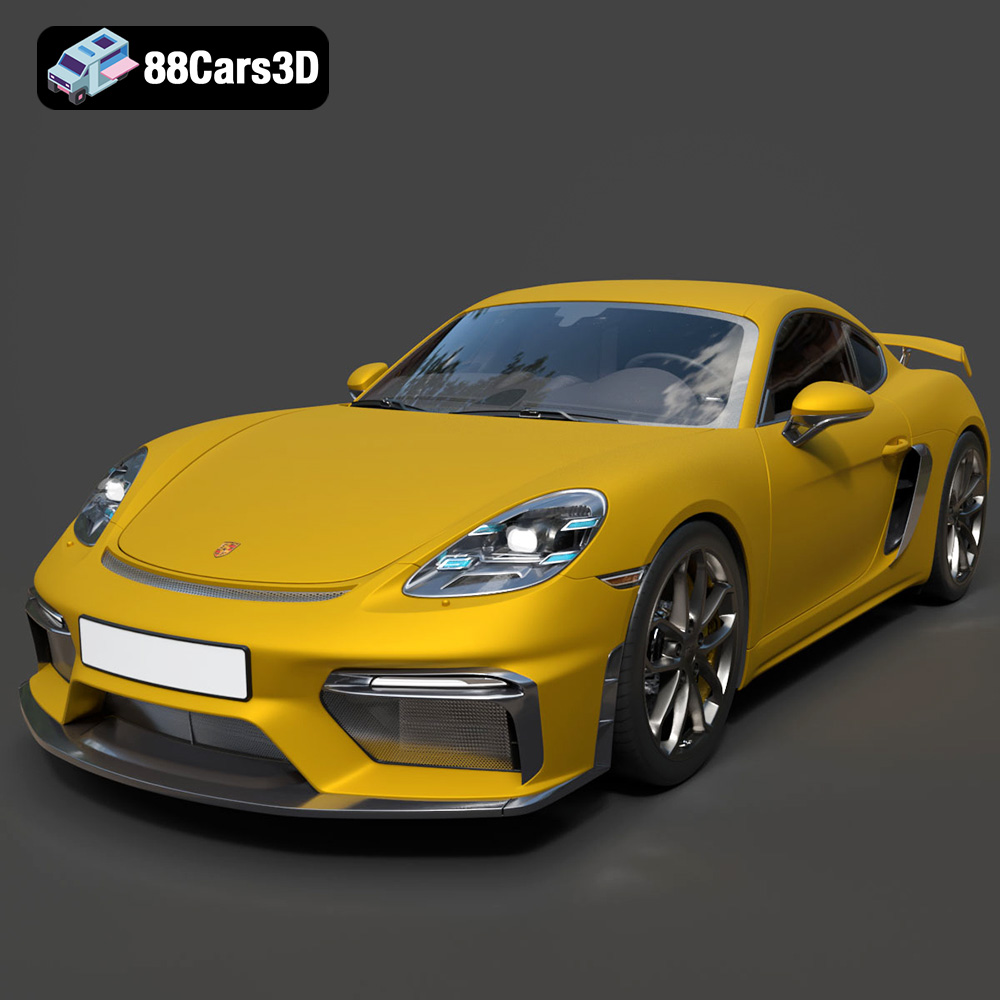
In the world of high-performance sports cars, the Porsche 718 Cayman GT4 stands as a testament to engineering excellence, a mid-engine track weapon that perfectly marries raw power with surgical precision. Its naturally aspirated 4.0-liter flat-six engine, aggressive aerodynamics, and unmistakable Porsche styling deliver an unfiltered driving experience. For 3D artists, game developers, automotive designers, and visualization specialists, capturing the essence of such a machine in the digital realm is paramount. A meticulously crafted 3D model doesn’t just represent the car; it embodies its spirit, allowing creators to push boundaries in rendering, real-time simulations, and immersive experiences.
Imagine harnessing the aerodynamic prowess of its prominent fixed rear wing, the intricate details of its large functional air intakes, or the aggressive lines of its rear diffuser for your next project. This is where a premium 3D asset becomes invaluable. The Porsche 718 Cayman GT4 2020 3D Model available on 88cars3d.com is precisely such an asset, designed not just for visual fidelity but also for unparalleled versatility across a myriad of professional applications. Whether you’re aiming for photorealistic renders, demanding game engine integration, or cutting-edge AR/VR presentations, this model provides the robust foundation you need.
Navigating the diverse landscape of 3D modeling often begins with understanding the various file formats. Each format serves a specific purpose, catering to different software, workflows, and end applications. Selecting the right format for your project is crucial for efficiency, compatibility, and achieving optimal results. The Porsche 718 Cayman GT4 2020 3D Model comes with a comprehensive suite of formats, ensuring maximum adaptability for any professional pipeline.
The .blend file is the native format for Blender, a powerful and increasingly popular open-source 3D creation suite. When you download a .blend file, you’re getting a fully editable Blender scene, complete with the model’s geometry, materials, textures, lighting, cameras, and even animations. This format is ideal for users who primarily work in Blender, offering the most comprehensive access to the original scene setup. It allows for advanced customization, scene manipulation, and direct rendering within Blender’s Cycles or Eevee engines. For the Porsche GT4 model, this means access to the original PBR material setups, hierarchical object structures, and any specific optimizations implemented by the artist.
.fbx (Filmbox) is a proprietary file format developed by Autodesk, widely regarded as the industry standard for 3D data interchange. Its strength lies in its ability to store not only mesh data but also animations, rigging, cameras, lights, and PBR materials across different software packages. This makes .fbx incredibly versatile for pipelines involving multiple applications, such as moving models from 3ds Max or Blender to game engines like Unreal Engine or Unity. For the Porsche GT4, the .fbx format is ideal for real-time pipelines, ensuring that the optimized triangle counts, proper pivot setups for animation (steering, wheels, suspension), and UV layouts are preserved upon export and import into a game engine, guaranteeing a seamless transition for game developers.
.obj (Wavefront Object) is one of the oldest and most universally supported 3D file formats. Primarily, it stores geometric data – vertices, normals, UV coordinates, and faces. While it doesn’t typically store advanced scene information like animations or rigging, it is excellent for transferring pure mesh data between almost any 3D software. .obj files often come with an accompanying .mtl (material library) file that defines basic material properties like color and diffuse maps. For cross-software compatibility, especially when you need a clean mesh to start fresh with materials and rigging in a new environment, .obj remains a reliable choice for the Porsche GT4 3D Model.
.glb (GL Transmission Format Binary) is the binary version of glTF, an open-standard, royalty-free specification for the efficient transmission and loading of 3D scenes and models by applications. It’s designed specifically for real-time applications, particularly AR, VR, and browser-based displays. A single .glb file packages all assets – geometry, textures, animations, and materials – into one self-contained binary file, making it highly portable and efficient for web delivery. The Porsche GT4 in .glb format is perfect for embedding interactive 3D viewers on websites, creating virtual showrooms, or deploying mobile AR experiences, leveraging its optimized geometry and material packing.
.stl (STereoLithography) is the most common file format used for 3D printing. It represents a 3D model as a series of connected triangles (a triangulated surface mesh) without color, texture, or other CAD attributes. While simple, its ubiquity makes it the standard for sending models to 3D printers. The Porsche 718 Cayman GT4 3D Model, when converted to .stl, becomes a tangible asset, allowing hobbyists and professionals alike to produce physical replicas. It’s crucial to understand recommended print settings, such as scale, layer height, and support requirements, as detailed in the product description, to achieve a high-quality physical model.
.ply (Polygon File Format or Stanford Triangle Format) is another format used for storing 3D data, particularly popular for scanner data, scientific visualization, and 3D graphics applications. It can store a variety of properties including color, transparency, surface normals, and range data, and is known for its ability to handle “point cloud” data. While less common for general 3D model exchange compared to .fbx or .obj, .ply can be beneficial for precision mesh applications, CAD workflows, or when the integrity of point data is critical for analysis or reconstruction of the Porsche GT4’s geometry.
While not a universal file format in the same vein as .fbx or .obj, the inclusion of an .unreal file (often referring to a pre-packaged Unreal Engine asset or project file) signifies a model specifically prepared for direct integration into Unreal Engine. This often means the model has already been imported, scaled, had its materials set up (using Unreal’s robust material editor), and potentially includes blueprints for physics, animation, or interactive elements. For the Porsche 718 Cayman GT4 2020 3D Model, an .unreal asset significantly reduces setup time for game developers, offering an out-of-the-box solution for implementing this high-fidelity vehicle into their virtual worlds.
The .max file is the native scene file format for Autodesk 3ds Max, one of the leading 3D modeling, animation, and rendering software packages in the industry. Like .blend for Blender, a .max file contains the complete scene – geometry, textures, materials, lighting, cameras, rigging, and animation data – allowing for full editability within 3ds Max. Professionals working in architectural visualization, automotive design studios, or film pre-visualization often rely on .max for its comprehensive toolset and powerful rendering capabilities with V-Ray, Corona, or Arnold. Having the Porsche GT4 model in .max format ensures complete control over every aspect of the asset for high-end rendering and animation projects.
Photorealistic automotive rendering is an exacting discipline, demanding a deep understanding of light, materials, and composition. A high-quality 3D model like the Porsche 718 Cayman GT4 2020 is the cornerstone of success, providing the fidelity necessary to create stunning, believable visuals that captivate audiences in marketing campaigns, design reviews, or cinematic sequences.
The beauty of the Porsche 718 Cayman GT4 2020 3D Model lies in its meticulous attention to detail. From the accurate frame geometry and body panels to the precise alloy wheels with high-performance brake calipers and slotted rotors, every exterior feature is crafted for realism. Inside, the track-focused Alcantara sport bucket seats with detailed stitching, the GT sport steering wheel, and the iconic analog central tachometer contribute to an immersive cockpit experience. These details are only fully realized with sophisticated material setups. Modern rendering relies heavily on Physically Based Rendering (PBR) workflows, where materials react to light in a way that mimics real-world physics. This model comes with optimized PBR materials, ensuring paint, glass, rubber, and metal surfaces reflect, refract, and absorb light correctly, creating that hyper-realistic sheen and depth crucial for automotive visualization.
Once the model and materials are prepared, the magic happens with lighting. For cinematic quality renders, a virtual studio environment is often employed. This typically involves HDRI (High Dynamic Range Image) maps for global illumination and reflections, combined with targeted area lights or spotlights to highlight specific features of the vehicle. For example, a three-point lighting setup (key, fill, back) can bring out the sculpted lines of the GT4’s aggressive front spoiler and rear diffuser, while a carefully chosen HDRI can provide realistic ambient light and reflections from a pristine showroom or an open road. Experimentation with light temperatures, intensities, and positions allows artists to evoke different moods, from the crispness of a bright showroom to the dramatic shadows of a sunset drive.
Consider a typical rendering workflow using the Porsche 718 Cayman GT4 2020 3D Model. If you’re working in 3ds Max, you’d import the .max file directly, or an .fbx if you’re starting from scratch. Then, you’d apply or refine the PBR materials provided, ensuring textures like diffuse, roughness, metallic, and normal maps are correctly assigned. For rendering with V-Ray, you’d set up a V-Ray physical camera, add a V-Ray Dome Light with an HDRI, and potentially a few V-Ray Plane Lights for accentuation. In Blender, using the .blend file gives you immediate access to the Cycles or Eevee render engines. You would ensure the node-based PBR materials are correctly linked, and then use environmental lighting with an HDRI, augmented by mesh lights or area lights. Both workflows leverage the model’s clean topology and accurate UV mapping to produce flawless renders, showcasing every curve and vent of this track-ready beast.
In the realm of game development, balancing visual fidelity with real-time performance is a constant challenge. A “game-ready” asset like the Porsche 718 Cayman GT4 2020 3D Model is optimized from the ground up to meet these demands, offering stunning visuals without bogging down the frame rate of a high-speed racing simulator or an open-world environment.
The core of game-ready optimization lies in efficient polygon count and intelligent use of textures. This model boasts a carefully calculated triangle count, striking a perfect balance for real-time engines while maintaining high-end visual realism. This often involves techniques like decimation in less visible areas and precise detailing where it matters most, ensuring that the car looks breathtaking in close-ups and dynamic during high-speed chases. Additionally, efficient UV mapping allows for optimal texture packing, reducing draw calls and memory usage. For larger environments, Level of Detail (LOD) models would be generated, where simplified versions of the car are rendered at greater distances, further improving performance. The GT4 model’s inherent optimization provides a fantastic starting point, minimizing the need for extensive post-import cleanup.
Unreal Engine, a leading real-time 3D creation tool, is a prime destination for this Porsche 718 Cayman GT4 2020 3D Model. The included .fbx and especially the .unreal file formats simplify the import process. Upon importing the .fbx, developers can create PBR materials using Unreal’s robust material editor, connecting texture maps (base color, normal, roughness, metallic, ambient occlusion) to create realistic car paint, glass, and tire materials. The model’s proper pivot setup for steering, wheel rotation, and suspension travel is critical for implementing realistic vehicle physics via Unreal’s Chaos Vehicle system or custom blueprints. Separate components like wheels and suspension allow for dynamic animation, making the car react authentically to terrain and driver input. For game developers seeking top-tier automotive game assets, 88cars3d.com provides ready-to-integrate solutions.
Ultimately, the quality of a game asset directly impacts player immersion. The detailed exterior of the Porsche GT4, from its signature four-point LED headlights to its aggressive rear diffuser, enhances the visual spectacle during races. Crucially, the optimized interior geometry is perfect for first-person POV in gaming, allowing players to truly feel like they are inside the GT sport steering wheel-equipped cockpit. The meticulous detail, coupled with fluid animations enabled by the model’s structure, creates a believable and engaging driving experience, pushing the boundaries of what’s possible in virtual automotive environments.
The versatility of a high-quality 3D model extends far beyond traditional rendering and game development. The Porsche 718 Cayman GT4 2020 3D Model offers incredible potential for emerging technologies and specialized visualization tasks, opening up new avenues for creative and commercial applications.
Augmented Reality (AR) and Virtual Reality (VR) are revolutionizing how we interact with digital content, especially in automotive marketing and configurators. Imagine a customer exploring the Porsche GT4 in their living room via AR, able to walk around it, change colors, and even peek inside. In a VR showroom, they could sit virtually in the driver’s seat, experiencing the cockpit as if they were there. The .glb format, optimized for AR/VR and web-based display, is perfect for these applications. Its efficiency ensures smooth performance on various devices, from mobile phones to high-end VR headsets. The GT4 model’s detailed yet optimized geometry is ideal for creating these immersive virtual showrooms and interactive configurators, providing a powerful tool for brand engagement and sales.
For enthusiasts and professional designers alike, the ability to transform a digital model into a physical object is incredibly satisfying. The Porsche 718 Cayman GT4 2020 3D Model is convertible to the .stl format, making it suitable for 3D printing. This allows for the creation of display-scale replicas, prototypes, or custom parts. Achieving a high-quality print, especially for a complex model like a car, requires attention to detail in print settings. Recommended scales (1:12, 1:18, 1:24), layer height (0.04–0.12 mm, with resin printing often preferred for fine details), wall thickness, and infill percentages are crucial. Specific instructions on print orientation (e.g., frame angled for structural integrity, wheels printed separately) and the necessity of supports for delicate parts like mirrors or exhaust systems are vital considerations. Post-processing, including sanding, priming, and painting with authentic factory colors, can elevate a 3D print to a collector’s item.
Beyond interactive experiences, the Porsche GT4 model is a potent asset for professional visualization and marketing campaigns. Automotive brands and agencies can leverage this model to create breathtaking product showcases, lifestyle visual campaigns, and even architectural visualizations where a premium vehicle is needed to contextualize a luxurious environment. The ability to render the car in various hypothetical scenarios – from a sleek urban street to a rugged mountain pass – without the logistical challenges and costs of real-world photography or videography, makes this 3D asset an indispensable tool. Its versatility allows for rapid iteration of concepts, color schemes, and environmental adaptations, significantly accelerating creative workflows and reducing production costs.
The true value of a professional 3D asset lies not just in its visual appeal but also in its underlying technical integrity. The Porsche 718 Cayman GT4 2020 3D Model from 88cars3d.com stands out due to its adherence to industry best practices, offering numerous advantages to users across various disciplines.
At the heart of any high-quality 3D model is its topology. This model boasts exceptional topology, meaning the mesh is clean, well-optimized, and facilitates smooth deformations during animation. This ensures that the GT4’s aggressive lines and subtle curves are accurately preserved. Complementing this are carefully unwrapped UVs, which are essential for seamless texture application and preventing distortion. These UVs are laid out efficiently, allowing for maximum texture resolution and reducing wasted space. Combined with a comprehensive set of PBR (Physically Based Rendering) materials, including textures for color, roughness, metallic, and normal mapping, the model interacts realistically with light, guaranteeing breathtaking visual fidelity in any modern rendering engine.
For animators and game developers, a model that is prepared for motion is a huge time-saver. This Porsche GT4 model features proper pivot setups for crucial components like steering, wheel rotation, and suspension travel. This means that when you’re rigging the car for animation or integrating it into a physics engine, these elements will rotate and move intuitively, reflecting real-world mechanics. Furthermore, the model is built with real-world scale accuracy, based on the actual vehicle chassis. This is critical for maintaining realism in simulations, architectural visualizations, or when combining the model with other real-world assets in a scene. It eliminates the tedious process of scaling and ensures that the car’s proportions are always correct.
No two projects are identical, and the ability to customize a 3D model is paramount. This GT4 model provides extensive customization options. Users can easily change body colors, experimenting with iconic Porsche hues like Miami Blue or Guards Red, or even creating custom metallic finishes. Tire textures can be modified to switch between track slicks for a race scenario and street variants for a casual drive. Material finishes, such as matte, gloss, or carbon fiber accents, can be adjusted to match specific design requirements. Moreover, the model adapts seamlessly to different lighting environments, allowing artists to render it under a bright sunny sky, a dramatic sunset, or the artificial glow of a studio, providing unparalleled creative flexibility for any project requirement.
In the competitive world of 3D content creation, access to high-quality, meticulously crafted assets is a distinct advantage. The Porsche 718 Cayman GT4 2020 3D Model is more than just a digital representation of an iconic sports car; it’s a versatile, optimized tool designed to elevate professional projects across rendering, game development, AR/VR, and 3D printing. Its detailed topology, game-ready optimization, PBR materials, and extensive format support (including .blend, .fbx, .obj, .glb, .stl, .ply, .unreal, and .max) ensure seamless integration into virtually any workflow.
Whether you’re aiming to create a visually stunning automotive marketing campaign, an immersive racing simulator, a captivating virtual showroom, or a tangible physical replica, this model provides the necessary foundation for success. It saves invaluable time, reduces production costs, and empowers artists and developers to focus on creativity without compromising on technical fidelity. Explore the potential of premium 3D car models and discover how assets like the Porsche 718 Cayman GT4 2020 3D Model can transform your next project. Visit 88cars3d.com today to browse a curated selection of exceptional 3D automotive assets designed for the modern creator.
The 2020 Porsche 718 Cayman GT4 is a mid-engine track weapon that perfectly balances motorsport heritage with modern performance. Known for its naturally aspirated 4.0-liter flat-six engine, aggressive aerodynamics, and unmistakable Porsche styling, this sports car delivers a pure, unfiltered driving experience. From its prominent fixed rear wing and large functional air intakes to its dual sport exhaust system and aggressive rear diffuser, every element is meticulously designed for maximum downforce and cooling.
This high-fidelity 3D model boasts exceptional topology and game-ready optimization, featuring carefully calculated triangle counts to ensure maximum performance without sacrificing detail. It maintains breathtaking visual fidelity suitable for close-up shots while remaining fully optimized for real-time rendering environments. Whether you are developing a high-speed racing simulator, crafting an immersive AR/VR showroom, or producing photorealistic cinematic animations, this digital asset provides the perfect foundation.
Perfect for high-speed racing games, virtual automotive configurators, photorealistic studio renders, and lifestyle visual campaigns.
.blend, .fbx, .obj, .glb, .stl, .ply, .unreal, .max
Tags:
porsche, 718-cayman-gt4, 2020, sports-car, track-car, game-ready, low-poly, optimized, car-3d-model, game-asset, rendering, vr-ar, blend, fbx, obj, glb, stl, ply, unreal, maxVespa VNB 125 3D Model 3D Printable STL
$39.99
.2020
.blend
.fbx
.glb
.max
.obj
.ply
.porsche
.rendering
.sports car
.stl
.unreal
718-cayman-gt4
car-3d-model
game asset
game-ready
low-poly
optimized
track-car
VR/AR