Get 20% OFF All Premium 3D & STL Models!

In the vast landscape of automotive history, certain vehicles transcend their original purpose to become symbols of ingenuity, resilience, and unique engineering. The Volkswagen Schwimmwagen Typ 166 is undeniably one such icon. Conceived during World War II, this amphibious off-road vehicle captivated with its distinctive boat-like hull, robust four-wheel drive, and an innovative fold-down propeller system. It stands as a testament to practical design under extraordinary circumstances, holding the title of the most mass-produced amphibious car in history.
Today, the allure of the Schwimmwagen extends far beyond history books and museums. Thanks to the power of 3D modeling, this legendary machine can be meticulously recreated, studied, and integrated into modern digital environments. For professionals in game development, architectural visualization, virtual reality, and even 3D printing, a high-quality 3D car model of the Schwimmwagen Typ 166 offers an unparalleled asset. It bridges the gap between historical accuracy and cutting-edge digital application, providing a foundation for immersive experiences and stunning visual renders. The Volkswagen Schwimmwagen Typ 166 3D Model available at 88cars3d.com exemplifies this fusion, offering a deeply detailed and optimized digital twin ready for diverse professional pipelines.
The Schwimmwagen Typ 166 is more than just a military vehicle; it’s a piece of engineering marvel that continues to fascinate enthusiasts and historians alike. Its conversion from a land-faring Kübelwagen into a fully amphibious vehicle with a watertight chassis and a retractable propeller was a remarkable feat for its time. Translating such a complex and historically significant design into a 3D model requires not just artistic skill, but a deep understanding of its technical intricacies and visual nuances.
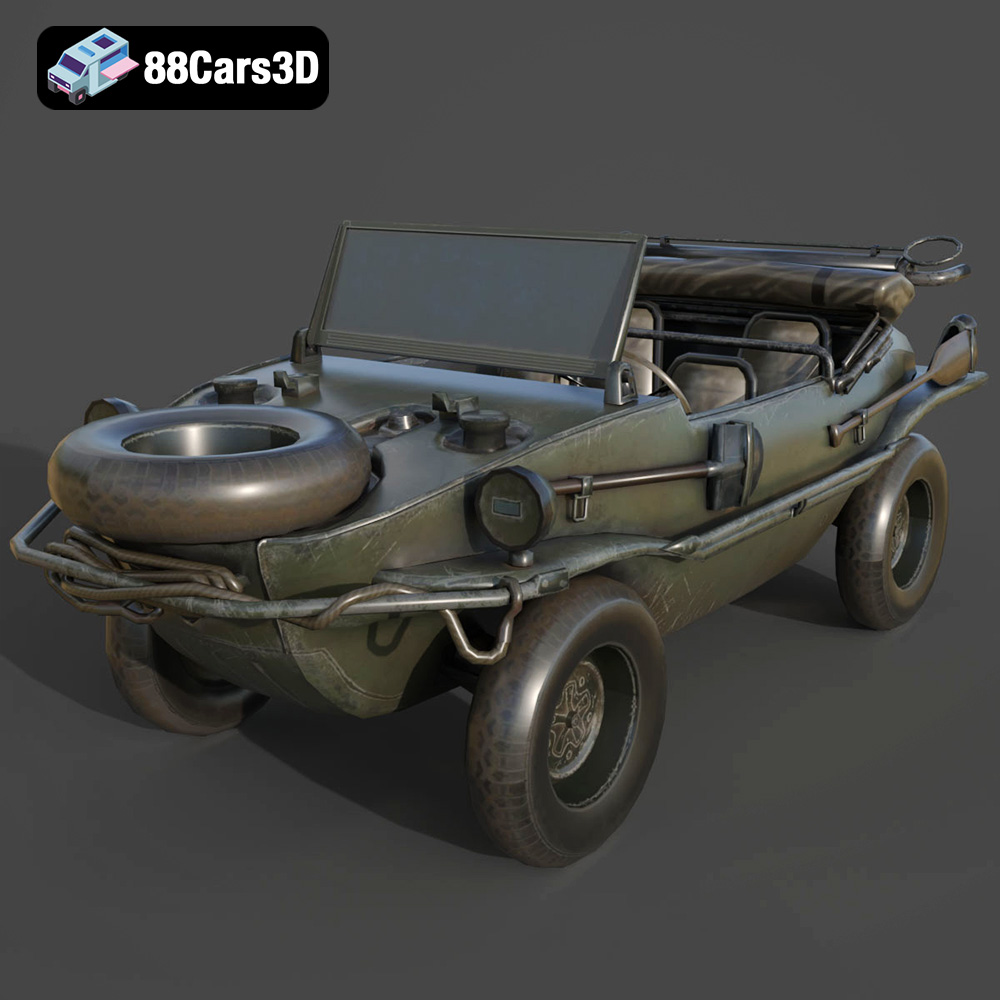
At its core, the Schwimmwagen’s design was driven by function. Its rounded, seamless hull, designed to minimize water resistance, perfectly illustrates form following function. The rear-mounted air-cooled flat-four engine, shared with its land-based cousins, provided reliable power for both terrestrial and aquatic locomotion. From the high-tread off-road tires to the distinctive blackout headlamps and the spare tire prominently mounted on the sloping front hood, every element of the real vehicle told a story of rugged utility. A high-quality 3D model, such as the Volkswagen Schwimmwagen Typ 166 3D Model, captures these historical details with precision, ensuring that its digital representation is as authentic as its physical counterpart. This authenticity is paramount for projects aiming for historical accuracy, whether for educational simulations or period-specific game environments.
The beauty of a well-crafted 3D model lies in its ability to transport users into a different time and place. For the Schwimmwagen, this means allowing players to navigate historical battlefields, enabling students to explore its mechanics in an interactive virtual exhibit, or even providing a unique subject for stunning automotive rendering portfolios. The digital format offers flexibility that physical models cannot match, allowing for easy integration into various scenes, customization of textures, and animation of its unique features like the propeller deployment or suspension travel. This capability makes such 3D car models invaluable assets for creators looking to bring history to life in engaging new ways.
When working with 3D car models, especially those as detailed and versatile as the Volkswagen Schwimmwagen Typ 166 3D Model, understanding the various file formats is crucial. Each format serves a specific purpose, offering different levels of compatibility, editability, and optimization for various workflows. The Schwimmwagen model from 88cars3d.com thoughtfully provides a comprehensive suite of formats, ensuring maximum utility for any professional project.
The .blend format is Blender’s native file type. It encapsulates an entire Blender scene, including the 3D model, materials, textures, lighting, cameras, animation data, and even scene settings. This makes it incredibly powerful for artists who use Blender, providing a fully editable and self-contained project file. When you download the Schwimmwagen as a .blend file, you’re not just getting the model; you’re getting a complete, ready-to-work-with scene where every aspect can be adjusted, from the intricate shader networks to the precise pivot points for animation. It’s the ideal choice for deep customization and complex scene integration within the Blender ecosystem.
.fbx (Filmbox) is an industry-standard proprietary file format developed by Autodesk, widely used for exchanging 3D data between different software applications. It supports geometry, materials, textures, animations, skinning, and camera data, making it a robust choice for complex models. The .fbx format is particularly ideal for real-time engines like Unreal Engine and Unity, as it maintains much of the scene’s hierarchy and animation data during import. This ensures that the Schwimmwagen’s separate wheels, propeller, and suspension components retain their individual pivot points, ready for animation straight out of the box. Its widespread adoption makes it a cornerstone for collaborative projects. In contrast, .obj (Wavefront OBJ) is a simpler, more universal geometry definition file format. It’s excellent for basic mesh data and UV coordinates, making it highly compatible across virtually all 3D software. While it doesn’t store animation or complex material definitions directly within the file, it’s often accompanied by an .mtl (material) file for basic color and texture references. For foundational mesh transfer and reliable cross-software compatibility, .obj remains a go-to format for the Volkswagen Schwimmwagen Typ 166 3D Model, ensuring it can be opened and worked on by almost any artist, regardless of their preferred software.
.glb (GL Transmission Format Binary) is the binary version of glTF, a royalty-free specification for the efficient transmission and loading of 3D scenes and models by applications. Optimized for AR, VR, and browser-based display, .glb packs all necessary data – model, textures, animations – into a single file, making it incredibly easy to share and embed. It’s the perfect format for showcasing the Schwimmwagen in interactive web viewers, augmented reality apps, or lightweight virtual reality experiences, offering quick load times and efficient performance. The .unreal format, or rather assets specifically optimized for Unreal Engine, refers to a collection of files and configurations tailored for direct integration into an Unreal project. This typically involves .fbx imports that are specifically prepared with proper material setups, collision meshes, LODs (Levels of Detail), and blueprint configurations to be engine-ready. It signifies that the asset has undergone a dedicated pipeline for optimal performance and functionality within Unreal, saving developers significant setup time. For a game asset like the Schwimmwagen, having an “unreal” option means it’s primed for immediate use in real-time environments, minimizing conversion and optimization steps.
.stl (Stereolithography) is the most common file format for 3D printing. It describes only the surface geometry of a 3D object as a raw, unstructured triangular mesh. The Schwimmwagen in .stl format is ready to be sliced and sent to a 3D printer, allowing enthusiasts to create physical replicas. While simple, its ubiquity in the additive manufacturing space makes it indispensable for bringing digital models into the physical world. .ply (Polygon File Format or Stanford Triangle Format) is another format that stores 3D data, often used for scanned 3D objects. It can store more complex information than .stl, including color, transparency, and sometimes even normal data. For precision mesh analysis, CAD integration, or specific manufacturing workflows, the .ply version of the Schwimmwagen provides a robust data set for advanced applications.
Finally, the .max format is the native project file for Autodesk 3ds Max, a leading software in architectural visualization, game development, and film production. Similar to .blend, a .max file contains the entire scene, including models, materials, lighting, cameras, and animation. For professionals using 3ds Max, having the Schwimmwagen in this native format means direct access to all its components within their preferred environment, facilitating complex rendering setups, rigging, and animation sequences without any data loss from conversion. This ensures that the high-quality assets on 88cars3d.com cater to a wide array of industry-standard tools.
Creating a 3D model that balances visual fidelity with performance is an art form, especially for an asset intended for diverse applications like game development, rendering, and AR/VR. The Volkswagen Schwimmwagen Typ 166 3D Model achieves this balance through meticulous attention to technical specifications and design principles.
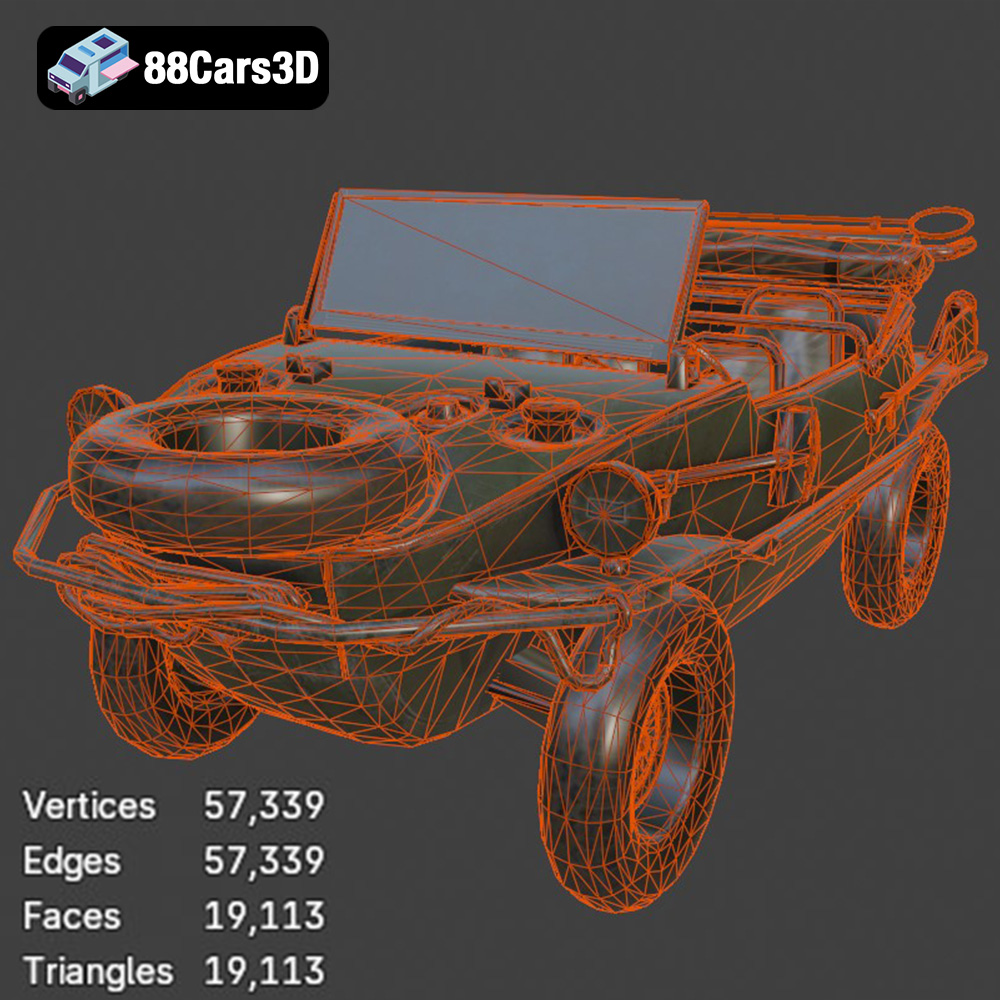
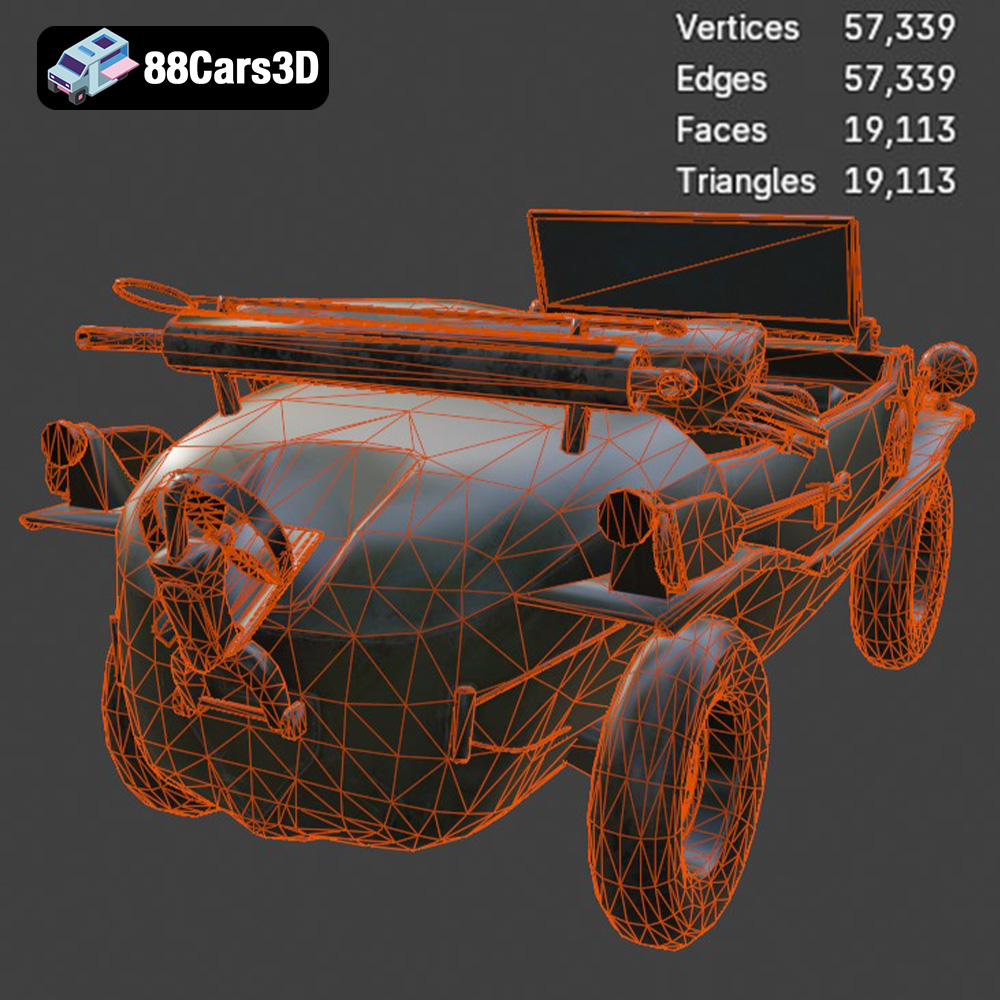
The core of any high-quality 3D asset is its topology – the arrangement of polygons that make up the mesh. For the Schwimmwagen, an optimized topology with approximately 150,000 triangles strikes a perfect balance. This polycount is sufficiently detailed to capture the distinct watertight hull geometry, the riveted panels, and the rugged features without being overly heavy for real-time engines. Clean, quad-based topology (where possible, before triangulation for game engines) ensures smooth subdivision if higher detail is needed for cinematic rendering, and prevents shading artifacts. Furthermore, proper UV mapping is critical. Unwrapped and organized UVs ensure that textures are applied without distortion, maximizing detail from painted camouflage patterns to weathered metal finishes. The precision in these technical details is what elevates this 3D car model from a mere representation to a versatile, performant asset.
One of the standout features of this Schwimmwagen model is its modularity. Components like the wheels, propeller, suspension, and steering parts are separate objects, each with correctly set pivot points. This isn’t merely a convenience; it’s a fundamental requirement for animation and dynamic interaction. Imagine a game where the Schwimmwagen navigates rough terrain: individual wheel rotation, independent suspension travel, and precise steering articulation are essential for believable physics. In an AR/VR experience, being able to interactively deploy the rear propeller or rotate the steering wheel adds a layer of immersion that static models cannot provide. This thoughtful breakdown allows animators and developers to bring the vehicle to life with authentic movement, significantly enhancing the asset’s value.
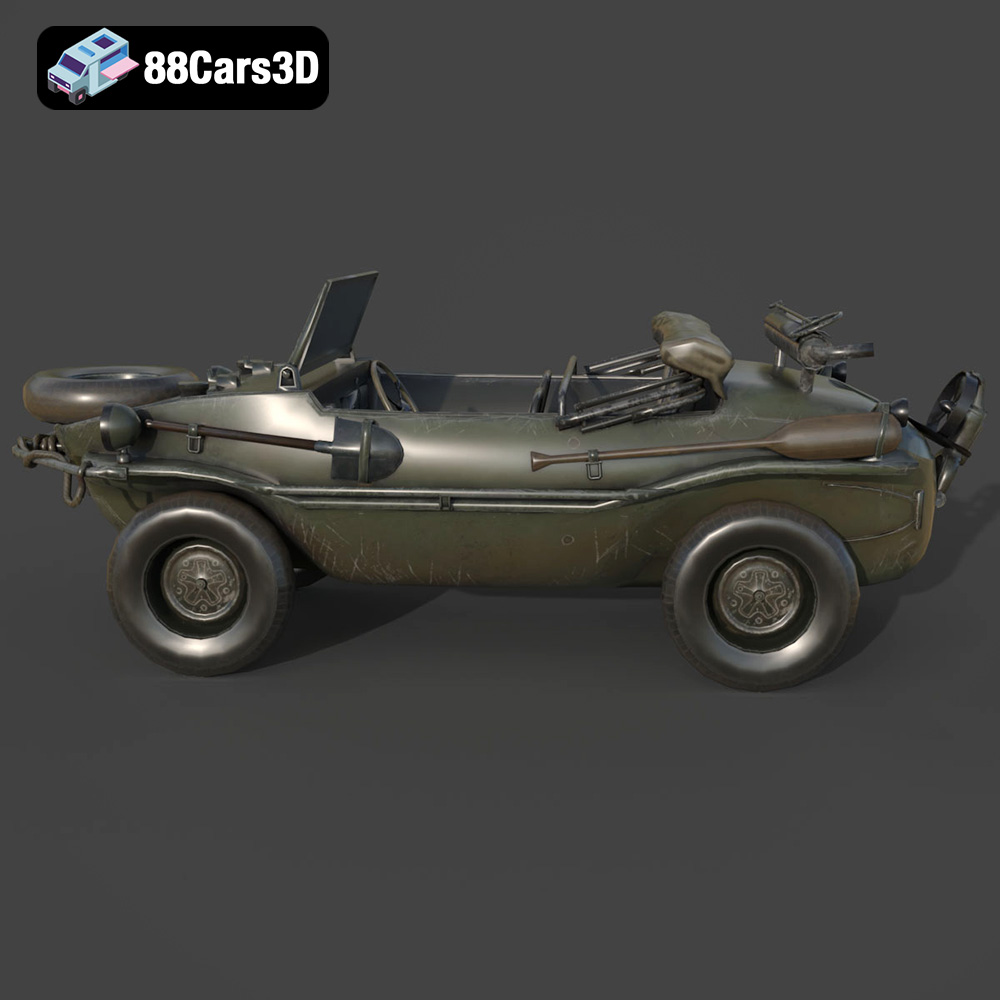
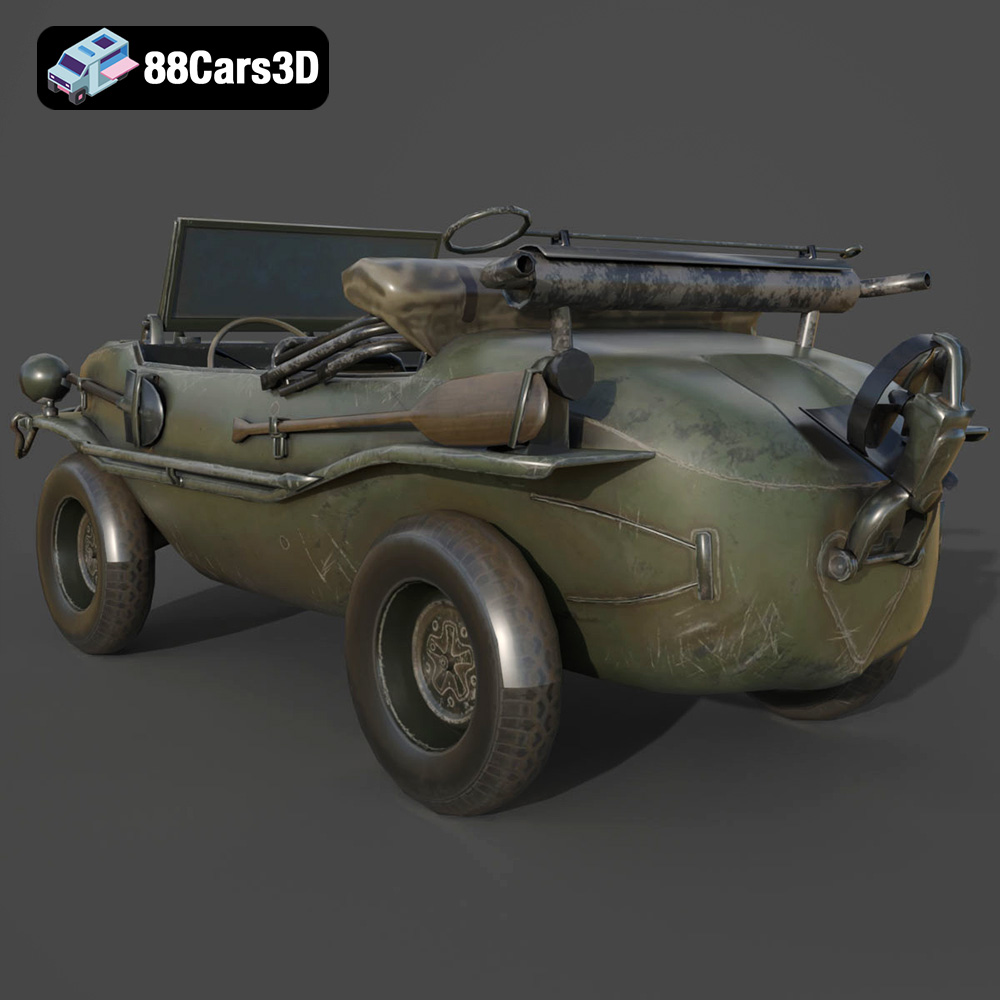
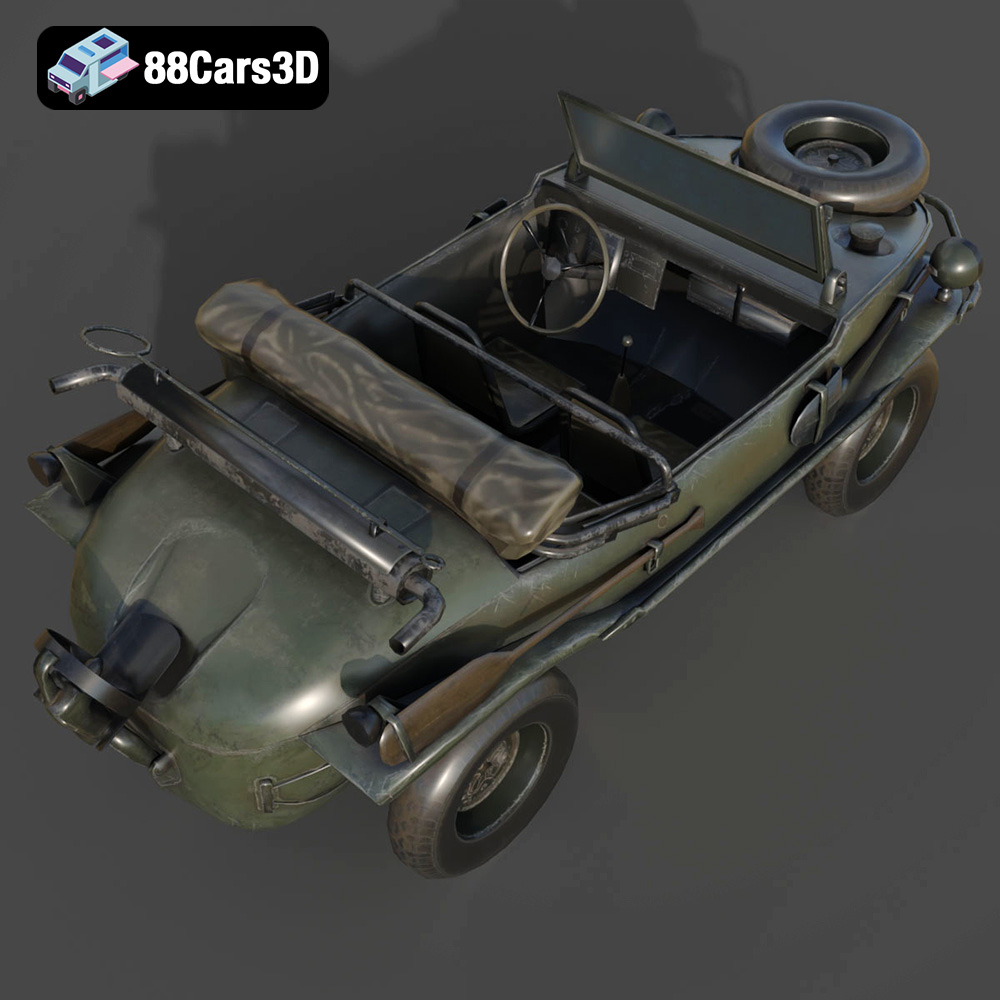
The product description highlights a wealth of detailed features, both exterior and interior, that contribute to the model’s authenticity. Externally, the accurate hull geometry, the detailed rear-mounted air-cooled flat-four engine housing, the authentic fold-down propeller mechanism, and period-accurate military lighting (including blackout headlamps) all speak to a deep commitment to historical accuracy. The high-tread off-road tires and stamped steel wheels, coupled with rugged leaf spring and torsion bar suspension details, complete the robust exterior. Inside, the model doesn’t disappoint, offering utilitarian front and rear military seating, a minimalist three-spoke steering wheel, an authentic column, sparse military-spec instrument cluster, and detailed floor-mounted gear shifter and 4WD engagement levers. This level of granular detail, especially in the optimized geometry for first-person POV in gaming, ensures that the Volkswagen Schwimmwagen Typ 166 3D Model can hold up to close-ups and immersive perspectives, making it ideal for a wide range of professional applications.
The true measure of a high-quality 3D car model lies in its seamless integration into diverse professional pipelines. The Volkswagen Schwimmwagen Typ 166 3D Model, with its optimized geometry and multiple file formats, is designed precisely for this purpose, empowering creators across various industries.
For game developers, time is a critical resource. The “game-ready” nature of the Schwimmwagen model means significant savings in the production pipeline. In engines like Unreal Engine and Unity, the provided .fbx or .unreal files can be directly imported. Developers can quickly set up physically based rendering (PBR) materials, leveraging provided textures (if any, or custom ones) to achieve realistic surfaces. Crucially, the proper pivot setup for animated components means rigging for vehicle physics and animation systems is straightforward. Collision meshes, essential for gameplay interaction, can be rapidly generated or integrated. Furthermore, for open-world games or titles with varying levels of detail, the optimized polycount of ~150,000 triangles provides a solid base, from which LODs (Levels of Detail) can be easily generated to ensure performance scalability without compromising visual quality at close ranges. This ensures the Schwimmwagen can be a central character in historical military simulators or a reliable vehicle in any off-road racing game.
When it comes to automotive rendering, the goal is often photorealism. Using the .max, .blend, or .obj/.fbx files, artists can import the Schwimmwagen into their preferred rendering software like 3ds Max, Blender, or Maya. Here, the model can be placed in elaborate studio lighting setups, or integrated into complex environment scenes. Advanced rendering engines such as V-Ray, Corona Renderer, Cycles, or Arnold can then be used to create breathtaking visuals. The model’s clean topology and detailed features allow for high-resolution texture application, precise material adjustments (e.g., weathered metal, muddy tires, or a pristine factory finish), and the creation of cinematic animations showcasing its unique amphibious capabilities. This makes it an excellent choice for brand campaigns, lifestyle scenes, or even a hero asset in an automotive design visualization project.
Augmented Reality (AR) and Virtual Reality (VR) demand efficient, optimized assets that can run smoothly on a variety of hardware. The .glb format, included with the Volkswagen Schwimmwagen Typ 166 3D Model, is a game-changer for AR/VR applications. Its single-file nature and optimization for web and mobile platforms make it ideal for virtual showrooms, interactive museum exhibits, or educational AR experiences where the Schwimmwagen can be explored in 3D. Developers can integrate the model into WebGL frameworks, mobile AR kits (like ARKit or ARCore), or dedicated VR platforms. The optimized geometry ensures quick load times and smooth framerates, critical for preventing motion sickness and maintaining user immersion. Imagine stepping into a virtual World War II diorama and being able to walk around, inspect, and even interact with this iconic amphibious vehicle – this is the power the Schwimmwagen 3D model brings to AR/VR.
The versatility of a high-quality 3D model extends beyond digital displays. The ability to physically manifest a virtual object opens up new avenues for hobbyists, collectors, and educators. The Volkswagen Schwimmwagen Typ 166 3D Model from 88cars3d.com, specifically through its .stl format, is perfectly suited for 3D printing, allowing enthusiasts to hold a piece of history in their hands.
Converting a digital model into a physical object via 3D printing requires careful preparation, even with a purpose-built .stl file. The recommended scales (1:16, 1:24, 1:35) are crucial for achieving appropriate detail without making the print too fragile or unwieldy. Resin printing is often recommended for intricate models like the Schwimmwagen due to its ability to achieve finer layer heights (0.04–0.12 mm), capturing minute details like rivets, engine housing vents, and the delicate propeller mechanism. For FDM printers, slightly thicker wall thicknesses (1.2–2.0 mm) and an infill of 20–30% ensure structural integrity. Critically, supports are required for overhanging parts such as the exhaust, propeller, and steering wheel to prevent drooping during the printing process. Optimal print orientation, like printing the frame angled, can further enhance structural strength and minimize support requirements. These guidelines ensure a successful and detailed physical reproduction.
Once printed, the journey from raw plastic to a museum-quality replica involves a series of post-processing steps. Sanding is often necessary to smooth out layer lines or support marks, followed by the application of a primer to create a uniform surface for painting. For authentic results, hobbyists can research historical factory colors or camouflage patterns used during WWII. Applying metallic finishes for engine components, rubberized textures for tires, and even subtle weathering effects (like rust, mud, or dust) can dramatically enhance the realism of the printed model. The separate components, such as wheels and the propeller, allow for easier painting and assembly, resulting in a highly detailed and display-worthy miniature that truly captures the spirit of the original Schwimmwagen.
A premium 3D car model, like the Volkswagen Schwimmwagen Typ 166 available at 88cars3d.com, is not a static asset. Its true value lies in its adaptability and the creative freedom it offers to artists and developers. The built-in customization options unlock a vast array of possibilities, making it a highly versatile tool across various projects.
The Schwimmwagen, iconic in its military green, can be transformed to suit any creative vision. Users can effortlessly change body colors, experimenting with different historical camouflage patterns or even fantastical custom finishes for a unique take on the classic. Modifying tire textures from clean, factory-fresh rubber to mud-splattered off-road variants can instantly communicate a narrative of terrain and use. Adjusting material finishes—from a matte, battle-worn appearance to a glossy, restored showpiece or a weathered metallic sheen—allows for nuanced storytelling and visual impact. These customization options enable the Schwimmwagen to seamlessly integrate into different periods, environments, and artistic styles, offering endless creative iterations for rendering and visualization projects.
The inherent versatility of the Volkswagen Schwimmwagen Typ 166 3D Model means it can serve a multitude of project types. For game developers, it’s a ready-to-deploy vehicle, animatable and optimized for real-time performance. In architectural visualization, it could be a distinctive prop in an outdoor scene, adding character and historical context. For educational content, its accurate representation makes it perfect for interactive simulations or virtual museum exhibits, allowing students to explore its mechanics and history in a dynamic way. Whether you need a rugged off-road racer, a historical military simulator asset, or a center piece for a museum-quality interactive exhibit, this model provides the foundational quality and flexibility to adapt. This broad applicability underlines the strategic advantage of investing in a meticulously crafted asset like this, maximizing its utility across your creative endeavors.
The Volkswagen Schwimmwagen Typ 166 stands as a remarkable testament to engineering ingenuity, and its digital reincarnation as a high-quality 3D model offers unparalleled opportunities for modern creators. From its meticulously crafted exterior and interior details to its optimized topology and multi-format compatibility, this 3D car model is more than just an asset; it’s a gateway to bringing history to life in engaging and immersive ways. Whether you’re a game developer seeking realistic vehicles for an open-world title, an automotive renderer striving for photorealistic visuals, or an AR/VR enthusiast building interactive experiences, the Schwimmwagen Typ 166 3D Model provides the technical foundation and artistic fidelity required. Its adaptability, ease of integration into various professional workflows, and potential for physical manifestation through 3D printing make it an exceptionally valuable addition to any digital library. For those seeking premium 3D car models that combine historical accuracy with modern optimization, the offerings at 88cars3d.com, including this iconic Schwimmwagen, represent an investment in quality and creative potential.
The Volkswagen Schwimmwagen Typ 166 is an iconic World War II amphibious off-road vehicle, celebrated for its rugged durability and unique boat-like hull design. Serving as one of the most mass-produced amphibious cars in history, it features a distinctive rear-mounted air-cooled flat-four engine, a fold-down propeller system, and four-wheel drive capability. This highly accurate 3D model meticulously captures its utilitarian military aesthetics, from the riveted watertight chassis to the spare tire mounted on the sloping front hood. Engineered with exceptional attention to detail, this 3D model boasts optimized topology and an efficient triangle count, ensuring it is fully game-ready without compromising on visual fidelity. Whether you are developing a historic military simulator, creating an immersive AR/VR educational experience, or producing high-end cinematic renders, this model delivers unparalleled realism and performance across all major real-time engines and 3D software.
$39.99
.blend
.fbx
.glb
.max
.obj
.ply
.rendering
.stl
.unreal
.volkswagen
amphibious-vehicle
car-3d-model
classic-car
game asset
game-ready
low-poly
military-vehicle
off-road
optimized
schwimmwagen-typ-166
VR/AR
ww2-vehicle