Get 20% OFF All Premium 3D & STL Models!

The world of digital content creation is constantly evolving, demanding ever-higher levels of realism, efficiency, and versatility. From breathtaking cinematic sequences to immersive virtual reality experiences and hyper-realistic game environments, the foundation of excellence lies in the quality of the 3D assets employed. For industries like automotive design, architectural visualization, and game development, securing meticulously crafted 3D car models is not just an advantage—it’s a necessity. These assets serve as the backbone for bringing concepts to life, enabling artists and developers to prototype, visualize, and render with unparalleled fidelity.
However, the journey from concept to a polished digital asset can be incredibly time-consuming and resource-intensive, often requiring specialized expertise. This is precisely where platforms like 88cars3d.com step in, offering a curated selection of high-quality, pre-optimized 3D models designed to seamlessly integrate into professional pipelines. Among these stellar offerings is the Suzuki King B 2008 3D Model, a perfect example of how exceptional craftsmanship and technical precision can empower creators to achieve their vision without compromise. This article delves into the technical intricacies, practical applications, and overall impact of leveraging premium 3D models, using the Suzuki King B as a prime illustration of what truly optimized automotive game assets and rendering-ready models can achieve.
Navigating the diverse landscape of 3D software and applications requires a solid understanding of the various file formats available. Each format is designed with specific use cases in mind, offering unique advantages in terms of compatibility, data retention, and optimization. Choosing the correct format is paramount for a smooth workflow, whether you’re dealing with automotive rendering, game asset integration, or 3D printing. The Suzuki King B 2008 3D Model, for instance, comes in a comprehensive suite of formats, ensuring maximum flexibility for any project.
The `.blend` file is the native format for Blender, a powerful open-source 3D creation suite. When you download a `.blend` file, you’re getting a complete Blender scene, often including cameras, lights, materials, textures, and even animation data, all editable within Blender. This format is ideal for users who operate primarily within the Blender ecosystem, allowing them full access to the original project’s setup, non-destructive modifiers, and node-based materials. It offers the highest level of editability and allows for intricate customization of the Suzuki King B model’s appearance and structure directly within Blender.
Filmbox, or `.fbx`, is an Autodesk-developed proprietary file format widely adopted across the 3D industry. It’s revered for its ability to store a vast array of 3D data, including mesh geometry, materials, textures, animations, and camera information, while maintaining compatibility across various software packages like Maya, 3ds Max, Unity, and Unreal Engine. For real-time pipelines, particularly in game development, `.fbx` is the go-to choice due to its robust support for animation and skeletal data, making it ideal for importing the Suzuki King B 2008 into game engines as a dynamic game asset.
The Wavefront `.obj` format is one of the oldest and most universally supported 3D formats. It’s a simple, text-based file that primarily describes geometry (vertices, normals, texture coordinates, and faces) and can reference external `.mtl` (material) files for basic material properties. While it doesn’t support animation or rigging, its widespread compatibility makes it an excellent choice for straightforward mesh exchange between different software applications. When you need a clean, unadulterated mesh of the Suzuki King B 2008 for sculpting or foundational modeling in any software, `.obj` is highly reliable.
`.glb` (GL Transmission Format Binary) is the binary version of `.gltf`, an open standard for 3D scenes and models. Optimized for efficiency and speed, `.glb` packs all necessary data—geometry, materials, textures, and animations—into a single file. This format is quickly becoming the standard for displaying 3D models on the web, in augmented reality (AR), and virtual reality (VR) applications, where quick loading times and small file sizes are critical. The Suzuki King B 2008 3D Model in `.glb` format is perfectly suited for interactive web viewers or mobile AR experiences.
`.stl` (stereolithography) is almost exclusively used for 3D printing. It represents a 3D model as a collection of unconnected triangular facets, defining only the surface geometry without color or texture information. While simple, its ubiquity in the 3D printing world makes it indispensable for bringing digital models into the physical realm. The Suzuki King B 2008 provided as an `.stl` is ready for direct export to a 3D printer, allowing hobbyists and professionals to create physical replicas.
The Polygon File Format, or `.ply`, is a relatively simple format for storing 3D data, including color, transparency, and sometimes normal vectors. It can store points, lines, triangles, or other polygon types. `.ply` is often used in scientific applications, CAD, and 3D scanning, particularly for storing data from 3D scanners where precise mesh data is crucial. For specific engineering or analytical tasks related to the Suzuki King B 2008 geometry, the `.ply` format can offer a precise representation.
While not a standalone file format in the traditional sense, `.unreal` often refers to a pre-packaged asset designed specifically for direct import and optimal performance within Unreal Engine. This typically means the model, materials, textures, and sometimes even blueprints are structured and optimized according to Unreal Engine’s best practices. An `.unreal` asset for the Suzuki King B 2008 implies a frictionless integration, requiring minimal setup and offering immediate utility within the engine’s powerful real-time rendering environment.
Similar to `.blend` for Blender, `.max` is the native file format for Autodesk 3ds Max, a leading software for 3D modeling, animation, and rendering. A `.max` file contains the complete scene, including geometry, materials, lighting, cameras, and animation data, offering full editability within 3ds Max. For professionals working in architectural visualization, automotive rendering, or complex animation sequences, the `.max` version of the Suzuki King B 2008 allows for in-depth scene integration and modification.
Understanding these formats is key to selecting the right tool for the job and maximizing the potential of a premium 3D asset like the Suzuki King B 2008 3D Model from 88cars3d.com.
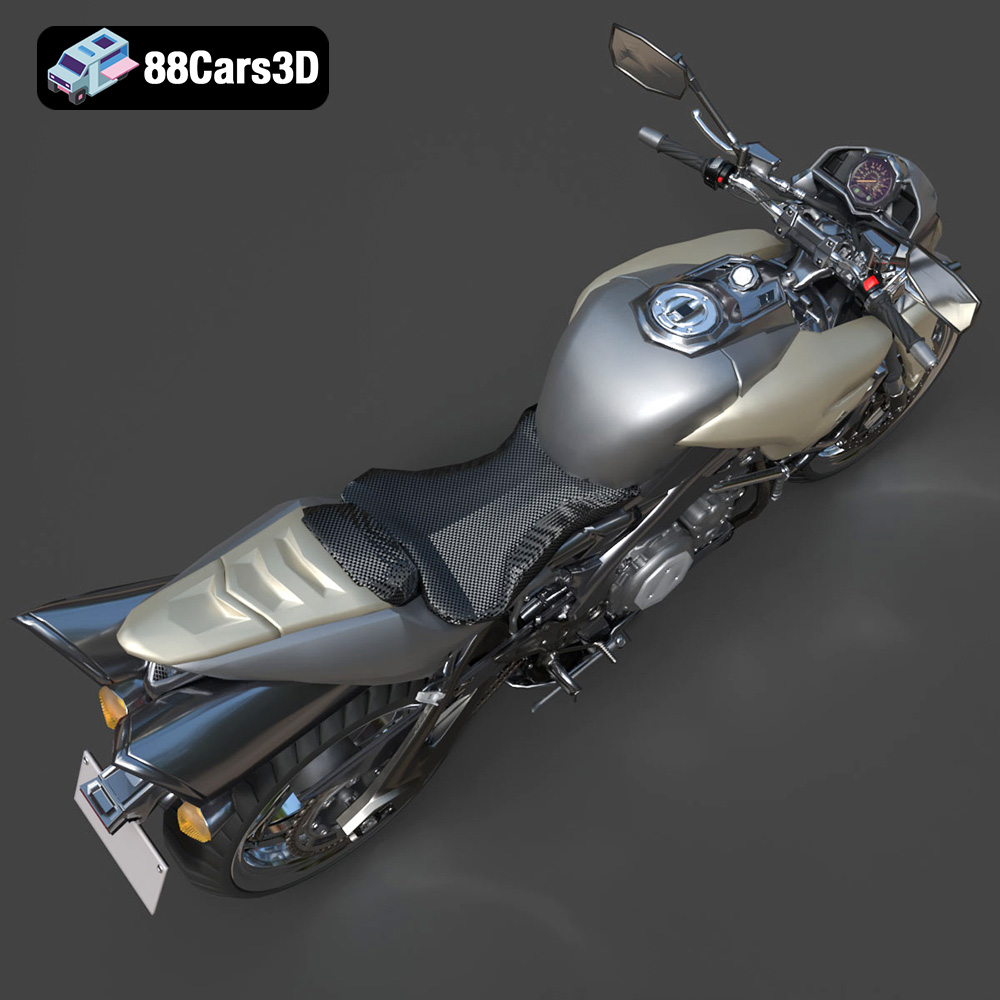
The Suzuki King B (B-King) 2008 is a legendary motorcycle, celebrated for its muscular aesthetics and the raw power of its Hayabusa-derived engine. Translating such an iconic machine into a digital asset requires a meticulous balance of artistic interpretation and technical precision. The Suzuki King B 2008 3D Model available at 88cars3d.com exemplifies this balance, offering a premium asset that is both visually stunning and highly optimized for diverse applications.
The exterior features of this 3D model are a testament to accurate replication. The model boasts precise frame geometry and proportions, capturing the imposing stance and aggressive lines of the original super naked motorcycle. Key components such as the detailed 1340cc inline-four engine block, prominent radiator cowls, and the signature massive dual under-seat exhaust system are all meticulously modeled. This level of detail extends to the distinctive futuristic headlight design, integrated taillights, intricate multi-spoke alloy wheels, and street-performance tires, ensuring that every angle holds up under scrutiny in high-end automotive rendering.
Beyond static realism, the model is engineered for dynamic use. It features separate wheels, suspension, and steering components. This crucial design choice enables seamless animation, allowing for realistic wheel rotation, responsive steering input, and authentic suspension travel – vital for dynamic in-game physics or cinematic sequences. The pivot points are correctly established, saving significant setup time for animators and technical artists.
The interior (cockpit) elements are equally well-considered, delivering an immersive experience, especially critical for first-person perspectives in gaming. The sculpted, ergonomic rider and pillion saddle details, wide aggressive streetfighter handlebar setup, and the digital/analog hybrid instrument cluster with hyper-detailed gauges all contribute to a sense of authenticity. Every lever, pedal, and control – from foot pegs to the brake, clutch, and gear shifter – is accurately represented, enhancing realism for racing simulations and virtual experiences.
Technically, the model hits a sweet spot for performance without sacrificing visual quality. With approximately 120,000 triangles, it strikes a near-perfect balance for real-time engines like Unreal and Unity. This optimized polycount ensures that the model can be rendered efficiently in complex game environments, contributing to smooth frame rates without appearing low-fidelity. Furthermore, its real-world scale accuracy, based on actual vehicle chassis data, guarantees correct integration into scenes alongside other assets. The proper pivot setup for all moving parts is a hidden gem for developers, streamlining the rigging and animation process considerably.
The true value of a premium 3D asset like the Suzuki King B 2008 3D Model lies in its seamless integration into various professional workflows. Whether your project demands ultra-realistic automotive rendering, high-performance game assets, or interactive AR/VR experiences, this model is engineered to accelerate your production pipeline.
For game developers, the Suzuki King B 2008 3D Model is a dream asset. Its optimized triangle count (~120,000) and game-ready status mean it can be directly imported into popular engines like Unreal Engine and Unity without extensive optimization work. The inclusion of `.fbx` and `.unreal` formats specifically caters to these environments. In Unreal Engine, for example, the `.unreal` package might include pre-configured materials, textures, and even basic physics assets, allowing developers to drop the motorcycle into a scene, apply relevant physics constraints, and immediately test its behavior. The accurately set pivots for wheels, steering, and suspension are crucial for implementing realistic vehicle dynamics, enabling seamless integration into racing titles or open-world games. The model’s clean topology also ensures that level of detail (LOD) generation, a critical step for performance optimization, can be done efficiently and effectively.
When it comes to creating stunning visuals for marketing, advertising, or product showcases, the Suzuki King B 2008 3D Model shines in professional automotive rendering environments. With `.max`, `.blend`, and `.obj` formats available, artists using 3ds Max, Blender, Maya, or Cinema 4D can leverage the model’s high-fidelity details. In a 3ds Max workflow, for instance, designers can import the `.max` file, which preserves all modeling data, allowing for intricate material application using renderers like V-Ray or Corona. Artists can swap out default textures, create custom paint finishes—from metallic flakes to matte wraps—and set up complex studio lighting scenarios to highlight the motorcycle’s aggressive form. In Blender, the native `.blend` file allows full access to the original node-based materials, enabling artists to modify reflections, refractions, and surface imperfections with granular control, producing photorealistic renders for brochures, virtual showrooms, or lifestyle imagery.
The burgeoning fields of Augmented Reality (AR) and Virtual Reality (VR) demand highly optimized assets that can perform smoothly on various devices, often with lower computational power. The Suzuki King B 2008 3D Model, with its balanced polycount and `.glb` format, is perfectly suited for these applications. For AR, the `.glb` format allows for quick loading and efficient display on mobile devices, enabling experiences like virtual motorcycle showrooms where users can place the King B in their real-world environment. In VR, the model can populate immersive environments, providing a realistic and interactive object for users to explore. Imagine a virtual motorcycle configurator where customers can customize paint, accessories, and view the bike from any angle in a fully immersive setting. The optimized geometry ensures a high frame rate, crucial for preventing motion sickness in VR and providing a responsive AR experience.
The versatility of a well-crafted 3D model extends far beyond digital screens. The Suzuki King B 2008 3D Model, with its detailed geometry and multiple file formats, also caters to the fascinating world of physical manifestation through 3D printing and offers extensive customization options to truly make the asset your own.
The inclusion of the `.stl` format is a significant advantage for enthusiasts and professionals looking to bring the Suzuki King B into the physical realm. The `.stl` format, being the universal standard for 3D printing, allows for direct input into slicing software. However, successful 3D printing requires careful consideration of settings. For a model as intricate as the King B, the recommended scales (1:12 / 1:18 / 1:24) are crucial for capturing fine details without excessive print time or material usage. Resin printing is often recommended for such detailed automotive models, as it allows for much finer layer heights (0.04–0.12 mm) compared to FDM, resulting in smoother surfaces and sharper edges on components like the engine fins or exhaust tips.
Structural integrity for physical models is also paramount. Recommendations for wall thickness (1.2–2.0 mm) and infill (20–30%) provide a solid base, while the necessity of supports for complex geometries like the under-seat exhaust, mirrors, and handlebars is a given for successful prints. Print orientation—such as printing the frame angled and wheels separately—is a common technique to minimize supports and maximize part strength. Post-processing, including sanding, priming, and applying authentic factory colors with metallic finishes, transforms a raw print into a display-worthy replica, bridging the gap between digital precision and tangible art.
While the Suzuki King B 2008 3D Model arrives with impeccable detail, its true power for creators lies in its inherent customizability. Digital assets, unlike their real-world counterparts, offer limitless possibilities for modification without physical constraints.
* Change Body/Tank Colors: Artists can easily modify the body and tank colors to match factory specifications from different years, explore concept color schemes, or apply custom finishes like chrome, iridescent paints, or unique graphic liveries. This is invaluable for marketing campaigns showcasing different trim levels or for game assets requiring player customization.
* Modify Tire Textures: The ability to swap or modify tire textures allows for adapting the motorcycle to various scenarios. From grippy street-performance tires for a race track render to rugged off-road variants for an adventurous scene, this flexibility broadens the model’s applicability.
* Adjust Material Finishes: Beyond color, the model allows for adjusting material properties. Artists can transform matte finishes to glossy, add metallic sheens to engine components, or introduce subtle wear and tear for a more “lived-in” look. This granular control over surface properties is essential for achieving photorealistic rendering.
* Adapt Lighting for Different Environments: The model’s robust material setup ensures it reacts realistically to various lighting conditions. This means it can be seamlessly integrated into diverse environments, from bright outdoor scenes to moody studio setups or neon-lit urban landscapes, without requiring extensive material re-work.
These customization options empower artists to not only use the Suzuki King B 2008 3D Model as a ready-made asset but also as a foundational element for limitless creative exploration, extending its value significantly across multiple projects.
In the fast-paced world of 3D content creation, the difference between good and great often hinges on the quality of the assets used. High-quality 3D car models, such as the Suzuki King B 2008 3D Model from 88cars3d.com, are not merely aesthetic enhancements; they are strategic investments that streamline production, elevate visual fidelity, and ultimately deliver superior results.
The most immediate benefit of leveraging premium, pre-made 3D assets is the immense time and resource savings. Creating a highly detailed, optimized 3D model from scratch, especially an automotive asset with complex curves and intricate mechanical components, can take hundreds of hours of a skilled artist’s time. This involves extensive blueprint research, meticulous modeling, UV mapping, texture painting, and optimization for various platforms. By acquiring a professional-grade asset like the Suzuki King B 2008 3D Model, studios and individual artists bypass this entire arduous process, allowing them to allocate their valuable time and talent to other critical aspects of their project, such as scene composition, animation, or interactive development. This efficiency translates directly into reduced project timelines and lower production costs.
Beyond efficiency, high-quality 3D models fundamentally elevate the overall quality of a project. A meticulously crafted model, with accurate proportions, precise geometry, and optimized materials, forms a solid foundation for any scene. The Suzuki King B 2008 3D Model, with its exceptional topology and attention to every detail, ensures that the motorcycle will look stunning whether it’s viewed up close in a cinematic render or as part of a larger game environment. This level of detail and realism creates a more immersive and believable experience for the audience, enhancing player engagement in games, conveying brand prestige in automotive rendering, or delivering impactful visualizations in architectural projects. Choosing a professional asset demonstrates a commitment to excellence and provides a competitive edge in an increasingly crowded digital landscape. Platforms like 88cars3d.com specialize in providing these types of assets, ensuring creators have access to the best tools to realize their artistic and technical ambitions.
The landscape of 3D content creation demands not only artistic vision but also technical mastery and efficient workflows. For designers, developers, and visual artists, the availability of premium 3D models is a game-changer, enabling them to reach new heights of realism and productivity. The Suzuki King B 2008 3D Model stands as a prime example of such an asset – meticulously crafted, technically optimized, and incredibly versatile.
From its precise exterior details and functional interior features to its game-ready optimization and comprehensive file format support, this model is engineered to seamlessly integrate into any professional pipeline. Whether you are crafting hyper-realistic automotive rendering scenes in 3ds Max, developing immersive racing game assets for Unreal Engine, designing interactive AR/VR experiences, or even fabricating a physical replica through 3D printing, the Suzuki King B 2008 3D Model provides a robust and reliable foundation. It represents the pinnacle of digital craftsmanship, offering both aesthetic beauty and technical prowess to accelerate your creative journey. Explore this exceptional model and a wide array of other high-quality 3D car models at 88cars3d.com to empower your next project with unparalleled digital assets.
The Suzuki King B (B-King) 2008 is a legendary naked streetfighter motorcycle that commands attention with its imposing stance and aggressive styling. Born from a radical concept, it features the heart of the iconic Hayabusa, showcasing a massive 1340cc inline-four engine, dual under-seat exhausts, and distinctive muscular bodywork that defined a new era of hyper-naked bikes. This premium 3D model features exceptional topology and an optimized triangle count, ensuring game-ready performance without compromising visual fidelity. It is expertly crafted for high-end rendering, game development, AR/VR experiences, and animation, capturing every intricate detail of the original super naked motorcycle. Perfect for high-octane racing games, urban street environments, virtual motorcycle showrooms, and detailed architectural visualization scenes.
$39.99
.2008
.blend
.fbx
.glb
.max
.motorcycle
.obj
.ply
.rendering
.stl
.streetfighter
.suzuki
.unreal
b-king
game asset
game-ready
hyper-naked
king-b
low-poly
motorcycle-3d-model
naked-bike
optimized
VR/AR