Get 20% OFF All Premium 3D & STL Models!

In the fast-evolving world of 3D visualization, the demand for high-fidelity, production-ready assets is greater than ever. Whether you’re an automotive designer, a game developer, an architect, or a marketing professional, the quality of your 3D models can make or break your project. Precision, clean geometry, and optimized performance are not just buzzwords; they are fundamental requirements for achieving professional results that truly stand out.
Creating photorealistic vehicles from scratch is a labor-intensive process, demanding extensive modeling, texturing, rigging, and optimization expertise. It’s a journey from capturing intricate design details to ensuring seamless integration into diverse digital pipelines. This is where leveraging professionally crafted 3D car models becomes not just a convenience, but a strategic advantage. It allows artists and studios to focus on their core creative tasks, saving valuable time and resources while guaranteeing a level of quality that’s difficult to achieve independently without significant investment.
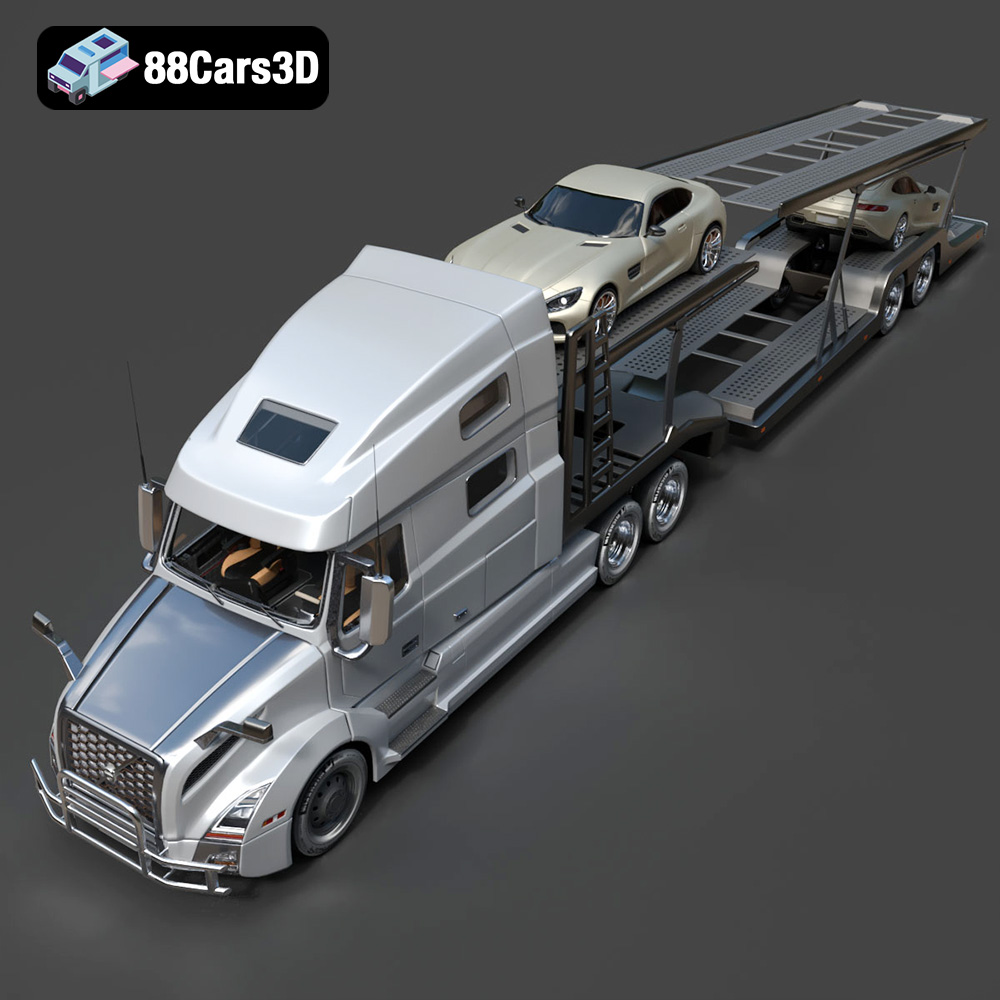
Today, we’re diving deep into the technical intricacies and creative possibilities unlocked by such assets, using the exceptional Volvo Trucks Benz GT-001 3D Model as our prime example. This model, available on 88cars3d.com, encapsulates the essence of what a professional-grade 3D vehicle should be: robust presence, intricate aesthetic, and optimal performance across multiple platforms. It’s not just a model; it’s a foundation for innovation, ready to be deployed in anything from cinematic renders to interactive AR/VR experiences.
The versatility of a 3D model often hinges on the range of file formats it supports. Each format is designed with specific use cases and software ecosystems in mind, offering unique advantages for different stages of a production pipeline. The Volvo Trucks Benz GT-001 3D Model comes with a comprehensive suite of formats, ensuring seamless integration into virtually any professional workflow.
The .blend format is native to Blender, a powerful and increasingly popular open-source 3D creation suite. A .blend file typically includes not just the mesh data, but also materials, textures, lighting setups, cameras, animations, and even physics simulations. For artists working in Blender, having a fully editable .blend scene, complete with pre-configured materials and lighting, is invaluable. It allows for immediate customization, scene setup, and rendering without the need to import and re-configure elements, making it ideal for creative iteration and precise adjustments.
.fbx (Filmbox) is a proprietary file format owned by Autodesk, widely recognized as the industry standard for interoperability between 3D software and game engines. Its strength lies in its ability to store a vast array of 3D data, including geometry, materials, textures, animations, skinning, and even camera and light data. When preparing assets for Unreal Engine, Unity, or other real-time pipelines, .fbx is often the format of choice due to its robust support for these complex data types, ensuring that animated vehicles, for instance, retain all their kinematic properties when imported.
The .obj (Wavefront OBJ) format is one of the oldest and most universally supported 3D file formats. It’s renowned for its simplicity and excellent cross-software compatibility. An .obj file primarily stores geometric data (vertices, faces, UVs) and can reference external material (.mtl) and texture files. While it doesn’t store animation or complex scene data, its widespread adoption makes it an indispensable format for sharing static mesh data between different 3D applications, from 3ds Max to Blender, Maya, and beyond, without compatibility headaches.
.glb (GL Transmission Format Binary) is the binary version of glTF, an open standard developed by the Khronos Group. It’s specifically optimized for efficient transmission and loading of 3D scenes and models in web applications, augmented reality (AR), and virtual reality (VR) environments. A .glb file encapsulates all necessary data—geometry, materials, textures, animations—into a single, compact file, making it perfect for delivering lightweight, interactive 3D experiences directly within browsers or mobile devices. Its PBR (Physically Based Rendering) material support ensures consistent visual fidelity across platforms.
.stl (Stereolithography) is the de facto standard format for 3D printing. It represents a 3D model as a collection of unconnected triangular facets, defining the surface geometry of an object. While it doesn’t store color, texture, or material information, its simplicity makes it universally compatible with 3D printers and slicing software. For prototyping or creating physical replicas of the Volvo Trucks Benz GT-001 3D Model, the .stl file provides the precise mesh data required for manufacturing.
.ply (Polygon File Format, or Stanford Triangle Format) is another format for storing 3D data, often used in scientific and academic contexts, particularly for scanned data. It can store a wider range of properties than .obj, including color, transparency, surface normals, and even confidence values. While less common for general artistic asset transfer, it’s a robust format for precision mesh analysis, archival, and applications requiring highly detailed point cloud or polygonal data.
The inclusion of an .unreal file (often a .uasset or a specifically structured folder containing .uassets) signifies a model that has been pre-configured and optimized for direct import into Unreal Engine. This means materials are set up, textures are correctly referenced, and sometimes even collision meshes or LODs (Levels of Detail) are already integrated. For game developers or real-time visualization specialists using Unreal Engine, this dramatically reduces setup time and ensures the model performs optimally within the engine’s ecosystem.
Finally, the .max format is the native file type for Autodesk 3ds Max, a leading software for 3D modeling, animation, and rendering in professional visualization and design. A .max file contains the complete scene, including geometry, materials, textures, lighting, cameras, animation keyframes, and plugins. For those working within the 3ds Max environment, having an editable .max file of the Volvo Trucks Benz GT-001 provides maximum flexibility for intricate animations, high-resolution rendering, and integrating the model into existing studio pipelines.
The availability of such a diverse array of formats for the Volvo Trucks Benz GT-001 3D Model underscores its professional utility, allowing users to select the optimal format for their specific project needs, ensuring maximum compatibility and efficiency.
Automotive rendering is a specialized field that blends artistic vision with technical precision. It’s about more than just showcasing a vehicle; it’s about evoking emotion, highlighting design philosophy, and presenting every curve and reflection with photorealistic accuracy. Achieving this requires not only powerful rendering software but also meticulously crafted 3D assets.
The foundation of a stunning render lies in its materials and textures. For a truck like the Volvo Trucks Benz GT-001, this means developing complex shaders for paintwork that simulate metallic flakes and clear coats, realistic rubber for tires, chrome for accents, and various plastics and fabrics for the interior. Physically Based Rendering (PBR) workflows are standard, utilizing maps like Albedo (or Base Color), Metallic, Roughness, Normal, and Ambient Occlusion to accurately simulate how light interacts with surfaces. The Volvo Trucks Benz GT-001 3D Model is built with these principles in mind, ensuring its materials translate beautifully across different renderers like V-Ray, Corona, or Cycles in Blender.
Just as in real-world photography, lighting is paramount in 3D rendering. Automotive renders often utilize High Dynamic Range Image (HDRI) maps to simulate realistic environmental lighting, providing natural reflections and ambient illumination. Coupled with targeted area lights, spot lights, and volumetric effects, an artist can create stunning studio shots or immerse the vehicle in a believable outdoor scene. The editable .max and .blend files included with the Volvo Trucks Benz GT-001 offer a perfect starting point, often coming with pre-configured lighting setups that can be fine-tuned to achieve specific moods and highlights.
Once a raw render is complete, post-production in software like Photoshop or Fusion elevates it to cinematic quality. Techniques such as color grading, lens flares, depth of field, motion blur, and subtle atmospheric effects are applied to enhance realism and visual drama. For professional automotive visualizations, meticulous attention to these details ensures that the final image or animation resonates with the target audience, whether for marketing campaigns or design reviews.
Game development and real-time applications like architectural walkthroughs demand a different kind of optimization compared to offline rendering. Performance is king, and every polygon, every texture, and every draw call matters. The Volvo Trucks Benz GT-001 3D Model is engineered with this balance in mind, offering clean geometry that is suitable for real-time environments without sacrificing visual fidelity.
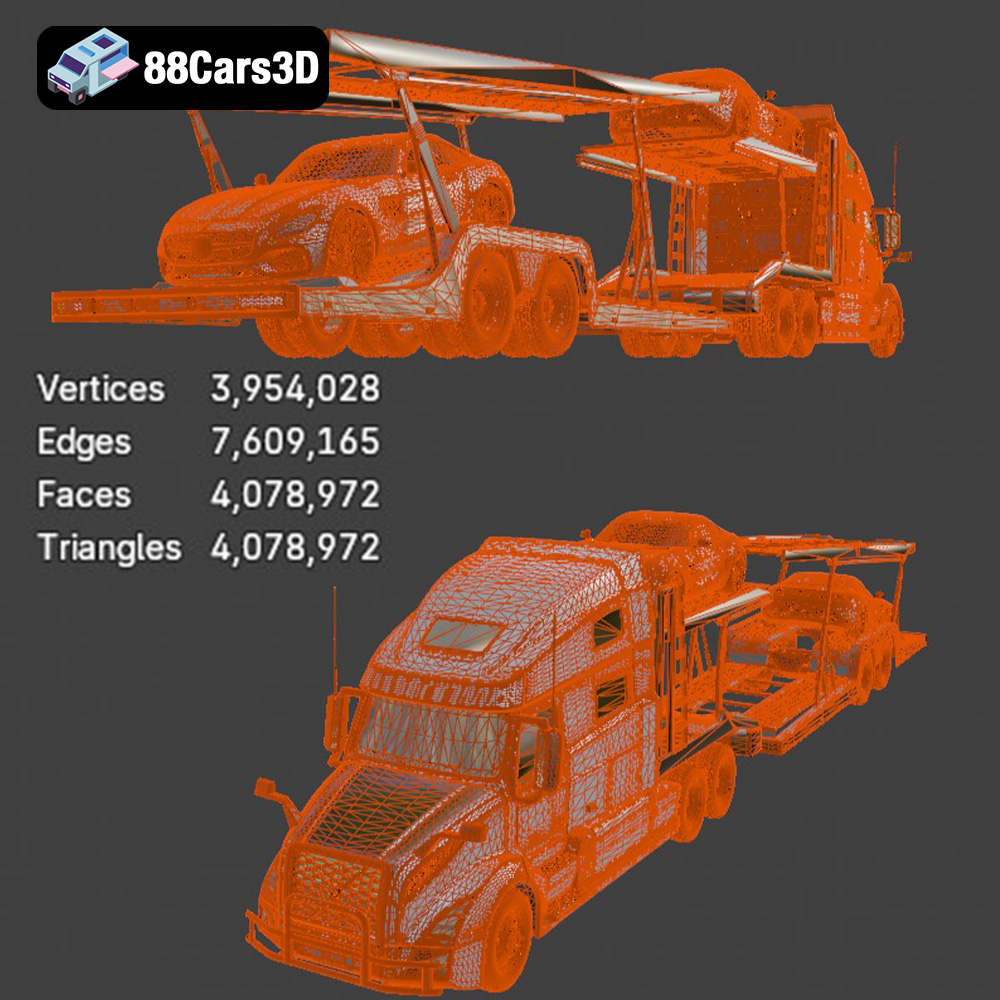
Game engines have strict polygon budgets to maintain high frame rates. While the Volvo Trucks Benz GT-001 features detailed geometry, including a fully modeled interior, it’s crucial for developers to manage its complexity. This is where Levels of Detail (LODs) come into play. LODs are simplified versions of a model that automatically swap in as the camera moves further away, reducing the polygon count of distant objects without noticeable visual degradation. A professional asset like this is designed to facilitate the creation of effective LODs, ensuring optimal performance for dynamic game environments or interactive simulations.
Efficient UV mapping is vital for texture quality and performance. Clean, non-overlapping UVs ensure textures are applied correctly and utilize space effectively. For game assets, consolidating multiple textures into a single texture atlas (a large image containing many smaller textures) can significantly reduce draw calls, improving rendering speed. The professional crafting of the Volvo Trucks Benz GT-001 implies well-organized UVs, making it easier to implement these optimization strategies within engines like Unreal and Unity, supported by its .fbx and .unreal file formats.
In game development, vehicles need collision detection and realistic physics. Custom collision meshes, which are simplified versions of the model used solely for collision calculations, are often created to improve performance over using the high-poly visual mesh. Physics assets, defining aspects like mass, inertia, and suspension, are then integrated to ensure the truck behaves realistically within the game engine. The robust geometry of the Volvo Trucks Benz GT-001 provides an excellent base for developing accurate collision and physics assets, contributing to an immersive gameplay experience.
Augmented Reality (AR) and Virtual Reality (VR) are transforming how we interact with 3D content, offering unprecedented levels of immersion. The Volvo Trucks Benz GT-001 3D Model is particularly well-suited for these cutting-edge applications, as well as for high-stakes industrial visualizations.
Imagine showcasing a new truck concept by letting potential buyers walk around it in AR, projected onto their driveway, or sit inside it in a VR showroom. The clean geometry, authentic proportions, and realistic materials of the Volvo Trucks Benz GT-001 are perfect for such interactive experiences. The .glb format, specifically optimized for AR/VR and web-based display, ensures that the model loads quickly and maintains visual fidelity across various devices, from standalone VR headsets to smartphones. Its fully modeled interior further enhances immersion, allowing users to explore the cabin from a first-person perspective.
Beyond entertainment, industrial visualization uses 3D models for critical applications like training simulations, logistics planning, and design reviews. A highly detailed and accurate model like the Volvo Trucks Benz GT-001 can be integrated into simulators for driver training, allowing operators to practice in a safe, virtual environment. Engineers can use it for ergonomic studies or to visualize how the truck interacts with complex infrastructure. The precision and realism offered by 88cars3d.com’s models are invaluable for these professional contexts, providing a clear and unambiguous representation of the real-world asset.
With its high quality and multi-format support, the Volvo Trucks Benz GT-001 model can be the backbone of real-time vehicle configurators, allowing customers to customize colors, wheels, and accessories interactively. Furthermore, it can contribute to the creation of ‘digital twins’ – virtual replicas of physical assets used for monitoring, analysis, and optimization throughout their lifecycle. This level of utility underscores the long-term value of investing in premium 3D assets.
The journey of a vehicle often starts as a digital concept, but quickly moves into the physical realm for prototyping and testing. 3D printing has revolutionized this process, allowing designers to rapidly iterate on physical models directly from their 3D data. The Volvo Trucks Benz GT-001 3D Model provides the necessary data for this transition.
The inclusion of an .stl file makes the Volvo Trucks Benz GT-001 directly suitable for 3D printing. Designers can print scale models for aesthetic evaluation, ergonomic testing, or as tangible representations during presentations. This rapid prototyping capability significantly speeds up the design cycle, allowing for early detection of issues and quick modifications, thereby reducing costs and development time. Even complex internal components or specific design features can be isolated and printed for detailed examination.
When preparing the model for 3D printing, considerations extend beyond just the digital file. The choice of printing material (e.g., PLA, ABS, resin, metal) will depend on the desired properties of the physical prototype – strength, finish, flexibility, or even transparency. The clean geometry of the Volvo Trucks Benz GT-001 ensures that the mesh is watertight and manifold, crucial characteristics for successful 3D prints, preventing errors during slicing and ensuring a solid physical object.
The true value of a professional 3D car model from a source like 88cars3d.com lies in its ability to streamline production pipelines and elevate output quality. Instead of spending hundreds of hours on modeling and texturing, artists can immediately jump into creative tasks, knowing they have a solid, optimized foundation.
For studios and freelancers, time is money. Developing a complex vehicle model like the Volvo Trucks Benz GT-001 from scratch can take weeks or even months of dedicated effort. Purchasing a pre-made, high-quality asset is a significant time-saver, freeing up resources for animation, scene composition, interaction design, or client revisions. This efficiency directly translates to cost savings and faster project turnaround, allowing teams to take on more projects or meet tighter deadlines.
Premium 3D models adhere to professional standards for geometry, UVs, and materials. This means clean topology (quads), efficient polygon counts, proper scaling, and PBR-ready textures. Such models minimize the need for extensive clean-up or rework, ensuring compatibility across different software and rendering engines. This inherent quality from 88cars3d.com provides peace of mind, allowing artists to integrate the Volvo Trucks Benz GT-001 confidently into critical projects.
The multi-format delivery of the Volvo Trucks Benz GT-001, including .blend, .fbx, .obj, .glb, .stl, .ply, .unreal, and .max, offers unparalleled flexibility. A single purchase can serve multiple project types – a cinematic advertisement (3ds Max, Blender), a new racing game (Unreal, Unity via FBX), an AR marketing campaign (GLB), or even a physical product showcase (STL). This adaptability makes it an incredibly versatile asset for any studio’s digital library.
In the dynamic realm of 3D visualization, the quality and adaptability of your assets are paramount. From producing breathtaking automotive renders to developing immersive game environments, crafting interactive AR/VR experiences, or driving industrial innovation through prototyping, the right 3D car models are essential tools for success. The Volvo Trucks Benz GT-001 3D Model stands as a testament to what professional-grade digital assets can offer: precision, versatility, and optimal performance across a multitude of applications.
By providing clean geometry, authentic proportions, realistic materials, and a comprehensive suite of industry-standard file formats, this model empowers professionals to push creative boundaries and achieve unparalleled results. It seamlessly integrates into complex workflows, whether you are leveraging the power of 3ds Max for animation, Blender for artistic freedom, or Unreal Engine for real-time interactivity. Investing in such meticulously crafted assets from trusted sources like 88cars3d.com is not just a purchase; it’s an investment in efficiency, quality, and the boundless potential of your digital projects.
Explore the full potential of your next automotive project with a foundation built on excellence. The future of digital content creation is here, and it’s driven by premium 3D models that bridge the gap between imagination and stunning reality.
Discover exceptional digital realism with the Volvo Trucks Benz GT-001 3D Model, crafted for professionals seeking precision and accuracy in vehicle design. This model captures the robust presence and intricate aesthetic of the original vehicle, providing an incredible asset for your digital environment. Engineered with clean geometry, authentic proportions, and realistic materials, this model delivers a professional standard without unnecessary polygon overhead. Every detail is meticulously constructed to ensure optimal performance across various platforms. It perfectly highlights the modern design elements and functional features synonymous with premium truck concepts. Whether you are working on game development, creating cinematic rendering sequences, building interactive AR/VR experiences, or producing industrial visualizations, this versatile model provides the foundation you need. The inclusion of a fully modeled interior expands its utility for both external showcase shots and immersive first-person simulation setups. The package includes a comprehensive set of industry-standard file formats to guarantee seamless integration into any pipeline:
Tags: .volvo, .volvotrucks, .benz, .gt001, .truck, .commercialvehicle, .concepttruck, .car3dmodel, .rendering, .simulation, .gameasset, .arvr, .blend, .fbx, .obj, .glb, .stl, .ply, .unreal, .max
$39.99
.arvr
.benz
.blend
.car3dmodel
.commercialvehicle
.concepttruck
.fbx
.gameasset
.glb
.gt001
.max
.obj
.ply
.rendering
.simulation
.stl
.truck
.unreal
.volvo
.volvotrucks