Get 20% OFF All Premium 3D & STL Models!

In the exhilarating world of automotive design, game development, and hyper-realistic visualization, precision and authenticity are paramount. Whether you’re crafting a high-octane racing simulator, developing an immersive AR experience, or simply aiming for a stunning render that blurs the line between digital and reality, the foundation of your project lies in the quality of your 3D assets. Few vehicles command attention quite like the Kawasaki Ninja, a name synonymous with speed, agility, and cutting-edge design.
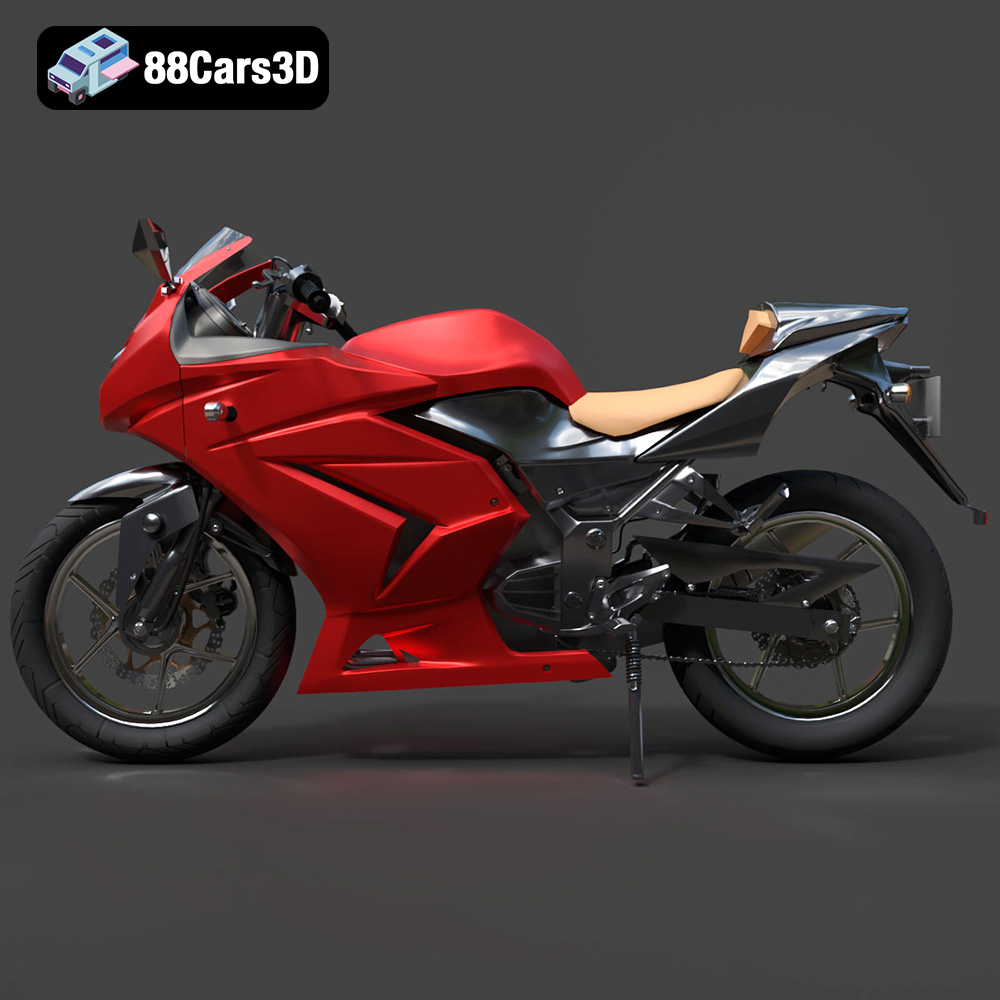
For professionals seeking to integrate this iconic machine into their projects, a meticulously crafted 3D model is indispensable. Imagine a digital replica that not only looks identical to its real-world counterpart but is also optimized for seamless integration into various pipelines – from game engines to architectural visualization suites. This is precisely what the Kawasaki Ninja 3D Model offers, providing an unparalleled blend of visual fidelity and technical readiness. From its aggressive dual-headlight fascia to the finely tuned inline-four engine, every curve and component has been faithfully recreated, offering artists and developers a powerful tool to elevate their creations. This isn’t just a model; it’s a gateway to bringing the spirit of the Ninja into your digital realm, serving as a prime example of the high-quality 3D car models available at 88cars3d.com.
Choosing the correct file format is a critical decision in any 3D workflow, impacting compatibility, feature retention, and overall project efficiency. A high-quality asset like the Kawasaki Ninja 3D Model is typically offered in a variety of formats to ensure maximum versatility across different software and applications. Understanding the strengths and weaknesses of each is crucial for seamless integration and optimal performance.
The .blend format is Blender’s native file type, offering a complete scene package. When you acquire a .blend file, you’re not just getting the mesh; you’re getting the entire Blender project. This includes materials, textures, lighting setups, cameras, animations, modifiers, and even custom scripts. For artists deeply integrated into the Blender ecosystem, this provides the most flexibility for editing, customization, and non-destructive workflows. The Kawasaki Ninja 3D Model in .blend format allows for direct manipulation of its intricate geometry, material adjustments using Blender’s powerful node-based shader editor, and easy scene integration.
.fbx (Filmbox) is arguably the most widely adopted interchange format in the 3D industry, particularly favored for game development and animation pipelines. Developed by Autodesk, FBX excels at preserving complex scene data such as hierarchical structures (parent-child relationships), animations, skinning information, cameras, and lights, in addition to mesh data and PBR (Physically Based Rendering) materials. Its robust nature makes it the go-to format for exporting assets between different DCC (Digital Content Creation) applications like 3ds Max, Maya, Blender, and directly into game engines like Unreal Engine and Unity. The Kawasaki Ninja 3D Model in .fbx ensures that all its separated parts, proper pivot setups, and material assignments are preserved when moving into a real-time environment.
The .obj (Wavefront OBJ) format is a venerable and highly compatible format, often considered a universal standard for transmitting basic 3D mesh data. It stores geometry (vertices, faces, normals, UV coordinates) and can reference external .mtl (material template library) files for color and texture information. While .obj is excellent for static models and offers near-universal compatibility across almost all 3D software, it does not support animation, rigging, or complex scene hierarchies. For simple model exchange or as a fallback when other formats fail, the .obj version of the Kawasaki Ninja 3D Model provides reliable geometric data.
.glb (GL Transmission Format Binary) is a relatively newer format designed for efficient transmission and loading of 3D scenes and models in web and AR/VR applications. It’s the binary version of glTF, packaging all assets (geometry, textures, animations, PBR materials) into a single, compact file. This “all-in-one” characteristic makes .glb incredibly efficient for browser-based display, mobile AR experiences, and anywhere file size and quick loading are critical. The Kawasaki Ninja 3D Model in .glb format is perfect for virtual showrooms or interactive web configurators, delivering high visual quality with optimized performance.
.stl (Stereolithography) is the standard file format for 3D printing. It represents a 3D model as a collection of unconnected triangular facets, defining only the surface geometry of an object without color, texture, or material information. For designers looking to bring the Kawasaki Ninja 3D Model into the physical realm, the .stl format is essential. It requires a manifold mesh (watertight) to ensure successful printing, and the detailed geometry of the Ninja model is optimized for this purpose, allowing hobbyists and professionals to create physical replicas at various scales.
The .ply (Polygon File Format) is often used for storing 3D data from 3D scanners, CAD systems, and scientific applications. It can store not only polygonal mesh data but also additional properties like color per vertex, normal vectors, and even transparency. While less common for general asset exchange than FBX or OBJ, its ability to store highly detailed and attributed mesh data makes it valuable for specific use cases requiring precision and additional vertex-level information, such as reverse engineering or detailed analysis.
While not a standalone file format in the same vein as .fbx or .obj, the term .unreal typically refers to assets specifically prepared, optimized, or even pre-imported into an Unreal Engine project. This signifies that the asset has undergone the necessary setup within the engine—collision meshes, LODs (Levels of Detail), material instances, and blueprint integrations—to be immediately usable in an Unreal environment. For game developers, having the Kawasaki Ninja 3D Model available as an “Unreal-ready” asset significantly cuts down on integration time, allowing them to drop it directly into their scenes with minimal further configuration.
The .max format is Autodesk 3ds Max’s native file type, akin to Blender’s .blend. It encompasses the entirety of a 3ds Max scene, including all geometry, textures, materials, lighting, cameras, animations, rigging, and modifiers. For professionals working within the 3ds Max environment, this format provides the most complete and editable version of the Kawasaki Ninja 3D Model, enabling full control over every aspect of the asset for high-end rendering, complex animations, or further architectural visualization integrations. This allows leveraging powerful rendering engines like V-Ray or Corona directly within the native environment.
The availability of the Kawasaki Ninja 3D Model in such a comprehensive array of formats from 88cars3d.com underscores its utility across the diverse landscape of 3D production.
Creating a truly high-quality 3D car model, especially one as iconic as the Kawasaki Ninja, goes far beyond simply replicating its shape. It involves a meticulous balance of artistic skill and technical precision to ensure the model is both visually stunning and functionally adaptable for various applications. The Kawasaki Ninja 3D Model stands as a testament to this philosophy, engineered for peak performance in diverse digital environments.
The aggressive styling of the Kawasaki Ninja is its signature, and this 3D model captures every nuance with remarkable fidelity. From the accurate frame geometry and proportions that define its lean, athletic stance to the distinctive dual-headlight assembly, every aspect reflects the real-world machine. The detailed inline-four engine block, often considered the heart of a sportbike, is not merely suggested but faithfully recreated with intricate components, lending an air of mechanical realism. Even the upswept exhaust system, a common aesthetic and performance element, features realistic metallic shading that reacts authentically to virtual lighting setups. High-performance alloy wheels and sport-compound tires are not just textures but detailed geometric elements, capable of supporting close-up renders and dynamic animations. The inclusion of telescopic front forks and a rear monoshock suspension, alongside separated components for wheels, suspension, and steering, highlights the model’s readiness for advanced animation rigs and physics simulations.
While often overlooked in external renders, the cockpit and rider’s perspective are crucial for gaming and AR/VR experiences. The Kawasaki Ninja 3D Model meticulously addresses this with an ergonomic split-seat design featuring realistic texture details, ensuring a convincing visual even from a first-person POV. The clip-on handlebars are equipped with integrated switchgear and grips, providing a sense of tangible interaction. A digital/analog hybrid instrument cluster is modeled to accurately reflect the bike’s dashboard, enhancing realism for player views. Adjustable rearset footpegs, gear shifter, and brake levers further contribute to the immersive quality, making the model ideal for detailed virtual rides or intricate product showcases.
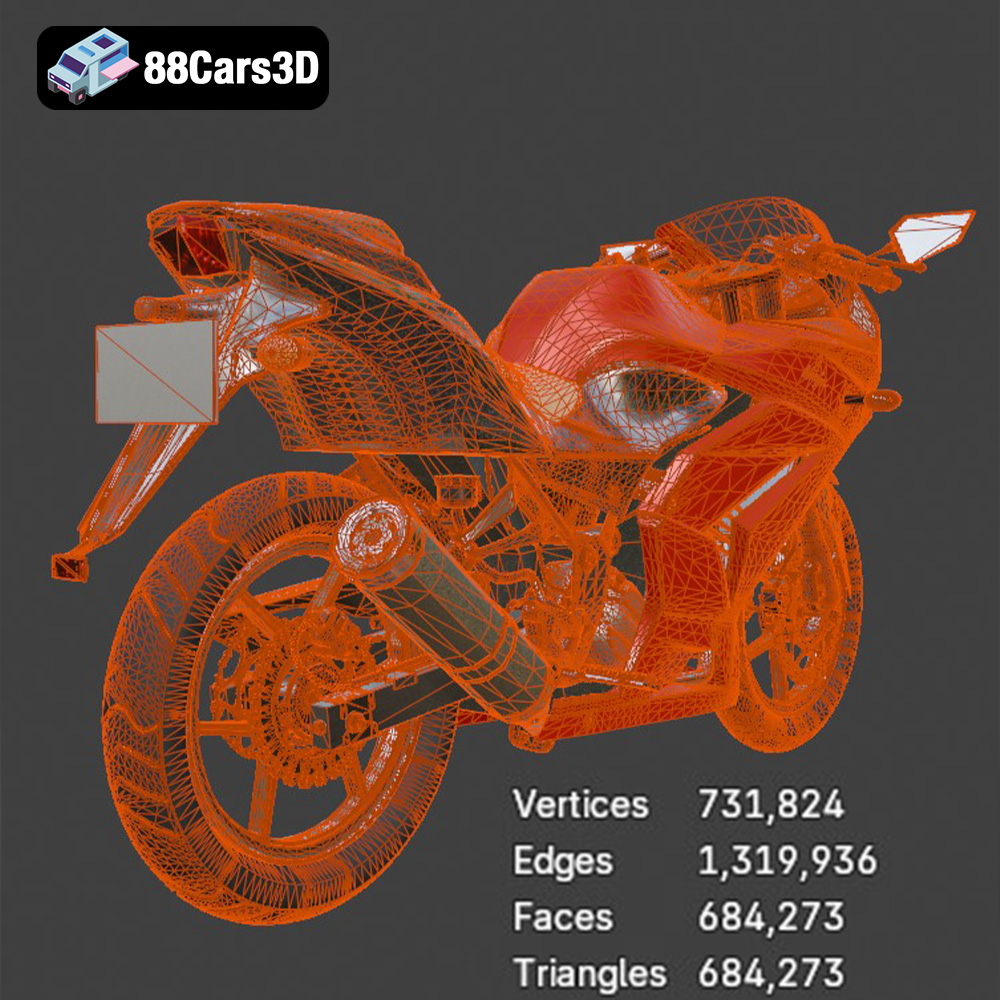
A critical technical advantage of this model is its optimized topology. With approximately 150,000 triangles, it strikes a near-perfect balance between visual realism and real-time performance. This “game-ready” polycount ensures that the model renders smoothly in demanding game engines like Unreal and Unity without compromising on high-end visual fidelity. Furthermore, the model adheres to real-world scale accuracy, based on actual vehicle chassis dimensions. This precision is vital for integration into existing environments, ensuring correct proportions alongside other assets and accurate physics simulations. Proper pivot setups for steering, wheel rotation, and suspension travel are pre-configured, drastically reducing setup time for animators and game developers, making this an ideal game asset.
The versatility of a premium 3D model is defined by its ability to seamlessly integrate into various professional pipelines. The Kawasaki Ninja 3D Model, available on 88cars3d.com, is engineered with this multi-platform compatibility in mind, empowering artists and developers across diverse sectors.
For game developers, the Kawasaki Ninja 3D Model is an immediate asset for creating immersive racing titles, open-world adventures, or realistic simulators. Its optimized polycount (~150,000 triangles) is a sweet spot, providing ample detail for modern game engines while maintaining efficient real-time performance. When imported as an .fbx or utilizing the .unreal package, the model’s separated parts and correct pivot setups mean that rigging for suspension, steering, and wheel rotation is straightforward, saving invaluable development time. Developers can easily apply custom physics assets, create LODs (Levels of Detail) for performance optimization, and integrate it into existing vehicle systems. Imagine it as a hero vehicle in a city driving game, a track weapon in a simulation, or even a background prop in an expansive virtual environment.
The burgeoning fields of Augmented Reality (AR) and Virtual Reality (VR) demand highly optimized yet visually rich assets. The Kawasaki Ninja 3D Model is perfectly suited for creating interactive virtual showrooms, product configurators, or engaging mobile AR experiences. Using the .glb format, the model can be effortlessly deployed on web platforms or mobile applications, allowing users to inspect the bike from all angles, change colors, or even “place” it in their own physical space. Its accurate scaling and detailed geometry ensure a convincing presence, making it an invaluable tool for automotive brands seeking innovative ways to present their products or for educational purposes.
For advertising agencies, architectural visualization studios, or cinematic productions, the Kawasaki Ninja 3D Model provides a high-fidelity foundation for stunning renders. Whether working in 3ds Max (.max file) with V-Ray or Corona, or Blender (.blend file) with Cycles or Eevee, the model’s clean topology, high-quality materials, and real-world scale are ideal. Artists can set up studio lighting, composite the bike into architectural scenes, or create dynamic promotional videos. The ability to customize body/tank colors, modify tire textures, and adjust material finishes (matte, gloss, metallic) allows for limitless creative expression, ensuring each render is unique and visually impactful, showcasing the pinnacle of automotive rendering.
The utility of a robust 3D model extends beyond digital screens, offering tangible outputs and diverse visualization possibilities. The Kawasaki Ninja 3D Model is designed with this versatility in mind, bridging the gap between virtual and physical realms, and expanding its application scope significantly.
For hobbyists, collectors, or designers looking for a physical representation, the Kawasaki Ninja 3D Model can be easily converted to an .stl format for 3D printing. This capability opens up avenues for creating display-scale models, custom prototypes, or even educational tools. The technical specifications provided with the model, such as recommended scales (1:12, 1:18, 1:24), layer heights, and infill percentages, ensure a successful printing experience. Resin printing is often recommended for capturing the fine details, especially on intricate parts like the exhaust, mirrors, and handlebars. Furthermore, the suggestion for specific print orientations (e.g., frame angled for structural integrity, wheels separately) and post-processing steps like sanding, priming, and painting with authentic factory colors, transforms the raw print into a museum-quality replica. This hands-on capability truly brings the digital asset into the physical world.
A truly professional 3D asset provides ample room for customization, allowing artists to tailor it to specific project requirements. The Kawasaki Ninja 3D Model excels in this regard. Its separated parts and well-structured materials allow for straightforward modifications. Users can easily change body and tank colors to match factory variants or apply custom finishes, experimenting with different aesthetics. Modifying tire textures can instantly shift the bike’s context, from a pristine street machine to an off-road beast. Adjusting material finishes from matte to gloss or metallic can drastically alter its perceived value and visual impact under various lighting conditions. This level of adaptability ensures that the model can serve a wide range of visualization needs, from high-end marketing campaigns to bespoke personal projects.
Beyond static renders, the Kawasaki Ninja 3D Model is ideal for interactive visualization tools. Leveraging its game-ready optimization and various file formats (especially .glb for web), companies can create compelling online configurators where potential buyers can customize their dream bike in real-time. Imagine selecting different paint schemes, wheel types, or accessory packages, and seeing the changes instantly applied in a fully rendered 3D environment. This level of engagement significantly enhances the customer experience and provides valuable insights into product customization preferences, making it a powerful marketing and sales tool.
The true measure of a professional 3D asset lies not just in its visual appeal but in its underlying technical craftsmanship. The Kawasaki Ninja 3D Model exemplifies this, offering a suite of technical specifications and advantages that make it a robust solution for demanding digital production environments.
One of the most critical specifications for real-time applications like game development or AR/VR is the polygon count, often measured in triangles. The Kawasaki Ninja 3D Model boasts approximately 150,000 triangles. This figure represents a meticulously engineered sweet spot. For game developers, a model with too few polygons lacks detail, appearing blocky and unrealistic. Conversely, a model with an excessively high polycount can severely impact performance, leading to frame rate drops and long loading times. 150,000 triangles provide enough geometric detail to capture the sleek curves and intricate components of the Ninja, ensuring high-end visual realism, while remaining lean enough to render efficiently in real-time engines such as Unreal Engine and Unity. This balance is key to creating engaging and smooth interactive experiences, ensuring the model is a true game asset.
Precision in scale is non-negotiable for professional 3D artists. The Kawasaki Ninja 3D Model is built to real-world scale, accurately mirroring the dimensions of an actual vehicle chassis. This isn’t merely a cosmetic detail; it’s fundamental for correct integration into larger scenes, especially in architectural visualization, cinematic production, or virtual reality environments where objects must appear proportionate to human scale and other assets. Accurate scaling also ensures that physics simulations behave predictably within game engines, from collision detection to suspension dynamics, contributing to a more believable and immersive user experience.
Animation and interactivity hinge on correctly set up pivot points. The Kawasaki Ninja 3D Model comes with a proper pivot setup for crucial interactive elements: steering, wheel rotation, and suspension travel. This pre-configuration saves animators and developers significant setup time. Instead of manually identifying and adjusting pivot origins for each component, they can immediately begin animating realistic steering movements, natural wheel spins, and accurate suspension compression and rebound. This attention to detail dramatically streamlines the animation pipeline and facilitates the integration of the model into complex interactive systems, allowing for dynamic camera shots and realistic vehicle behavior.
The versatility of a 3D model is often defined by its compatibility across various software platforms and rendering engines. As highlighted earlier, the Kawasaki Ninja 3D Model is available in a comprehensive range of file formats including .blend, .fbx, .obj, .glb, .stl, .ply, .unreal, and .max. This extensive format support ensures compatibility with virtually all major 3D software (Blender, 3ds Max, Maya, Cinema 4D) and real-time engines (Unreal Engine, Unity). This means that regardless of your preferred toolset or project requirements, the model can be imported, modified, and rendered with minimal friction, making it an incredibly flexible asset for any professional studio or independent artist.
The demand for high-quality, technically proficient 3D assets continues to surge across industries, from game development and automotive rendering to AR/VR and 3D printing. The Kawasaki Ninja 3D Model represents the pinnacle of this demand, offering an expertly crafted digital replica of a legendary sportbike. Its meticulous detail, from the aggressive exterior features to the immersive cockpit, ensures visual authenticity that meets the most stringent professional standards.
Beyond its striking appearance, the model’s technical specifications truly set it apart. Its game-ready optimization with a balanced polycount, real-world scale accuracy, and pre-configured pivot points make it an ideal asset for immediate integration into real-time engines and complex animation pipelines. The comprehensive array of included file formats – .blend, .fbx, .obj, .glb, .stl, .ply, .unreal, and .max – guarantees unparalleled compatibility across virtually any professional workflow. Whether you’re designing the next big racing game, creating a photorealistic automotive advertisement, building an interactive VR showroom, or even bringing a physical model to life through 3D printing, this Kawasaki Ninja 3D Model provides the robust foundation you need.
It’s more than just a 3D model; it’s a versatile tool engineered to accelerate your creative process and elevate your final output. Explore this exceptional asset and many other high-quality 3D car models by visiting 88cars3d.com today and transform your digital projects with unparalleled realism and performance. The power and prestige of the Kawasaki Ninja are now at your fingertips, ready to integrate into your next masterpiece.
The Kawasaki Ninja 3D Model accurately captures the legendary sportbike’s aggressive styling, track-focused performance, and cutting-edge aerodynamics. Featuring optimized topology, game-ready triangle count (~150,000), and high-quality materials, this model is designed for maximum versatility. Perfect for game development, AR/VR experiences, high-end animation, and product visualization, it includes detailed exterior and cockpit features, real-world scale accuracy, and proper pivot setups for animation. Available in multiple formats for seamless integration into any professional workflow, including 3D printing.
$39.99
.blend
.fbx
.glb
.kawasaki
.max
.ninja
.obj
.ply
.rendering
.stl
.superbike
.unreal
game asset
game-ready
low-poly
motorcycle-3d-model
optimized
sports-bike
VR/AR