Get 20% OFF All Premium 3D & STL Models!

In the vast landscape of digital creation, the automobile stands as a perpetual muse. From high-octane racing simulations to serene architectural visualizations, vehicles provide crucial context, movement, and aesthetic appeal. Yet, the creation of highly detailed, accurate, and optimized 3D car models from scratch is an immense undertaking, demanding significant time, specialized skills, and computational power. This is where premium, pre-built assets become indispensable tools for professionals across various industries.
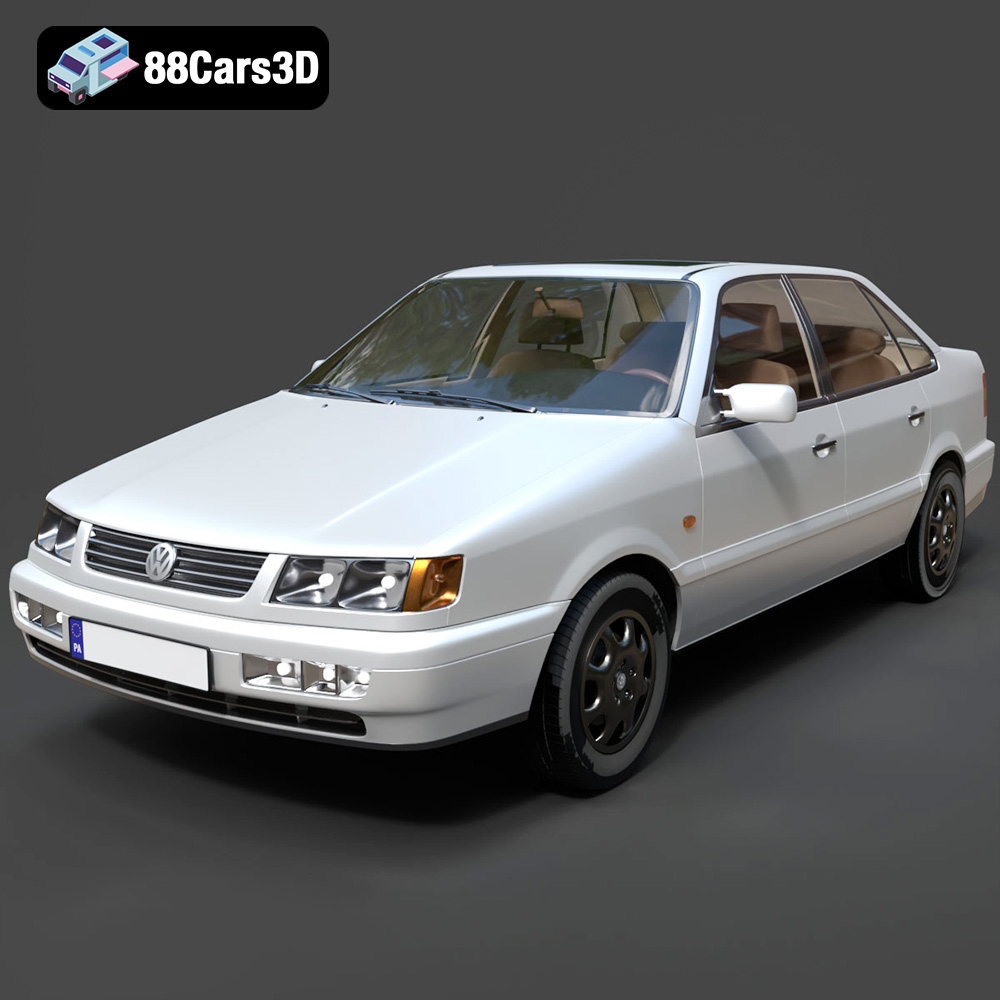
Today, we delve into the world of automotive 3D modeling by exploring a specific icon that perfectly exemplifies the blend of historical significance and digital utility: the 1993 Volkswagen Passat Mk4 B4 Sedan. This isn’t just any car; it represents a pivotal moment in German engineering, known for its robust reliability and understated 90s aesthetic. For 3D artists, game developers, and visualization specialists, a meticulously crafted model of such a vehicle, like the one available at 88cars3d.com, offers a gateway to creating authentic, immersive digital experiences without the prohibitive initial investment in modeling time.
This comprehensive guide will explore the technical intricacies, versatile applications, and professional workflows enabled by high-quality 3D car models, with a particular focus on how the Volkswagen Passat Mk4 B4 Sedan 1993 3D Model fits seamlessly into diverse creative pipelines. We’ll uncover how these assets accelerate production, enhance realism, and empower artists to push the boundaries of their digital visions, from game-ready optimization to stunning photorealistic renders and even tangible 3D prints.
The Volkswagen Passat Mk4 B4 Sedan, produced from 1993, holds a special place in automotive history. It wasn’t a flashy supercar, but rather a testament to practical, reliable German engineering designed for the everyday family. Its introduction marked a notable aesthetic shift from its B3 predecessor, bringing back a traditional front grille and refining its clean, utilitarian lines. This understated elegance and robust build quality have cemented its legacy as an icon of 90s European motoring, making it a highly desirable subject for digital preservation and recreation.
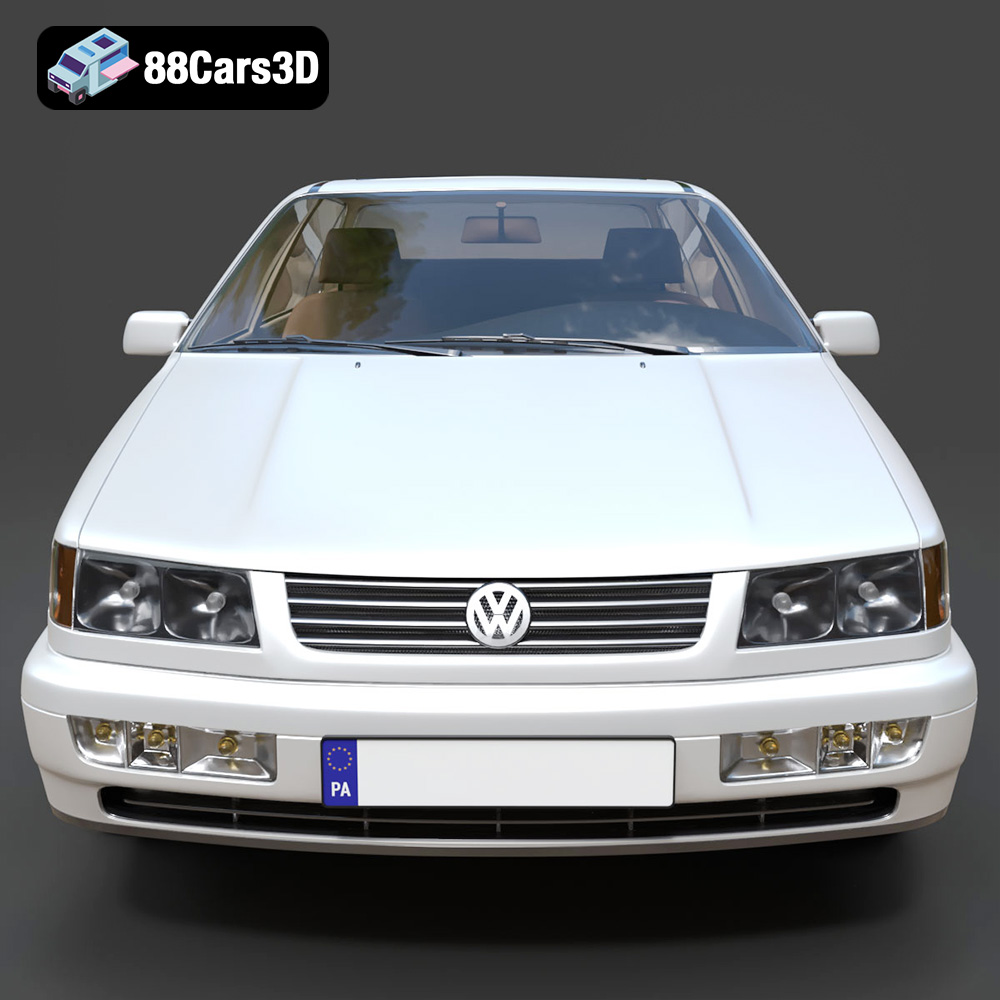
The design philosophy of the Passat B4 was one of subtle evolution rather than revolution. Volkswagen opted for a more conventional yet timeless look, which included the return of a distinct grille that differentiated it from the ‘grille-less’ B3. Its clean body panels, characteristic halogen headlight housings, and classic factory wheel options perfectly encapsulate the mid-90s European automotive aesthetic. This era prioritized functionality and build quality, characteristics that resonate with a wide audience today, from enthusiasts of classic cars to professionals seeking authentic period-correct assets for their projects.
Digitally capturing these nuances is crucial. A well-crafted 3D model allows designers to integrate this historical context into modern simulations and visualizations, providing a tangible link to a specific design era. The accurate representation of its sedan roofline and the subtle curves that defined its silhouette are essential for maintaining visual fidelity.
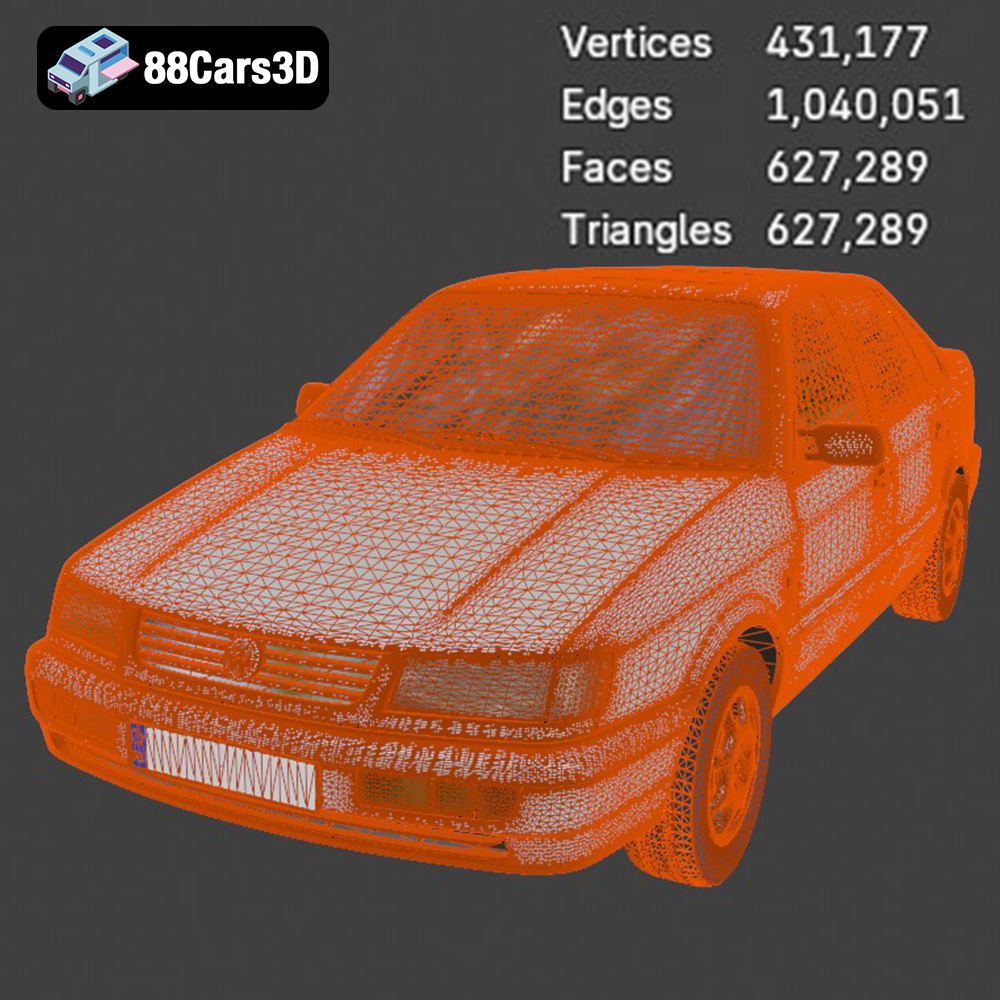
For 3D artists and developers, the availability of a meticulously detailed model like the Volkswagen Passat Mk4 B4 Sedan 1993 is a significant advantage. This particular model boasts exceptional quality with optimized topology and a game-ready triangle count, striking an ideal balance between high visual fidelity and performance efficiency. Its geometry ensures seamless integration into modern real-time engines, providing crisp reflections and accurate proportions across various applications.
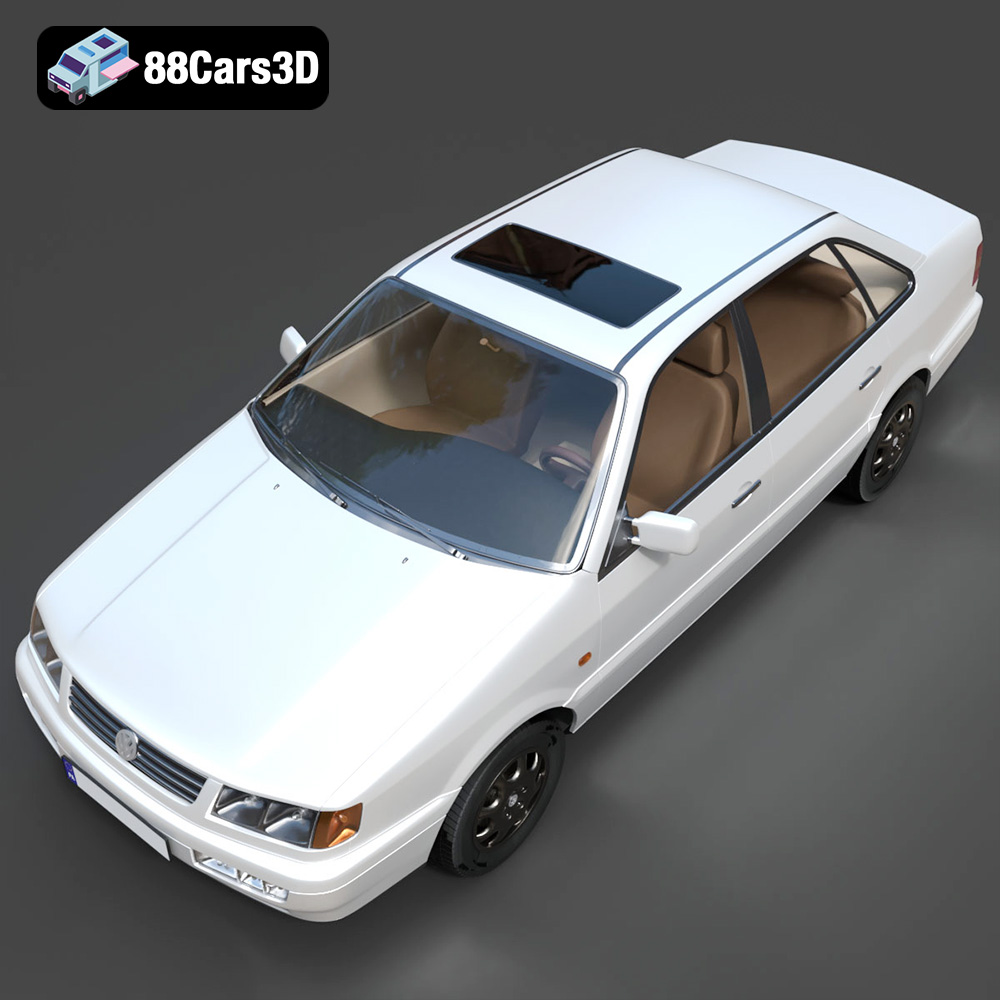
Whether the goal is to populate a retro open-world game with authentic background traffic, create an interactive architectural visualization featuring a period-correct vehicle, or develop a detailed close-up rendering for a brand campaign, the Passat B4 model delivers. Its exterior features are accurately replicated, from the classic 90s front fascia with authentic grille and headlight assemblies to the factory-accurate exhaust tip styling and detailed suspension components. The interior, too, is faithfully reproduced, offering accurate 90s European sedan seating, a classic four-spoke steering wheel, and an authentic analog instrument cluster, making it suitable even for first-person perspectives in gaming.
The versatility of a 3D model is often defined by the file formats it supports. For professionals, having access to a wide array of formats ensures compatibility across different software packages and pipelines. The Volkswagen Passat Mk4 B4 Sedan 1993 3D Model from 88cars3d.com exemplifies this flexibility by offering a comprehensive suite of file types, each optimized for specific applications.
The .blend format is the native file type for Blender, the popular open-source 3D creation suite. When you download a .blend file, you’re getting a fully editable Blender scene, complete with all its materials, textures, lighting, and even animation data. This format is ideal for artists who primarily work in Blender and require full control over the model’s structure, materials, and rigging. It allows for deep customization, adjustments to topology, and easy integration into Blender-centric workflows for rendering, animation, or further asset development.
.fbx (Filmbox) is a proprietary file format owned by Autodesk, widely regarded as the industry standard for 3D data interchange between different software applications. Its strength lies in its ability to store not just geometry, but also animation, materials, textures, bone rigs, and cameras in a single file. This makes .fbx incredibly versatile for pipelines involving Unreal Engine, Unity, 3ds Max, Maya, and other major software. It’s particularly ideal for real-time applications like game development where animations and hierarchical structures are crucial. The .fbx version of the Passat model would include its separate wheels, suspension, and steering components, ready for animation.
.obj (Wavefront OBJ) is one of the oldest and most universally supported 3D file formats. It’s an open standard that primarily stores geometric data – vertices, normals, UV coordinates, and faces. While it can reference external material (.mtl) files, its strength is its simplicity and widespread compatibility across almost every 3D software application. It’s excellent for basic mesh transfer and is often used as a fallback when more complex formats are not supported. For the Passat, the .obj provides a clean, raw mesh suitable for import into virtually any rendering or modeling package.
.glb (GLB for glTF Binary) is the binary version of the glTF (GL Transmission Format) format, which is an open standard designed for efficient transmission and loading of 3D scenes and models by engines and applications. It’s become the “JPEG for 3D” due to its optimization for web-based, AR (Augmented Reality), and VR (Virtual Reality) experiences. A .glb file packages all necessary data—geometry, materials, textures—into a single, compact file, making it perfect for rapid deployment on mobile, web browsers, and immersive platforms. The Passat .glb model is perfectly tailored for interactive virtual showrooms or mobile AR experiences.
.stl (Stereolithography) is the most common file format for 3D printing. It represents a 3D model as a series of connected triangles (a tessellated surface) without color, texture, or other CAD attributes. Its simplicity makes it universally readable by 3D printers and slicing software. While it doesn’t store complex scene data, it’s essential for converting digital models into physical objects. The Passat model, convertible to .stl, allows hobbyists and designers to bring this classic car to life as a physical display piece.
.ply (Polygon File Format or Stanford Triangle Format) is another format used for storing 3D data, particularly from 3D scanners. It can store a wider range of properties than .stl, including color, transparency, and often higher precision vertex data. It’s frequently used in scientific applications, CAD, and when precise mesh analysis is required. While less common for general asset distribution, its inclusion for the Passat model provides options for highly detailed reconstruction or specialized engineering workflows.
The .unreal file is a proprietary format specific to Unreal Engine, often implying an asset that has been specifically prepared and exported for optimal performance and integration within the Unreal ecosystem. This could mean pre-configured materials, LODs (Levels of Detail), collision meshes, and even blueprints. An .unreal package typically saves significant setup time, allowing developers to drop the Volkswagen Passat Mk4 B4 model directly into their real-time environments with minimal fuss, ensuring it’s “engine-ready.”
The .max format is the native file type for Autodesk 3ds Max, a leading software for 3D modeling, animation, rendering, and visualization. A .max file contains the complete 3ds Max scene, including all objects, materials, lights, cameras, modifiers, and animation data. This format is invaluable for professionals working in 3ds Max who require full editing capabilities, access to complex modifiers, or specific rendering setups. The .max version of the Passat provides the deepest level of control for animation, high-end rendering, and integration into existing 3ds Max projects.
By offering all these formats, 88cars3d.com ensures that the Volkswagen Passat Mk4 B4 Sedan 1993 3D Model is not just a high-quality asset, but a highly adaptable one, ready for any professional pipeline.
The true value of a well-optimized 3D car model shines brightest in interactive and highly realistic environments. For game developers and visualization artists, the Volkswagen Passat Mk4 B4 Sedan 1993 3D Model offers a compelling foundation for creating truly immersive digital worlds.
Modern game development relies on efficiency and fidelity. The Passat Mk4 model, with its “Game-Ready & Optimized: 50,000-80,000 triangle count,” perfectly strikes this balance, making it ideal for integration into leading engines like Unreal Engine and Unity. The primary workflow involves importing the .fbx or .unreal formats.
Case Studies: Imagine populating a realistic 90s European city street in an open-world adventure game, where the Passat Mk4 serves as an authentic background vehicle. Or perhaps a retro racing title where players can customize and drive this classic sedan. Its optimized polycount makes it suitable for generating dense traffic without crippling frame rates, while its detailed interior allows for compelling first-person cockpit views in simulators.
Beyond game engines, the Passat Mk4 B4 3D Model excels in high-fidelity rendering for architectural visualization (ArchViz), marketing campaigns, and cinematic sequences. Here, the emphasis shifts from real-time performance to absolute visual quality and photorealism.
The versatility of this 3D model means it can serve as a hero asset for a detailed product showcase or a subtle background element that enhances the overall realism of an architectural visualization, all while maintaining its authentic 90s charm. The availability of diverse formats on 88cars3d.com ensures that artists can pick the optimal starting point for their specific rendering workflow.
The utility of high-quality 3D car models extends far beyond traditional screens, venturing into the realms of immersive augmented and virtual reality, and even tangible physical objects through 3D printing. The Volkswagen Passat Mk4 B4 Sedan 1993 3D Model is meticulously prepared to excel in these cutting-edge applications.
Augmented Reality (AR) and Virtual Reality (VR) are transforming how we interact with digital content, offering immersive and highly engaging experiences. For automotive models, AR/VR presents unique opportunities for visualization, marketing, and interactive training. The Passat Mk4 B4 model is perfectly suited for these environments thanks to its optimized geometry and the inclusion of the .glb format.
The Passat Mk4 B4 Sedan 3D Model provides developers with a robust and performant asset to build compelling and memorable AR/VR experiences, leveraging its optimized structure for fluid interactivity.
For enthusiasts, collectors, and designers who wish to hold a piece of automotive history in their hands, 3D printing offers an incredible bridge between the digital and physical worlds. The Volkswagen Passat Mk4 B4 Sedan model, convertible to the ubiquitous .stl format, opens up a world of possibilities for display-scale hobbyists and prototyping.
The availability of a high-quality 3D model on 88cars3d.com that can be readily adapted for 3D printing empowers model makers and collectors to create truly unique physical representations of this beloved German sedan, merging digital craftsmanship with tangible artistry.
In professional 3D production pipelines, efficiency and adaptability are paramount. A premium 3D asset like the Volkswagen Passat Mk4 B4 Sedan 1993 3D Model is not just a static object; it’s a flexible foundation upon which artists can build bespoke solutions. Its inherent features and file format options contribute significantly to streamlining professional workflows.
Even with a highly detailed base model, customization is often a key requirement for unique projects. The Passat B4 model provides ample opportunities for artists to personalize its appearance, ensuring it perfectly fits the narrative or aesthetic of their digital scene.
These customization options empower artists to create diverse scenes and narratives using a single base asset, saving time on modeling and focusing on artistic direction.
The true measure of a professional-grade 3D asset lies in its technical specifications and how those translate into workflow efficiency. The Volkswagen Passat Mk4 B4 Sedan model is designed with these advantages in mind.
By providing a foundation that is already optimized, accurately scaled, and ready for animation and diverse software, 88cars3d.com offers 3D car models like the Volkswagen Passat Mk4 B4 that act as accelerators for professional projects, allowing artists and developers to focus on creativity rather than technical hurdles.
The digital landscape is continually evolving, demanding ever-increasing levels of realism, performance, and creative flexibility from 3D assets. The Volkswagen Passat Mk4 B4 Sedan 1993 3D Model stands as a prime example of how a high-quality, meticulously crafted asset can be a cornerstone for a vast array of projects, from immersive game environments and photorealistic architectural visualizations to engaging AR/VR experiences and even tangible 3D prints.
We’ve explored how its optimized topology, game-ready polycount, and real-world scale make it ideal for real-time applications in Unreal Engine and Unity, allowing for seamless integration and dynamic animation. Its detailed interior and exterior features shine in cinematic renders, while its .glb format facilitates cutting-edge AR/VR deployments. Furthermore, its convertibility to .stl format unlocks the exciting potential of 3D printing, enabling enthusiasts to bring this classic German sedan into the physical realm.
The versatility provided by its extensive range of file formats—including .blend, .fbx, .obj, .glb, .stl, .ply, .unreal, and .max—ensures unparalleled compatibility across professional workflows, saving invaluable time and resources. For any professional seeking to elevate their projects with authentic, high-fidelity 3D car models, resources like 88cars3d.com offer an invaluable trove of premium assets, empowering creators to focus on their artistic vision without compromising on technical excellence.
Whether you’re populating a bustling 90s cityscape, designing a nostalgic driving simulator, or crafting an interactive product showcase, the Volkswagen Passat Mk4 B4 Sedan 1993 3D Model provides the perfect blend of historical charm and modern digital utility. It’s more than just a model; it’s a foundational tool for bringing your creative ambitions to life.
The 1993 Volkswagen Passat Mk4 (B4) Sedan represents a pivotal moment in German automotive design, blending practical family hauling capabilities with robust, reliable engineering. Known for its clean, understated aesthetic and the distinct introduction of a traditional front grille compared to its B3 predecessor, this classic sedan has cemented its legacy as an icon of 90s European motoring. The model captures the quintessential utilitarian charm, featuring the accurate sedan roofline, distinctive halogen headlight housings, and classic factory wheel options that defined mid-90s Volkswagen styling. This 3D model boasts exceptional quality with optimized topology and a game-ready triangle count. The geometry strikes the ideal balance between high visual fidelity and performance efficiency, ensuring seamless integration into modern real-time engines. Whether utilized for background traffic generation, interactive configurators, or detailed close-up rendering, the model maintains crisp reflections and accurate proportions across the board. Perfect for 90s-themed street scenes, retro driving simulators, architectural visualizations, and immersive virtual environments.
$39.99
.blend
.fbx
.glb
.max
.obj
.passat
.ply
.rendering
.sedan
.stl
.unreal
.volkswagen
1993
b4
car-3d-model
classic-car
family-car
game asset
game-ready
low-poly
mk4
optimized
VR/AR