Get 20% OFF All Premium 3D & STL Models!

Few vehicles embody a blend of practical transport and timeless style quite like the Vespa P200E. This celebrated Italian scooter isn’t just a mode of conveyance; it’s a cultural phenomenon, an icon of freedom, flair, and classic design that continues to captivate enthusiasts worldwide. Its distinctive silhouette, robust 2-stroke engine, and unmistakable vintage aesthetic have cemented its place in automotive history.
Today, the legacy of such iconic machines extends far beyond the tarmac. In the dynamic world of 3D modeling, these vehicles find new life, serving as crucial assets for everything from immersive video games and breathtaking architectural visualizations to cutting-edge augmented reality experiences and high-fidelity product renderings. Capturing the essence of a classic like the Vespa P200E in a meticulously crafted 3D model offers creators unparalleled opportunities to infuse their projects with character, authenticity, and a touch of nostalgic charm.
For professionals seeking to integrate such a distinguished asset into their workflows, precision and versatility are paramount. This is where a high-quality asset like the Vespa P200E 3D Model from 88cars3d.com truly shines. It provides not just a visual representation, but a technically sound and optimized foundation ready for a multitude of digital applications, ensuring that the spirit of this legendary scooter is faithfully preserved and powerfully presented in any virtual environment.
Translating the intricate details and undeniable charisma of a real-world vehicle into a compelling 3D model requires an exceptional eye for detail and profound technical skill. The Vespa P200E 3D model is a testament to this craft, painstakingly developed to reflect the original scooter’s iconic design and functional components with remarkable accuracy.
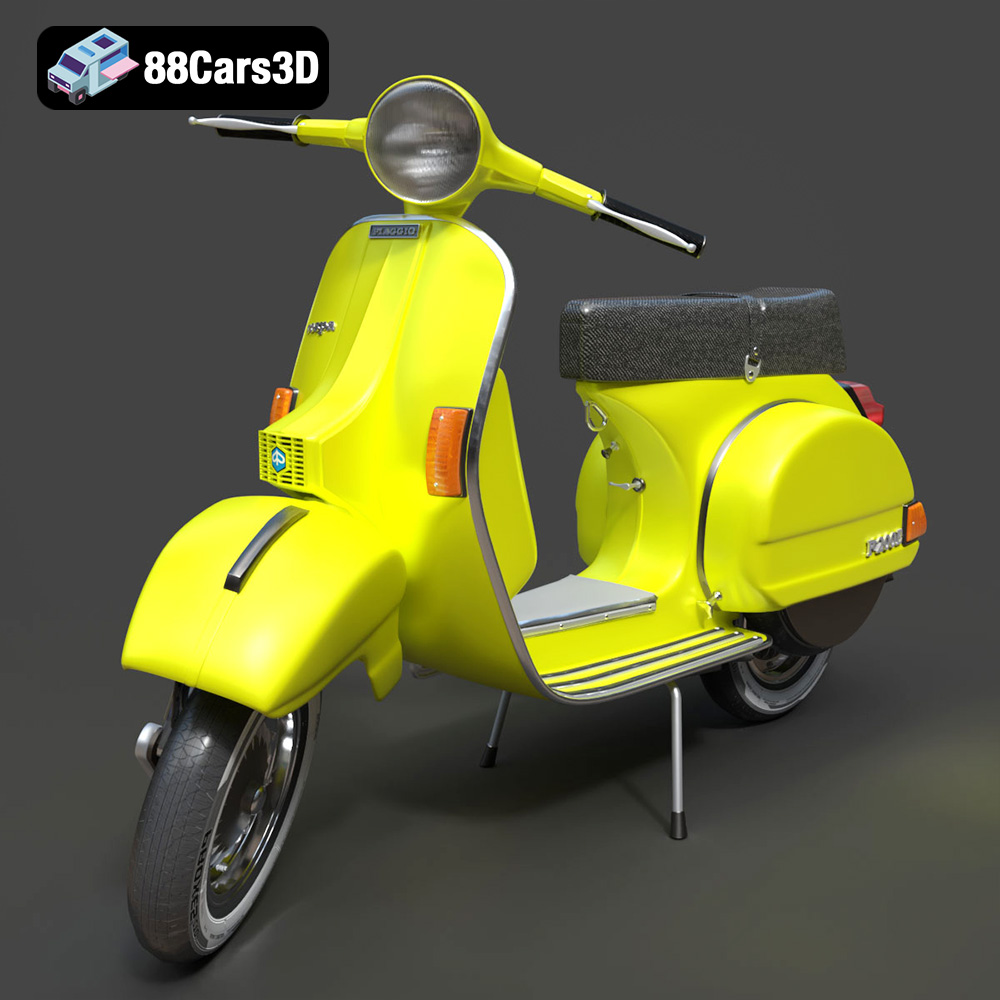
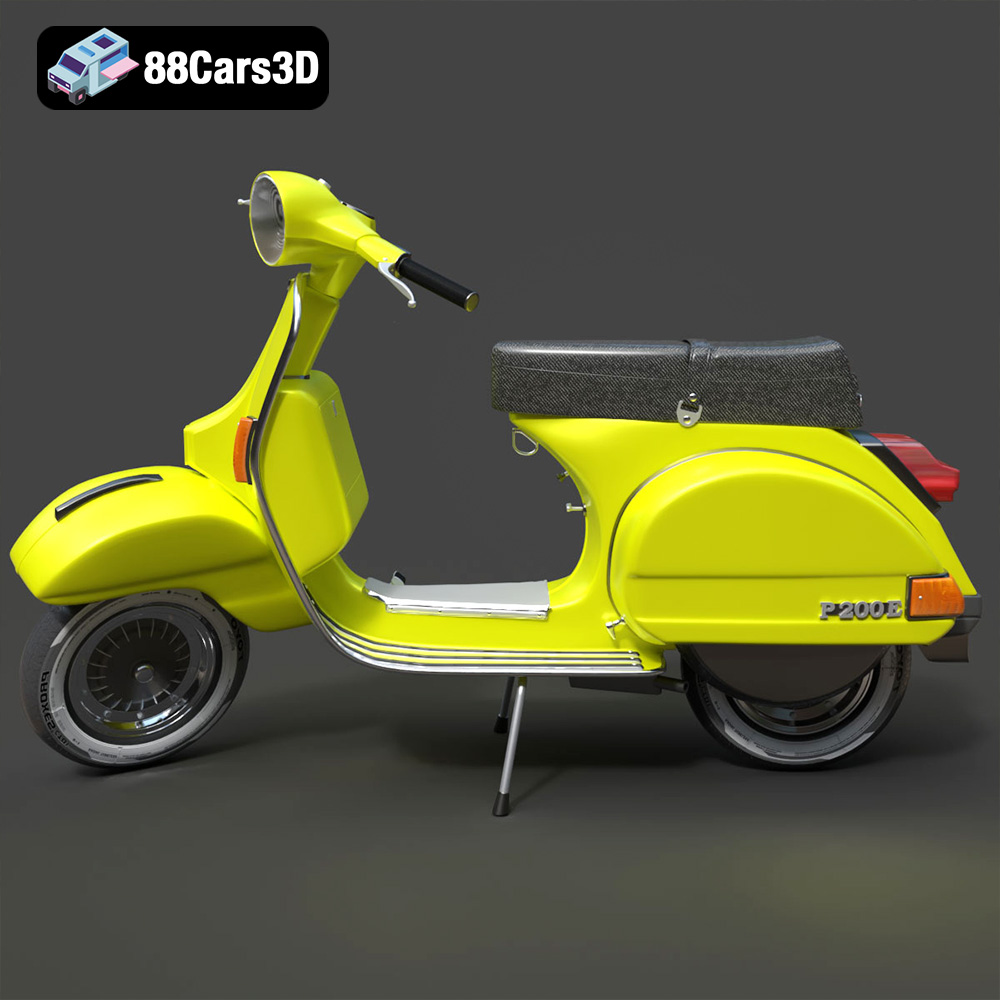
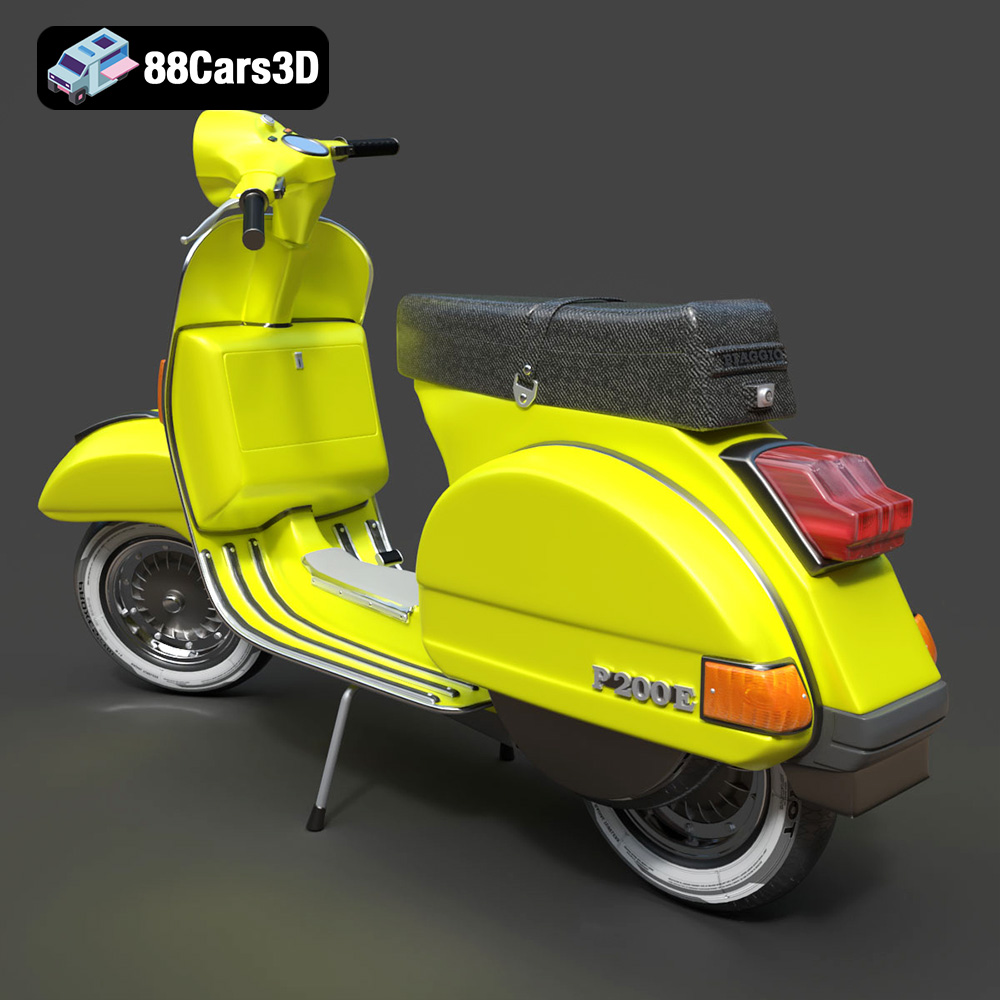
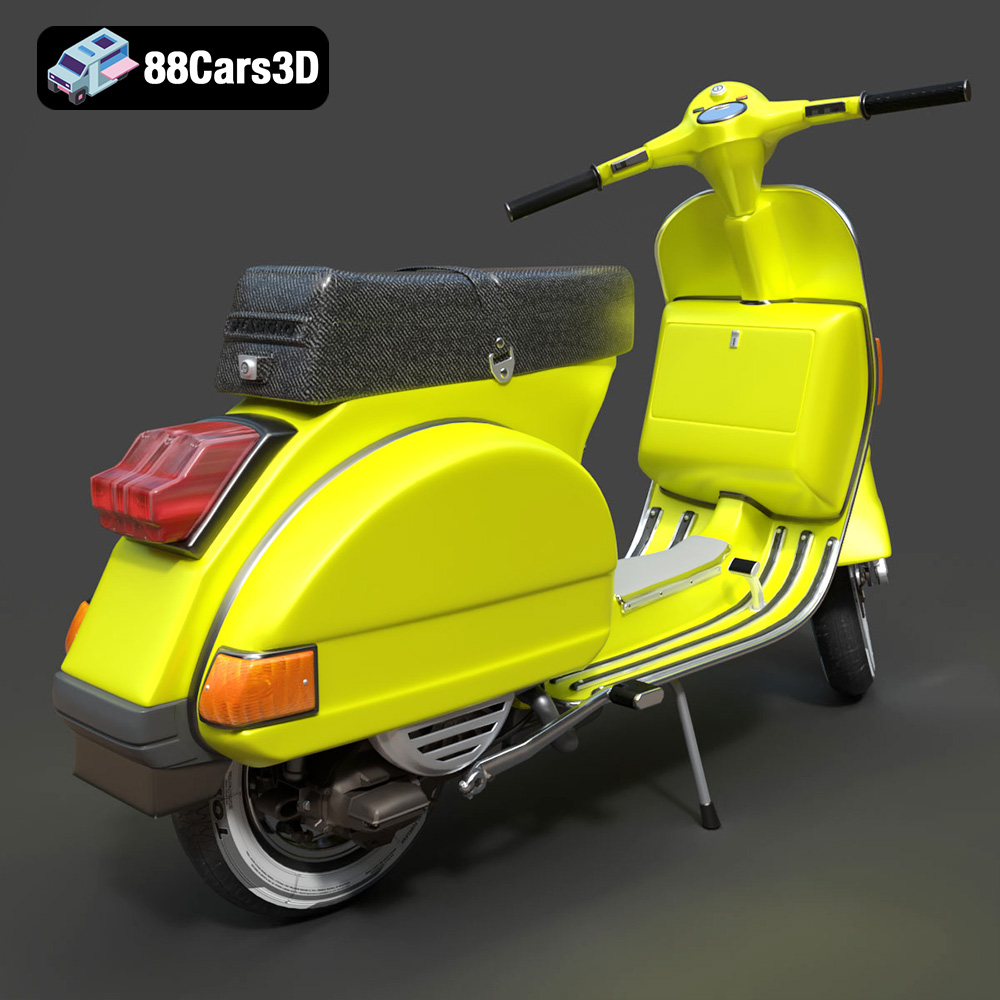
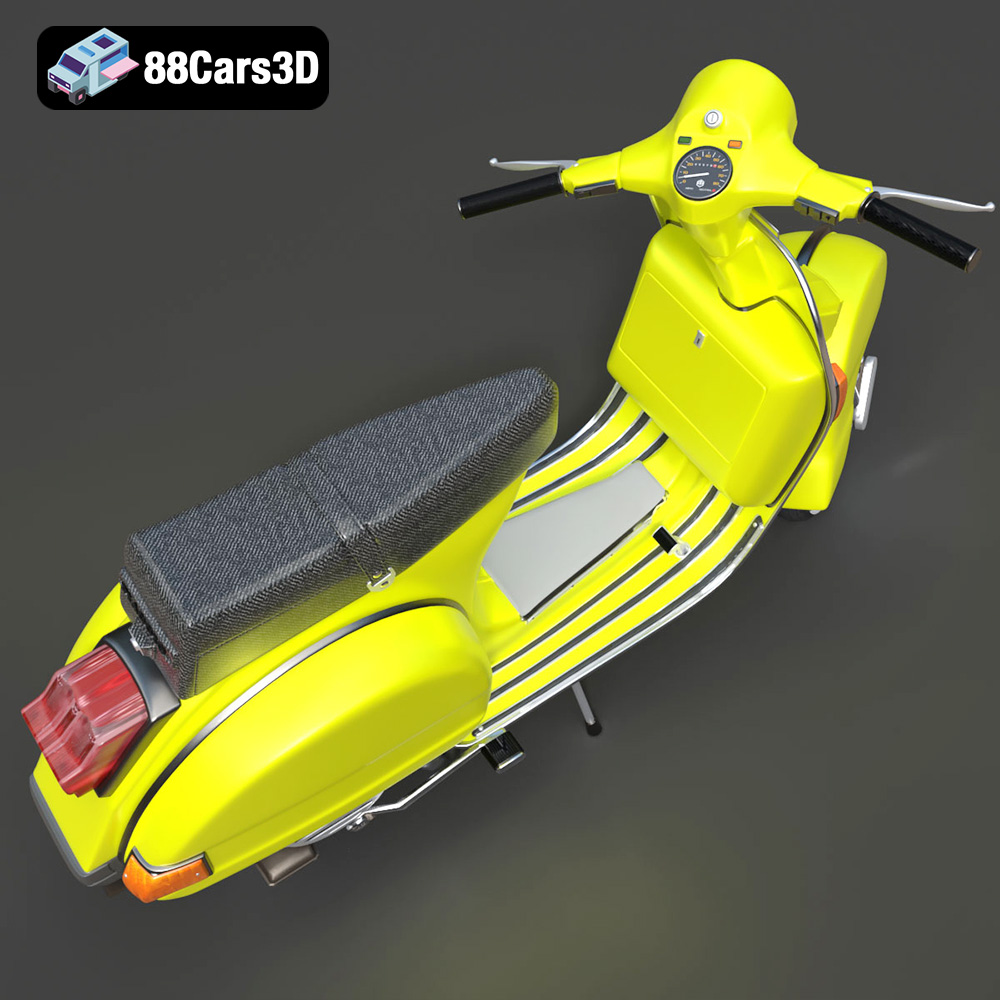
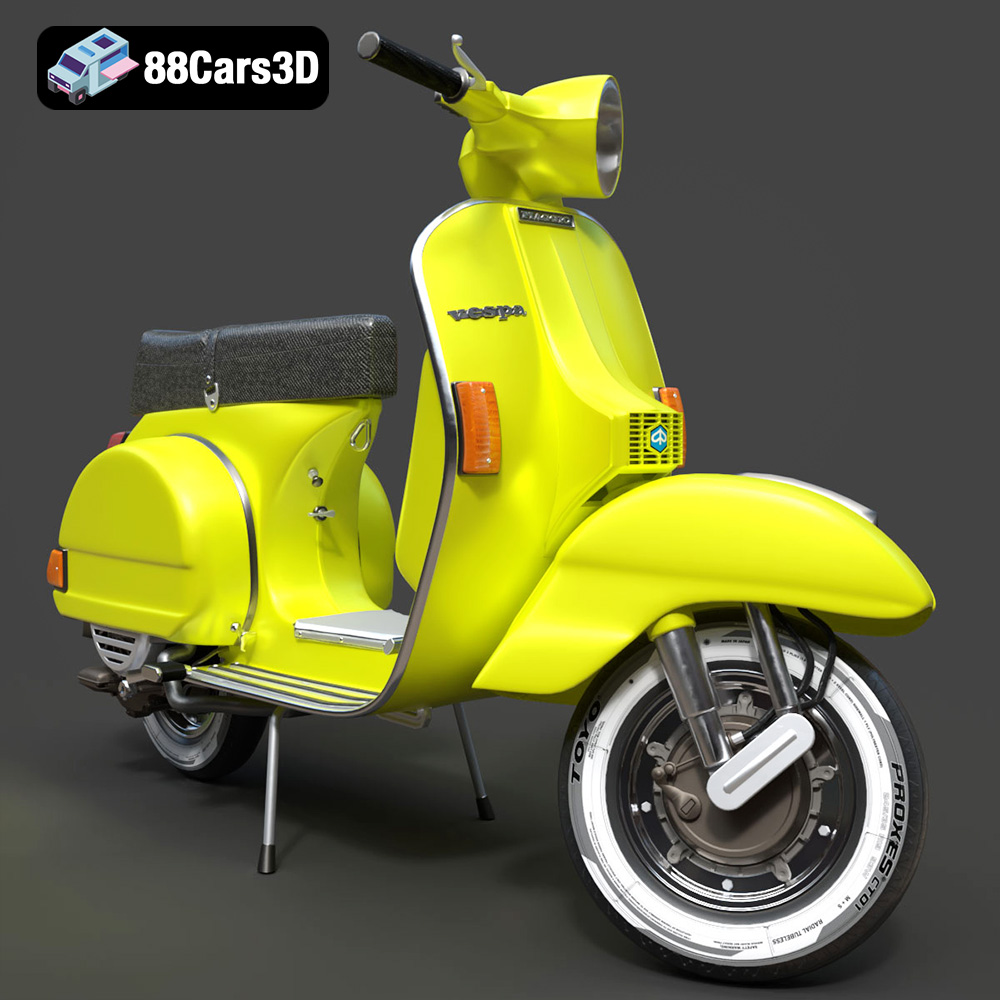
The essence of the Vespa P200E lies in its distinctive form. This 3D model perfectly captures the scooter’s signature step-through frame geometry and proportions, which are central to its unique rider experience and visual identity. From the signature rear engine cowlings that house its reliable 2-stroke engine to the authentic classic exhaust box, every exterior element has been meticulously recreated. The model features the signature round headlight, classic indicators, and integrated taillight, all contributing to that unmistakable vintage aesthetic that made the P200E a cultural phenomenon. Even the accurate 10-inch wheels with classic tread patterns and the detailing of the front trailing link suspension and rear mono-shock are present, ensuring an authentic representation down to the smallest visible component. This level of detail makes it an invaluable asset for automotive rendering and historical visualizations.
Beyond its striking exterior, the Vespa P200E 3D model extends its fidelity to the often-overlooked interior and mechanical elements crucial for realism and interactive applications. The cockpit features a classic dual-seat design with textured upholstery detailing, inviting a closer look. The signature curved handlebars with integrated controls, along with an authentic vintage analog speedometer and instrument cluster, are all modeled with precision, vital for immersive first-person perspectives in gaming or virtual tours. Furthermore, the detailed floorboard with anti-slip strips and the foot brake pedal enhance the overall realism. For animators and game developers, the inclusion of separate wheels, suspension, and steering components is a critical advantage, allowing for dynamic, realistic motion and interaction. These elements ensure that the model is not merely a static object, but a living, breathing component ready to be driven, displayed, or analyzed in a diverse array of digital scenarios.
In the expansive world of 3D modeling, the choice of file format is far more than a technicality; it’s a strategic decision that dictates compatibility, functionality, and performance across various platforms and applications. The Vespa P200E 3D Model from 88cars3d.com thoughtfully provides a comprehensive suite of formats, empowering artists and developers with maximum flexibility. Understanding the nuances of each is essential for optimizing your workflow, especially when dealing with complex assets like 3D car models or game assets.
The .blend format is native to Blender, the powerful open-source 3D creation suite. When you receive a .blend file, you’re getting a fully editable Blender scene. This means it includes not just the mesh data, but also materials, textures, lighting setups, camera positions, animation data, and even modifiers or rigging. For users deeply integrated into the Blender ecosystem, this format offers unparalleled flexibility for customization, tweaking, and further development of the 3D car models. It’s ideal for those who want to delve into the model’s construction, make significant alterations, or integrate it seamlessly into a Blender-centric pipeline for automotive rendering or animation projects.
Autodesk’s .fbx (Filmbox) format has become an unofficial industry standard for 3D asset exchange, particularly in game development and real-time visualization. It’s renowned for its robust ability to store not only geometry but also materials, textures, animations, skinning, and skeletal data. This makes it an ideal choice for importing complex 3D car models into game engines like Unreal Engine and Unity, or for transferring animated assets between different 3D software packages (e.g., from 3ds Max to Maya). Its versatility makes it a go-to for pipelines requiring extensive data transfer and ensuring that all aspects of an animated asset are preserved.
The .obj (Wavefront Object) format is one of the oldest and most widely supported 3D file formats. It’s primarily used for exchanging pure geometric data, typically vertices, faces, and UV coordinates. While it doesn’t store animation, rigging, or scene information like lights and cameras, it’s incredibly reliable for transferring static mesh data between virtually any 3D software. For simple static renders or when cross-software compatibility is the absolute priority, .obj is an excellent choice. It often comes paired with an .mtl (material library) file that defines basic material properties like color and diffuse texture references.
.glb (GL Transmission Format Binary) is the binary version of glTF, an open-standard format specifically designed for efficient transmission and loading of 3D scenes and models by engines and applications. It’s rapidly gaining traction as the “JPEG of 3D” due to its optimized nature, combining all model data (geometry, materials, textures, animations) into a single, compact file. This makes .glb perfect for web-based 3D viewers, AR/VR applications, and mobile experiences where fast loading times and efficient resource usage are critical. For showcasing 3D car models in a browser or an augmented reality app, .glb is often the best choice.
.stl (Stereolithography) is synonymous with 3D printing. This format represents a 3D model as a series of connected triangles, defining only the surface geometry of an object without color, texture, or other CAD attributes. Its simplicity makes it universally compatible with 3D printing software (slicers). When preparing a 3D car model for physical fabrication, converting it to .stl is the standard first step. Designers use it to prototype, create figurines, or produce physical models for hobbyists. The Vespa P200E model’s inclusion of this format is a significant advantage for those looking to manifest their digital asset in the physical world.
The .ply (Polygon File Format) is a file format for storing three-dimensional data. It’s particularly common in 3D scanning and scientific applications because it can store a variety of properties beyond just geometry, such as color, transparency, normals, texture coordinates, and even confidence values. While less common for general 3D asset exchange than .fbx or .obj, it’s highly valued in fields requiring precise mesh data or capturing complex visual information from real-world objects. For detailed analysis or specialized rendering, .ply offers a robust data container.
The .unreal format signifies an asset specifically optimized and configured for direct use within Unreal Engine. This often means the asset comes with pre-set materials, collision geometry, LODs (Levels of Detail), and other engine-specific optimizations. Leveraging an .unreal file drastically streamlines the import process for game developers and real-time visualization artists, ensuring that the 3D car model performs optimally within the engine environment from the outset. This format removes much of the manual setup typically required, accelerating development for projects like interactive simulations or game assets.
Autodesk’s .max format is the proprietary file format for 3ds Max, a leading software for 3D modeling, animation, rendering, and visualization. A .max file contains the entire scene data, including all geometry, textures, materials, lighting, cameras, animation keyframes, and modifiers. It provides the highest level of editability and functionality for users working within 3ds Max. For professionals engaged in high-end automotive rendering, detailed architectural visualization, or complex animation sequences, having the native .max file ensures full control over every aspect of the Vespa P200E 3D model.
Beyond its aesthetic accuracy, the Vespa P200E 3D model is engineered with robust technical specifications that make it a highly practical and versatile asset for various digital production pipelines. Its design philosophy prioritizes a balance between visual fidelity and performance, a critical factor for professional artists and developers.
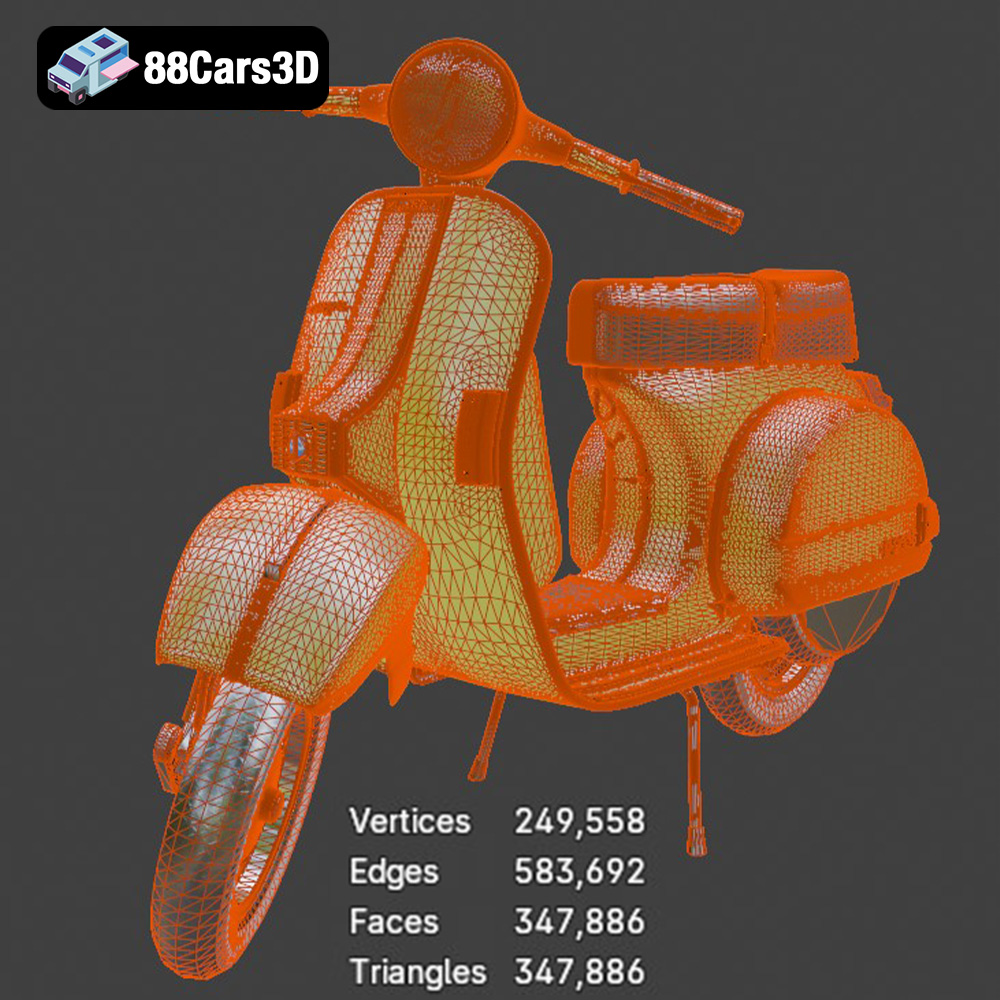
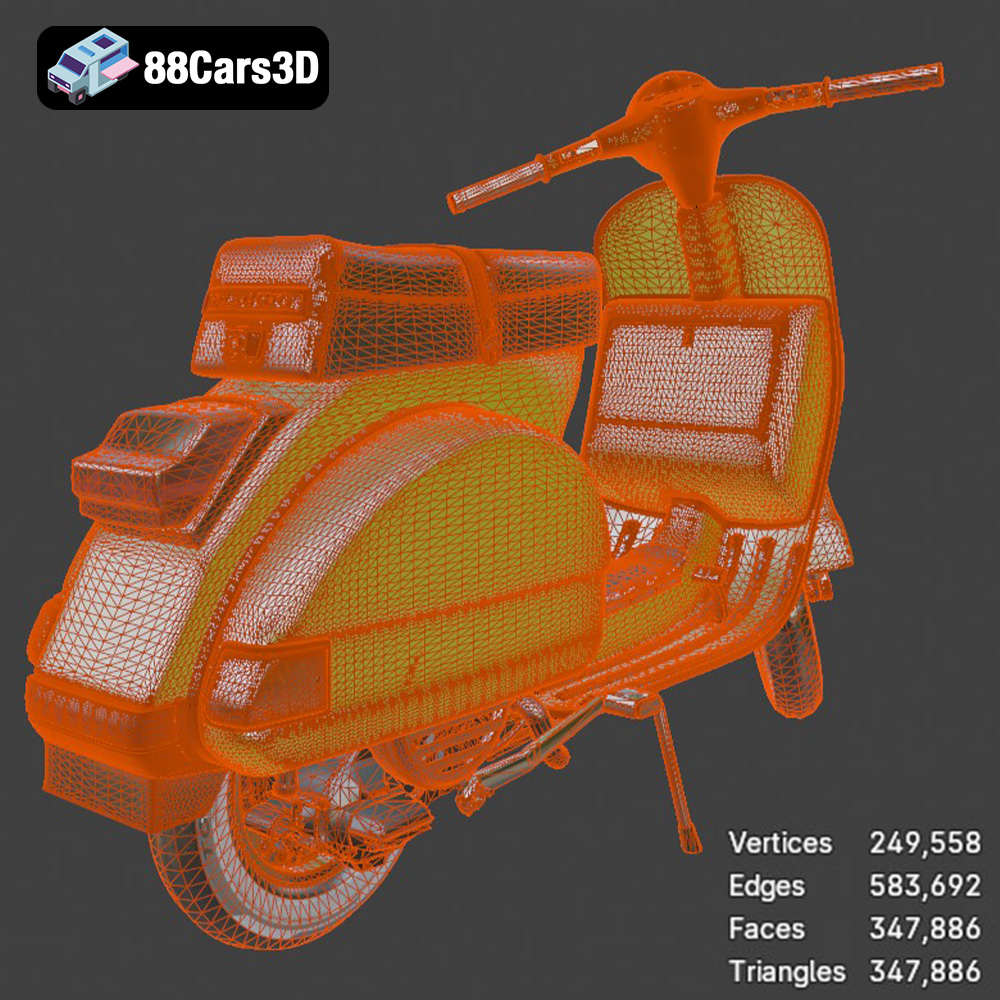
One of the standout advantages of this model is its “game-ready” optimization. With approximately 50,000 triangles, it strikes a perfect balance, delivering stunning visual realism without sacrificing performance in real-time environments. This polycount is carefully chosen to ensure that the Vespa P200E can be seamlessly integrated into demanding game engines like Unreal and Unity, where efficient resource management is paramount. The clean geometry ensures smooth shading and excellent material response, which translates to superior visual quality even under varied lighting conditions. Furthermore, the model is built with real-world scale accuracy, based on the actual vehicle chassis, making it perfect for consistent integration into existing scenes or CAD workflows. Crucial for animation, the model also features proper pivot setup for steering, wheel rotation, and suspension travel, enabling lifelike motion without extensive rigging work. This makes it an ideal candidate for high-performance game assets and interactive simulations.
The commitment to versatility is further underscored by the model’s compatibility with major 3D software platforms and real-time rendering engines. As highlighted in the file formats section, the availability of .blend, .fbx, .obj, .glb, .stl, .ply, .unreal, and .max formats ensures that professionals, regardless of their preferred software ecosystem, can incorporate this Vespa P200E model into their projects with minimal friction. Whether you’re working in Blender for indie game development, 3ds Max for high-end automotive rendering, or Unreal Engine for cutting-edge virtual production, the model is designed to integrate effortlessly. This extensive format support, a hallmark of quality offerings on 88cars3d.com, significantly reduces overhead, allowing artists to focus on creative execution rather than conversion woes or compatibility issues.
The versatility of the Vespa P200E 3D model extends across a wide spectrum of professional applications, making it an invaluable asset for various industries. Its optimized design and extensive format support open doors to numerous creative and commercial ventures.
For game developers, the Vespa P200E is a prime example of a meticulously crafted game asset. Its optimized polycount (~50,000 triangles) makes it ideal for open-world games, racing titles, and simulators where performance is key. Imagine cruising through a virtual Italian city on this iconic scooter or integrating it as an atmospheric background element in a bustling urban scene. The clean geometry and accurate proportions ensure that it looks fantastic from any angle, including first-person POV in gaming, enhancing player immersion. Its proper pivot setup for animation allows for realistic steering, wheel rotation, and suspension movement, crucial for dynamic gameplay mechanics. The .fbx and .unreal formats specifically streamline its integration into Unity and Unreal Engine pipelines, making it an efficient choice for creating believable and engaging virtual environments.
Beyond gaming, the Vespa P200E 3D model is a powerful tool for sophisticated visualization and interactive experiences. In the realm of AR/VR, it’s perfect for creating immersive virtual showrooms, where customers can explore the scooter in full 3D, or for developing interactive configurators that allow for real-time customization. Mobile AR experiences can bring this vintage classic directly into the user’s physical space, offering a unique blend of digital and real-world interaction. For traditional rendering and visualization, the model excels in brand campaigns, lifestyle scenes, and studio lighting setups, where its classic aesthetic can elevate product storytelling. Architectural visualization artists can leverage it to add a touch of realism and character to urban cityscapes or street scenes, grounding their renders with a recognizable and beloved object. Its high visual fidelity and robust material response make it a cornerstone for professional-grade automotive rendering projects.
A truly valuable 3D model offers more than just a pre-defined asset; it provides a canvas for creativity and a pathway for both digital and physical manifestation. The Vespa P200E 3D model excels in both these areas, offering extensive customization options and even the potential for 3D printing.
Creative professionals often need to adapt assets to fit specific brand guidelines, artistic visions, or project requirements. The Vespa P200E model provides significant flexibility for customization. Artists can easily change body and tank colors, applying anything from authentic factory colors to unique custom finishes, or even experimental metallic sheens to make the scooter truly one-of-a-kind. Modifying tire textures to switch between off-road and street variants can dramatically alter the vehicle’s character, tailoring it for different environments or narrative contexts. Adjusting material finishes – be it matte, gloss, or various metallic properties – allows for fine-tuning the visual impact and realism. Furthermore, adapting lighting for different environments is straightforward, enabling the scooter to shine under studio lights, bright sunlight, or dramatic evening ambiance. This level of adaptability ensures that the Vespa P200E 3D model isn’t just a static representation, but a dynamic tool that can be reinterpreted to suit countless creative scenarios in automotive rendering and game asset design.
For enthusiasts and collectors, the ability to transition a digital asset into a tangible object is a significant appeal. The Vespa P200E 3D model is designed with 3D printing in mind, providing the necessary .stl format and detailed print settings. Hobbyists can bring this classic scooter to life on their desks or shelves, scaled to popular sizes like 1:12, 1:18, or 1:24. To achieve the best results, specific print settings are recommended: a layer height of 0.04–0.12 mm, with resin printing often yielding the finest details, particularly for intricate parts like the engine housing or handlebars. A wall thickness of 1.2–2.0 mm and an infill of 20–30% ensure structural integrity. Supports are required for complex parts such as the exhaust, mirrors, and handlebars, while printing the frame at an angle can enhance structural stability. Post-processing, including sanding, priming, and painting with authentic factory colors or metallic finishes, can truly elevate the printed model to a display-worthy piece. This fusion of digital design and physical craftsmanship offers a unique avenue for interaction with this beloved vintage icon.
The Vespa P200E is more than just a scooter; it’s a piece of cultural heritage. Its digital counterpart, the Vespa P200E 3D Model, faithfully captures this legacy, delivering a high-quality, technically robust asset for a diverse range of professional applications. From its meticulous aesthetic accuracy, mirroring every curve and detail of the original, to its optimized geometry and extensive file format support, this model stands as a prime example of excellence in 3D automotive modeling. Whether you’re crafting immersive game worlds, producing high-end automotive rendering for brand campaigns, developing cutting-edge AR/VR experiences, or even planning to 3D print a physical replica, this asset provides the foundation you need.
Its “game-ready” optimization ensures seamless performance in real-time engines, while the provision of formats like .blend, .fbx, .obj, .glb, .stl, .ply, .unreal, and .max ensures unparalleled compatibility across virtually any professional workflow. This commitment to quality and versatility makes the Vespa P200E 3D model an indispensable tool for designers, artists, and developers looking to inject authentic vintage charm and technical precision into their projects. For those seeking premium 3D car models and other exceptional digital assets, 88cars3d.com remains a trusted source, offering carefully curated models that meet the rigorous demands of today’s creative industries.
The Vespa P200E is a true icon of Italian design, celebrated for its timeless styling and reliable 2-stroke engine. This 3D model perfectly captures the scooter’s distinctive step-through frame, signature rear engine cowlings, and classic vintage aesthetic that made it a cultural phenomenon. From the rounded headlamp to the unmistakable tail section, every curve has been meticulously recreated to offer an authentic representation of this legendary two-wheeler. Crafted with a focus on optimization and visual fidelity, this model features a game-ready topology of approximately 50,000 triangles. It delivers stunning realism without sacrificing performance in real-time environments. The clean geometry ensures smooth shading and excellent material response, making it highly versatile for game development, AR/VR applications, animation, and high-end visualization. Perfect for urban cityscapes, vintage street scenes, lifestyle brand rendering, and interactive mobile applications.
$39.99
.blend
.fbx
.glb
.max
.obj
.ply
.rendering
.scooter
.stl
.unreal
.vespa
.vintage
classic-scooter
game asset
game-ready
low-poly
motorcycle-3d-model
optimized
p200e
VR/AR