Get 20% OFF All Premium 3D & STL Models!

The automotive industry is undergoing a monumental shift, with electric vehicles (EVs) at the forefront of innovation and design. As these groundbreaking vehicles reshape our roads, their digital counterparts are similarly revolutionizing how we design, visualize, and interact with cars in the virtual realm. From breathtaking cinematic renders to immersive game experiences and critical engineering simulations, high-quality 3D car models are the fundamental building blocks. Today, we’ll dive deep into the technical intricacies and professional applications of these digital assets, focusing on a prime example of modern automotive design: the Volkswagen ID. Buzz 2023 3D Model.
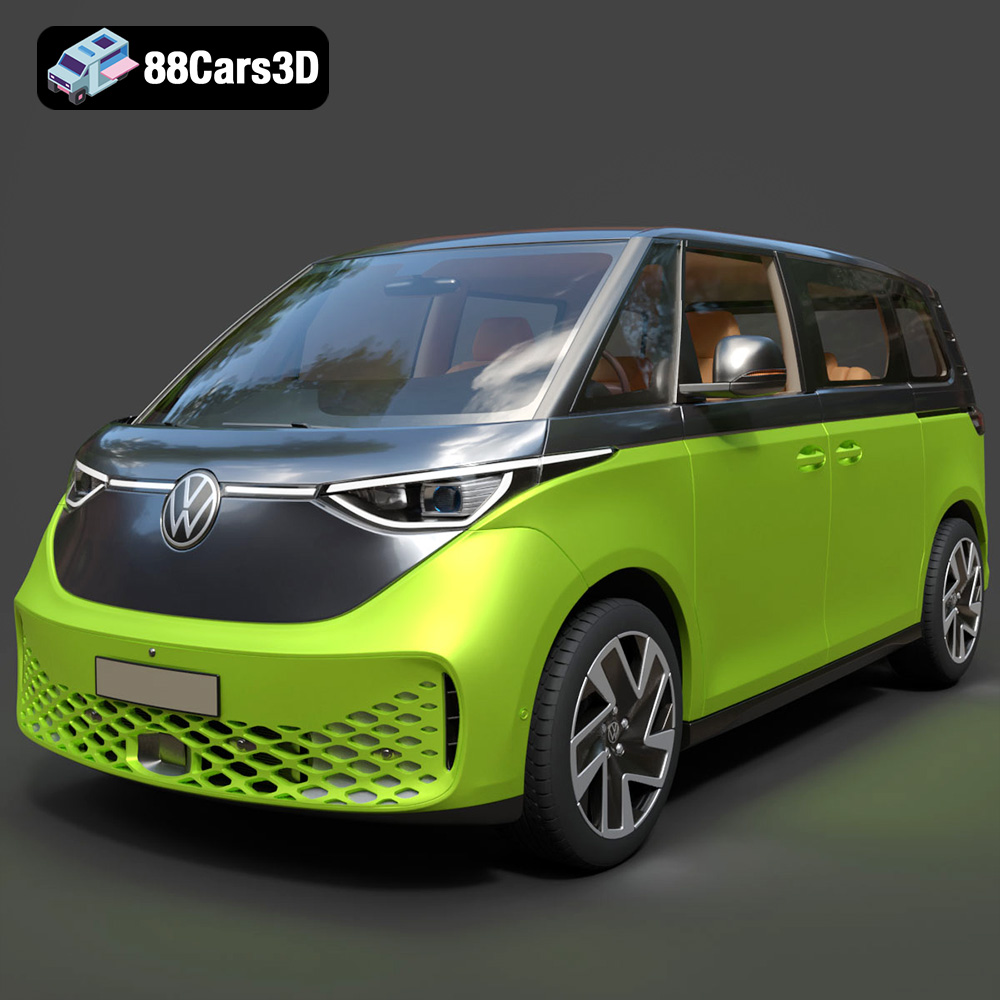
This comprehensively built asset accurately recreates the unique design and modern characteristics of the celebrated electric van. It incorporates key features such as clean geometry, realistic materials, and professional quality, guaranteeing accurate representations in demanding visual projects. Such a model isn’t just a static object; it’s a versatile tool that drives innovation across various industries, enabling artists, developers, and engineers to bring their visions to life with unparalleled realism and efficiency.
Choosing the correct file format for a 3D car model is paramount to a successful project. Each format serves distinct purposes, offering varying degrees of compatibility, data retention, and optimization for specific applications. Understanding these differences is crucial for any professional working with 3D assets, especially when sourcing high-quality models like the Volkswagen ID. Buzz 2023 3D Model from platforms like 88cars3d.com.
The .blend format is the native file type for Blender, a powerful open-source 3D creation suite. A .blend file typically includes the entire scene setup: geometry, materials, textures, lighting, cameras, animations, modifiers, and even custom scripts. For artists working primarily in Blender, this format offers the most flexibility and control, allowing for full editability of every aspect of the model. The Volkswagen ID. Buzz 2023 3D Model in .blend format, for instance, comes as an editable Blender file with its materials and lighting setup, making it ready for immediate scene integration, modification, or rendering within Blender.
.fbx (Filmbox) is a proprietary file format developed by Autodesk, widely regarded as the industry standard for 3D data interchange. Its strength lies in its ability to store a wide range of 3D data, including models, materials, textures, animations, and rigs, while maintaining compatibility across various software applications like 3ds Max, Maya, Blender, and game engines such as Unreal Engine and Unity. For game development and real-time pipelines, .fbx is invaluable due to its robust support for animations and hierarchical structures. The ID. Buzz model’s .fbx version is designed to be game-engine ready, streamlining the asset import process into these demanding real-time environments.
.obj (Wavefront OBJ) is one of the oldest and most universally supported 3D file formats. It primarily stores geometric data (vertices, normals, texture coordinates, and faces) and can reference external material files (.mtl). While it doesn’t support animations or advanced scene data, its simplicity makes it incredibly compatible across virtually all 3D software. When maximum compatibility is the goal, or for situations where only the pure mesh data is required for import into an unconventional software, .obj is an excellent choice. It serves as a standard 3D model format compatible with all major software, making the Volkswagen ID. Buzz available to the widest possible audience of 3D artists.
.glb (GL Transmission Format Binary) is the binary version of the glTF format, specifically designed for efficient transmission and loading of 3D scenes and models in web and AR/VR applications. It’s self-contained, embedding textures and other assets directly within the single file, which simplifies distribution and loading times. Its optimization for real-time rendering and small file sizes makes it perfect for interactive web experiences, augmented reality apps, and virtual reality environments. The .glb version of the ID. Buzz is optimized for AR/VR and web-based visualization, ensuring smooth performance in these rapidly growing sectors.
.stl (Stereolithography) is the de facto standard file format for 3D printing. It represents a 3D model as a series of connected triangles, describing only the surface geometry without color, texture, or other CAD attributes. While not ideal for rendering or animation due to its lack of advanced data, it’s essential for prototyping and physical manufacturing. If the goal is to produce a physical replica of the Volkswagen ID. Buzz 2023 3D Model, the .stl file is the go-to format, suitable for 3D printing and prototyping.
.ply (Polygon File Format or Stanford Triangle Format) is another format for storing 3D data, often used in scientific and engineering applications, particularly for scanned data. It supports properties like color, transparency, texture coordinates, and confidence values for vertices and faces. While less common in general 3D art workflows than .fbx or .obj, it’s valued for its precision and comprehensive mesh data, making it useful for detailed polygon mesh analysis and visualization, especially in CAD or metrology contexts. The Volkswagen ID. Buzz 2023 3D Model’s .ply format provides a detailed polygon mesh for such specific analytical and visualization needs.
The .unreal format, or more accurately, assets packaged for Unreal Engine, implies a model specifically prepared and optimized for direct import and use within the Unreal Engine ecosystem. This often means pre-configured materials, collision meshes, LODs (Levels of Detail), and sometimes even basic blueprints. Assets like the ID. Buzz model provided as “pre-configured for Unreal Engine use” significantly reduce the setup time for developers, allowing for faster integration into game worlds, architectural visualizations, or cinematic sequences powered by Unreal Engine.
.max is the native scene file format for Autodesk 3ds Max, a leading software for 3D modeling, animation, rendering, and compositing. Similar to .blend files, a .max file contains all scene information, including geometry, materials, textures, lighting, camera setups, animations, and plug-in data. For professionals deeply embedded in the 3ds Max pipeline, the .max version of the Volkswagen ID. Buzz 2023 3D Model offers maximum flexibility for rendering, animation, and further development within their preferred environment.
The availability of the Volkswagen ID. Buzz 2023 3D Model across these diverse formats underscores its versatility and suitability for a wide range of professional workflows, ensuring that every user, regardless of their primary software or end application, can leverage this exceptional asset.
Automotive rendering is where raw 3D data transforms into photorealistic imagery that can captivate audiences and sell concepts. The Volkswagen ID. Buzz 2023 3D Model, with its “clean geometry, realistic materials, and professional quality,” is an exemplary asset for achieving stunning visual results. Professionals in advertising, product visualization, and design studios rely on such detailed 3D car models to produce compelling visuals without the need for physical prototypes or costly photoshoots.
The realism of a rendered vehicle hinges significantly on its materials. High-fidelity 3D car models come equipped with physically based rendering (PBR) materials, which accurately simulate how light interacts with different surfaces. For the ID. Buzz model, this means precise reflections on the paint, subtle imperfections on glass, and the unique textures of interior fabrics and plastics. Artists can leverage these pre-built materials within their preferred renderers – be it V-Ray, Corona, Arnold (for 3ds Max users), Cycles, or Eevee (for Blender users) – to achieve consistent and believable lighting responses. This attention to detail in material setup drastically reduces post-production work and enhances the overall visual integrity of the final image.
Beyond materials, effective lighting is crucial. Automotive rendering often employs HDRI (High Dynamic Range Image) environments to provide realistic ambient lighting and reflections, mimicking real-world conditions. Imagine the ID. Buzz model bathed in the soft glow of a sunset urban environment or gleaming under the crisp light of a studio setup. Artists can manipulate virtual light sources to highlight design features, emphasize contours, and create dramatic compositions. The quality of the underlying 3D car model directly impacts how these lights interact, with clean topology ensuring smooth reflections and accurate shadow casting, crucial for presenting the distinctive lines of the ID. Buzz.
Modern rendering engines offer advanced features like global illumination, subsurface scattering (for materials like rubber or plastic), and volumetric effects. These contribute significantly to the depth and realism of automotive renders. Post-production in software like Adobe Photoshop or Nuke allows for further refinement – color grading, adding atmospheric effects, lens flares, and motion blur – to elevate the rendered image to a photorealistic masterpiece. The accuracy and detail of the Volkswagen ID. Buzz 2023 3D Model mean that these post-production efforts build upon an already robust foundation, allowing artists to focus on artistic expression rather than correcting underlying model flaws.
In the rapidly evolving world of interactive entertainment, realism is a key differentiator. Game developers constantly seek high-quality game assets that can elevate player experiences. A 3D car model like the Volkswagen ID. Buzz 2023, optimized for performance and visual fidelity, is invaluable for creating immersive racing simulations, open-world environments, and even casual mobile games.
The transition from high-poly rendering models to game-ready assets requires meticulous optimization. While the ID. Buzz model features “optimized mesh structure” and “clean geometry,” game developers often need to implement additional strategies. This includes creating various Levels of Detail (LODs) – progressively lower polygon versions of the model that swap out at different distances from the camera. This ensures that distant vehicles don’t consume excessive resources, maintaining high frame rates. Similarly, efficient UV mapping and texture atlasing are vital for reducing draw calls and optimizing GPU performance. The .fbx and .unreal formats of the ID. Buzz are specifically tailored for these demanding real-time environments, offering a streamlined workflow for developers.
For any vehicle in a game, realistic interaction with the environment is paramount. This necessitates accurate collision meshes – simplified geometries that define the physical boundaries of the car for physics calculations. These meshes are separate from the render mesh and are designed to be as simple as possible while maintaining fidelity for collisions. Integrating the ID. Buzz model into a game engine like Unreal Engine or Unity involves setting up its physics assets, defining mass, friction, and suspension parameters to ensure it handles, crashes, and drives realistically within the game world. The quality and accuracy of the base model facilitate the creation of these critical physics assets.
Many modern games allow for vehicle customization. High-quality 3D car models designed with modularity in mind can greatly enhance this feature. While specific modularity isn’t detailed for the ID. Buzz, professional assets often have components like wheels, doors, and interior elements as separate, well-grouped objects. This allows developers to easily swap out parts, apply different paint jobs, or even animate specific components (like opening doors or charging ports) for interactive sequences. The “fully modeled exterior components alongside detailed interior elements” of the Volkswagen ID. Buzz 2023 3D Model suggest a robust foundation for such customization, making it an excellent candidate for detailed game mechanics.
The applications of high-fidelity 3D car models extend far beyond traditional rendering and gaming. Augmented Reality (AR), Virtual Reality (VR), and advanced simulation environments are increasingly relying on detailed digital assets to create immersive, interactive, and highly functional experiences. The Volkswagen ID. Buzz 2023 3D Model, as an electric vehicle, is particularly relevant for these cutting-edge applications, addressing the growing demand for EV visualizations.
AR and VR offer unique ways to interact with 3D car models. Imagine “placing” the Volkswagen ID. Buzz in your driveway using an AR app on your phone, exploring its interior in full scale, or even taking it for a virtual test drive in a VR headset. For these experiences, performance and optimized file sizes are critical. The .glb format of the ID. Buzz model is specifically optimized for AR/VR and web-based visualization, ensuring smooth performance and rapid loading times on various devices. This allows potential customers to virtually explore the car’s features, colors, and trims in a highly engaging and realistic manner, long before a physical vehicle is available.
Engineers and designers utilize 3D car models for sophisticated simulations, ranging from aerodynamic analysis and crash testing to driver training simulators. The “optimized mesh structure” and “precise surfacing” of the ID. Buzz model provide the accuracy required for these demanding simulation environments. For instance, in a virtual training scenario, emergency responders could practice extracting occupants from the ID. Buzz, understanding its structural components and battery placement without risking a real vehicle. Similarly, urban planners could simulate traffic flow with realistic EV models, assessing infrastructure needs for charging stations and dedicated lanes. The comprehensive detail offered by assets from 88cars3d.com facilitates these high-stakes applications.
Before any physical prototype is built, detailed 3D models serve as the foundation for digital prototyping. Designers can iterate on concepts, make real-time adjustments, and visualize changes in a virtual environment. The .stl and .ply formats, while not for visualization, allow for physical prototyping of parts or the entire vehicle through 3D printing. The Volkswagen ID. Buzz 2023 3D Model’s comprehensive nature means it can be used throughout the design lifecycle, from initial concept visualization to detailed engineering analysis and even the creation of marketing materials, all stemming from a single, high-quality digital source.
Achieving the perfect balance between visual fidelity and performance is a constant challenge in 3D production. A truly professional 3D car model, such as the Volkswagen ID. Buzz 2023 3D Model available on 88cars3d.com, is designed with this balance in mind, ensuring it performs optimally across diverse applications while maintaining its stunning realism.
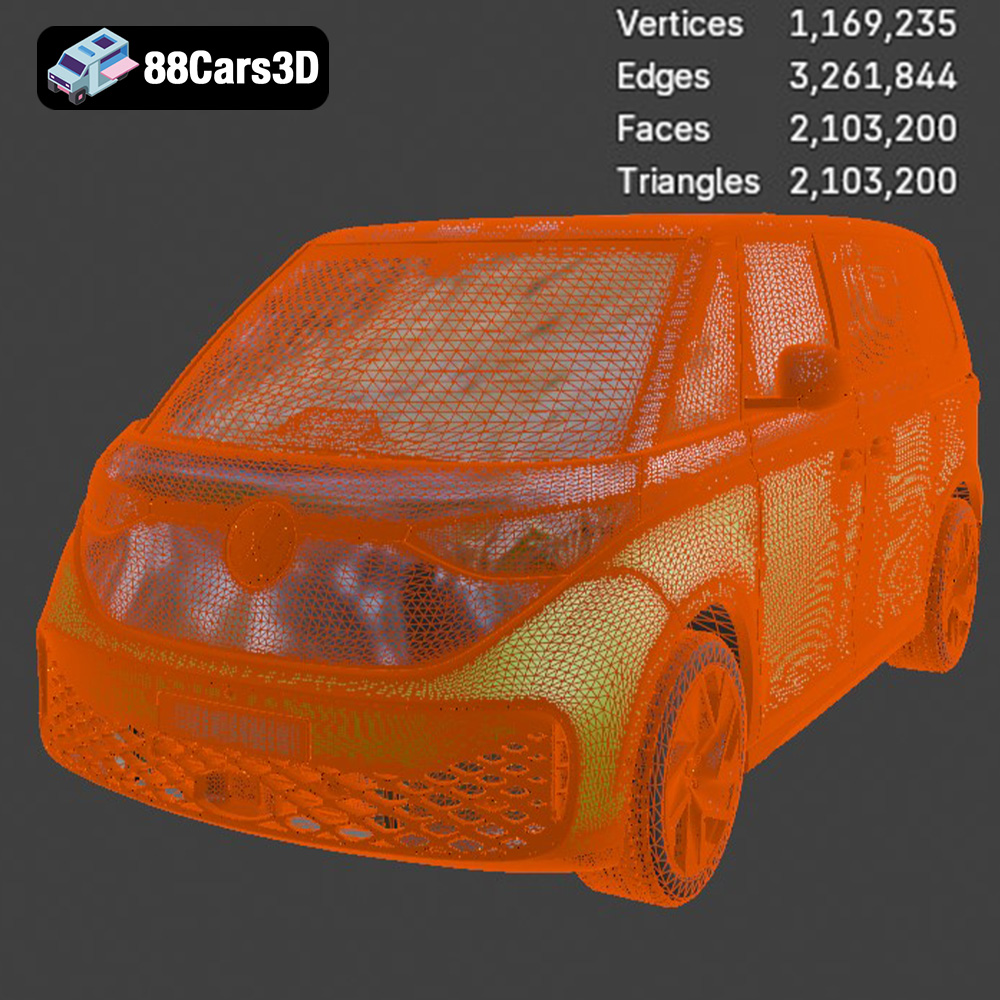
The phrase “clean geometry” is not just a buzzword; it’s a cornerstone of professional 3D modeling. It implies a mesh built primarily with quadrilaterals (quads) rather than triangles or n-gons, which leads to predictable deformation during animation and smooth subdivision. Efficient topology means that polygons are distributed logically, with higher density in areas requiring fine detail (like sharp edges or complex curves) and lower density in flat, less critical areas. This approach results in a lighter, more manageable mesh without sacrificing visual quality, a characteristic evident in the ID. Buzz model’s “optimized mesh structure.” This is critical for both rendering and real-time engines, where polygon count directly impacts processing time.
Proper UV mapping is essential for applying textures and materials without distortion. A well-laid-out UV map maximizes texture space efficiency and minimizes seams, ensuring that complex details like decals, carbon fiber patterns, or interior fabric weaves appear seamless and realistic. High-quality 3D car models typically come with non-overlapping UVs across their main components. Efficient texture management involves using optimized texture resolutions, employing PBR texture sets (Albedo, Normal, Roughness, Metallic, AO), and sometimes utilizing texture atlases to reduce the number of material calls, further boosting performance in real-time applications.
Investing in a high-quality 3D car model from a reputable source like 88cars3d.com is an investment in scalability. A well-built model can be easily adapted for future needs – whether that means generating LODs for a new game engine, converting it for a cutting-edge AR platform, or updating its materials for the latest render technology. The versatility offered by multiple file formats (.blend, .fbx, .obj, .glb, .stl, .ply, .unreal, .max) ensures that the Volkswagen ID. Buzz 2023 3D Model remains a flexible and valuable asset in an ever-evolving digital landscape, ready for any professional challenge that comes its way.
In the dynamic world of digital content creation, the quality of your foundational assets can make or break a project. As we’ve explored, a high-fidelity 3D car model like the Volkswagen ID. Buzz 2023 is far more than just a collection of polygons; it’s a versatile, optimized tool designed to meet the rigorous demands of professional workflows across automotive rendering, game development, AR/VR experiences, and advanced simulations.
From the nuanced choices of file formats for specific applications to the intricate details of materials, lighting, and performance optimization, every aspect of a premium 3D car model contributes to its ultimate utility and impact. Such assets empower artists and developers to create visually stunning and technically robust projects, pushing the boundaries of realism and immersion.
For those seeking to elevate their digital automotive projects, the Volkswagen ID. Buzz 2023 3D Model represents a benchmark in quality and versatility. Available in a comprehensive array of formats including .blend, .fbx, .obj, .glb, .stl, .ply, .unreal, and .max, it is a testament to the meticulous craftsmanship and technical expertise that professional studios demand. Discover this exceptional asset and many more at 88cars3d.com, where quality meets innovation in the realm of 3D car models.
Discover exceptional detail with the Volkswagen ID. Buzz 2023 3D Model. This comprehensively built asset accurately recreates the unique design and modern characteristics of the celebrated electric van. It incorporates key features such as clean geometry, realistic materials, and professional quality, guaranteeing accurate representations in demanding visual projects. The optimized mesh structure offers precise surfacing and fully modeled exterior components alongside detailed interior elements. This asset is specifically tailored for advanced professional workflows where accuracy is essential. Ideal applications for this model encompass game development, offline rendering, AR/VR experiences, simulation environments, and commercial visualization.
$39.99
.arvr
.blend
.buzz
.car3dmodel
.electricvehicle
.ev
.fbx
.gameasset
.glb
.idbuzz
.max
.minivan
.obj
.ply
.rendering
.simulation
.stl
.unreal
.van
.volkswagen