Get 20% OFF All Premium 3D & STL Models!

In the dynamic world of digital content creation, the foundation of any compelling visual experience, whether it’s a breathtaking cinematic render, an immersive game world, or a detailed AR/VR application, lies in the quality of its 3D assets. Professionals across industries demand models that not only look authentic but are also technically robust, optimized, and versatile enough to integrate seamlessly into complex pipelines. From automotive visualization to game development, the need for precision and fidelity has never been greater.
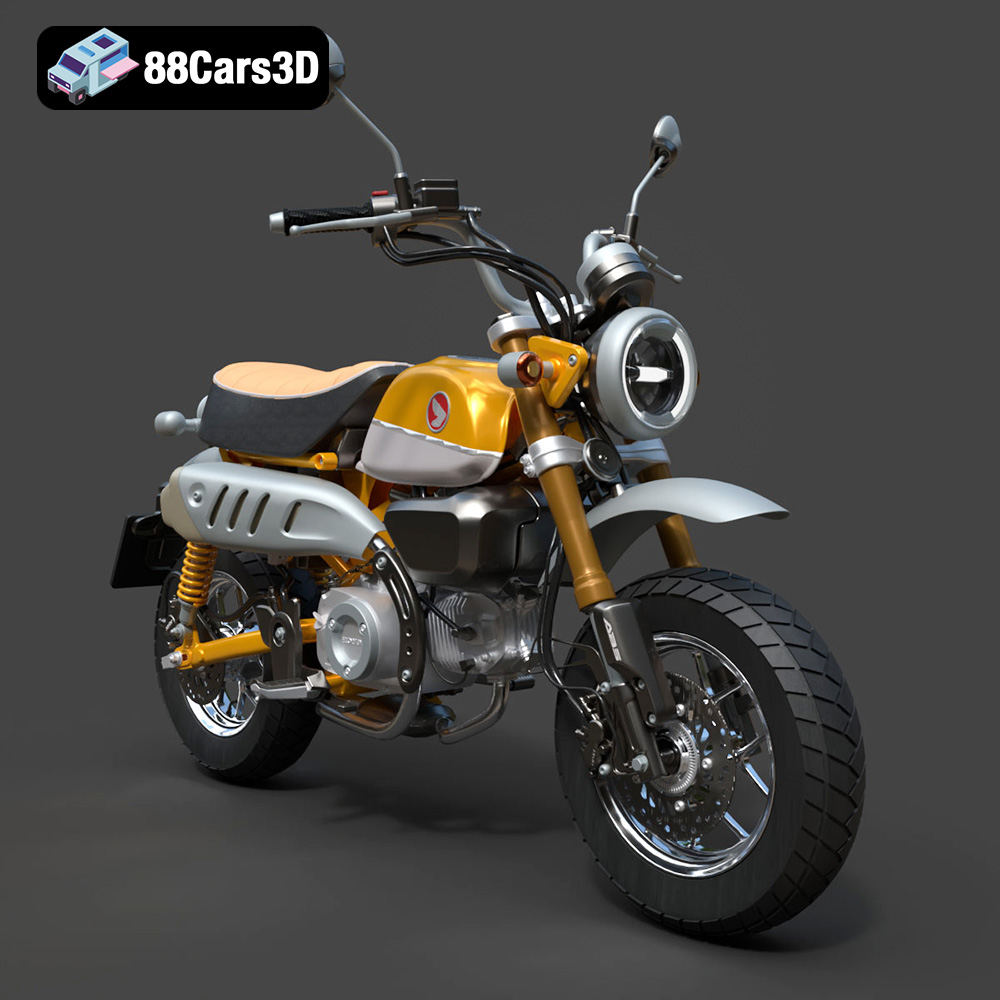
Today, we delve into the critical role that meticulously crafted 3D models play in achieving photorealism and efficient workflow, using an exemplary asset as our guide: the Honda Monkey 125 2019 3D Model. This particular model stands out as a testament to what high-quality digital assets can offer, capturing the iconic essence and unique design of the original vehicle with exceptional detailing and technical integrity. It provides a perfect case study for understanding the multi-faceted demands of modern 3D production and how a well-engineered model can meet them across various applications.
High-quality 3D models are not merely aesthetic elements; they are engineering marvels that underpin the success of any digital project. Their impact extends from the initial concept phase through final production, influencing everything from performance to visual appeal. When selecting 3D car models, for instance, designers and developers must consider a myriad of factors beyond just surface appearance.
For automotive rendering, precision is paramount. Every curve, every reflection, every material property must be exact to convey the intended design and luxury of a vehicle. A low-quality model often translates to distorted reflections, incorrect shading, and a general lack of realism that can undermine an entire visualization project. High-quality 3D car models, like the Honda Monkey 125 2019, are built with accurate dimensions, clean topology, and carefully calibrated PBR (Physically Based Rendering) materials. This attention to detail ensures that when rendered in advanced engines like V-Ray, Corona, or Cycles, the result is virtually indistinguishable from a photograph, allowing manufacturers to showcase their designs long before physical prototypes exist.
In game development, the challenges are even greater, combining visual fidelity with strict performance requirements. Game assets must be highly optimized with appropriate polygon counts, efficient UV layouts, and well-structured materials to ensure smooth frame rates without sacrificing visual appeal. Using a premium asset like the Honda Monkey 125 2019 3D Model means game developers inherit a robust foundation, saving countless hours on optimization and re-modeling. Its clean geometry and game-engine-ready formats facilitate quicker integration into real-time environments such as Unreal Engine and Unity, contributing significantly to a more immersive and believable game world.
The burgeoning fields of Augmented Reality (AR) and Virtual Reality (VR) demand models that are not only high-fidelity but also extremely lightweight and optimized for real-time interaction. Latency and performance are critical in AR/VR to prevent user discomfort. A well-constructed 3D model, such as those found on 88cars3d.com, including our featured Honda Monkey 125, is designed with these constraints in mind. Its optimized mesh and texture atlases ensure smooth performance on mobile devices and VR headsets, enabling creators to build compelling interactive showrooms, virtual training simulations, or engaging AR experiences where users can explore vehicles in their own environment.
The versatility of a 3D model is often defined by the range and quality of its supported file formats. A professional asset package should provide multiple formats, each tailored for specific workflows and software applications. The Honda Monkey 125 2019 3D Model exemplifies this approach, offering a comprehensive suite of formats to ensure maximum compatibility and utility across diverse creative pipelines. Understanding these formats is crucial for any 3D professional.
The .blend format is the native file type for Blender, a powerful, open-source 3D creation suite. When you acquire a .blend file for the Honda Monkey 125, you’re getting a fully editable scene, complete with materials, textures, lighting setups, and often, camera configurations. This format is ideal for artists who primarily work in Blender, allowing them to dive directly into the model’s construction, make modifications, adjust materials, or even re-rig components for animation. It preserves all native Blender-specific features, modifiers, and node-based material graphs, offering unparalleled flexibility for customization and further development within the Blender ecosystem.
The .fbx (Filmbox) format is an industry-standard proprietary file format developed by Autodesk for 3D content exchange. It is exceptionally popular for transferring models between different 3D software applications and, critically, for integration into game engines like Unreal Engine and Unity. An .fbx file can encapsulate not only mesh data but also materials, textures, animations, skinning, and camera information. It’s designed for efficiency in real-time pipelines, making it the go-to choice for game assets. When using the Honda Monkey 125 .fbx, developers can expect a robust, optimized asset ready for immediate import and deployment in their interactive projects, complete with proper scaling and pivot points.
The .obj (Wavefront OBJ) format is one of the most widely supported and universal 3D file formats. It’s a simple, text-based format that primarily stores geometric data – vertices, normals, UV coordinates, and faces. While it doesn’t typically store advanced material definitions or animation data directly within the file itself (materials are usually referenced in an accompanying .mtl file), its universality makes it an excellent choice for cross-software compatibility. Almost every 3D modeling, rendering, or CAD application can import and export .obj files. For the Honda Monkey 125, the .obj version ensures that users of niche or legacy software can still access the core geometric data of the model.
The .glb (GL Transmission Format Binary) is a modern, open-standard file format specifically designed for efficient transmission and loading of 3D scenes and models in web and real-time applications. It packages all necessary assets – geometry, materials, textures, and animations – into a single binary file, making it incredibly streamlined for AR, VR, and browser-based experiences. The .glb version of the Honda Monkey 125 3D Model is pre-optimized for quick loading and rendering in environments like webGL viewers, ARKit, and ARCore, making it perfect for interactive product configurators or virtual showrooms directly on a website or mobile device.
The .stl (Standard Tessellation Language or Stereolithography) format is the standard file type for 3D printing. It represents a 3D model as a series of connected triangles, describing only the surface geometry of an object without color, texture, or other CAD attributes. While simple, its ubiquity in the additive manufacturing world is unmatched. The .stl version of the Honda Monkey 125 is provided for users who intend to 3D print the motorcycle, perhaps for prototyping, scale models, or detailed collectibles. It ensures the mesh is watertight and ready for slicing software, though users should always verify scale and printability for their specific printer.
The .ply (Polygon File Format or Stanford Triangle Format) is another format for storing 3D data, particularly useful for scanned data, CAD applications, and scientific analysis. Like .obj, it can store geometric information, but it offers greater flexibility to store additional attributes for each vertex (e.g., color, transparency, normals) and face (e.g., color). It’s often used where precise mesh information and additional data per polygon or vertex are important. The .ply file for the Honda Monkey 125 could be valuable for engineers or researchers needing a precise mesh representation for simulations or detailed analysis.
The .unreal designation refers to a pre-configured asset package specifically prepared for direct import into Unreal Engine. While typically not a single file format in the way .fbx or .obj are, it signifies a complete, optimized asset (often an .fbx internally, but pre-configured) that has been tested and packaged for seamless integration into an Unreal Engine project. This often includes correct scaling, material assignments, texture packing, and potentially even basic collision meshes or LODs (Levels of Detail). For the Honda Monkey 125, the .unreal asset significantly reduces setup time for game developers using Unreal Engine, providing an immediate, engine-ready component.
Similar to .blend for Blender, the .max format is the native file type for Autodesk 3ds Max, another industry-leading 3D modeling, animation, and rendering software. The .max file for the Honda Monkey 125 offers a fully editable project, preserving all 3ds Max-specific features, modifiers, material setups (e.g., V-Ray or Corona materials), lighting, and scene organization. This is indispensable for professionals working in 3ds Max who require full control over the model for high-end rendering, complex animations, or integrating it into intricate architectural visualizations or product design presentations.
The inclusion of all these diverse formats with the Honda Monkey 125 2019 3D Model underscores its professional-grade quality and commitment to enabling a vast array of project requirements and software preferences, making it a truly versatile game asset and rendering solution.
Beyond simply providing multiple file formats, the true value of a premium 3D model lies in its underlying technical construction. The Honda Monkey 125 2019 3D Model from 88cars3d.com is engineered with a deep understanding of professional production requirements, focusing on clean geometry, realistic materials, and robust optimization.
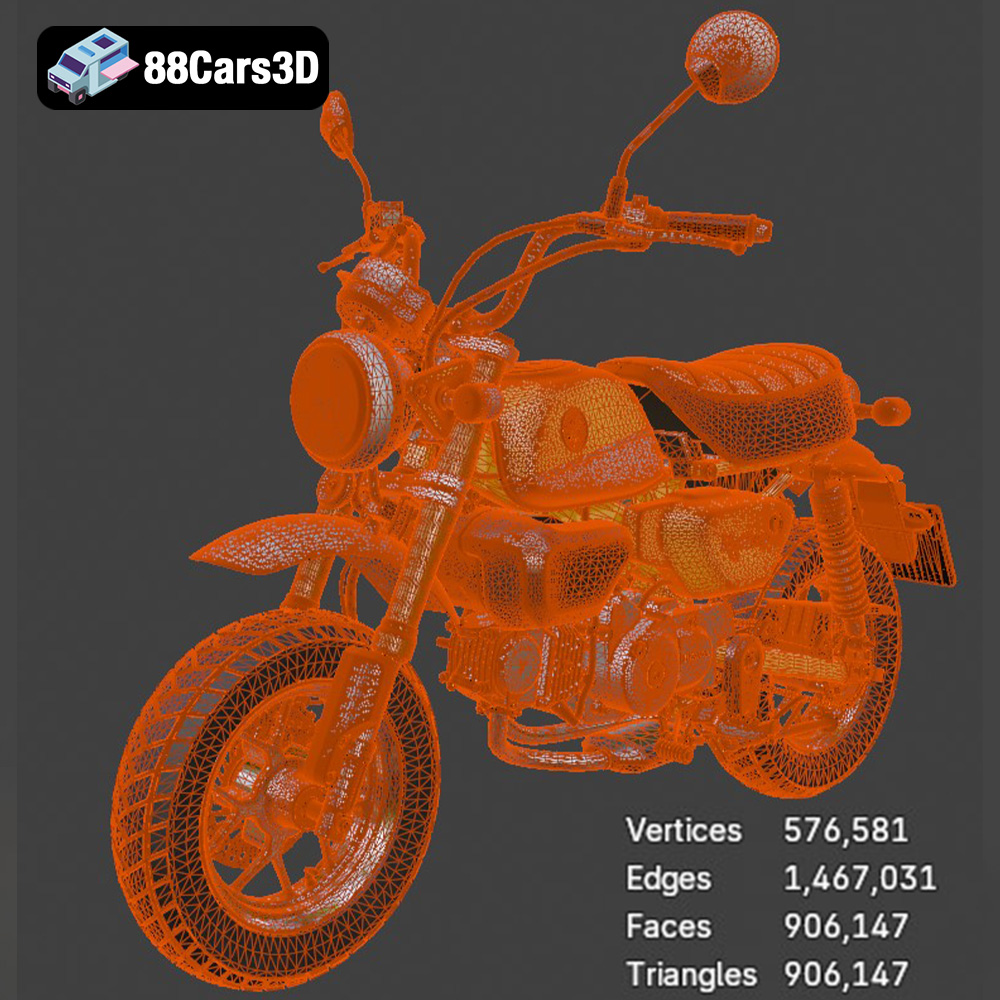
The first sign of a high-quality 3D model is its geometry. The Honda Monkey 125 features clean, quad-based topology, which is crucial for smooth subdivisions and distortion-free deformation if the model were to be animated. Every curve and panel is represented accurately, avoiding pinching or unnatural artifacts. The polygon count is optimized, meaning it’s detailed enough for close-up renders but also efficient enough for real-time applications. This involves strategic use of polygons: higher density where details are crucial (e.g., engine components, badges) and lower density in flatter, less visible areas. This balance is key for creating versatile 3D car models that can perform well in diverse scenarios without compromising visual fidelity.
Materials and texturing are where a 3D model truly comes to life. The Honda Monkey 125 2019 3D Model utilizes realistic PBR (Physically Based Rendering) materials, which accurately simulate how light interacts with surfaces in the real world. This means metallic parts reflect light correctly, painted surfaces show appropriate gloss and roughness, and rubber components have distinct tactile qualities. The textures are high-resolution, meticulously UV unwrapped to avoid stretching or seams, and often include diffuse (albedo), normal, roughness, metallic, and ambient occlusion maps. This comprehensive texturing allows the model to look fantastic under various lighting conditions and in different rendering engines, ensuring consistent visual quality across projects.
While the Honda Monkey 125 is primarily a static model, its clean geometry and structured components lay a solid groundwork for potential rigging and animation. Individual parts, such as wheels, handlebars, and suspension elements, are meticulously separated and logically named. This organization drastically simplifies the process for artists who might wish to rig the motorcycle for dynamic sequences, turning it into an interactive game asset or an animated element in a cinematic production. The robust topology ensures that any deformation or movement applied through rigging will be smooth and visually convincing, an essential aspect for those aiming to push the boundaries of their automotive rendering projects.
The true measure of a versatile 3D asset is its seamless integration into various professional workflows. The Honda Monkey 125 2019 3D Model is designed precisely for this, providing engineers, artists, and developers with pre-configured options for their preferred software and use cases.
For high-end rendering, the included .max and .blend files are invaluable. In 3ds Max, artists can open the .max file, which often comes with pre-set V-Ray or Corona Renderer materials, optimized lighting, and camera angles. This allows for immediate high-quality automotive rendering with minimal setup. Users can easily adjust materials, lighting, or scene composition to fit specific project requirements, creating stunning marketing visuals or detailed product showcases. Similarly, in Blender, the .blend file provides an editable scene with Cycles or Eevee-ready materials, enabling artists to jump straight into producing photorealistic images or animations. The clean topology also makes it easy to add subdivision surfaces for even smoother results in close-up shots.
Game developers will appreciate the game-engine-ready formats. The .fbx file is a universal choice for both Unreal Engine and Unity. Upon import, the model’s optimized geometry, UVs, and PBR textures translate efficiently, allowing for quick setup of materials and physics assets. The dedicated .unreal asset goes a step further, providing a pre-configured package that can be dropped directly into an Unreal project, saving significant time on asset preparation. This includes optimized mesh, correctly assigned materials, and potentially even basic collision volumes, making the Honda Monkey 125 an ideal game asset for racing simulations, open-world environments, or interactive product showcases within games.
For interactive experiences on the web or in AR/VR, the .glb format is indispensable. This single-file format contains all the necessary data—geometry, materials, textures—for efficient delivery and rendering in browser-based viewers (e.g., Three.js, Babylon.js) or dedicated AR/VR platforms. Developers can easily embed the Honda Monkey 125 3D Model into websites for 360-degree interactive views, integrate it into mobile AR apps, or use it in VR training simulations. Its optimized nature ensures smooth performance without taxing device resources, crucial for engaging user experiences.
Beyond digital visualization, the Honda Monkey 125 also caters to physical production. The .stl and .ply formats are provided for 3D printing and prototyping. Designers can use the .stl file to create physical scale models, test design elements, or produce custom accessories for their real-world projects. The .ply format, with its ability to store richer mesh data, can be useful for more advanced analysis or if the model needs to be integrated into a CAD workflow for precise manufacturing or reverse engineering studies. This versatility extends the utility of the 3D model far beyond the screen, bridging digital design with tangible reality.
The demand for high-quality 3D car models is pervasive, touching numerous industries and enabling innovative solutions. The Honda Monkey 125 2019 3D Model, with its comprehensive features and format support, is perfectly positioned to serve a wide array of real-world applications.
Automotive manufacturers and marketing agencies constantly seek stunning visuals to promote new vehicles. Studios use models like the Honda Monkey 125 for creating photorealistic imagery for brochures, commercials, and online configurators. Before a physical prototype is even built, designers can iterate on colors, finishes, and accessories in a virtual environment, saving immense time and cost. The detailed materials and accurate geometry of 88cars3d.com’s models ensure that the final render captivates potential buyers, providing an immersive preview of the product.
Major game titles, from racing simulators to open-world adventures, rely heavily on authentic vehicle models. A detailed motorcycle like the Honda Monkey 125 can be a compelling game asset, enhancing player immersion whether it’s an intractable vehicle in a virtual city or a customizable collectible. Its optimized topology and game-engine-ready formats drastically reduce development time, allowing studios to focus on gameplay mechanics rather than extensive asset cleanup. The ability to integrate it directly into Unreal Engine or Unity streamlines the process, bringing vehicles to life with realistic physics and visual effects.
Beyond entertainment, high-fidelity 3D models are invaluable for education and training. The Honda Monkey 125 3D Model could be used in virtual mechanic training simulations, allowing students to disassemble and reassemble components in a safe, virtual environment. It can also serve in driving schools for motorcycle safety courses, where students can interact with a realistic representation of the vehicle in various scenarios without real-world risks. The versatility of formats like .glb also makes it suitable for interactive e-learning modules accessible directly through web browsers, making complex machinery more understandable and engaging.
Architectural visualization (ArchViz) studios often incorporate vehicles into their renders to add scale, context, and a sense of realism to their building designs. Placing a beautifully rendered Honda Monkey 125 in a virtual garage or outside a modern cafe can significantly enhance the visual narrative of an architectural scene. Similarly, product design firms can use such models for product placement visualizations, showcasing how their complementary products (e.g., helmets, gear) would look alongside a specific vehicle in a lifestyle setting, refining marketing strategies and visual presentations.
The landscape of 3D content creation is increasingly complex, demanding assets that are not only visually appealing but also technically robust, optimized, and versatile. As we’ve explored with the Honda Monkey 125 2019 3D Model, the commitment to clean geometry, realistic materials, and comprehensive file format support is what truly differentiates a professional-grade asset. Whether your project involves producing stunning automotive rendering, developing immersive game assets for the latest titles, or creating interactive AR/VR experiences, the quality of your foundational 3D models is paramount.
Investing in meticulously crafted 3D models like the Honda Monkey 125 ensures efficiency in your workflow, reduces production bottlenecks, and ultimately elevates the realism and impact of your final output. It’s a strategic choice for professionals aiming to deliver exceptional results across a spectrum of industries. For those seeking a reliable source for top-tier 3D car models and vehicle assets, 88cars3d.com offers a curated selection designed to meet the highest standards of digital production.
Experience superior realism with the Honda Monkey 125 2019 3D Model. This carefully crafted digital asset delivers exceptional detailing, capturing the iconic essence and unique design of the original vehicle. The model features clean geometry and realistic materials, ensuring a professional standard for any project. Every component is meticulously structured, offering accurate proportions and an optimized polygon count for seamless integration into complex scenes. Perfect for a wide range of applications, this versatile 3D model is ideal for game development, professional rendering, AR/VR experiences, and immersive visual simulations. Whether you are creating a dynamic cinematic sequence or an interactive showroom, this asset provides the reliability and visual fidelity required.
$39.99
.arvr
.blend
.car3dmodel
.fbx
.gameasset
.glb
.honda
.max
.minibike
.monkey125
.motorcycle
.obj
.ply
.rendering
.simulation
.stl
.unreal