Get 20% OFF All Premium 3D & STL Models!

In the fast-paced world of digital creation, the demand for high-quality 3D assets is ever-increasing. Whether you’re a game developer crafting expansive open worlds, an architect visualizing urban landscapes, a filmmaker producing compelling animations, or an automotive designer pushing the boundaries of virtual prototyping, the foundation of your success often rests on the realism and efficiency of your 3D models. Few subjects command attention quite like an iconic vehicle, and the Vespa P200E is a prime example of timeless design and cultural resonance. Transforming such a classic into a versatile 3D asset requires a blend of artistic fidelity and technical precision. This article delves into the intricate process of utilizing professional 3D car models, focusing on the technical considerations that empower creators across various industries. We will explore everything from file format selection to real-world application, showcasing how a meticulously crafted model, like the Vespa P200E 3D Model available at 88cars3d.com, can elevate your projects to new heights.
The world of 3D modeling is rich with diverse file formats, each serving specific purposes and workflows. Understanding these formats is crucial for any professional working with 3D assets, as selecting the right one can significantly impact compatibility, performance, and the ease of your pipeline. The Vespa P200E 3D Model, for instance, comes in a comprehensive suite of formats, ensuring maximum flexibility for artists and developers.
The .blend format is the native file type for Blender, one of the most powerful and widely used open-source 3D content creation suites. When you download a .blend file, you’re getting a fully editable Blender scene. This includes not only the mesh geometry but also materials, textures, lighting setups, animation data, cameras, and even physics simulations. For artists working primarily in Blender, this format offers unparalleled flexibility for customization and direct integration into their existing projects. It’s ideal for those who wish to dissect the model, learn from its construction, or make extensive modifications to its topology, UVs, or shading networks.
.fbx (Filmbox) is a proprietary file format developed by Autodesk, which has become the de facto industry standard for 3D data exchange between various software applications and game engines. Its strength lies in its ability to encapsulate a wide range of 3D data, including models, animations, cameras, lights, and even blend shapes, into a single file. This makes .fbx ideal for pipelines involving Unreal Engine, Unity, and other real-time environments, where efficient data transfer and animation support are paramount. While incredibly versatile, users should be mindful of version compatibility and potential export/import settings that can affect material translation across different software.
The .obj (Wavefront OBJ) format is one of the oldest and most universally supported 3D file formats. It primarily stores geometry data (vertices, normals, texture coordinates, and faces) and references external material files (.mtl). Its simplicity is its greatest asset, ensuring excellent cross-software compatibility. Almost every 3D application can open an .obj file, making it a reliable choice for basic mesh exchange when complex scenes or animations are not required. It’s often used as a fallback format or for raw mesh data import.
.glb (GL Transmission Format Binary) is the binary version of glTF, a royalty-free specification for the efficient transmission and loading of 3D scenes and models by applications. .glb files are highly optimized for AR/VR applications, web-based 3D viewers, and mobile platforms due to their compact size and efficient runtime parsing. They embed all texture and animation data directly within a single file, simplifying asset management. This format is increasingly popular for interactive 3D experiences in browsers and for integrating 3D content into augmented reality apps.
.stl (STereoLithography) is the standard file format for additive manufacturing (3D printing). It represents a 3D model as a series of connected triangles, defining only the surface geometry of an object without color, texture, or other CAD attributes. While simple, its ubiquity makes it essential for anyone looking to bring their digital models into the physical world. For a model like the Vespa P200E, converting to .stl allows hobbyists and professionals alike to produce physical replicas, requiring careful consideration of mesh integrity, wall thickness, and printability.
The .ply (Polygon File Format or Stanford Triangle Format) is another format that describes a 3D object as a collection of polygons. It’s often used in fields requiring precision mesh data, such as scientific analysis, 3D scanning, and CAD applications. Unlike .obj, .ply can also store additional properties like color, transparency, and range data for each vertex and face, making it suitable for more complex data sets derived from scanning or highly detailed geometric analysis.
The .unreal format, or more accurately, assets packaged for Unreal Engine, implies an asset that has been specifically prepared and optimized for the engine’s ecosystem. This often means the model has appropriate LODs (Levels of Detail), collision meshes, material instances, and possibly even Blueprint scripting integrated. While not a standalone file extension in the traditional sense like .fbx, receiving an “.unreal” package signifies an asset designed for seamless integration into an Unreal Engine project, saving countless hours of preparation time for game developers and real-time visualization artists.
Finally, the .max format is the native file type for Autodesk 3ds Max, a powerful 3D modeling, animation, rendering, and compositing software. Similar to .blend files, .max files contain the complete scene data, including all objects, lights, cameras, animations, and material setups specific to 3ds Max. For professionals entrenched in the Autodesk ecosystem, the .max file provides full access to the original scene, allowing for advanced rendering with V-Ray or Corona, complex animation rigging, and detailed modifications within a robust production environment.
The availability of such a wide array of formats for the Vespa P200E 3D Model highlights 88cars3d.com’s commitment to providing versatile assets for every professional pipeline.
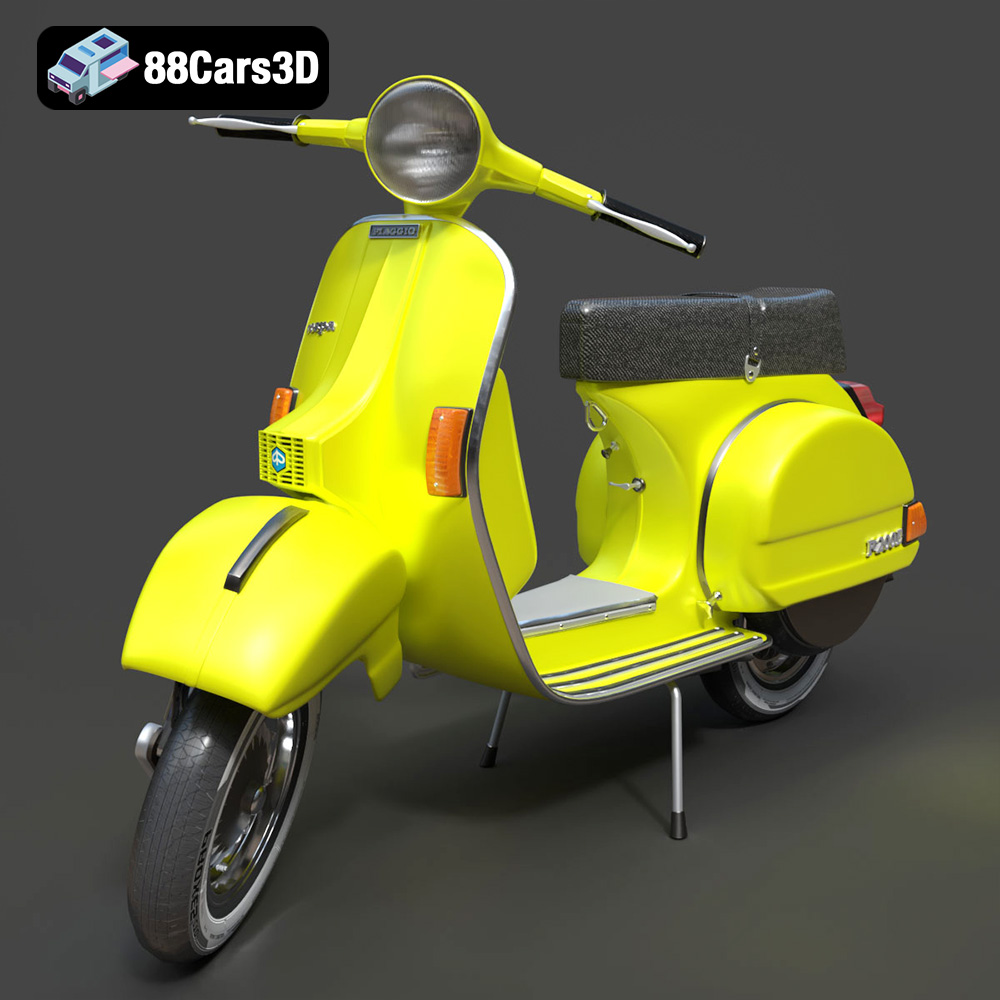
The Vespa P200E is more than just a scooter; it’s a cultural symbol, a design masterpiece that resonates with a sense of freedom and style. Translating such an icon into a high-fidelity 3D model demands meticulous attention to detail and a deep understanding of its original form. The Vespa P200E 3D Model achieves this by perfectly capturing its distinctive features while simultaneously optimizing for modern digital applications.
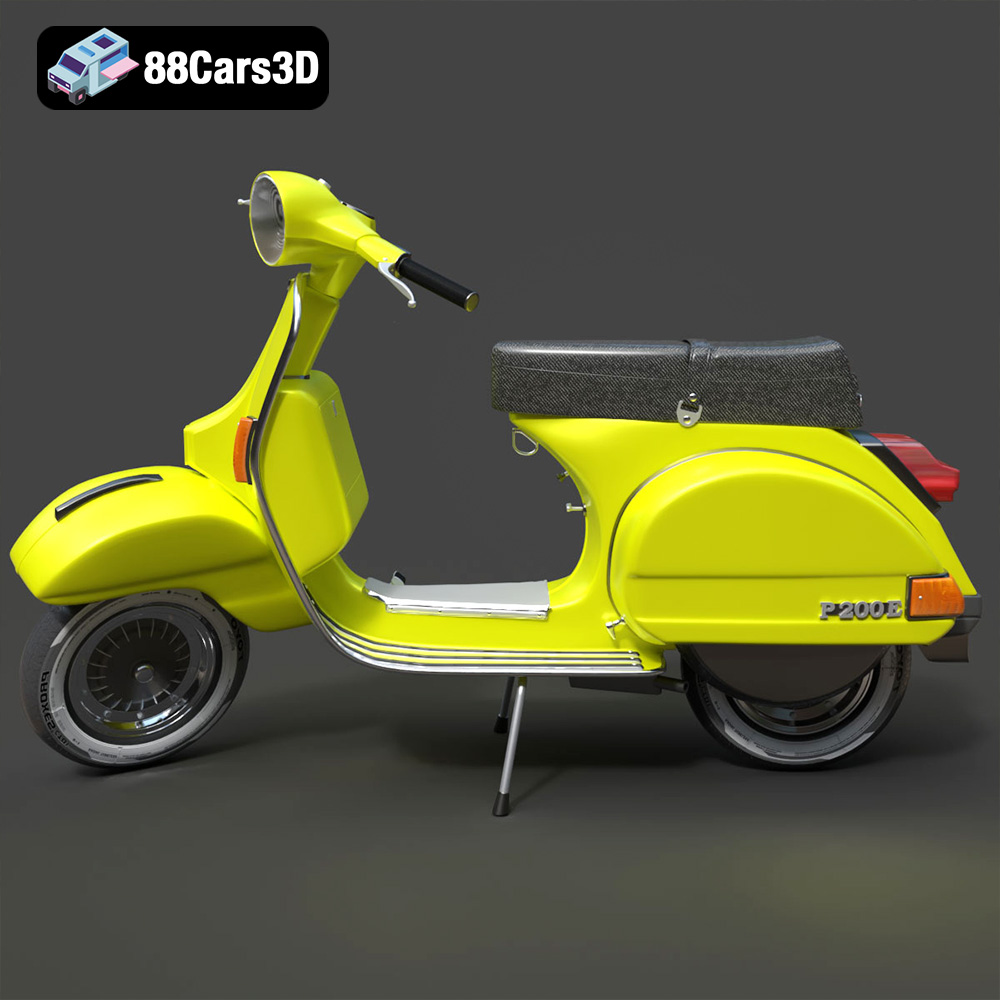
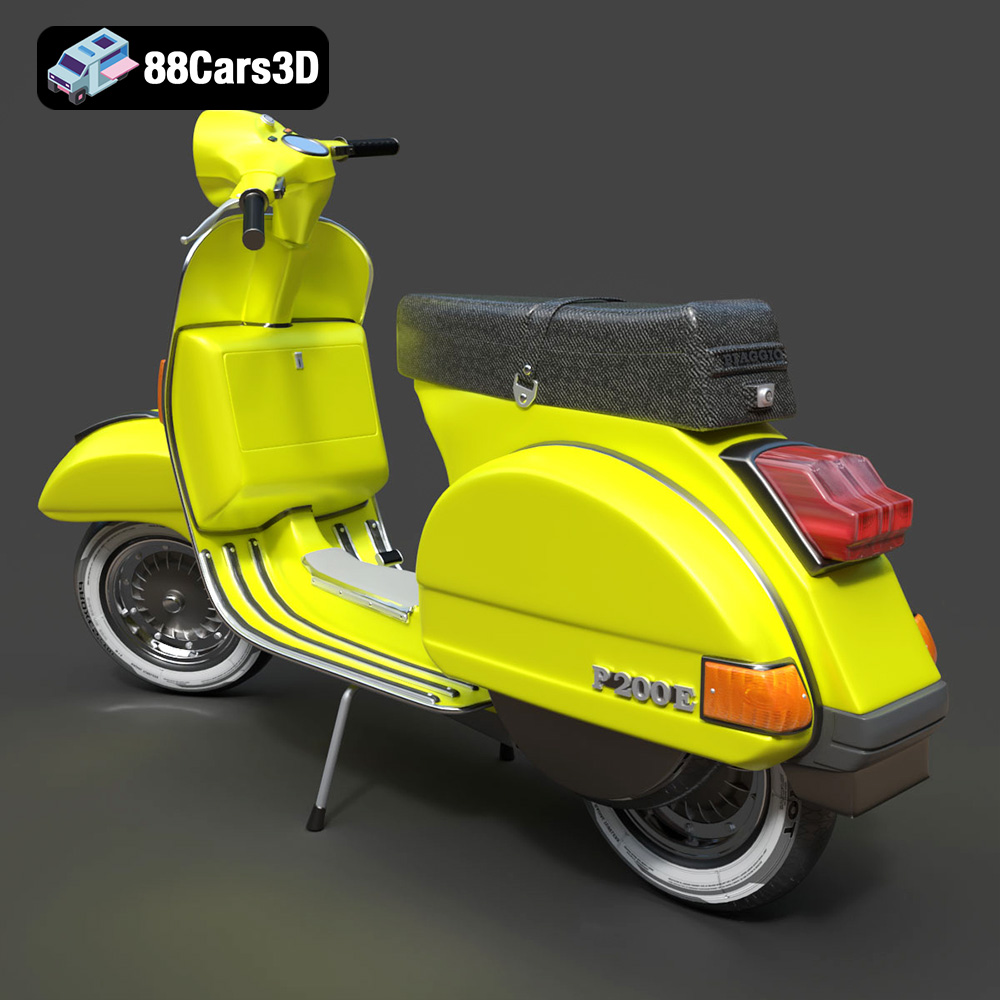
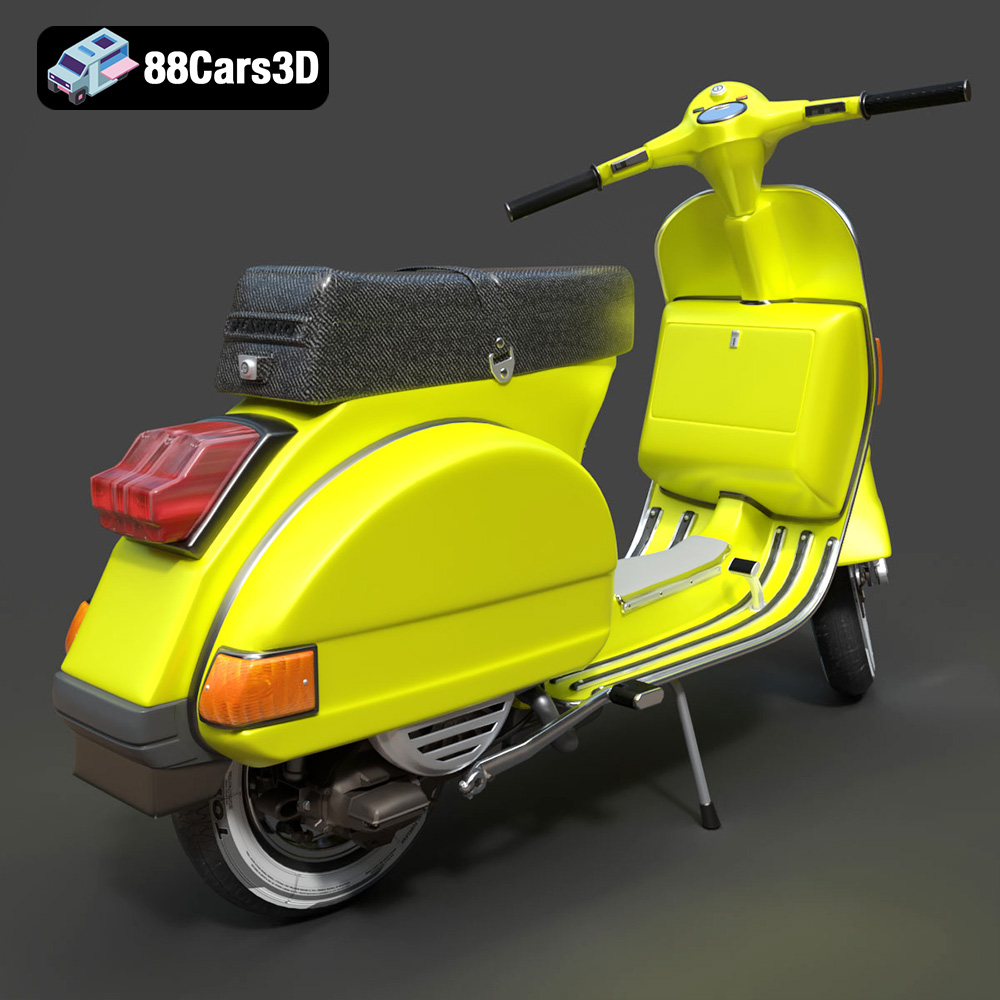
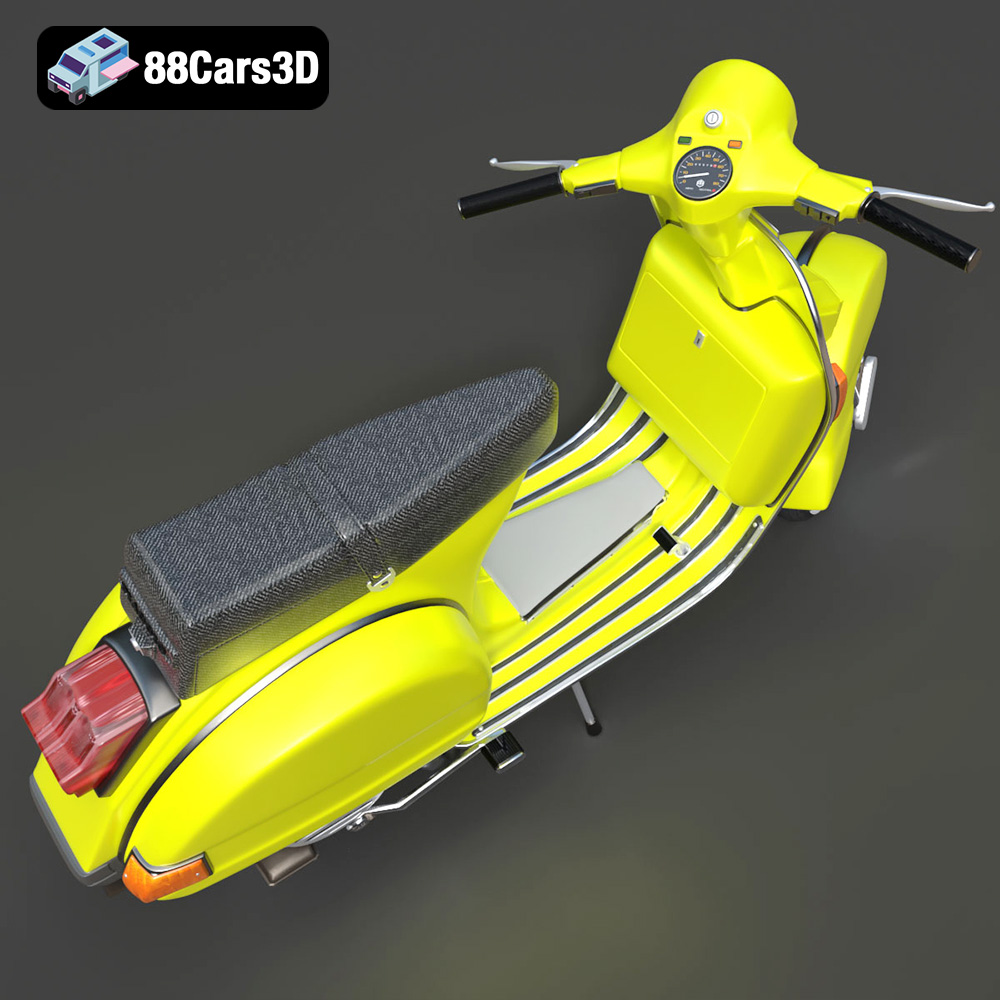
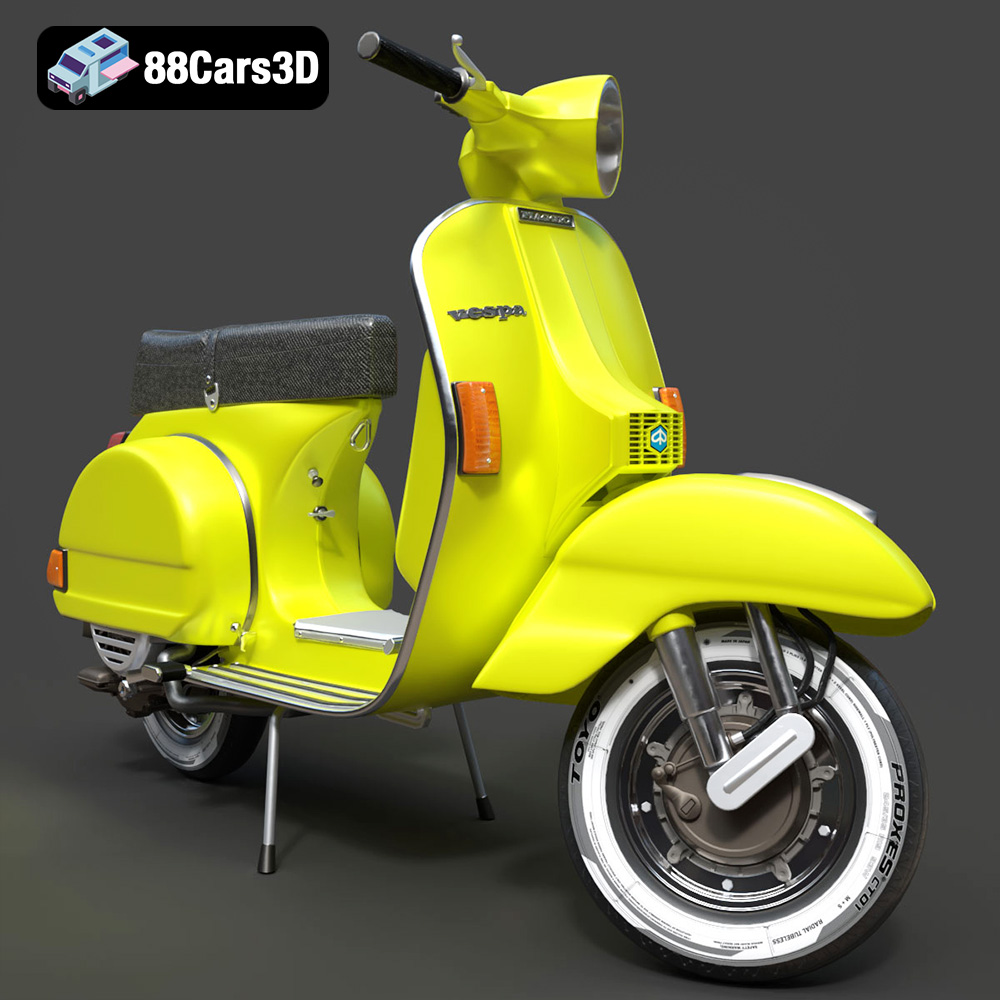
The core of any successful automotive 3D model lies in its accuracy. For the Vespa P200E, this means recreating its celebrated step-through frame geometry, signature rear engine cowlings, and the overall classic vintage aesthetic. Every curve, every line, from the rounded headlamp to the unmistakable tail section, has been meticulously studied and modeled to reflect the real-world vehicle. This dedication to authentic proportions ensures that whether the model is placed in a realistic urban cityscape rendering or used in a historical game setting, it will look convincingly true to life. This fidelity is critical for rendering, visualization, and even AR/VR applications where accurate scale and form are paramount for immersion.
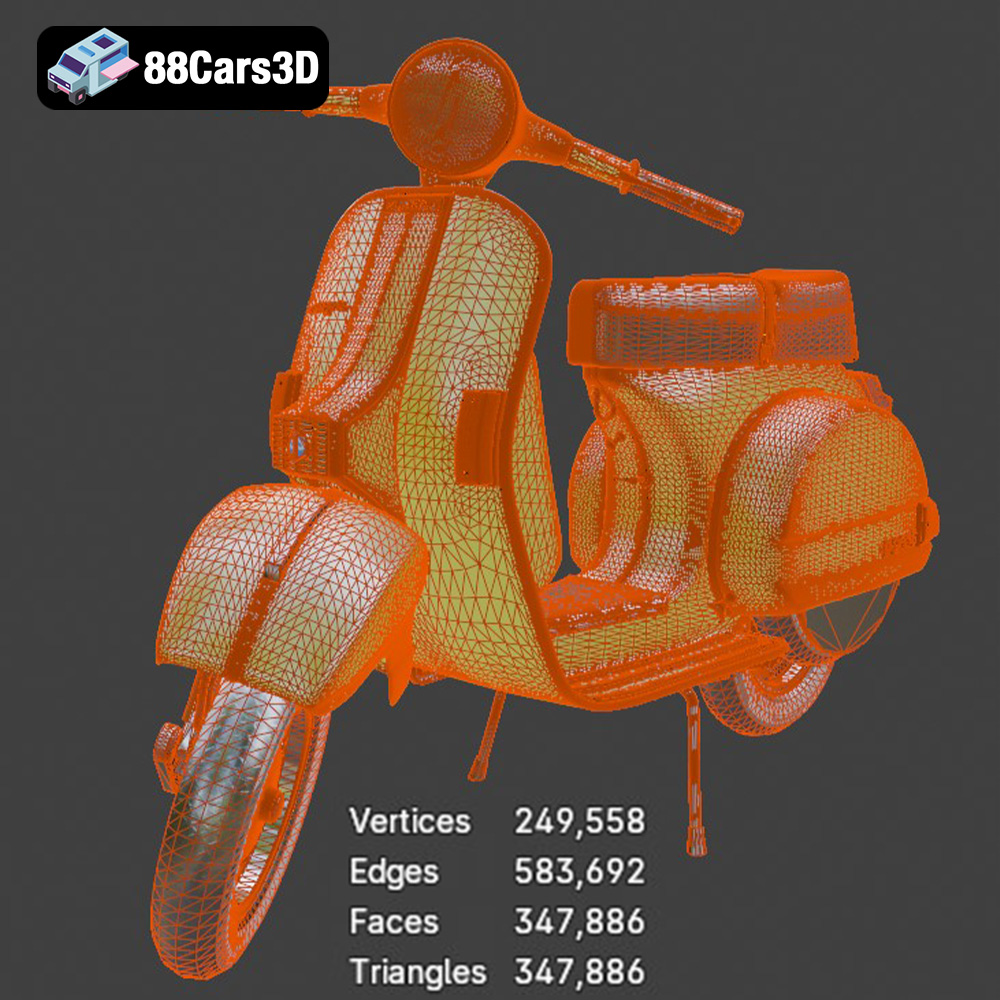
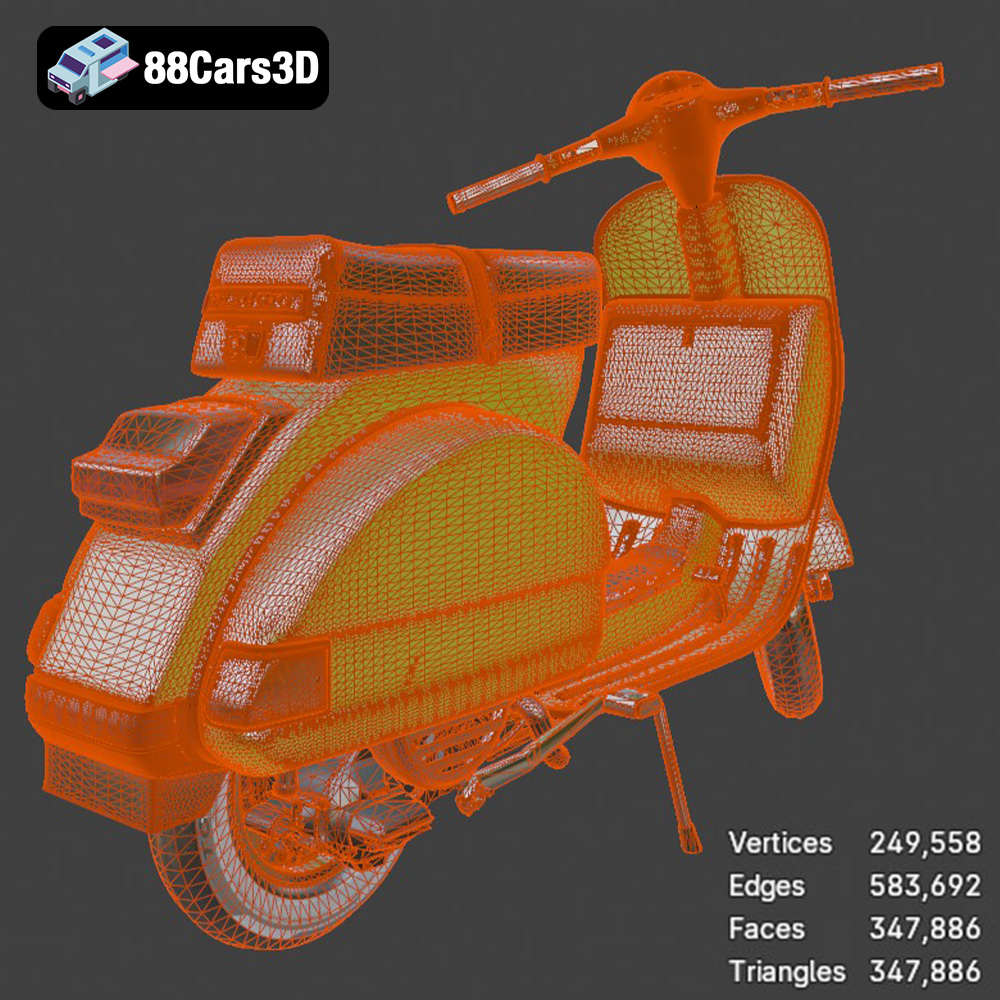
While visual fidelity is crucial, raw detail can be a detriment in real-time environments. The Vespa P200E 3D Model strikes a perfect balance with a game-ready topology of approximately 50,000 triangles. This poly count is a sweet spot, delivering stunning realism without sacrificing performance. In game development, asset optimization is key to maintaining high frame rates and smooth gameplay. For platforms like Unreal Engine and Unity, an optimized model means less computational overhead, allowing developers to populate scenes with multiple vehicles without performance bottlenecks. The clean geometry of the model ensures smooth shading and excellent material response, which translates into beautiful visuals whether lit by a powerful rendering engine or dynamically illuminated within a game world.
A truly professional 3D car model goes beyond just the overall shape; it’s about the intricate details that bring it to life. The Vespa P200E 3D Model excels in this regard, meticulously recreating both its exterior and interior features to provide a comprehensive and immersive digital asset.
The external features of the Vespa P200E 3D Model are a testament to its detailed craftsmanship. This includes the accurate representation of the 2-stroke engine housing and transmission case, elements often overlooked in less detailed models but crucial for true authenticity. The classic exhaust box, signature round headlight, period-correct indicators, and integrated taillight are all faithfully reproduced. Moving to the chassis, the accurate 10-inch wheels boast classic tread patterns, while the front trailing link suspension and rear mono-shock detailing add a layer of mechanical realism. Crucially for animators, components like the wheels, suspension, and steering are separated, allowing for realistic motion, turns, and bumps in any scene. This level of granularity makes the model incredibly versatile for high-end automotive rendering, detailed game cutscenes, and even interactive virtual showrooms.
The rider’s perspective is equally important, especially for first-person POV applications in gaming or immersive VR experiences. The Vespa P200E 3D Model delivers a rich interior experience starting with its classic dual-seat design, featuring textured upholstery that adds tactile realism. The signature curved handlebars, complete with integrated controls, are accurately modeled, making the interaction feel natural. The authentic vintage analog speedometer and instrument cluster further enhance the sense of period accuracy, offering visual cues that transport the viewer back in time. Even the detailed floorboard with its anti-slip strips and foot brake pedal is accounted for, showcasing the developer’s commitment to a complete and convincing model. This level of interior detail is invaluable for close-up shots, virtual tours, and player interaction within a game environment.
In today’s demanding digital landscape, a 3D model must not only look good but also perform flawlessly across a multitude of platforms and applications. The Vespa P200E 3D Model is engineered with a keen understanding of these professional requirements, offering both technical robustness and remarkable versatility.
The “Game-Ready & Optimized” designation for the Vespa P200E 3D Model isn’t just a label; it’s a promise of performance. With its ~50,000 triangle count, the model achieves an ideal balance for real-time engines like Unreal and Unity. This polycount ensures that developers can integrate the Vespa into open-world games, racing titles, or simulators without compromising frame rates. Furthermore, its real-world scale accuracy is critical for maintaining consistency within game environments, preventing visual glitches or scaling issues. The proper pivot setup for steering, wheel rotation, and suspension travel is a significant time-saver, allowing animators and technical artists to quickly implement realistic vehicle dynamics without extensive rigging work. This makes the Vespa P200E an outstanding asset for quickly populating virtual cities or creating engaging interactive experiences.
Beyond gaming, the technical advantages of this 3D model extend deeply into Augmented Reality (AR), Virtual Reality (VR), and high-end visualization. For AR/VR applications, optimized geometry and real-world scale are fundamental for creating believable and immersive experiences. Imagine a virtual showroom where customers can explore the Vespa P200E in a photorealistic AR overlay in their driveway, or a VR experience that transports them to a bustling Italian street. The model’s clean topology and material response are also perfect for brand campaigns and lifestyle scene rendering. Whether it’s a glossy advertisement showcasing the scooter’s timeless appeal or a detailed studio lighting setup for product shots, the Vespa P200E 3D Model provides a high-quality foundation. Its compatibility with major 3D software platforms like 3ds Max and Blender, alongside real-time rendering engines, ensures it can be seamlessly integrated into virtually any professional visualization pipeline.
The journey of a 3D model doesn’t always end on a screen. For many enthusiasts and professionals, the ultimate goal is to bring digital creations into the physical world through 3D printing. The Vespa P200E 3D Model, with its detailed design, is an excellent candidate for this transformation, allowing for the creation of tangible replicas.
Converting a high-fidelity rendering or game asset into a printable model requires specific considerations. The Vespa P200E model is convertible to .stl format, making it accessible for 3D printing hobbyists. When preparing for print, recommended scales such as 1:12, 1:18, or 1:24 allow for a good balance of detail and manageable print size. For fine details, especially on a classic like the Vespa, resin printing is highly recommended, paired with a layer height of 0.04–0.12 mm for smooth surfaces and intricate elements. Structural integrity is key: a wall thickness of 1.2–2.0 mm is generally advised. Infill at 20–30% provides sufficient strength without excessive material use. Due to the Vespa’s complex geometry, supports are required for parts like the exhaust, mirrors, and handlebars to prevent sagging during the printing process. Proper print orientation, such as printing the frame angled, is vital for structural integrity, while wheels are best printed separately for cleaner results.
Once printed, the journey continues with post-processing to achieve a showroom-quality finish. This often involves careful sanding to remove layer lines or support marks, followed by the application of a primer to create a uniform base. The real magic happens with painting. Using authentic factory colors and metallic finishes can truly bring the miniature Vespa to life, mimicking the luster and depth of the original vehicle. This process not only demonstrates the versatility of 3D car models but also offers a unique opportunity for model makers to engage with the asset in a physical, tactile way. The precise details of the digital model translate beautifully into a physical form, providing a rewarding experience for those who appreciate both digital craftsmanship and traditional model building.
A truly valuable 3D asset provides not just a finished product, but a canvas for further creativity and customization. The Vespa P200E 3D Model offers extensive options, empowering artists and designers to tailor the model to their specific project needs and artistic visions.
The beauty of a well-structured 3D model lies in its flexibility. Users can easily change the body and tank colors, applying authentic factory hues or experimenting with custom finishes to match a particular brand aesthetic or scene mood. This allows the Vespa P200E to seamlessly integrate into diverse visual contexts, from vintage advertisements to futuristic cityscapes. Similarly, modifying tire textures—whether opting for off-road variants for an adventurous scene or classic street patterns for an urban setting—adds another layer of realism and narrative depth. Material finishes, such as matte, gloss, or metallic, can be adjusted to achieve specific reflections and light interactions, crucial for photorealistic rendering and dynamic game environments. This level of control ensures that the Vespa P200E 3D Model is not just a static asset, but a dynamic component that can be adapted to any creative challenge.
Beyond material adjustments, the model’s design facilitates comprehensive scene integration. Adapting lighting for different environments is a fundamental aspect of 3D rendering and storytelling. The clean geometry and well-defined surfaces of the Vespa P200E respond beautifully to various lighting conditions, from bright, sunny outdoor scenes to moody, atmospheric interiors. This makes it an ideal prop for architectural visualizations, automotive rendering showcases, or animated short films. Whether it’s the centerpiece of a static render or a dynamic element in an animated sequence, the ability to customize its appearance and integrate it seamlessly allows creators to tell compelling stories. From showing a Vespa cruising through an Italian village at sunset to a stylized render for a lifestyle brand campaign, the possibilities for creative expression are virtually limitless with this versatile 3D car model from 88cars3d.com.
The journey from a timeless automotive icon like the Vespa P200E to a versatile, high-fidelity 3D model demonstrates the incredible convergence of art and technology in today’s digital creative industries. We’ve explored the critical importance of understanding diverse file formats, from .blend for native Blender work to .fbx for industry interoperability and .glb for cutting-edge AR/VR experiences. We’ve seen how meticulous attention to detail in design and game-ready optimization transforms a classic scooter into a powerful asset for everything from immersive games and realistic automotive rendering to tangible 3D prints.
The Vespa P200E 3D Model stands as a testament to technical excellence, offering game developers, visualization artists, animators, and designers a robust and adaptable tool. Its authentic recreation, optimized geometry, and comprehensive suite of technical features ensure seamless integration and superior performance across various professional workflows. Whether you’re building a vibrant open-world game, creating a compelling brand visualization, or simply appreciating the beauty of digital craftsmanship, high-quality 3D car models are indispensable. For those seeking to elevate their projects with meticulously crafted 3D assets, explore the diverse collection at 88cars3d.com, where precision meets possibility.
The Vespa P200E is a true icon of Italian design, celebrated for its timeless styling and reliable 2-stroke engine. This 3D model perfectly captures the scooter’s distinctive step-through frame, signature rear engine cowlings, and classic vintage aesthetic, meticulously recreated for stunning realism and game-ready optimization across various applications.
$39.99
.blend
.fbx
.glb
.max
.obj
.ply
.rendering
.scooter
.stl
.unreal
.vespa
.vintage
classic-scooter
game asset
game-ready
low-poly
motorcycle-3d-model
optimized
p200e
VR/AR