Get 20% OFF All Premium 3D & STL Models!

In today’s visually-driven world, the demand for hyper-realistic and functionally optimized 3D assets is skyrocketing across industries. From the immersive landscapes of cutting-edge video games to the meticulous detail of architectural visualizations and the interactive experiences of augmented reality, high-fidelity 3D car models are no longer a luxury but a fundamental necessity. These digital representations are the building blocks that empower creators to bring complex scenes to life, conduct detailed simulations, and craft compelling narratives.
A prime example of such a versatile and meticulously crafted asset is the Toyota Camry 2018 3D Model, available for download at 88cars3d.com. This model encapsulates the balance between aesthetic accuracy and technical optimization, making it an invaluable tool for a wide spectrum of professional applications. Whether you’re an automotive designer evaluating a new concept, a game developer populating a virtual city, or an architect adding realism to a street scene, understanding the intricacies of such assets and their diverse applications is key to unlocking their full potential.
Navigating the world of 3D modeling often begins with understanding the myriad of file formats available. Each format serves a specific purpose, offering unique advantages depending on the target software, application, and desired output. The Toyota Camry 2018 3D Model, like many professional assets, comes in a comprehensive suite of formats, ensuring maximum compatibility and utility across various production pipelines. Let’s delve into these essential formats:
The .blend format is the native file type for Blender, the powerful open-source 3D creation suite. When you download a .blend file, you’re getting a fully editable Blender scene, complete with materials, textures, lighting, cameras, and even animations if present. This format is ideal for artists who primarily work in Blender, offering the most control over every aspect of the model. It allows for direct manipulation of geometry, material node setups, rigging, and complex scene compositions without any loss of data during conversion. For the Toyota Camry 2018 model, the .blend file would provide the foundational setup for advanced customization within Blender’s ecosystem.
.fbx (Filmbox) is arguably the most widely adopted interchange format in the 3D industry. Developed by Autodesk, it excels at transferring data between different 3D applications and is particularly crucial for real-time pipelines like game development. An .fbx file can encapsulate not only mesh data but also materials, textures, animations, rigging, cameras, and lights. Its robust support for skeletal animation and instancing makes it the go-to choice for importing assets into game engines like Unreal Engine and Unity. For a vehicle model like the Camry, an .fbx ensures that all crucial elements, from the detailed suspension to the wheel pivots, transfer seamlessly into a game project.
.obj (Wavefront Object) is one of the oldest and most universally compatible 3D formats. It’s a simple, text-based format primarily used for transferring geometric data (vertices, normals, texture coordinates) and group information between different 3D software. While it doesn’t support advanced features like animation or rigging, its simplicity ensures widespread compatibility. For the Toyota Camry 2018, the .obj file serves as an excellent fallback for cross-software compatibility, ensuring that the base mesh and UV mapping can be imported into almost any 3D application for further texturing or rendering.
.glb (GL Transmission Format Binary) is a relatively newer format gaining significant traction, especially for web-based 3D, augmented reality (AR), and virtual reality (VR) applications. It’s a self-contained, binary format that bundles models, textures, and animations into a single file, making it highly efficient for transmission and rendering in real-time environments. Its compact size and ease of integration into web platforms and mobile AR/VR viewers make it perfect for virtual showrooms or interactive product experiences featuring the Camry.
.stl (Stereolithography) is the standard file format for 3D printing. Unlike other formats that describe surface appearance, .stl defines only the surface geometry of a 3D object using a collection of triangular facets. It doesn’t contain color or texture information. For hobbyists and professionals looking to materialize their digital models, the .stl version of the Toyota Camry 2018 allows for direct conversion into a physical object, facilitating prototyping or collectible production. The product description’s specific 3D print settings highlight its readiness for tangible output.
.ply (Polygon File Format) is another mesh format primarily used for storing 3D data from 3D scanners, CAD systems, and other precise measurement tools. It can store a wider range of properties than .obj, including color per vertex, normal information, and confidence values. While less common for everyday artistic endeavors, its precision makes it valuable for applications requiring accurate mesh analysis or integration into engineering workflows.
The .unreal format isn’t a standalone file type in the traditional sense, but rather signifies an asset that has been specifically prepared and optimized for direct integration into Unreal Engine. This often means the included .fbx has been meticulously exported with Unreal’s specific import settings in mind, potentially including LODs (Levels of Detail), collision meshes, proper material setups, and pivot points. For the Toyota Camry 2018, having an “.unreal” package means minimal setup time for developers looking to drop the car into a real-time simulation or game environment.
Similar to .blend for Blender, .max is the native project file format for Autodesk 3ds Max. It stores the complete scene data, including all geometry, materials, lighting, cameras, animations, and modifier stacks. This format offers maximum flexibility for artists working within 3ds Max, allowing for deep editing and complex rendering setups with engines like V-Ray or Corona. The .max file for the Camry 2018 would be invaluable for those needing to animate its independent suspension or adjust its lighting for high-fidelity architectural renders.
Understanding these formats is crucial for any professional working with 3D car models. The comprehensive offerings for the Toyota Camry 2018 3D Model ensure that it’s a “plug-and-play” solution, ready for action regardless of your chosen software or end-application.
The mark of a truly professional 3D car model lies in its meticulous balance between visual authenticity and technical optimization. The Toyota Camry 2018 3D Model exemplifies this principle, offering a highly detailed representation of the eighth-generation sedan while remaining incredibly efficient for real-time applications. This dual focus ensures that the model is not just a static image, but a dynamic asset ready for interaction and integration.
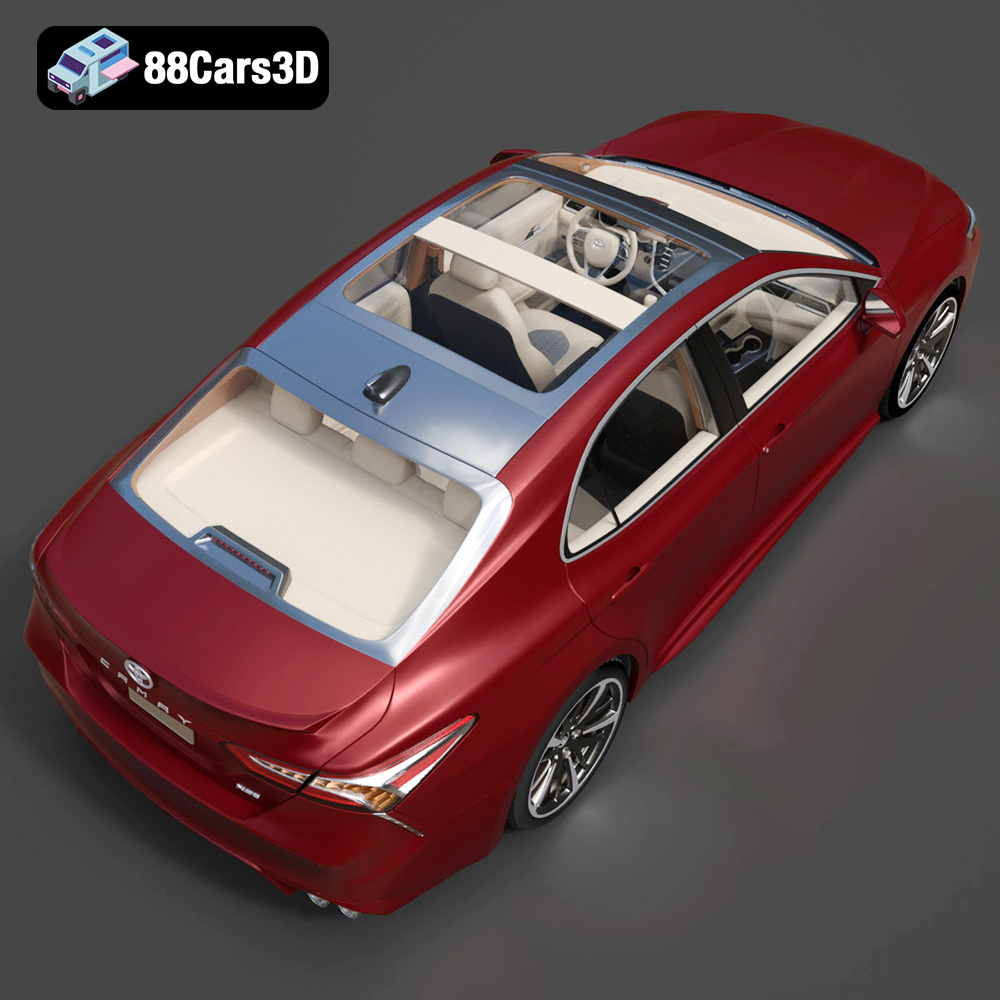
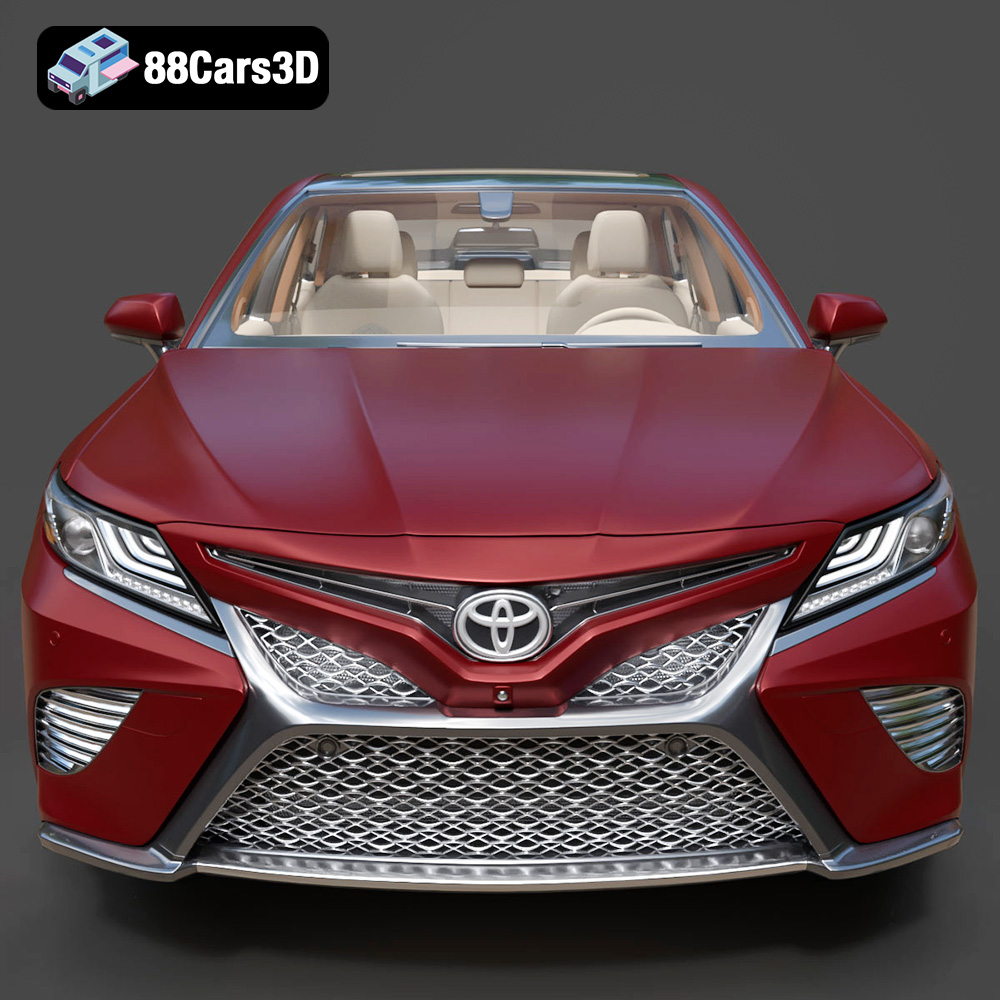
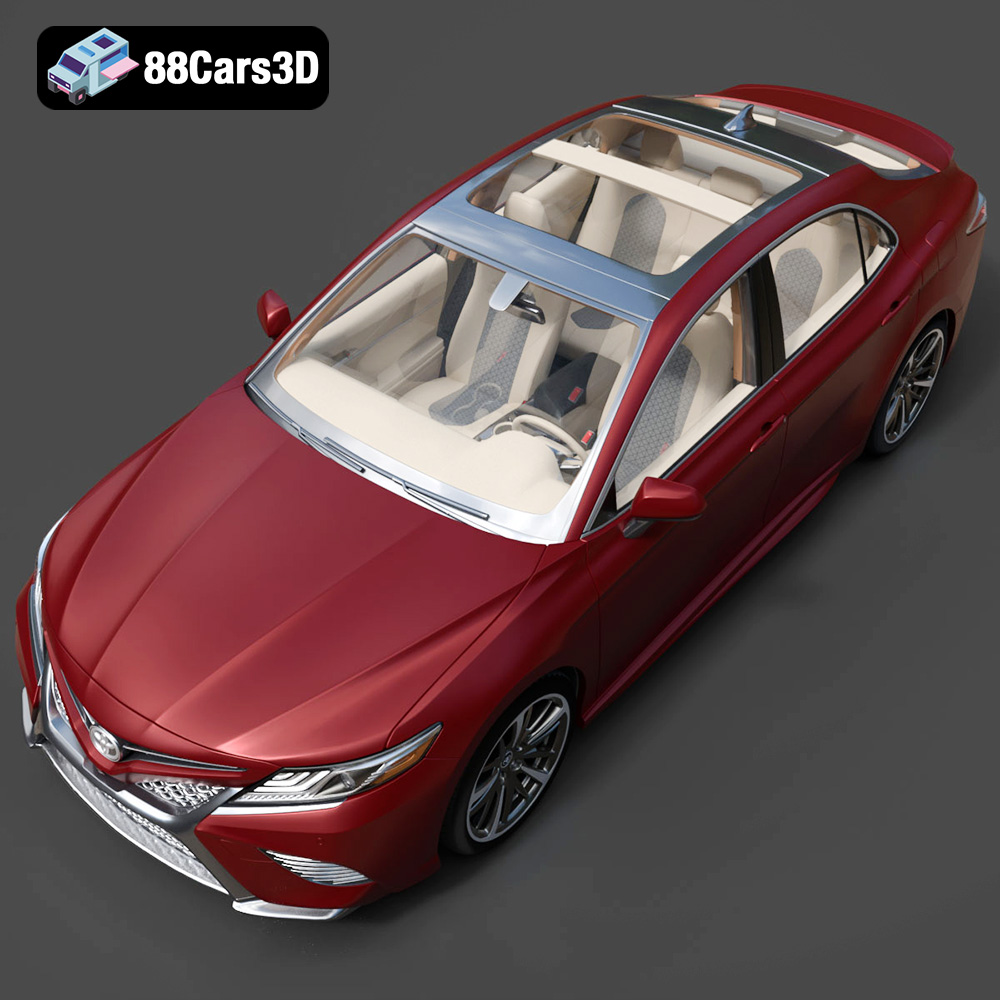
The 2018 Toyota Camry was a significant departure from its predecessors, introducing a more aggressive and sporty aesthetic built on the TNGA (Toyota New Global Architecture) platform. This 3D model accurately captures that transformation. From the sweeping roofline and sculpted doors to the prominent front grille and modern LED lighting signature, every exterior detail has been carefully recreated. The accuracy extends to the subtle nuances, such as the authentic dual exhaust system details reflecting the sportier trims, and highly detailed bi-LED headlights and sleek taillight assemblies. The multi-spoke alloy wheels are meticulously modeled with realistic tire treads, ensuring that even close-up renders maintain a high level of fidelity. Furthermore, critical components like the independent MacPherson strut front and multi-link rear suspension, along with separate wheels and steering components, are modeled for potential animation, offering unparalleled realism for simulations or interactive presentations.
Beyond the impressive exterior, the interior of the Toyota Camry 2018 3D Model provides a rich and immersive experience. The cockpit features detailed ergonomic bucket seats with visible stitching, an accurate leather-wrapped steering wheel, and a high-fidelity Entune 3.0 infotainment screen and digital instrument cluster. Every button, dial, and lever on the center console, including the pedals and automatic shifter, is precisely modeled. This level of interior detail is crucial for applications demanding a first-person perspective, such as driving simulators, architectural walkthroughs, or virtual showroom experiences, where users can truly “sit” inside the vehicle and interact with its environment.
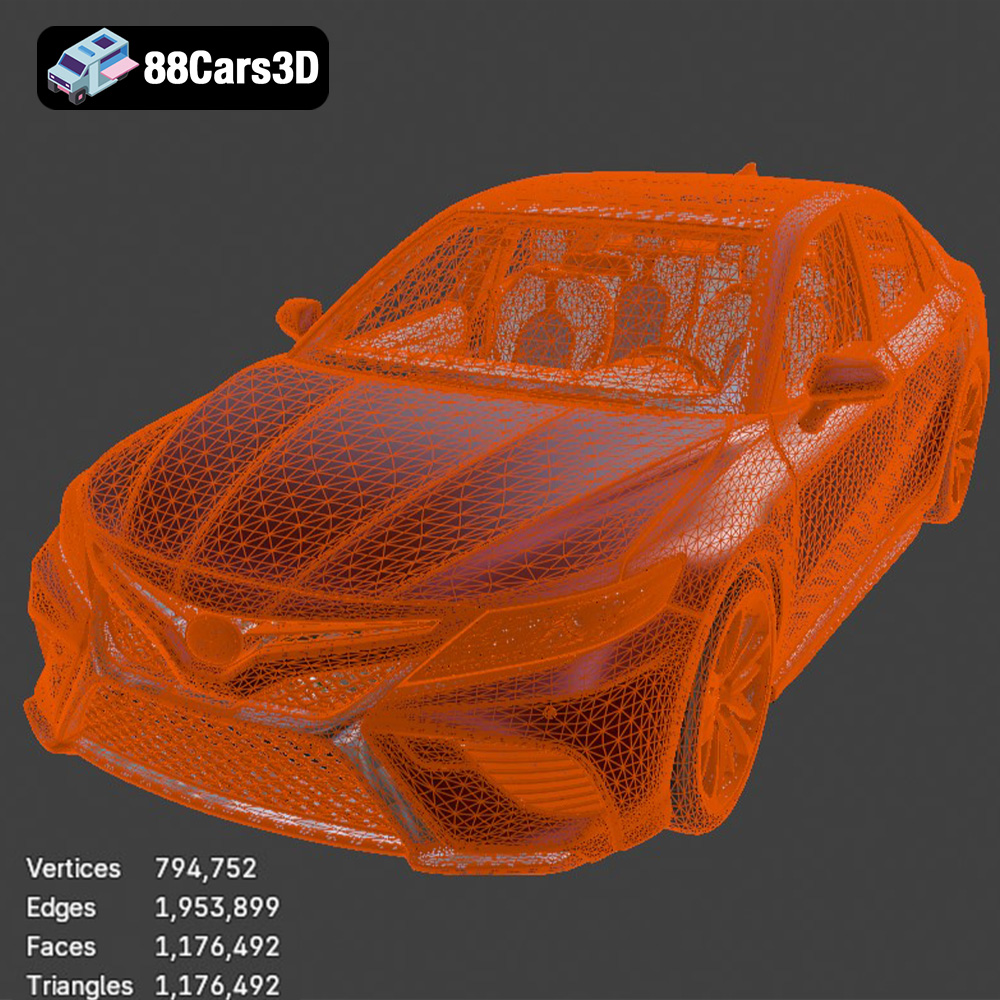
A significant advantage of this 3D model is its game-ready optimization. With an approximate triangle count of 150,000, it strikes a perfect balance. This polycount is lean enough to ensure excellent performance in real-time engines like Unreal and Unity, preventing performance bottlenecks in complex scenes with multiple vehicles. Simultaneously, it’s rich enough to maintain a high level of visual realism, ensuring that details like body lines, interior elements, and wheel designs are not compromised. The model adheres to real-world scale accuracy, based on the actual vehicle chassis, which is paramount for believable integration into any scene. Crucially, it boasts proper pivot setups for steering, wheel rotation, and suspension travel, making it animation-ready and easy to integrate into physics-based simulations without extensive re-rigging.
The versatility of the Toyota Camry 2018 3D Model truly shines when integrated into professional production workflows. Its range of file formats and optimized topology make it an adaptable asset for diverse creative and technical challenges.
For game developers, integrating a vehicle like the Toyota Camry 2018 is a critical step in building believable virtual worlds. Using the provided .fbx or .unreal formats, developers can quickly import the model into engines like Unreal Engine or Unity. The game-ready optimization, with its ~150,000 triangle count, is perfectly suited for open-world environments, racing games, and simulators where performance is paramount. Once imported, the model’s clean topology facilitates the creation of Level of Detail (LOD) meshes, ensuring that the car renders efficiently regardless of its distance from the camera. The pre-configured pivot points for wheels, steering, and suspension significantly reduce setup time for vehicle physics and animation, allowing developers to focus on gameplay mechanics and player experience rather than intricate rigging.
Architectural visualization and product rendering demand photorealistic results. The .max and .blend files included with the Toyota Camry 2018 3D Model are ideal for these high-fidelity rendering workflows. In 3ds Max, artists can leverage advanced rendering engines like V-Ray or Corona to create stunning studio shots or integrate the car seamlessly into architectural scenes. The editable geometry and material setups allow for precise customization of finishes, reflections, and lighting interactions. Similarly, Blender artists can utilize the .blend file with Cycles or Eevee, experimenting with intricate material nodes, HDRI lighting setups, and volumetric effects to achieve breathtaking automotive renders that rival real-world photography. The detailed engine block and suspension components, though optimized, retain enough fidelity to be showcased in close-up renders for technical demonstrations or promotional materials.
The rise of AR and VR has opened new avenues for interactive product experiences. The .glb format, optimized for these platforms, makes the Toyota Camry 2018 3D Model perfect for virtual showrooms, interactive configurators, and mobile AR applications. Imagine a customer being able to place a virtual Camry in their driveway via their smartphone, inspect its interior, or cycle through different factory colors in real-time. The compact nature of .glb ensures fast loading times and smooth performance on mobile devices, providing a seamless and engaging user experience. Such applications are invaluable for marketing, sales, and educational purposes, offering a level of interaction previously unattainable.
While digital visualization is powerful, the ability to transform a virtual asset into a tangible object offers a unique dimension to project development. The Toyota Camry 2018 3D Model is not just for screens; it’s also designed for the physical world through 3D printing.
The inclusion of the .stl format is a testament to the model’s versatility. For automotive enthusiasts, designers, or educators, having a physical replica of the 2018 Camry can be incredibly valuable. The detailed 3D print settings provided, recommending specific scales (1:12 / 1:18 / 1:24), layer heights, and infill percentages, guide users toward successful printing. Resin printing is specifically recommended for achieving the fine details of the Camry’s frame, headlights, and interior components. The necessity for supports on parts like the exhaust, mirrors, and handlebars, along with suggestions for print orientation, indicates a thoughtful design process aimed at making the model 3D-printable. Post-processing recommendations, such as sanding, priming, and applying authentic factory colors, emphasize the potential for creating truly impressive physical models from the digital asset.
Beyond simple printing, the modularity and detail of the model allow for extensive customization, both digital and physical. Digitally, artists can easily change body colors, modify tire textures to represent different variants (street vs. all-season), and adjust material finishes (matte, gloss, metallic) to fit specific scene requirements or client requests. The separate components, like wheels and suspension, mean that enthusiasts can even consider printing and assembling individual parts, creating highly detailed scale models. This level of adaptability makes the Toyota Camry 2018 3D Model a powerful tool for both professional production pipelines and personal creative projects.
The success of any digital project hinges on the quality of its foundational assets. Investing in premium 3D car models saves invaluable time, ensures consistent quality, and elevates the overall professionalism of your work. Generic, low-quality models often come with messy topology, incorrect scale, and poor material setups, leading to endless cleanup and rework that ultimately costs more than purchasing a high-quality, pre-optimized asset.
A high-quality 3D car model, such as the Toyota Camry 2018 3D Model, is a carefully engineered product designed to be production-ready out of the box. It represents countless hours of expert modeling, texturing, and optimization. This includes clean mesh geometry, proper UV mapping, accurate real-world scaling, and robust material setups compatible with various rendering engines. Such attention to detail means faster iteration times, more believable renders, and smoother integration into real-time applications.
When it comes to sourcing such critical assets, a reputable marketplace is essential. 88cars3d.com stands out as a reliable online destination for high-quality 3D car models. They curate a diverse collection of meticulously crafted vehicles, ensuring that each product meets professional standards for geometry, optimization, and material fidelity. By choosing 88cars3d.com, you are investing in assets that are not only visually stunning but also technically sound, ready to be dropped into your most demanding projects. The comprehensive file format support, as seen with the Toyota Camry 2018, ensures that artists and developers, regardless of their preferred software, have the tools they need to succeed.
The journey through the world of 3D car models reveals them to be far more than simple digital objects; they are intricate tools that empower innovation across diverse industries. From game development and high-end automotive rendering to architectural visualization and the exciting frontier of AR/VR, high-quality 3D assets are indispensable. The Toyota Camry 2018 3D Model serves as an exceptional case study, demonstrating how a single, well-crafted asset can fulfill a multitude of technical and creative demands, offering both visual realism and optimized performance across various platforms and workflows.
Whether you’re crafting an immersive virtual reality experience, developing a next-generation racing game, or simply need a photorealistic vehicle for an architectural render, the value of a meticulously detailed and properly optimized 3D car model cannot be overstated. By leveraging assets like those found at 88cars3d.com, professionals can streamline their workflows, enhance visual fidelity, and ultimately drive their projects towards unparalleled success.
The 2018 Toyota Camry, representing the eighth generation of this iconic mid-size sedan, brought a dramatic shift in styling with its aggressive lines, sportier stance, and prominent front grille. Known for its legendary reliability and comfort, this specific generation introduced the TNGA platform, elevating its driving dynamics while boasting striking visual elements like its sweeping roofline, sculpted doors, and modern LED lighting signature.
This high-quality 3D model features game-ready optimization with an approximate triangle count of 150,000, ensuring excellent performance without sacrificing visual fidelity. Designed for modern pipelines, it boasts clean topology perfect for real-time applications like game development, AR/VR experiences, architectural visualization, and high-end animation.
Perfect for urban traffic simulations, architectural renders, open-world driving games, and virtual showroom applications.
$19.99
.blend
.fbx
.glb
.max
.obj
.ply
.rendering
.sedan
.stl
.toyota
.unreal
camry-2018
car-3d-model
family-car
game asset
game-ready
low-poly
mid-size-car
optimized
VR/AR