Get 20% OFF All Premium 3D & STL Models!

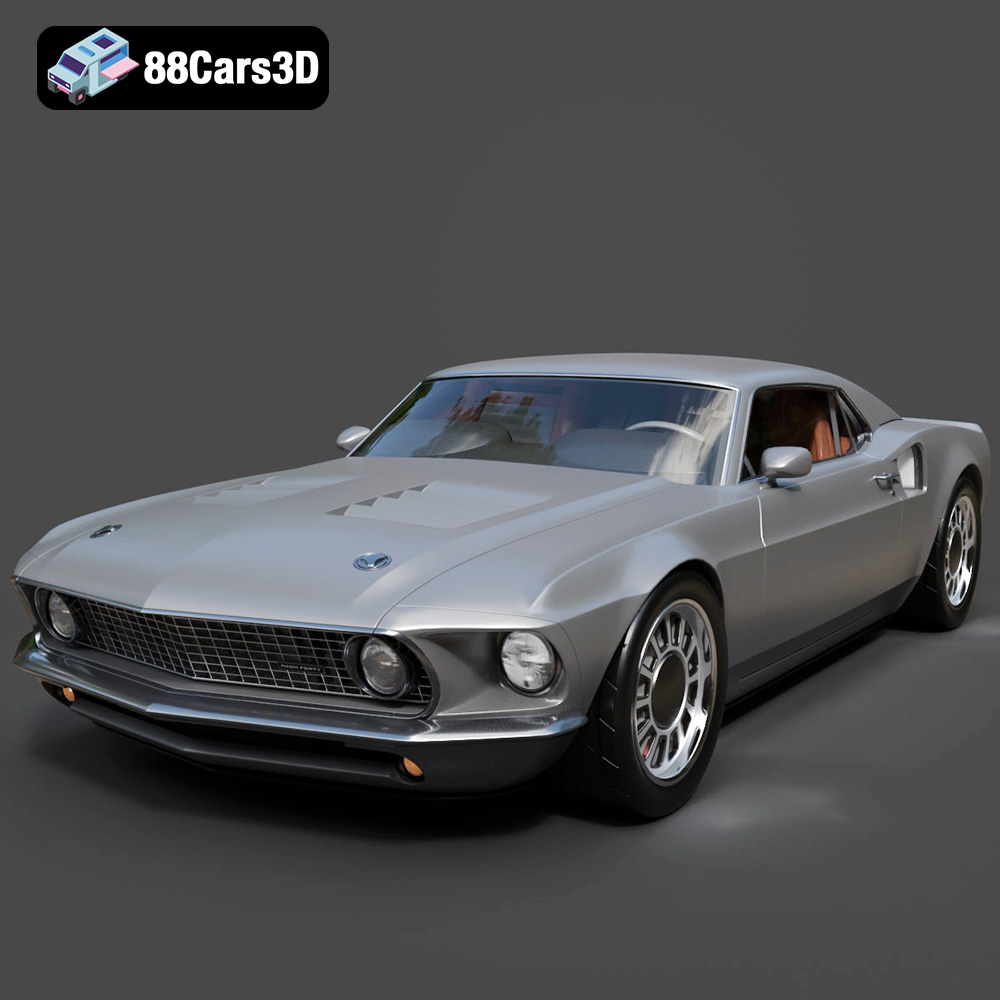
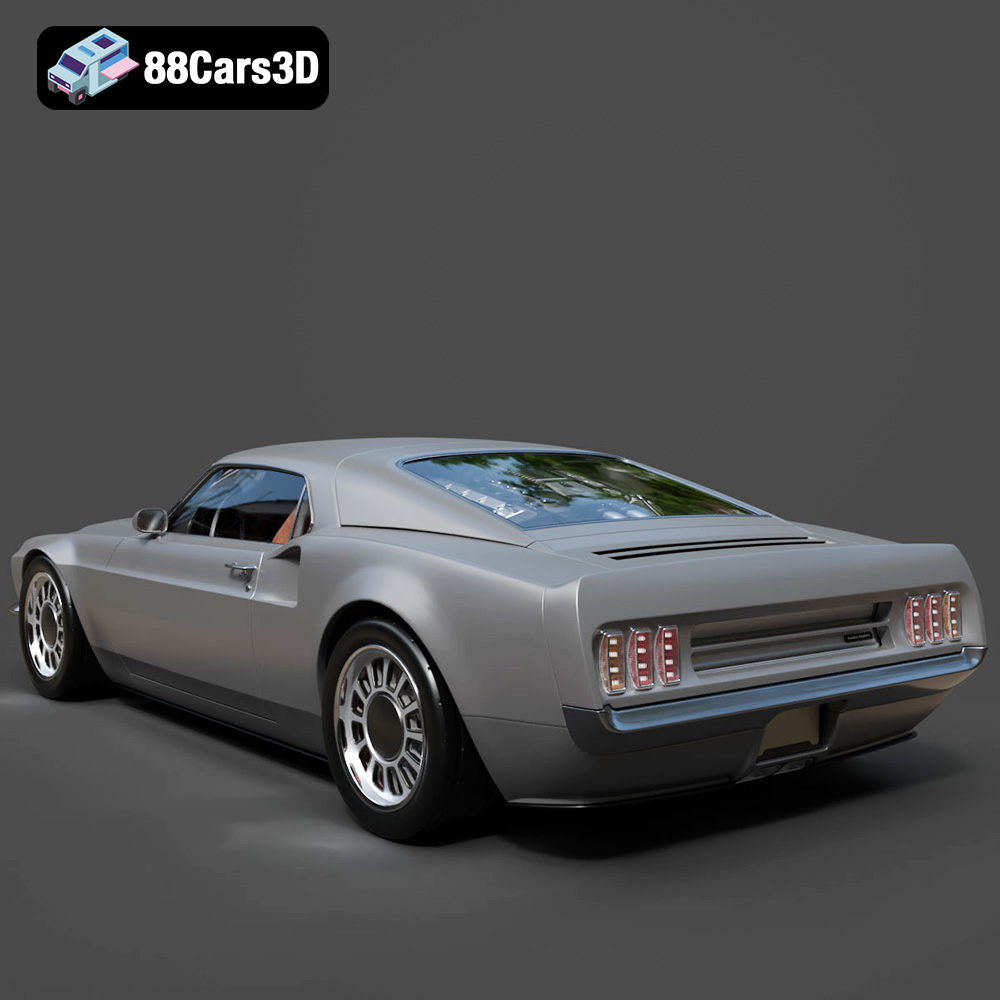
In the world of custom automobiles, some creations transcend mere engineering to become works of art. The Ford Mustang Mach 40 is undoubtedly one such masterpiece, a vehicle that boldly fuses the brute force aesthetics of a 1969 Mustang Mach 1 with the agile, mid-engine prowess of a legendary Ford GT40. It’s a breathtaking custom restomod, born from a vision of what could be – a widened stance, a massive supercharged 5.4-liter V8 engine visibly mounted behind the cockpit, and sleek, retro-futuristic styling that commands attention. Its signature shark-nose front fascia, classic lighting, and custom dual exhaust system all contribute to an aura of absolute dominance.
For 3D artists, game developers, automotive visualization specialists, and AR/VR creators, bringing such an iconic and unique machine into the digital realm is both a challenge and an immense opportunity. High-fidelity 3D car models are the bedrock of realistic simulations, immersive experiences, and captivating renders. They are not just aesthetic assets but complex technical constructs requiring meticulous attention to detail, optimized topology, and versatile file format support. It’s precisely this blend of artistry and technical rigor that defines a premium asset like the Ford Mustang Mach 40 3D Model, available for download at 88cars3d.com.
This digital rendition captures every nuance of the Mach 40, from its custom frame geometry to its detailed interior, making it an indispensable asset for a myriad of professional applications. Whether you’re designing an open-world racing game, crafting a cinematic car render, or building an interactive virtual showroom, the precision and optimization of this model pave the way for unparalleled realism and performance.
In the diverse landscape of 3D content creation, understanding the various file formats is paramount. Each format serves specific purposes, offering unique advantages for different stages of a project, from initial modeling to final deployment in real-time engines or even physical fabrication. The Ford Mustang Mach 40 3D Model exemplifies this versatility by offering a comprehensive suite of formats, ensuring seamless integration into virtually any professional workflow.
The `.blend` file format is native to Blender, the powerful open-source 3D creation suite. When you download a `.blend` file, you’re not just getting a mesh; you’re receiving a complete Blender scene. This includes all scene data, such as camera setups, lighting, animation data, modifiers, and crucially, fully editable material node trees. For artists working primarily in Blender, this format offers the maximum level of flexibility and control. You can easily dissect the model, adjust its PBR materials directly within the node editor, modify geometry, or even re-rig components. It’s the ideal starting point for deep customization and complex scene integration within the Blender pipeline.
FBX (Filmbox) is a proprietary file format owned by Autodesk and has become a de facto standard for 3D data exchange across various software applications, especially in game development. It’s renowned for its robust support for mesh data, skeletal animation, blend shapes, lights, cameras, and embedded textures. For assets destined for real-time engines like Unreal Engine and Unity, `.fbx` is often the preferred choice due to its ability to consolidate complex scene information into a single, manageable file. The Ford Mustang Mach 40, in its `.fbx` incarnation, ensures that all crucial elements like separated components for animation (wheels, suspension, steering) and PBR material assignments translate cleanly into these demanding environments, maintaining crucial pivot points and hierarchical structures.
OBJ (or Wavefront OBJ) is one of the oldest and most widely supported 3D file formats. It’s a simple, universal format primarily focused on geometry (vertices, normals, texture coordinates, and faces) and can also reference external material files (`.mtl`). While it doesn’t support animation or rigging directly, its simplicity and ubiquitous compatibility make it an excellent choice for basic mesh exchange between different 3D software without encountering proprietary conversion issues. For situations where a clean, straightforward mesh is needed for sculpting, retopology, or foundational rendering in an application without specific `.fbx` or `.max` support, the `.obj` version of the Mach 40 is invaluable.
GLB (Binary glTF) is the binary version of the GL Transmission Format (glTF), which has emerged as the “JPEG for 3D” due to its efficiency and optimization for web-based 3D, AR, and VR applications. A `.glb` file contains all necessary data—model, textures, animations—in a single, compact file, making it incredibly easy to load and render quickly in browsers, mobile AR apps, and VR platforms. For artists looking to showcase the Ford Mustang Mach 40 in a virtual showroom on a website or integrate it into a mobile augmented reality experience, the `.glb` format provides the best balance of visual fidelity and performance, ensuring fast loading times and smooth interactions.
STL (STereoLithography) is the standard file format for 3D printing. It represents a 3D object as a collection of unconnected triangular facets, defining only the surface geometry without color, texture, or material information. The Ford Mustang Mach 40 3D Model includes an `.stl` version, making it convertible for display-scale hobbyists who wish to bring this custom restomod into the physical world. While typically needing specific preparation for printing (like ensuring manifold geometry and appropriate scaling), the availability of this format opens up an exciting avenue for enthusiasts and model makers to own a tangible representation of this digital marvel.
PLY (Polygon File Format, or Stanford Triangle Format) is a file format for storing three-dimensional data from 3D scanners. It’s often used for representing high-resolution point clouds or polygonal meshes, with the ability to store properties like color, transparency, surface normals, and texture coordinates for each vertex. While less common for typical game assets, `.ply` is valuable in scientific, engineering, and CAD workflows where precise geometric data with rich per-vertex information is crucial for analysis or reverse engineering. For specialized applications involving the Mach 40’s chassis or components, the `.ply` format provides a robust data structure.
The `.unreal` format isn’t a single file type but rather an umbrella term for assets specifically prepared and optimized for direct import and use within Unreal Engine. This often implies an `.fbx` with specific settings for Unreal’s coordinate system, scale, material naming conventions, and LOD (Level of Detail) meshes already configured. When an asset is described as `.unreal`, it typically means it has undergone a rigorous preparation process to ensure it performs optimally within the engine, minimizing setup time and maximizing visual quality for game development, architectural visualization, or cinematic sequences. The Mach 40 in this format guarantees a streamlined integration into Unreal projects.
The `.max` file is the native scene file format for Autodesk 3ds Max, a leading software for 3D modeling, animation, and rendering. Similar to `.blend` for Blender, a `.max` file contains a complete 3ds Max scene, including all geometry, textures, lighting, cameras, animation keyframes, modifiers, and plugin-specific data. For professionals whose primary workflow revolves around 3ds Max, having the Ford Mustang Mach 40 3D Model in its native `.max` format provides the most comprehensive and editable version of the asset. This allows for unparalleled freedom in adjusting hierarchies, applying advanced modifiers, setting up complex animation rigs, and leveraging 3ds Max’s powerful rendering capabilities for high-end automotive visualizations.
The inclusion of these diverse formats with the Ford Mustang Mach 40 3D Model underscores its versatility and value. It ensures that regardless of your preferred software or final application, you have an optimized, high-quality asset ready to integrate seamlessly into your project.
Bringing a vehicle as complex and visually striking as the Ford Mustang Mach 40 into the digital realm requires more than just artistic flair; it demands a deep understanding of 3D modeling best practices and technical optimization. This 3D model, available at 88cars3d.com, exemplifies what high-quality automotive assets should be, blending visual fidelity with performance efficiency.
The Ford Mustang Mach 40 3D Model boasts an optimized triangle count of approximately 250,000. This figure is a critical sweet spot for professional 3D assets. It’s low enough to be considered “game-ready,” meaning it can be rendered in real-time engines like Unreal and Unity without excessively taxing system resources. Simultaneously, it’s high enough to maintain top-tier visual realism, capturing the intricate curves, sharp lines, and distinct mechanical components of the Mach 40 without appearing blocky or simplistic. The underlying topology is meticulously clean, primarily composed of quads where appropriate, which facilitates smooth subdivision if a higher polycount is desired for extreme close-ups or pre-rendered cinematics. This balanced approach ensures versatility for both real-time interactive experiences and high-resolution offline renders.
One of the hallmarks of a premium 3D car model is its material setup, particularly the implementation of Physically Based Rendering (PBR) materials. PBR materials accurately simulate how light interacts with surfaces in the real world, accounting for properties like albedo (color), roughness, metallicness, and normal maps. The Mach 40 model features accurate PBR materials that perfectly replicate the varying surface qualities of the actual vehicle – from the glossy, reflective paintwork of the body to the matte textures of the tires and the metallic sheen of engine components. This attention to detail results in flawless body reflections, dynamic highlights, and realistic light scattering, making the digital car indistinguishable from a photograph in a well-lit scene. The distinction between mechanical components, achieved through precise material separation, further enhances realism and allows for easy customization of individual parts.
A static 3D model, no matter how detailed, has limited utility in dynamic environments. The Ford Mustang Mach 40 3D Model addresses this by adopting a modular design. Key components like the wheels, suspension, and steering are separated from the main body and feature proper pivot setups. This crucial technical detail allows for realistic animation of steering, wheel rotation, and suspension travel, essential for racing games, simulators, and cinematic sequences. Beyond animation, this modularity facilitates extensive customization. Artists can easily modify individual parts, swap out components, or apply unique material treatments to different sections of the car without affecting the integrity of the overall model. This flexibility empowers creators to adapt the Mach 40 to diverse project requirements, whether it’s changing body colors, modifying tire textures, or adjusting material finishes.
The true value of a meticulously crafted asset like the Ford Mustang Mach 40 3D Model lies in its seamless integration into various professional workflows. From conceptual design and automotive rendering to game development and immersive experiences, this model is engineered for performance and versatility, saving countless hours of manual modeling and optimization.
For rendering and animation specialists, having the Mach 40 model compatible with industry-standard software like 3ds Max and Blender is a significant advantage. In 3ds Max, artists can leverage the `.max` file to dive deep into the model’s structure, apply advanced modifiers, and set up intricate lighting scenarios with renderers like V-Ray or Corona. The clean topology and separated components allow for easy rigging, enabling complex vehicle animations, such as detailed suspension compression during cornering or engine bay reveals. Similarly, Blender users can utilize the `.blend` file to integrate the Mach 40 into sophisticated scenes, employing its powerful Eevee or Cycles renderers for stunning visual output. From studio-lit product shots to dramatic action sequences, the model’s inherent quality provides a strong foundation for creative expression.
The optimized geometry and PBR materials of the Ford Mustang Mach 40 3D Model make it an exceptional game asset, particularly for Unreal Engine projects. Importing the `.fbx` or the `.unreal` specific version into Unreal is a straightforward process, maintaining material assignments and component separation. Developers can quickly set up advanced car physics, add collision meshes, and integrate the model into a vast open-world environment or a dedicated racing track. Its ~250,000 triangle count strikes a perfect balance, ensuring high visual fidelity without compromising frame rates, a critical factor for competitive racing titles or large-scale virtual simulations. The accurate real-world scale also ensures proper interaction with other assets and environments within the engine.
Beyond entertainment, the demand for high-quality automotive rendering in marketing and visualization is growing rapidly. The Mach 40 model is perfectly suited for creating compelling brand campaigns, lifestyle scenes, and studio lighting setups. Imagine a virtual configurator where potential customers can customize the Mach 40’s paint, wheels, and interior in real-time, or a photorealistic animation showcasing its design philosophy. The precision of the model, combined with its PBR materials, allows for renders that are virtually indistinguishable from real photography, making it an invaluable tool for automotive manufacturers, custom builders, and marketing agencies seeking to captivate audiences with stunning visual content.
The versatility of the Ford Mustang Mach 40 3D Model extends far beyond traditional rendering. Its careful optimization and comprehensive file format support unlock a multitude of applications across various burgeoning industries, proving its worth as a truly multi-purpose digital asset.
The core design philosophy behind this 3D model, particularly its optimized polycount and real-time ready materials, positions it as an ideal asset for game development. For open-world games, racing titles, and simulators, the Mach 40 offers a high-performance vehicle that looks fantastic without bogging down the game engine. Developers can implement it as a player-controlled vehicle, an AI opponent, or even an environmental prop, knowing it will maintain visual consistency and performance. Its separated components, such as wheels and suspension, are game-changer for implementing realistic vehicle physics and damage systems, enhancing the immersive experience for players who expect dynamic and responsive car behavior. Finding such a game-ready, iconic asset can significantly reduce development time and costs for studios.
The burgeoning fields of Augmented Reality (AR) and Virtual Reality (VR) demand highly optimized 3D assets that can be rendered smoothly on various devices. The Ford Mustang Mach 40 3D Model, especially in its `.glb` format, is perfectly suited for these immersive environments. Imagine stepping into a virtual showroom where you can walk around the Mach 40, open its doors, and inspect its detailed interior, all in a high-fidelity VR experience. Or, consider an AR application where you can place the digital Mach 40 in your driveway, scaled to real-world size, and interact with its features using your smartphone. This model enables the creation of engaging virtual configurators, educational experiences, and interactive marketing tools that push the boundaries of how we experience automotive design.
For cinematics, advertisements, and high-quality visualizations, the Mach 40 model excels. Its meticulous detail, accurate PBR materials, and clean topology allow artists to produce stunning, photorealistic renders that capture the essence of this custom build. Imagine an animation showcasing the powerful mid-mounted V8 engine, or a dramatic slow-motion sequence of the Mach 40 tearing down a digital track. The model’s real-world scale accuracy and proper pivot setup make it easy to integrate into complex animated scenes, ensuring that every movement and interaction feels authentic. This level of fidelity is crucial for projects where visual impact and realism are paramount, helping creators tell compelling stories and evoke strong emotions.
While often associated with digital screens, 3D models can also bridge the gap to the physical world through 3D printing. The Ford Mustang Mach 40 3D Model’s inclusion of the `.stl` format makes this a tangible reality, allowing enthusiasts to bring a miniature version of this custom masterpiece into their collection. However, the journey from a digital mesh to a physical object involves specific considerations.
The `.stl` format simplifies the model into a series of triangles, a language easily understood by 3D printers. For optimal 3D printing, the model’s geometry needs to be “manifold,” meaning it has no holes, self-intersecting faces, or non-uniform normals – essentially, it must be a watertight mesh. While the provided `.stl` is generally optimized, users might need to perform minor cleanup or integrity checks in their slicing software to ensure a flawless print. Crucially, scaling is key. The product description recommends scales of 1:12, 1:18, or 1:24, offering a good balance between manageable print size and visible detail. Printing a larger scale typically allows for finer details to resolve, while smaller scales are more economical in terms of material and print time.
Choosing the right print settings is vital for success. For a model with intricate details like the Mach 40, resin-based 3D printing (SLA or DLP) is highly recommended over FDM (Fused Deposition Modeling). Resin printers can achieve much finer layer heights (0.04–0.12 mm recommended), capturing the subtle curves and sharp edges of the car more accurately. Supports will be necessary for overhangs and delicate parts like the exhaust system, mirrors, and interior details. Careful print orientation, such as angling the frame for structural integrity and printing wheels separately, also contributes to a cleaner final product. After printing, post-processing is where the model truly comes to life. Sanding, priming, and applying authentic factory colors with metallic finishes can elevate a raw 3D print into a display-worthy replica. This hands-on process allows hobbyists to engage with the model in a completely new dimension.
The true power of a high-quality 3D asset lies not just in its inherent detail but in the flexibility it offers for customization. The Ford Mustang Mach 40 3D Model provides extensive options for artists and designers to adapt it to their unique visions and project requirements, making it an incredibly versatile component of any digital library, especially from marketplaces like 88cars3d.com.
The base model of the Mach 40 comes with exceptional PBR materials that replicate its real-world appearance. However, the included file formats, particularly `.blend`, `.max`, and `.fbx` (with proper material channels), allow for virtually limitless aesthetic modifications. Artists can easily change body colors, experimenting with a spectrum of hues from classic factory shades to wild custom finishes. Adjusting material properties like metallicness and roughness can transform a high-gloss paint job into a sleek matte finish or a vibrant metallic sheen. Furthermore, tire textures can be swapped or modified to depict different variants, such as performance street tires for racing simulations or a more rugged off-road look for a conceptual scene. This level of control ensures that the digital Mach 40 can be tailored to fit any narrative or brand identity.
Beyond surface appearance, the Mach 40 3D Model offers the flexibility to be integrated into diverse environments and narratives. By modifying its lighting setup, artists can dramatically alter the mood and atmosphere of a scene, transitioning from a brightly lit studio showcase to a dramatic sunset drive, or even a futuristic, neon-drenched cityscape. The ability to animate separate components like wheels, suspension, and steering also means the car isn’t static; it can be portrayed in motion, reacting realistically to its surroundings. This adaptability makes the Mach 40 an excellent storytelling tool, capable of featuring prominently in advertisements, game cinematics, or virtual reality experiences that require dynamic and responsive automotive assets.
The Ford Mustang Mach 40 is a symbol of audacious automotive design, a harmonious blend of classic muscle and modern supercar engineering. Its digital counterpart, the Ford Mustang Mach 40 3D Model, meticulously captures this spirit, offering a high-fidelity, optimized asset that meets the rigorous demands of professional 3D production. With its balanced polycount, accurate PBR materials, modular design, and comprehensive suite of file formats (including .blend, .fbx, .obj, .glb, .stl, .ply, .unreal, and .max), this model stands as a testament to quality and versatility.
Whether your project involves crafting an immersive open-world racing game, developing an interactive AR/VR experience, rendering photorealistic automotive visualizations, or even 3D printing a physical replica, this Mach 40 model provides an unparalleled foundation. It empowers artists and developers to integrate an iconic, custom vehicle into their workflows with ease and confidence, saving valuable time while elevating the visual standard of their creations. For those seeking premium 3D car models that truly deliver on performance and aesthetic excellence, exploring the offerings at 88cars3d.com is a definitive step toward achieving outstanding digital results.
The Ford Mustang Mach 40 is a breathtaking custom restomod that perfectly marries the classic, aggressive aesthetics of a 1969 Mustang Mach 1 with the mid-engine supercar layout of the legendary Ford GT40. This iconic vehicle features a dramatically widened stance, a massive supercharged 5.4-liter V8 engine visibly mounted behind the cockpit, and sleek, retro-futuristic styling cues. From its signature shark-nose front fascia and classic lighting to its custom dual exhaust system, the Mach 40 represents the absolute pinnacle of custom automotive engineering and visual dominance. This highly detailed 3D model boasts meticulous topology with an optimized triangle count (~250,000), making it exceptionally game-ready without compromising on top-tier visual fidelity. Crafted for maximum performance and realism, it features accurate PBR materials, flawless body reflections, and distinct separation of mechanical components. It is the perfect digital asset for game development, AR/VR experiences, high-resolution animations, and professional automotive visualizations. Perfect for open-world racing games, virtual automotive showrooms, cinematic car renders, and high-octane action animations.
$19.99
.blend
.fbx
.ford
.glb
.max
.obj
.ply
.rendering
.restomod
.stl
.unreal
car-3d-model
custom-car
game asset
game-ready
low-poly
muscle-car
mustang-mach-40
optimized
VR/AR