Get 20% OFF All Premium 3D & STL Models!

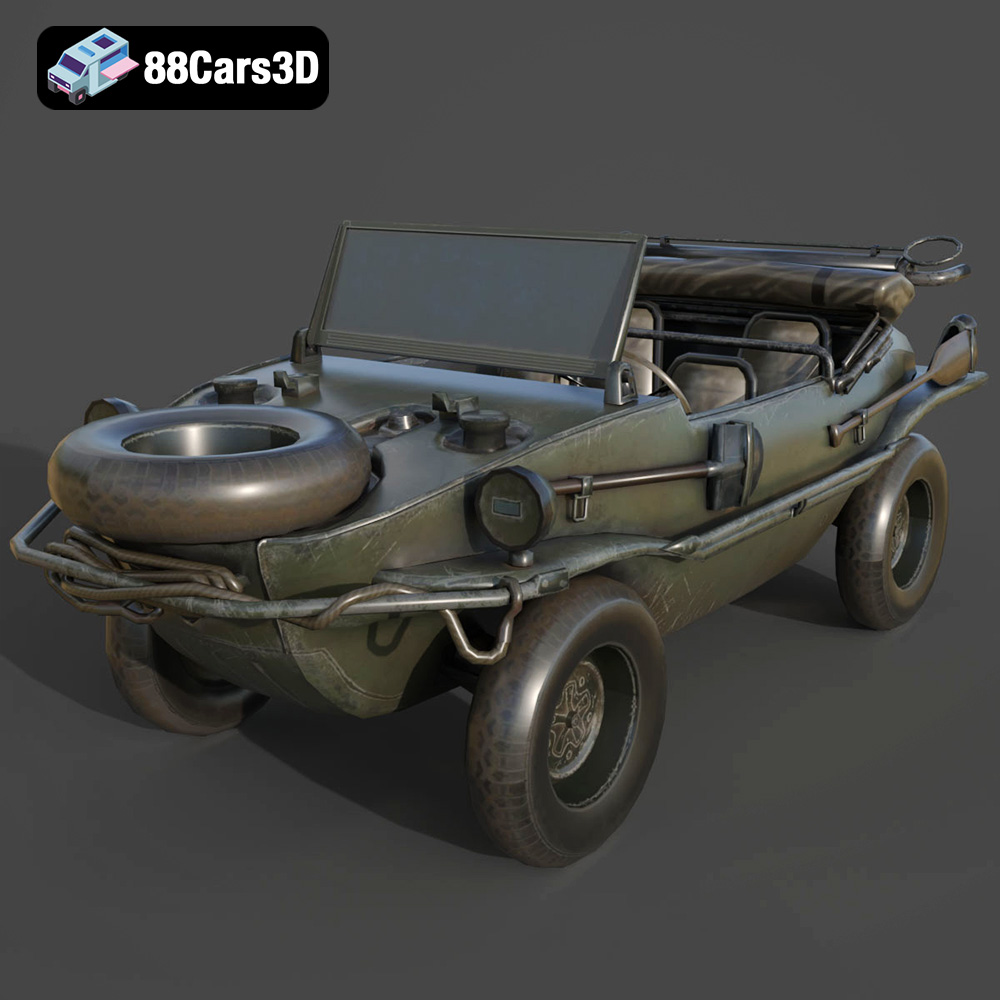
In the vast tapestry of automotive history, few vehicles capture the imagination quite like the Volkswagen Schwimmwagen Typ 166. An amphibious marvel born of necessity during World War II, its distinctive boat-like hull, rugged four-wheel drive, and ingenious fold-down propeller system made it an icon of wartime engineering. Today, its legacy transcends historical documents and museum displays, finding new life in the digital realm through meticulously crafted 3D models.
The ability to accurately recreate such a complex and historically significant vehicle in three dimensions opens up a world of possibilities for game developers, automotive rendering artists, AR/VR experiences, and even hobbyist 3D printers. It’s about preserving history while simultaneously pushing the boundaries of digital realism and interactive engagement. This is precisely where a high-quality asset like the Volkswagen Schwimmwagen Typ 166 3D Model from 88cars3d.com truly shines, offering unparalleled detail, optimization, and versatility for a myriad of professional applications.
Join us as we embark on a journey to explore the technical intricacies and creative potential unlocked by bringing iconic vehicles like the Schwimmwagen into the digital age. We’ll delve into the foundational aspects of 3D asset creation, understand crucial file formats, examine professional workflows, and discover how such a model can elevate your projects to new heights.
The journey of any 3D model, from creation to implementation, often involves navigating a diverse landscape of file formats. Each format serves specific purposes, catering to different software, platforms, and stages of a project. Understanding these distinctions is crucial for professionals seeking efficiency, compatibility, and optimal performance from their 3D car models. The Volkswagen Schwimmwagen Typ 166 3D model, for instance, comes equipped with a comprehensive suite of formats, ensuring its utility across virtually any pipeline.
The .blend file format is Blender’s native project file. It encapsulates not just the mesh data, but an entire scene, including materials, textures, lighting setups, cameras, animations, and even modifiers and rigging information. For artists deeply integrated into the Blender ecosystem, or those needing to perform extensive modifications, the .blend file offers maximum flexibility. You can easily dissect the model, adjust its topology, create custom animations for its propeller or suspension, or re-render it with Blender’s Cycles or Eevee engines. It’s the ideal starting point for anyone looking to truly make the Schwimmwagen their own, allowing for full artistic control over every aspect of the asset.
FBX (Filmbox) is arguably the most widely adopted 3D exchange format in the industry, particularly favored in game development and real-time visualization. Developed by Autodesk, it excels at preserving complex scene data, including meshes, materials, textures, animations, and even skeletal rigs, across different software packages. For importing the Schwimmwagen into Unreal Engine, Unity, or other real-time pipelines, .fbx is the go-to choice. Its binary structure ensures efficient file sizes and fast loading times, making it ideal for large-scale projects where performance is paramount. When dealing with animated components like the Schwimmwagen’s fold-down propeller or steering, FBX ensures these elements transfer seamlessly.
OBJ (or Wavefront OBJ) is a foundational, universal 3D file format that has been a staple in the industry for decades. While it’s an older format, it’s incredibly robust for transferring mesh data (vertices, normals, UVs, faces) and material assignments between almost any 3D software. Unlike FBX, OBJ doesn’t typically store animation or skeletal data, but it’s unparalleled for its compatibility. If you need to bring the Schwimmwagen into a less common software package or simply require a clean mesh without complex scene data, .obj is an excellent choice. It’s also often accompanied by an .mtl file that defines basic material properties and texture paths.
GLB (GL Transmission Format Binary) is rapidly gaining traction as the format of choice for augmented reality (AR), virtual reality (VR), and efficient browser-based 3D experiences. It’s a compact, self-contained binary format that bundles 3D model data (geometry, materials, textures, animation) into a single file, making it incredibly easy to share and load on web pages or mobile devices. For interactive virtual showrooms of the Schwimmwagen or embedding it into an AR app for educational purposes, the .glb format offers superior performance and simplicity, ensuring fast loading and smooth interactivity without external dependencies.
STL (STereoLithography) is the de facto standard format for 3D printing. It represents the surface geometry of a 3D object using a collection of interconnected triangles. While it doesn’t contain color or texture information, its simplicity makes it universally compatible with 3D slicing software. The Schwimmwagen Typ 166 3D model, when provided as .stl, is ready for physical manifestation. Hobbyists can scale, slice, and print this iconic vehicle, bringing a tangible piece of history to life. The detailed geometry of the digital model translates directly into a high-fidelity physical object.
PLY (Polygon File Format) is another format that stores 3D data, often used for scanned data, CAD, and scientific applications where precise geometry and often additional data per vertex (like color, normals, or confidence values) are crucial. While less common for general asset exchange than FBX or OBJ, its ability to store more detailed vertex attributes can be valuable for specific rendering or analysis tasks where the exact surface properties of the Schwimmwagen are important.
While not a standalone “file format” in the traditional sense like .fbx or .obj, the inclusion of “.unreal” often signifies an asset specifically prepared or packaged for direct integration into Unreal Engine. This typically means the FBX has been imported, materials set up, possibly collisions generated, and the asset organized within an Unreal project structure, ready for drag-and-drop use. This offers a significant time-saving advantage for developers, as much of the initial setup work for the Schwimmwagen within the engine is already complete, allowing for immediate iteration and scene population.
The .max file is the native scene format for Autodesk 3ds Max, one of the most powerful and widely used 3D modeling, animation, and rendering software packages. Similar to .blend, it contains all scene data—meshes, materials, textures, lighting, cameras, animation, and complex modifiers—specific to 3ds Max. For professional studios and artists using 3ds Max for high-end automotive rendering, architectural visualization, or cinematic animation, the .max file provides complete control over the Schwimmwagen model. It allows for advanced material setups with renderers like V-Ray or Corona, complex rigging, and integration into existing 3ds Max pipelines.
The availability of such a diverse array of formats for the Volkswagen Schwimmwagen Typ 166 3D model ensures that regardless of your software preference, project type, or final output, you have the right tools at your disposal to achieve your creative vision. This foresight in asset packaging is a hallmark of quality found on platforms like 88cars3d.com.
Creating a truly high-quality 3D model, especially for an iconic vehicle like the Volkswagen Schwimmwagen Typ 166, goes far beyond simply replicating its shape. It requires a meticulous balance of artistic fidelity, technical optimization, and an understanding of its intended applications. The Schwimmwagen model available on 88cars3d.com exemplifies this philosophy, delivering a game-ready asset that doesn’t compromise on visual authenticity.
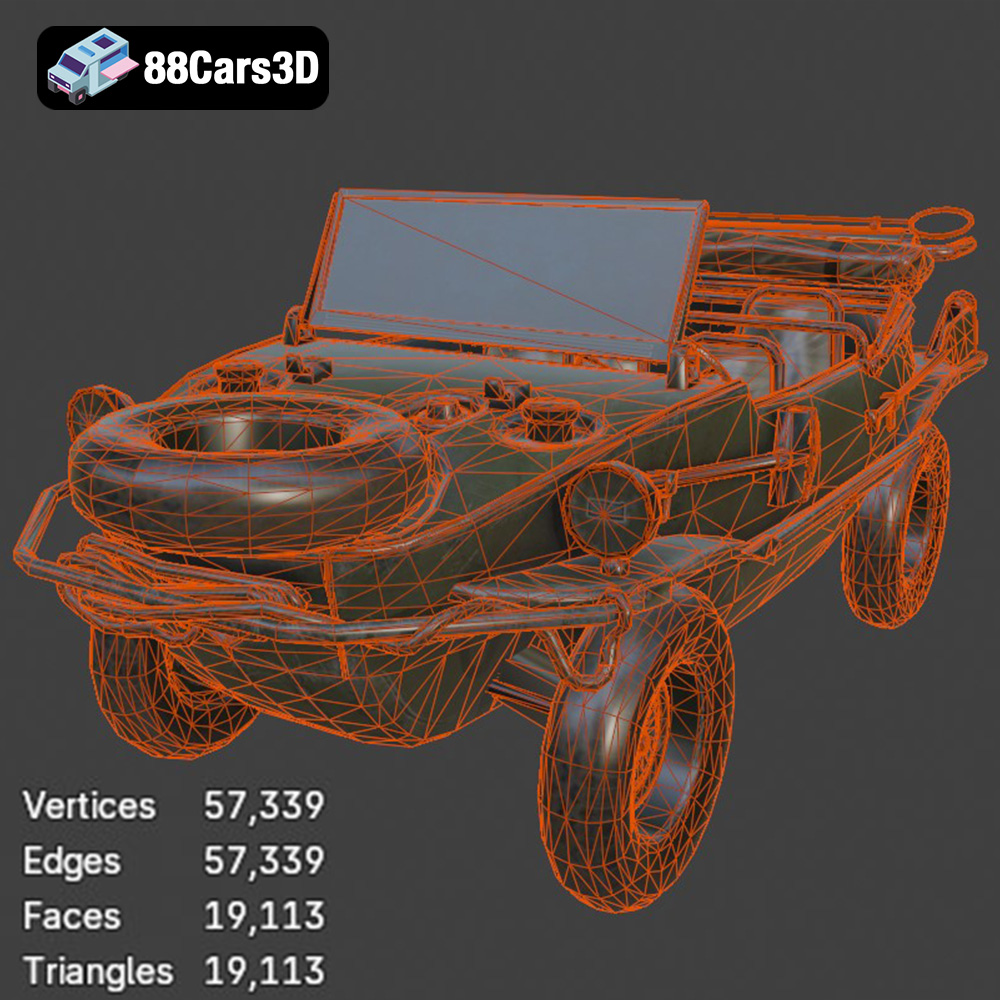
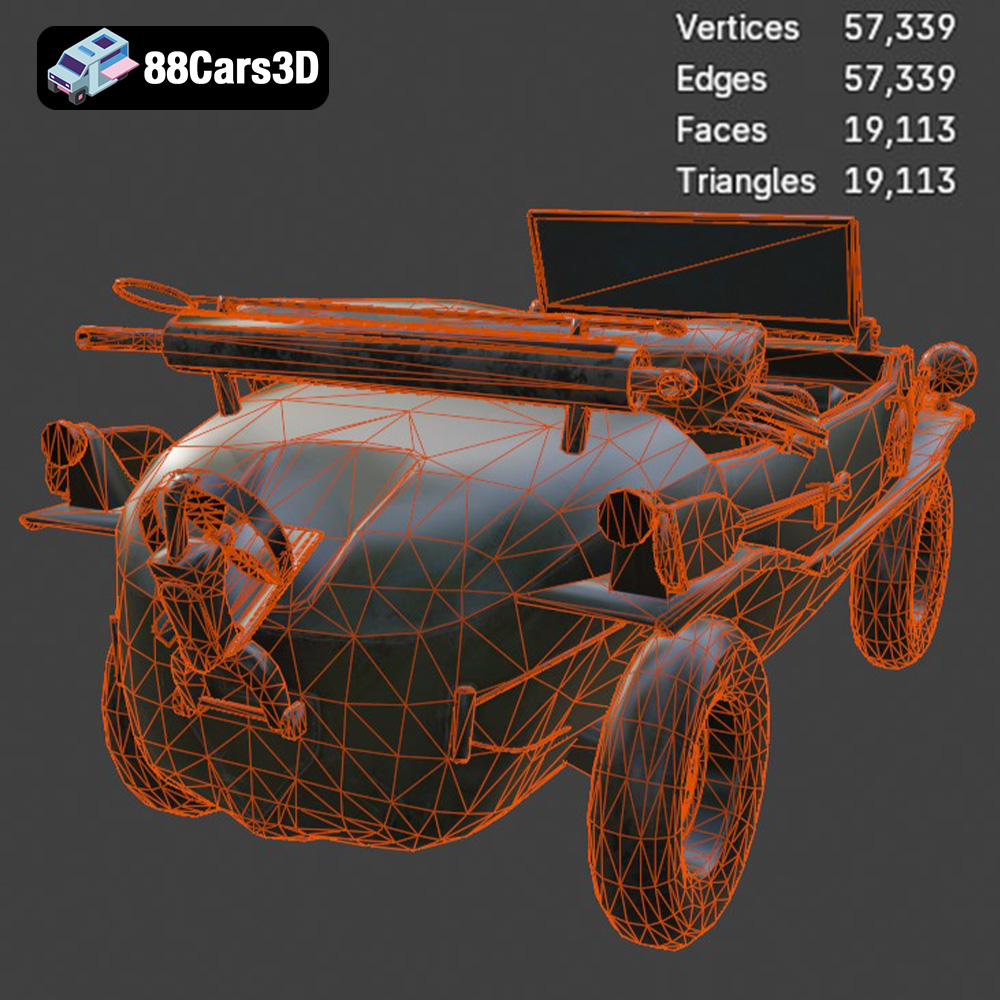
One of the most critical aspects of any 3D asset, particularly 3D car models destined for real-time engines, is its topology. The Volkswagen Schwimmwagen Typ 166 3D model boasts an optimized topology with approximately 150,000 triangles. This figure strikes a perfect balance: it’s sufficiently detailed to capture the vehicle’s unique watertight hull geometry, riveted panels, and intricate mechanical components without being overly dense. A lower polygon count ensures smooth performance in game engines like Unreal and Unity, preventing frame rate drops and long loading times. Conversely, enough detail is retained to support high-quality normal maps and displacement maps, which fake finer details during rendering, giving the illusion of a much higher poly model without the performance cost. This optimized geometry ensures the model looks stunning up close and performs flawlessly from a distance.
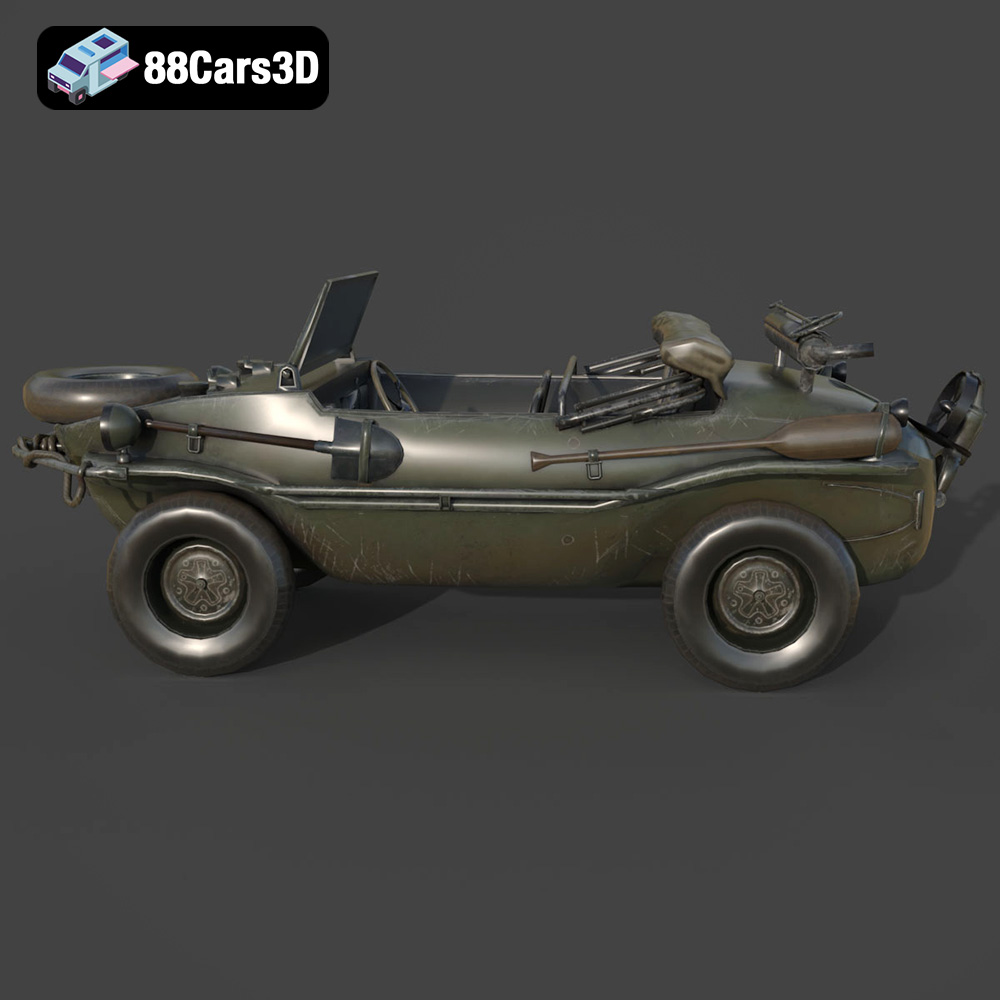
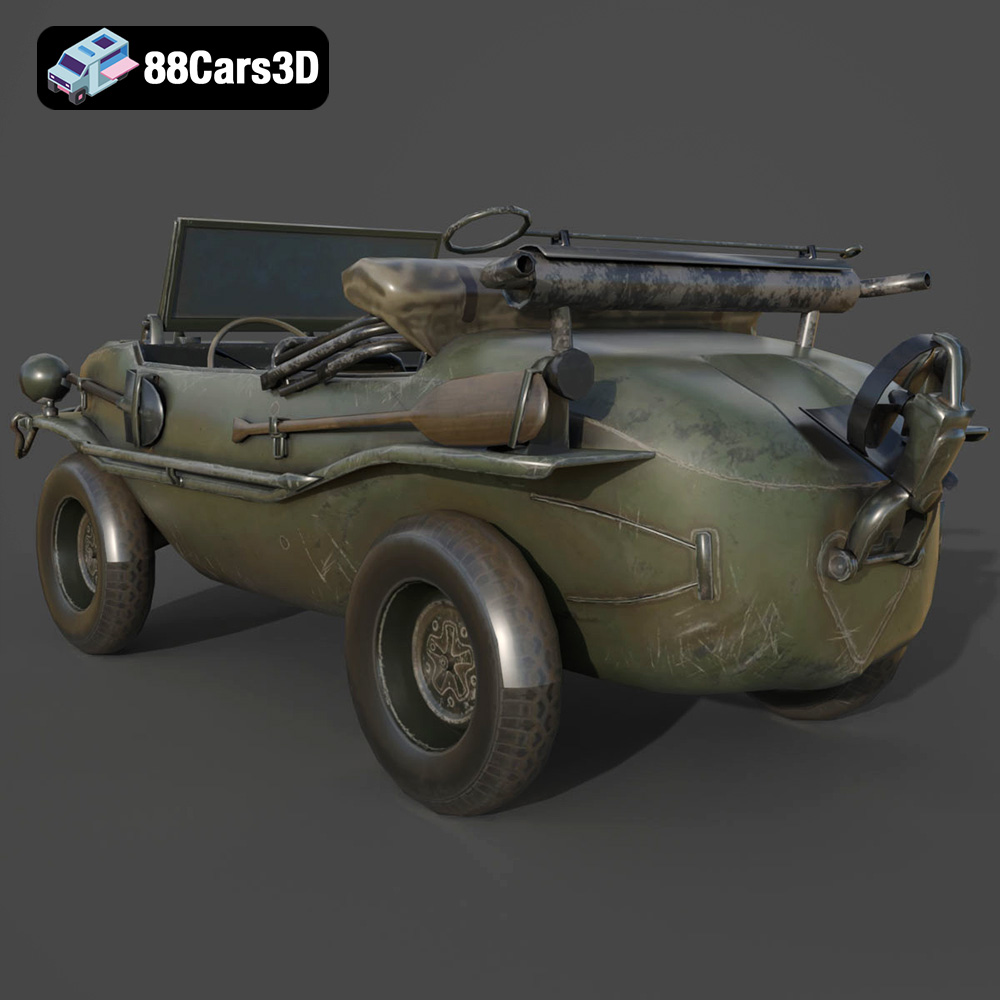
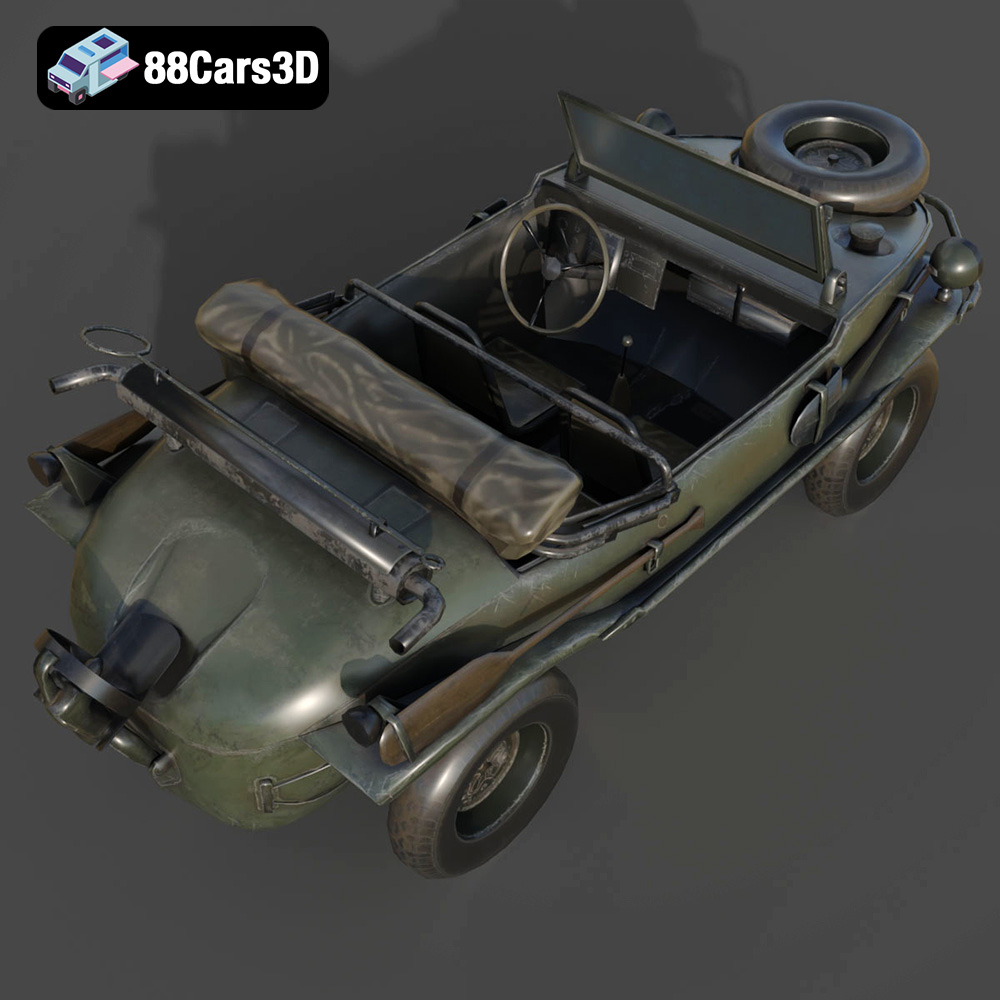
The commitment to realism in this Schwimmwagen model is evident in its painstaking replication of authentic features. From the detailed rear-mounted air-cooled flat-four engine housing to the period-accurate military lighting, every element has been carefully considered. The fold-down rear propeller mechanism isn’t just a static piece; it’s designed with separate components, ready for animation, allowing artists to depict its amphibious nature dynamically. The high-tread off-road tires and stamped steel wheels, along with the rugged leaf spring and torsion bar suspension, are all accurately modeled, down to the bolts and mounts. This level of granular detail is essential for historically accurate simulations, immersive AR/VR experiences, and high-end cinematic renders where authenticity is paramount.
Accuracy extends beyond visual appearance to the very dimensions and functionality of the model. The Schwimmwagen is built to real-world scale, a crucial factor for seamless integration into existing scenes, architectural visualizations, or game environments. This prevents common scaling issues and ensures consistency across diverse projects. Furthermore, a significant technical advantage is the proper pivot setup for key animatable components. The wheels, propeller, suspension, and steering components are all separated and correctly pivoted, meaning they are “rig-ready.” This greatly accelerates the animation process, allowing game developers to quickly implement driving mechanics, prop deployment, or even damaged states with minimal fuss. For automotive rendering specialists, this means easily creating dynamic scenes showing the vehicle in motion or transitioning from land to water.
The true power of a meticulously crafted 3D asset like the Volkswagen Schwimmwagen Typ 166 lies in its versatility across professional pipelines. Whether you’re a game developer, an automotive rendering artist, or creating immersive AR/VR experiences, this model provides a robust foundation.
For game developers, the “game-ready & optimized” designation of the Schwimmwagen model is a significant advantage. Importing the .fbx or using the pre-packaged .unreal asset into engines like Unreal Engine or Unity is the starting point. Artists would then proceed with:
For high-end automotive rendering and visualization, artists typically prefer working with the native .max or .blend files. This allows for maximum control over lighting, materials, and scene composition:
The Schwimmwagen Typ 166 3D model is exceptionally well-suited for AR/VR applications, offering immersive educational and interactive opportunities. The .glb format is particularly beneficial here, ensuring lightweight, high-performance assets for mobile AR or standalone VR headsets.
The versatility of a well-engineered 3D model extends beyond digital displays, reaching into the tangible world through 3D printing. The Volkswagen Schwimmwagen Typ 166 3D model, specifically prepared in .stl format, allows enthusiasts, model makers, and educators to bring this iconic vehicle into physical existence.
Achieving a high-quality physical replica requires careful attention to 3D print settings. The product description provides excellent guidelines, highlighting considerations unique to complex models like the Schwimmwagen:
Complex geometries with overhangs, like the Schwimmwagen’s exhaust system, propeller, and steering wheel, will inevitably require supports during printing. Proper support placement is vital to prevent print failures and minimize post-processing work. The recommendation to print the frame angled for structural integrity and wheels separately is a strategic approach, allowing for better detail on cylindrical parts and easier assembly. Post-processing, including sanding to smooth layer lines, applying primer for an even paint surface, and then painting with authentic factory colors or military camouflage patterns, transforms a raw 3D print into a museum-quality miniature. Metallic finishes can further enhance the realism of engine parts and chassis components.
A truly professional 3D car model offers more than just fidelity; it provides a canvas for customization, allowing artists and developers to adapt it to diverse creative needs. The Volkswagen Schwimmwagen Typ 166 3D model excels in this area, offering various options to tailor its appearance and functionality.
The ability to change body and tank colors is a fundamental customization. This allows the Schwimmwagen to be depicted in its authentic factory colors, various military camouflage patterns from different theaters of war, or even custom finishes for fictional scenarios. Beyond color, modifying tire textures from “off-road mud” to “clean variants” dramatically alters the vehicle’s context, instantly transforming it from a battle-hardened machine to a pristine museum piece. Adjusting material finishes—from matte military paint to glossy civilian concepts or weathered metal—allows for nuanced storytelling and visual aesthetics, reflecting the vehicle’s history or imagined future. This flexibility is powered by the underlying PBR texture maps, making these changes intuitive and realistic within any modern rendering engine.
The Schwimmwagen model’s adaptability extends to its environment. Changing lighting for different environments is key to achieving photorealism. Imagine the vehicle under harsh desert sun, shrouded in dense jungle foliage, or captured in the soft glow of a studio light rig. Each scenario demands unique lighting setups, and a well-built 3D model responds realistically to these changes, with PBR materials accurately reflecting and absorbing light. The ability to animate separate components like the propeller and suspension also opens doors for dynamic storytelling – showing the Schwimmwagen traversing diverse terrains or transitioning from land to water, its appearance subtly shifting with the environment.
In today’s competitive digital landscape, the difference between a good project and an exceptional one often comes down to the quality of its assets. High-quality 3D car models are no longer a luxury; they are a necessity for achieving realism, engaging audiences, and streamlining production workflows across industries.
Investing in pre-made, optimized 3D car models like the Volkswagen Schwimmwagen Typ 166 from 88cars3d.com offers significant advantages in efficiency. Instead of dedicating valuable artist hours to modeling a vehicle from scratch, teams can leverage ready-to-use assets, allowing them to focus on more complex, creative tasks like scene composition, animation, and interaction design. This accelerates development cycles, reduces costs, and ensures a consistently high standard of visual fidelity that might be challenging to achieve with limited resources. For automotive rendering studios, having access to a library of high-quality vehicles means rapid prototyping and faster client turnarounds.
The level of detail and optimization present in a professional-grade 3D model directly impacts the perceived realism of a project. Whether it’s the intricate engine housing of the Schwimmwagen in a game, its precise proportions in an AR visualization, or its weathered textures in a cinematic render, these details immerse the viewer. The accurate real-world scale, proper pivot setups for animation, and game-ready poly count ensure that the model doesn’t just look good, but behaves realistically within digital environments. This commitment to realism is crucial for attracting and retaining audiences in game development, convincing clients in visualization, and educating users in AR/VR.
Ultimately, a premium 3D asset is more than just a collection of polygons and textures; it’s a foundational element that empowers creators to tell compelling stories, build immersive worlds, and deliver visually stunning experiences. The Volkswagen Schwimmwagen Typ 166 3D Model is a testament to this principle, providing a versatile, high-fidelity asset that is ready to elevate any project it becomes a part of.
The Volkswagen Schwimmwagen Typ 166 stands as a testament to ingenious engineering, a historical icon now brilliantly translated into the digital realm. As we’ve explored, a high-quality 3D model of such a vehicle is far more than just a visual representation; it’s a versatile tool capable of driving success across diverse professional applications. From game development to cinematic automotive rendering, and from immersive AR/VR experiences to precise 3D prints, the technical excellence and meticulous detail of this model make it an invaluable asset.
Understanding the nuances of file formats, appreciating the balance of optimized topology with visual fidelity, and leveraging the model’s inherent customization options are key to unlocking its full potential. The included file formats—.blend, .fbx, .obj, .glb, .stl, .ply, .unreal, and .max—ensure unparalleled compatibility and flexibility, ready for any modern workflow. Whether you’re aiming for historical accuracy in a military simulator or captivating audiences with stunning visualizations, the Volkswagen Schwimmwagen Typ 166 3D Model provides the foundation for truly exceptional work.
For professionals seeking top-tier 3D car models and game assets, the quality and technical foresight demonstrated in this Schwimmwagen model are hallmarks of the offerings available at 88cars3d.com. Elevate your projects and bring your visions to life with assets that are built for performance, realism, and boundless creative freedom.
The Volkswagen Schwimmwagen Typ 166 is an iconic World War II amphibious off-road vehicle, celebrated for its rugged durability and unique boat-like hull design. Serving as one of the most mass-produced amphibious cars in history, it features a distinctive rear-mounted air-cooled flat-four engine, a fold-down propeller system, and four-wheel drive capability. This highly accurate 3D model meticulously captures its utilitarian military aesthetics, from the riveted watertight chassis to the spare tire mounted on the sloping front hood.
$39.99
.blend
.fbx
.glb
.max
.obj
.ply
.rendering
.stl
.unreal
.volkswagen
amphibious-vehicle
car-3d-model
classic-car
game asset
game-ready
low-poly
military-vehicle
off-road
optimized
schwimmwagen-typ-166
VR/AR
ww2-vehicle