Get 20% OFF All Premium 3D & STL Models!

The iconic Vespa P200E, a timeless emblem of Italian design and engineering, transcends its role as mere transportation to become a cultural phenomenon. Its distinctive silhouette, robust 2-stroke engine, and effortless style have etched it into the hearts of enthusiasts worldwide. For 3D artists, game developers, architectural visualizers, and AR/VR creators, capturing such a legend in digital form presents a unique challenge and opportunity. It requires not just accurate modeling but a deep understanding of optimization, material fidelity, and diverse application pathways.
At 88cars3d.com, we understand the demand for precision and performance in 3D assets. That’s why models like our Vespa P200E 3D Model are meticulously crafted to meet the rigorous standards of professional production environments. This digital recreation doesn’t just look the part; it’s engineered for seamless integration into a multitude of workflows, from photorealistic automotive rendering to high-performance game engines. Whether you’re designing an urban cityscape in Unreal Engine, populating a vintage street scene for an animation, or creating an interactive AR experience, this model provides the foundational quality you need to bring your vision to life.
This comprehensive guide delves into the technical intricacies of high-quality 3D car models, using the Vespa P200E as a prime example. We’ll explore the critical aspects of model creation, the importance of file formats, integration into popular software, and the expansive applications these assets enable. Join us as we uncover how such detailed and optimized 3D assets accelerate creative projects and deliver unparalleled visual fidelity.
In the vast landscape of 3D production, choosing the right file format is paramount to ensuring compatibility, preserving data integrity, and optimizing workflows. The Vespa P200E 3D Model, for instance, comes in a comprehensive suite of formats, each serving distinct purposes and catering to different professional needs. Understanding these formats is crucial for maximizing the utility of any 3D asset.
The .blend file is the native format for Blender, a powerful and increasingly popular open-source 3D creation suite. When you download a .blend file, you’re getting the complete Blender scene, including all meshes, materials, textures, lighting, cameras, animation data, and even modifiers. This format offers maximum editability, allowing artists to delve deep into the model’s construction, adjust parameters, and customize every aspect of the Vespa P200E within the Blender ecosystem. It’s ideal for those who primarily work in Blender and require full control over the asset, whether for animation, rendering, or further design iterations.
.fbx (Filmbox) is an Autodesk-developed proprietary file format widely recognized as an industry standard for 3D data exchange. Its strength lies in its ability to encapsulate a broad range of 3D data, including geometry, materials, textures, bones, skinning, animation, and cameras. For this Vespa model, the .fbx format is an excellent choice for transferring the asset between different 3D software packages and, critically, for direct import into game engines like Unreal Engine and Unity. Its robust support for animations and hierarchical structures makes it indispensable for real-time pipelines and complex animated sequences, ensuring the separate wheels, suspension, and steering components of the Vespa retain their animation readiness.
The .obj (Wavefront OBJ) format is one of the oldest and most universally supported 3D formats. It primarily stores geometric data – vertices, faces, normals, and UV coordinates – making it highly compatible across virtually all 3D software. While it doesn’t store animation or complex material definitions directly (these are typically handled by an accompanying .mtl file for basic material properties and texture paths), its ubiquity makes it a safe bet for basic geometry transfer. For the Vespa P200E, the .obj provides a clean, raw mesh suitable for those who want to apply their own materials and set up scenes from scratch in their preferred rendering engine.
.glb is the binary version of glTF (GL Transmission Format), a relatively newer, royalty-free specification designed for efficient transmission and loading of 3D scenes and models by engines and applications. It’s a self-contained format that embeds models, textures, and animations into a single file, making it incredibly efficient for web-based 3D, augmented reality (AR), and virtual reality (VR) applications. Its compact size and optimized structure are perfect for deploying the Vespa P200E into immersive virtual showrooms, mobile AR experiences, or interactive browser-based visualizations without compromising visual quality.
.stl (Stereolithography) is the de facto standard for 3D printing. It represents a 3D model as a collection of unconnected triangles, defining only the surface geometry without color, texture, or other model attributes. While it lacks visual fidelity, it’s precisely what 3D printers need to interpret the physical shape. The Vespa P200E 3D Model, offered in .stl, is perfectly prepared for physical manifestation, allowing hobbyists and professionals to print display-scale replicas. The product description highlights print settings like layer height, supports, and orientation, emphasizing its readiness for additive manufacturing.
The .ply (Polygon File Format or Stanford Triangle Format) is another format for storing 3D data, particularly useful for representing scanned 3D objects. It supports a wider range of properties than .stl, including color, transparency, normals, texture coordinates, and confidence values. While less common for general asset exchange than .fbx or .obj, .ply files are often employed in applications requiring precise mesh information, such as CAD integration, scientific visualization, or scenarios where the model’s integrity for analysis is paramount. For the Vespa, it provides a highly detailed mesh structure for those needing exact surface data.
The inclusion of .unreal files signifies assets specifically configured and optimized for direct integration into Unreal Engine projects. This isn’t a single file format in the same way as .fbx or .obj; rather, it implies a set of assets (meshes, materials, textures) pre-packaged or formatted to seamlessly drop into an Unreal project with minimal setup. This drastically speeds up the development process for game developers and real-time visualizers, ensuring the Vespa P200E is instantly usable within Unreal’s powerful rendering pipeline, complete with proper pivots and material assignments.
Finally, the .max file is the native project format for Autodesk 3ds Max, one of the leading 3D modeling, animation, and rendering software packages. Similar to .blend, a .max file contains the complete scene, offering full editability of the Vespa P200E, including its detailed geometry, materials, lighting, and any setup animation. This format is crucial for 3ds Max users who require complete control over the model, allowing them to modify the frame, engine details, cockpit features, and prepare it for advanced rendering or cinematic animations.
Recreating a vehicle as beloved as the Vespa P200E in 3D is a meticulous process that balances artistic interpretation with technical precision. It’s more than just modeling shapes; it’s about translating the emotional essence and mechanical integrity of the original into a digital form that resonates with authenticity.
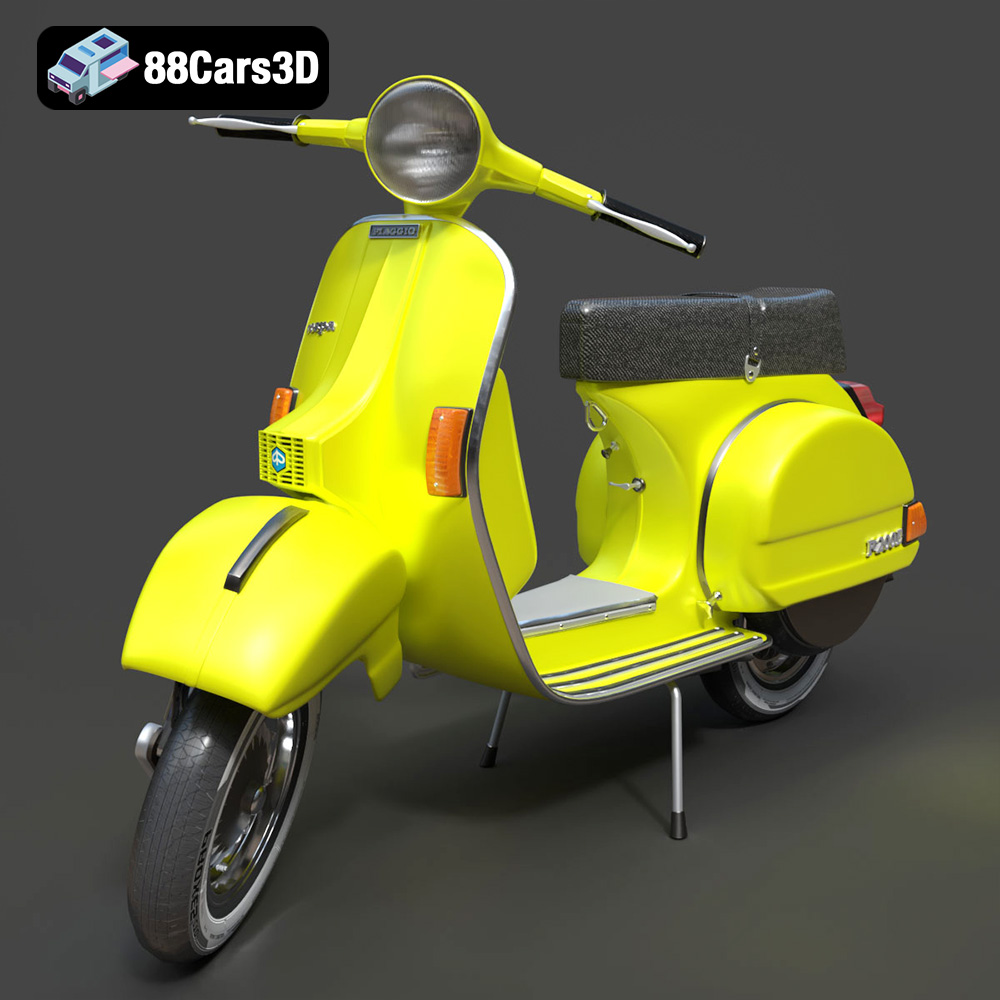
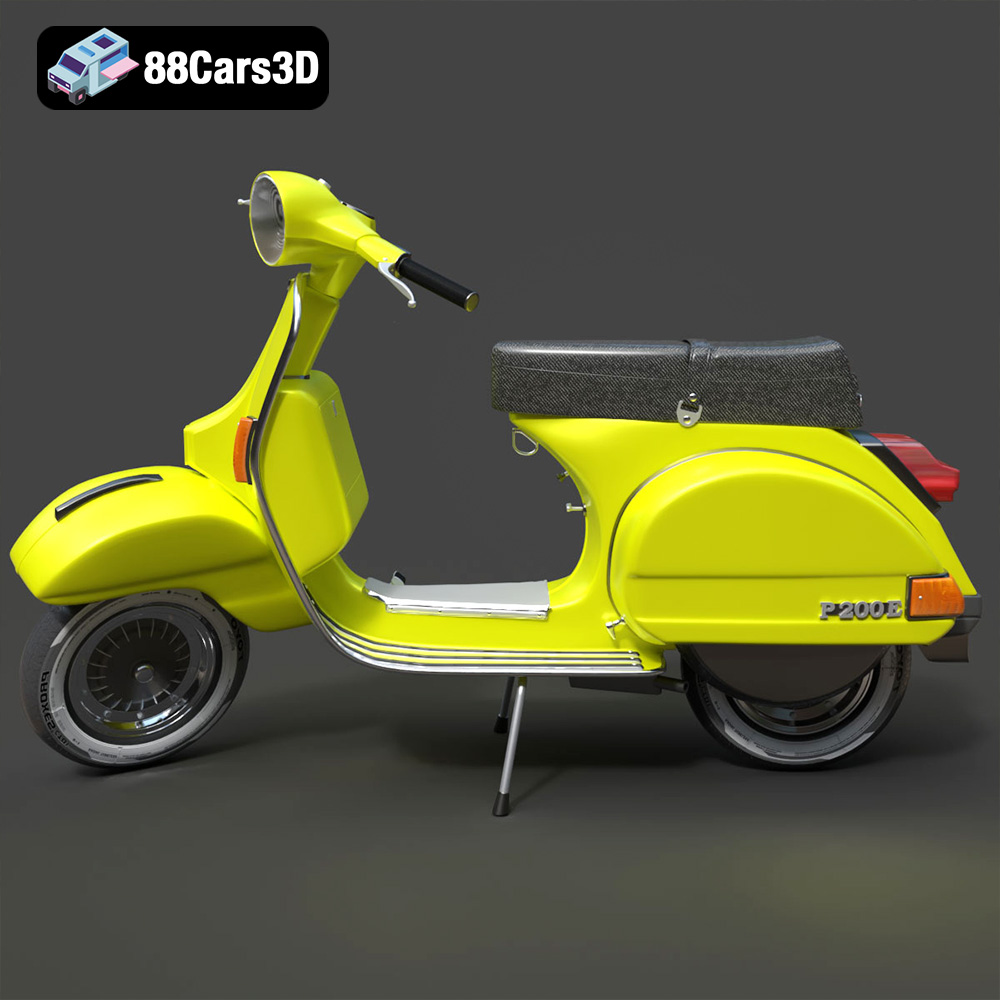
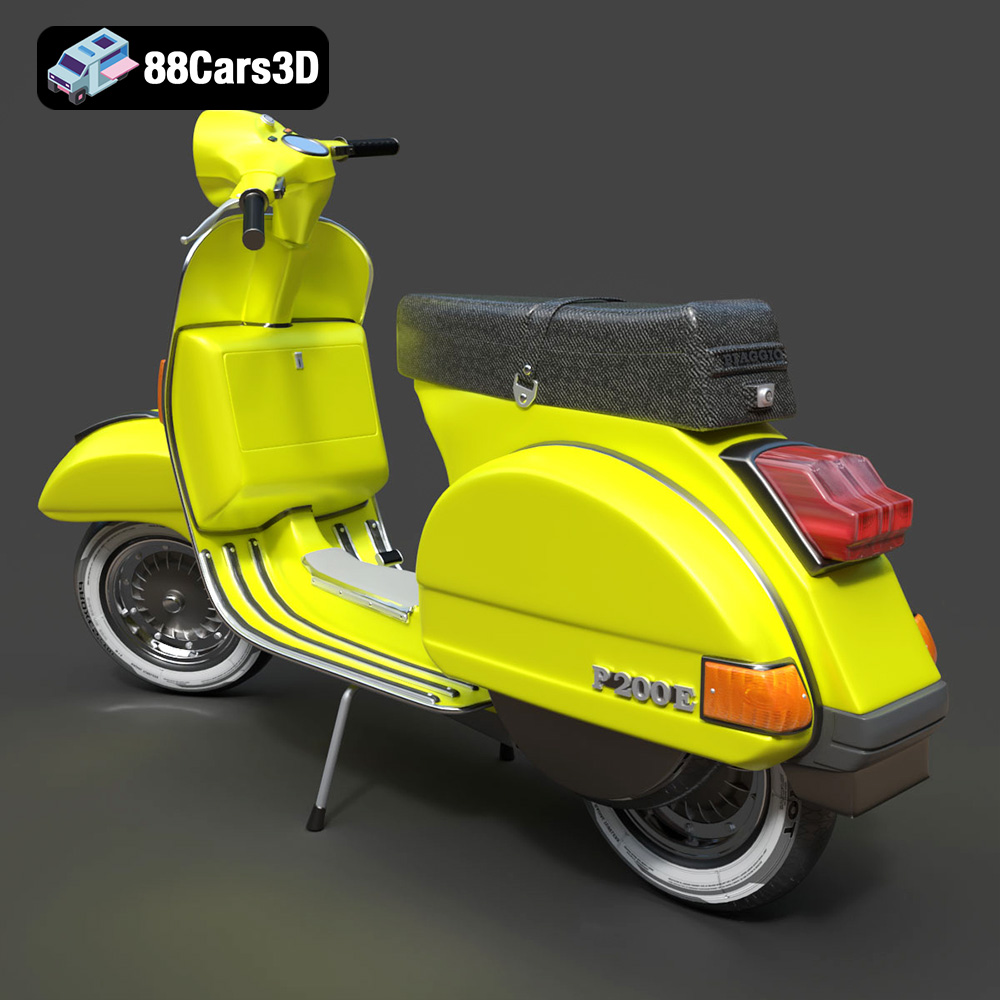
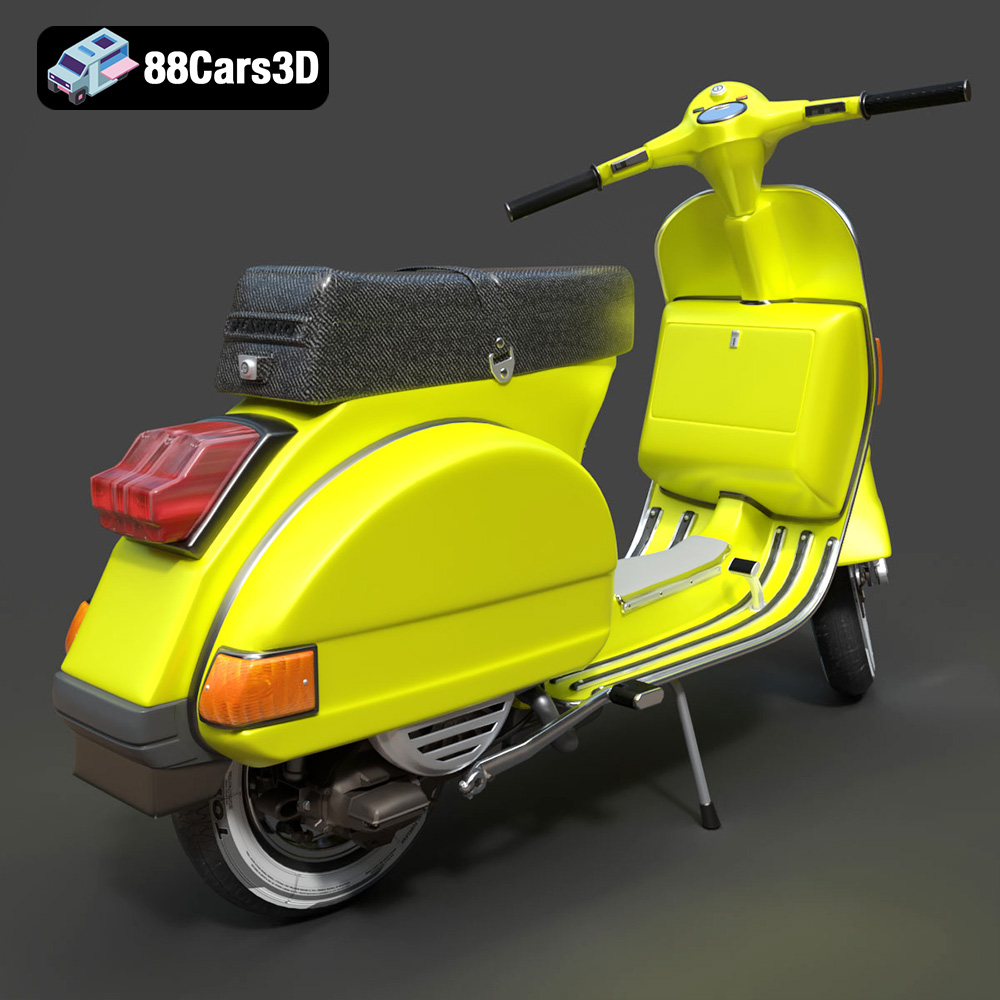
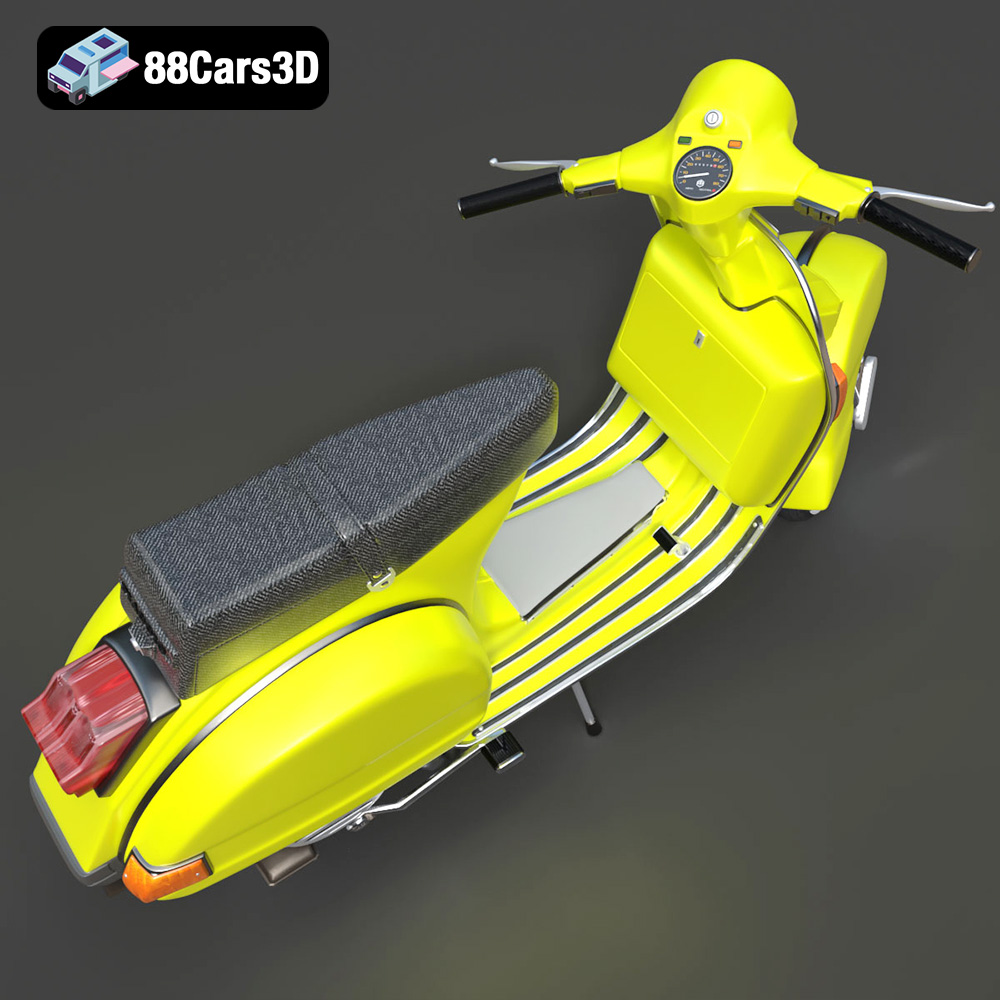
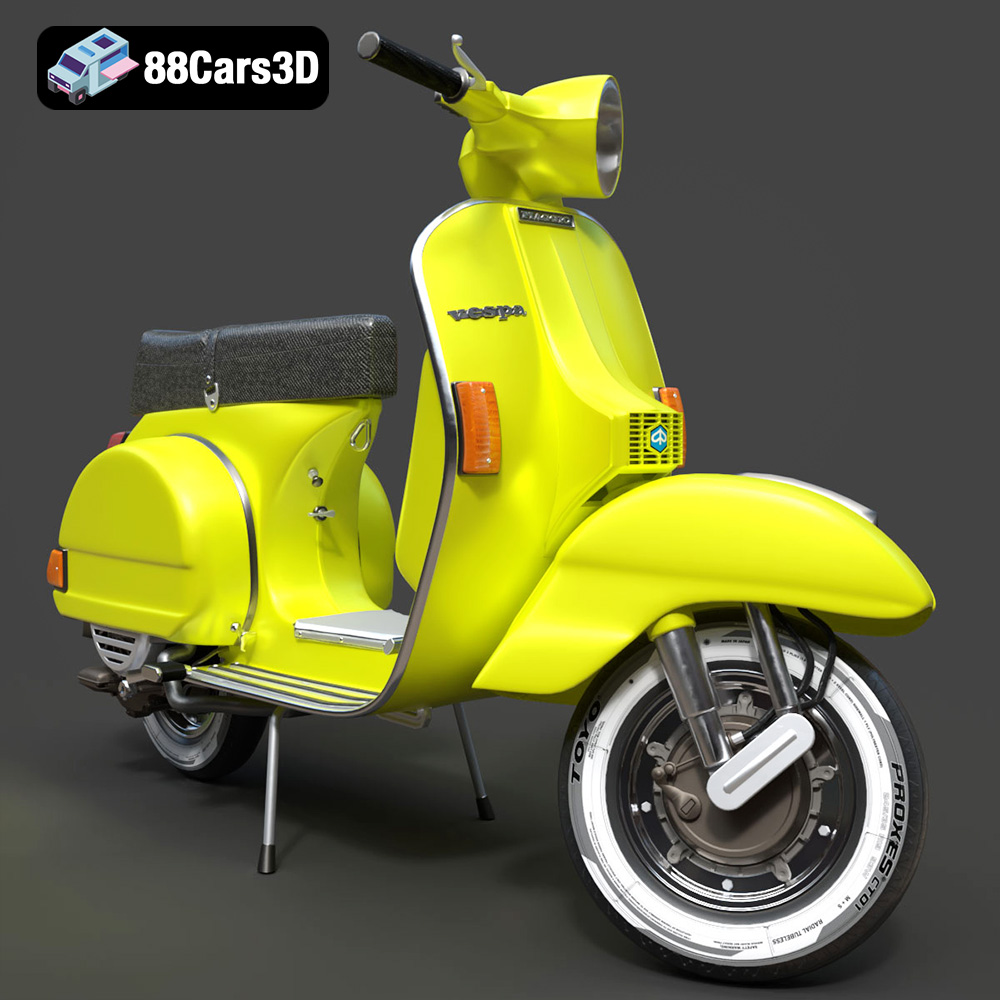
The true challenge in automotive 3D modeling lies in capturing both macroscopic forms and microscopic details. For the Vespa P200E, this means meticulously recreating its distinctive step-through frame geometry, the signature rear engine cowlings, and the classic vintage aesthetic. Every curve, from the rounded headlamp to the unmistakable tail section, must be faithful to the original. This fidelity extends to the smaller components: the authentic classic exhaust box, the detailed 2-stroke engine housing, the front trailing link suspension, and the rear mono-shock detailing. Achieving this often involves working from blueprints, photogrammetry data, and extensive reference imagery to ensure real-world scale accuracy and precise proportions. Such attention to detail is evident in the Vespa P200E 3D Model available at 88cars3d.com, ensuring it stands up to close-up renders and detailed inspections.
While often overlooked in exterior-focused models, the cockpit of a vehicle is crucial for immersive experiences, especially in game development or virtual reality. The Vespa P200E 3D Model excels here with a classic dual-seat design featuring textured upholstery detailing, signature curved handlebars with integrated controls, and an authentic vintage analog speedometer and instrument cluster. Even the detailed floorboard with anti-slip strips and the foot brake pedal are accurately represented. This level of internal detailing is vital for first-person POV in gaming or interactive VR scenarios, where users might virtually sit on the scooter, enhancing realism and user engagement.
In the realm of modern 3D applications, particularly game development and interactive experiences, stunning visual fidelity must be paired with exceptional performance. An overly complex model, no matter how beautiful, will bog down a real-time engine. This is where optimization becomes a critical engineering discipline.
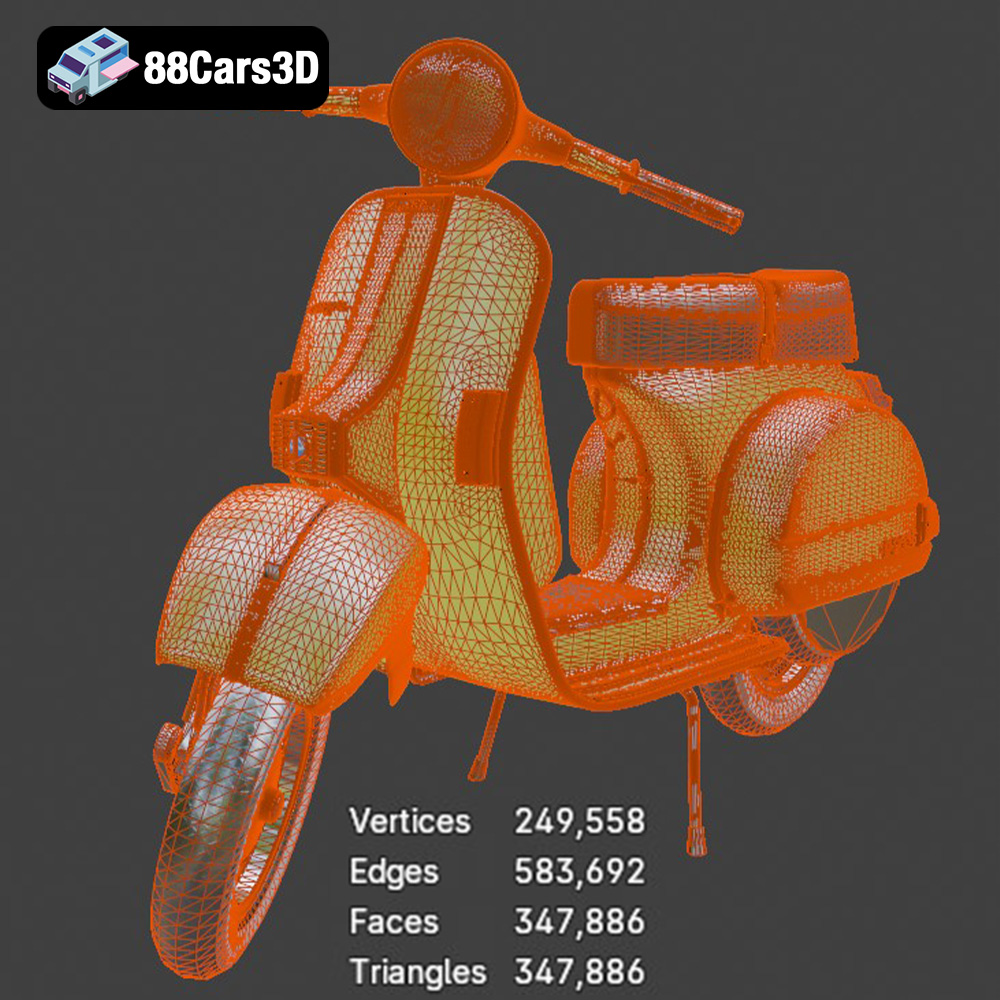
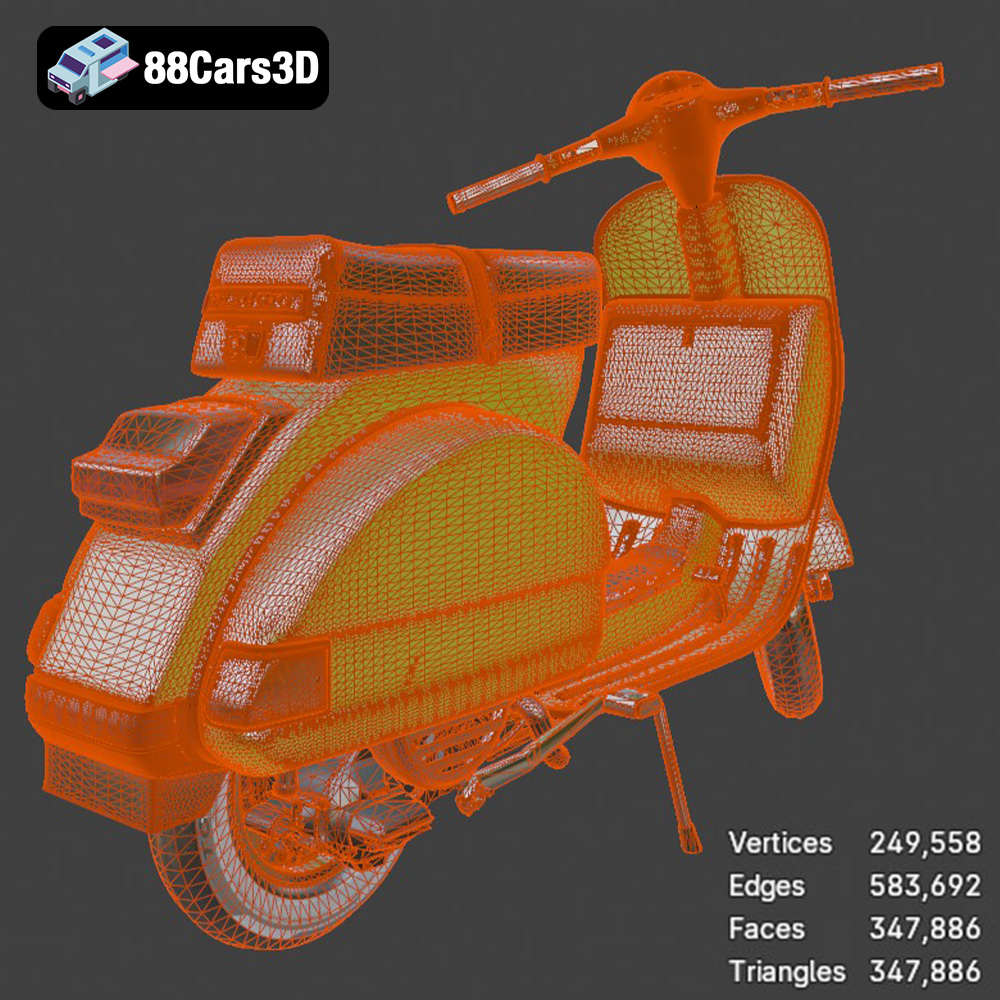
The Vespa P200E 3D Model achieves an impressive balance with its game-ready topology of approximately 50,000 triangles. This polycount is a sweet spot: it’s dense enough to convey high-end visual realism, capturing the smooth curves and distinct features of the Vespa, yet lean enough to perform efficiently within real-time engines like Unreal Engine and Unity. For truly demanding scenarios, professional 3D car models also typically employ Levels of Detail (LODs). LODs are simplified versions of the model that automatically swap in at greater distances from the camera, reducing the computational load without a noticeable drop in visual quality. While not explicitly mentioned for this specific model, the base optimization suggests it’s designed with these principles in mind or is an excellent foundation for creating them.
Beyond raw polycount, the quality of the mesh geometry is paramount. Clean geometry, characterized by quads (four-sided polygons) and efficient edge flow, ensures smooth shading, prevents artifacts, and facilitates easy modification. Proper UV mapping is equally critical; this is the process of flattening the 3D surface into a 2D space for texture application. Well-laid-out UVs prevent stretching or distortion of textures and optimize texture memory usage. The “clean geometry” of the Vespa model ensures excellent material response, meaning textures and shaders (such as metallic paints, leathers, and chrome) will render accurately and realistically, providing stunning realism without sacrificing performance. This combination of optimized topology, clean UVs, and appropriate material setup makes the model highly versatile for any real-time application.
While game development is a primary driver for optimized 3D assets, the utility of a high-quality model like the Vespa P200E extends far beyond virtual battlefields or racing circuits. Its detailed craftsmanship makes it invaluable across diverse industries and creative endeavors.
Augmented Reality (AR) and Virtual Reality (VR) are transforming how we interact with digital content. High-fidelity 3D models are the backbone of these immersive experiences. The Vespa P200E 3D Model is perfect for virtual showrooms, allowing prospective buyers to explore the scooter in 360 degrees, customize colors, and even place it in their real-world environment via AR on their mobile devices. Imagine walking around a life-sized virtual Vespa in your garage, or configuring different paint finishes and tire types in a VR configurator. Its optimized polycount and support for formats like .glb make it ideal for seamless integration into such interactive and engaging platforms.
For advertising, marketing, and architectural visualization, photorealistic rendering is non-negotiable. The Vespa model, with its accurate geometry, detailed textures, and proper material setup, excels in creating stunning visual content. It can be placed in lifestyle brand campaigns, vintage street scenes, or studio lighting setups to evoke specific moods and narratives. Architects can integrate it into urban planning visualizations to add a touch of authentic city life. The ability to change body colors, modify tire textures, and adjust material finishes provides immense creative freedom for visualizers to tailor the model to any client brief or artistic vision.
The bridge between digital and physical is 3D printing, and the Vespa P200E 3D Model is fully prepared for this journey. Provided in .stl format, it allows hobbyists and designers to bring the digital icon into the physical world. The detailed 3D print settings, including recommended scales (1:12 / 1:18 / 1:24), layer height, infill, and support requirements, demonstrate its readiness for additive manufacturing. Resin printing is recommended for capturing fine details like the exhaust and handlebars, enabling enthusiasts to create highly accurate display-scale models that can then be post-processed with sanding, primer, and authentic factory colors.
A truly valuable 3D asset is one that seamlessly integrates into existing professional workflows. The Vespa P200E 3D Model is designed with this versatility in mind, offering compatibility with major 3D software platforms and real-time rendering engines.
For users of Autodesk 3ds Max, the inclusion of the .max file provides an immediate, fully editable project. Artists can open the scene, inspect the model’s construction, modify its materials, animate its separate components (wheels, steering, suspension), and render it using advanced renderers like V-Ray or Corona. Similarly, Blender users benefit from the .blend file, offering the same level of deep customization and control within their preferred open-source environment. This native file access streamlines the initial setup process, allowing artists to focus on creative enhancements rather than conversion issues. Whether you’re a seasoned professional or an aspiring enthusiast, having native files reduces friction and accelerates production.
For game developers and real-time visualizers, Unreal Engine is a powerhouse. The Vespa P200E 3D Model’s game-ready optimization and the provision of .fbx and .unreal formats are crucial. An .fbx file can be directly imported into Unreal, bringing in the mesh, UVs, and basic material assignments. The model’s approximately 50,000 triangle count ensures it will run smoothly within the engine, maintaining high frame rates. Crucially, its proper pivot setup for steering, wheel rotation, and suspension travel is vital for interactive simulations or animations within the engine. This means a developer can quickly set up vehicle physics, implement driveable controls, and integrate the scooter into dynamic game environments without extensive re-rigging or re-exporting. This level of engine-ready preparation saves countless hours in a fast-paced development cycle.
Beyond native and engine-specific formats, the inclusion of .obj and .ply ensures broad compatibility. If a project requires a less common software or a bespoke pipeline, these universal formats act as reliable bridges. An .obj file provides the clean geometry for importing into virtually any 3D application for retopology, texturing in Substance Painter, or rendering in KeyShot. This flexibility underscores the model’s value as a foundational asset that can adapt to evolving project requirements and diverse software ecosystems, making it a truly future-proof investment for any studio or individual artist.
A high-quality 3D model isn’t just about static perfection; it’s about the potential for dynamic adaptation and creative expression. The Vespa P200E 3D Model provides extensive customization options, allowing artists to tailor its appearance to suit any artistic vision or project requirement.
The ability to easily change body and tank colors is fundamental for automotive rendering. Whether you need an authentic factory color, a custom metallic finish, or a unique matte look, the model’s material setup facilitates these changes. Beyond color, modifying tire textures (e.g., swapping between off-road and street variants) can dramatically alter the vehicle’s context and narrative. Adjusting material finishes – from highly reflective chrome to aged, weathered paint – allows for an incredible range of visual storytelling. This level of customization ensures that the Vespa P200E can fit seamlessly into diverse scenes, from a pristine showroom display to a gritty urban alleyway. Furthermore, adapting lighting for different environments is a standard practice in rendering, and the model’s clean geometry and proper material response make it highly receptive to various lighting setups, enhancing its photorealism.
Investing in a well-crafted, optimized 3D asset like the Vespa P200E from 88cars3d.com is an investment in future projects. Its broad format support, game-ready topology, and real-world scale ensure its relevance across emerging technologies and evolving software standards. As AR/VR matures and real-time rendering continues to push visual boundaries, assets built on strong technical foundations will remain invaluable. The detailed exterior and cockpit features, combined with its animation-ready components, mean it’s not just a static model but a versatile tool capable of dynamic performances. This thoughtful construction means fewer headaches down the line, freeing up artists to focus on creativity rather than technical troubleshooting, ultimately saving time and resources on complex projects requiring high-quality 3D car models.
The journey from a legendary two-wheeler like the Vespa P200E to a versatile, high-fidelity 3D model is a testament to the intersection of art and engineering in the digital age. We’ve explored how meticulous detailing, strategic optimization, and comprehensive file format support transform a mere digital asset into an indispensable tool for professionals across game development, architectural visualization, AR/VR, and 3D printing. The Vespa P200E 3D Model embodies these principles, offering unparalleled realism without sacrificing performance.
Whether you’re developing an immersive open-world game, crafting a stunning automotive rendering for a marketing campaign, or fabricating a display-scale model, the technical advantages of this meticulously crafted asset are clear. Its game-ready topology, accurate proportions, and extensive customization options ensure it’s not just a model, but a catalyst for creative projects. By understanding the nuances of different file formats and how they integrate into professional pipelines, artists and developers can fully leverage such assets to achieve their most ambitious visions.
At 88cars3d.com, we are committed to providing premium 3D car models that empower creators. The Vespa P200E 3D Model is a prime example of this commitment, delivering the quality and flexibility demanded by today’s most challenging 3D productions. Elevate your next project with an asset that combines timeless design with cutting-edge technical execution.
The Vespa P200E is a true icon of Italian design, celebrated for its timeless styling and reliable 2-stroke engine. This 3D model perfectly captures the scooter’s distinctive step-through frame, signature rear engine cowlings, and classic vintage aesthetic that made it a cultural phenomenon. From the rounded headlamp to the unmistakable tail section, every curve has been meticulously recreated to offer an authentic representation of this legendary two-wheeler. Crafted with a focus on optimization and visual fidelity, this model features a game-ready topology of approximately 50,000 triangles. It delivers stunning realism without sacrificing performance in real-time environments. The clean geometry ensures smooth shading and excellent material response, making it highly versatile for game development, AR/VR applications, animation, and high-end visualization.
$39.99
.blend
.fbx
.glb
.max
.obj
.ply
.rendering
.scooter
.stl
.unreal
.vespa
.vintage
classic-scooter
game asset
game-ready
low-poly
motorcycle-3d-model
optimized
p200e
VR/AR