Get 20% OFF All Premium 3D & STL Models!

The world of 3D visualization and real-time interactive experiences demands unparalleled fidelity, especially when it comes to capturing the intricate beauty and engineering prowess of high-performance automobiles. From the sleek lines of a concept car in an automotive configurator to the adrenaline-pumping action of a racing simulator, the foundation of any successful project lies in the quality of its 3D car models. These digital assets are not merely representations; they are the heart of virtual worlds, driving engagement and immersion.
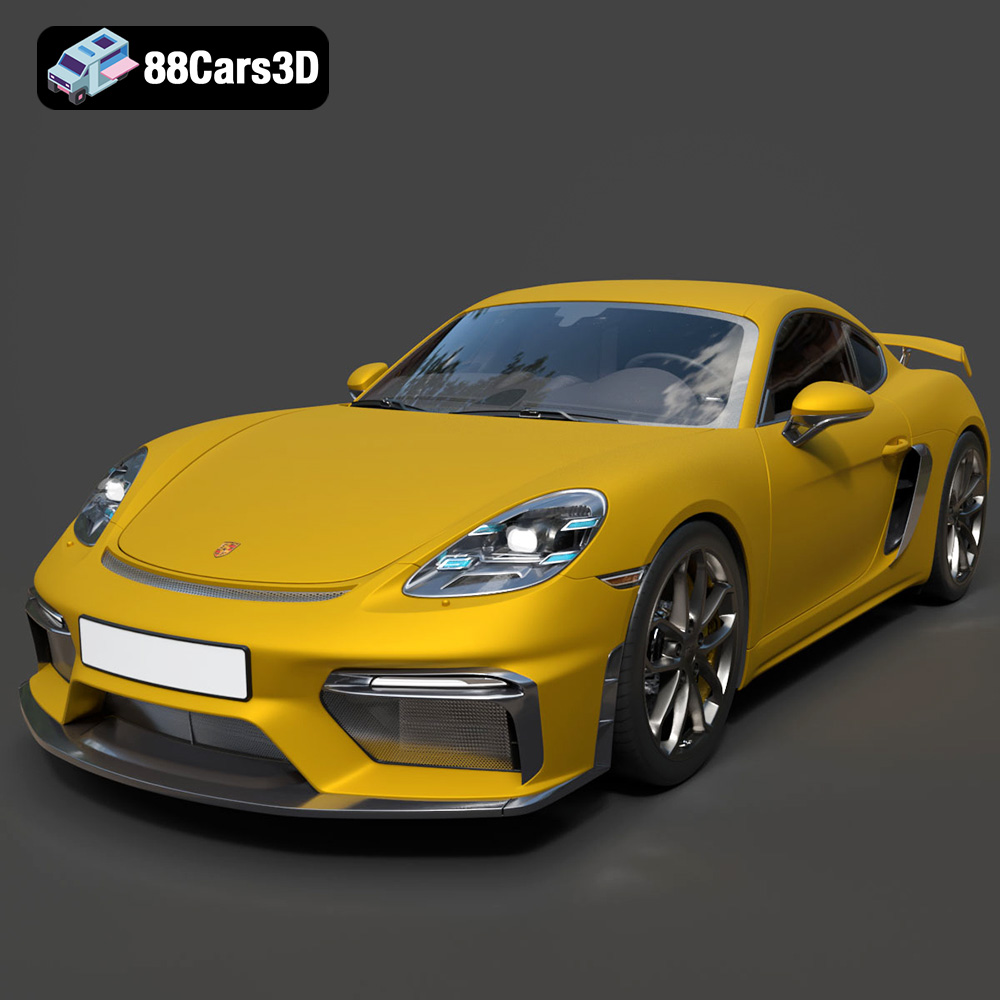
Today, we’re diving deep into an exceptional example of this digital craftsmanship: the Porsche 718 Cayman GT4 2020 3D Model. This mid-engine track weapon, celebrated for its naturally aspirated 4.0-liter flat-six engine and aggressive aerodynamics, translates into a spectacular digital asset. It offers an immaculate balance of visual realism and game-ready optimization, making it an indispensable tool for professionals across various industries. Whether your goal is photorealistic rendering, cutting-edge game development, or interactive AR/VR experiences, understanding the technical nuances of such a model is paramount to unleashing its full potential.
When an iconic vehicle like the Porsche 718 Cayman GT4 2020 is translated into a 3D model, the goal is not just to replicate its appearance, but to capture its essence and engineering integrity. This requires meticulous attention to detail and a profound understanding of 3D modeling principles, ensuring the asset is both visually stunning and technically robust for diverse applications.
The real-world Porsche 718 Cayman GT4 2020 is a masterpiece of design and performance. Its aggressive front fascia with large cooling intakes, prominent fixed rear wing, and dual sport exhaust integrated into an aggressive rear diffuser are all meticulously designed for maximum downforce and cooling. The digital model faithfully reproduces these elements, starting with accurate frame geometry, body panels, and proportions. Every curve, vent, and panel gap is carefully sculpted to reflect the actual vehicle, ensuring that from any angle, the digital counterpart is unmistakably a GT4. Details like the signature Porsche four-point LED headlights, tinted 3D taillights, and precise alloy wheels with high-performance brake calipers and slotted rotors are not merely textures but fully modeled components, adding depth and realism that truly shines in close-up shots and high-resolution renders.
Beyond its visual fidelity, the technical specifications of the Porsche 718 Cayman GT4 2020 3D Model are what truly set it apart. It boasts exceptional topology and game-ready optimization, a critical balance for modern workflows. This means the mesh is clean, efficient, and structured in a way that minimizes distortion during deformation or animation, while also allowing for smooth subdivisions if higher detail is required. The carefully calculated triangle counts ensure maximum performance without sacrificing detail, making it ideal for real-time environments like game engines where every millisecond of rendering time counts. Furthermore, the model is built with real-world scale accuracy, ensuring seamless integration into scenes and environments without manual scaling adjustments. A crucial technical advantage is the proper pivot setup for steering, wheel rotation, and suspension travel. This allows for immediate and realistic animation of vehicle dynamics, whether for a racing game, an automotive commercial, or a virtual showroom experience. The separation of wheels, suspension, and steering components provides animators with granular control, greatly simplifying the rigging and animation process.
The versatility of a high-quality 3D car model, such as the Porsche 718 Cayman GT4 2020, is greatly enhanced by its availability in multiple file formats. Each format caters to specific software environments, use cases, and technical requirements, making it crucial for artists and developers to understand which format to choose for their particular project. This comprehensive selection, available on 88cars3d.com, ensures maximum compatibility and workflow efficiency.
The .blend format is native to Blender, a powerful open-source 3D creation suite. A .blend file typically contains the entire Blender scene, including mesh data, materials, textures, lighting, cameras, animations, physics simulations, and even custom scripts. When you download a .blend file, you’re getting a fully editable project, allowing for deep customization. This is ideal for users who primarily work in Blender and want to leverage its robust modeling, sculpting, rigging, and rendering capabilities. You can easily modify geometry, adjust material nodes, add animation keyframes, or integrate the model into a larger Blender-based scene, making it a favorite for artists seeking complete creative control.
.fbx (Filmbox) is a proprietary file format owned by Autodesk, but it has become an industry-standard exchange format due to its comprehensive support for 3D models, animation, and various scene elements. It’s particularly ideal for transferring assets between different 3D software packages (e.g., 3ds Max, Maya, Blender) and, crucially, into real-time game engines like Unreal Engine and Unity. An .fbx file can encapsulate mesh geometry, PBR (Physically Based Rendering) material assignments, textures, skeletal animation data, and even camera and light information. Its robustness makes it a go-to for complex production pipelines where assets need to move seamlessly between different stages and tools.
The .obj (Wavefront OBJ) format is one of the oldest and most widely supported 3D file formats. It’s a universal standard, compatible with virtually every 3D application. .obj files primarily store geometry (vertices, normals, texture coordinates, and faces) and can reference external material files (.mtl) for basic shading information. While it doesn’t typically store animation or rigging data, its simplicity and widespread compatibility make it an excellent choice for straightforward mesh exchange, particularly when cross-software compatibility is the highest priority. It’s a reliable fallback when other formats might present compatibility issues.
.glb (GLB, the binary version of glTF) is a relatively newer format designed specifically for efficient transmission and loading of 3D scenes and models on the web and in AR/VR applications. It’s optimized for real-time rendering, embedding all assets (geometry, materials, textures, animations) into a single, compact binary file. This “all-in-one” characteristic makes .glb incredibly efficient for streaming 3D content in browsers, mobile AR apps, and virtual reality experiences, eliminating the need for multiple file requests and speeding up load times. It’s the perfect format for showcasing the Porsche GT4 in an interactive online configurator or an immersive virtual showroom.
.stl (Stereolithography) is the de facto standard file format for 3D printing. It represents a 3D model as a collection of triangulated surfaces, defining the external geometry of an object without any color, texture, or material information. For designers and hobbyists looking to bring the Porsche 718 Cayman GT4 into the physical world, the .stl file is indispensable. It’s a “watertight” mesh, meaning it has no holes or gaps, which is crucial for successful 3D printing, ensuring the printer can accurately interpret the object’s volume.
.ply (Polygon File Format or Stanford Triangle Format) is a file format for storing 3D data, particularly from 3D scanners. It can store a wider range of properties than .obj or .stl, including vertex colors, normals, and even transparency values, making it suitable for scientific data or models with per-vertex information. While less common for general 3D asset exchange than .fbx or .obj, it’s valuable for high-precision models, CAD applications, or situations where detailed mesh analysis is required.
The .unreal format signifies an asset optimized specifically for direct import and use within Unreal Engine. This often implies that the model has been pre-processed to meet Unreal’s specific requirements, potentially including optimized mesh density (LODs), proper material setup for Unreal’s PBR pipeline, collision meshes, and pivot points. Utilizing an .unreal file can significantly streamline the workflow for Unreal Engine developers, saving time on setup and ensuring optimal performance within the engine’s real-time rendering environment. It’s a direct path to getting the Porsche GT4 racing in your next virtual world.
Finally, the .max format is native to Autodesk 3ds Max, one of the leading 3D modeling, animation, and rendering software packages in the industry. Like .blend, a .max file contains the complete scene, including complex rigging, animation curves, advanced material setups (e.g., V-Ray or Corona Renderer materials), lighting rigs, and camera views. For professionals working within the 3ds Max ecosystem, having the native .max file offers the highest degree of editability and allows them to leverage all the powerful tools and plugins available in 3ds Max for further customization, high-end rendering, and complex animation sequences.
High-fidelity 3D car models like the Porsche 718 Cayman GT4 are the cornerstone of breathtaking automotive rendering and visualization. These assets enable artists to create marketing materials, product configurators, and immersive experiences that are indistinguishable from reality, driving engagement and sales.
For achieving ultimate photorealism, professional rendering engines such as V-Ray or Corona Renderer integrated with 3ds Max are invaluable. Artists can leverage the Porsche 718 Cayman GT4 2020 3D Model‘s detailed geometry and material flexibility to craft stunning studio renders. This involves setting up realistic lighting environments, often using HDRI (High Dynamic Range Image) maps for global illumination, complemented by strategic key and fill lights to highlight the vehicle’s contours. The model’s customizable materials allow for precise adjustment of paint finishes—from metallic flakes to clear coat reflections—tire textures, and carbon fiber accents. Focusing on accurate reflections, intricate shadows, and depth of field, artists can create hero shots that showcase every meticulous detail, from the stitching on the Alcantara sport seats to the precise brake calipers and slotted rotors.
Beyond isolated studio shots, integrating the 3D car model into dynamic scenes and lifestyle visuals brings it to life. This involves placing the Porsche GT4 in various environments, such as urban cityscapes, scenic mountain roads, or sleek architectural backdrops. The model’s real-world scale accuracy ensures it fits naturally within these digital sets. Artists can then use storytelling techniques to create compelling narratives around the vehicle, perhaps depicting it speeding down a track or parked elegantly in front of a luxurious villa. Animation capabilities, stemming from the properly pivoted wheels, suspension, and steering components, can simulate driving sequences or subtle idle movements, adding another layer of realism and dynamism to lifestyle campaigns and automotive rendering projects.
For automotive brands, high-quality 3D assets are a powerful tool for marketing and communication. The Porsche 718 Cayman GT4 2020 3D Model is perfect for creating consistent, high-impact visuals across diverse platforms. It can be used for interactive online configurators, allowing potential buyers to customize colors (e.g., Miami Blue, Guards Red), wheel designs, and interior trims in real-time. It’s also ideal for crafting visually rich advertising campaigns, brochures, and digital presentations. The ability to render the car in any desired color or material finish, without the need for physical prototypes or elaborate photoshoots, offers immense flexibility and cost-efficiency for modern brand promotion. This makes assets from marketplaces like 88cars3d.com incredibly valuable.
The demand for immersive and high-performance experiences in video games and interactive applications has never been higher. High-quality game assets like the Porsche 718 Cayman GT4 2020 3D Model are critical for developers aiming to deliver breathtaking realism and fluid gameplay in real-time environments.
Game development requires a delicate balance between visual fidelity and performance. The Porsche 718 Cayman GT4 2020 3D Model is explicitly designed with game-ready optimization in mind, featuring a carefully calculated triangle count that strikes this perfect balance. For engines like Unreal Engine and Unity, this means the model is ready for immediate integration. Developers can leverage the .fbx format for robust import, ensuring all PBR material assignments and mesh data are transferred correctly. Further optimization techniques like Level of Detail (LOD) can be applied, where lower-polygon versions of the model are automatically swapped in when the car is further from the camera, significantly reducing rendering overhead. The availability of an .unreal format for direct Unreal Engine integration further streamlines this process, potentially offering pre-configured materials and collision meshes optimized for the engine’s internal systems, such as Lumen and Nanite for advanced global illumination and geometry streaming.
For racing titles and open-world games, the authenticity of vehicles is paramount. The Porsche 718 Cayman GT4 2020 3D Model excels here with its highly detailed exterior and interior features, including track-focused Alcantara sport bucket seats and the iconic analog central tachometer. Crucially, the model’s separate wheels, suspension, and steering components, coupled with proper pivot setups, are game-changers for realistic vehicle physics and animation. Developers can easily rig the model for advanced suspension simulations, dynamic wheel rotation, and responsive steering, creating a truly immersive driving experience. Its optimized geometry is also suitable for first-person POV in gaming, allowing players to feel fully integrated into the cockpit, enhancing the sense of speed and control.
Augmented Reality (AR) and Virtual Reality (VR) are transforming how consumers interact with products, especially in the automotive sector. The Porsche 718 Cayman GT4 2020 3D Model is ideally suited for creating immersive virtual showrooms, interactive configurators, and mobile AR experiences. The .glb format, optimized for web and XR, allows for easy deployment of the model onto websites or AR applications, providing seamless, high-quality real-time rendering. Imagine a potential buyer exploring the GT4’s interior in VR, rotating it 360 degrees, or even placing a life-size virtual model in their driveway using AR – all powered by a robust and optimized 3D asset. This level of interaction drives engagement and provides an unparalleled preview of the vehicle.
The versatility of a well-crafted 3D car model extends beyond the digital realm, offering a tangible connection to the virtual design. The Porsche 718 Cayman GT4 2020 3D Model provides a fantastic opportunity for enthusiasts and professionals to bring this track weapon to life through 3D printing.
The first step in transforming a digital model into a physical object is often preparing the mesh for 3D printing. The availability of the model in the .stl format is crucial for this. STL files represent the model as a triangulated mesh, which is the standard input for most 3D printers. For successful printing, the model needs to be “manifold” or “watertight,” meaning it has no holes or inverted faces, ensuring a solid, printable volume. While the provided .stl is designed for this, minor clean-up might sometimes be beneficial depending on the specific printer and slicer software. The recommended scales (1:12, 1:18, 1:24) are excellent starting points for display-scale hobbyists, offering a good balance between detail and printability.
Achieving a high-quality 3D print of a detailed car model like the GT4 requires careful consideration of print settings. For fine details, resin printing is highly recommended over FDM (Fused Deposition Modeling) due to its ability to produce much finer layers (0.04–0.12 mm layer height) and capture intricate geometries. Wall thickness (1.2–2.0 mm) is important for structural integrity, ensuring parts don’t become too brittle. An infill of 20–30% provides a good balance between material usage and strength. Given the GT4’s complex aerodynamics and intricate components, supports will be required for overhangs and detailed parts such as the exhaust system, mirrors, and side scoops. Printing orientation also plays a significant role; printing the frame angled can improve structural integrity and surface finish, while wheels should generally be printed separately for optimal detail and easier post-processing.
Once printed, the real artistry begins with post-processing. This typically involves removing supports, sanding to smooth out layer lines, and applying primer to prepare the surface for painting. For an authentic finish, hobbyists can use automotive-grade paints, striving for factory colors with metallic finishes to mimic the original car’s luster. Detailed painting of brake calipers, window trims, and interior elements can elevate the model’s realism. Finally, assembling separate components like wheels and mirrors completes the physical manifestation of this exceptional 3D car model, creating a stunning display piece that truly bridges the digital and physical worlds.
One of the most powerful aspects of working with high-quality 3D car models is the inherent flexibility and customization options they provide. This capability future-proofs your digital assets, allowing them to adapt to evolving project needs and creative visions.
The Porsche 718 Cayman GT4 2020 3D Model offers extensive customization potential, starting with its materials and textures. Artists are not limited to a single factory color; they can effortlessly change body colors to anything imaginable, from iconic Miami Blue or Guards Red to bespoke custom finishes that reflect unique brand identities or personal preferences. Beyond paint, material finishes can be adjusted to matte, gloss, or metallic, and specific elements can be swapped for carbon fiber textures to enhance a high-performance aesthetic. Furthermore, tire textures can be modified to represent different variants, such as track slicks for a race scenario or street tires for a casual render, significantly altering the vehicle’s context and visual impact. This level of material control is vital for creating diverse visual campaigns and immersive user experiences.
A 3D model’s visual impact is profoundly influenced by its surrounding environment and lighting. The flexibility of the Porsche GT4 model allows artists to adapt lighting for virtually any scenario. Whether you need a crisp, evenly lit studio setup for a product shot, the dramatic shadows of a sunset drive, or the subtle glow of a nighttime urban environment, the model will react realistically to the light. This adaptability ensures that the asset remains relevant and impactful across a multitude of applications, from interactive configurators where lighting can be dynamically changed, to cinematic renders requiring specific atmospheric conditions. Integrating the model into various scenes becomes seamless, as its real-world scale and clean geometry ensure it sits perfectly within any digital environment.
Investing in high-quality 3D car models like the Porsche 718 Cayman GT4 2020 is not just about acquiring an asset for a single project; it’s about building a robust digital library that can serve numerous purposes over time. Such models are timeless game assets, valuable for repeated use in different games, visualizations, and interactive experiences. Their technical excellence ensures compatibility with future software iterations and rendering advancements. Platforms like 88cars3d.com specialize in providing these enduring, versatile assets, empowering creators to focus on their artistic vision and development, knowing they have a solid foundation. The ability to customize and adapt these models to new trends and technologies solidifies their position as invaluable tools in the ever-evolving landscape of 3D digital creation.
The journey from a legendary track machine to a versatile digital asset is a testament to the meticulous craft of 3D modeling. The Porsche 718 Cayman GT4 2020 3D Model stands as a prime example of a high-fidelity, technically optimized asset that caters to the demanding needs of modern digital production. Its exceptional topology, game-ready optimization, real-world scale accuracy, and comprehensive file format support (from .blend and .max for deep editing to .fbx and .unreal for game engines, .glb for AR/VR, and .stl for 3D printing) make it an indispensable tool.
Whether you are an automotive renderer striving for photorealistic visuals, a game developer building the next blockbuster racing simulator, an AR/VR innovator crafting immersive experiences, or a hobbyist bringing digital designs to life through 3D printing, this model provides the robust foundation you need. It embodies the essence of high-performance automotive engineering in a digital form, ready to be customized, animated, and integrated into your most ambitious projects.
To explore this exceptional model and discover a vast array of other premium 3D car models and game assets, visit 88cars3d.com. Elevate your creative projects with assets built for excellence.
The 2020 Porsche 718 Cayman GT4 is a mid-engine track weapon that perfectly balances motorsport heritage with modern performance. Known for its naturally aspirated 4.0-liter flat-six engine, aggressive aerodynamics, and unmistakable Porsche styling, this sports car delivers a pure, unfiltered driving experience. From its prominent fixed rear wing and large functional air intakes to its dual sport exhaust system and aggressive rear diffuser, every element is meticulously designed for maximum downforce and cooling. This high-fidelity 3D model boasts exceptional topology and game-ready optimization, featuring carefully calculated triangle counts to ensure maximum performance without sacrificing detail. It maintains breathtaking visual fidelity suitable for close-up shots while remaining fully optimized for real-time rendering environments. Whether you are developing a high-speed racing simulator, crafting an immersive AR/VR showroom, or producing photorealistic cinematic animations, this digital asset provides the perfect foundation.
$39.99
.2020
.blend
.fbx
.glb
.max
.obj
.ply
.porsche
.rendering
.sports car
.stl
.unreal
718-cayman-gt4
car-3d-model
game asset
game-ready
low-poly
optimized
track-car
VR/AR