Get 20% OFF All Premium 3D & STL Models!

In the vast landscape of automotive design, some vehicles transcend their utilitarian purpose to become cultural touchstones. The 1993 Volkswagen Passat Mk4 B4 Sedan is precisely one such vehicle. Representing a pivotal era in German engineering, it fused robust reliability with an understated, functional aesthetic that defined 90s European motoring. For 3D artists, game developers, and visualization specialists, recreating such an iconic machine is more than just a technical exercise; it’s an act of digital preservation.
The demand for high-quality 3D car models has never been greater, driven by the insatiable appetite of industries ranging from immersive gaming to hyper-realistic architectural visualization and cutting-edge AR/VR experiences. Every detail, from the authentic headlight housings to the period-correct wheel options, contributes to the overall fidelity and believability of a digital scene. It’s in this demanding environment that specialized assets, such as the Volkswagen Passat Mk4 B4 Sedan 1993 3D Model, prove their invaluable worth. This particular model, available at 88cars3d.com, encapsulates the utilitarian charm and engineering precision of its real-world counterpart, making it an exceptional example of a meticulously crafted automotive asset designed for diverse professional applications.
The utility of a 3D model is often defined by its compatibility and the specific format it’s delivered in. Each file format serves a distinct purpose, optimized for different stages of the 3D pipeline, from initial modeling and animation to real-time game engines and physical production. Understanding these distinctions is paramount for any professional leveraging 3D car models, and the Volkswagen Passat Mk4 B4 Sedan model from 88cars3d.com demonstrates this versatility by offering a comprehensive suite of formats.
The .blend format is the native file type for Blender, the popular open-source 3D creation suite. When you download a .blend file, you’re getting a fully editable scene that typically includes the mesh, materials, textures, lighting, camera setups, and even animation data, exactly as it was prepared by the artist in Blender. This makes it ideal for users who wish to customize the model extensively, dissect its construction, or integrate it into an existing Blender project. For the Passat model, having a .blend file means you can easily modify its textures, adjust its geometry, or even re-rig it for specific animation sequences, directly within its original environment.
The .fbx (Filmbox) format, owned by Autodesk, has become the de facto standard for exchanging 3D data between various applications and is particularly crucial for real-time engines like Unreal Engine and Unity. FBX files can store not just geometry, but also materials, textures, animations, skinning, and rigging. Its robustness in handling complex hierarchies and animation data makes it indispensable for game development and cinematics. For the Volkswagen Passat model, the .fbx format ensures smooth import into game engines, preserving its optimized topology, proper pivot setups for animation, and material assignments ready for a PBR workflow.
The .obj (Wavefront OBJ) format is one of the oldest and most universally supported 3D file formats. It’s a simple, text-based format primarily used to store 3D geometry (vertices, normals, texture coordinates, and faces) and references to external material files (.mtl). While it doesn’t typically store animation or rigging data, its widespread compatibility across almost all 3D software makes it excellent for cross-platform model sharing. If you need a clean mesh of the Passat for sculpting, retopology, or import into specialized rendering software, .obj is a reliable choice.
.glb (GL Transmission Format Binary) is the binary version of glTF, an open-standard 3D file format designed for efficient transmission and loading of 3D scenes and models by applications. GLB files package textures and other assets directly into a single file, making them highly optimized for web-based 3D viewers, augmented reality (AR), virtual reality (VR), and mobile applications. Its compact size and ease of integration make it perfect for showcasing the Passat in an interactive web configurator or an AR experience on a smartphone.
The .stl (Stereolithography) format is the standard file type for 3D printing. It represents a 3D model as a series of connected triangles, defining only the surface geometry of an object without color, texture, or other CAD attributes. While simple, it’s universally accepted by 3D printers and slicing software. The Passat model, being convertible to .stl, allows enthusiasts to bring a physical representation of this classic sedan to life, following the recommended print settings for optimal detail and structural integrity.
The .ply (Polygon File Format, or Stanford Triangle Format) is primarily used for storing 3D data from 3D scanners. It supports properties like color, transparency, surface normals, texture coordinates, and confidence values. While less common for general asset exchange than FBX or OBJ, its ability to store precise mesh data and vertex properties makes it valuable in specific engineering, reverse engineering, and scientific visualization workflows where the accurate representation of scanned data is critical. For the Passat model, this format could be used for highly precise analyses or further CAD integration.
A specific .unreal file (or often, a set of assets packaged specifically for Unreal Engine) denotes an asset optimized and prepared for direct import and use within Unreal Engine. This often means pre-configured materials, collision meshes, LODs (Levels of Detail), and sometimes even blueprint setups. For the Volkswagen Passat Mk4 model, an Unreal-ready asset minimizes setup time, allowing game developers to drop the car directly into their virtual environments with confidence in its performance and visual fidelity.
The .max format is the native file type for Autodesk 3ds Max, a powerful 3D modeling, animation, rendering, and compositing software. Like .blend, a .max file contains the complete scene, including geometry, materials, textures, lighting, cameras, animations, and render settings. It’s invaluable for users who operate primarily within the 3ds Max ecosystem, offering full editability and the ability to leverage Max-specific modifiers, plugins, and renderers. The availability of the Passat model in .max format ensures seamless integration for professionals accustomed to 3ds Max’s robust toolset.
For game developers, the quality and optimization of 3D car models are paramount. A vehicle asset needs to look fantastic, but critically, it must also perform efficiently within a real-time engine. The Volkswagen Passat Mk4 B4 Sedan 1993 3D Model is specifically engineered with these considerations in mind, making it an excellent candidate for various game development scenarios, from sprawling open-world titles to period-specific racing simulators.
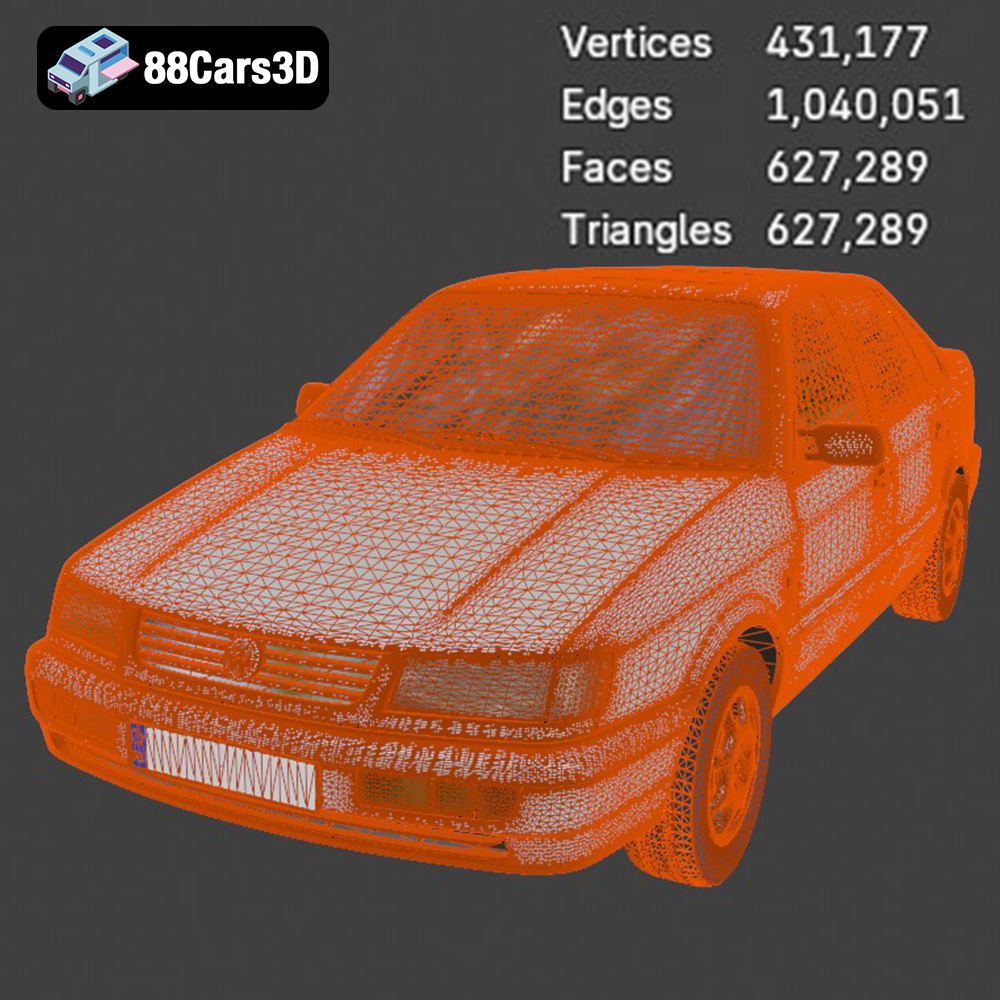
The “game-ready” designation is not merely marketing; it implies rigorous optimization. The Passat model boasts an optimized triangle count of 50,000-80,000. This range strikes a crucial balance: it’s high enough to maintain sharp details and crisp reflections even on modern hardware, yet low enough to prevent excessive GPU strain when numerous vehicles populate a scene. For even greater efficiency in large open-world games, professional assets like this are often designed with multiple Levels of Detail (LODs). As the player moves further from the vehicle, lower-poly versions automatically swap in, maintaining visual continuity while significantly reducing render overhead. This thoughtful approach ensures the Passat can serve as primary driveable vehicle, background traffic, or interactive set piece without compromising frame rates.
Beyond static appearance, a game asset must be animation-ready. The Passat model excels here with proper pivot setups for critical components. Wheels are typically separated with their pivots correctly placed at their rotational centers, allowing for realistic spinning. Suspension components are often individual elements, enabling dynamic compression and extension, while steering parts are also isolated for accurate articulation. This modular design extends to interior elements, making it easier for game designers to implement interactive cockpits or destructible environments. A car model that requires minimal setup for animation saves valuable development time and allows for richer, more dynamic gameplay experiences.
Maintaining real-world scale is a non-negotiable aspect of professional game development. Inconsistent scaling can lead to visual anomalies, physics glitches, and a general lack of immersion. The Volkswagen Passat Mk4 B4 Sedan 1993 3D Model adheres to accurate real-world scale, ensuring it fits seamlessly into virtual environments alongside other assets. This consistency is vital for maintaining a believable world, whether it’s for accurately simulating vehicle physics or simply ensuring the car doesn’t look like a toy next to a digital building. Sourcing high-quality 3D car models from platforms like 88cars3d.com guarantees this foundational accuracy, allowing developers to focus on gameplay rather than asset correction.
For rendering and architectural visualization (ArchViz) specialists, the goal is often photorealism, creating images and animations indistinguishable from real life. Here, 3D car models are not just props; they are integral storytelling elements that define mood, context, and a sense of lived-in reality. The Volkswagen Passat Mk4 B4 Sedan 1993 3D Model offers the fidelity required to shine in high-resolution renders.
Photorealistic rendering hinges on accurately simulating how light interacts with surfaces. This is achieved through physically based rendering (PBR) workflows, which require models to have well-defined materials that mimic real-world properties like roughness, metallicness, and normal maps. The Passat model’s exceptional quality means it comes with PBR-ready materials that capture the sheen of its painted bodywork, the texture of its tires, and the subtle reflectivity of its glass. The accurate representation of materials, from the plastic trims to the metallic finishes and interior upholstery, ensures that whether rendered in V-Ray, Corona, Arnold, or Cycles, the car will react realistically to virtual lighting conditions.
A well-modeled car is only as good as its environment. In automotive rendering, designers often place vehicles within virtual studio setups or integrate them into complex architectural scenes. The Passat’s detailed geometry and accurate proportions make it an ideal subject for showcasing a design, illustrating a lifestyle, or simply adding a touch of realism to a building exterior render. Its classic lines and authentic features allow it to seamlessly blend into 90s-themed street scenes or provide a focal point in a retro-inspired advertisement. The flexibility to change body colors and adjust material finishes further enhances its utility, allowing artists to tailor the model to specific brand campaigns or aesthetic requirements.
Beyond technical precision, automotive visualization is about conveying a narrative. A car in a scene isn’t just an object; it’s a character or a silent witness. The 1993 Volkswagen Passat, with its distinct identity as a reliable, practical family sedan, evokes a sense of nostalgia and everyday life. Placing this specific model in an ArchViz project, for instance, can immediately date a scene to the 90s, adding authenticity and a layer of storytelling that generic modern vehicles cannot. This emotional connection, facilitated by meticulously crafted 3D car models, is invaluable for creating compelling and memorable visualizations.
The journey of a 3D model doesn’t always end on a screen. For hobbyists, collectors, or designers creating physical prototypes, 3D printing offers an exciting avenue to manifest digital creations into tangible objects. The Volkswagen Passat Mk4 B4 Sedan 1993 3D Model, with its conversion to .stl format, opens up this possibility for fans of classic cars and 3D printing alike.
While the .stl format simplifies the geometry for printers, successful 3D printing requires careful consideration of the model’s design and structural integrity. The Passat model, being game-ready and optimized, typically translates well into a printable format. However, understanding recommendations like a recommended scale (1:12 / 1:18 / 1:24) and necessary wall thickness (1.2–2.0 mm) is crucial. These guidelines ensure that the printed model retains its shape and doesn’t become too fragile. For intricate components like the exhaust or mirrors, separate printing and assembly might be required, which a well-structured 3D model facilitates.
The level of detail achieved in a 3D print is heavily dependent on the chosen scale and printing technology. For a highly detailed model like the Passat, resin printing (SLA/DLP) is often recommended over FDM (filament-based) printing due to its ability to produce finer layers (0.04–0.12 mm) and capture small intricacies like grilles, headlight textures, and interior elements more accurately. Supports are almost always required for overhangs and delicate parts, and proper print orientation (e.g., printing the frame angled) can significantly improve structural integrity and reduce visible layer lines. The detailed interior features of the Passat, such as the classic four-spoke steering wheel and analog instrument cluster, truly shine when printed with high precision.
A raw 3D print is just the beginning. To achieve a museum-quality display model, post-processing is essential. This often involves removing supports, sanding to smooth out layer lines, and applying primer to create a uniform surface for painting. For an automotive model like the Passat, applying authentic factory colors with metallic finishes and carefully painting details like lights, window trim, and badges can elevate the printed object to a stunning replica. This blend of digital precision and artisanal finishing allows enthusiasts to celebrate the classic 1993 Volkswagen Passat Mk4 in a unique, tangible way, transforming a digital asset into a cherished physical piece.
The true power of a professionally crafted 3D car model lies not just in its initial fidelity but in its inherent versatility and potential for customization. A high-quality asset, such as the Volkswagen Passat Mk4 B4 Sedan 1993 3D Model from 88cars3d.com, acts as a robust foundation upon which creators can build, adapt, and innovate to meet specific project demands.
Customization options are key to maximizing the value of a 3D asset. The Passat model offers the flexibility to change body colors, allowing artists to match factory paint schemes or experiment with custom finishes to fit a particular brand aesthetic or scene mood. The ability to modify tire textures, from all-season to performance variants, subtly alters the vehicle’s character and suitability for different environments. Furthermore, adjusting material finishes – switching between matte, gloss, metallic, or plastic trims – provides granular control over the vehicle’s appearance under various lighting conditions, ensuring it always looks its best. This level of adaptability ensures that the single Passat model can serve multiple roles across diverse projects without needing to create a new asset from scratch.
A premium 3D car model is more than just a visually appealing mesh; it’s a meticulously structured digital object. The Passat model’s design with separate wheels, suspension, and steering components isn’t just for animation; it also facilitates easy customization. Need to swap out the factory wheels for aftermarket rims? The modular design makes it straightforward. Want to animate a complex suspension system for a specialized simulation? The individual components are already there, properly pivoted. This thoughtful approach to asset construction saves countless hours in modification and integration, making the initial investment in a high-quality model profoundly worthwhile. Whether for game development, high-end rendering, or even AR/VR applications where interaction is key, the intrinsic versatility of models like the Volkswagen Passat Mk4 B4 Sedan 1993 3D Model from 88cars3d.com significantly accelerates creative workflows and expands artistic possibilities.
The world of 3D modeling thrives on detail, authenticity, and technical precision. From the nuanced curves of a vintage chassis to the intricate interplay of light on a metallic paint job, every element contributes to an immersive digital experience. The 1993 Volkswagen Passat Mk4 B4 Sedan 3D Model exemplifies this dedication to quality, offering a robust, game-ready, and highly detailed asset perfectly suited for a multitude of professional applications.
Whether you’re populating an open-world game with period-correct traffic, generating photorealistic marketing renders, crafting interactive AR/VR showrooms, or even 3D printing a tangible piece of automotive history, the meticulous design and versatile file formats (including .blend, .fbx, .obj, .glb, .stl, .ply, .unreal, and .max) of this model ensure seamless integration into any workflow. Its optimized topology, real-world scale, and animation-ready pivots make it a powerhouse asset for developers and artists alike, while its customizable materials unlock endless creative possibilities. In a dynamic industry where time is money and quality is paramount, investing in expertly crafted 3D car models from trusted sources like 88cars3d.com provides a significant advantage, allowing creators to focus on innovation and storytelling rather than laborious asset creation from scratch. The legacy of the Passat Mk4 lives on, now perfectly preserved and ready to drive digital creativity forward.
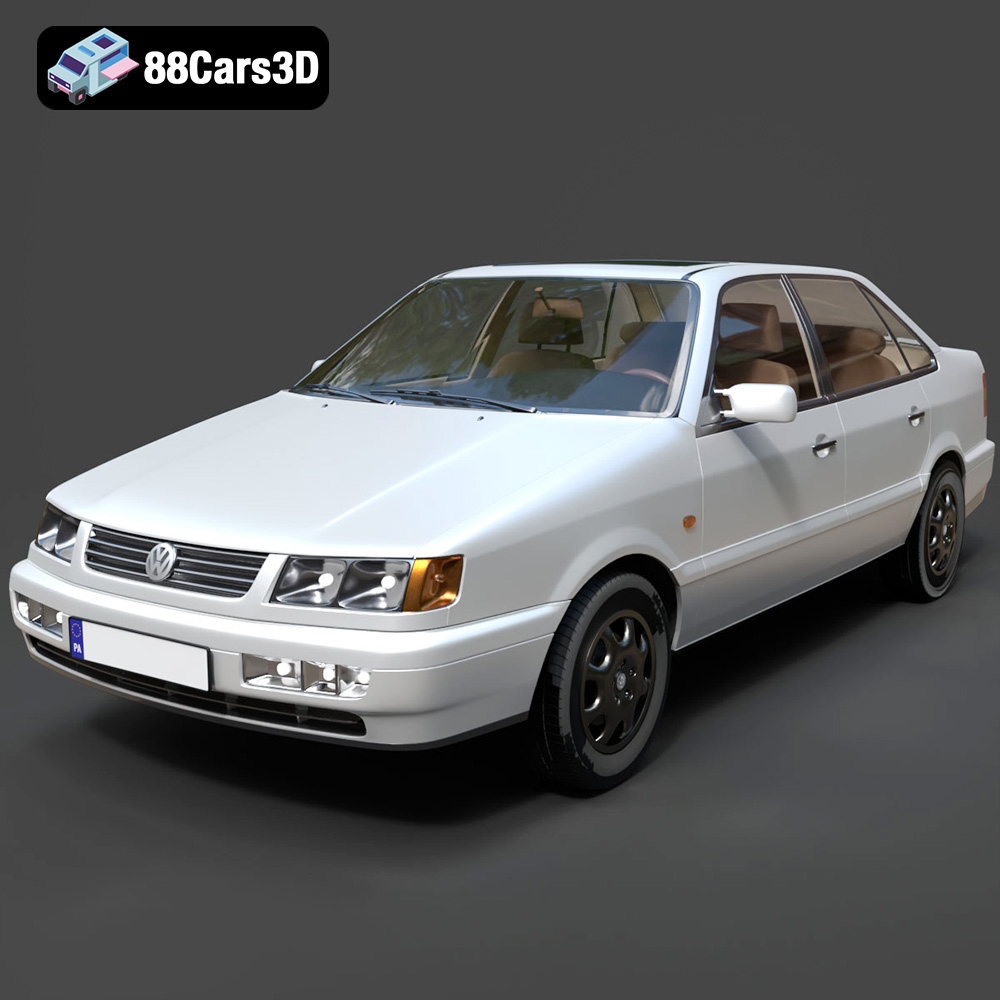
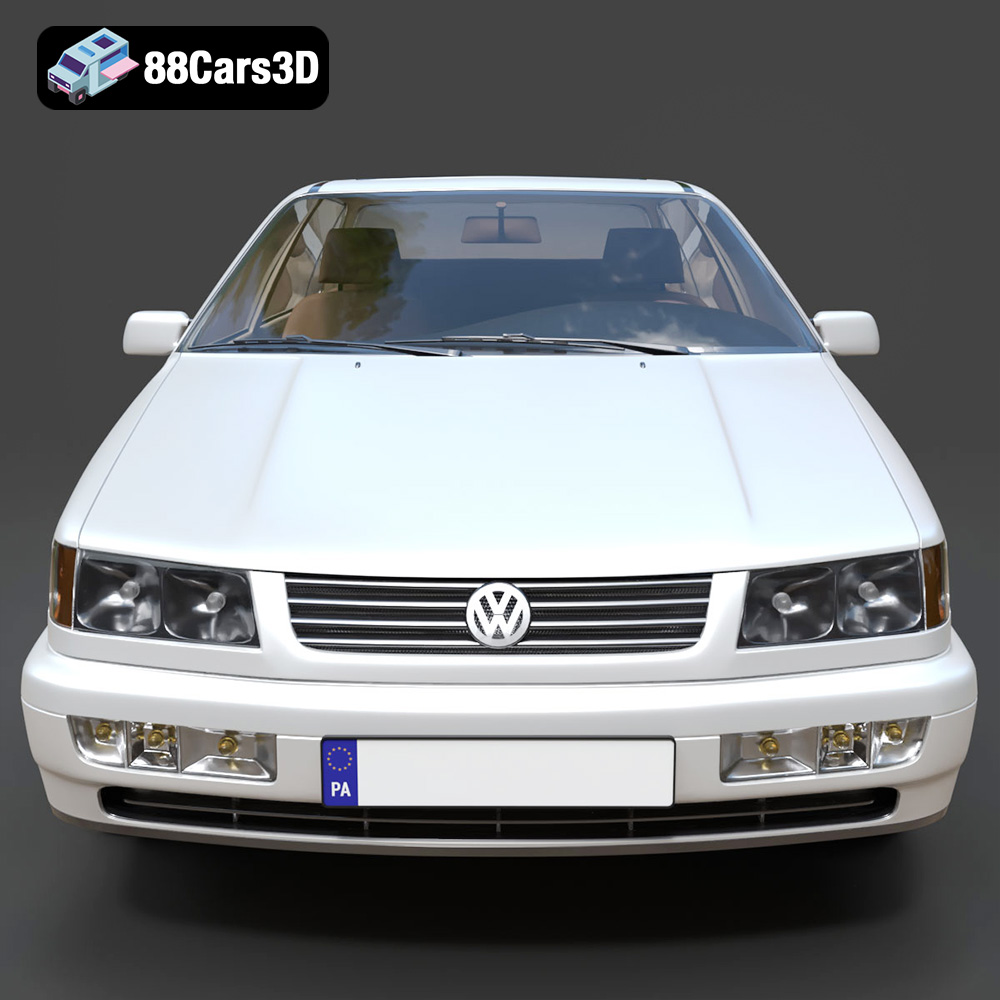
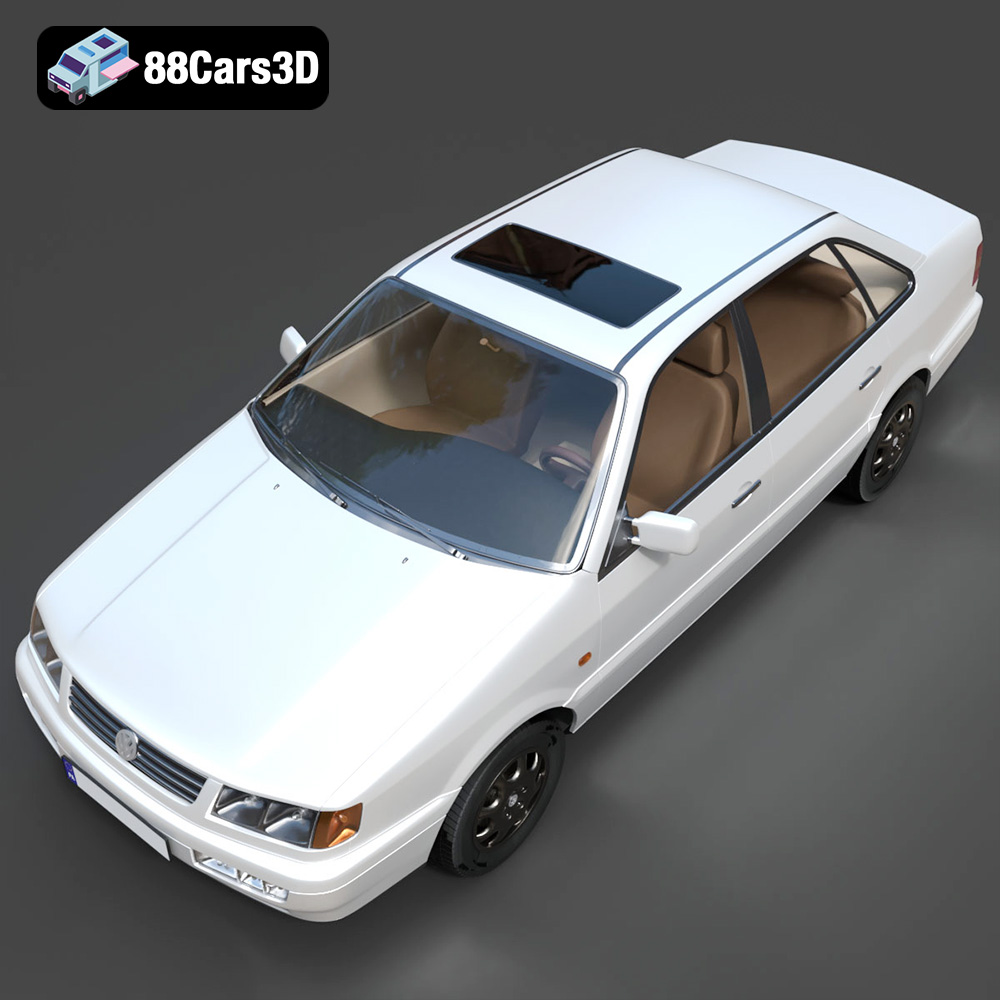
The 1993 Volkswagen Passat Mk4 (B4) Sedan represents a pivotal moment in German automotive design, blending practical family hauling capabilities with robust, reliable engineering. Known for its clean, understated aesthetic and the distinct introduction of a traditional front grille compared to its B3 predecessor, this classic sedan has cemented its legacy as an icon of 90s European motoring. The model captures the quintessential utilitarian charm, featuring the accurate sedan roofline, distinctive halogen headlight housings, and classic factory wheel options that defined mid-90s Volkswagen styling. This 3D model boasts exceptional quality with optimized topology and a game-ready triangle count. The geometry strikes the ideal balance between high visual fidelity and performance efficiency, ensuring seamless integration into modern real-time engines. Whether utilized for background traffic generation, interactive configurators, or detailed close-up rendering, the model maintains crisp reflections and accurate proportions across the board. Perfect for 90s-themed street scenes, retro driving simulators, architectural visualizations, and immersive virtual environments.
$39.99
.blend
.fbx
.glb
.max
.obj
.passat
.ply
.rendering
.sedan
.stl
.unreal
.volkswagen
1993
b4
car-3d-model
classic-car
family-car
game asset
game-ready
low-poly
mk4
optimized
VR/AR