Get 20% OFF All Premium 3D & STL Models!

The world of 3D modeling has revolutionized how we perceive and interact with automotive design. From breathtaking cinematic renders to hyper-realistic gaming environments and immersive virtual reality experiences, high-fidelity 3D car models are the bedrock of modern digital visualization. They offer unparalleled flexibility, enabling designers, developers, and artists to explore concepts, simulate performance, and bring visions to life without the constraints of physical prototypes. These digital assets are more than just pretty pictures; they are complex technical constructions, meticulously crafted to serve diverse professional applications.
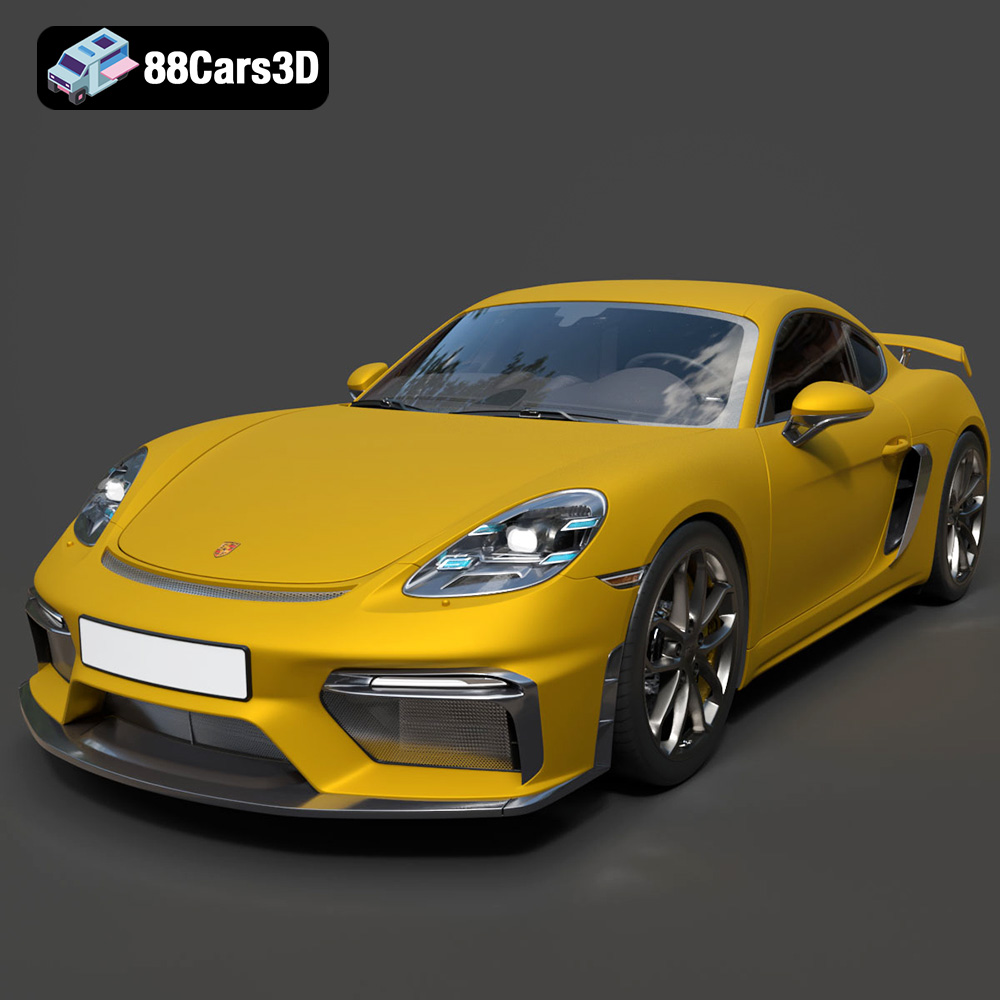
At the heart of this digital automotive revolution lies a commitment to precision, optimization, and versatility. Whether you’re a game developer seeking the ultimate in game assets, an architect visualizing a cutting-edge showroom, or a marketing professional crafting a brand campaign, the quality of your 3D car models directly impacts the realism and impact of your project. Today, we delve into the intricate details of such an asset – the Porsche 718 Cayman GT4 2020 3D Model. This exceptional digital rendition of a mid-engine track weapon exemplifies the pinnacle of digital automotive artistry, offering a foundation for an incredibly wide range of creative and technical endeavors.
Few vehicles capture the essence of pure driving passion quite like the Porsche 718 Cayman GT4. Its naturally aspirated 4.0-liter flat-six engine, aggressive aerodynamics, and unmistakable Porsche styling make it a coveted machine in the real world. Translating this mechanical poetry into a digital asset requires a profound understanding of both automotive engineering and 3D modeling principles. The goal is not just to replicate its form but to capture its spirit, ensuring that every curve, every vent, and every interior detail contributes to an authentic and believable experience, whether viewed in a static render or a dynamic game environment. This commitment to realism, coupled with technical optimization, is what elevates a good 3D model to an indispensable professional tool.
Navigating the landscape of 3D software and applications often begins with understanding the myriad of file formats available. Each format serves a specific purpose, designed for compatibility, efficiency, or specialized use cases. When acquiring a premium 3D asset like the Porsche 718 Cayman GT4 2020 3D Model, understanding which format to use for your project is paramount. The model is offered in a comprehensive suite of formats, ensuring broad applicability across virtually any pipeline. Let’s explore the technical nuances of each.
The .blend format is the native file type for Blender, the popular open-source 3D creation suite. A .blend file encapsulates an entire Blender scene, including all geometry (meshes), materials, textures, lighting, cameras, animations, rigging, modifiers, and even scene settings. This makes it incredibly versatile for artists who work predominantly within Blender, offering full editability and access to all the original scene data. For the Porsche GT4 model, the .blend file would provide the foundational setup, allowing users to easily modify materials using Cycles or Eevee render engines, adjust subdivision levels, or even re-rig elements for custom animations. It’s the ideal starting point for deep customization within the Blender environment.
Autodesk’s .fbx (Filmbox) format is arguably the most widely adopted interchange format in the 3D industry, particularly for game development (Unreal Engine, Unity) and animation pipelines. FBX can store a vast array of 3D data, including geometry, materials (with texture references), animations (skeletal and blend shapes), cameras, and lights. Its strength lies in its ability to maintain scene hierarchy and animation data across different software packages. When importing the Porsche GT4 as an .fbx, developers benefit from its robust support for bone-based animation (for suspension, wheels, steering), PBR (Physically Based Rendering) material information, and optimized mesh data suitable for real-time engines. It’s the go-to format for ensuring consistent asset transfer between modeling, animation, and game engine stages.
The .obj (Wavefront Object) format is one of the oldest and most universally supported 3D file formats. It’s a simple, text-based format primarily used to store 3D geometry data (vertices, normals, texture coordinates, and faces). While it doesn’t support animation or scene data, it often includes references to material files (.mtl) that define basic material properties and texture maps. The .obj format for the Porsche GT4 is excellent for static renders, modeling workflows where clean geometry is paramount, or as a reliable fallback for cross-software compatibility when more complex formats encounter issues. Its widespread support makes it a safe choice for almost any 3D application, from ZBrush to Houdini, ensuring the core mesh data is always accessible.
.glb (GL Transmission Format Binary) is the binary version of glTF (GL Transmission Format), designed for efficient transmission and loading of 3D scenes and models by applications. It’s rapidly becoming the “JPEG of 3D” due to its focus on delivering high-quality, lightweight 3D models suitable for web-based AR/VR, e-commerce product viewers, and mobile applications. A .glb file contains the 3D model, textures, and animation data all bundled into a single file, making it incredibly convenient for deployment. For the Porsche GT4, the .glb variant is optimized for fast loading and rendering in browsers or mobile AR applications, allowing users to interact with the model seamlessly on various devices without requiring heavy software installations.
The .stl (STereoLithography) format is the standard for 3D printing. It represents a 3D model as a series of connected triangles, describing only the surface geometry of an object without color, texture, or other CAD attributes. While simple, its ubiquity in additive manufacturing is undeniable. The .stl version of the Porsche GT4 model is specifically prepared for physical output, allowing hobbyists and professionals to 3D print miniature replicas of the car. Considerations like manifold geometry, wall thickness, and print orientation (as detailed in the product description) are crucial for successful printing, making the provided .stl a carefully optimized asset for this purpose.
The .ply (Polygon File Format or Stanford Triangle Format) is another common format for storing 3D data, particularly from 3D scanners or for CAD applications. Like .obj, it defines geometry, but it can also store a wider range of properties for each vertex or face, such as color, transparency, normals, texture coordinates, and even scalar properties. The .ply version of the Porsche GT4 might be preferred for precise measurement, reverse engineering, or specific CAD/CAE (Computer-Aided Engineering) workflows where additional per-vertex data is beneficial, providing a robust dataset for analysis beyond purely visual representation.
While not a traditional file extension in the same vein as FBX or OBJ, the term .unreal refers to a deeply integrated, engine-ready asset specifically configured for Unreal Engine. This often implies an FBX or other source file meticulously imported, optimized, and set up within an Unreal project. It would include correctly configured PBR materials, LODs (Levels of Detail), collision meshes, proper pivot points for animation, and potentially basic Blueprint setups for interactive elements like doors or wheels. For the Porsche GT4, an “.unreal” asset implies a streamlined workflow for game developers, saving significant time on asset preparation and ensuring optimal performance within Epic’s powerful engine.
The .max format is the native file type for Autodesk 3ds Max, a leading 3D modeling, animation, rendering, and compositing software. Similar to .blend, a .max file contains the complete scene data, including all objects, materials, textures, lighting, cameras, animation tracks, and render settings. This format is invaluable for studios and artists relying on 3ds Max for high-end visualization and animation. The .max version of the Porsche GT4 allows full access to the original scene, enabling artists to leverage powerful renderers like V-Ray or Corona, utilize advanced modifiers, and integrate the model into complex architectural or advertising scenes with ease. It’s the ultimate format for those who need deep control and flexibility within the 3ds Max environment.
The acquisition of a premium 3D asset like the Porsche 718 Cayman GT4 2020 3D Model is not merely about owning a digital representation; it’s about investing in a foundation for creativity and technical excellence. This model, available through 88cars3d.com, is a testament to meticulous craftsmanship, striking an ideal balance between visual fidelity and performance optimization. Every aspect, from its aggressive stance to the intricate cockpit details, has been considered to deliver a versatile and high-quality asset.
The exterior of the Porsche 718 Cayman GT4 is a symphony of form and function. This 3D model faithfully reproduces its iconic design, capturing the aggressive aerodynamics and muscular proportions that define the GT4. You’ll find accurate frame geometry, body panels, and proportions, critical for both realistic rendering and believable interaction in games. The detailed front fascia with its large cooling intakes and aerodynamic spoiler, the prominent fixed rear wing, and the aggressive rear diffuser with its dual-pipe sport exhaust system are all meticulously modeled. Furthermore, signature Porsche four-point LED headlights and tinted 3D taillights add to the realism, crucial for close-up shots and cinematic sequences. The precision extends to the alloy wheels with high-performance brake calipers and slotted rotors, and even visible suspension components through the wheel arches – elements vital for realistic animation and visual depth in simulation. With separate components for wheels, suspension, and steering, animators have complete control over realistic movement.
Beyond the stunning exterior, the interior of the Porsche 718 Cayman GT4 2020 3D Model is equally impressive. The track-focused Alcantara sport bucket seats, complete with detailed stitching, offer a glimpse into the car’s performance DNA. The GT sport steering wheel with its center top marker, the iconic analog central tachometer, and the digital instrument cluster are all precisely rendered. Essential controls like the gear shifter, center console, and sport pedal assembly are also included, providing a comprehensive cockpit experience. This level of detail is paramount for first-person POV in gaming or for creating immersive virtual reality experiences where users can virtually “sit” inside the car. The optimized geometry ensures that even with this level of detail, the model remains suitable for real-time environments, providing a seamless user experience.
A truly professional 3D car model is defined not just by its visual accuracy but by its technical robustness. This Porsche GT4 model is “game-ready & optimized,” meaning its triangle count is carefully balanced to deliver high-end visual realism without bogging down real-time engines like Unreal or Unity. This is a critical advantage, as it allows for beautiful close-ups while maintaining smooth performance in interactive applications. The model boasts real-world scale accuracy, based on actual vehicle chassis data, ensuring that it fits seamlessly into any scene or environment. Proper pivot setups for steering, wheel rotation, and suspension travel are included, simplifying the animation process and allowing for highly realistic vehicle dynamics. This technical attention to detail makes the model a versatile asset, ready for immediate integration into diverse professional pipelines.
The applications for a high-quality 3D car model like the Porsche 718 Cayman GT4 are incredibly diverse, spanning multiple industries and creative disciplines. The inherent flexibility and technical optimization embedded in this asset make it an invaluable tool for professionals pushing the boundaries of digital content creation.
For game developers, the Porsche 718 Cayman GT4 2020 3D Model is a dream asset. Its “game-ready” optimization means it’s ideal for integration into high-speed racing titles, realistic driving simulators, or expansive open-world games where vehicle performance is key. The carefully calculated triangle count ensures that the vehicle renders smoothly at high frame rates, a critical factor for immersive gameplay. The separate, animatable components for wheels, steering, and suspension allow for complex physics-driven simulations and visually convincing vehicle dynamics. Furthermore, the optimized interior geometry is perfect for first-person camera perspectives, giving players a true sense of being behind the wheel of this legendary machine. From a technical standpoint, the provided .fbx and .unreal formats streamline the import and setup process in engines like Unreal Engine and Unity, significantly reducing development time.
Beyond gaming, high-fidelity 3D car models play a crucial role in architectural visualization (ArchViz) and product marketing. Imagine a stunning modern showroom render, complete with realistic reflections on the polished floor and sophisticated lighting. The Porsche GT4 model can be precisely placed within these architectural environments, adding a touch of luxury, scale, and realism that static images cannot replicate. For automotive brands, these models are indispensable for creating compelling marketing campaigns, studio renders, and lifestyle visual assets. They allow for the creation of photorealistic visuals in any imagined setting, from a desert road to a bustling city street, showcasing the vehicle in its best light without the logistical challenges and costs of physical photography shoots. Artists can use software like 3ds Max with V-Ray or Blender with Cycles to produce stunning, photorealistic images and animations.
The rise of augmented reality (AR) and virtual reality (VR) has opened new frontiers for 3D car models. The Porsche GT4 model is perfectly suited for creating immersive virtual showrooms, allowing potential buyers to explore every detail of the car from the comfort of their homes. Users can “walk around” the vehicle, open doors, examine the interior, and even customize colors and materials in real-time. For mobile AR experiences, the optimized .glb format ensures lightweight, fast-loading interactions on smartphones and tablets. These technologies also extend to training simulations, where detailed vehicle models can be used to educate technicians on maintenance procedures or familiarize drivers with cockpit controls in a safe, virtual environment. The model’s real-world scale accuracy and detailed interior are crucial for these highly interactive applications.
The digital realm often inspires physical creation, and 3D printing is where this connection becomes tangible. The Porsche 718 Cayman GT4 2020 3D Model, specifically its .stl format, is prepared for physical fabrication. Hobbyists and collectors can bring a scaled replica of this iconic car into existence. The product description provides specific 3D print settings, recommending resin printing for fine details, along with layer height, wall thickness, infill, and crucial support requirements for delicate parts like mirrors and exhaust. This functionality transforms the digital asset into a blueprint for a physical object, offering a unique avenue for engagement and appreciation of the model’s intricacies. Post-processing like sanding, priming, and painting can further enhance the realism of the printed model, replicating authentic factory finishes.
Possessing a high-quality 3D asset is the first step; unlocking its full potential lies in applying advanced workflows and leveraging customization options. The Porsche 718 Cayman GT4 2020 3D Model offers extensive possibilities for tailoring it to specific project needs, whether through rendering, real-time integration, or material adjustments.
For artists working in 3ds Max, the provided .max file offers complete control over the scene. To achieve stunning photorealism, combining the model with powerful rendering engines like V-Ray or Corona is essential. The workflow typically involves:
These detailed steps ensure that the Porsche GT4 model shines in any rendered presentation, making it ideal for high-end marketing visuals or portfolio pieces.
For game developers and real-time visualization specialists using Unreal Engine, the optimization of the GT4 model (available as .fbx and implicitly as “.unreal”) is a significant advantage. The integration process involves more than just importing the mesh:
This deep integration allows the Porsche GT4 to become a fully interactive and performant asset within the Unreal ecosystem, perfect for simulators and virtual experiences.
The beauty of a high-quality 3D model lies in its capacity for customization. Beyond standard body colors, artists can modify tire textures (from track slicks to street variants), adjust material finishes for different parts (e.g., carbon fiber accents), and adapt lighting to suit various environments. For instance, creating a night render would involve setting up artificial streetlights or neon signs to reflect dynamically off the car’s paint, enhancing its visual appeal. The clean topology of the Porsche GT4 model ensures that texture mapping and UV unwrapping are efficient, allowing for precise application of custom decals, racing liveries, or wear and tear effects, truly personalizing the digital asset for any specific project.
In a competitive digital landscape, the choice of assets can make or break a project. Investing in premium 3D car models like the Porsche 718 Cayman GT4 from a trusted source such as 88cars3d.com offers significant advantages that extend beyond mere aesthetics.
Creating a high-fidelity 3D car model from scratch is an incredibly time-consuming and resource-intensive process, often requiring hundreds of hours of expert labor. By acquiring a pre-made, professionally crafted model like the Porsche 718 Cayman GT4 2020, studios and individual artists can dramatically cut down on development cycles. This translates directly into significant cost savings and faster project delivery. Instead of spending valuable time on modeling and optimization, teams can focus on creative direction, animation, rendering, or game logic, leveraging a ready-to-use foundation that meets industry standards.
When you purchase a 3D model from 88cars3d.com, you are investing in quality assurance. These models are not just visually appealing; they are technically robust, with optimized geometry, clean topology, and proper pivot setups. This means they are truly “game-ready” and “render-ready,” minimizing the need for extensive cleanup or rework. Such reliability is crucial for professional productions where time is money and performance is paramount. Whether it’s for a high-stakes automotive campaign or a demanding game title, the Porsche GT4 model provides a dependable, high-performance asset right out of the box, ensuring that your final output consistently meets the highest professional standards.
The digital automotive realm continues to evolve, pushing the boundaries of realism and immersion. At the core of this evolution are meticulously crafted 3D car models that serve as the building blocks for an infinite array of creative projects. The Porsche 718 Cayman GT4 2020 3D Model stands as a prime example of such an asset – a high-fidelity, game-ready, and render-optimized masterpiece designed for versatility. From its precise exterior aerodynamics and detailed interior to its robust technical specifications and broad file format compatibility, it empowers artists and developers to achieve stunning results across game development, architectural visualization, AR/VR experiences, and even 3D printing.
By understanding the nuances of various 3D model file formats and leveraging the detailed features and technical advantages of this premium asset, professionals can streamline their workflows and elevate the quality of their digital productions. The investment in such a comprehensive and high-quality 3D model from 88cars3d.com is an investment in efficiency, reliability, and ultimately, unparalleled creative freedom. The digital road ahead is wide open, and with assets like the Porsche 718 Cayman GT4, you’re equipped to drive innovation.
The 2020 Porsche 718 Cayman GT4 is a mid-engine track weapon that perfectly balances motorsport heritage with modern performance. Known for its naturally aspirated 4.0-liter flat-six engine, aggressive aerodynamics, and unmistakable Porsche styling, this sports car delivers a pure, unfiltered driving experience. From its prominent fixed rear wing and large functional air intakes to its dual sport exhaust system and aggressive rear diffuser, every element is meticulously designed for maximum downforce and cooling. This high-fidelity 3D model boasts exceptional topology and game-ready optimization, featuring carefully calculated triangle counts to ensure maximum performance without sacrificing detail. It maintains breathtaking visual fidelity suitable for close-up shots while remaining fully optimized for real-time rendering environments. Whether you are developing a high-speed racing simulator, crafting an immersive AR/VR showroom, or producing photorealistic cinematic animations, this digital asset provides the perfect foundation.
$39.99
.2020
.blend
.fbx
.glb
.max
.obj
.ply
.porsche
.rendering
.sports car
.stl
.unreal
718-cayman-gt4
car-3d-model
game asset
game-ready
low-poly
optimized
track-car
VR/AR