Get 20% OFF All Premium 3D & STL Models!

In the vast and dynamic world of 3D content creation, the demand for highly detailed and technically accurate assets is ever-present. From blockbuster game titles and cinematic animations to precise engineering visualizations and immersive AR/VR experiences, the quality of a 3D model can make or break a project. While sports cars and luxury sedans often grab the spotlight, the robust and iconic commercial vehicle segment holds immense significance, particularly for simulation, logistics, and industrial visualization.
Few vehicles embody the spirit of heavy-duty transportation quite like the Volvo VNL Tractor Truck 2002. Renowned for its blend of aerodynamic efficiency, driver comfort, and unwavering reliability, the VNL series became a cornerstone of North American freight hauling. Capturing the essence of such a workhorse in a digital format requires not just artistic skill but profound technical understanding. This is precisely where a meticulously crafted asset, such as the Volvo VNL Tractor Truck 2002 3D Model available at 88cars3d.com, proves invaluable. This comprehensive guide will delve into the technical intricacies, workflow applications, and transformative potential of integrating such a high-quality 3D car model into your professional projects, highlighting why having access to a versatile and optimized asset is crucial for creators across various industries.
The choice of file format for a 3D model is far more than a mere technicality; it’s a critical decision that dictates compatibility, functionality, and the efficiency of your workflow. When you acquire a professional 3D car model like the Volvo VNL Tractor Truck 2002 from 88cars3d.com, it comes bundled with an array of formats, each serving distinct purposes and optimized for specific applications. Understanding these formats is key to maximizing your asset’s utility and ensuring a smooth production pipeline.
.blend – Fully Editable Blender Scene with Materials: The native file format for Blender, the popular open-source 3D creation suite. A .blend file typically contains the complete scene data, including mesh geometry, materials, textures, lighting, cameras, and even animation data. This format is ideal if Blender is your primary software, as it offers the highest level of editability and preserves all proprietary Blender-specific settings, modifiers, and node-based materials. It’s perfect for artists who need to extensively customize the model, apply complex shaders, or integrate it deeply into existing Blender projects.
.fbx – Ideal for Unreal, Unity, and Real-time Pipelines: FBX (Filmbox) is a proprietary file format owned by Autodesk, widely regarded as the industry standard for exchanging 3D data between different software applications. Its strength lies in its ability to store not just geometry and materials, but also animation, rigging, and even basic lighting information in a robust, interoperable package. For game developers working with engines like Unreal Engine and Unity, .fbx is often the go-to format. It’s highly optimized for real-time applications, ensuring efficient loading and rendering, and it supports hierarchical structures crucial for animated assets like vehicle components (wheels, suspension, steering).
.obj – Universal Format for Cross-Software Compatibility: The OBJ (or Wavefront .obj) format is one of the oldest and most universally supported 3D file formats. It’s an open standard that primarily stores geometric data – vertices, normals, UV coordinates, and faces. While it doesn’t typically store advanced features like animation or complex PBR materials directly within the file (materials are usually referenced via an accompanying .mtl file), its sheer compatibility makes it indispensable. If you need to import the Volvo VNL model into a less common 3D application or guarantee basic geometry transfer without proprietary data, .obj is a reliable choice.
.glb – Optimized for AR, VR, and Browser-based Display: GLB is the binary version of glTF (Graphics Library Transmission Format), a relatively newer, royalty-free specification for 3D scenes and models. It’s designed to be a compact, efficient, and runtime-deliverable format, making it exceptionally well-suited for web-based 3D, augmented reality (AR), virtual reality (VR), and mobile applications. A single .glb file can embed all necessary data (geometry, textures, animations) into one self-contained package, simplifying distribution and speeding up loading times in browser-based viewers and AR/VR platforms.
.stl – Suitable for 3D Printing Output: STL (STereoLithography) is the de facto standard file format for 3D printing. It represents a 3D model as a collection of unconnected triangular facets, defining only the surface geometry of an object without color, texture, or other advanced attributes. When preparing the Volvo VNL model for physical output, converting it to .stl is the crucial step. It’s a simple, robust format that ensures your 3D printer can accurately interpret the shape of the model, making it perfect for hobbyists or professionals creating physical prototypes or display pieces.
.ply – Precision Mesh Format for CAD or Analysis: PLY (Polygon File Format, or Stanford Triangle Format) is a file format for storing 3D data, particularly point clouds and polygon meshes. It can store a wider range of properties than .obj, including color, transparency, and normal vectors for each vertex, as well as comments and other arbitrary attributes. While not as universally used as .obj or .fbx, .ply is often favored in scientific, engineering, and CAD applications where precise mesh data, including surface properties derived from 3D scanning, is critical for analysis and manufacturing processes.
.unreal – Engine-ready Asset for Real-time Environments: While not a standalone file format in the conventional sense, an “.unreal” file often refers to an asset package specifically prepared and optimized for direct import into Unreal Engine. This might be a highly structured .fbx, or sometimes a proprietary UAsset file, that includes pre-configured materials, LODs (Levels of Detail), collision meshes, and even blueprints. Such a package saves significant setup time for Unreal Engine developers, as the asset is already configured to leverage the engine’s capabilities immediately, allowing for rapid integration and iteration.
.max – Editable 3ds Max Project for Animation and Rendering: The native file format for Autodesk 3ds Max, a leading software for 3D modeling, animation, and rendering. Similar to .blend, a .max file stores all scene information, including complex modifiers, render settings, and specialized material types unique to 3ds Max. This format is essential for users of 3ds Max who require full editability, wish to leverage V-Ray or Corona Renderer features, or need to integrate the model into a larger 3ds Max-centric production pipeline for high-fidelity architectural or product visualizations.
The provision of this diverse array of formats with the Volvo VNL Tractor Truck 2002 3D Model underscores its versatility, ensuring that whether your project involves high-performance game development, intricate cinematic rendering, interactive AR/VR experiences, or precision 3D printing, you have the right tools at your disposal.
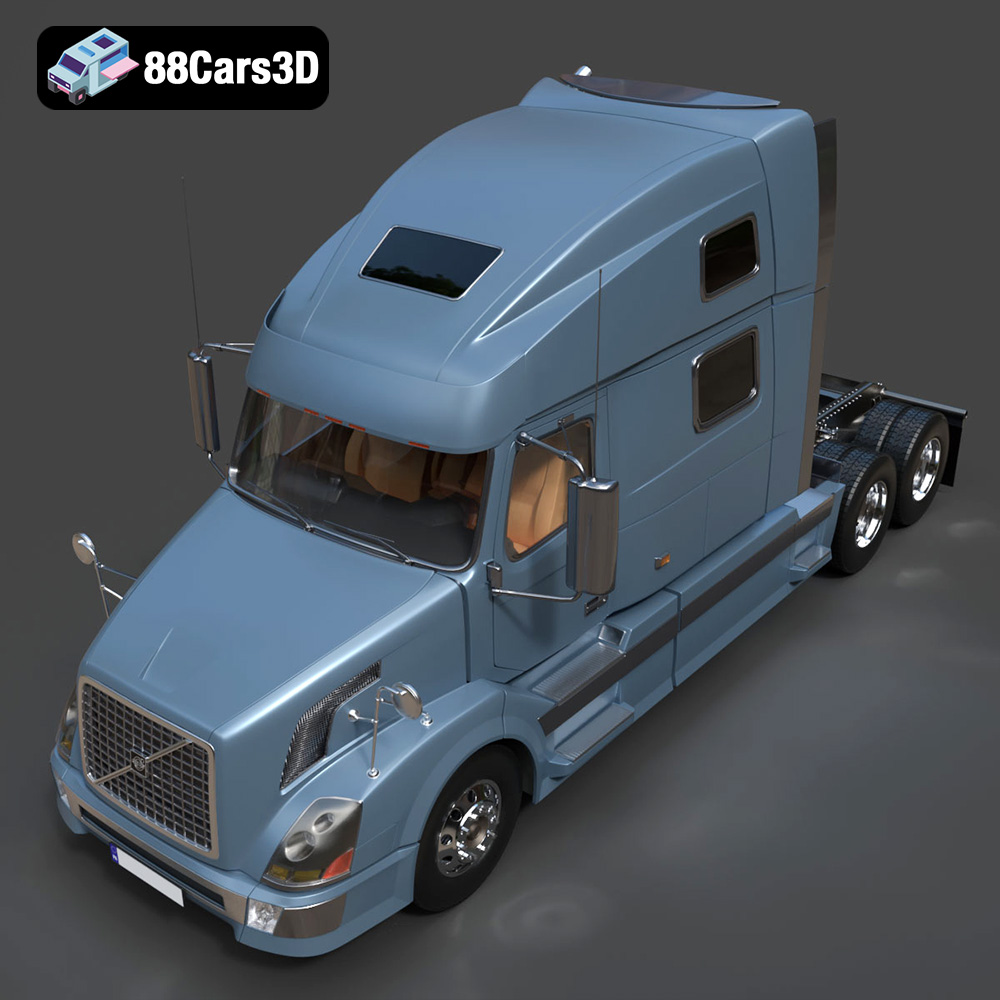
The Volvo VNL Tractor Truck 2002 is more than just a vehicle; it’s an icon of commercial efficiency and design. Translating this real-world presence into a high-quality 3D model demands an acute eye for detail and a deep understanding of vehicle architecture. The featured Volvo VNL Tractor Truck 2002 3D Model excels in this regard, offering a highly accurate and functionally rich digital representation.
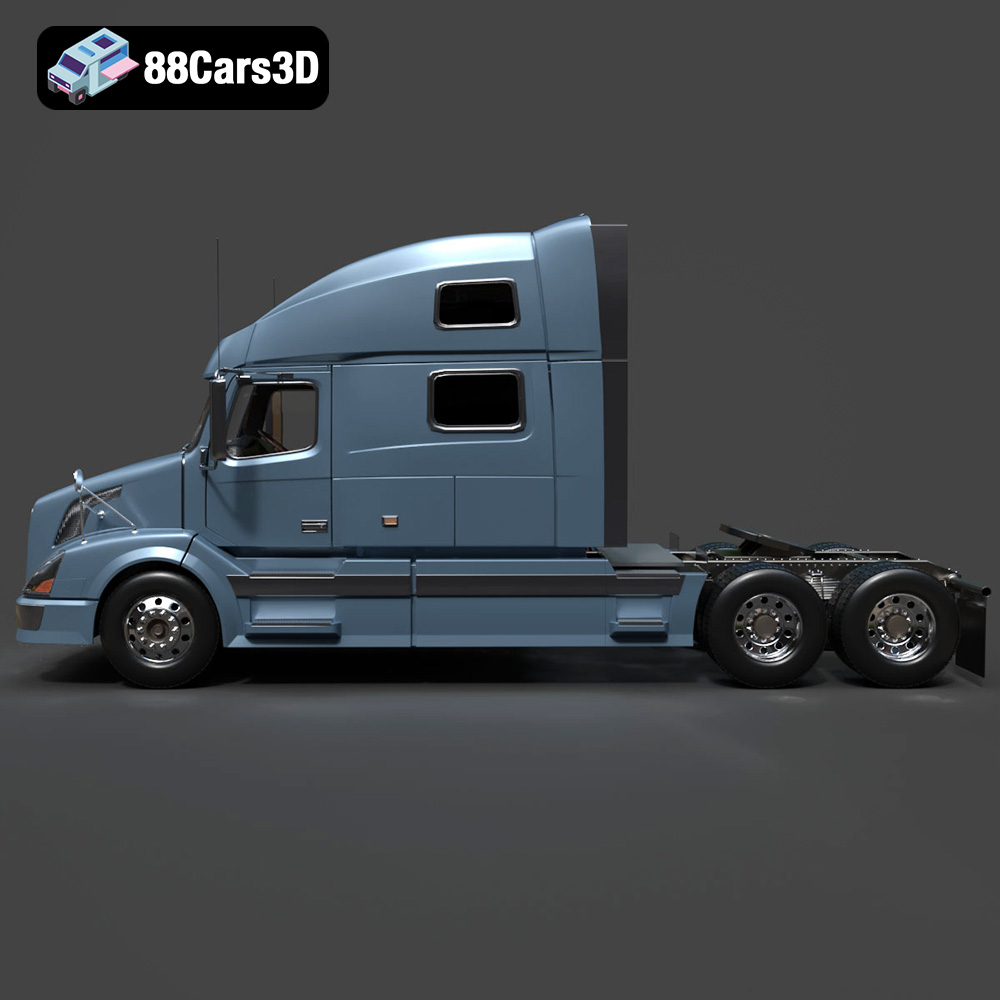
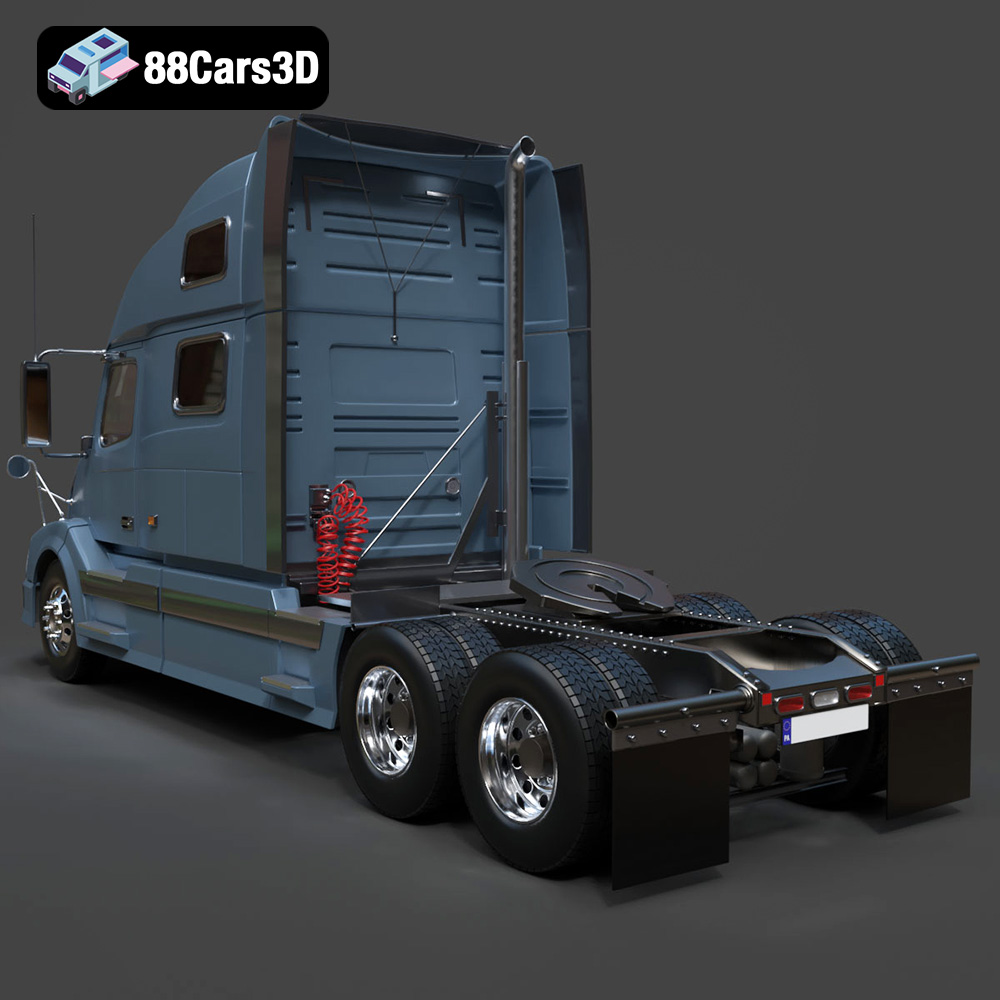
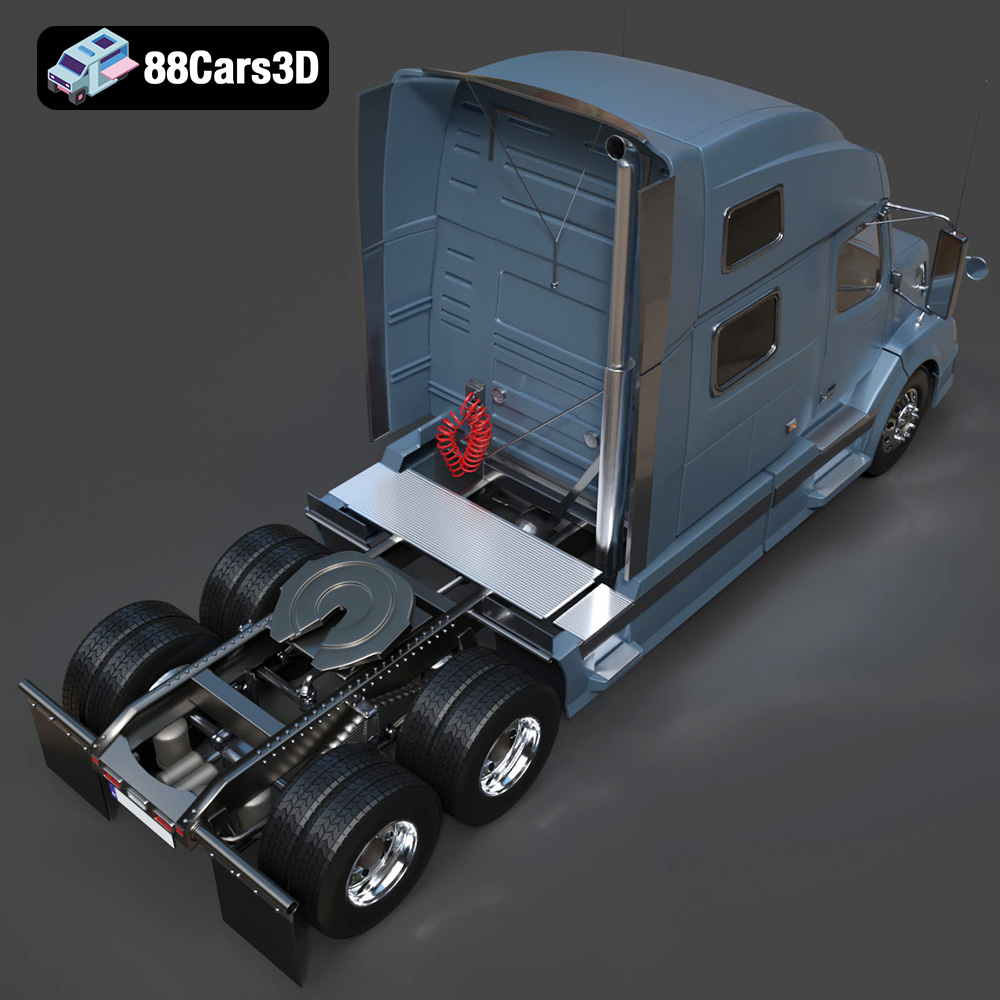
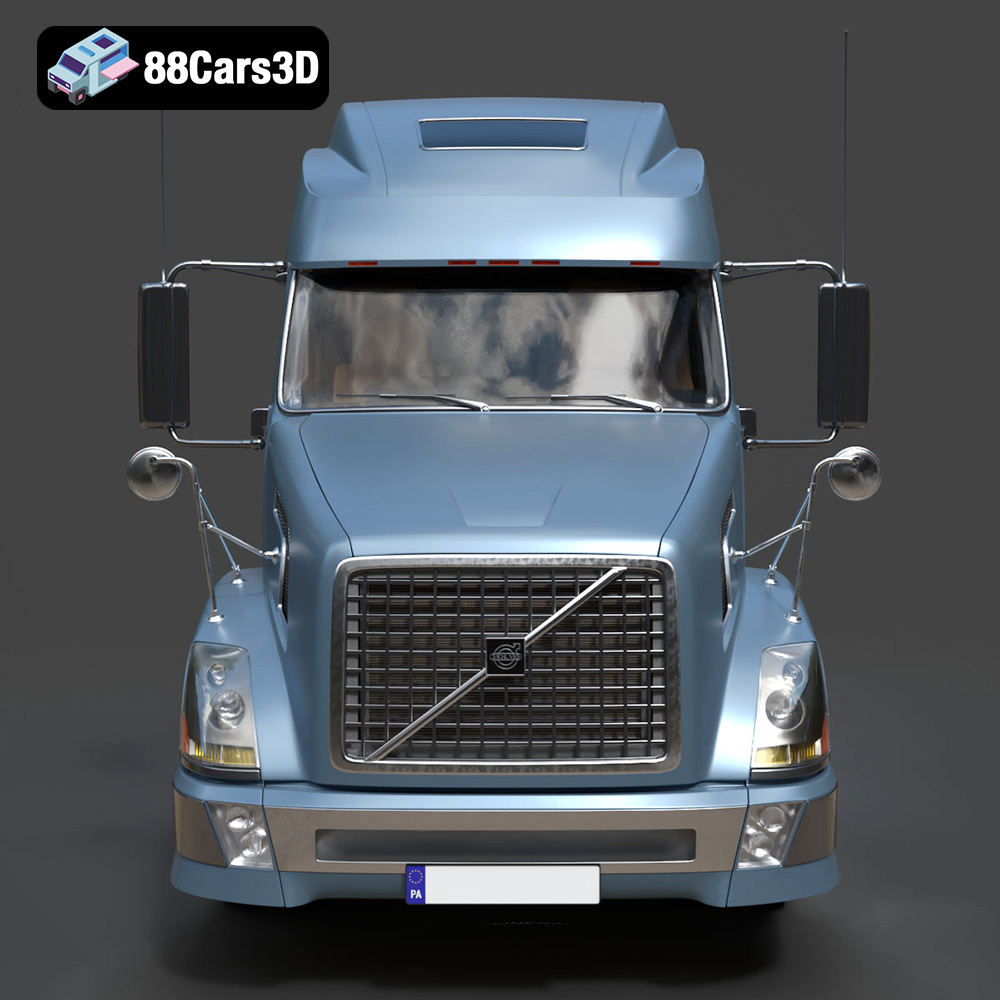
A key strength of this 3D model lies in its faithful reproduction of the Volvo VNL’s distinctive exterior. The aerodynamic cab geometry and proportions are precisely matched to the 2002 model, which was revolutionary for its time in reducing drag and improving fuel efficiency. Every significant external feature has been meticulously recreated: the heavy-duty chassis, the functional fifth-wheel coupling system ready for trailer integration, and the prominent dual vertical exhaust stacks that are a signature of these powerful machines. Furthermore, details such as the aerodynamic fairings, realistic lighting components—including large halogen headlights and cab roof markers—and the heavy-duty commercial dually wheels with accurate tire treads, contribute to an unparalleled sense of realism. Even the intricate air suspension and drive axle components are modeled, providing the level of fidelity required for close-up renders and detailed simulations.
Beyond the impressive exterior, the Volvo VNL model offers an interior that’s optimized for immersive experiences. The driver’s air-ride seat and a detailed sleeper cab blockout provide a solid foundation for interior camera shots or first-person perspectives in driving simulators. The authentic heavy-duty commercial steering wheel, complete with a realistic wrap-around instrument cluster featuring dials and gauges, creates an engaging cockpit environment. Crucial control details, such as air brake valves and the manual shifter, are also present, ensuring that the model is not just visually appealing but also functionally appropriate for interactive applications like trucking simulators. This attention to both exterior grandeur and interior functionality makes the model an exceptional asset for projects demanding a true-to-life commercial vehicle experience.
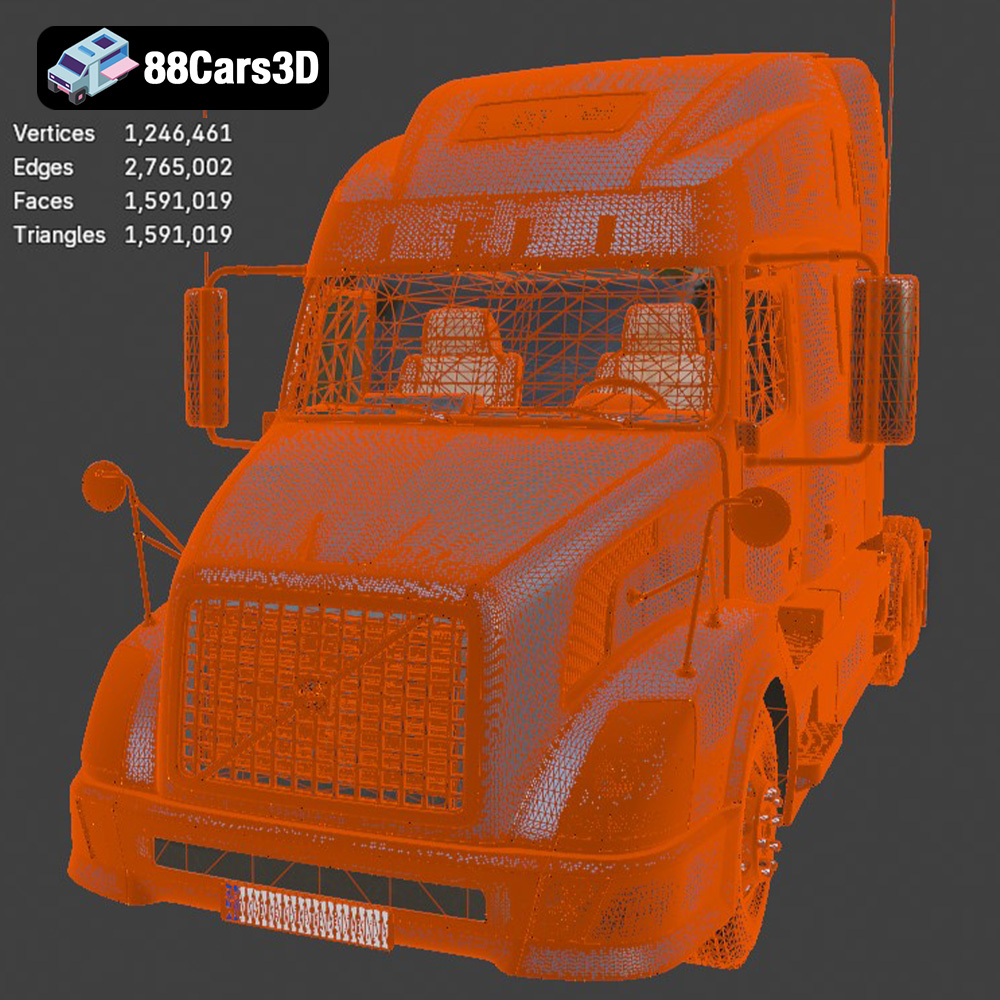
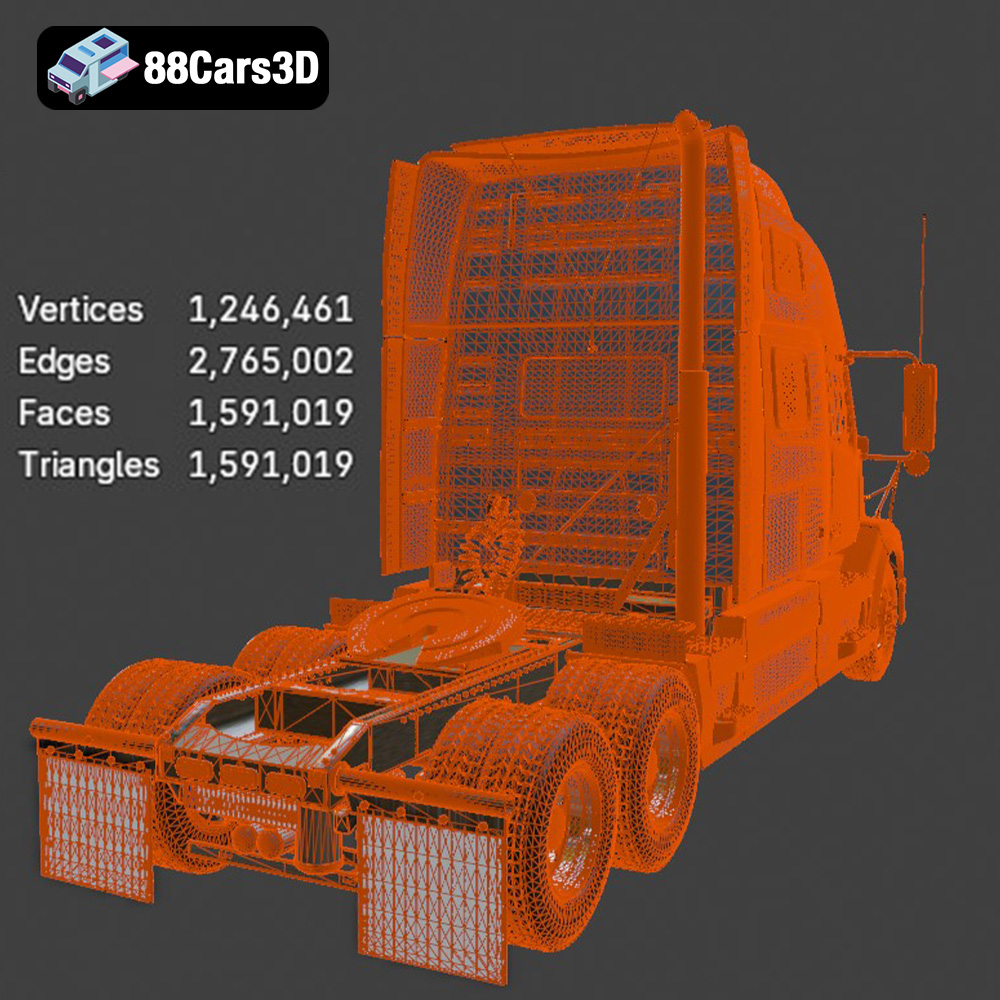
High-quality 3D car models must strike a delicate balance between visual fidelity and technical efficiency. The Volvo VNL Tractor Truck 2002 3D Model achieves this equilibrium, making it suitable for a broad spectrum of applications, from real-time game engines to high-resolution rendering pipelines.
One of the most significant advantages of this asset is its “game-ready” optimization. With an approximate 200,000 triangle count, the model hits a sweet spot: it’s detailed enough to convey a high level of visual realism, yet optimized to ensure smooth real-time rendering performance in demanding engines like Unreal Engine and Unity. This careful polycount management means developers don’t have to spend precious time decimation or retopologizing the model, accelerating production timelines significantly. Furthermore, the model is built with real-world scale accuracy, based on actual Volvo commercial truck chassis dimensions, which is vital for maintaining proportionality and realism in simulations and visualizations. Crucial technical setups like proper pivot points for steering, wheel rotation, trailer coupling, and suspension travel are already configured, simplifying animation workflows considerably.
The asset’s design extends beyond static beauty. Its components – wheels, suspension, and steering – are separate, allowing for complex animations directly out of the box. This modularity is a godsend for animators creating dynamic driving sequences or interactive vehicle mechanics. Beyond mechanical flexibility, the model offers extensive customization options. Users can easily change body colors, from standard fleet white to bespoke company liveries, making it adaptable for various client needs or game scenarios. Tire textures can be modified to reflect different road conditions or purposes (e.g., highway rib vs. traction variants), and material finishes can be adjusted for matte plastics, chrome grilles, or metallic paints. Even lighting can be adapted for different environments, from bright daytime hauling to moody night driving, further enhancing its versatility for diverse rendering and visualization tasks.
The true measure of a 3D asset’s quality lies in its seamless integration into various professional pipelines. The Volvo VNL Tractor Truck 2002 3D Model, with its multiple file formats and optimized structure, is engineered for this purpose, proving to be an invaluable component across diverse creative fields.
For game developers, the inclusion of .fbx and specifically optimized .unreal files means rapid deployment into leading game engines. In Unreal Engine, for instance, importing the .fbx is a straightforward process. The model’s clean topology and moderate polycount ensure that it can be integrated without significant performance overhead. Developers can easily set up physically based rendering (PBR) materials, leveraging the engine’s advanced lighting capabilities to achieve photo-realistic results. Collision meshes can be automatically generated or custom-created to ensure accurate physics interactions. The pre-configured pivot points for wheels and steering drastically simplify the rigging and animation setup, allowing game designers to quickly implement driveable vehicles for trucking simulators, open-world highway games, or logistics management titles. Similar efficiencies are found in Unity, where the .fbx format provides robust support for importing meshes, materials, and animations, accelerating the creation of immersive digital environments that demand authentic commercial vehicles.
For professionals in architectural visualization, industrial design, or advertising, the .max and .blend formats offer full creative control within Autodesk 3ds Max and Blender, respectively. In 3ds Max, artists can utilize the comprehensive scene data, including editable meshes and advanced material definitions. This allows for intricate studio lighting setups, high-resolution texture application, and integration with powerful renderers like V-Ray or Corona Renderer to produce breathtakingly realistic automotive renders. Similarly, Blender users can leverage the .blend file to apply sophisticated node-based materials, sculpt additional details if needed, and render with Cycles or Eevee for both photorealistic stills and cinematic animations. This makes the Volvo VNL model ideal for creating captivating industrial campaigns, visualizing highway infrastructure projects, or producing detailed logistics animations that require the imposing presence of a modern semi-truck.
The versatility of the Volvo VNL Tractor Truck 2002 3D Model extends into emerging technologies. For augmented reality (AR) and virtual reality (VR) applications, the .glb format is a game-changer. Its compact, self-contained nature ensures quick loading and optimal performance on mobile devices and VR headsets, making it perfect for immersive virtual fleet showrooms, interactive training configurators, or mobile AR experiences that bring the truck into real-world environments. For those working in physical prototyping or hobbyist model making, the .stl format facilitates 3D printing. The product description provides excellent guidelines for 3D print settings, recommending scales like 1:24 or 1:32 for display models and suggesting resin printing for finer details. Such specific advice ensures successful physical output, allowing diorama builders and collectors to create tangible representations of this iconic vehicle.
To truly appreciate the value of a high-quality 3D asset like the Volvo VNL Tractor Truck 2002 3D Model, it’s helpful to consider its impact in real-world scenarios. This model isn’t just a static object; it’s a dynamic tool that empowers creators to solve complex problems and build compelling experiences.
Imagine a global logistics company aiming to revolutionize its driver training program. Instead of relying solely on costly, time-consuming on-road training, they decide to develop a sophisticated virtual reality simulator. The challenge is to create an environment that feels utterly real, where new drivers can practice maneuvering a heavy-duty semi-truck, understand various road conditions, and master complex loading and unloading procedures. The Volvo VNL Tractor Truck 2002 3D Model becomes the cornerstone of this simulation. Its accurate real-world scale, detailed cockpit, and pre-configured pivot points for steering and suspension allow developers to build a highly realistic driving experience. Trainees can interact with an authentic heavy-duty commercial steering wheel, manipulate air brake valves, and learn trailer coupling, all within a safe, controlled virtual environment. The game-ready optimization ensures the simulation runs smoothly on VR hardware, providing an immersive experience crucial for effective training. This not only reduces training costs but also prepares drivers for real-world scenarios with unprecedented fidelity.
Consider a cutting-edge game studio embarking on the creation of a next-generation trucking simulator – a genre that demands both visual authenticity and robust physics. The studio needs a fleet of trucks that are not only beautiful but also performant and easily animatable. The Volvo VNL Tractor Truck 2002 3D Model is an ideal asset for their needs. Its ~200,000 triangle count strikes the perfect balance for high-end gaming, allowing for stunning visual fidelity without bogging down frame rates. The separate components for wheels, suspension, and steering mean that the developers can quickly integrate the model with their physics engine, enabling realistic driving dynamics, damage models, and interactive vehicle systems. The included .fbx and .unreal formats streamline the import process into engines like Unreal Engine, allowing artists to focus on environmental design and gameplay mechanics rather than extensive asset preparation. The customization options – from changing body colors to modifying tire textures – enable the studio to create diverse fleet variants, adding richness and replayability to their game world.
An urban planning firm is tasked with visualizing a proposed new highway interchange, complete with surrounding industrial parks and logistic hubs. Presenting a barren road network would lack realism and context. By incorporating the Volvo VNL Tractor Truck 2002 3D Model into their visualizations, the firm can breathe life into the scene. Placing several models in various states of motion or parked at loading docks immediately conveys scale and purpose. Using the .max or .blend format, their visualization specialists can render the trucks with realistic lighting and reflections, simulating different times of day and weather conditions. The model’s detail ensures that even in close-up shots of a truck approaching a bridge or leaving a warehouse, the realism holds up. This enhances client presentations, helps secure funding, and provides a more compelling vision for urban planners and stakeholders, illustrating the project’s impact on commercial traffic and regional logistics.
The journey through the intricacies of 3D modeling for commercial vehicles reveals a profound intersection of art and engineering. The Volvo VNL Tractor Truck 2002 stands as a testament to American trucking heritage, and its digital counterpart, the Volvo VNL Tractor Truck 2002 3D Model, embodies the pinnacle of technical excellence and versatility in 3D asset creation. From its meticulously recreated aerodynamic exterior and detailed, functional interior to its optimized, game-ready topology and extensive file format support, this model is designed to seamlessly integrate into virtually any professional workflow.
Whether you are a game developer crafting the next immersive trucking simulator, an architect visualizing complex industrial infrastructure, an animator producing captivating commercials, or an AR/VR designer building interactive experiences, the technical precision and flexibility of this 3D car model make it an indispensable asset. Its ability to serve high-fidelity rendering, real-time game engines, and even physical 3D printing workflows speaks volumes about its quality and the foresight behind its design.
In a world where efficiency and realism are paramount, investing in high-quality 3D models like the Volvo VNL Tractor Truck 2002 is not just a convenience; it’s a strategic advantage. For access to this exceptional model and a wide array of other premium 3D car models and assets, visit 88cars3d.com – your trusted source for bringing digital automotive visions to life.
The 2002 Volvo VNL Tractor Truck represents a pivotal era in commercial freight transportation, renowned for its aerodynamic design, exceptional driver comfort, and robust heavy-hauling capabilities. This meticulously crafted 3D model captures the imposing presence of the iconic semi-truck, featuring its signature sloped hood, prominent front grille, distinct dual exhaust stacks, and the spacious sleeper cab architecture that made it an industry standard. Engineered with exceptional attention to detail, this 3D model features game-ready topology with an optimized triangle count that delivers stunning visual fidelity without compromising performance. Designed seamlessly for heavy-duty vehicle simulators, industrial animations, and logistics visualizations, the geometry ensures smooth real-time rendering in major engines while preserving the intricate mechanical details of a true commercial workhorse. Perfect for trucking simulators, highway driving games, industrial freight visualization, and large-scale logistics animations.
$39.99
.blend
.fbx
.glb
.max
.obj
.ply
.rendering
.stl
.unreal
.volvo
2002
car-3d-model
commercial-vehicle
game asset
game-ready
heavy-duty-truck
low-poly
optimized
semi-truck
truck-3d-model
vnl-tractor-truck
VR/AR