Get 20% OFF All Premium 3D & STL Models!

The automotive world is a perpetual motion machine of innovation, style, and engineering prowess. Capturing this dynamism in the digital realm requires an equally sophisticated approach to 3D modeling. From sleek concept cars to iconic everyday vehicles, the demand for high-fidelity 3D car models is constant across industries. Whether for breathtaking automotive rendering, immersive game experiences, or intricate architectural visualizations, the quality of a 3D model can make or break a project.
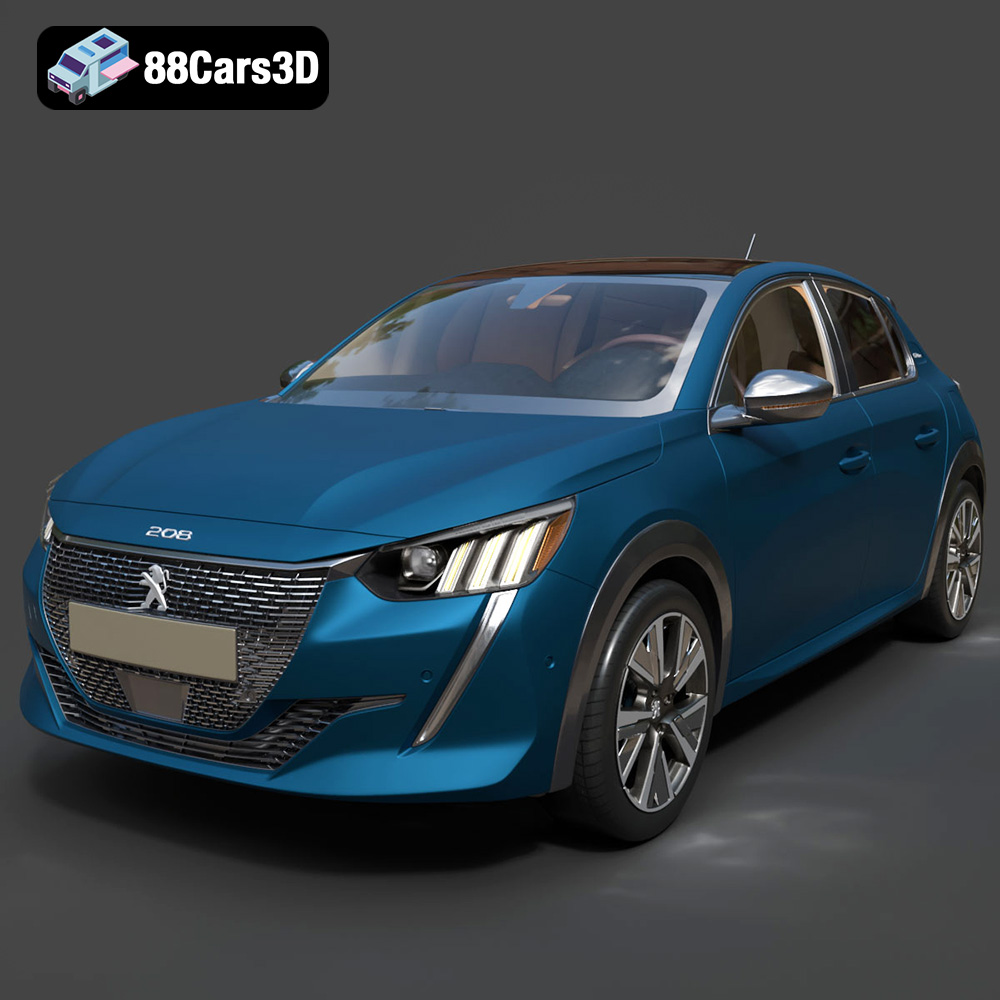
Today, we’re diving deep into a prime example of modern automotive design brought to life in exquisite detail: the 2020 Peugeot 208. This compact hatchback redefined its segment with bold, aggressive styling, featuring the striking ‘saber-tooth’ LED daytime running lights and an elegant gloss-black rear light cluster fascia. Translating such a distinctive vehicle into a versatile, high-performance 3D asset is a testament to meticulous craftsmanship, and the Peugeot 208 2020 3D Model available on 88cars3d.com perfectly embodies this.
This comprehensive guide will explore the technical nuances, professional workflows, and creative possibilities that a premium 3D vehicle asset offers, using the Peugeot 208 2020 as our central case study. We’ll delve into file formats, optimization strategies, and real-world applications across various digital mediums.
In the vast ecosystem of 3D content creation, understanding the nuances of different file formats is paramount. Each format serves a specific purpose, offering unique advantages for particular workflows and applications. A versatile 3D asset, such as the Peugeot 208 2020 3D Model, provides a comprehensive suite of formats to ensure maximum compatibility and utility. Let’s break down the most crucial ones:
The .blend format is Blender’s native file type. It encapsulates an entire Blender project, including all geometry, materials, textures, lighting setups, cameras, animation data, and even modifiers. For artists and studios heavily invested in the Blender ecosystem, a .blend file offers the highest degree of editability and flexibility. You can modify mesh topology, adjust shaders, fine-tune lighting, or even dissect the scene to understand how the model was constructed. This is ideal for deep customization or for integrating the model seamlessly into an existing Blender scene with consistent material pipelines.
The .fbx (Filmbox) format is an industry-standard proprietary file format developed by Autodesk. It’s renowned for its robust support for 3D model data, including geometry, animation, skinning, and materials. FBX is a powerhouse for interoperability between different 3D software applications and, critically, a preferred format for game engines like Unreal Engine and Unity. Its ability to efficiently store hierarchical data, precise transformations, and animation clips makes it the go-to choice for exporting game assets. When you need to get a rigged, animated, or simply clean model into a real-time environment quickly and reliably, .fbx is your best bet.
The .obj (Wavefront Object) format is one of the oldest and most universally supported 3D file formats. It’s a simple, text-based format that primarily stores geometry data (vertices, normals, texture coordinates, and faces). While it doesn’t typically store animation or complex material node setups, it’s excellent for static meshes and offers incredible cross-software compatibility. Almost every 3D application can import and export .obj files, making it a reliable choice for sharing raw geometry between different pipelines or as a fallback when other formats encounter issues. Material definitions are typically stored in a separate .mtl file.
The .glb (GL Transmission Format Binary) format is a relatively newer standard designed for efficient transmission and loading of 3D scenes and models. It’s the binary version of glTF and is highly optimized for web-based 3D applications, augmented reality (AR), and virtual reality (VR) experiences. A .glb file packages all necessary data—geometry, materials, textures, animations—into a single, self-contained file, making it incredibly easy to share and integrate into web viewers or mobile AR applications with minimal loading times. For interactive online showrooms or mobile AR experiences of the Peugeot 208 2020, .glb is indispensable.
The .stl (STereoLithography) format is the standard file type for 3D printing. It represents a 3D model as a collection of unconnected triangular facets, defining only the surface geometry without color, texture, or other CAD attributes. While simple, its ubiquity in the 3D printing world means it’s essential for anyone looking to physicalize their digital creations. For hobbyists or designers wishing to 3D print a scaled model of the Peugeot 208 2020, an .stl file is what they’ll need to send to their slicer software.
The .ply (Polygon File Format or Stanford Triangle Format) is another format for storing 3D data, often used in scientific and academic contexts, particularly for scanned data. It supports properties like color, transparency, surface normals, and range data, making it more comprehensive than .obj for certain applications. While less common in typical game or rendering workflows, .ply can be useful for precision mesh analysis or specific CAD integrations.
The .unreal format, or more accurately, assets packaged for Unreal Engine, typically refers to a pre-configured asset that’s ready to be directly imported and used within Unreal Engine. This isn’t a single file type like FBX, but rather a set of files (mesh, materials, textures, blueprints, etc.) arranged in an Unreal Engine project structure or an asset pack. It means less setup time for the user, as materials are often pre-made, pivots are correctly aligned, and collisions might already be set up. For developers using Unreal, this direct integration significantly streamlines the workflow for assets like the Peugeot 208 2020, offering an “out-of-the-box” solution for real-time environments.
The .max format is the native file type for Autodesk 3ds Max, a powerful 3D modeling, animation, and rendering software. Similar to .blend for Blender, a .max file contains the complete scene data, including geometry, complex material networks, lighting, cameras, animation keyframes, and modifiers. For professionals working in architectural visualization, product design, or high-end cinematic rendering who use 3ds Max, having the model in its native .max format offers unparalleled control for adjustments, integration into complex scenes, and leveraging advanced renderers like V-Ray or Corona. This allows for bespoke animation setups or intricate material customization specific to 3ds Max’s robust toolset.
Bringing a contemporary vehicle like the 2020 Peugeot 208 into the 3D realm requires an understanding of both artistic interpretation and technical accuracy. This model, available on 88cars3d.com, is a prime example of how digital assets can capture the essence and detail of real-world automotive design.
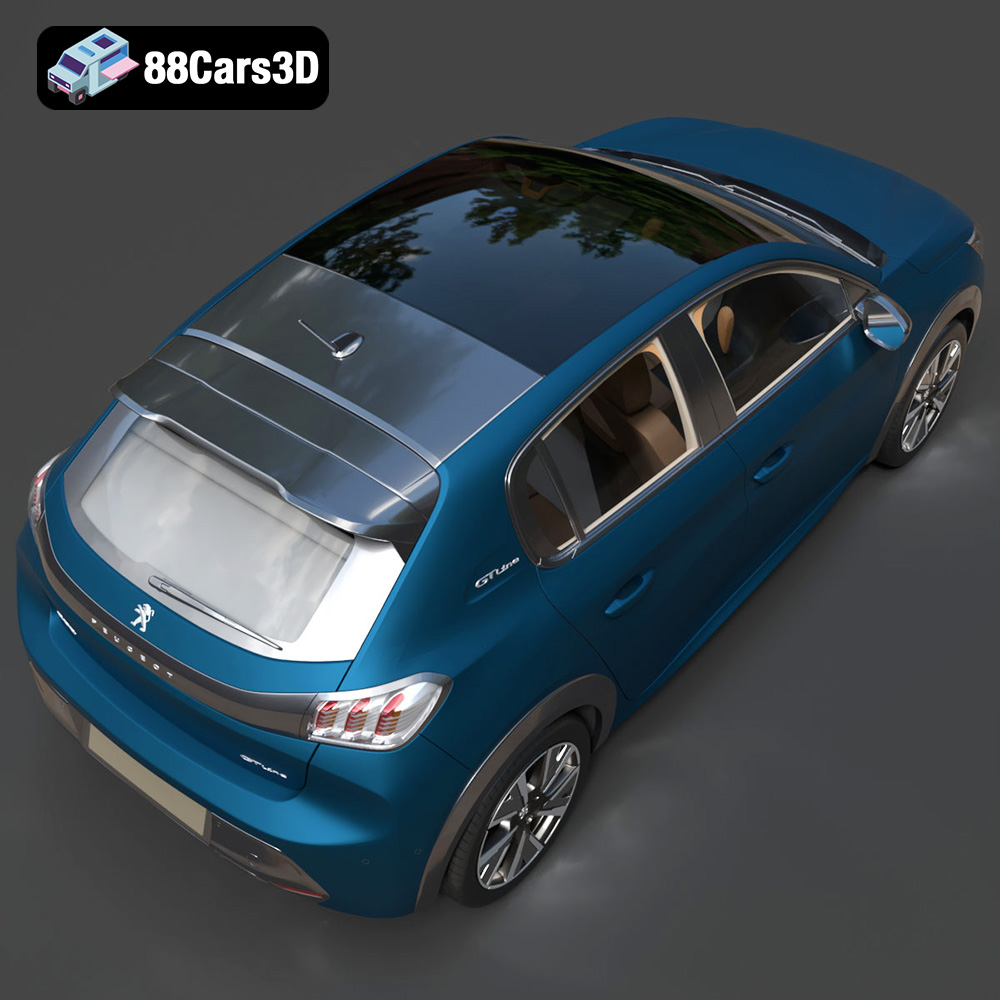
The Peugeot 208 2020 redefined its segment with an aggressive and sporty aesthetic, and the 3D model meticulously replicates these defining characteristics. The “Accurate Peugeot 208 2020 frame geometry and sporty hatchback proportions” are the foundation, ensuring the vehicle’s dynamic stance and streamlined profile are preserved. Key visual identifiers, like the “signature ‘fang’ LED DRLs” (Daytime Running Lights), are rendered with precision, complete with the intricate internal housing and realistic reflectors. The front grille, a focal point of any vehicle, features the prominent Peugeot lion emblem, demonstrating attention to even the smallest details. Moving to the rear, the “3-claw taillight integration” within an elegant gloss-black fascia completes the car’s distinctive lighting signature. Furthermore, the “aerodynamic alloy wheels with detailed brake calipers and disc rotors” are accurately modeled, and “realistic tire treads mapped for city and highway driving” provide convincing visual fidelity for both close-up shots and dynamic action sequences.
While the exterior often grabs immediate attention, a truly comprehensive 3D car model doesn’t neglect the interior. The Peugeot 208’s revolutionary i-Cockpit design is a crucial aspect of its identity, and this model delivers. “Detailed seating with realistic fabric/leather texture mapping” creates an inviting and authentic cabin environment. The “ergonomic i-Cockpit layout with the signature compact steering wheel” is accurately recreated, providing a sense of immersion for virtual drivers. Essential elements like the “digital 3D instrument cluster and modern infotainment display details” are included, even if not fully interactive in all formats, they provide the necessary visual cues. The “accurate central console, gear shifter, and tactile control buttons” further enhance realism. Crucially, the “optimized geometry for first-person POV in gaming” means that the interior is built with performance in mind, ensuring smooth framerates even when the virtual camera is inside the car.
Beyond aesthetic accuracy, a professional 3D car model must excel in its technical execution. This involves striking a delicate balance between visual fidelity and computational efficiency, especially for modern applications like real-time game engines and AR/VR experiences. The Peugeot 208 2020 3D model stands out in this regard.
One of the most critical aspects of any 3D asset intended for interactive or real-time use is its polycount. The Peugeot 208 2020 model boasts an “optimized topology of approximately 120k triangles.” This figure is not arbitrary; it represents a “perfect balance for real-time engines (Unreal, Unity) while maintaining high-end visual realism.” A higher polycount would strain performance, while a lower one would compromise visual quality. This optimized approach ensures the model can be dropped into an open-world game or a VR experience without causing significant performance bottlenecks, yet still deliver “crisp reflections, accurate ambient occlusion, and an immaculate flow of polygons tailored for both performance and close-up cinematic shots.” Every vertex and polygon is placed strategically to minimize unnecessary complexity while preserving the distinctive curves and sharp lines of the Peugeot 208.
Technical precision extends beyond just polycount. The model adheres to “real-world scale accuracy based on actual vehicle chassis,” which is essential for integration into diverse scenes, ensuring the car fits realistically alongside other assets like buildings, characters, or roads. Without correct scale, a vehicle can look out of place or distort perspectives. Another critical feature for animation and dynamic interaction is the “proper pivot setup for steering, wheel rotation, and suspension travel.” This seemingly minor detail is fundamental for animators and game developers. Correct pivot points mean that the wheels rotate realistically around their axes, the steering responds naturally, and the suspension can be animated to compress and rebound accurately, adding a layer of authenticity to any simulation or animation. Furthermore, the model’s “compatibility with major 3D software platforms and real-time rendering engines” via its diverse file formats (like .fbx, .obj, .blend, .max) ensures it can be seamlessly integrated into virtually any professional pipeline, saving countless hours of conversion and adjustment.
The versatility of a well-crafted 3D car model like the Peugeot 208 2020 lies in its ability to be integrated across various professional workflows. From high-octane gaming to static visualizations, its technical specifications and format options make it an invaluable asset.
For game developers, finding production-ready game assets is a constant challenge. The Peugeot 208 2020 3D model, with its optimized ~120k triangle count, is perfectly suited for game engines. Importing the .fbx or .unreal format into Unreal Engine or Unity is straightforward. Developers can quickly set up physically-based rendering (PBR) materials, apply appropriate collision meshes for realistic vehicle physics, and even generate Levels of Detail (LODs) to ensure optimal performance at varying distances. Imagine the Peugeot 208 2020 as a core vehicle in an open-world city game, either as a player-controlled car or as part of the dynamic AI traffic. Its “separate wheels, suspension, and steering components for animation” mean that advanced driving mechanics and realistic vehicle deformation systems can be implemented without extensive remodeling. This model empowers developers to focus on gameplay and immersive experiences rather than asset creation from scratch.
When it comes to creating stunning marketing visuals, product showcases, or atmospheric architectural scenes, automotive rendering is paramount. Artists using 3ds Max or Blender will find the native .max and .blend files, or even the universal .obj, incredibly valuable. In 3ds Max, the model can be loaded directly, allowing artists to leverage powerful renderers like V-Ray or Corona. They can set up studio-quality lighting, refine material properties for hyper-realistic paint finishes (metallic, gloss, matte), and add environmental elements to create compelling lifestyle scenes. Similarly, Blender users can utilize Cycles or Eevee to achieve breathtaking photorealism. For instance, visualizing the Peugeot 208 2020 parked elegantly in front of a modern high-rise for an architectural visualization project, or showcasing its design details in a cinematic product animation, becomes significantly more efficient with a pre-built, high-quality asset. The crisp reflections and accurate ambient occlusion are critical for achieving that signature polished look in professional renderings.
The applications extend beyond traditional screen-based media. For augmented reality (AR) and virtual reality (VR), the .glb format is a game-changer. Imagine a virtual showroom where potential buyers can walk around, inspect, and even customize the Peugeot 208 2020 in a fully immersive VR environment, or use AR on their phone to place the car virtually in their driveway. The optimized nature of the .glb file ensures smooth performance and quick loading times for these interactive experiences. Furthermore, for enthusiasts and designers, the model is “convertible to .stl format for display-scale hobbyists.” This opens up the world of 3D printing, allowing for physical replicas. The product description provides “3D Print Settings” recommendations, including layer height, wall thickness, infill, and specific support requirements for parts like side mirrors and exhaust tips. This level of detail ensures successful prints, making it perfect for creating tangible prototypes or display models.
A high-quality 3D model isn’t just about static representation; it’s a foundation for boundless creative expression. The Peugeot 208 2020 3D model offers significant opportunities for customization, allowing artists and designers to tailor the vehicle to specific project needs or artistic visions.
One of the most straightforward yet impactful customization options is changing the body color. The model supports a wide spectrum, enabling users to switch between vibrant hues like “Faro Yellow, Vertigo Blue, or Elixir Red” to more understated tones, matching brand guidelines or specific scene aesthetics. This is typically achieved by adjusting the material’s base color or by swapping out texture maps. Beyond color, the ability to “modify tire textures (summer vs. all-season variants)” adds a layer of realism relevant to environmental context. Imagine the car with rugged all-season tires for a wintry scene versus sleek summer tires for a sunny coastal drive. Furthermore, adjusting “material finishes (matte, gloss, metallic)” allows for fine-tuning the car’s appearance – from a stealthy matte black to a brilliant, high-gloss metallic finish. These material adjustments can dramatically alter the vehicle’s mood and perceived luxury. Finally, “adapting lighting for different environments” is crucial; whether it’s studio lighting for a product shot, dynamic sunlight for an outdoor scene, or ambient city lights for a night render, the model responds realistically to varying light setups, showcasing its well-calibrated PBR materials.
For those seeking to push the boundaries, the included editable formats like .blend and .max provide a canvas for advanced customization. Artists can delve into the shader networks to create unique iridescent paint effects or implement intricate decal systems for racing liveries or branding. While the model provides a strong base, its clean topology and proper UV mapping facilitate the creation of custom body kits, spoilers, or even interior modifications. Imagine a custom-tuned version of the Peugeot 208 2020 for a virtual racing event, featuring unique aerodynamic elements and personalized graphics. The “separate wheels, suspension, and steering components” also enable custom wheel designs or even advanced suspension modifications for specific animation or simulation requirements. This level of flexibility ensures that the Peugeot 208 2020 3D model is not just a static asset, but a dynamic toolkit for creative professionals.
The demand for high-quality 3D car models continues to grow, driven by the expanding frontiers of virtual production, immersive experiences, and sophisticated visualizations. The Peugeot 208 2020 3D Model exemplifies what a premium digital asset should be: meticulously detailed, technically optimized, and incredibly versatile. From its striking ‘saber-tooth’ DRLs to its game-ready ~120k triangle count, every aspect has been crafted to meet the rigorous demands of professional workflows.
Whether you are developing the next big racing title, crafting stunning automotive rendering for a marketing campaign, creating an interactive AR/VR configurator, or even 3D printing a scale model for your desk, this Peugeot 208 2020 model provides an exceptional foundation. Its comprehensive suite of file formats—including .blend, .fbx, .obj, .glb, .stl, .ply, .unreal, and .max—ensures seamless integration into virtually any pipeline, making it an indispensable resource for designers, game developers, and visualization specialists.
Investing in high-quality game assets like the Peugeot 208 2020 3D model from 88cars3d.com allows you to accelerate your projects, achieve unparalleled realism, and unlock new creative possibilities. It’s more than just a model; it’s a meticulously engineered digital twin, ready to bring your visions to life with precision and style.
The 2020 Peugeot 208 redefined the modern compact hatchback segment with its bold, aggressive styling and sporty proportions. Featuring the striking ‘saber-tooth’ LED daytime running lights, a muscular sculpted hood, and an elegant gloss-black rear light cluster fascia, this vehicle stands out in any urban setting. Its dynamic stance and streamlined profile perfectly capture the essence of contemporary European car design. This meticulously crafted 3D model boasts an optimized topology of approximately 120k triangles, ensuring flawless game-ready performance without compromising visual fidelity. Designed for high-end rendering and real-time engines, it delivers crisp reflections, accurate ambient occlusion, and an immaculate flow of polygons tailored for both performance and close-up cinematic shots. Perfect for modern city driving games, architectural visualization street scenes, VR automotive showrooms, and commercial lifestyle rendering.
$39.99
.2020
.208
.blend
.fbx
.glb
.hatchback
.max
.obj
.peugeot
.ply
.rendering
.stl
.unreal
car-3d-model
city-car
compact-car
game asset
game-ready
low-poly
optimized
VR/AR