Get 20% OFF All Premium 3D & STL Models!

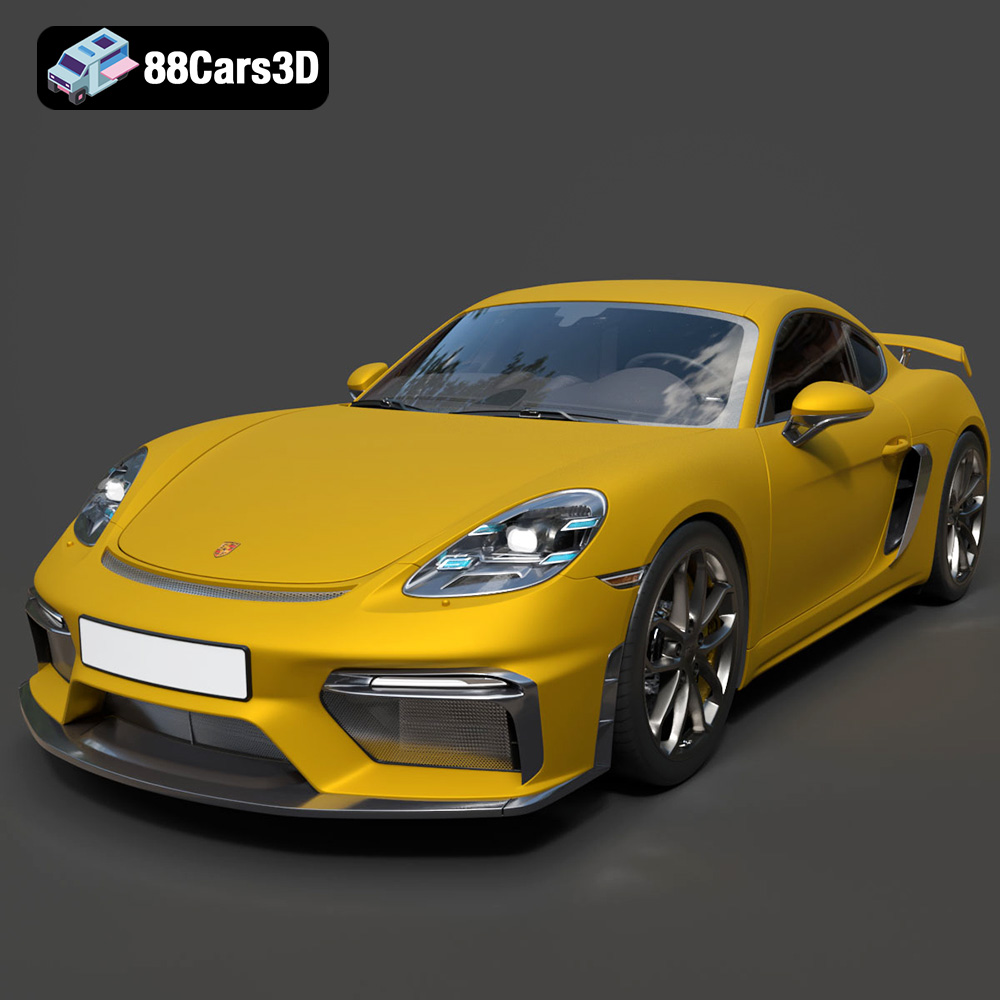
In the dynamic world of 3D content creation, high-quality assets are the bedrock of any successful project. Whether you’re a seasoned game developer crafting the next-generation racing simulator, an automotive designer visualizing a new concept, or an architect integrating vehicle models into a realistic scene, the fidelity and optimization of your 3D car models are paramount. We’re talking about more than just a pretty mesh; we’re talking about a digital asset engineered for performance, versatility, and visual impact. Today, we delve into precisely such an asset: the Porsche 718 Cayman GT4 2020 3D Model. This remarkable digital recreation captures the essence of Porsche’s mid-engine track weapon, offering an unparalleled foundation for a myriad of professional applications, available at 88cars3d.com.
The real-world Porsche 718 Cayman GT4 is a symphony of engineering, known for its naturally aspirated 4.0-liter flat-six engine, aggressive aerodynamics, and a driving experience that harks back to purer forms of motorsport. Its prominent fixed rear wing, large functional air intakes, dual sport exhaust system, and aggressive rear diffuser are not merely aesthetic; they are meticulously designed for maximum downforce and cooling. Translating this level of precision into a 3D model requires a deep understanding of both automotive design and digital optimization. This particular 3D model embodies that understanding, presenting a game-ready asset that doesn’t compromise on the breathtaking visual fidelity required for close-up shots and cinematic renders.
Creating a truly outstanding 3D car model goes far beyond merely replicating its shape. It involves a meticulous process of translating complex physical design into optimized digital geometry, ensuring accuracy while preparing it for diverse computational environments. The Porsche 718 Cayman GT4 2020 3D model exemplifies this careful balance, offering an asset that is both visually stunning and technically robust.
The Porsche 718 Cayman GT4 is a masterclass in functional design. Every curve, every vent, and every aero element serves a purpose. Its digital counterpart reflects this philosophy. The accurate frame geometry, body panels, and proportions are faithfully recreated, ensuring that the unmistakable silhouette of the GT4 is immediately recognizable. From the detailed front fascia with its large cooling intakes and aerodynamic front spoiler to the integrated dual-pipe sport exhaust system within the aggressive rear diffuser, the model pays homage to the original’s motorsport pedigree. This attention to detail isn’t just for show; it’s crucial for projects where authenticity is key, whether for a highly realistic racing simulation or an official automotive configurator.
Beyond the overall form, the devil is in the details. The model features signature Porsche four-point LED headlights and tinted 3D taillights that capture the brand’s iconic lighting signature. Precise alloy wheels, complete with high-performance brake calipers and slotted rotors, are rendered with precision. Even the suspension components are detailed enough to be visible through the wheel arches, providing an extra layer of realism for those dynamic shots or close-up inspections. Crucially, components like wheels, suspension, and steering are separated, enabling advanced animation and simulation. Inside, the track-focused cockpit features Alcantara sport bucket seats with detailed stitching, a GT sport steering wheel with a center top marker, an iconic analog central tachometer, and a digital instrument cluster. This level of interior fidelity makes the model suitable for first-person POV in gaming and immersive VR experiences, where every glance matters.
Navigating the world of 3D assets requires a solid grasp of file formats. Each format serves a specific purpose, excelling in different stages of the 3D pipeline, from initial design and animation to real-time rendering and physical production. The Porsche 718 Cayman GT4 2020 3D model comes with a comprehensive suite of file formats, ensuring maximum compatibility and utility across virtually any professional workflow. Understanding when and why to use each format is critical for efficient project management and optimal results.
The .blend format is the native file type for Blender, the powerful open-source 3D creation suite. When you download the GT4 model in .blend format, you gain access to a fully editable Blender scene. This means all the model’s raw data—mesh geometry, materials, textures, lighting setups, cameras, and even animation rigs (if applicable)—are preserved within a single file. For artists working primarily in Blender, this is the go-to format for full control and customization. You can easily modify the topology, adjust PBR material properties, tweak UV layouts, or even re-rig the model for specific animations without any loss of fidelity or conversion artifacts. It’s ideal for deep artistic manipulation, creating custom renders, or integrating the car into existing Blender projects.
The provision of such a comprehensive array of formats from 88cars3d.com ensures that the Porsche 718 Cayman GT4 3D model is a truly versatile and professional-grade asset, ready for any project requirement.
In the fiercely competitive realm of game development, especially for racing titles and open-world experiences, the quality and optimization of vehicle assets can make or break immersion. The Porsche 718 Cayman GT4 2020 3D model is meticulously engineered to excel in these demanding environments, offering a perfect blend of visual fidelity and real-time performance.
The product description highlights “carefully calculated triangle counts to ensure maximum performance without sacrificing detail.” This is a critical advantage for game developers. High-fidelity models, while visually stunning, can be computationally expensive, leading to frame rate drops and sluggish performance. The GT4 model strikes a delicate balance, maintaining visual realism for close-up views and cinematics while remaining optimized for real-time engines. For professional workflows, this often means the model is prepared with appropriate Level of Detail (LOD) groups. As the car moves further from the camera, lower polygon versions are automatically swapped in, dramatically reducing the processing load without a perceptible drop in quality to the player. This intelligent optimization ensures the Porsche GT4 can be deployed efficiently in large open-world games with many concurrent vehicles, or in high-speed racing scenarios where every millisecond of processing time counts.
The inclusion of .fbx and .unreal file formats explicitly targets integration into industry-leading game engines like Unreal Engine and Unity. When importing into Unreal, for instance, the .fbx model can be brought in with its materials and textures, ready for the engine’s sophisticated PBR (Physically Based Rendering) pipeline. A developer can quickly assign and tweak master materials, add collision meshes, and set up the model for vehicle physics. The .unreal format, if it denotes a pre-packaged asset, would further streamline this, potentially including pre-configured blueprints for basic vehicle movement or camera setups. For Unity, a similar process applies, leveraging its robust asset pipeline to quickly bring the GT4 into a scene, apply shaders, and integrate it with Unity’s vehicle systems. This “game-ready” nature significantly reduces development time and resources, allowing teams to focus on gameplay and user experience rather than asset preparation.
A static car model is of limited use in a dynamic game. The GT4 model is designed with animation in mind, featuring a “proper pivot setup for steering, wheel rotation, and suspension travel.” This modularity is invaluable. Wheels can be individually rotated for driving animations, the steering wheel can turn in sync with player input, and suspension components can accurately articulate over terrain, adding layers of realism to the driving experience. This attention to detail extends to the separate wheels, suspension, and steering components, making it easier for animators and technical artists to rig the vehicle for complex physics simulations and in-game interactions. Imagine a racing game where the suspension visibly compresses during braking or when hitting a curb—such details are made possible by assets like this Porsche GT4 model, elevating the realism of the simulation.
Beyond game development, the Porsche 718 Cayman GT4 2020 3D model is an exceptional tool for photorealistic rendering and visualization. From high-end marketing campaigns to architectural visualizations, the ability to render a vehicle with lifelike precision is paramount. This model, with its exquisite detail and versatile file formats, offers a powerful foundation for achieving breathtaking results.
Achieving photorealism is a complex interplay of geometry, materials, and lighting. The GT4 model provides an accurate geometric base, but its true potential shines when paired with advanced rendering engines. Using the .blend or .max files, artists can leverage the power of Cycles or V-Ray, Corona Renderer, or Arnold to create incredibly realistic scenes. The model’s topology is suitable for subdivision surfaces, ensuring smooth, artifact-free reflections and highlights even in extreme close-ups. With PBR (Physically Based Rendering) materials, artists can accurately simulate the physical properties of the car’s paint, glass, carbon fiber accents, and interior Alcantara. This means authentic reflections, precise specularity, and realistic light absorption, allowing the car to respond naturally to studio lighting setups, high dynamic range (HDR) environment maps, or custom lighting rigs designed to highlight specific features. Imagine showcasing the deep gloss of Miami Blue paint or the subtle sheen of a carbon fiber spoiler under perfectly controlled virtual studio lights.
For cinematic sequences, commercials, or product visualizations, the GT4 model seamlessly integrates into professional workflows. Using 3ds Max or Blender, artists can animate the car’s components—from wheel rotation and steering to door openings or even subtle suspension movements—to create dynamic shots. With renderers like V-Ray for 3ds Max or Cycles for Blender, these animations can be output at incredibly high resolutions with stunning visual quality. The model’s “real-world scale accuracy” is crucial here, ensuring that it fits proportionally into any scene, whether it’s a bustling city street or a minimalist showroom. Artists can also take advantage of the customization options, such as changing body colors, modifying tire textures (e.g., from track slicks to street variants), or adjusting material finishes (matte, gloss, metallic) to match specific creative briefs. This flexibility makes the GT4 model an invaluable asset for agencies and production houses aiming for top-tier automotive visualization.
Brand campaigns often demand unique aesthetics and specific brand identity elements. The GT4 model’s robust structure and material setup allow for extensive customization. Agencies can easily change the body color to align with a client’s brand palette, apply custom liveries, or integrate company logos onto the car’s surface. The ability to modify tire textures means the car can be depicted in various scenarios, from a pristine showroom floor to a rugged rally track. Adjusting material finishes allows for exploring different design concepts—a matte black GT4 for a stealthy, aggressive look, or a vibrant metallic finish for a lively, energetic feel. The model’s versatility extends to adapting lighting for different environments, allowing designers to create a consistent brand mood across various visual assets, ensuring the Porsche GT4 resonates perfectly with the target audience of any marketing or advertising campaign.
The utility of high-quality 3D car models extends far beyond traditional screens. With the rise of Augmented Reality (AR) and Virtual Reality (VR), and the increasing accessibility of 3D printing, versatile assets like the Porsche 718 Cayman GT4 2020 3D model are opening new avenues for interactive experiences and physical production.
Imagine stepping into a virtual showroom where you can walk around, inspect, and even customize a Porsche 718 Cayman GT4 from every angle. The GT4 3D model is “perfect for immersive virtual showrooms, configurators, and mobile AR experiences.” The .glb format is particularly optimized for these applications, offering a lightweight, single-file solution that loads quickly and performs efficiently on various devices, including smartphones and VR headsets. Developers can create interactive AR applications that allow users to place a life-sized GT4 in their driveway via their phone camera, changing colors and inspecting interior details in real-time. For VR, the model’s optimized geometry and detailed interior make it ideal for seated or room-scale experiences, allowing potential buyers to “sit” inside the car, explore its cockpit, and feel immersed in the luxury and performance before ever setting foot in a physical dealership. This technology revolutionizes how products are experienced and sold, with models from 88cars3d.com leading the charge.
For enthusiasts and collectors, the ability to transform a digital model into a tangible object is incredibly exciting. The Porsche 718 Cayman GT4 3D model is “convertible to .stl format for display-scale hobbyists,” making it suitable for 3D printing. This means you can download the model and, with the right printer and settings, produce a physical miniature replica of this iconic sports car. This application extends beyond hobbyists to professional prototyping, where design iterations can be quickly materialized for physical review. The product even provides specific 3D print settings, offering guidance for optimal results and demonstrating the model’s readiness for this transition from digital to physical.
To achieve the best results when 3D printing the GT4, several factors need careful consideration. The recommended scales (1:12, 1:18, 1:24) provide a good balance between detail and printability. For fine details and smooth surfaces, resin printing is highly recommended over FDM, along with a low layer height (0.04–0.12 mm). Structural integrity is addressed by recommendations like wall thickness (1.2–2.0 mm) and infill (20–30%). Crucially, the model’s design accounts for the need for supports for intricate parts like the exhaust, mirrors, and side scoops. The advice to print the frame angled and wheels separately is practical, ensuring both structural strength and optimal detail capture. Post-processing, including sanding, primer, and painting with authentic factory colors and metallic finishes, transforms a raw print into a display-worthy replica. This comprehensive guidance ensures that even those new to 3D printing can achieve impressive results with the Porsche 718 Cayman GT4 model.
Choosing the right assets is a critical decision for any 3D project. The Porsche 718 Cayman GT4 2020 3D Model from 88cars3d.com stands out not just for its inherent quality but for the comprehensive support it offers across various creative pipelines. This marketplace is committed to providing assets that are not only visually appealing but also technically sound and highly versatile, empowering professionals and hobbyists alike.
The core advantage of procuring assets from a reputable source like 88cars3d.com is the ability to significantly streamline your creative pipeline. Instead of spending countless hours modeling a complex vehicle from scratch—a process that demands specialized skills in modeling, texturing, and optimization—you can acquire a pre-built, production-ready asset. The GT4 model, with its “game-ready optimization,” “real-world scale accuracy,” and “proper pivot setup,” saves valuable development time and resources. The inclusion of multiple file formats (.blend, .fbx, .obj, .glb, .stl, .ply, .unreal, .max) ensures that no matter your preferred software or target platform, you have a compatible starting point. This means quicker iteration cycles, more efficient project delivery, and the freedom to focus on the unique aspects of your project rather than foundational asset creation. For studios and individual artists, this translates directly into cost savings and enhanced productivity, making it an intelligent investment for any automotive-centric 3D endeavor.
In conclusion, the Porsche 718 Cayman GT4 2020 3D model represents the pinnacle of digital automotive artistry and technical precision. From its meticulously recreated exterior and interior details to its game-ready optimization and extensive format compatibility, this asset is designed to meet the rigorous demands of professional 3D workflows. Whether you’re developing high-speed racing games, crafting immersive AR/VR experiences, producing photorealistic cinematic renders, or even bringing a digital design to life through 3D printing, this model provides an unparalleled foundation. Its versatility across platforms and applications—from Unreal Engine to 3ds Max, and from virtual showrooms to physical scale models—underscores its value as a premium asset. By choosing high-fidelity 3D car models like this from 88cars3d.com, you are investing in efficiency, quality, and the limitless potential of your creative projects.
The 2020 Porsche 718 Cayman GT4 is a mid-engine track weapon that perfectly balances motorsport heritage with modern performance. Known for its naturally aspirated 4.0-liter flat-six engine, aggressive aerodynamics, and unmistakable Porsche styling, this sports car delivers a pure, unfiltered driving experience. From its prominent fixed rear wing and large functional air intakes to its dual sport exhaust system and aggressive rear diffuser, every element is meticulously designed for maximum downforce and cooling.
This high-fidelity 3D model boasts exceptional topology and game-ready optimization, featuring carefully calculated triangle counts to ensure maximum performance without sacrificing detail. It maintains breathtaking visual fidelity suitable for close-up shots while remaining fully optimized for real-time rendering environments. Whether you are developing a high-speed racing simulator, crafting an immersive AR/VR showroom, or producing photorealistic cinematic animations, this digital asset provides the perfect foundation.
Perfect for high-speed racing games, virtual automotive configurators, photorealistic studio renders, and lifestyle visual campaigns.
.blend, .fbx, .obj, .glb, .stl, .ply, .unreal, .max
Tags:
porsche, 718-cayman-gt4, 2020, sports-car, track-car, game-ready, low-poly, optimized, car-3d-model, game-asset, rendering, vr-ar, blend, fbx, obj, glb, stl, ply, unreal, maxVespa VNB 125 3D Model 3D Printable STL
$39.99
.2020
.blend
.fbx
.glb
.max
.obj
.ply
.porsche
.rendering
.sports car
.stl
.unreal
718-cayman-gt4
car-3d-model
game asset
game-ready
low-poly
optimized
track-car
VR/AR