Get 20% OFF All Premium 3D & STL Models!

The roar of a finely tuned engine, the glint of chrome under the sun, the perfect blend of classic aesthetics and modern power – motorcycles have always held a special place in automotive culture. Among them, the Yamaha XV950 Racer stands out as a true icon, a bike that masterfully fuses cafe-racer heritage with the muscular performance of a V-twin cruiser. Its aggressive stance, stripped-down styling, and distinctive mini-cowl evoke a sense of freedom and rebellious spirit, making it a favorite for custom builders and enthusiasts alike. Capturing such an intricate and revered machine in the digital realm requires immense skill and attention to detail.
For 3D artists, game developers, architects, and visualization specialists, the demand for high-quality, game-ready 3D car models and vehicle assets is constant. Whether it’s for an immersive open-world game, a photorealistic architectural visualization, a dynamic AR/VR experience, or even a detailed 3D print, the underlying digital asset must be robust, optimized, and accurate. This is precisely where a meticulously crafted asset like the Yamaha XV950 Racer 3D Model available on 88cars3d.com excels. It brings the essence of this magnificent machine to life in the digital world, ready for a multitude of professional applications.
Navigating the world of 3D modeling can often feel like deciphering a complex code, especially when it comes to file formats. Each format serves a specific purpose, offering unique advantages depending on your workflow and end-use application. Understanding these distinctions is crucial for selecting the right asset and ensuring seamless integration into your projects. The Yamaha XV950 Racer 3D Model comes packaged with a comprehensive array of formats, ensuring maximum compatibility and utility across diverse professional pipelines.
The .blend format is the native file type for Blender, the powerful open-source 3D creation suite. When you download the Yamaha XV950 Racer as a .blend file, you’re getting a fully editable Blender scene. This means all the scene data – including geometry, materials, textures, lighting setups, cameras, and even animation rigs – is preserved. For users deeply integrated into the Blender ecosystem, this format offers unparalleled flexibility. You can easily modify the mesh, adjust shaders, re-rig components, or extend animations directly within Blender without any loss of data that might occur during format conversions. It’s the ideal choice for deep customization and iterative design within Blender.
.fbx (Filmbox) is arguably the most widely adopted proprietary file format for 3D data exchange, particularly prevalent in the game development and animation industries. Developed by Autodesk, FBX files can store not only model geometry but also material properties, textures, animation data, skeletal rigs, and even camera and light information. Its robust support for animation makes it the go-to format for exporting animated characters and vehicles into game engines like Unreal Engine and Unity. For the Yamaha XV950 Racer, the .fbx file ensures that all its animated components, like the rotating wheels and steering, transfer smoothly, making it ideal for creating dynamic scenes and real-time simulations.
The .obj (Wavefront Object) format is one of the oldest and most universal 3D file formats. It’s essentially a geometric data carrier, storing vertex positions, UV coordinates, normals, and polygon faces. While .obj files are excellent for transferring static mesh data between different 3D software applications (like 3ds Max, Maya, Cinema 4D, and Blender), they typically do not store animation, rigging, or advanced material properties within the file itself (materials are often referenced by an accompanying .mtl file). The .obj version of the Yamaha XV950 Racer is perfect for ensuring cross-software compatibility when the primary need is robust geometric transfer for rendering or sculpting.
.glb (GL Transmission Format Binary) is the binary version of glTF, a royalty-free specification for the efficient transmission and loading of 3D scenes and models by applications. It’s specifically optimized for web-based 3D, augmented reality (AR), and virtual reality (VR) applications due to its compact size and efficiency. A .glb file bundles the 3D model, textures, and animations into a single file, making it incredibly easy to share and display across platforms and browsers. For deploying the Yamaha XV950 Racer in a web-based configurator, a mobile AR experience, or a lightweight VR showroom, the .glb format is the undisputed champion.
The .stl (STereoLithography) format is the standard for 3D printing. It represents a 3D model as a series of connected triangles, describing only the surface geometry of an object without color, texture, or other CAD attributes. While simple, its ubiquity in the additive manufacturing world makes it indispensable. The .stl version of the Yamaha XV950 Racer allows enthusiasts and professionals to bring this digital model into the physical world, creating tangible replicas. The product description’s specific recommendations for scale, layer height, and support illustrate the thought put into ensuring a successful physical print from this digital asset.
.ply (Polygon File Format or Stanford Triangle Format) is another format for storing 3D data, particularly known for its ability to store properties such as color, transparency, texture coordinates, normals, and confidence values per vertex and face. It’s often used in academic and scientific fields for storing data from 3D scanners, and is excellent for precision mesh data. While less common for general animation or game development than FBX, it offers a robust solution for specific CAD or analytical pipelines where detailed mesh integrity is paramount for the Yamaha XV950 Racer.
The .unreal format, or more accurately, assets packaged for Unreal Engine, implies that the model has been specifically prepared and perhaps even imported into an Unreal project environment. This often means textures are properly linked, materials are set up with Unreal’s Physically Based Rendering (PBR) pipeline, and possibly even basic collision meshes are integrated. While not a standalone file type in the same way .fbx is, having an “unreal” package means the asset is ready for drag-and-drop integration, saving significant setup time for game developers working with Epic’s flagship engine.
The .max format is the native file format for Autodesk 3ds Max, a leading software for 3D modeling, animation, rendering, and visualization. Similar to .blend, a .max file contains all the scene data relevant to 3ds Max, including complex modifiers, render settings, lights, and animation curves. For studios and artists who primarily use 3ds Max for high-end rendering and detailed animation sequences, the .max version of the Yamaha XV950 Racer provides the most comprehensive and editable starting point for their projects.
Creating a high-fidelity 3D model, especially of a complex mechanical object like a motorcycle, is a blend of artistic vision and rigorous technical execution. The Yamaha XV950 Racer 3D Model from 88cars3d.com stands as a testament to this, meticulously crafted to serve both aesthetic demands and performance requirements across various digital mediums.
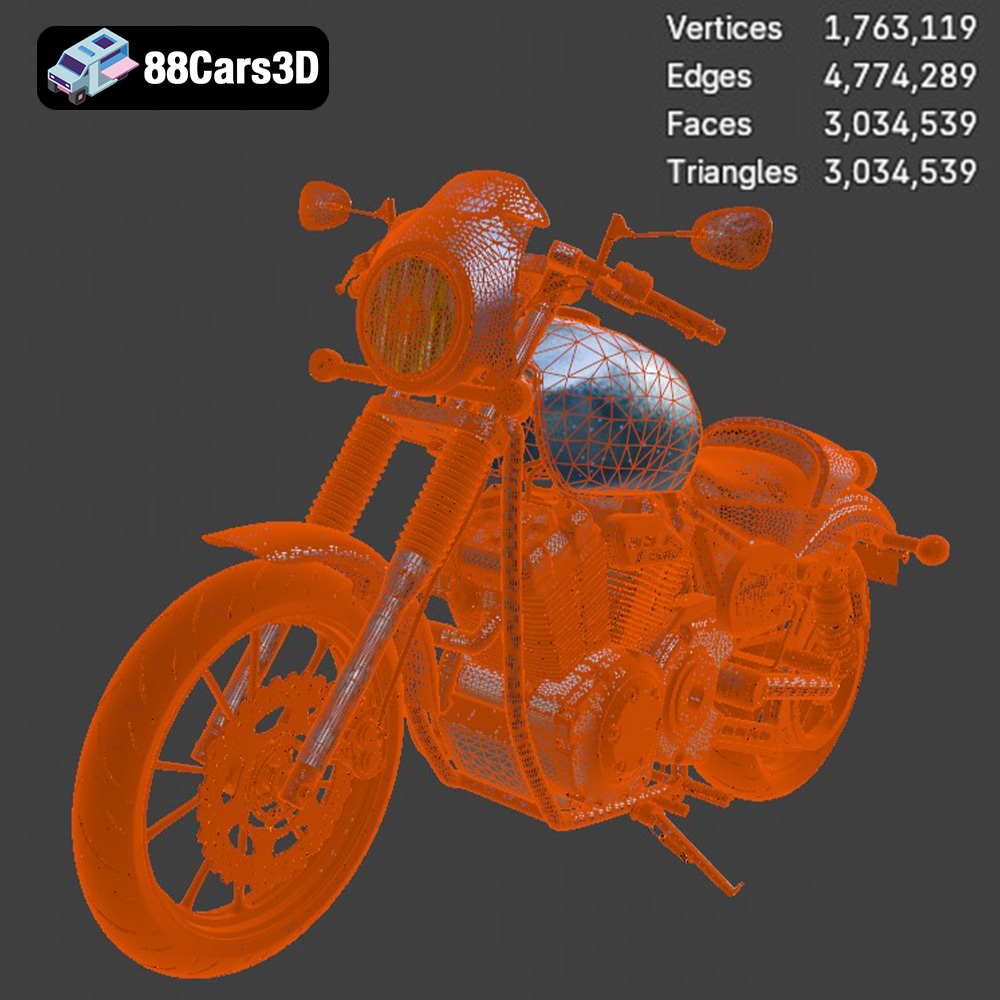
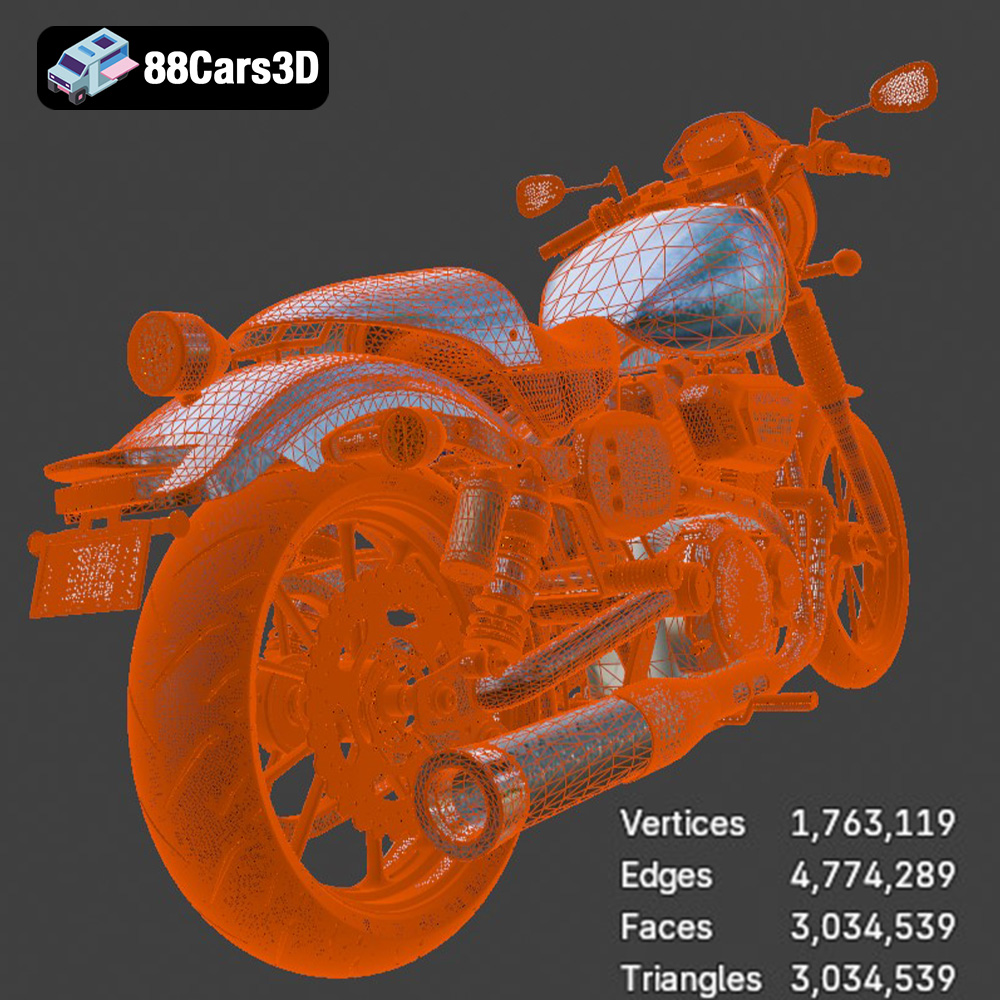
At the heart of any professional 3D asset lies its topology – the arrangement of vertices, edges, and faces that form the mesh. This model boasts a highly optimized topology, striking an exceptional balance between visual fidelity and real-time performance. With approximately 130,000 triangle count, it is perfectly tailored for modern game engines like Unreal and Unity. This polycount ensures that the model can be rendered smoothly in interactive applications without bogging down system resources, while still retaining enough detail to appear incredibly realistic during close-up shots or high-end cinematics. Furthermore, its clean geometry, derived from real-world scale accuracy, guarantees a faithful reproduction of the bike’s dimensions and proportions, a critical factor for authentic simulations and visualizations. The inclusion of proper pivot setups for the steering, wheel rotation, and suspension travel is a subtle yet vital technical detail, enabling seamless and realistic animation without the need for extensive re-rigging.
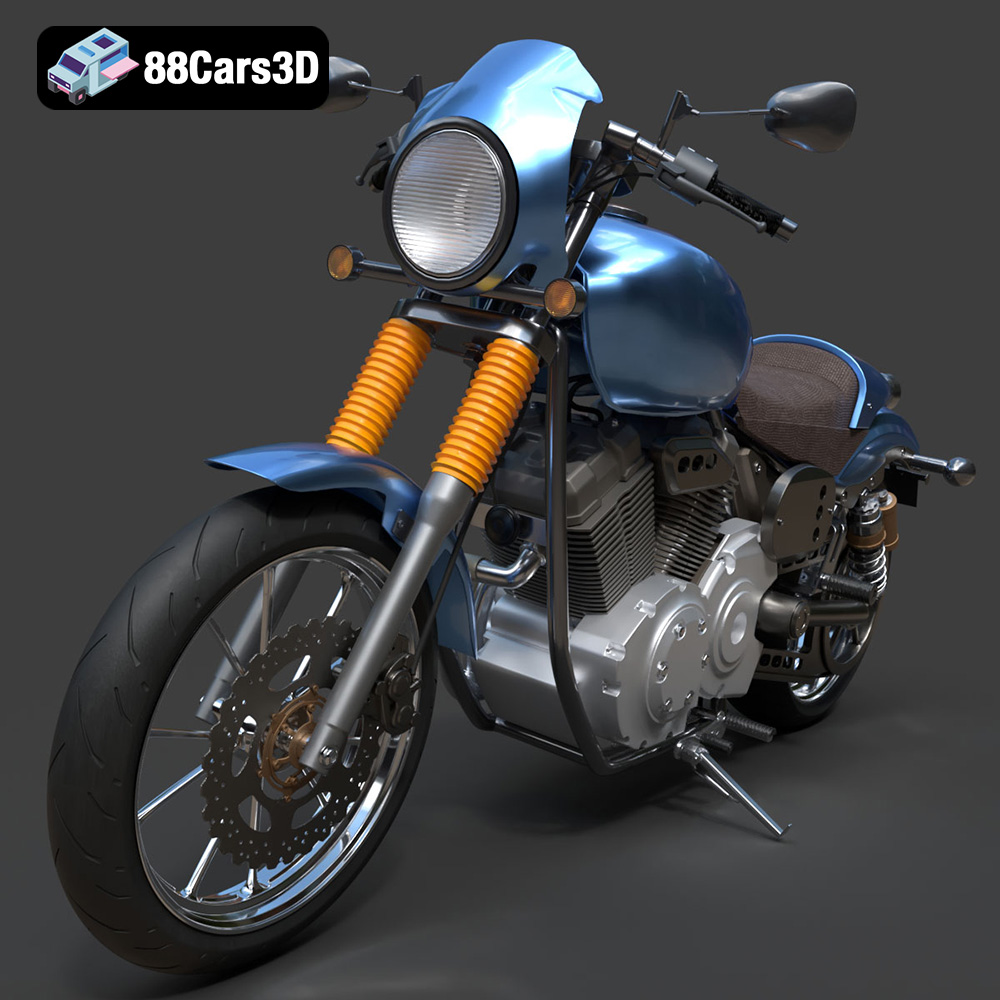
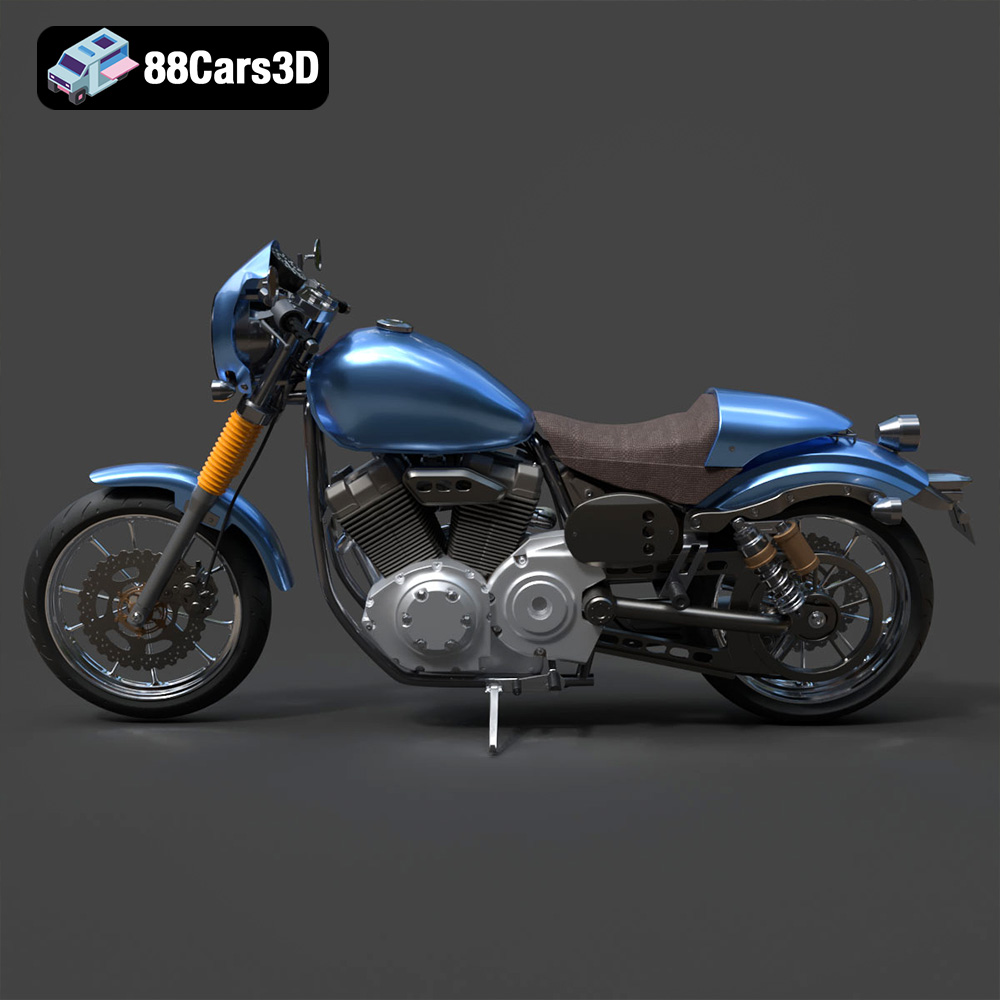
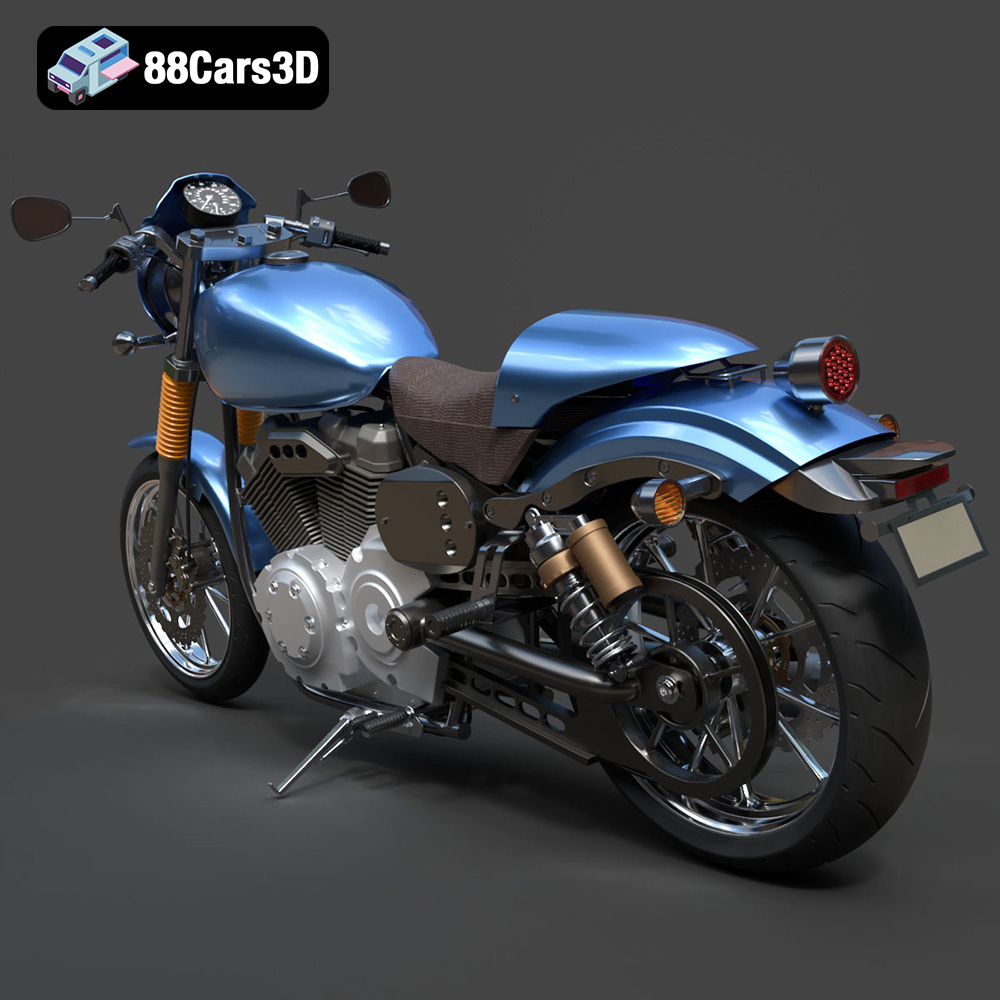
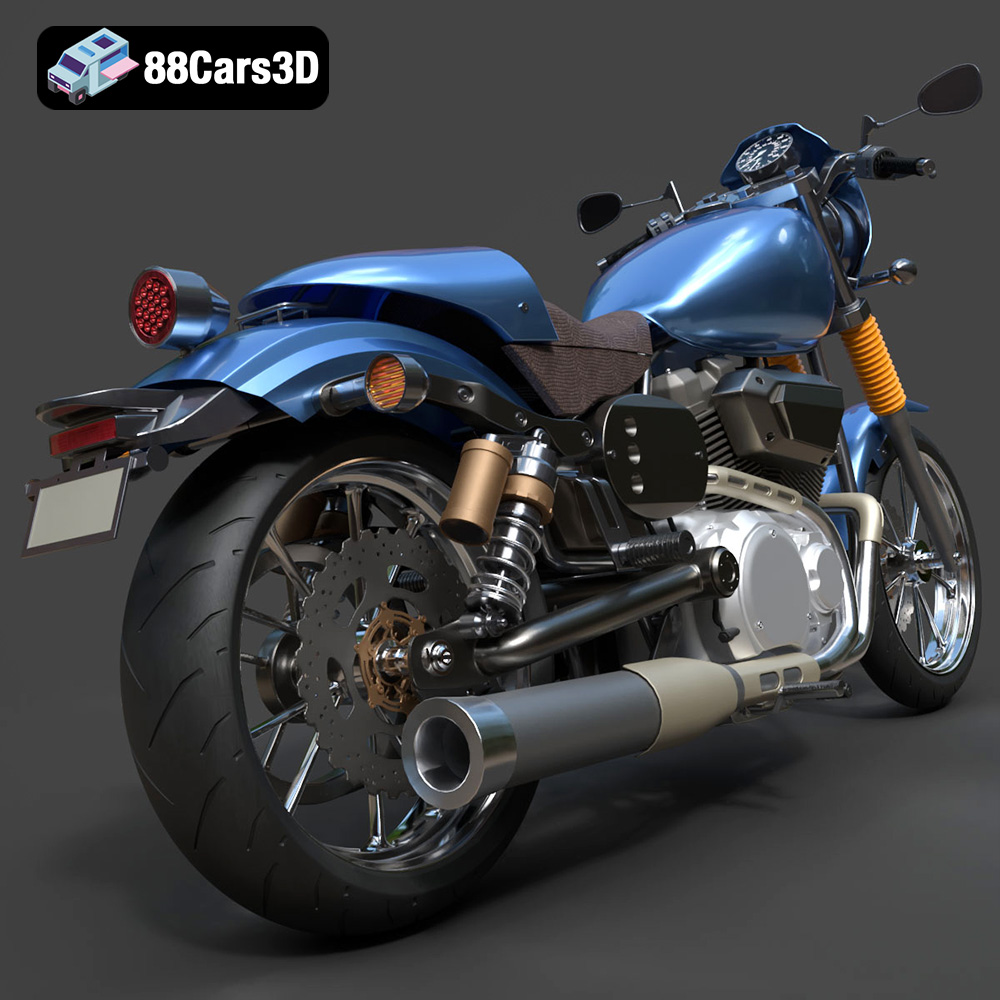
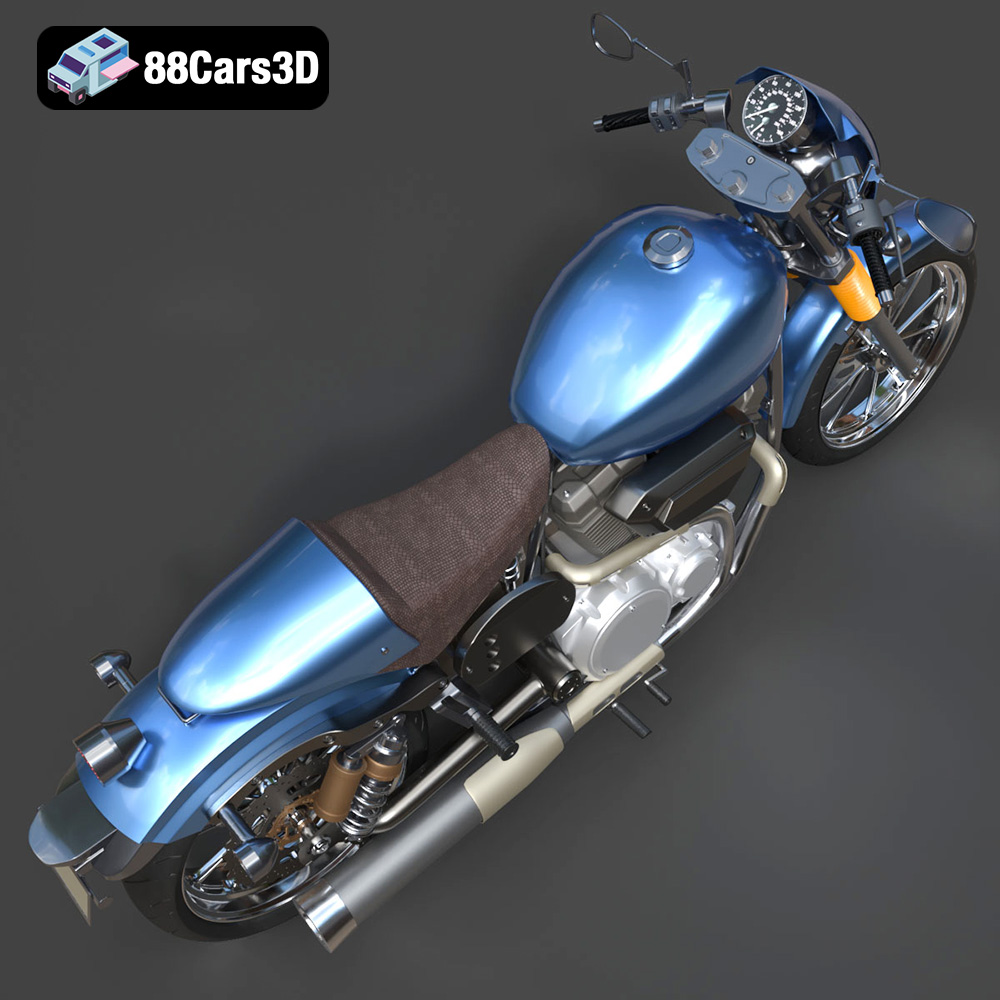
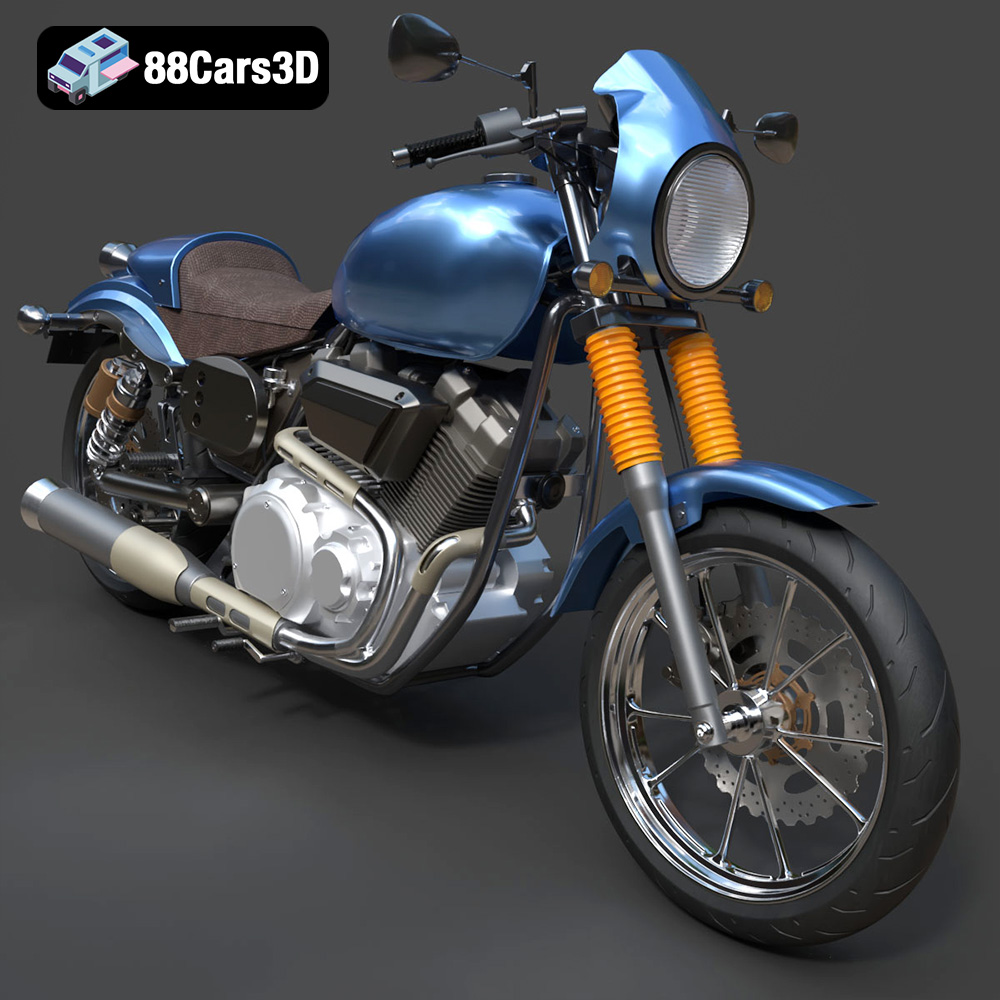
The level of detail in this 3D model goes far beyond basic shapes. Every significant component of the Yamaha XV950 Racer has been carefully replicated to capture its iconic design. The accurate frame geometry and aggressive cafe-racer proportions are instantly recognizable. The 942cc air-cooled V-twin engine block features sculpted cooling fins, adding a layer of authenticity that is often overlooked in less detailed models. The dual-shotgun style exhaust system, complete with heat shields, mirrors the bike’s real-world counterpart precisely. Key exterior features like the classic round headlight with its signature mini front cowl, the LED-style taillight, and the high-detail cast alloy wheels with treaded street tires further enhance its realism. The piggyback twin rear shock suspension setup completes the external authenticity.
Moving to the rider’s perspective, the cockpit and interior features are equally impressive. A sporty solo saddle with an aerodynamic rear seat cover, authentic clip-on handlebars positioned for an aggressive forward-leaning posture, and a minimalist circular digital instrument cluster all contribute to an immersive experience. Accurate control details, including rear-set footpegs, clutch/brake levers, and the shifter, are all present and optimized. This meticulous attention ensures that the model is not only visually stunning for external shots but also perfectly suited for first-person POV in motorcycle gaming, allowing players to feel truly connected to the machine.
The versatility of a premium 3D model like the Yamaha XV950 Racer is defined by its seamless integration into various professional pipelines. From interactive entertainment to sophisticated product visualization, this asset is engineered to accelerate workflows and elevate output quality across the board.
For game developers, finding truly “game-ready” 3D car models or motorcycle assets can be a challenge. The Yamaha XV950 Racer 3D Model meets this demand head-on. Its optimized polycount and clean topology make it an ideal candidate for a wide array of game development scenarios, including open-world adventures, high-octane racing titles, and realistic simulators. The inclusion of .fbx and .unreal formats significantly streamlines the import process into engines like Unreal Engine and Unity. Developers can expect minimal setup regarding material assignments, collision mesh generation, and animation integration, allowing them to focus on gameplay mechanics and world-building. Imagine this highly detailed motorcycle tearing through a neon-lit city or cruising down a scenic highway in your next big title. It’s a foundational asset that enhances visual fidelity and player immersion.
Beyond gaming, the demand for high-quality automotive rendering for marketing, advertising, and product visualization is immense. The Yamaha XV950 Racer 3D Model excels in this arena, offering the precision and detail required for stunning CGI rendering. Using formats like .max or .blend, artists can import the model into industry-standard software like 3ds Max or Blender. Here, they can harness advanced rendering techniques, complex lighting setups, and photorealistic material shaders to create breathtaking visuals for brand campaigns, lifestyle scenes, or virtual showrooms. The model’s real-world scale and accurate proportions ensure that every render is grounded in reality, making it perfect for presenting the bike in its best light. Furthermore, its .glb format facilitates its use in augmented reality (AR) and virtual reality (VR) experiences, allowing potential customers to virtually interact with the bike, explore its features, or even “place” it in their own driveways through a smartphone app, pushing the boundaries of immersive marketing.
A truly valuable 3D asset provides not just a static representation but a dynamic canvas for creativity. The Yamaha XV950 Racer 3D Model offers extensive opportunities for customization and animation, empowering artists and developers to tailor it precisely to their vision.
One of the most exciting aspects of working with a well-structured 3D model is the freedom to customize. The Yamaha XV950 Racer allows for significant artistic modification. Artists can easily change body and tank colors, experimenting with authentic factory hues or creating unique custom finishes to match a specific brand identity or game aesthetic. The ability to modify tire textures, perhaps swapping street variants for off-road treads, dramatically alters the bike’s character and functionality. Adjusting material finishes—from matte to gloss to metallic—can profoundly impact how the bike interacts with light, adding another layer of realism and visual appeal. This level of adaptability ensures that the model isn’t just a static object but a versatile element that can be integrated into diverse themes and artistic directions.
The foresight in structuring the Yamaha XV950 Racer 3D Model with separate wheels, suspension, and steering components is a game-changer for animation. This modularity, combined with properly set pivots, means animators can quickly and realistically simulate movement. The wheels can rotate independently, the suspension can compress and extend, and the handlebars can steer, all in a physically accurate manner. This capability is indispensable for creating dynamic cutscenes, realistic driving simulations, or compelling marketing animations. Imagine the bike leaning into a turn, its suspension absorbing bumps, and the steering responding fluidly – such subtle details bring the model to life and enhance storytelling, whether in a high-fidelity render or a real-time game environment.
The journey of a 3D model doesn’t always end on a screen. For many enthusiasts and professionals, the ultimate goal is to bring digital creations into the physical world. The Yamaha XV950 Racer 3D Model’s inclusion of an .stl format opens the door to the exciting realm of 3D printing, transforming polygons into a tangible, desktop-sized replica.
The .stl format, while simplistic in its data representation, is the universal language of 3D printers. The Yamaha XV950 Racer can be converted into an .stl file, ready for additive manufacturing. This offers a unique opportunity for hobbyists, collectors, and even professional designers to create display-scale models. The provided recommended scales (1:12 / 1:18 / 1:24) guide users towards achieving the best balance between detail and printability. For optimal results, especially for retaining the fine details of the engine fins, exhaust, and intricate cockpit components, resin printing is highly recommended over filament-based FDM. This ensures a smoother surface finish and captures the subtle nuances of the original digital sculpt. Careful consideration of layer height (0.04–0.12 mm) and wall thickness (1.2–2.0 mm) is crucial for structural integrity and detail preservation during the printing process.
Successful 3D printing, especially of complex objects like motorcycles, requires more than just hitting print. The guidelines provided for the Yamaha XV950 Racer are invaluable. Supports are required for detailed and overhanging parts such as the exhaust system, mirrors, and handlebars to prevent warping and ensure geometric accuracy. Thoughtful print orientation is also key; printing the frame angled can improve structural integrity and minimize the need for excessive supports, while wheels are best printed separately to capture their circular perfection. After printing, the real craft begins with post-processing. Sanding to remove support marks, applying a good primer for an even surface, and finally, painting with authentic factory colors and metallic finishes will transform the raw print into a stunning, professional-grade replica. This meticulous process ensures that the physical model truly reflects the high standards of the digital asset, offering a rewarding experience for anyone venturing into 3D printing.
The digital landscape of 3D modeling demands assets that are not only visually captivating but also technically robust and versatile. The Yamaha XV950 Racer 3D Model exemplifies these qualities, offering a meticulously crafted and highly optimized asset suitable for an incredibly diverse range of professional applications. From powering the most demanding game engines and enriching immersive AR/VR experiences to generating breathtaking automotive rendering for marketing campaigns and even providing the foundation for high-quality 3D prints, this model is a true powerhouse.
Its thoughtful topology, accurate real-world scale, detailed componentry, and comprehensive file format support (including .blend, .fbx, .obj, .glb, .stl, .ply, .unreal, and .max) ensure that artists, developers, and designers have all the tools they need to integrate this iconic motorcycle into their projects seamlessly. Whether you’re crafting the next big racing title, designing a virtual showroom, or simply admire the fusion of classic and modern in motorcycle design, this model offers an unparalleled starting point. Explore the possibilities and elevate your next project with this exceptional asset, available among a curated collection of high-quality 3D car models and vehicles at 88cars3d.com.
The Yamaha XV950 Racer is a stunning motorcycle that beautifully merges classic cafe-racer heritage with modern V-twin cruiser performance. Known for its aggressive riding posture and stripped-down aesthetic, this bike boasts a muscular 942cc air-cooled engine, a distinctive front mini-cowl, and swept-back exhaust lines that capture the essence of retro-modern custom culture. This premium 3D model is meticulously crafted with highly optimized topology, striking the perfect balance between high-end visual fidelity and real-time performance. Designed to be fully game-ready, it features clean geometry and a polycount tailored for modern game engines, making it an exceptional asset for interactive applications, AR/VR experiences, and professional CGI rendering. Perfect for urban street-racing games, custom motorcycle configurators, realistic virtual showrooms, and lifestyle rendering scenes.
$19.99
.blend
.cruiser
.fbx
.glb
.max
.motorcycle
.obj
.ply
.rendering
.stl
.unreal
.yamaha
cafe-racer
game asset
game-ready
low-poly
motorcycle-3d-model
optimized
VR/AR
xv950-racer