Get 20% OFF All Premium 3D & STL Models!

In the dynamic world of digital design, the demand for high-quality, technically precise 3D car models has never been greater. Whether for breathtaking automotive rendering, immersive game environments, cutting-edge AR/VR experiences, or even detailed 3D printing, the foundational asset is always a meticulously crafted 3D model. These digital vehicles aren’t just pretty pictures; they are complex data structures built with specific applications in mind, demanding an intricate understanding of topology, materials, and file formats.
Today, we delve deep into the art and science behind creating and utilizing premium 3D car models, using a prime example: the Mercedes-Benz GLB-Class Mk1 AMG Line 2019 3D Model. This particular model embodies the perfect blend of aesthetic fidelity and technical optimization, making it an ideal candidate for a vast array of professional projects. It showcases how a single, well-developed asset can serve diverse needs, from capturing the rugged versatility and premium luxury of a modern SUV in a photorealistic studio shot to navigating the fast-paced, real-time demands of an open-world racing game.
Join us as we explore the technical intricacies, practical applications, and professional workflows that elevate a mere digital representation into an indispensable tool for designers and developers alike.
The journey of automotive design from physical clay models to digital prototypes has been transformative. Early 3D models were often rudimentary, serving primarily as conceptual tools. Today, however, 3D car models are central to every stage of vehicle development, marketing, and entertainment. This evolution has been driven by advancements in software, hardware, and an increasing need for photorealism and interactive experiences.
Initially, Computer-Aided Design (CAD) software revolutionized engineering, allowing for unparalleled precision in vehicle component design. As technology progressed, the focus expanded to encompass the vehicle’s aesthetic appeal. Artists began translating engineering data into visually rich, high-polygon models capable of showcasing every curve and panel gap with stunning accuracy. These models form the backbone of modern automotive rendering, enabling manufacturers to visualize and market new vehicles long before physical production begins. The Mercedes-Benz GLB-Class Mk1 AMG Line 2019 3D Model, for instance, perfectly captures the distinctive boxy silhouette and aggressive AMG Line styling, a testament to the high standards of modern digital sculpting.
A significant challenge in 3D automotive modeling lies in balancing visual fidelity with performance requirements. High-polygon models, rich in detail, are perfect for pre-rendered cinematic sequences or static visualizations. However, they are often too heavy for real-time applications like video games or AR/VR experiences, where smooth frame rates are paramount. This necessitates a careful optimization process, often involving retopology, baking normal maps, and streamlining textures. The Mercedes-Benz GLB-Class 3D model tackles this head-on, with its optimized topology of approximately 250,000 triangles, striking an impeccable balance for both high-end rendering and efficient real-time performance, making it a truly game-ready asset.
Choosing the right file format is crucial for any 3D project, dictating compatibility, feature retention, and overall workflow efficiency. Professionals working with 3D car models must understand the strengths and weaknesses of each format to ensure seamless integration into their chosen software and pipelines. The Mercedes-Benz GLB-Class Mk1 AMG Line 2019 3D Model comes packaged in a comprehensive suite of formats, catering to virtually every conceivable use case.
The .blend format is Blender’s native file type. It encapsulates an entire Blender scene, including all 3D mesh data, materials, textures, lighting, cameras, animations, physics simulations, and even custom scripts. This format is ideal for users working primarily within Blender, offering full editability and preserving every nuance of the original artist’s setup. For designers who wish to dissect, modify, or extend the Mercedes-Benz GLB-Class model’s interior, exterior, or material properties within Blender, this is the most flexible option.
Autodesk’s .fbx (Filmbox) is arguably the most widely adopted format for exchanging 3D data between different software applications. It supports geometry, materials, textures, animations, and camera data. Its robust nature makes it ideal for real-time pipelines, especially with game engines like Unreal Engine and Unity, where it ensures consistent asset behavior and visual integrity. When bringing the Mercedes-Benz GLB-Class into a game development environment, .fbx is often the go-to choice due to its reliable transfer of skeletal animations (like wheel rotation and suspension travel) and PBR material setups.
The .obj (Wavefront OBJ) format is a simple, universal 3D geometry definition format. It stores vertex positions, UV coordinates, normals, and polygon faces. While it doesn’t support animation or advanced material properties directly (these are often handled by accompanying .mtl files), its simplicity makes it incredibly compatible across almost all 3D software. For basic mesh transfer or as a fallback option when more complex formats fail, .obj is indispensable. It’s a reliable choice for importing the Mercedes-Benz GLB-Class model into less common 3D applications or for purely static rendering scenarios.
.glb (GLB Transmission Format) is the binary version of glTF (GL Transmission Format). It’s designed to be a compact, efficient, and runtime-agnostic format for the transmission of 3D scenes and models. .glb files embed textures and other assets directly, making them single-file deliverables perfect for web-based 3D viewers, augmented reality (AR), virtual reality (VR) applications, and mobile experiences. For showcasing the Mercedes-Benz GLB-Class in an immersive virtual showroom or a mobile AR configurator, the .glb format offers optimal performance and ease of deployment.
The .stl (Stereolithography) format represents a 3D model as a series of connected triangles, describing only the surface geometry of an object. It contains no color, material, or texture information, making it specifically tailored for additive manufacturing (3D printing). While the Mercedes-Benz GLB-Class model is primarily designed for digital visualization, its inclusion as .stl demonstrates its versatility, allowing hobbyists and professionals to create physical prototypes or display models with recommended scales and print settings provided.
The .ply (Polygon File Format or Stanford Triangle Format) is another format that describes 3D objects as a collection of polygons. It’s more flexible than .obj in that it can store additional properties like color, transparency, normals, texture coordinates, and even reliability information for each vertex or face. It’s often used in applications requiring precise mesh data, such as scientific visualization, CAD, or scan data processing. For detailed analysis or specialized engineering tasks involving the Mercedes-Benz GLB-Class, .ply offers a robust data representation.
While not a standalone file format in the same vein as .fbx or .obj, .unreal refers to an asset that has been specifically prepared and configured for direct import and optimal performance within Unreal Engine. This typically means the .fbx has been processed, materials have been set up with Unreal’s PBR shaders (e.g., roughness, metallic, normal maps), collisions have been applied, and LODs (Levels of Detail) might be configured. The Mercedes-Benz GLB-Class model’s designation as “.unreal” signifies that it’s designed for a streamlined workflow within Epic’s powerful real-time environment, reducing setup time for game developers and real-time configurator creators.
Autodesk’s .max is the native file format for 3ds Max. Similar to .blend, it stores the entire scene, including geometry, modifiers, materials, lights, cameras, animations, and render settings. It provides the highest level of editability and feature retention for users working within 3ds Max, a long-standing industry standard for architectural visualization, animation, and high-fidelity rendering. Professionals using 3ds Max can leverage the .max file for the Mercedes-Benz GLB-Class model to fine-tune animations, render detailed product shots, or integrate it into complex scene compositions.
The quality of a 3D car model is ultimately judged by its fidelity to the real-world counterpart. The Mercedes-Benz GLB-Class Mk1 AMG Line 2019 3D Model exemplifies this commitment to detail, capturing the essence of the vehicle through meticulous design and technical precision.
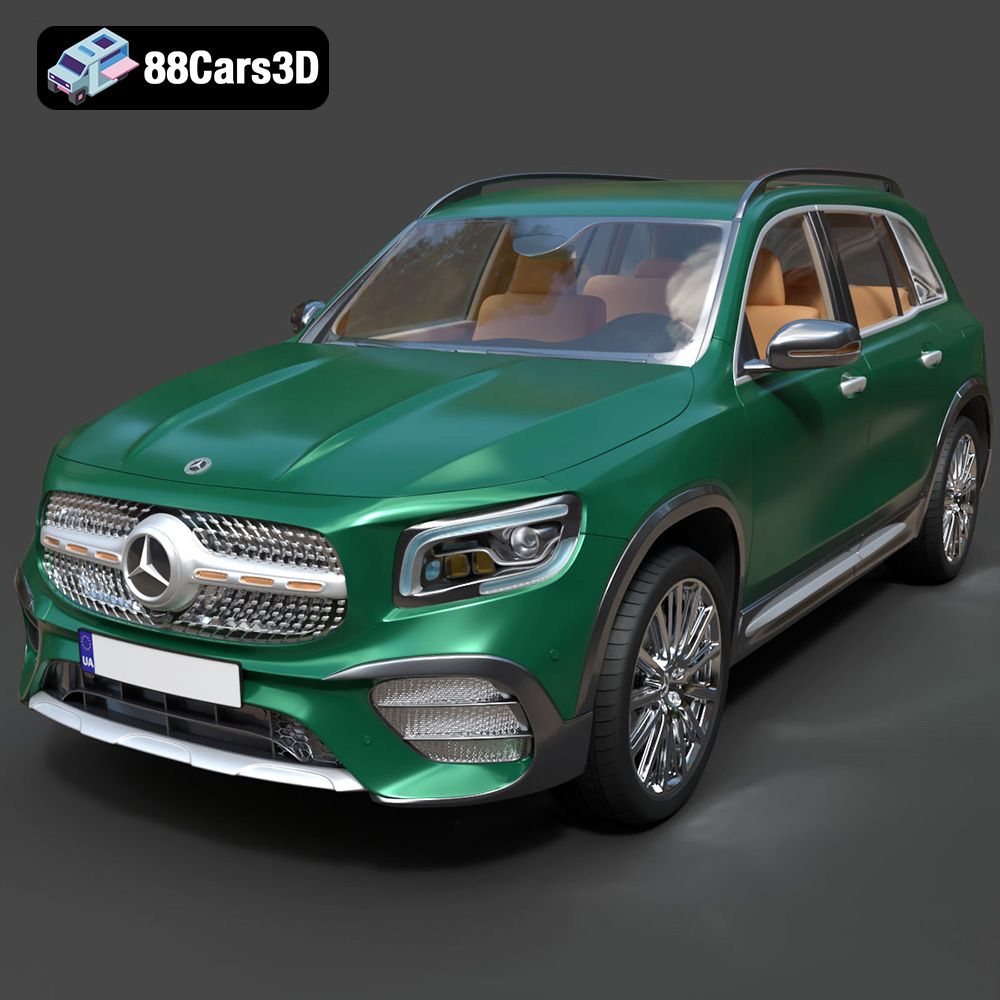
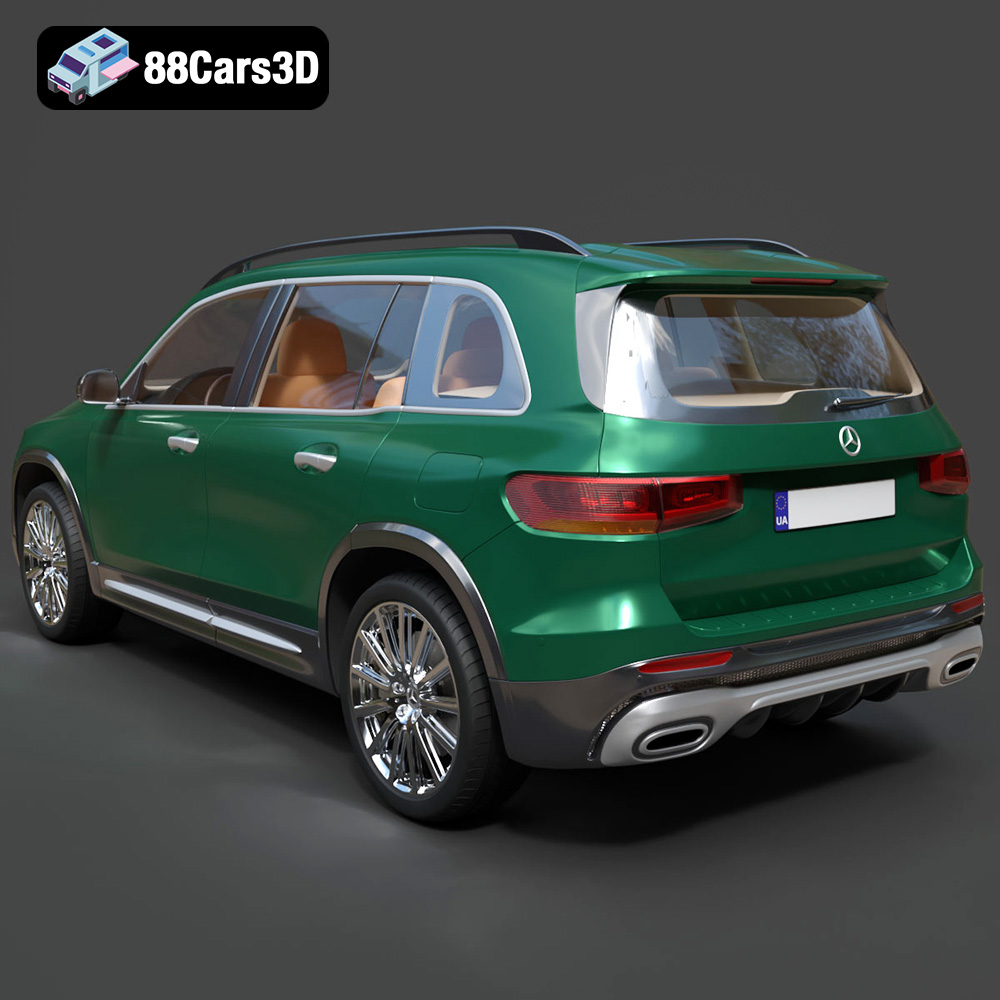
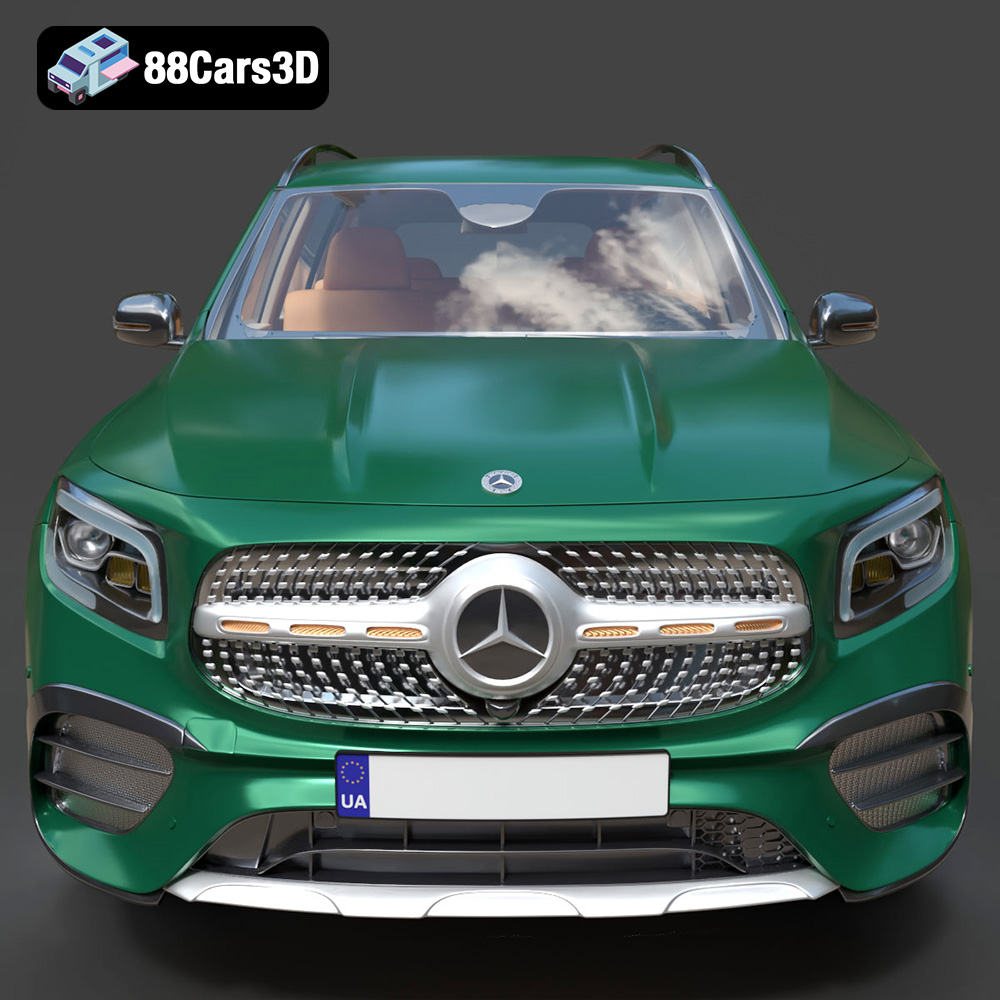
From the moment you inspect the model, the accurate Mercedes-Benz GLB-Class (Mk1) AMG Line frame geometry and proportions are evident. Every curve, panel line, and vent is faithfully reproduced. The distinctive boxy silhouette, which gives the GLB-Class its commanding stance, is perfectly translated into the digital realm. Furthermore, the aggressive AMG Line styling cues, such as the signature diamond radiator grille, sporty front aprons, and prominent dual exhaust system, are rendered with striking accuracy. Even detailed engine block and undercarriage components are included, a testament to its comprehensive design, making it suitable for even close-up inspections or cinematic camera angles.
Key details like the high-detail LED High Performance headlamps and distinctive taillight clusters are modeled with precision, reflecting the complex optics of modern automotive lighting. The authentic AMG 5-twin-spoke light-alloy wheels and performance tires are not just textures, but fully modeled components, paired with sport-tuned suspension detailing. Critically, components like wheels, suspension, and steering are separated, allowing for seamless animation in various applications, from dynamic driving simulations to product showcases.
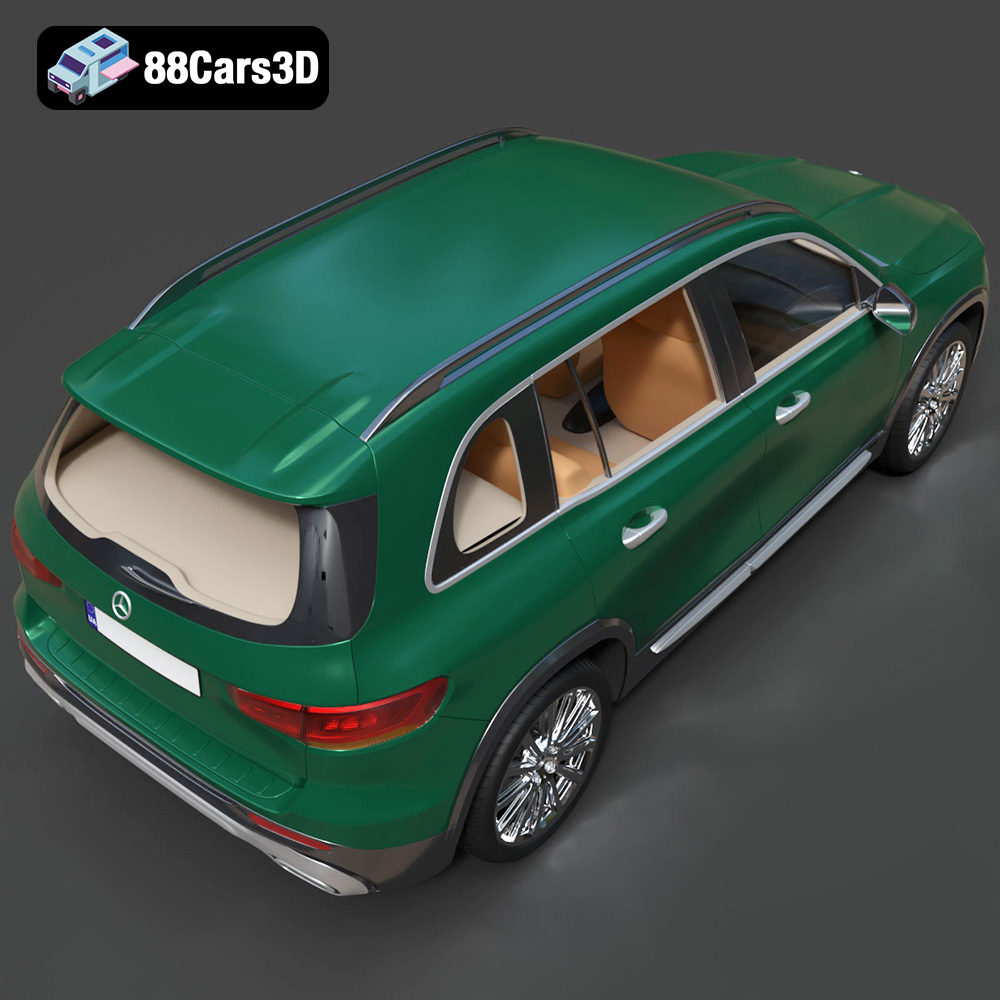
The interior of a luxury vehicle is just as important as its exterior, and this 3D model doesn’t disappoint. The cockpit and interior features are crafted to deliver an immersive experience, whether for a first-person perspective in a game or a detailed virtual tour. Detailed sport seating with intricate stitching and contouring brings a touch of luxury to the digital space. The Nappa leather multifunction sports steering wheel, complete with precise switchgear, is accurately recreated, inviting interaction.
Modern vehicles are defined by their digital interfaces, and the accurate MBUX dual-screen digital instrument cluster and infotainment system are faithfully represented. A detailed central console, complete with touch controls, air vents, and pedals, completes the sense of realism. This optimized geometry for first-person POV makes the Mercedes-Benz GLB-Class model an exceptional asset for gaming and VR simulations, allowing users to feel truly present within the vehicle.
In today’s interactive digital landscape, a beautiful model is only half the story. Its ability to perform efficiently in real-time environments, such as video games and AR/VR, is equally critical. This requires careful optimization without sacrificing visual quality.
The Mercedes-Benz GLB-Class Mk1 AMG Line 2019 3D Model is a prime example of a game-ready asset. With approximately 250,000 triangles, it achieves an optimal balance between high-end visual realism and efficient real-time performance. This polycount is sufficiently detailed to hold up under close scrutiny for cinematics and product shots, yet lean enough to integrate into complex game scenes without significantly impacting frame rates. This is further enhanced by PBR (Physically Based Rendering) texturing. PBR materials accurately simulate how light interacts with surfaces in the real world, providing realistic reflections, refractions, and surface properties, ensuring the vehicle looks consistent and believable under diverse lighting conditions in game engines like Unreal and Unity.
Technical specifications extend beyond just visual fidelity. Real-world scale accuracy, based on the actual vehicle chassis, ensures that the model fits perfectly within any scene, whether an architectural visualization or a virtual city. Furthermore, proper pivot setup for steering, wheel rotation, and suspension travel is critical for animators and game developers. This allows for realistic movement and interaction, from subtle road imperfections to full-blown crashes. The separate wheels, suspension, and steering components enable seamless animation, providing total control over the vehicle’s dynamic behavior.
The utility of a high-quality 3D car model like the Mercedes-Benz GLB-Class Mk1 AMG Line extends far beyond its initial creation, finding applications in a myriad of industries.
For game developers, the Mercedes-Benz GLB-Class model is a ready-to-use asset. Its optimized polycount and PBR textures make it ideal for open-world games, racing titles, and vehicle simulators. Players can drive this distinct SUV through virtual landscapes, experience its detailed interior, and customize its appearance. Its “game-ready” status means less time spent on optimization and more time on game logic and level design. The inclusion of an .unreal format means that assets are prepped for immediate integration, saving valuable development time.
The immersive potential of augmented and virtual reality is perfectly leveraged by detailed 3D car models. Imagine a customer exploring a virtual showroom, walking around the Mercedes-Benz GLB-Class, opening its doors, and even sitting inside, all before stepping into a physical dealership. The optimized .glb format makes it perfect for such immersive virtual showrooms, configurators, and mobile AR experiences, allowing users to interact with the vehicle in their own environment. This technology is revolutionizing how products are marketed and experienced.
For advertising agencies, product designers, and architectural visualization artists, premium 3D car models are essential. They serve as central elements in brand campaigns, lifestyle scenes, and studio lighting setups, adding realism and context. The Mercedes-Benz GLB-Class model, with its accurate proportions and PBR materials, can be placed within architectural renders to give scale and luxury, or featured in high-resolution marketing imagery that is indistinguishable from real photography. The .max and .blend formats provide the flexibility needed for these demanding visualization tasks.
While often associated with digital screens, 3D models can also manifest in the physical world. The Mercedes-Benz GLB-Class model is convertible to the .stl format, making it suitable for 3D printing. This opens up possibilities for display-scale hobbyists, model makers, or even designers creating physical prototypes. With recommended scales (1:12 / 1:18 / 1:24), layer heights, infill percentages, and crucial support structures, enthusiasts can bring a tangible replica of this SUV to life. Post-processing with sanding, primer, and authentic factory colors can result in a truly impressive physical model.
The true value of a versatile 3D asset like the Mercedes-Benz GLB-Class Mk1 AMG Line 2019 model lies in its seamless integration into various professional 3D software and real-time engine pipelines.
For professionals leveraging Autodesk 3ds Max, the included .max file offers immediate access to a fully editable project. This means artists can easily:
Blender users benefit from the .blend file, providing full access to the model within their native environment. This allows for:
For game developers and real-time visualization specialists using Unreal Engine, the .fbx and .unreal files are invaluable. The process typically involves:
These flexible formats and optimized structures ensure that professionals can integrate the Mercedes-Benz GLB-Class Mk1 AMG Line 2019 3D Model into their preferred workflow with minimal friction, maximizing efficiency and creative output.
In a crowded digital marketplace, the differentiation comes down to quality, technical precision, and diverse usability. When sourcing 3D car models for critical projects, ensuring that the assets are meticulously crafted and properly optimized is paramount. This is where specialized platforms like 88cars3d.com prove invaluable.
The Mercedes-Benz GLB-Class Mk1 AMG Line 2019 3D Model available on 88cars3d.com is a testament to the commitment to delivering premium, production-ready assets. From its accurate real-world scale and authentic AMG Line detailing to its optimized polycount and comprehensive file format support, every aspect is designed with the professional user in mind. This attention to detail reduces the need for extensive post-purchase cleanup or optimization, allowing designers and developers to focus on their creative work rather than technical hurdles.
Whether you’re building the next generation of racing games, producing high-fidelity automotive advertising, developing immersive AR applications, or even crafting intricate 3D prints, starting with a foundation of quality is essential. Assets from 88cars3d.com are built to meet these exacting standards, providing the tools needed to bring your digital visions to life with unparalleled realism and efficiency.
The world of 3D modeling is a complex interplay of artistic vision and technical prowess. High-quality 3D car models are not just static images; they are versatile digital assets, capable of transforming projects across industries. The Mercedes-Benz GLB-Class Mk1 AMG Line 2019 3D Model serves as an excellent illustration of what a premium asset can achieve – from its stunning visual fidelity and meticulous interior/exterior details to its game-ready optimization and extensive file format support.
We’ve explored how its optimized topology, PBR texturing, and animatable components make it ideal for game development, while its accurate scaling and detailed realism enhance automotive rendering and architectural visualization. Its compatibility across 3ds Max, Blender, Unreal Engine, and other platforms, alongside its suitability for AR/VR and 3D printing, underscores its professional utility.
For designers, developers, and artists seeking to elevate their projects, investing in meticulously crafted 3D car models from trusted sources like 88cars3d.com is a crucial step. Such assets not only streamline workflows but also unlock new creative possibilities, ensuring that every digital creation stands out with realism, performance, and precision. Embrace the power of professional 3D assets and drive your projects forward.
Experience the perfect blend of rugged versatility and premium luxury with our meticulous 3D model of the Mercedes-Benz GLB-Class (Mk1) AMG Line 2019. This compact crossover SUV stands out with its distinctive boxy silhouette, commanding stance, and aggressive AMG Line styling cues, including the signature diamond radiator grille, sporty front aprons, and prominent dual exhaust system. Designed to encapsulate the modern elegance and muscular heritage of the Mercedes-Benz brand, this digital replica captures every striking curve and sophisticated detail. This high-fidelity, game-ready 3D model is meticulously crafted with optimized topology (~250,000 triangles), striking an impeccable balance between exceptional visual realism and efficient real-time performance. Designed for maximum versatility, the model features PBR texturing and precise structural proportions, making it a premium asset for game engines, high-end rendering, and immersive interactive media. Perfect for urban racing games, luxury vehicle configurators, architectural visualizations, and mobile AR experiences.
$39.99
.2019
.blend
.fbx
.glb
.luxury suv
.max
.obj
.ply
.rendering
.stl
.unreal
amg-line
car-3d-model
compact-suv
game asset
game-ready
glb-class
low-poly
mercedes-benz
optimized
VR/AR