Get 20% OFF All Premium 3D & STL Models!

In the expansive and ever-evolving landscape of digital design, the demand for high-quality, meticulously crafted 3D assets is paramount. From the visceral thrill of open-world gaming to the stunning realism of architectural visualization and the cutting-edge immersion of AR/VR experiences, a robust foundation of detailed models is crucial. Among these,
3D car models
and other
automotive 3D models
hold a special place, often serving as focal points that define the authenticity and atmosphere of a digital scene.
Few vehicles embody timeless design and cultural resonance quite like the Vespa P200E. This iconic Italian scooter, with its distinctive silhouette and enduring appeal, transcends mere transportation to become a symbol of freedom, style, and a bygone era. Reimagining such a classic for the digital realm requires not only artistic fidelity but also deep technical understanding. Today, we’ll delve into the intricacies of integrating such a prized asset into modern pipelines, focusing on the exceptional
Vespa P200E 3D Model
available at 88cars3d.com. This model isn’t just a visual replica; it’s a versatile tool engineered for professional use across various industries, from creating compelling
automotive rendering
projects to building immersive
game assets
.
This comprehensive guide will explore the technical nuances, workflow considerations, and diverse applications that make a high-quality 3D model like the Vespa P200E an indispensable asset for designers, developers, and artists. We’ll discuss everything from optimal file formats to real-world integration strategies in leading 3D software and game engines, ensuring you’re equipped to maximize its potential.
When working with 3D assets, particularly complex
3D car models
or
game assets
like the Vespa P200E, understanding the various file formats is critical. Each format serves a specific purpose, excelling in certain workflows, software compatibility, or optimization levels. The Vespa P200E 3D Model from 88cars3d.com thoughtfully includes a comprehensive suite of these formats, ensuring maximum versatility for any project.
The .blend file is the native format for Blender, a powerful and widely-used open-source 3D creation suite. When you receive a .blend file, you’re not just getting the model; you’re getting a fully editable Blender scene. This includes the mesh geometry, materials, textures (often packed within the file or linked), lighting setups, cameras, animations, and even modifiers. For artists who primarily work in Blender, this is the most flexible format, allowing for direct modification, rigging, animation, and
automotive rendering
within their preferred environment without any data loss or conversion issues. It’s ideal for deep customization of the Vespa P200E, from altering its color scheme to adding custom accessories or intricate scene setups.
.fbx (Filmbox) is arguably the most common and versatile exchange format in the 3D industry. Developed by Autodesk, it’s designed to facilitate seamless data transfer between various 3D applications like 3ds Max, Maya, Blender, Cinema 4D, and most importantly, game engines like Unreal Engine and Unity. An .fbx file can carry a wealth of information, including mesh data, materials, textures, animations, skinning, and camera data. Its strength lies in its robustness for conveying complex scenes while maintaining hierarchy and animation curves. For integrating the Vespa P200E into an Unreal or Unity project, .fbx is often the go-to choice due to its reliable import process and ability to preserve animation data for components like wheels and suspension.
The .obj (Wavefront OBJ) format is a universal, open standard for representing 3D geometry. It’s incredibly simple and widely supported across virtually all 3D software. An .obj file primarily contains vertex positions, UV coordinates, normals, and face definitions. While it doesn’t typically store advanced features like animation or complex material definitions (these are usually stored in an accompanying .mtl file for basic materials), its ubiquity makes it excellent for basic mesh exchange when full scene data isn’t required. If you need to import the Vespa P200E into a less common application or simply want the raw geometry, .obj is a dependable choice.
.glb (GL Transmission Format Binary) is the binary version of glTF, a modern, open standard for 3D model transmission. It’s specifically optimized for efficient loading and rendering in web browsers, AR (Augmented Reality), and VR (Virtual Reality) applications. A .glb file packages all necessary assets – geometry, materials, textures, animations – into a single, compact file, making it incredibly convenient for sharing and deployment in real-time web and mobile environments. For showcasing the Vespa P200E in an interactive online configurator or an AR experience on a smartphone, .glb provides the best performance and ease of use.
.stl (Stereolithography) is the de facto standard file format for 3D printing. Unlike other formats that describe surfaces, .stl represents a 3D model as a series of connected triangles (a tessellated surface) without color, texture, or other CAD attributes. Its simplicity makes it universally compatible with 3D slicer software, which prepares models for printing. While not ideal for visual rendering, the inclusion of an .stl file for the Vespa P200E 3D Model means it’s ready for direct physical fabrication, perfect for collectors, hobbyists, or creating scale models for display.
.ply (Polygon File Format) is another format that describes a 3D object, primarily used for storing data from 3D scanners. It can store a variety of properties including color, transparency, normals, texture coordinates, and even reliability information. While less common for general
game assets
or
automotive rendering
, its ability to store precise data makes it valuable in specific scientific, engineering, or CAD applications where detailed point cloud data or precise mesh reconstruction might be necessary for the Vespa P200E model.
The .unreal designation refers to an asset specifically prepared and optimized for direct import into Unreal Engine. While not a distinct file extension in the traditional sense, it signifies that the model, often in .fbx format, has been meticulously set up with proper scaling, pivot points, material assignments, and collision meshes to work flawlessly within Unreal Engine. This pre-optimization for the Vespa P200E streamlines the import process, saving developers significant time and effort in engine-specific setup, allowing them to focus on scene creation and interaction.
Similar to .blend for Blender, .max is the native file format for Autodesk 3ds Max, one of the leading 3D modeling, animation, and rendering software packages in the industry. An .max file contains all elements of a 3ds Max scene, including geometry, modifiers, materials, textures, lights, cameras, animations, and scene settings. For professionals working in 3ds Max, having the Vespa P200E in this format offers the ultimate flexibility for detailed modifications, complex
automotive rendering
setups, and advanced animation sequences. It provides direct access to the original scene construction, making it an invaluable asset for high-fidelity projects.
The charm of the Vespa P200E is undeniable, a classic that evokes a sense of nostalgia and Italian flair. Translating this cultural phenomenon into a high-quality 3D model requires both artistic sensitivity and technical precision. The Vespa P200E 3D Model from 88cars3d.com exemplifies this balance, offering an asset that is both visually stunning and functionally optimized.
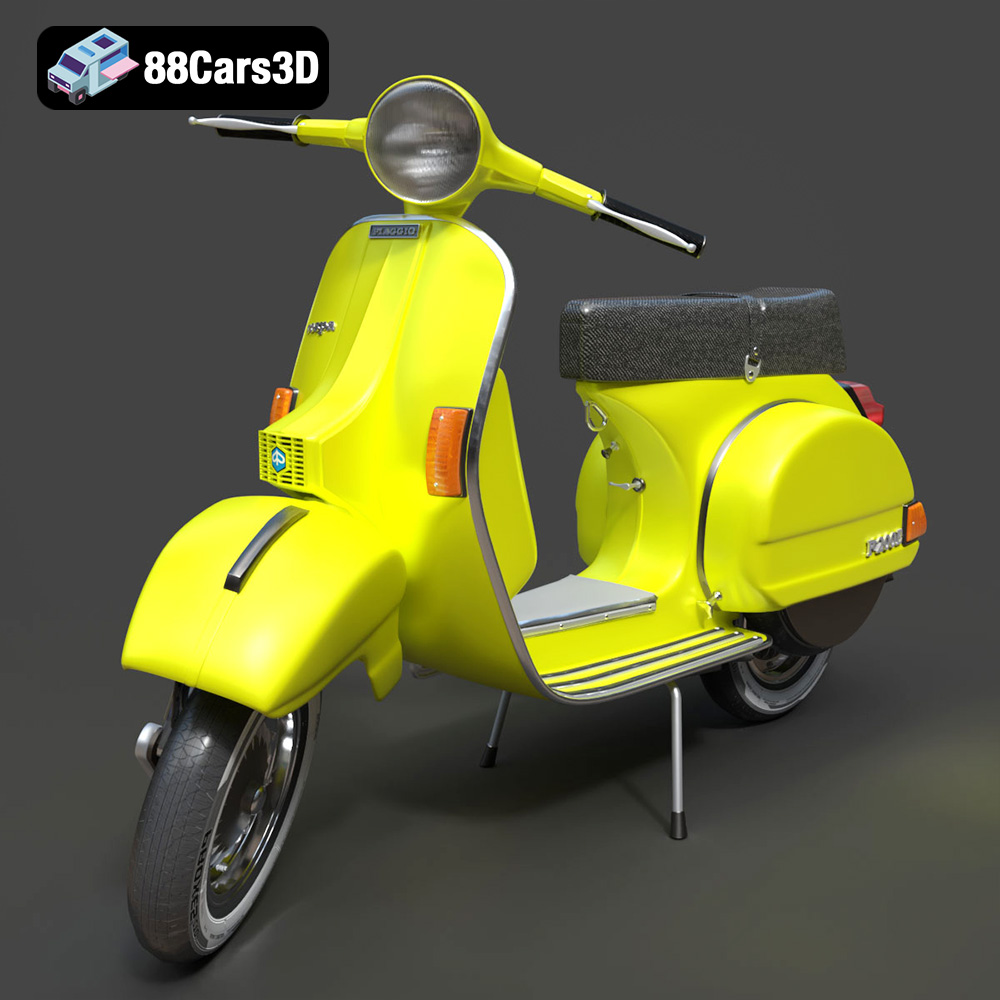
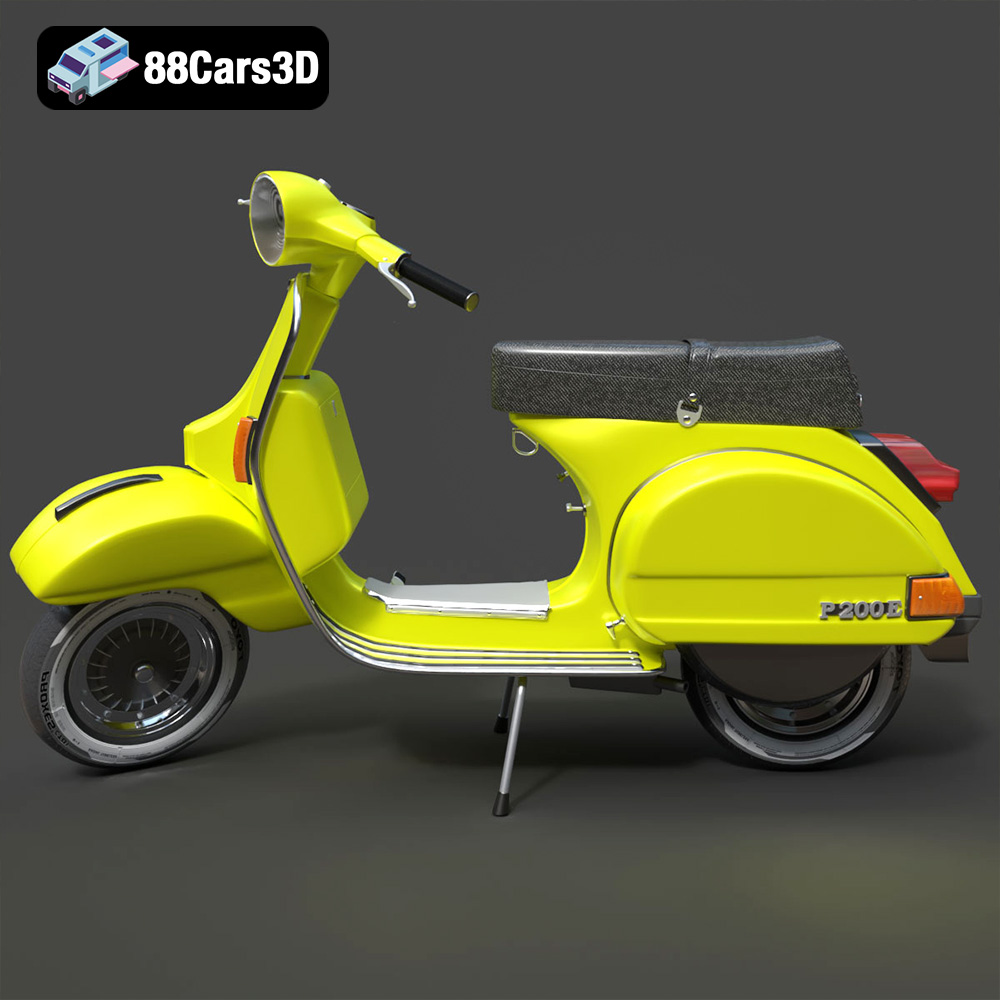
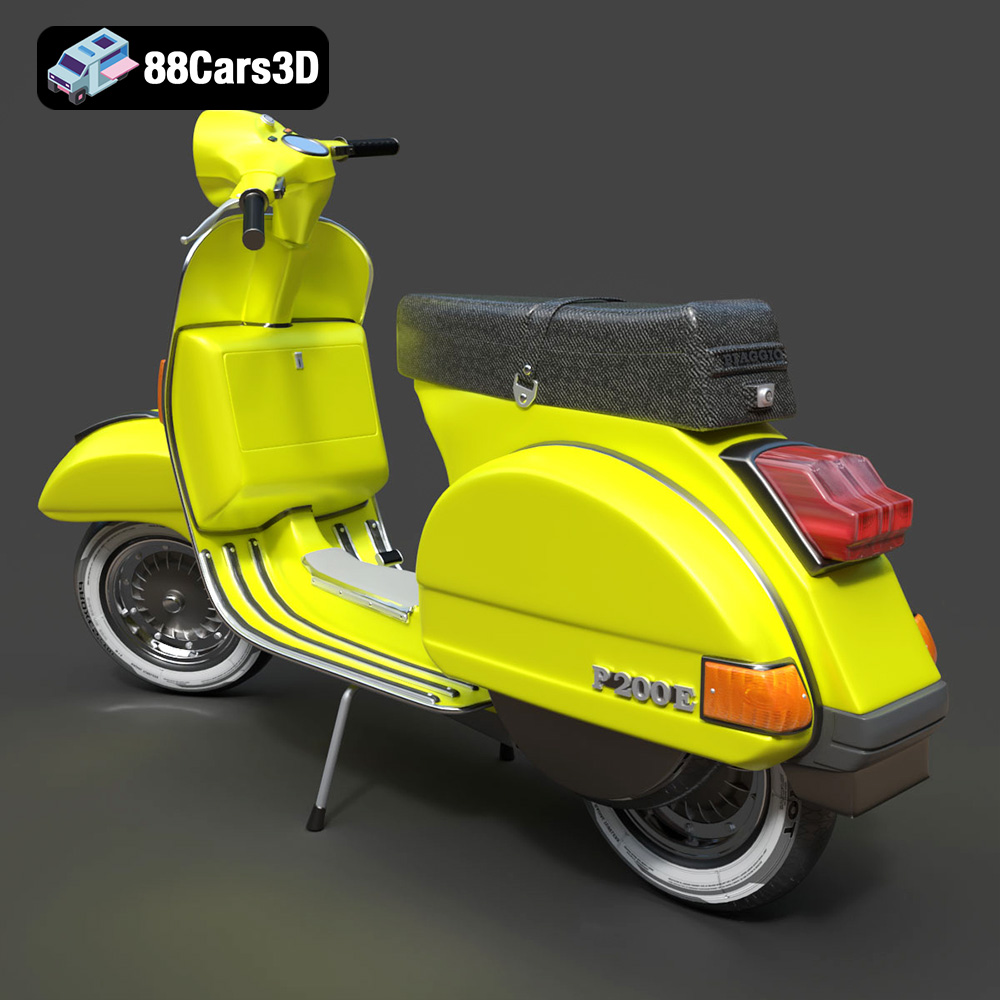
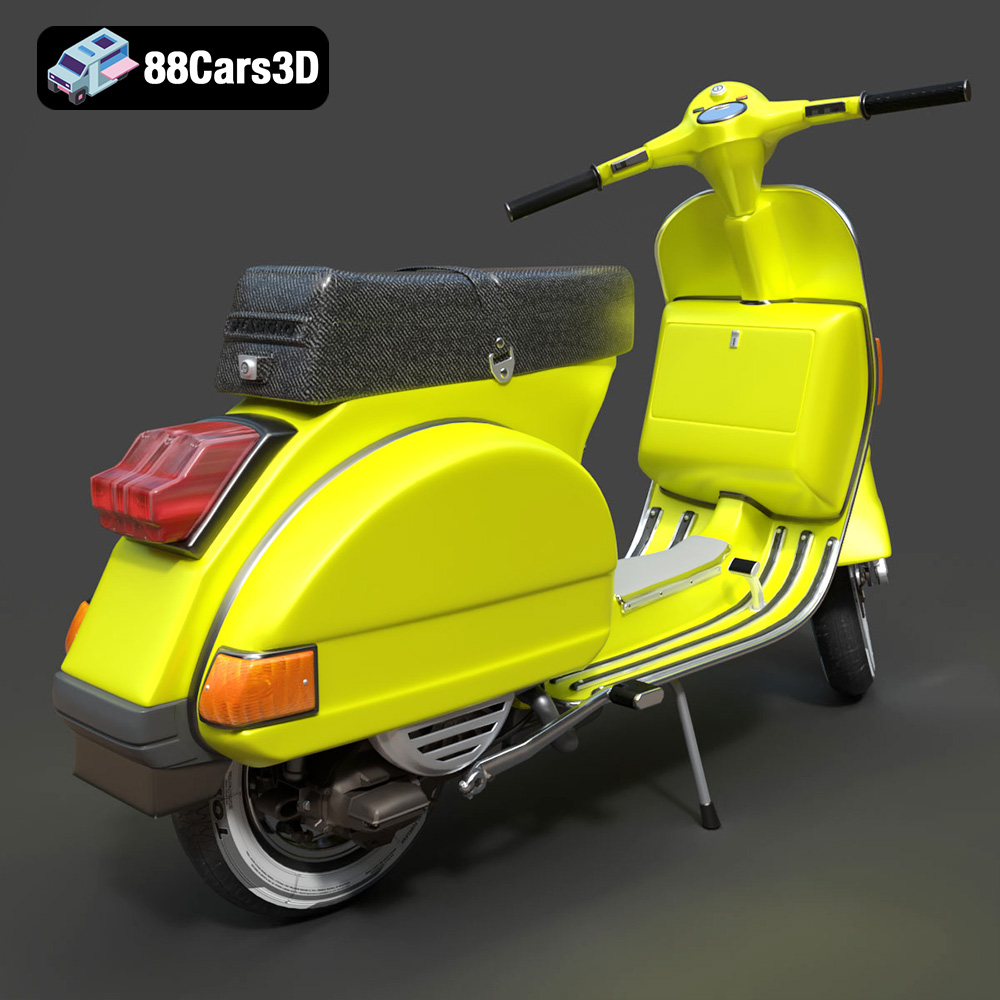
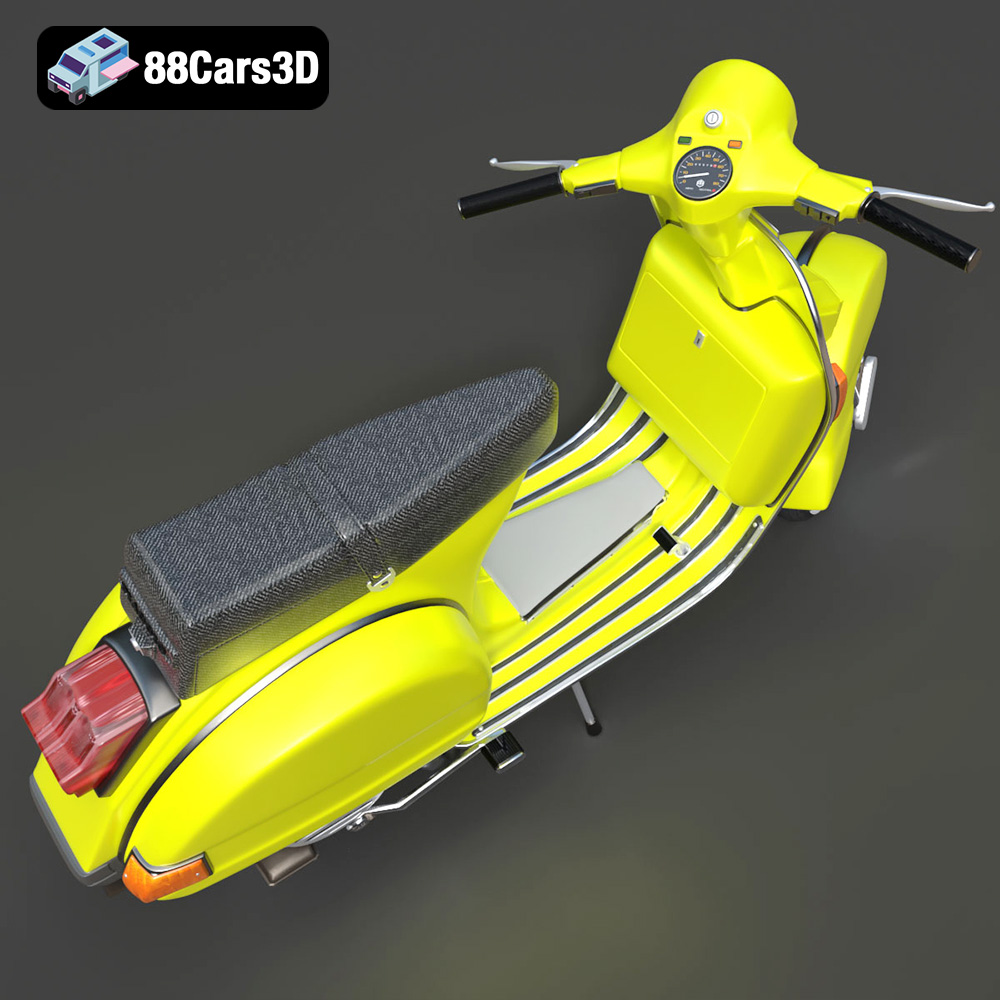
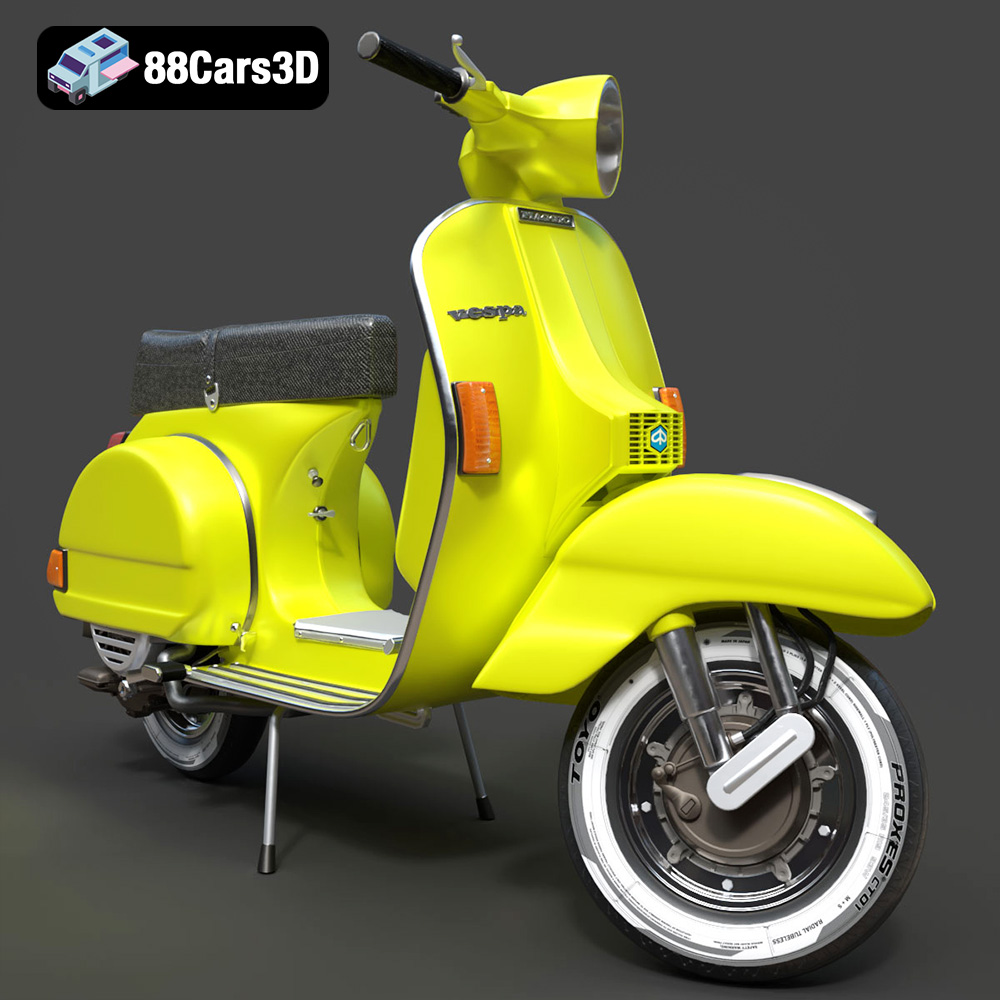
What sets this model apart is the extreme care taken in its recreation. Every curve of the distinctive step-through frame, the signature rear engine cowlings, and the classic vintage aesthetic have been meticulously observed and replicated. From the rounded headlamp and integrated taillight to the accurate 10-inch wheels with classic tread patterns, the model captures the essence of the original. Even the subtle details of the front trailing link suspension and rear mono-shock detailing are present, providing a level of authenticity that elevates any digital scene. For
automotive rendering
specialists, this means a reliable foundation for photorealistic imagery.
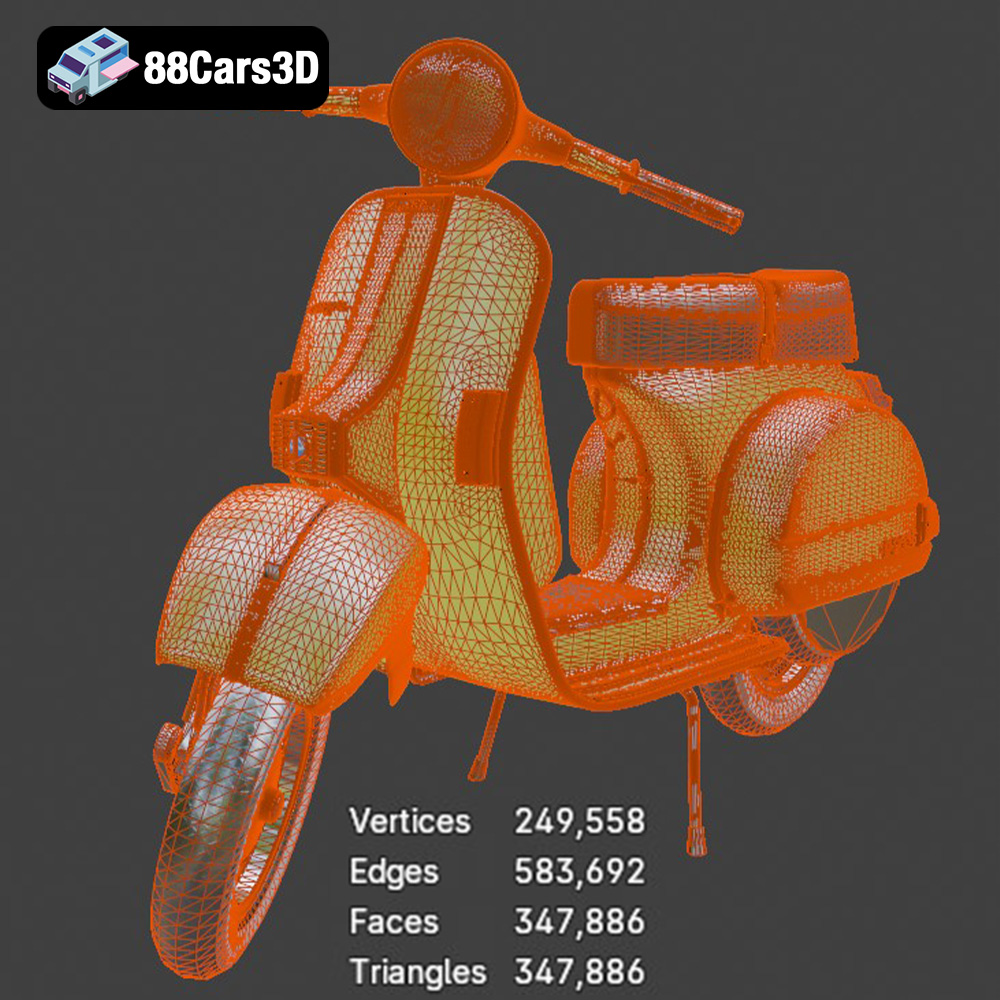
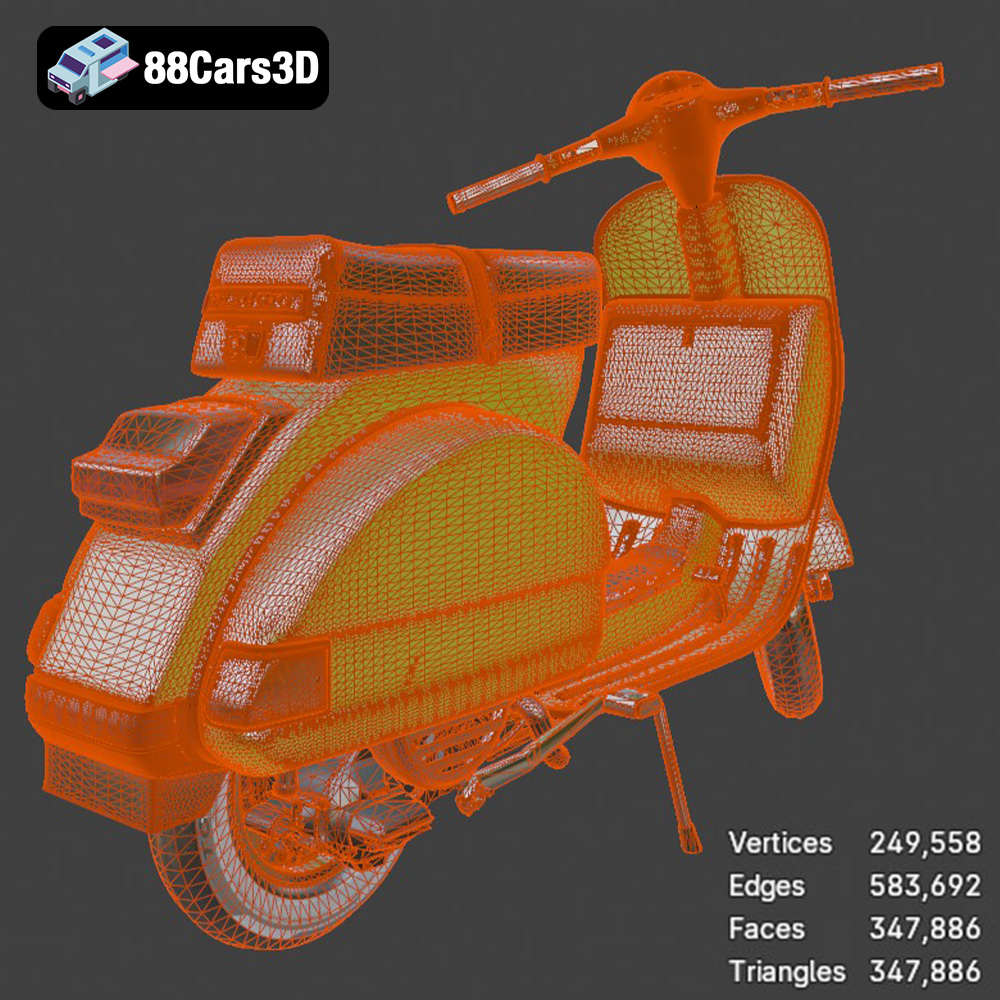
Beyond aesthetic accuracy, the technical craftsmanship of the Vespa P200E 3D Model is equally impressive. It boasts a game-ready topology of approximately 50,000 triangles. This polycount strikes a perfect balance, delivering stunning realism without sacrificing performance in real-time environments. The clean geometry ensures smooth shading and excellent material response, making it highly versatile. Whether you’re developing an open-world game, creating an AR/VR experience, producing high-end marketing visualizations, or even preparing for 3D printing, this model is engineered to perform without the need for extensive re-optimization.
The attention to detail extends to both the exterior and interior features. On the outside, we find accurate frame geometry, a detailed 2-stroke engine housing, and an authentic classic exhaust box. Crucially, components like the wheels, suspension, and steering are separate, making the model highly animatable. Inside, the classic dual-seat design features textured upholstery, and the signature curved handlebars are complete with integrated controls. The authentic vintage analog speedometer and instrument cluster, along with the detailed floorboard and foot brake pedal, are all present. This level of internal detail even allows for compelling first-person POV shots in gaming, truly immersing the user.
For game developers, finding high-quality, optimized
game assets
that integrate seamlessly into their engines is a continuous challenge. The Vespa P200E 3D Model is designed to meet this demand, offering an ideal solution for urban environments, racing titles, and narrative-rich experiences.
The ~50,000 triangle count of the Vespa P200E 3D Model is a testament to its “game-ready” status. This polycount is perfectly optimized for modern game engines like Unreal Engine and Unity, allowing for the inclusion of multiple instances of the scooter in a scene without significant performance impact. The clean mesh topology not only ensures smooth deformation if rigged further but also facilitates efficient rendering. For developers, this means less time spent on optimizing models and more time focusing on gameplay and scene design. Proper UV mapping (implicitly supported by “clean geometry ensuring smooth shading and excellent material response”) ensures that textures are applied without distortion, a critical factor for visual fidelity in real-time.
A static model, no matter how detailed, has limited utility in game development. The Vespa P200E 3D Model addresses this by providing separate components for wheels, suspension, and steering. This intelligent separation, combined with proper pivot setup for steering, wheel rotation, and suspension travel, makes the model easily animatable. Developers can quickly rig these components within their game engine, allowing for realistic vehicle dynamics. Imagine a player character riding through a bustling digital city on this iconic scooter, with its wheels turning, suspension reacting to bumps, and handlebars accurately steering – this model provides the foundational elements for such immersive interactions.
The visual impact of a game environment is significantly boosted by the quality of its assets. The Vespa P200E, with its authentic vintage aesthetic, is perfect for populating urban cityscapes, creating retro-themed levels, or serving as a unique quest objective. Its presence can instantly elevate the visual storytelling of a game, grounding players in a believable and evocative world. Whether featured as a player vehicle, a background prop, or an interactive element, this
game asset
adds a layer of realism and character that generic models often lack, providing a distinct visual identity to your project.
Beyond interactive entertainment, high-fidelity 3D models are indispensable for
automotive rendering
and visualization, spanning advertising, product showcases, and even architectural visualization. The Vespa P200E 3D Model is a prime candidate for crafting breathtaking static or animated visuals.
The inclusion of .max and .blend formats for the Vespa P200E 3D Model makes it immediately ready for professional
automotive rendering
workflows in Autodesk 3ds Max and Blender. Artists can leverage the powerful rendering engines within these applications (e.g., V-Ray, Corona, Cycles, Eevee) to achieve photorealistic results. The model’s clean geometry and well-defined materials serve as an excellent starting point. Artists can easily adjust material properties – glossiness, metallic sheen, roughness – to match specific finishes, from a showroom-pristine look to a weathered, vintage appearance. With the ability to modify body/tank colors, tire textures, and material finishes, the customization options are vast, allowing for truly unique visualizations.
Achieving stunning renders is a delicate dance between lighting, materials, and post-production. With the Vespa P200E 3D Model, artists can experiment with various studio lighting setups, HDRIs (High Dynamic Range Images) for realistic environmental reflections, and direct light sources to highlight its iconic contours. The clean mesh allows for perfect subsurface scattering effects on rubber tires or a subtle metallic flake on the paintwork. In post-production, techniques like color grading, depth of field, motion blur (for animations), and subtle lens flares can be applied to elevate the raw render into a compelling visual narrative. The model’s inherent quality reduces the need for extensive cleanup, streamlining the entire rendering pipeline.
The applications for the Vespa P200E in
automotive rendering
are diverse. In advertising, it can be the centerpiece of a lifestyle campaign, evoking a sense of European charm and freedom. Imagine it parked artfully outside a Parisian café or cruising along an Italian coastline. For architectural visualization, placing the Vespa P200E in front of a modern building or an old-world street scene immediately adds a sense of scale, human activity, and character. In product showcases, companies can use the model to highlight complementary products or simply celebrate the timeless design of the scooter itself, creating virtual showrooms or interactive configurators where customers can personalize their own digital P200E. The precision and detail of models from 88cars3d.com make these scenarios possible and impactful.
The utility of a high-quality 3D model extends far beyond traditional screen-based rendering and gaming. With the rise of immersive technologies and rapid prototyping, assets like the Vespa P200E find new and exciting applications in AR/VR and 3D printing.
The inclusion of the .glb format makes the Vespa P200E 3D Model perfectly suited for Augmented Reality (AR) and Virtual Reality (VR) applications. In AR, imagine placing a life-sized virtual Vespa P200E in your living room using your smartphone, allowing you to walk around it, inspect its details, and even take virtual photos. This is invaluable for virtual showrooms, product configurators, or even educational tools. In VR, the model can populate immersive virtual environments, from a detailed street scene to a historical museum exhibit. The optimized geometry and single-file nature of .glb ensure quick loading times and smooth performance in these demanding real-time, untethered environments, offering a seamless user experience. The Vespa P200E can become a focal point for interactive mobile applications or full-scale virtual walkthroughs.
For enthusiasts and collectors, the ability to physically hold a scale model of the Vespa P200E is a unique thrill. The provided .stl file transforms the digital asset into a tangible object, ready for 3D printing. This opens up possibilities for display models, detailed dioramas, or even custom parts for existing physical models. The technical specifications provided for 3D printing (recommended scales, layer height, wall thickness, infill, supports, and print orientation) are crucial for success. These guidelines ensure that the delicate details of the scooter, from the exhaust box to the handlebars, are accurately captured during the fabrication process, minimizing print failures and maximizing fidelity.
When preparing the Vespa P200E 3D Model for physical output, a few practical tips can make all the difference. Resin printing is often recommended for fine details due to its higher resolution capabilities compared to FDM printers. Printing the frame at an angle improves structural integrity, while printing smaller, intricate parts separately (like mirrors and handlebars) allows for better support placement and detail preservation. Post-processing, including sanding, priming, and painting with authentic factory colors and metallic finishes, is essential to achieve a professional-grade physical replica. This blend of digital precision and hands-on craftsmanship truly brings the iconic scooter to life in a new dimension.
In a competitive digital landscape, the difference between good and great often lies in the quality of the underlying assets. Investing in premium
3D car models
and
game assets
like the Vespa P200E from 88cars3d.com is not merely an expense; it’s a strategic decision that yields significant benefits for any project.
Developing high-fidelity 3D models from scratch is an incredibly time-consuming and resource-intensive process. It requires skilled artists, significant software investments, and countless hours of modeling, texturing, and optimization. By leveraging a pre-optimized, game-ready model like the Vespa P200E, studios and individual artists can drastically cut down on development time and costs. The work of ensuring clean topology, proper UVs, accurate scale, and multiple file formats is already done, allowing your team to focus on creative execution rather than technical groundwork. This efficiency translates directly to faster project turnaround and more effective resource allocation.
In any visualization or interactive experience, authenticity builds trust and immersion. A generic or low-quality 3D model can detract from an otherwise well-designed scene. The Vespa P200E 3D Model, with its meticulous attention to detail – from the classic headlight to the precise engine housing – provides an unparalleled level of realism. This authenticity is critical for
automotive rendering
in marketing campaigns, historical recreations in games, or accurate product representation in AR/VR. High-quality assets elevate the overall production value, making your projects stand out and resonate more deeply with your audience.
The digital design industry is constantly evolving, with new software, rendering techniques, and immersive platforms emerging regularly. Investing in versatile 3D models available in multiple industry-standard formats (like .fbx, .blend, .max, .glb, .stl) ensures that your assets remain relevant and usable across future pipelines. A well-constructed model, like the Vespa P200E, is a future-proof investment, adaptable to different scales, detail levels, and rendering environments. Building a robust library of such assets enhances your studio’s capabilities and preparedness for diverse client needs and technological advancements.
The Vespa P200E is more than just a scooter; it’s a cultural icon, and its digital rendition demands a level of quality and versatility that few models achieve. The
Vespa P200E 3D Model
from 88cars3d.com stands as a testament to meticulous craftsmanship and technical optimization, offering a truly exceptional asset for a wide range of applications. Whether your goal is to create stunning
automotive rendering
for advertising, develop immersive
game assets
for a new title, design cutting-edge AR/VR experiences, or even produce highly detailed 3D prints, this model provides an unparalleled foundation.
Its thoughtful design, game-ready topology, and comprehensive suite of file formats (from .blend and .max for deep editing, to .fbx for universal compatibility, .glb for web/AR/VR, and .stl for 3D printing) ensure that professionals across various disciplines can integrate it seamlessly into their workflows. By choosing such high-quality
3D car models
, you’re not just acquiring an asset; you’re investing in efficiency, authenticity, and the power to bring your creative visions to life with unparalleled detail. Explore this exceptional model and more at 88cars3d.com, where quality meets digital innovation.
The Vespa P200E is a true icon of Italian design, celebrated for its timeless styling and reliable 2-stroke engine. This 3D model perfectly captures the scooter’s distinctive step-through frame, signature rear engine cowlings, and classic vintage aesthetic that made it a cultural phenomenon. From the rounded headlamp to the unmistakable tail section, every curve has been meticulously recreated to offer an authentic representation of this legendary two-wheeler. Crafted with a focus on optimization and visual fidelity, this model features a game-ready topology of approximately 50,000 triangles. It delivers stunning realism without sacrificing performance in real-time environments. The clean geometry ensures smooth shading and excellent material response, making it highly versatile for game development, AR/VR applications, animation, and high-end visualization. Perfect for urban cityscapes, vintage street scenes, lifestyle brand rendering, and interactive mobile applications.
$39.99
.blend
.fbx
.glb
.max
.obj
.ply
.rendering
.scooter
.stl
.unreal
.vespa
.vintage
classic-scooter
game asset
game-ready
low-poly
motorcycle-3d-model
optimized
p200e
VR/AR