Get 20% OFF All Premium 3D & STL Models!

In the dynamic worlds of automotive design, game development, cinematic rendering, and immersive AR/VR experiences, the quality of your 3D assets can make or break a project. From the sleek lines of a modern supercar to the rugged utility of a historical classic, a meticulously crafted 3D car model is more than just geometry; it’s a foundation for storytelling, interaction, and visual fidelity. Professionals across these industries constantly seek assets that not only look stunning but are also technically robust, optimized for performance, and versatile enough to integrate seamlessly into diverse pipelines.
Imagine bringing to life a piece of history, an iconic vehicle that defied convention and conquered challenging terrains. One such marvel is the Volkswagen Schwimmwagen Typ 166, a testament to ingenious engineering and wartime versatility. This legendary amphibious off-road vehicle, with its distinctive boat-like hull and robust design, holds a unique place in automotive history. For artists and developers looking to recreate historical scenes, develop immersive simulations, or simply appreciate automotive heritage, a high-quality 3D model of the Schwimmwagen is an invaluable asset. It’s precisely this blend of historical accuracy and technical excellence that platforms like 88cars3d.com specialize in providing, offering a gateway to a vast library of professionally crafted 3D car models.
The journey of a 3D car model from concept to a rendered scene or game engine involves navigating a complex ecosystem of file formats. Each format serves a specific purpose, offering unique advantages for different stages of the 3D pipeline. Understanding these formats is crucial for professionals seeking to optimize their workflows, ensure compatibility, and leverage the full potential of their 3D assets. The Volkswagen Schwimmwagen Typ 166 3D model, for instance, comes packed with a comprehensive suite of file types, catering to virtually every professional need.
The .blend format is the native file type for Blender, the widely acclaimed open-source 3D creation suite. When you acquire a .blend file, you’re not just getting a static model; you’re gaining access to a fully editable Blender scene. This includes the model’s geometry, materials, textures, lighting, camera setups, and even animation data. For artists who use Blender as their primary DCC (Digital Content Creation) tool, the .blend format offers unparalleled flexibility for customization, rigging, animation, and rendering within the Blender environment. It’s ideal for those who want to delve deep into the model’s construction, make significant modifications, or integrate it into complex Blender-based projects, from architectural visualization to short film production.
As Autodesk’s proprietary format, .fbx (Filmbox) has become the de facto standard for exchanging 3D data between different software applications and particularly for real-time engines like Unreal Engine and Unity. It’s renowned for its ability to store not only geometry and materials but also complex animation data, skeletal rigs, and even embedded textures. For game developers and VFX artists, .fbx is often the format of choice due to its robust support for mesh hierarchies, joint information, and animation curves, making it ideal for characters, vehicles, and animated props. When importing a Schwimmwagen model as .fbx, you can expect its pivot points, scale, and general structure to transfer cleanly, streamlining its integration into game development pipelines.
.obj (or Wavefront OBJ) is one of the oldest and most widely supported 3D file formats, making it a truly universal choice for cross-software compatibility. It primarily stores geometry (vertices, normals, texture coordinates, and faces) and can reference external material files (.mtl). While it doesn’t support animation or advanced rigging, its simplicity and widespread adoption ensure that nearly every 3D application can open and interpret an .obj file. This makes it an excellent fallback or starting point for projects where maximum compatibility is paramount, or when you only need the raw mesh data of your 3D car models for sculpting or retopology work.
Developed by the Khronos Group, .glb (GL Transmission Format Binary) is the binary version of glTF, specifically designed for efficient transmission and loading of 3D scenes and models by engines and applications. It’s rapidly gaining traction as the standard for 3D content on the web, AR (Augmented Reality), and VR (Virtual Reality) platforms due to its compact size and comprehensive capabilities. A single .glb file can contain geometry, materials (PBR ready), textures, animations, and scene graph information, all self-contained. For developers looking to showcase the Schwimmwagen in an interactive web viewer, a mobile AR experience, or an immersive VR environment, the .glb format offers optimal performance and ease of deployment.
.stl (stereolithography) is almost exclusively used for 3D printing. This format represents a 3D object as a raw, unstructured triangular mesh, defining only the surface geometry of a 3D object without color, texture, or other CAD attributes. When preparing the Schwimmwagen for physical fabrication, an .stl file ensures that the printer receives a watertight mesh ready for slicing. The product description highlights its suitability for hobbyists printing at various scales (1:16, 1:35, 1:24), emphasizing the importance of this format for tangible recreations of the iconic vehicle.
The .ply (Polygon File Format or Stanford Triangle Format) is another format for storing 3D data, particularly useful for high-precision mesh data often derived from 3D scanners or for CAD (Computer-Aided Design) and scientific analysis. While it can store color and other properties per vertex or face, it’s typically employed when geometric accuracy and detailed mesh information are critical, such as for reverse engineering, quality inspection, or advanced simulations. It offers more flexibility than .obj in terms of storing additional mesh properties.
The .unreal format isn’t a standalone file type in the traditional sense, but rather indicates that the asset has been specifically pre-packaged and optimized for direct import into Unreal Engine. This often means the asset includes properly set up materials (using Unreal’s PBR workflow), collision meshes, LODs (Levels of Detail), and correct scale, saving developers significant time on asset preparation. Acquiring the Schwimmwagen in this “engine-ready” state means it’s practically a plug-and-play solution for your Unreal Engine projects, significantly accelerating development cycles for games, simulations, and virtual productions.
Similar to .blend for Blender, .max is the native project file format for Autodesk 3ds Max, a leading software for 3D modeling, animation, rendering, and visual effects. A .max file contains the complete scene data, including all models, lights, cameras, materials, modifiers, animation curves, and scene settings. For professionals working within the 3ds Max ecosystem, the .max file provides the highest level of editability and allows full access to the model’s construction, enabling advanced customizations, complex rigging, and integration into sophisticated animation and rendering pipelines. The availability of this format for the Schwimmwagen ensures maximum flexibility for those entrenched in 3ds Max workflows.
The comprehensive range of file formats offered with the Volkswagen Schwimmwagen Typ 166 3D model ensures that regardless of your software preference or project requirements, you have a perfectly tailored asset at your disposal. This versatility is a hallmark of high-quality 3D car models found on platforms like 88cars3d.com, empowering artists and developers with the tools they need to succeed.
Recreating historical vehicles in 3D demands a meticulous blend of artistic skill and rigorous research. The Volkswagen Schwimmwagen Typ 166, an engineering marvel of its time, presents a fascinating challenge. Its unique design, born out of a specific functional requirement, means every curve, rivet, and component tells a story. A truly exceptional 3D model doesn’t just replicate its form; it captures its essence, allowing users to experience a piece of history firsthand, whether through immersive simulation or cinematic rendering.
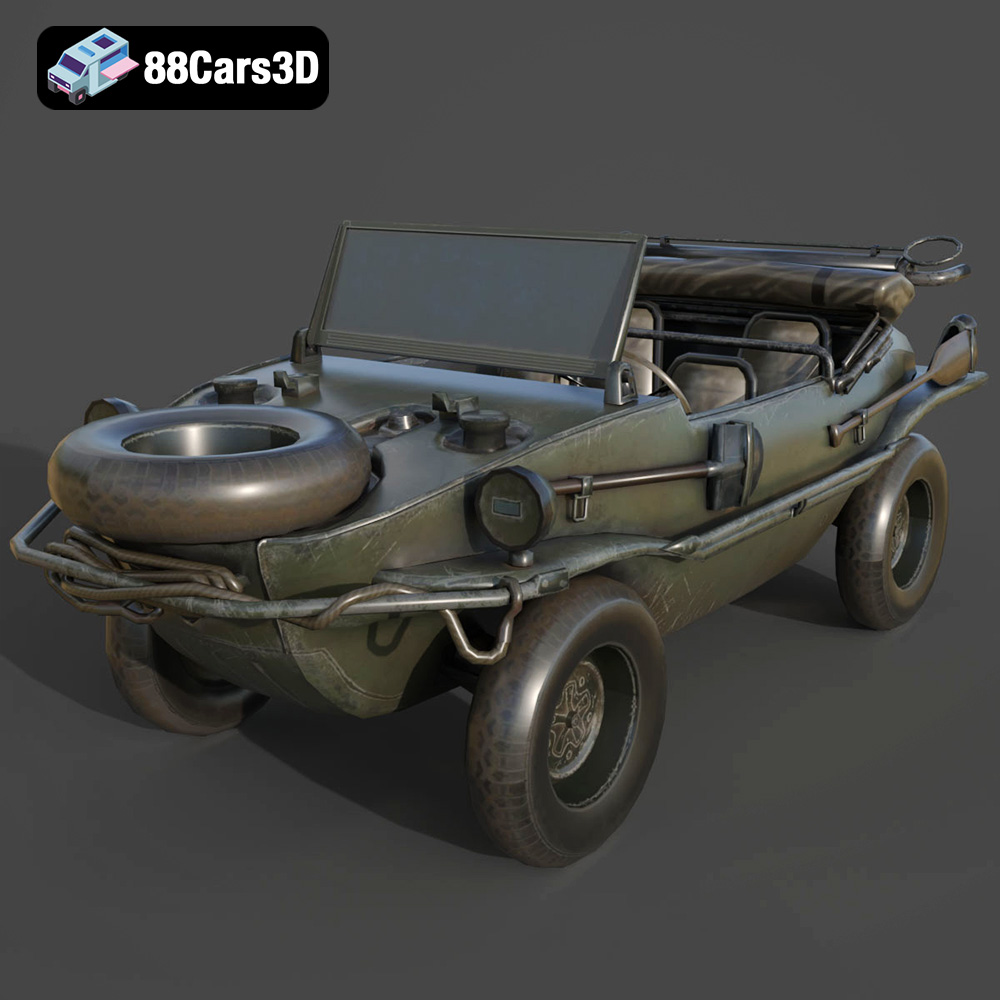
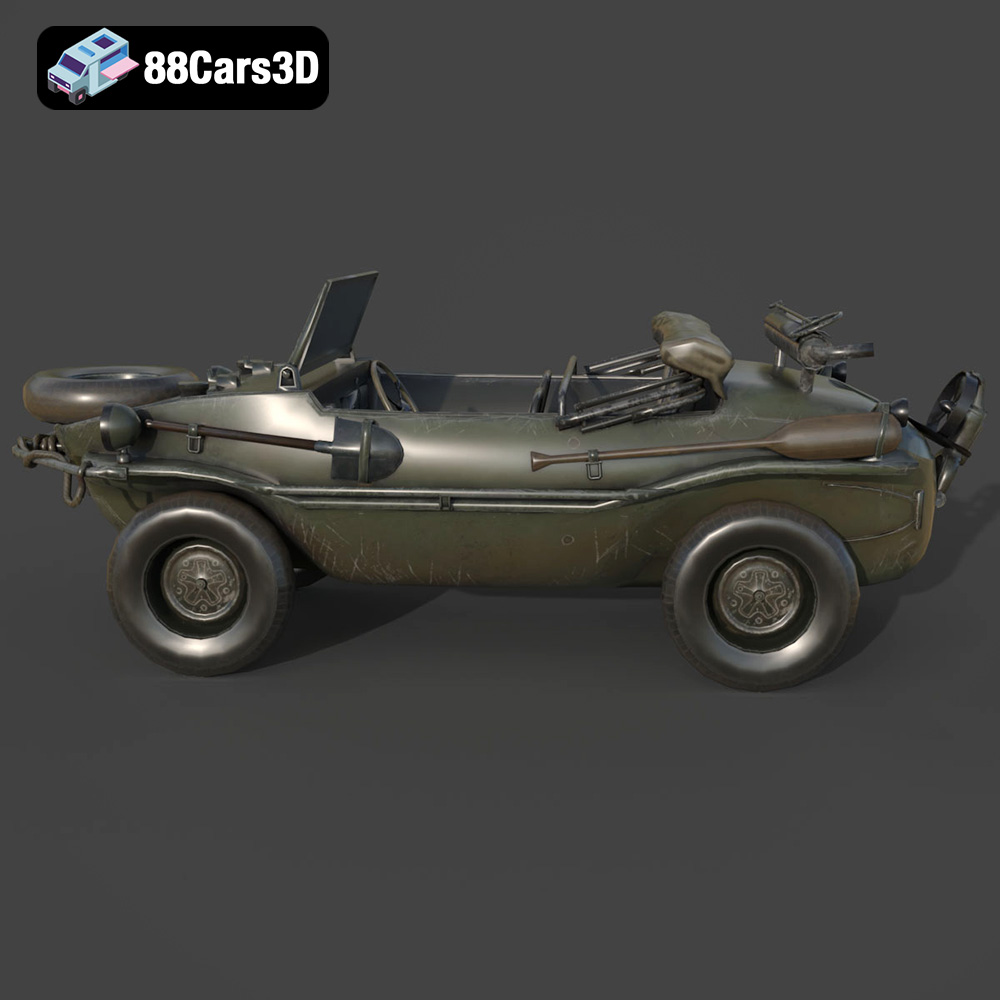
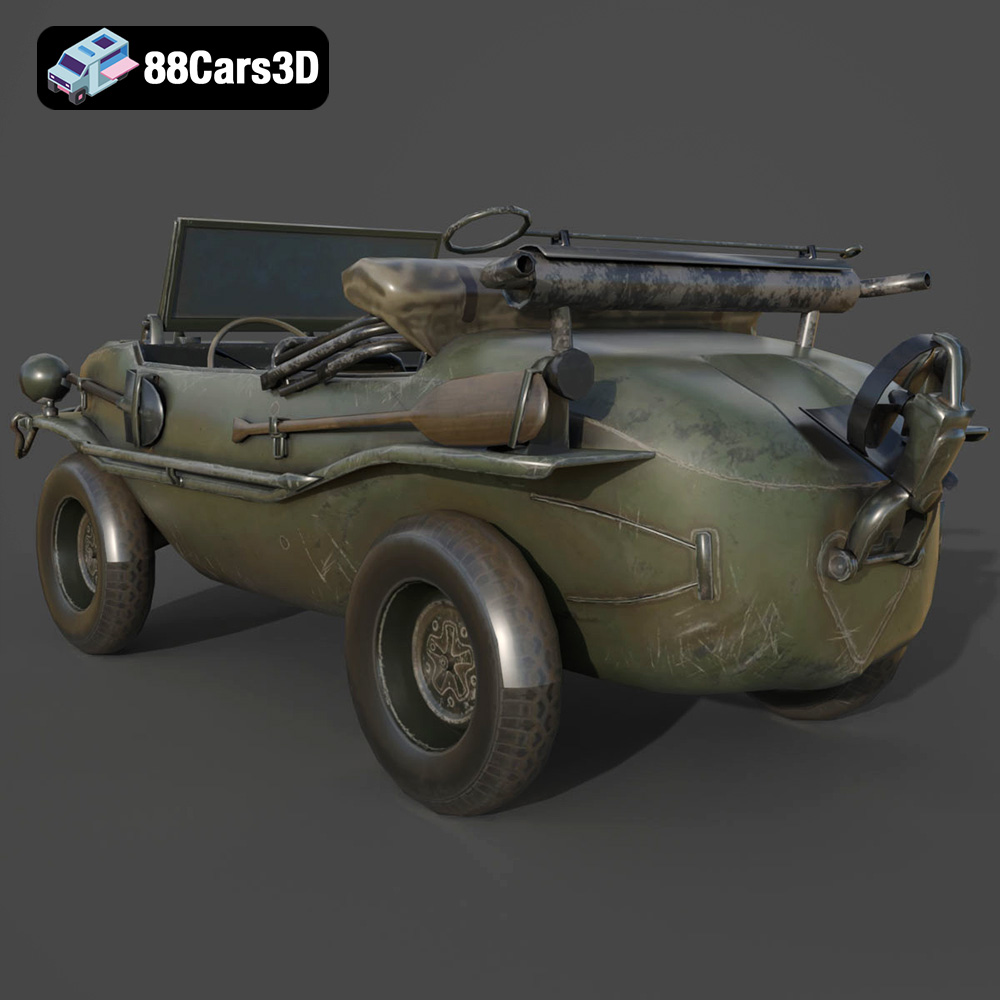
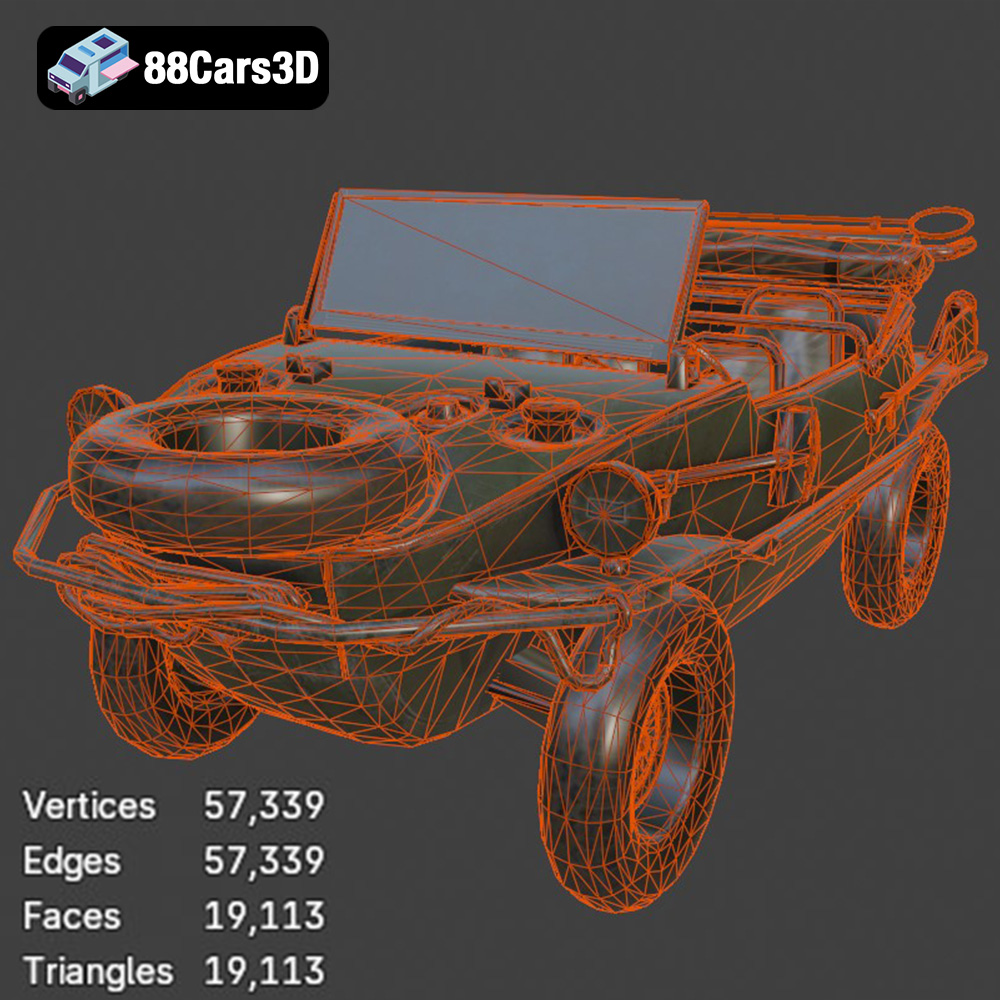
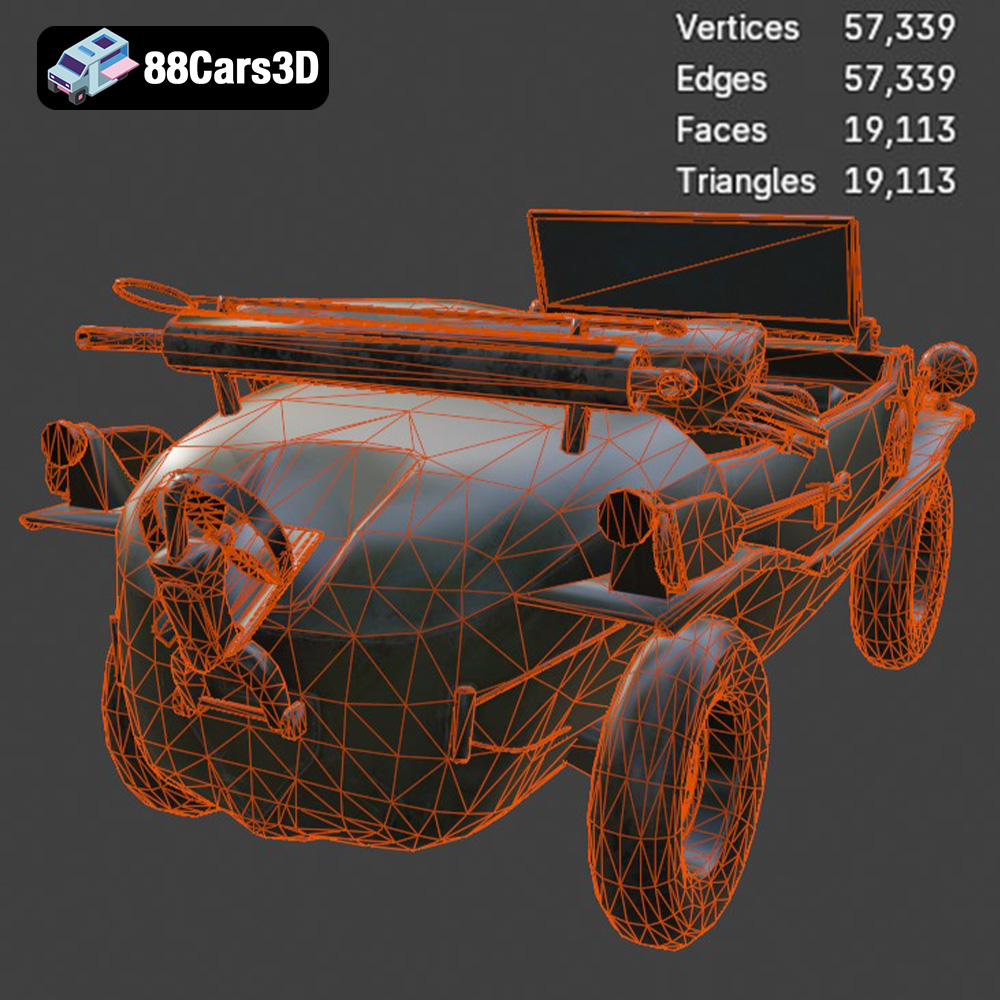
The Schwimmwagen’s exterior is its most defining feature. Its watertight hull geometry, designed to glide through water, needed to be precisely replicated, right down to its distinctive proportions. The 3D model meticulously captures the rear-mounted air-cooled flat-four engine housing, a key characteristic of Volkswagen’s wartime vehicles, and integrates an authentic fold-down rear propeller mechanism. This isn’t merely an aesthetic detail; its separate geometry means it’s ready for animation, allowing for realistic deployment and retraction. Period-accurate military lighting, including blackout headlamps, along with high-tread off-road tires and stamped steel wheels, complete the rugged, utilitarian look. Even the leaf spring and torsion bar suspension details, crucial for its off-road capability, have been faithfully modeled. This level of detail elevates the model from a simple visual asset to a historical document, perfect for military simulations, educational content, or even World War II dioramas. The attention to separate components like wheels, propeller, suspension, and steering further enhances its utility for animators seeking dynamic movement.
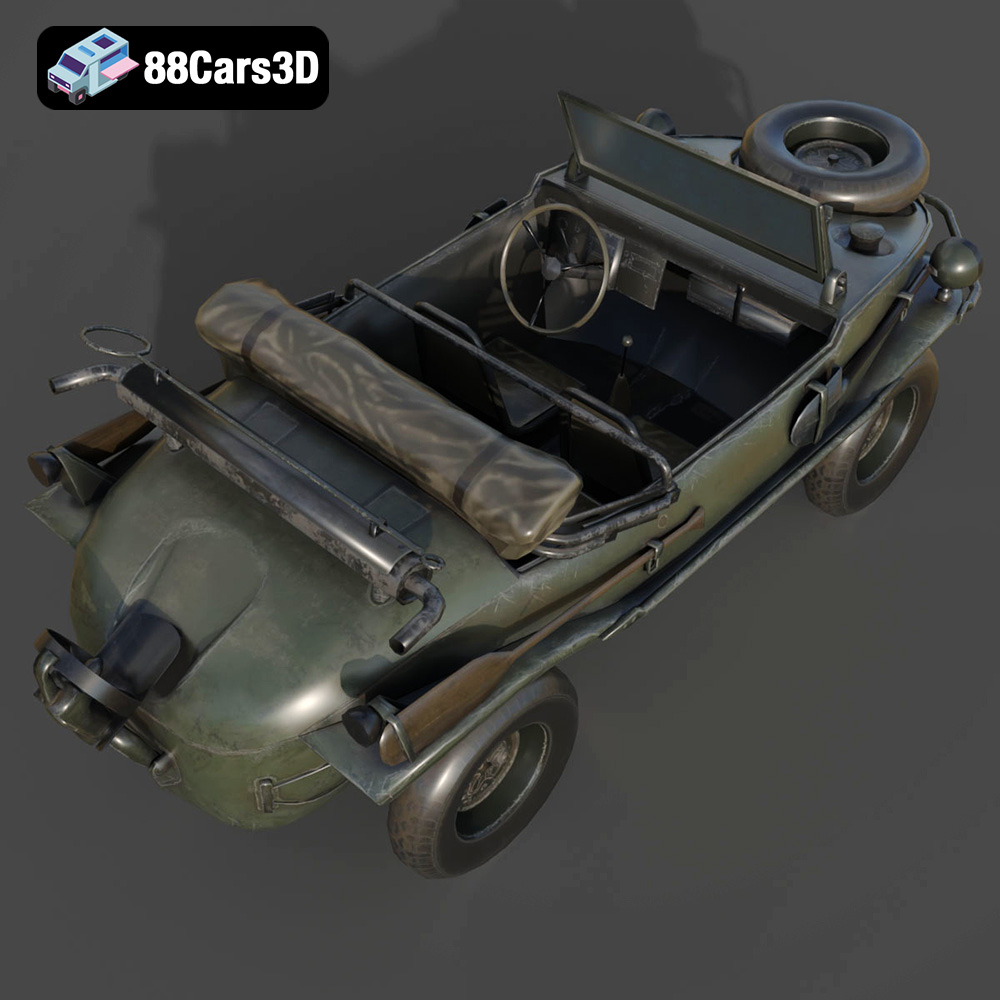
While the Schwimmwagen’s exterior commands attention, its interior is equally critical for immersive experiences, particularly for first-person viewpoints in gaming or AR/VR simulations. The 3D model provides a detailed yet utilitarian cockpit and crew space, true to its military-spec origins. This includes minimalist front and rear military seating, designed for functionality rather than comfort. The three-spoke steering wheel and authentic column, along with the sparse instrument cluster and gauges, transport the user directly into the driver’s seat of a wartime vehicle. Crucially, the detailed floor-mounted gear shifter and 4WD engagement levers are modeled with precision, allowing for interactive elements in game development. The optimized geometry ensures that even from a first-person perspective, the visual fidelity holds up without overburdening real-time engines, striking a perfect balance between detail and performance.
In the world of real-time applications like video games, AR/VR experiences, and interactive visualizations, simply having a beautiful 3D model isn’t enough. It must also be highly optimized to run smoothly across various hardware configurations without sacrificing visual realism. This delicate balance between visual fidelity and performance is a hallmark of expertly crafted 3D car models, and the Volkswagen Schwimmwagen Typ 166 3D model exemplifies this engineering prowess.
One of the most critical technical specifications for any game-ready asset is its polygon count. The Schwimmwagen model boasts approximately 150,000 triangles. This figure represents a sweet spot: it’s detailed enough to convey the intricate historical design and rugged textures, yet optimized to run efficiently in demanding real-time environments such as Unreal Engine and Unity. The topology—the arrangement of polygons—is clean and efficient, avoiding unnecessary complexity that can hinder performance or cause rendering artifacts. This attention to optimized topology ensures that the model can be integrated into large-scale environments with many other assets without significant frame rate drops, making it ideal for open-world games or complex simulators. For developers, this means less time spent on manual optimization and more time on creative implementation.
Beyond static visual appeal, the true value of a versatile 3D car model lies in its capacity for dynamic interaction. The Schwimmwagen model comes with a proper pivot setup for key movable components: steering, wheel rotation, propeller deployment, and suspension travel. This pre-configured pivot setup is a tremendous advantage for animators and riggers. Instead of spending hours meticulously setting up pivot points, they can immediately begin animating the vehicle’s functions, bringing it to life with realistic movement. This includes the subtle bounce of the suspension over terrain, the precise rotation of the wheels, the operational steering, and the iconic deployment of the rear propeller when transitioning from land to water. This level of preparation significantly accelerates the animation pipeline, allowing for complex interactive behaviors in games or compelling sequences in cinematic renders. The separate components, such as wheels, suspension parts, and the propeller, further facilitate independent rigging and animation, offering maximum control and flexibility to the artist.
The utility of a high-quality 3D car model like the Volkswagen Schwimmwagen Typ 166 extends far beyond its historical context. Its robust design and optimized technical specifications make it a truly versatile asset, adaptable to a wide range of professional applications, from interactive media to static visualization.
For game developers, the Schwimmwagen model is a ready-made treasure. Its optimized polycount (~150,000 triangles) is perfectly suited for modern game engines. When working with Unreal Engine or Unity, developers can leverage the provided .fbx or .unreal/.blend files. Importing the .fbx typically involves creating new materials within the engine, configuring PBR (Physically Based Rendering) texture maps (albedo, normal, metallic, roughness, ambient occlusion), and setting up collision meshes. The .unreal format, on the other hand, often implies a more streamlined import, potentially with materials and even basic collision already configured, saving valuable development time. The proper pivot setup for wheels, steering, and the propeller directly translates into easier vehicle rigging and animation systems within the engine, allowing for realistic driving mechanics, amphibious transitions, and interactive elements in open-world games, racing titles, or military simulators. Its real-world scale accuracy ensures it fits seamlessly into environments built to true proportions, enhancing player immersion.
Beyond interactive applications, the Schwimmwagen 3D model shines in high-fidelity rendering for brand campaigns, lifestyle scenes, and studio lighting setups. For automotive rendering artists, having a detailed model with clean topology and accurate proportions is fundamental. Using software like 3ds Max with V-Ray or Corona, or Blender with Cycles, artists can achieve breathtaking photorealistic results. The model allows for sophisticated material customization—from weathered military greens with subtle metallic glints to battle-scarred camouflage patterns. It can be placed in a variety of contexts: a serene lakeside setting for a historical documentary, a dramatic dusty off-road scene, or even an unexpected juxtaposition in an urban architectural visualization project. Its detailed exterior and interior mean close-up shots maintain visual integrity, crucial for cinematic quality and detailed marketing imagery. For those using 3ds Max, the included .max file offers native editing capabilities, enabling advanced scene composition, lighting studies, and complex animation sequences without compatibility issues.
The Schwimmwagen’s unique status as an iconic amphibious vehicle makes it a prime candidate for AR/VR experiences. Imagine a virtual museum tour where users can walk around, inspect, and even virtually drive this historical vehicle, transitioning from land to water seamlessly. The optimized geometry and the inclusion of the .glb format make it ideal for such immersive virtual showrooms, educational experiences, and mobile AR applications, ensuring smooth performance on various devices. Furthermore, for enthusiasts and model makers, the model’s availability in .stl format opens the door to 3D printing. Hobbyists can reproduce the Schwimmwagen at scales like 1:16, 1:35 (military modeling standards), or 1:24. The product provides detailed 3D print settings, recommending resin printing for fine details, specific layer heights, wall thickness, infill percentages, and crucial support requirements. This allows for tangible, display-scale replicas, bridging the gap between digital asset and physical artifact, truly bringing history to life.
The true power of a professional 3D car model lies not just in its initial quality but also in its adaptability. The Volkswagen Schwimmwagen Typ 166 3D model is designed with customization in mind, allowing artists and developers to tailor its appearance and integrate it seamlessly into their unique project workflows. This flexibility is a key differentiator for assets procured from trusted sources like 88cars3d.com, ensuring they meet diverse creative demands.
While the model arrives with authentic, period-accurate materials, the ability to customize them is paramount for specific project needs. Users can easily change body colors, applying anything from original factory military greens to custom finishes or intricate camouflage patterns. Imagine a weathered, mud-splattered version for a battlefield scene versus a pristine, museum-quality display. The model supports modification of tire textures, allowing for options like off-road mud variants for a rugged look or clean versions for a showroom presentation. Material finishes can be adjusted from matte to gloss, metallic, or even heavily weathered metal to reflect different conditions or stories. Adapting lighting for various environments further enhances this customization, allowing the Schwimmwagen to appear under the harsh sun of a desert, the overcast sky of a European winter, or the dramatic lighting of a cinematic set. This granular control over visual attributes empowers artists to create truly unique iterations of the vehicle.
For artists deeply invested in specific DCC applications, the inclusion of native project files like .max (for 3ds Max) and .blend (for Blender) is an invaluable asset. These files provide full access to the model’s underlying geometry, modifier stacks, material setups, and scene organization. In 3ds Max, users can leverage the full array of modeling tools, FFD modifiers, and complex material editors to make intricate changes. Animators can utilize 3ds Max’s robust rigging and animation tools to create highly detailed movement sequences for the Schwimmwagen, perhaps simulating a complex terrain traversal or a dynamic water entry. Similarly, Blender users can take advantage of its powerful Cycles or Eevee render engines, non-destructive workflows, and extensive add-on ecosystem to further enhance or modify the model. This level of native file support means that advanced customization, complex animation, or even retopology for extreme optimization is not just possible but streamlined, ensuring maximum creative freedom and project longevity for these high-quality 3D car models.
The journey of a 3D car model, from its meticulous creation to its diverse applications across industries, underscores the critical importance of quality, optimization, and versatility. The Volkswagen Schwimmwagen Typ 166 3D model stands as a testament to this principle, offering a historically accurate, technically robust, and highly adaptable asset for professionals. Whether your goal is to develop an immersive game, produce photorealistic renders, create an engaging AR/VR experience, or even 3D print a tangible piece of history, this model provides the necessary foundation.
With its optimized polycount, clean topology, animation-ready components, and comprehensive suite of file formats—including .blend, .fbx, .obj, .glb, .stl, .ply, .unreal, and .max—it addresses the technical demands of virtually any modern 3D pipeline. This commitment to detail and usability is what sets professional 3D car models apart and what artists and developers expect from reputable marketplaces. By choosing assets that combine historical authenticity with cutting-edge technical specifications, you empower your projects with unparalleled visual fidelity and performance, ultimately delivering more engaging and impactful experiences. For those seeking such high-caliber assets, exploring the curated selection at 88cars3d.com offers a reliable path to elevating your digital automotive endeavors.
The Volkswagen Schwimmwagen Typ 166 is an iconic World War II amphibious off-road vehicle, celebrated for its rugged durability and unique boat-like hull design. Serving as one of the most mass-produced amphibious cars in history, it features a distinctive rear-mounted air-cooled flat-four engine, a fold-down propeller system, and four-wheel drive capability. This highly accurate 3D model meticulously captures its utilitarian military aesthetics, from the riveted watertight chassis to the spare tire mounted on the sloping front hood. Engineered with exceptional attention to detail, this 3D model boasts optimized topology and an efficient triangle count, ensuring it is fully game-ready without compromising on visual fidelity. Whether you are developing a historic military simulator, creating an immersive AR/VR educational experience, or producing high-end cinematic renders, this model delivers unparalleled realism and performance across all major real-time engines and 3D software.
$39.99
.blend
.fbx
.glb
.max
.obj
.ply
.rendering
.stl
.unreal
.volkswagen
amphibious-vehicle
car-3d-model
classic-car
game asset
game-ready
low-poly
military-vehicle
off-road
optimized
schwimmwagen-typ-166
VR/AR
ww2-vehicle