Get 20% OFF All Premium 3D & STL Models!

In the vibrant world of 3D visualization and interactive experiences, the demand for high-quality, meticulously crafted 3D car models is ever-growing. From the realism of automotive rendering to the immersive environments of game development and the practical applications of architectural visualization, a robust 3D asset forms the backbone of any successful project. Today, we’re taking a deep dive into an excellent example of such an asset: the Mitsubishi Outlander GT 2010 3D Model, available for download on 88cars3d.com.
This particular model stands out not just for its accurate representation of the acclaimed crossover SUV, known for its aggressive ‘Jet Fighter’ front grille and advanced S-AWC all-wheel-drive system, but also for its technical prowess. It’s a game-ready asset that beautifully balances visual fidelity with optimized performance, making it a versatile choice for a wide array of professional applications. Whether you’re developing the next big open-world game, crafting stunning product visualizations, or creating immersive AR/VR experiences, understanding the nuances of such a model, and the file formats it comes in, is crucial.
The versatility of a 3D model often hinges on the file formats it supports. Different formats are optimized for specific workflows, software, and end-use applications. The Mitsubishi Outlander GT 2010 3D Model, for instance, offers an impressive array of formats, ensuring maximum compatibility and utility across various professional pipelines. Let’s break down each one:
The .blend format is Blender’s native file type. It’s incredibly powerful because it stores everything about your Blender project: the 3D mesh data, materials, textures, lighting, cameras, animation, physics simulations, modifiers, and even the user interface layout. For professionals working primarily in Blender, having a .blend file means full editability. You can dissect the model, adjust its topology, modify materials with Blender’s Cycles or Eevee render engines, fine-tune rigging, or extend animations directly within the native environment. This format offers the most flexibility for those who wish to deeply customize or integrate the Outlander model into a Blender-centric workflow.
The .fbx (Filmbox) format is arguably the most widely used 3D interchange format in the entertainment industry. Developed by Autodesk, it’s ideal for transferring 3D data between various applications, especially for game engines like Unreal Engine and Unity, and other DCC (Digital Content Creation) software. FBX excels at supporting complex scene data, including geometry, materials, textures, animations, and even rigging. For the Mitsubishi Outlander GT 2010 model, the .fbx file ensures that all elements—from the accurate frame geometry to the separate wheels and suspension components for animation—are preserved when imported into a new environment. Its robust support for real-time pipelines makes it a critical component for game developers and real-time visualization artists.
The .obj (Wavefront Object) format is a highly universal and widely supported file type, recognized by virtually every 3D application. It primarily stores geometric data (vertices, faces, UV coordinates) and can reference external material (.mtl) and texture files. While it doesn’t support animation or rigging, its simplicity and widespread compatibility make it an excellent choice for straightforward mesh transfer. If you need to bring the Mitsubishi Outlander GT 2010 into a niche 3D application or simply need the raw mesh data without complex scene information, .obj is a reliable fallback. It’s also often used as a base for retopology or high-resolution sculpting.
The .glb (GL Transmission Format Binary) is a relatively newer format gaining significant traction, particularly for web-based 3D, augmented reality (AR), and virtual reality (VR) applications. It’s a compact, self-contained format that embeds all necessary data—geometry, materials, textures, and even animation—into a single binary file. This makes .glb incredibly efficient for streaming and displaying 3D models online or on mobile devices. For the Outlander model, its .glb version would be perfect for virtual automotive showrooms accessible via a browser, or for integrating into mobile AR experiences where file size and loading speed are paramount.
The .stl (Stereolithography) format is the de facto standard for 3D printing. It represents a 3D model as a series of connected triangles, describing only the surface geometry without color or texture information. While it may seem simplistic, this triangulated mesh is precisely what 3D printers need to interpret and build physical objects layer by layer. The Mitsubishi Outlander GT 2010 3D Model’s availability in .stl format means hobbyists and professionals can translate the digital design into a tangible, display-scale replica, with specific recommendations for optimal printing such as scale, layer height, and support structures.
The .ply (Polygon File Format) is another format for storing 3D data, often used in applications dealing with point clouds, 3D scanning, and CAD. It can store not only vertices and faces but also properties like color, transparency, and normal vectors for each vertex. While less common for general 3D asset exchange, .ply is valued for its precision and ability to carry additional data per vertex or face, making it suitable for scientific visualizations, reverse engineering, or detailed analysis of the Outlander’s geometry if required for specific engineering or design studies.
When you see .unreal listed, it generally implies a highly optimized and pre-configured asset package specifically designed for Unreal Engine. While not a singular file extension in the same way .fbx or .obj are, it signifies that the asset has been meticulously prepared to integrate seamlessly into an Unreal Engine project. This often means the included FBX files are correctly scaled, materials are set up using Unreal’s physically based rendering (PBR) system, textures are optimized, collision meshes might be included, and even rudimentary blueprints or scene arrangements might be provided. For game developers or real-time artists using Unreal, this “engine-ready” designation means significantly reduced setup time and a smoother workflow, allowing immediate drag-and-drop integration of the Mitsubishi Outlander GT 2010 into their interactive environments.
Similar to .blend for Blender, the .max format is Autodesk 3ds Max’s native file type. It encapsulates the entire 3ds Max scene, including geometry, materials, textures, lighting, cameras, animation data, and modifiers. For users of 3ds Max, having the model in its native .max format provides the most comprehensive level of access and control. This allows for deep customization, complex rigging, and integration into high-fidelity rendering pipelines like V-Ray or Corona. Professionals using 3ds Max for automotive rendering or architectural visualization will find this format invaluable for leveraging all the robust tools 3ds Max offers for the Mitsubishi Outlander GT 2010 model.
Creating a 3D car model that excels in various applications, particularly real-time environments, requires a meticulous balance of detail and optimization. The Mitsubishi Outlander GT 2010 3D Model perfectly exemplifies this approach, offering a robust foundation for any project.
One of the most critical aspects of a game-ready asset is its topology and polygon count. The Mitsubishi Outlander GT 2010 3D Model boasts approximately 180,000 triangles. This figure strikes a perfect balance: it’s high enough to capture the vehicle’s intricate details and curves, ensuring a high-end visual realism that holds up even in close-up shots, yet low enough to ensure exceptional real-time performance. In game engines like Unreal or Unity, an optimized triangle count is paramount for maintaining smooth frame rates, especially when multiple vehicles or complex environments are present. Clean, efficient topology also facilitates better UV unwrapping, more accurate normal map baking, and smoother deformation if the model is animated or damaged in a simulation. The optimized geometry ensures that this 3D car model can be a plug-and-play solution without necessitating extensive optimization work from the artist.
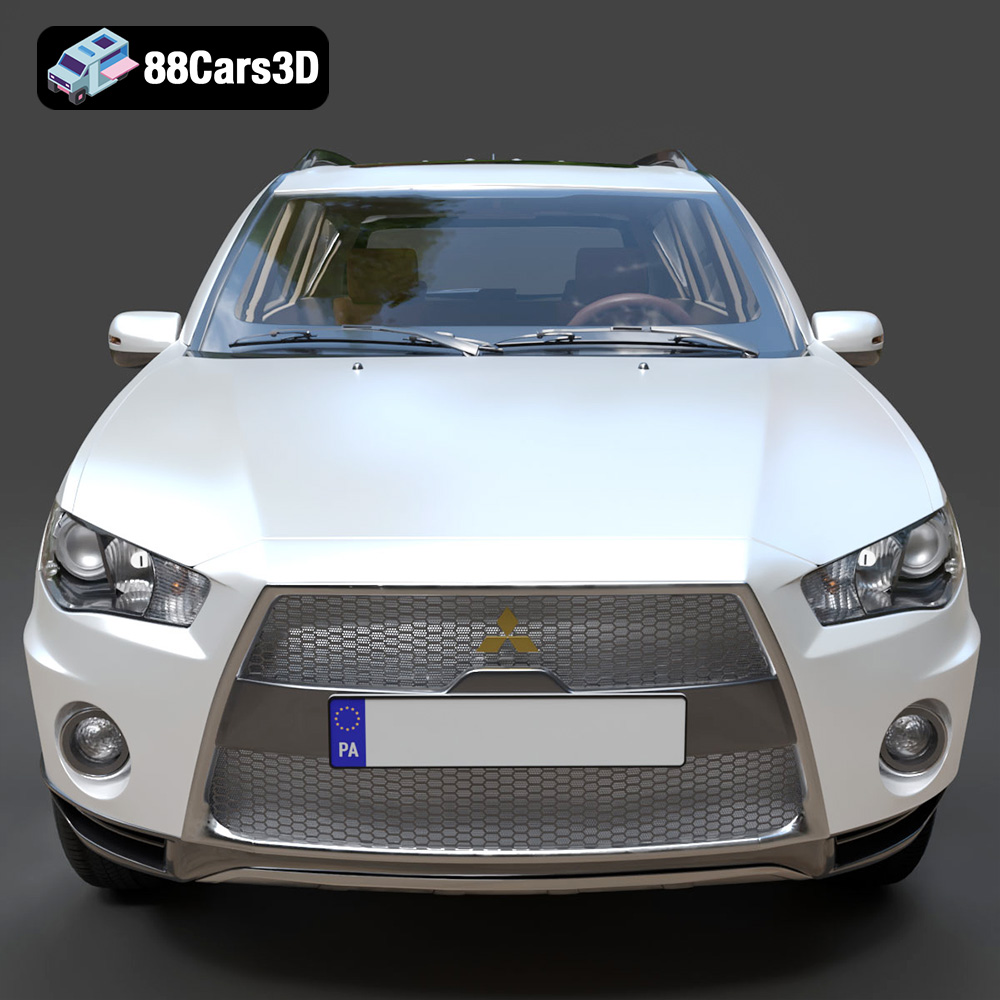
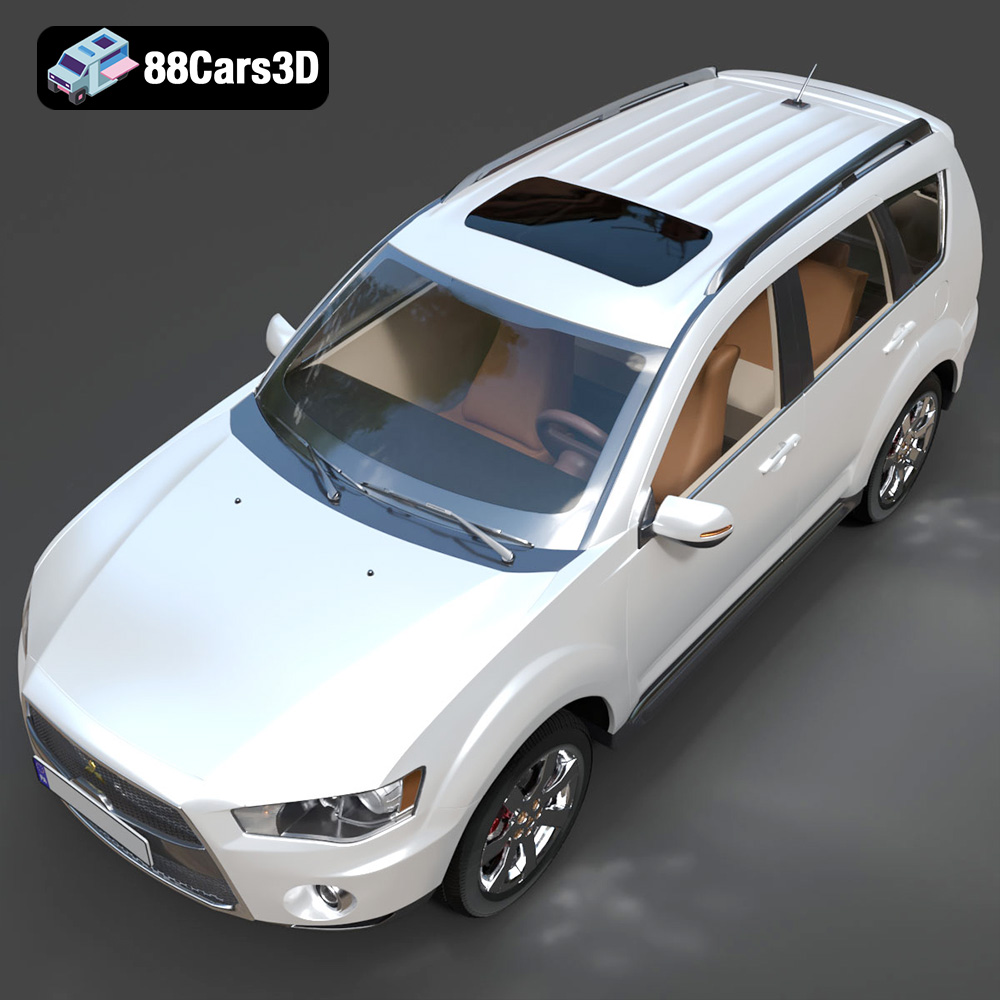
The hallmark of a premium 3D model lies in its faithful representation of the real-world counterpart. The Outlander model excels in this regard, meticulously capturing the distinctive features of the 2010 Mitsubishi Outlander GT. From the iconic, aggressive ‘Jet Fighter’ front grille, inspired by the Lancer Evolution, to the robust V6 engine profile and its signature dual exhaust setup, every exterior line and proportion is accurately replicated. Enthusiasts will appreciate the highly detailed bi-xenon HID headlights and striking LED taillights, along with the replicated 18-inch alloy wheels and detailed crossover tires. Even the independent front and rear suspension details are modeled, contributing to overall realism and potential for detailed animation.
The interior is equally impressive. The model features premium leather-appointed seating with detailed stitching, a multifunction steering wheel equipped with paddle shifters, and an accurate instrument cluster and central infotainment screen. Realistic control details, including pedals, the gear shifter, and the drive mode selector, are all present. This level of interior detail is crucial for first-person perspective (POV) gaming, virtual showrooms, or any scenario where the user might explore the vehicle’s cockpit.
Beyond static representation, the Mitsubishi Outlander GT 2010 3D Model is engineered for dynamic applications. Its construction includes separate components for wheels, suspension, and steering. This intelligent segmentation, coupled with a proper pivot setup for steering, wheel rotation, and suspension travel, makes the model inherently animation-ready. Artists can easily rig the vehicle for realistic driving simulations, cinematic sequences, or interactive configurators. This foresight in design significantly reduces the animation workflow, allowing creators to focus on storytelling and interaction rather than foundational rigging challenges.
High-quality 3D car models like the Mitsubishi Outlander GT 2010 are indispensable tools across a spectrum of professional industries. Their versatility, especially with the comprehensive file format support from 88cars3d.com, allows for seamless integration into diverse production pipelines.
For game developers, the availability of a truly “game-ready” asset is a game-changer. Using the .fbx or .unreal formats, the Outlander model can be quickly imported into leading real-time engines like Unreal Engine and Unity. The optimized polycount (~180,000 triangles) ensures minimal performance impact, critical for open-world games, racing titles, or even tactical simulations. Developers can leverage the accurate geometry and separated components to create realistic physics-based driving experiences. Materials can be easily set up using PBR (Physically Based Rendering) workflows, ensuring consistent visual quality under various lighting conditions. For instance, imagine a bustling urban environment in an open-world title; populating it with realistic 3D car models like the Outlander adds a layer of authenticity that significantly enhances player immersion. The pre-setup pivots for wheels and suspension also streamline the integration of vehicle blueprints and physics assets in Unreal, saving countless hours of development time.
In the realm of high-fidelity rendering, whether for automotive marketing or architectural visualization, the Mitsubishi Outlander GT 2010 3D Model shines. Using the native .max or .blend files, artists can harness the full power of rendering engines like V-Ray, Corona Renderer, Cycles, or Arnold. This allows for hyper-realistic lighting setups using HDRI environments, physical sun and sky systems, and intricate studio lighting. The detailed exterior and interior can be showcased with stunning realism, allowing for product configurators where clients can customize colors, materials, and features in real-time or through static renders. For architectural visualization, placing a highly detailed 3D car model like the Outlander in a scene of a new housing development or commercial building adds a crucial element of scale, lifestyle, and visual interest, making the rendering more compelling and believable.
The rise of augmented and virtual reality, alongside interactive web experiences, has created a new frontier for 3D assets. The .glb format of the Outlander model is perfectly suited for these applications. Developers can use it to create immersive virtual showrooms where users can walk around and even “sit inside” the car, experiencing its features in 3D. For mobile AR applications, the optimized nature of .glb allows for seamless overlay of the virtual Outlander onto real-world environments via a smartphone camera. This offers powerful tools for marketing, product demonstration, and even virtual test drives. Imagine using your phone to place a virtual Mitsubishi Outlander GT 2010 in your driveway to see how it looks, or interacting with a full-scale model in a VR headset, exploring every detail of its cockpit before making a purchase decision. The efficiency of the .glb format ensures these experiences are smooth and accessible.
The utility of a comprehensive 3D car model extends beyond digital displays into the tangible world of 3D printing and physical prototyping. The inclusion of .stl and .ply formats for the Mitsubishi Outlander GT 2010 3D Model provides fascinating avenues for creators.
For hobbyists and professionals alike, the ability to convert a high-quality digital model into a physical object is incredibly exciting. The .stl format is the industry standard for 3D printing, translating the Outlander’s intricate geometry into a triangulated mesh ready for fabrication. The product description provides specific, invaluable guidelines for achieving optimal print quality: recommended scales (1:12, 1:18, 1:24) ensure manageable print sizes while retaining detail. Recommendations for layer height (0.04–0.12 mm) for resin printing underscore the desire for fine detail, especially for intricate parts like the grille, headlights, and interior elements. Specifics on wall thickness, infill, and the necessity of supports for delicate components like the exhaust or mirrors are crucial for successful prints. Furthermore, advice on print orientation, such as printing the frame angled for structural integrity and wheels separately, highlights an expert understanding of 3D printing best practices. Post-processing steps like sanding, priming, and painting with authentic factory colors and metallic finishes can elevate a raw print into a stunning display model, a true testament to the digital asset’s fidelity.
While .stl focuses on manufacturability, the .ply format offers a different kind of value. It’s often favored in fields requiring precise mesh data, such as those derived from 3D scanning or for detailed analysis in CAD software. The .ply file for the Mitsubishi Outlander GT 2010 could be used by designers or engineers who need to perform specific measurements, conduct simulations, or integrate the model into a larger system for tolerance analysis. It provides a robust, often more data-rich representation of the mesh compared to .stl, especially when additional vertex properties are embedded. This makes the model valuable not just for artistic display but for technical evaluation and integration into specific engineering workflows.
A truly versatile 3D model isn’t just a static representation; it’s a foundation for endless creative possibilities. The Mitsubishi Outlander GT 2010 3D Model provides substantial room for customization, allowing artists and designers to adapt it to their specific vision and project requirements.
One of the most immediate and impactful ways to customize any 3D car model is through its materials and textures. With the Outlander model, users can effortlessly change body colors, experimenting with a spectrum of options from authentic factory colors to custom finishes like matte, gloss, or metallic. This flexibility is invaluable for brand campaigns, client presentations, or simply artistic exploration. Beyond the bodywork, the ability to modify tire textures allows for a quick transformation from street-ready to off-road variants, catering to different thematic needs in games or visualizations. Adjusting material finishes on various components—from chrome accents to interior plastics—grants artists precise control over the visual realism and aesthetic appeal, ensuring the model perfectly fits the desired mood and environment.
The beauty of a high-quality 3D asset lies in its ability to adapt to diverse environments. The Mitsubishi Outlander GT 2010 can be seamlessly integrated into virtually any scene, whether it’s a sun-drenched cityscape, a moody nighttime street, a professional studio setup, or a rugged off-road landscape. Artists can experiment with various lighting schemes, from natural daylight simulations using HDRI maps to dramatic artificial lighting setups. This flexibility allows the Outlander to be a key element in different visual narratives, whether it’s showcasing a family SUV in a suburban setting or highlighting its sporty capabilities in a dynamic action sequence. The adaptability ensures that this 3D car model can serve as a compelling focal point or a sophisticated background element in countless creative projects.
The landscape of 3D content creation is dynamic and demanding, requiring assets that are not only visually stunning but also technically robust and highly versatile. The Mitsubishi Outlander GT 2010 3D Model exemplifies these qualities, offering an exceptionally detailed, game-ready, and animation-friendly asset that caters to a broad spectrum of professional applications.
From its meticulously optimized topology and authentic exterior and interior details to its comprehensive file format support, this 3D car model stands out as a prime example of expert craftsmanship. Whether your project involves developing an immersive racing simulator in Unreal Engine, crafting a photorealistic automotive rendering for a marketing campaign, creating an interactive AR/VR showroom, or even bringing a physical replica to life through 3D printing, the Outlander model provides the essential foundation. Its adaptability for customization—from material finishes to environmental integration—further enhances its value, empowering creators to achieve their unique artistic and technical goals.
For professionals seeking premium 3D car models that streamline workflows and elevate visual quality, exploring options like the Mitsubishi Outlander GT 2010 3D Model on 88cars3d.com is a step towards achieving truly outstanding results in automotive rendering, game development, and beyond. This model isn’t just a digital representation; it’s a versatile tool designed to accelerate your creative vision and deliver unparalleled fidelity across diverse digital and physical mediums.
Discover the dynamic and versatile 2010 Mitsubishi Outlander GT, a highly acclaimed crossover SUV known for its aggressive Lancer Evolution-inspired ‘Jet Fighter’ front grille and advanced S-AWC all-wheel-drive system. Our meticulously crafted 3D model perfectly captures the vehicle’s sporty aesthetic, featuring accurate exterior lines, a robust V6 engine profile, and its signature dual exhaust setup. Engineered with highly optimized topology and an efficient triangle count, this game-ready asset guarantees exceptional visual fidelity without compromising real-time performance. Designed to meet the stringent demands of modern 3D engines, it acts as a plug-and-play solution for game development, AR/VR experiences, animation, and architectural visualization. Perfect for urban driving simulators, off-road racing titles, virtual automotive showrooms, and high-end lifestyle rendering projects.
$39.99
.2010
.blend
.crossover
.fbx
.glb
.max
.mitsubishi
.obj
.outlander
.ply
.rendering
.stl
.unreal
car-3d-model
game asset
game-ready
low-poly
optimized
outlander-gt
SUV
VR/AR