Get 20% OFF All Premium 3D & STL Models!

In the dynamic world of digital content creation, the demand for incredibly realistic and technically sound 3D assets is ever-growing. From the breathtaking cutscenes of AAA video games to hyper-realistic architectural visualizations and immersive AR/VR experiences, the quality of 3D models forms the bedrock of believability and engagement. Automotive design, in particular, stands at the forefront of this evolution, requiring a meticulous blend of artistic fidelity and engineering precision.
At the heart of many professional projects lies the need for accurately modeled vehicles that can withstand close scrutiny, perform efficiently in real-time environments, or render beautifully in high-definition stills. This is where specialized marketplaces like 88cars3d.com become indispensable, offering a curated selection of premium 3D car models designed to meet these exact demands. Today, we’ll delve into the intricate world of creating and utilizing these assets, using an exceptional example: the Toyota Camry 2018 3D Model, a versatile asset ready for a multitude of professional applications.
The journey of a 3D car model from creation to its final application involves navigating a landscape of various file formats, each with its own strengths, limitations, and intended use cases. Choosing the right format is critical for compatibility, performance, and preserving the integrity of the asset across different software and platforms. Here, we break down the most common and crucial formats you’ll encounter, including those bundled with the versatile Toyota Camry 2018 3D model.
The .blend format is Blender’s native project file. It’s the go-to choice for users working within the Blender ecosystem, offering a complete, editable scene. This includes not just the mesh geometry, but also materials, textures, lighting, cameras, animations, physics simulations, and modifiers. For artists who want full control over the asset, from tweaking topology to adjusting shader networks, the .blend file provides maximum flexibility. When you download a .blend file, you’re getting the original source, allowing for deep customization and adaptation to specific project needs, making it invaluable for game development or rendering pipelines that leverage Blender’s robust toolset.
.fbx (Filmbox) is arguably the most widely adopted format for exchanging 3D data between different software applications. Developed by Autodesk, it excels at transferring not just geometry, but also animations, rigs, skinning, materials, and lighting information. This makes it ideal for pipelines involving multiple software packages, such as modeling in Blender or 3ds Max, then exporting to Unreal Engine or Unity for real-time applications. Its robust support for animation data is a significant advantage for game assets and cinematics, ensuring complex car animations like wheel rotations or suspension movements translate accurately.
.obj (Wavefront OBJ) is a simple, universal 3D geometry definition file format that is supported by nearly every 3D modeling application. It’s excellent for transferring mesh data (vertices, normals, UV coordinates) and can reference external material (.mtl) files for basic color and texture information. While it doesn’t store animation or rigging data, its widespread compatibility makes it a safe bet for cross-software transfers when you primarily need the raw geometry. For static renders or base meshes that will be textured and rigged from scratch in a new environment, .obj remains a reliable choice.
.glb (GLB format, often associated with glTF – GL Transmission Format) is an efficient, compact 3D file format designed for the web and real-time applications, especially AR/VR. It packages geometry, materials, textures, and even animations into a single, self-contained file, making it incredibly easy to load and display in browsers or mobile AR/VR viewers. Its optimization for rapid loading and smaller file sizes makes it perfect for interactive web experiences, virtual showrooms, and mobile augmented reality applications where the Toyota Camry 2018 3D model can be viewed directly on a smartphone.
.stl (STereoLithography) is the standard file format for 3D printing. It represents the surface geometry of a 3D object using a collection of interconnected triangles, without any color, texture, or material information. For hobbyists or professionals looking to physically manifest a digital model, converting to .stl is the first step. While the Toyota Camry 2018 3D model is highly detailed for rendering, its clean topology also allows for a conversion to .stl, enabling physical scale models to be produced with high precision, as noted in its recommended print settings.
.ply (Polygon File Format, or Stanford Triangle Format) is another format used to store 3D data, particularly from 3D scanners. It can store a wider range of properties than .obj, including color per vertex, normal information, and often stores point clouds or triangle meshes. It’s frequently used in scientific applications, CAD, and situations requiring precision mesh data for analysis or direct fabrication, offering a robust representation of complex geometries.
The .unreal designation typically refers to assets specifically prepared and optimized for direct import and use within Unreal Engine. This isn’t a single file format in the same way .fbx or .obj are, but rather a package of files and settings (often an FBX that has been pre-processed, with materials and textures correctly assigned in a native Unreal project structure). An “Unreal-ready” asset ensures that lighting, collisions, LODs (Levels of Detail), and material setups are already configured to Unreal’s specifications, drastically reducing setup time for game developers and real-time visualization artists. For the Toyota Camry 2018 3D model, having an .unreal variant means it’s primed for immediate integration into an Unreal project, saving countless hours of manual configuration.
Similar to .blend for Blender, .max is the native file format for Autodesk 3ds Max. It stores the complete scene data, including geometry, materials, textures, lights, cameras, animation, and scene setup. For users within a 3ds Max workflow, this file offers the highest degree of editability and preservation of all scene elements. It’s crucial for studios whose pipelines are built around 3ds Max for architectural visualization, advanced rendering, and animation projects, allowing for complex scene management and rendering solutions.
Understanding these formats empowers artists and developers to choose the most efficient path for their projects, ensuring seamless integration and optimal performance for valuable assets like the Toyota Camry 2018 3D model from 88cars3d.com.
The 2018 Toyota Camry marked a significant departure for the legendary sedan, introducing a bolder design language and a more engaging driving experience built on the TNGA platform. Translating such an iconic vehicle into a high-quality 3D model requires an exceptional eye for detail and a deep understanding of technical optimization. The Toyota Camry 2018 3D Model available on 88cars3d.com exemplifies these qualities, offering a robust asset suitable for a myriad of professional applications.
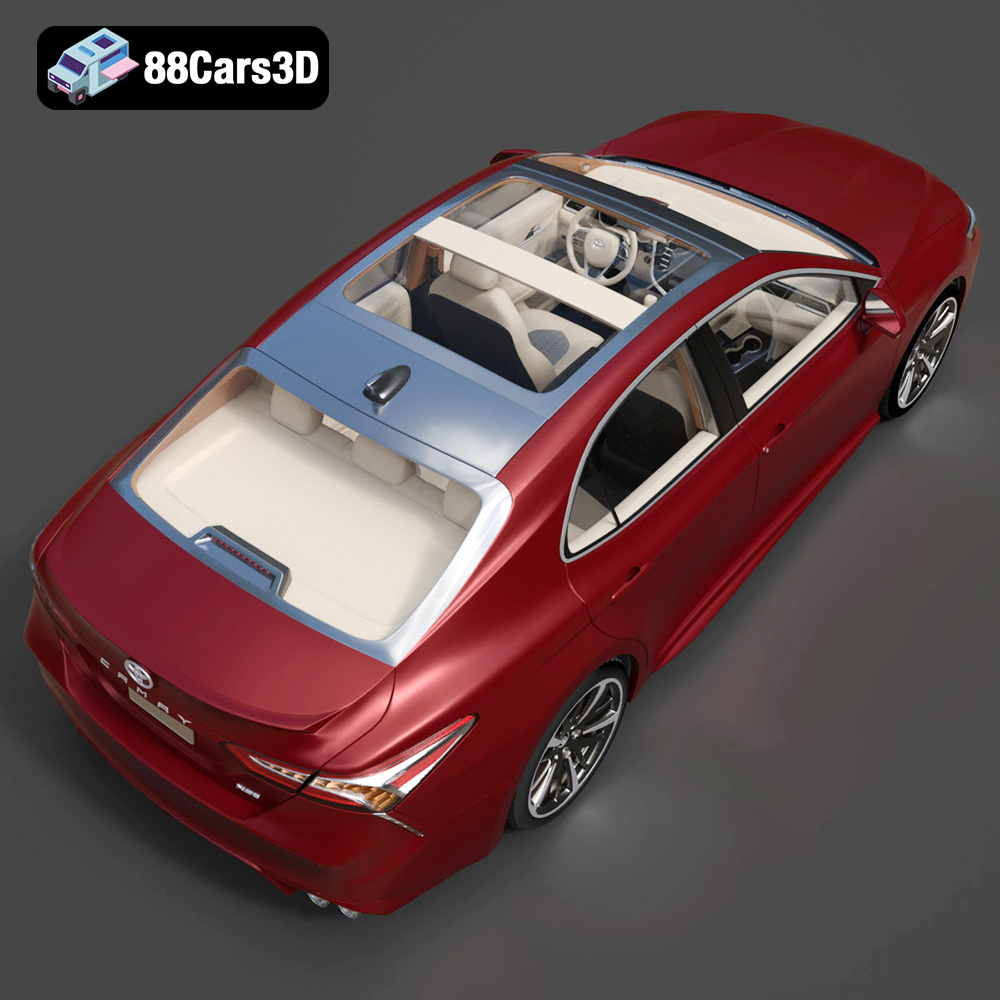
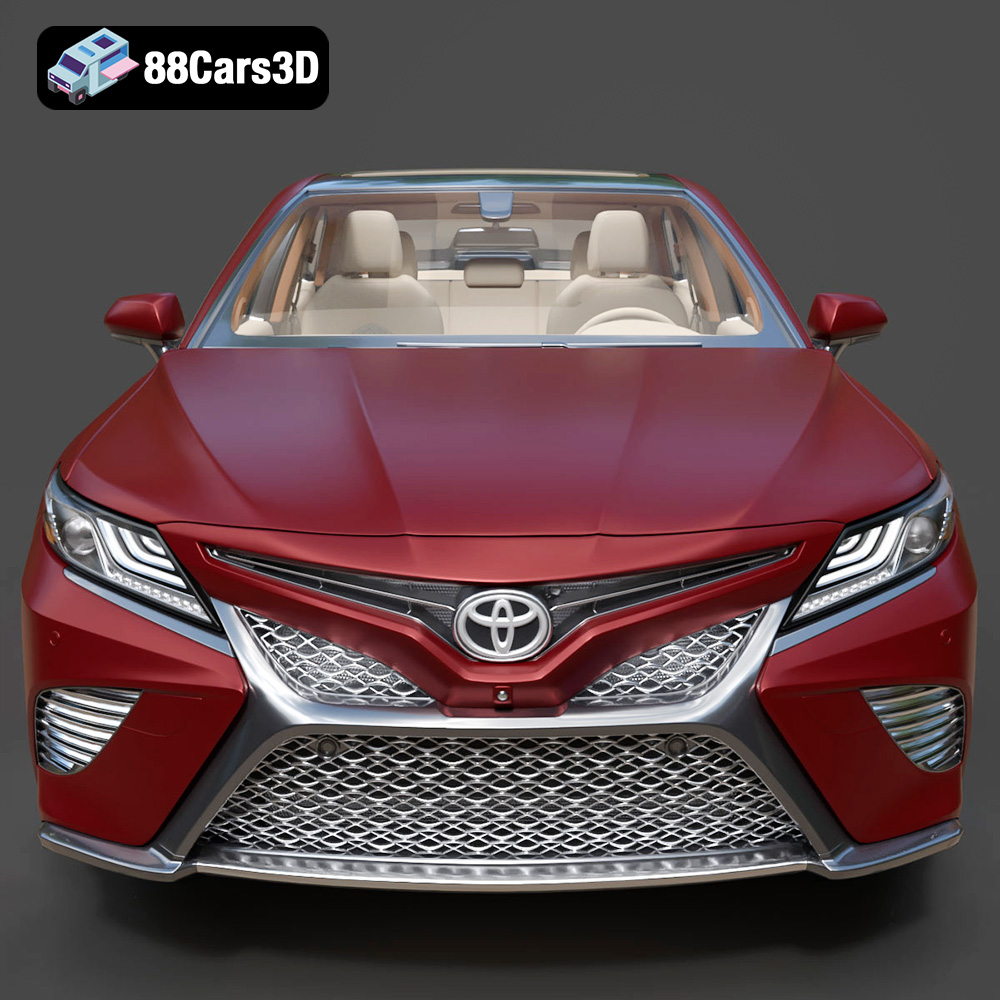
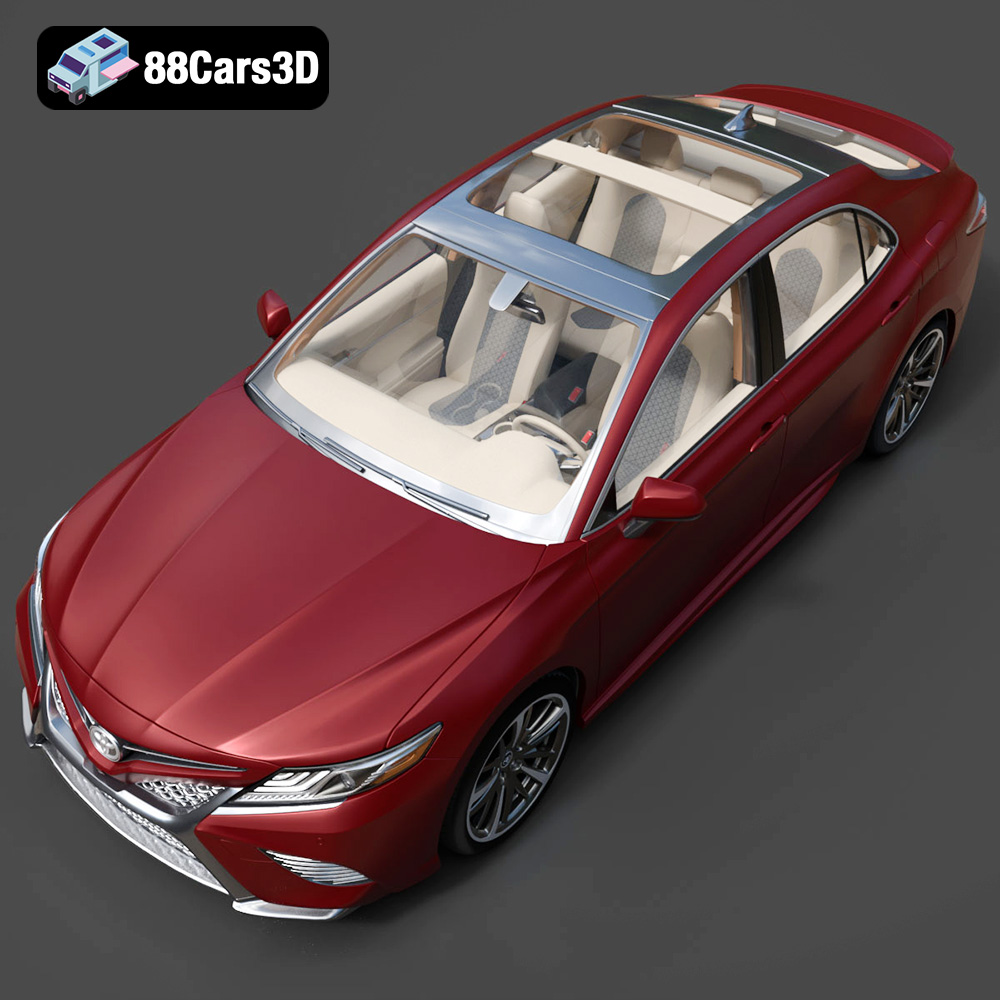
This particular 3D model captures the aggressive lines and sporty stance of the real-world 2018 Camry with remarkable accuracy. From its prominent front grille and highly detailed bi-LED headlights to its sweeping roofline and sculpted doors, every curve and panel is faithfully replicated. Beyond mere aesthetics, the model boasts accurate frame geometry and proportions, ensuring it scales correctly in any virtual environment. Technical details extend to an authentic dual exhaust system, multi-spoke alloy wheels with realistic tire treads, and even a detailed engine block based on the 2.5L Dynamic Force inline-four design. For demanding applications like engineering visualizations or vehicle simulators, the inclusion of separate, animatable components for wheels, suspension (MacPherson strut front, multi-link rear), and steering is invaluable, allowing for realistic kinematic simulations.
A truly comprehensive 3D car model doesn’t stop at the exterior. The Toyota Camry 2018 3D Model provides a highly detailed cockpit and interior, crucial for first-person perspective in games or interactive virtual tours. Ergonomic bucket seats with stitching details, an accurate leather-wrapped steering wheel, a high-fidelity Entune 3.0 infotainment screen, and a digital instrument cluster are all meticulously modeled. The center console, pedals, levers, and automatic shifter are rendered with precision, creating an immersive experience for the user. This level of interior detail is critical for game development, where players might spend significant time inside the vehicle, or for AR/VR applications designed to showcase vehicle features up close.
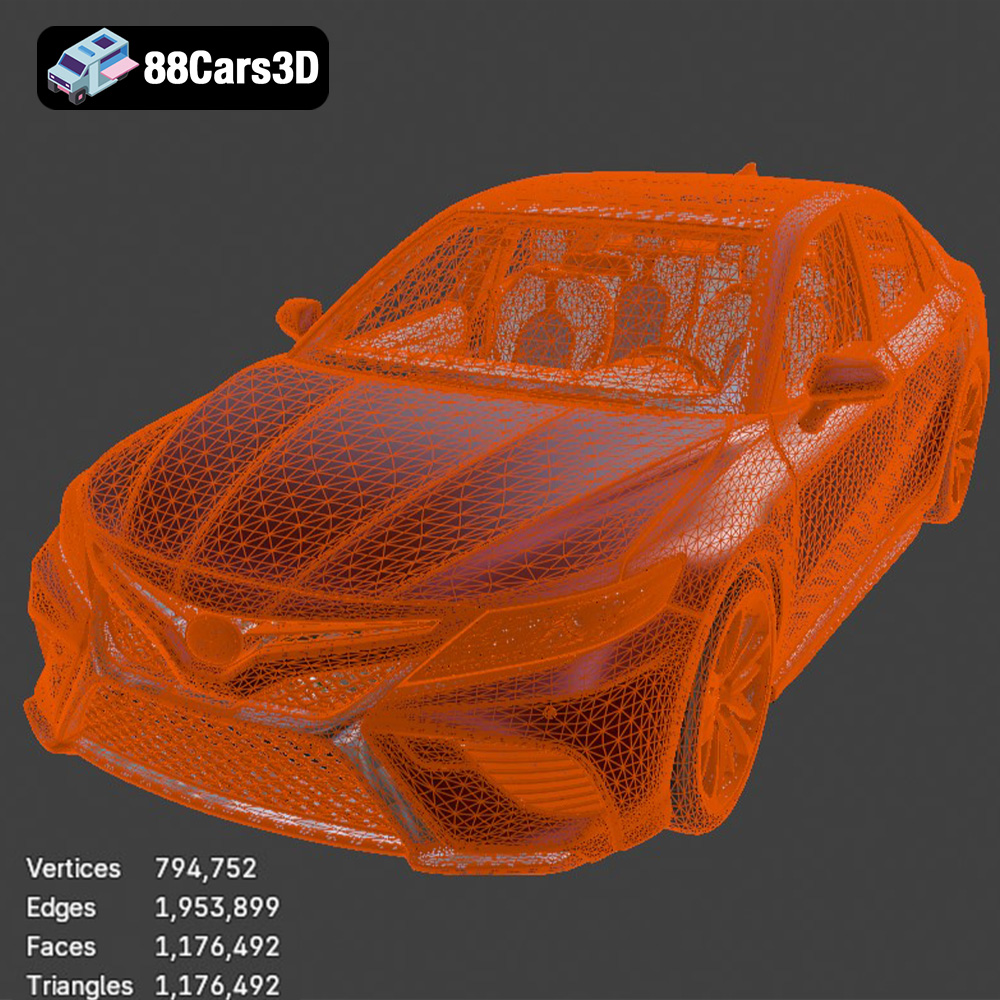
The strength of this 3D model lies not just in its visual accuracy but also in its technical optimization. With an approximate triangle count of 150,000, it strikes an excellent balance between visual realism and real-time performance. This “game-ready” optimization means it performs smoothly in demanding engines like Unreal and Unity without sacrificing visual fidelity. Other key specifications include real-world scale accuracy, ensuring it integrates seamlessly into existing scenes, and proper pivot setups for crucial animated components like steering, wheel rotation, and suspension travel. These technical advantages make the Toyota Camry 2018 3D Model a truly professional-grade asset, minimizing rework and maximizing efficiency for developers and artists alike.
High-quality 3D car models are more than just static objects; they are versatile tools that power diverse professional workflows. Whether it’s bringing a virtual world to life, crafting photorealistic advertisements, or designing next-generation interactive experiences, these assets are fundamental. The Toyota Camry 2018 3D Model serves as a prime example of an asset engineered to fit into various industry pipelines.
In the realm of video games, performance and visual quality are paramount. Game developers require assets that are optimized for real-time rendering, with clean topology, efficient material setups, and appropriate poly counts. The Toyota Camry 2018 3D Model, with its ~150,000 triangle count, is perfectly suited for open-world games, racing titles, and vehicle simulators. Its game-ready optimization means less time spent on manual retopology or LOD generation. For instance, in a large urban simulation game built in Unreal Engine, developers could quickly populate virtual streets with multiple instances of this Camry model without significantly impacting frame rates. The accurately modeled interior also allows for immersive first-person driving experiences, a crucial detail for modern simulation games where players expect high fidelity.
Architectural visualization (ArchViz) and product rendering demand photorealistic results. A barren street in an ArchViz render simply doesn’t convey realism; adding context with believable vehicles is essential. The high-fidelity details of the Camry model, from its accurate proportions to its detailed headlights and alloy wheels, make it an ideal choice for enhancing scene realism. Artists using 3ds Max or Blender for studio lighting setups can quickly integrate this model into their scenes, adjusting materials and reflections to achieve stunning results. Imagine a luxury apartment complex render where a realistic Toyota Camry 2018 is parked in the driveway, instantly adding a sense of scale, lifestyle, and authenticity to the image. Similarly, for product campaigns, the model can be placed in dynamic environments, telling a compelling story about a product’s interaction with the real world.
Augmented Reality (AR) and Virtual Reality (VR) are transforming how we interact with digital content, especially in automotive sectors. Virtual showrooms, car configurators, and immersive training simulations are becoming increasingly common. The Toyota Camry 2018 3D Model, particularly in its optimized .glb format, is ideal for these applications. Its game-ready polycount ensures smooth performance on mobile devices for AR experiences, allowing users to place a virtual Camry in their driveway. In VR, the detailed interior allows for fully immersive experiences where users can “sit inside” the car, explore its features, and even customize it in real-time. This capability is invaluable for sales and marketing, offering a new dimension for potential customers to engage with a vehicle before it even hits the showroom floor.
While a high-quality base model is essential, the true power of 3D car models often lies in their potential for customization and the meticulous effort invested in rendering them for maximum realism. Professional artists leverage sophisticated techniques and software features to transform a raw 3D asset into a breathtaking visual narrative. The Toyota Camry 2018 3D Model provides an excellent foundation for these advanced processes.
The realism of a 3D car model is heavily dependent on its materials and textures. PBR (Physically Based Rendering) workflows are standard, ensuring that surfaces react to light in a physically accurate manner. For the Camry model, artists can easily change body colors, experimenting with factory colors, custom metallic finishes, or even matte looks. This involves adjusting parameters like base color, roughness, metallicness, and normal maps. Modifying tire textures to represent street or all-season variants adds another layer of detail. In Blender, a shader artist might build a complex node network to simulate multi-layered car paint with clear coat reflections and subtle metallic flakes. In 3ds Max, V-Ray or Corona Renderer materials would be fine-tuned to achieve similar photorealistic results, adjusting reflection curves, Fresnel values, and clear coat layers to mimic real automotive paint finishes.
Lighting is the sculptor of perception in 3D rendering. The same Toyota Camry 2018 3D Model can evoke drastically different moods and highlight different design elements depending on the lighting setup. For a showroom render, bright, even studio lighting with softboxes and area lights would emphasize the car’s sleek lines and reflections. For an urban scene, an HDRI (High Dynamic Range Image) environment map combined with targeted light sources (streetlights, sun) would create realistic shadows and reflections, integrating the car seamlessly into its surroundings. Artists can adapt lighting for different environments – from a sunny Californian highway to a moody, rain-slicked city street – by manipulating light intensity, color temperature, and shadow properties. The accurate geometry and material properties of a good 3D model ensure that these lighting changes produce believable results.
Static renders are powerful, but animation brings a 3D car model to life. The Toyota Camry 2018 3D Model is designed with separate components for animation, including wheels, suspension, and steering. This enables animators to create realistic driving sequences, showcasing suspension travel over bumps or precise steering movements. In software like 3ds Max or Blender, Inverse Kinematics (IK) rigs can be set up for the suspension, allowing complex movements with minimal effort. Imagine a commercial showcasing the Camry’s smooth ride, where the suspension subtly compresses and expands as it navigates a winding road, all rendered with cinematic quality. Even simpler animations, like opening doors for an interactive configurator, add significant value and engagement to the asset.
The landscape of 3D automotive modeling is continuously evolving, pushing boundaries beyond traditional static renders or even basic game assets. The foundational principles of high-quality, optimized 3D models, as seen in the Toyota Camry 2018 3D Model, remain crucial, but their applications are expanding into exciting new territories.
Gone are the days when car configurators were limited to simple color changes on a static image. Modern web technologies and real-time engines allow for fully interactive 3D configurators where customers can explore a vehicle from every angle, customize its features (paint, wheels, interior trim), and even place it in a virtual environment via AR. The GLB format of models from 88cars3d.com is particularly suited for these browser-based or mobile AR experiences, offering instant visualization and personalization. This creates an incredibly engaging pre-purchase experience, blurring the lines between online browsing and physical interaction.
The development of autonomous vehicles relies heavily on vast amounts of data and rigorous testing in simulated environments. High-fidelity 3D car models populate these virtual worlds, serving as crucial elements for training AI perception systems. Models like the Toyota Camry 2018, with accurate proportions, detailed exterior features (like headlights and taillights for light detection), and realistic physics, provide the necessary visual and geometric data for AI algorithms to learn from. Running billions of miles in a digital twin of the real world, populated by diverse, accurate 3D traffic, is far safer and more cost-effective than physical road testing.
The concept of a “digital twin” – a virtual replica of a physical object or system – is gaining traction in the automotive industry. High-precision 3D models form the visual backbone of these digital twins, representing vehicles with extraordinary accuracy. This allows engineers to monitor real-time performance data, simulate scenarios, and even predict maintenance needs in a virtual environment. While the Camry model may not be a full engineering-grade digital twin, its detailed components (like the engine block and suspension) lay the groundwork for such applications, offering a visually compelling and geometrically sound representation for conceptual digital twin projects.
Beyond digital displays, the physical manifestation of 3D models through 3D printing is a growing field. The Toyota Camry 2018 3D Model, with its support for .stl format and clear print recommendations (scale, layer height, supports), caters to hobbyists and professionals alike. This allows for the creation of display-scale models, rapid prototyping of aftermarket parts, or even custom modifications. The ability to move from a digital concept to a tangible object quickly and affordably opens up new avenues for design review, marketing, and personalized collectibles.
The world of 3D modeling for automotive design is a fascinating intersection of art and technical prowess. From ensuring proper polygon counts and clean topology to understanding the nuances of various file formats like .blend, .fbx, .obj, .glb, and .unreal, every detail contributes to the final product’s utility and visual impact. Assets like the Toyota Camry 2018 3D Model exemplify the precision and versatility demanded by modern digital pipelines, empowering creators across game development, architectural visualization, AR/VR, and beyond.
Investing in high-quality 3D car models from trusted sources such as 88cars3d.com not only saves invaluable production time but also elevates the overall quality and realism of any project. Whether you’re a seasoned professional or an aspiring artist, understanding the technical specifications and application potential of these assets is key to unlocking new creative possibilities and pushing the boundaries of what’s achievable in the digital realm. The journey from a meticulously crafted mesh to a fully realized interactive experience is a testament to the power of expertly designed 3D assets.
The 2018 Toyota Camry, representing the eighth generation of this iconic mid-size sedan, brought a dramatic shift in styling with its aggressive lines, sportier stance, and prominent front grille. Known for its legendary reliability and comfort, this specific generation introduced the TNGA platform, elevating its driving dynamics while boasting striking visual elements like its sweeping roofline, sculpted doors, and modern LED lighting signature. This high-quality 3D model features game-ready optimization with an approximate triangle count of 150,000, ensuring excellent performance without sacrificing visual fidelity. Designed for modern pipelines, it boasts clean topology perfect for real-time applications like game development, AR/VR experiences, architectural visualization, and high-end animation. Perfect for urban traffic simulations, architectural renders, open-world driving games, and virtual showroom applications.
$19.99
.blend
.fbx
.glb
.max
.obj
.ply
.rendering
.sedan
.stl
.toyota
.unreal
camry-2018
car-3d-model
family-car
game asset
game-ready
low-poly
mid-size-car
optimized
VR/AR