Get 20% OFF All Premium 3D & STL Models!

In the dynamic world of 3D visualization, from high-octane game development to hyper-realistic automotive rendering and immersive AR/VR experiences, the quality of your 3D assets is paramount. It’s the difference between a project that captivates and one that falls flat. Professionals demand precision, optimization, and versatility from their digital creations, whether they’re crafting a new vehicle for a racing simulator or showcasing a design concept for a client.
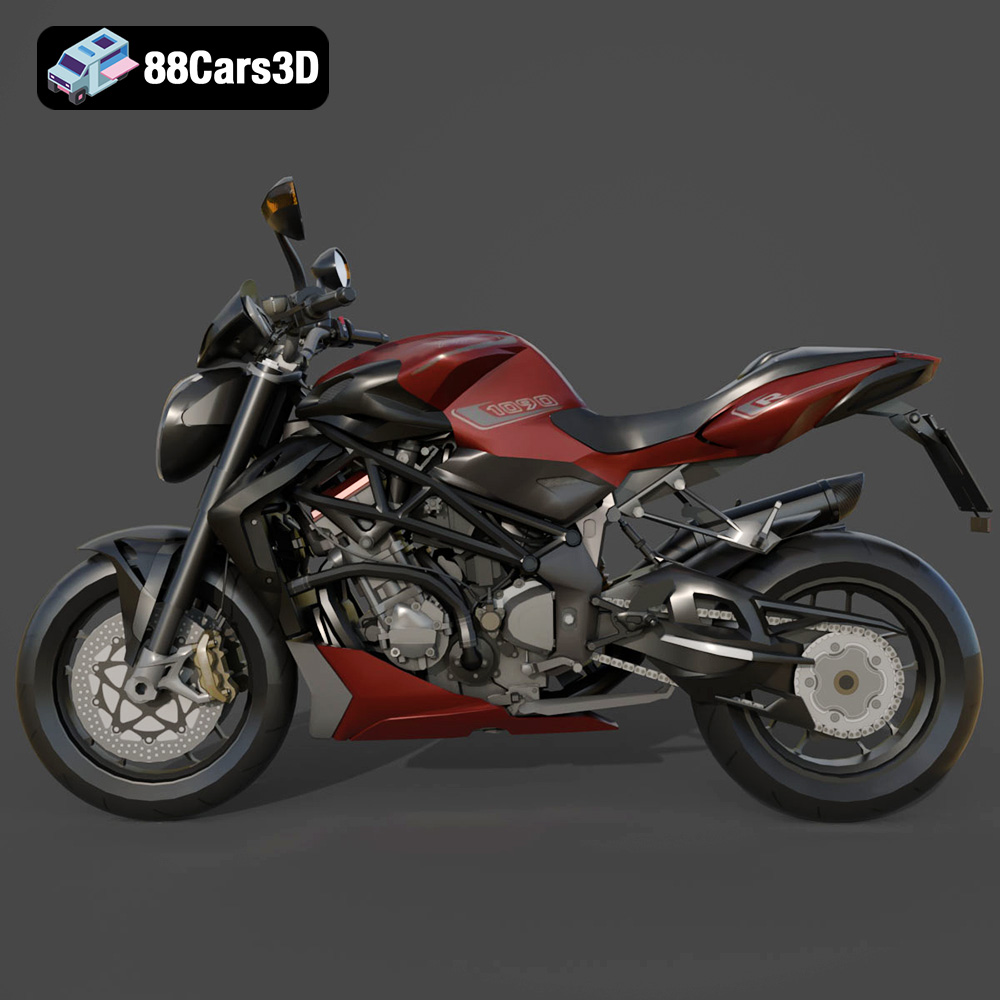
Today, we’re diving deep into what makes a 3D model truly exceptional, using a prime example of digital craftsmanship: the MV Agusta Brutale 1090 R 3D Model. This isn’t just any asset; it’s a meticulously engineered digital representation of an Italian icon, designed to excel across a multitude of professional applications. Its aggressive naked bike styling, thrilling performance, and iconic exposed trellis frame are all perfectly translated into a game-ready, high-fidelity asset, available for download on 88cars3d.com.
From understanding the nuances of various file formats to integrating these models into complex pipelines like Unreal Engine or Blender, and even preparing them for physical 3D printing, we’ll explore the technical intricacies and creative possibilities that a premium 3D model like the MV Agusta Brutale 1090 R unlocks for artists and developers worldwide.
Choosing the correct file format for your 3D model is a critical decision that impacts compatibility, feature retention, and overall workflow efficiency. Each format is designed with specific use cases and technical considerations in mind, making a detailed understanding indispensable for any 3D professional. The MV Agusta Brutale 1090 R 3D Model, for instance, comes in a comprehensive array of formats, ensuring maximum utility across diverse platforms.
The .blend format is the native file type for Blender, an incredibly powerful and popular open-source 3D creation suite. When you download a .blend file, you’re getting a fully editable Blender scene. This means not only the mesh data but also materials, textures, lighting setups, animation data, and even physics simulations are contained within. For artists who primarily work in Blender, this is often the most convenient format as it allows for immediate, unhindered customization and scene integration. The MV Agusta Brutale 1090 R in .blend format offers complete access to its intricate material nodes and armature setups for animations, providing a robust starting point for any Blender project.
Autodesk’s .fbx (Filmbox) format is arguably the most widely adopted interchange format in the 3D industry, particularly favored for game development and animation pipelines. It supports a vast range of data, including geometry (meshes), materials, textures, animation, rigging, and even camera and light data. Its strength lies in its ability to transfer complex scene information between different 3D software applications (like 3ds Max, Maya, Cinema 4D, Blender) and real-time engines such as Unreal Engine and Unity. When working with the MV Agusta Brutale 1090 R 3D Model, the .fbx version is ideal for bringing the vehicle directly into a game engine, ensuring that all animation pivots for wheels, steering, and suspension are correctly recognized.
The .obj (Wavefront OBJ) format is a much older but still incredibly versatile and universal format, primarily focused on geometric data. It stores vertices, normals, UV coordinates, and faces, along with references to external material files (.mtl) that define surface properties. While .obj doesn’t support animation or rigging data, its simplicity and widespread compatibility make it an excellent choice for basic mesh transfer between virtually any 3D software. For the MV Agusta Brutale 1090 R, the .obj file is perfect when you need to import the core geometry into a new software and rebuild or reapply materials from scratch, or when you are performing mesh cleanup and optimization.
.glb (GLB, GL Transmission Format Binary) is the binary version of glTF (GL Transmission Format), designed for efficient transmission and loading of 3D scenes and models by engines and applications. It packages all necessary data—geometry, materials, textures, animations—into a single, self-contained file. This makes .glb an absolute powerhouse for web-based 3D, augmented reality (AR), and virtual reality (VR) applications, where file size and rapid loading are critical. The MV Agusta Brutale 1090 R as a .glb asset is perfectly suited for immersive virtual showrooms, product configurators on websites, or mobile AR experiences due to its optimized structure.
.stl (STereoLithography) is the de facto standard file format for 3D printing and CAD software. It represents a 3D model as a collection of unconnected triangular facets, without color, texture, or other CAD attributes. Its simplicity is its strength for manufacturing. The MV Agusta Brutale 1090 R 3D Model, provided in .stl, can be directly fed into a slicer program for 3D printing. The accuracy of the model’s frame geometry and intricate details are crucial here for a successful physical reproduction, allowing hobbyists and designers to bring the digital bike into the tangible world.
The .ply (Polygon File Format, or Stanford Triangle Format) is a versatile format capable of storing a wide range of properties, including color, transparency, normals, texture coordinates, and even reliability information. While less common for general 3D asset exchange than .fbx or .obj, it’s often used in academic and research contexts, particularly for 3D scanning, scientific visualization, and CAD/CAM applications that require precise mesh data and attribute storage. For the MV Agusta Brutale 1090 R, a .ply file might be useful for highly specific engineering analysis or for integrating into specialized software that leverages this format’s robust data handling capabilities.
The .unreal format, or rather, the inclusion of “Unreal Engine-ready” assets, often implies a pre-packaged and optimized asset specifically prepared for direct import and use within Unreal Engine. This typically involves correct scaling, pivot points, material setup, and sometimes even pre-configured blueprints or animation sequences. While not a standalone file extension in the same vein as .fbx, its inclusion means the MV Agusta Brutale 1090 R has undergone specific preparation to ensure a smooth, efficient workflow for Unreal Engine developers, saving considerable time on asset integration and optimization.
Finally, the .max format is the native file type for Autodesk 3ds Max, a leading software for 3D modeling, animation, rendering, and visualization. Similar to .blend, a .max file contains the entire scene data, including geometry, modifiers, materials, textures, lights, cameras, animation, and scene settings. For 3ds Max users, this provides the most complete and editable version of the MV Agusta Brutale 1090 R, allowing for deep customization, advanced rendering setups with V-Ray or Corona, and complex animation sequences directly within the native environment.
Understanding these formats empowers professionals to choose the right tool for the job, ensuring seamless integration and optimal performance for the MV Agusta Brutale 1090 R 3D Model and any other high-quality 3D car models or vehicles acquired from platforms like 88cars3d.com.
The MV Agusta Brutale 1090 R is not merely a motorcycle; it’s a statement of Italian design and engineering prowess. Translating such a complex, visually striking machine into a high-fidelity 3D model requires an extraordinary level of attention to detail and technical skill. This MV Agusta Brutale 1090 R 3D Model exemplifies this synthesis, offering a digital asset that is both stunningly accurate and highly performant.
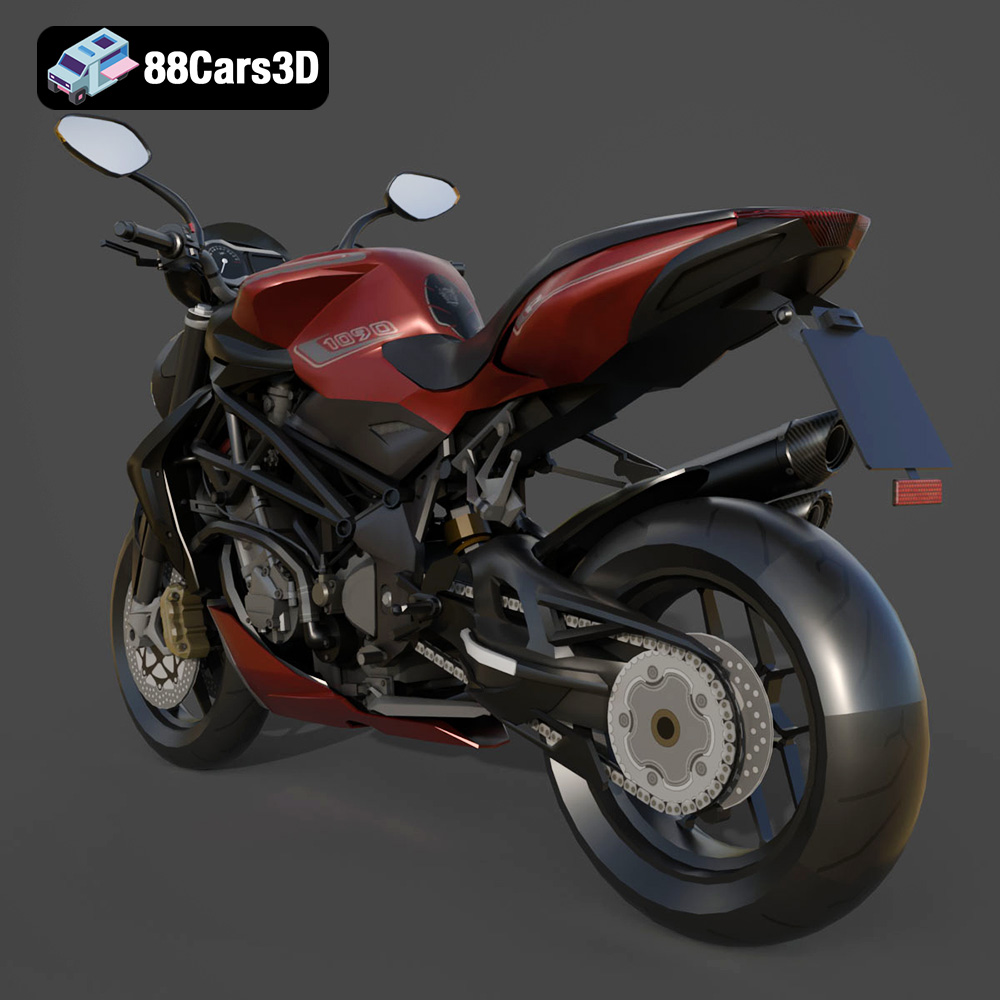
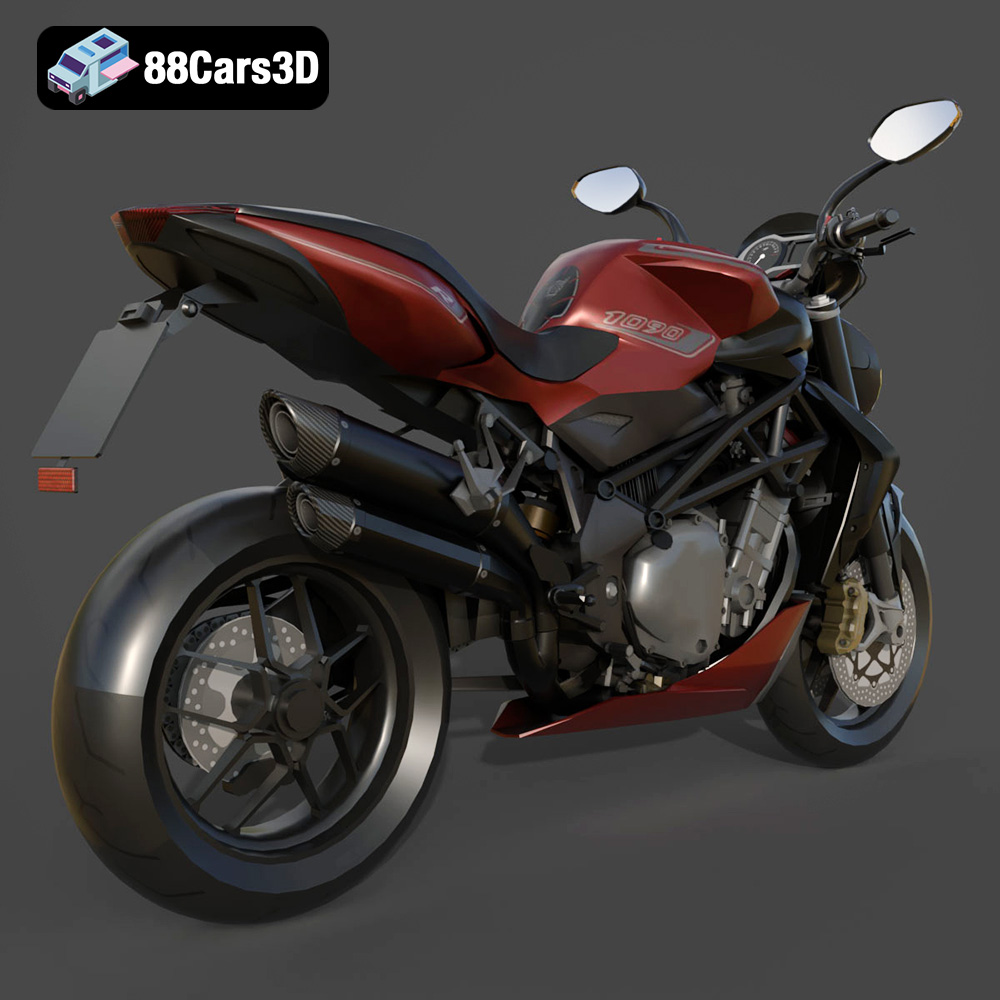
The essence of the Brutale lineage is its aggressive naked bike styling, and this 3D model perfectly encapsulates that spirit. From the signature muscular fuel tank to the distinctive teardrop headlight assembly and the raw mechanical beauty of its 1078cc inline-four engine, every curve and component has been meticulously replicated. The accurate frame geometry and proportions are critical, ensuring that the digital model holds true to its real-world counterpart. Details like the dual-pipe stacked exhaust system, intricate alloy wheel design with high-performance street tires, and the detailed front upside-down fork and rear single-sided swingarm suspension all contribute to an unparalleled level of realism. Even the cockpit, often overlooked in external models, features an ergonomically sculpted split seat, wide streetfighter handlebars, a detailed digital instrument cluster, and accurate control levers, making it ideal for first-person perspectives in games or VR.
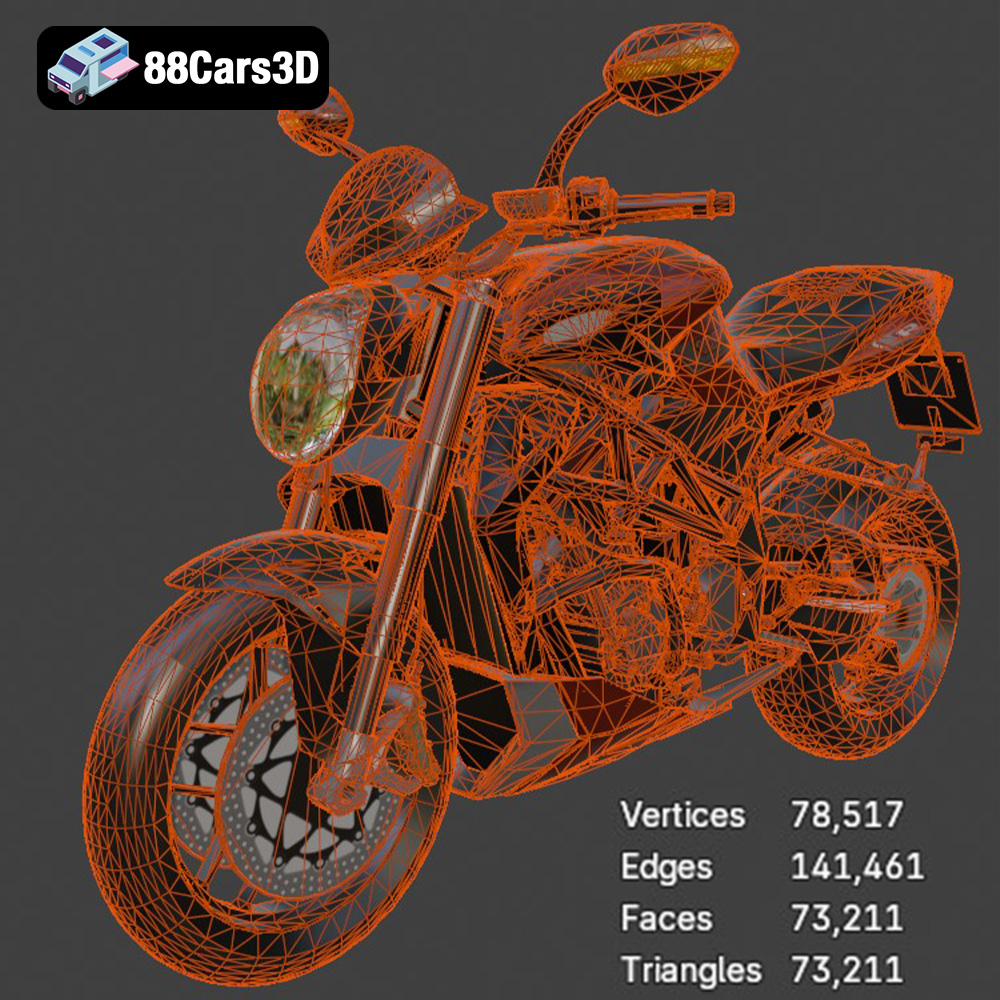
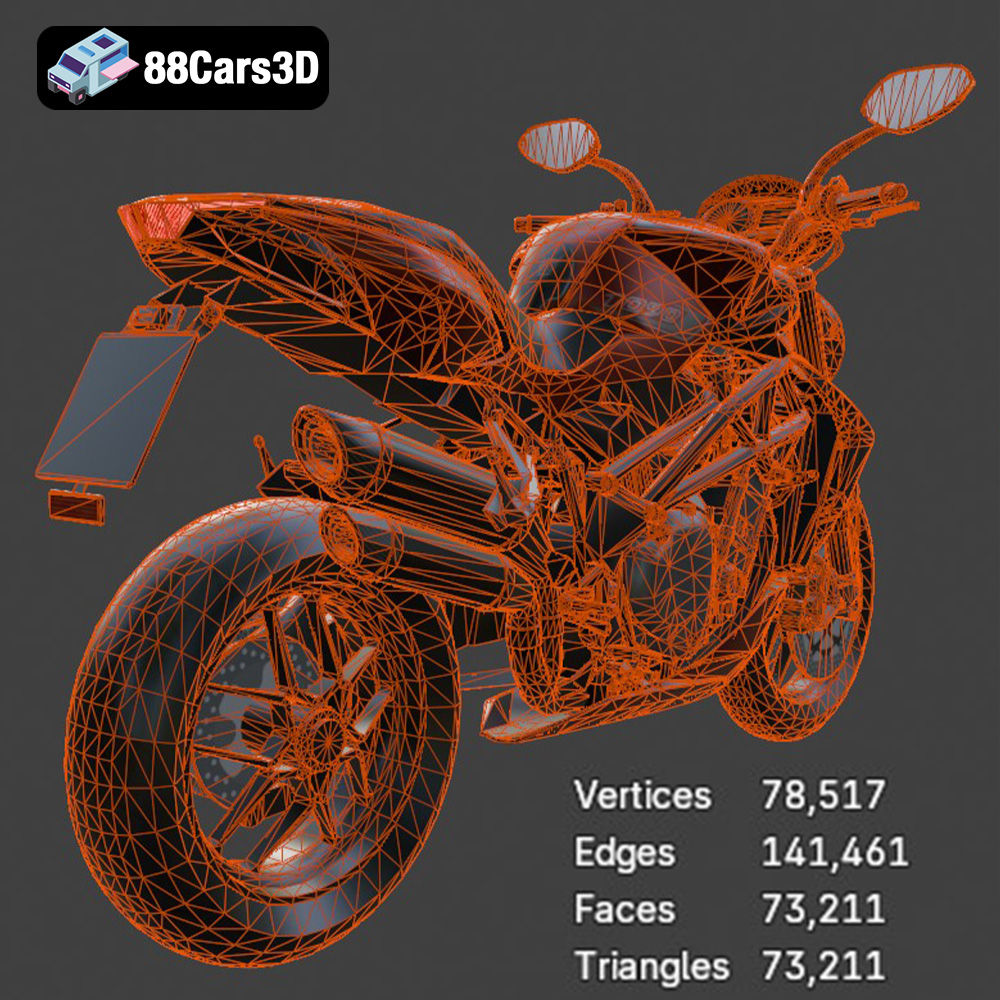
One of the most impressive technical specifications of this model is its optimized topology of approximately 200,000 triangles. This number strikes a perfect balance: it’s high enough to ensure stunning visual fidelity for high-end rendering and close-up shots, yet low enough to be considered “game-ready.” For real-time engines like Unreal and Unity, maintaining a manageable polycount is crucial for smooth frame rates, especially in environments with multiple complex assets. The model’s real-world scale accuracy further enhances its utility, allowing for seamless integration into existing scenes and environments without requiring scale adjustments. This careful optimization means developers don’t have to spend precious time reducing polygon counts or baking normal maps from high-poly versions – the work is already done.
Beyond static beauty, the MV Agusta Brutale 1090 R 3D Model is engineered for dynamic interactions. Crucially, it features separate wheels, suspension, and steering components. This modularity is vital for animation workflows, allowing animators to easily articulate these parts for realistic motion. The proper pivot setup for steering, wheel rotation, and suspension travel is already established, saving countless hours of rigging and setup time. Whether it’s banking into a turn, absorbing bumps, or simply idling, the model is prepared to bring the Brutale to life through fluid and accurate animations, making it an invaluable game asset for racing simulations or cinematic sequences.
High-quality 3D models are not just static images; they are versatile tools that integrate into a multitude of professional pipelines. The MV Agusta Brutale 1090 R 3D Model exemplifies how a single asset can serve different purposes, from the fast-paced world of game development to the meticulous craft of architectural visualization and the cutting edge of AR/VR.
For game developers, the MV Agusta Brutale 1090 R 3D Model is a true game-changer. Its “game-ready” designation means it’s optimized for real-time performance. In engines like Unreal Engine and Unity, the .fbx and dedicated .unreal formats are invaluable. Developers can simply import the model, and thanks to its optimized polycount and proper pivot setups, it’s immediately ready for integration. This workflow typically involves:
This streamlined process allows developers to focus on gameplay mechanics and world-building, rather than lengthy asset preparation.
When photorealism is the goal, the MV Agusta Brutale 1090 R shines in rendering applications like 3ds Max (using the .max file) or Blender (with the .blend file). These environments allow for ultimate control over lighting, materials, and camera settings to produce stunning marketing visuals or cinematic sequences. The workflow often includes:
The detail and accuracy of the MV Agusta Brutale 1090 R 3D Model make it an ideal candidate for creating award-winning automotive rendering projects.
The burgeoning fields of Augmented Reality (AR) and Virtual Reality (VR) demand highly optimized assets that can perform seamlessly on various devices, from powerful VR headsets to mobile phones. The .glb format is particularly well-suited here. For immersive virtual showrooms or product configurators, the Brutale model can be integrated into platforms that leverage WebGL or specific AR/VR SDKs:
The versatility of high-quality 3D car models and motorcycle models from 88cars3d.com ensures that creators are equipped for the future of digital interaction.
The utility of a robust 3D model extends far beyond digital environments. For enthusiasts, designers, and collectors, the ability to transform a digital asset into a tangible object through 3D printing is incredibly exciting. The MV Agusta Brutale 1090 R 3D Model, with its inclusion of the .stl format, opens up this very avenue.
3D printing requires models to be “watertight” and have sufficient wall thickness, free from non-manifold geometry or flipped normals. While the .stl format streamlines this process by representing the mesh purely as triangles, further preparation in a slicer software is essential. The provided recommendations for the MV Agusta Brutale 1090 R are invaluable:
Once printed, the journey of the physical Brutale doesn’t end. Post-processing is where the model truly comes to life. This typically involves:
The MV Agusta Brutale 1090 R 3D Model offers a fantastic opportunity to bridge the digital and physical realms, providing a rewarding project for any model-making enthusiast.
One of the most significant advantages of investing in a premium 3D model, such as the MV Agusta Brutale 1090 R from 88cars3d.com, is its inherent customization potential. Unlike a static image or a pre-rendered video, a high-quality 3D asset provides a flexible foundation upon which artists and developers can build and adapt to an endless array of creative visions and project requirements.
The MV Agusta Brutale 1090 R model comes with a strong base, but its true power lies in its adaptability. For instance, imagine a marketing campaign requiring the bike in a specific factory color not initially provided, or a custom finish that aligns with a unique brand identity. With this 3D model, designers can easily:
This level of control ensures that the digital asset can always align perfectly with the narrative or aesthetic demands of any project.
The versatility extends beyond superficial aesthetic changes to deeper environmental integration. A single 3D model needs to convincingly exist in a variety of lighting conditions and settings:
This capacity for deep customization makes models like the MV Agusta Brutale 1090 R invaluable assets for any professional working with 3D car models or vehicle simulations, ensuring long-term utility and creative freedom.
From the intricate curves of its bodywork to the precise mechanics of its engine, the MV Agusta Brutale 1090 R 3D Model stands as a testament to the power of expertly crafted digital assets. We’ve explored how its comprehensive file formats cater to every imaginable professional pipeline, from the interactive realms of game development and AR/VR to the photorealistic demands of high-end rendering and even the tangible world of 3D printing.
Its optimized polygon count, meticulous detailing, and animation-ready structure underscore the importance of investing in quality. Such models don’t just save time; they elevate the entire project, allowing artists and developers to focus on creativity and innovation rather than foundational asset creation. Whether you’re a game developer needing a high-speed racing machine, an architect visualizing an urban lifestyle, or a marketer creating a compelling brand campaign, this MV Agusta Brutale 1090 R 3D Model provides an unparalleled foundation.
For those seeking to bring their digital visions to life with stunning realism and uncompromised performance, exploring the extensive collection of high-quality 3D car models and motorcycle models at 88cars3d.com is a crucial step. Discover assets like the MV Agusta Brutale 1090 R that are engineered for excellence and ready to transform your next project.
The MV Agusta Brutale 1090 R is a masterpiece of Italian motorcycle engineering, renowned for its aggressive naked bike styling, thrilling performance, and iconic exposed trellis frame. This 3D model perfectly captures the essence of the Brutale lineage, featuring its signature muscular fuel tank, distinctive teardrop headlight assembly, and the raw mechanical beauty of its 1078cc inline-four engine. This meticulously crafted 3D model boasts an optimized topology of approximately 200,000 triangles, ensuring a perfect balance between stunning visual fidelity and real-time performance. It is fully game-ready and ideally suited for high-end rendering, animation, virtual reality (VR), and augmented reality (AR) applications.
$39.99