Get 20% OFF All Premium 3D & STL Models!

The allure of classic automobiles transcends generations, captivating enthusiasts with their timeless design, engineering prowess, and rich history. Among these legends, the Mercedes Benz 190 SL stands as an undeniable icon, a symbol of 1950s elegance, luxury, and open-top driving pleasure. Its graceful lines, distinctive grille, and refined proportions have cemented its place in automotive lore. But what happens when such a revered masterpiece makes the leap into the digital landscape? How do professionals across diverse industries leverage the digital twin of such a vehicle for their cutting-edge projects?
In today’s fast-paced digital world, the demand for high-quality, meticulously crafted 3D car models is at an all-time high. From immersive game development to photorealistic automotive rendering, and from interactive AR/VR experiences to precise 3D printing, accurate digital assets are the cornerstone of innovation. This is precisely where a model like the Mercedes Benz 190 SL 3D Model from 88cars3d.com shines. It’s not just a digital representation; it’s a meticulously engineered asset designed to empower creators with unparalleled versatility and technical excellence, ensuring this vintage gem continues to inspire in virtual environments.
The Mercedes Benz 190 SL, often seen as the more accessible sibling to the legendary 300 SL Gullwing, holds a special place in the hearts of car aficionados. Its design language, characterized by sweeping curves, a prominent three-pointed star grille, and sophisticated chrome accents, perfectly encapsulates the optimism and style of the post-war era. Translating such an intricate piece of automotive history into a digital model requires a deep understanding of its original design intent and an unwavering commitment to detail.
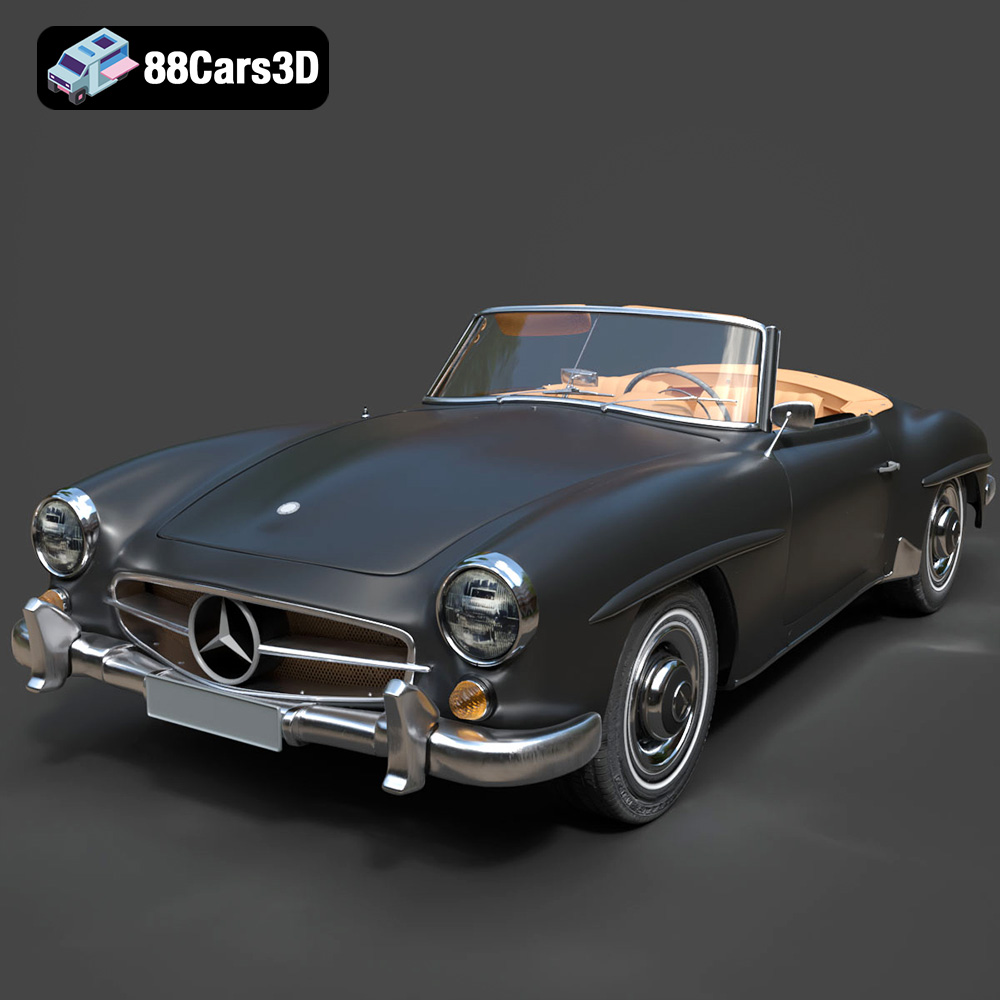
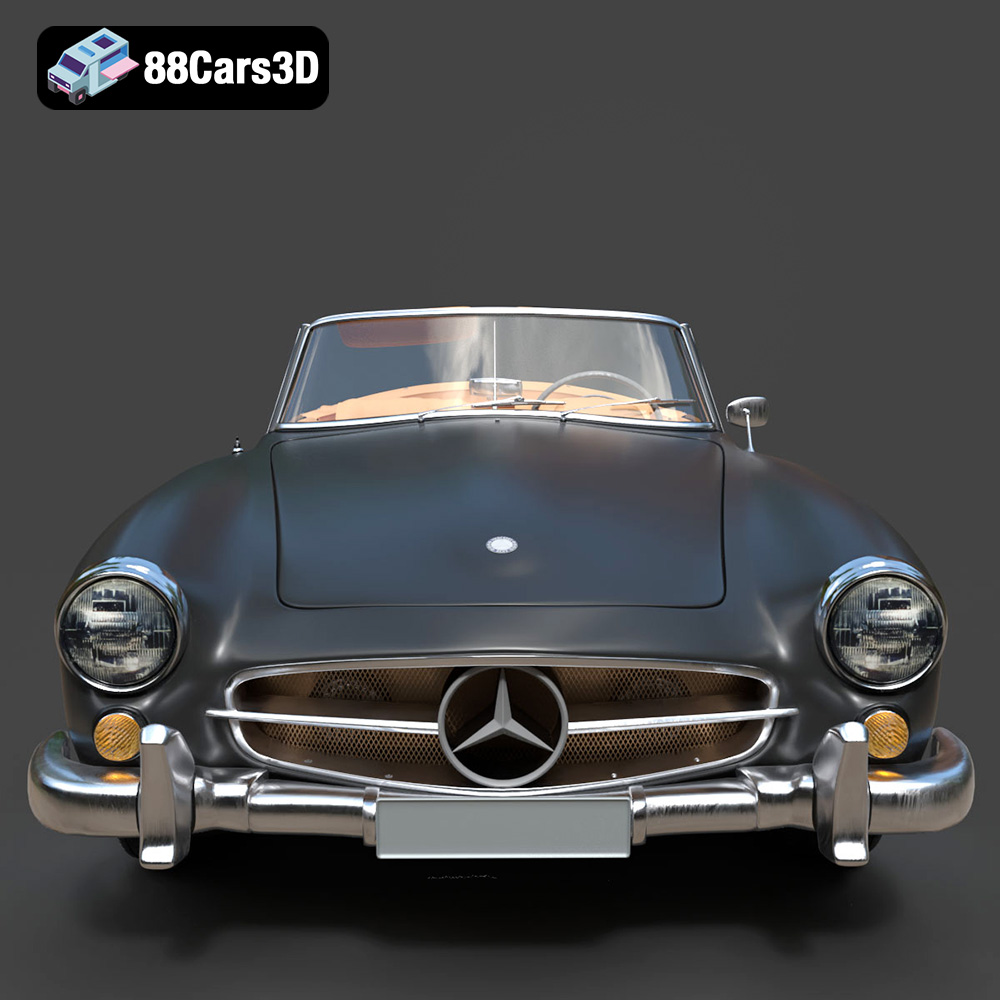
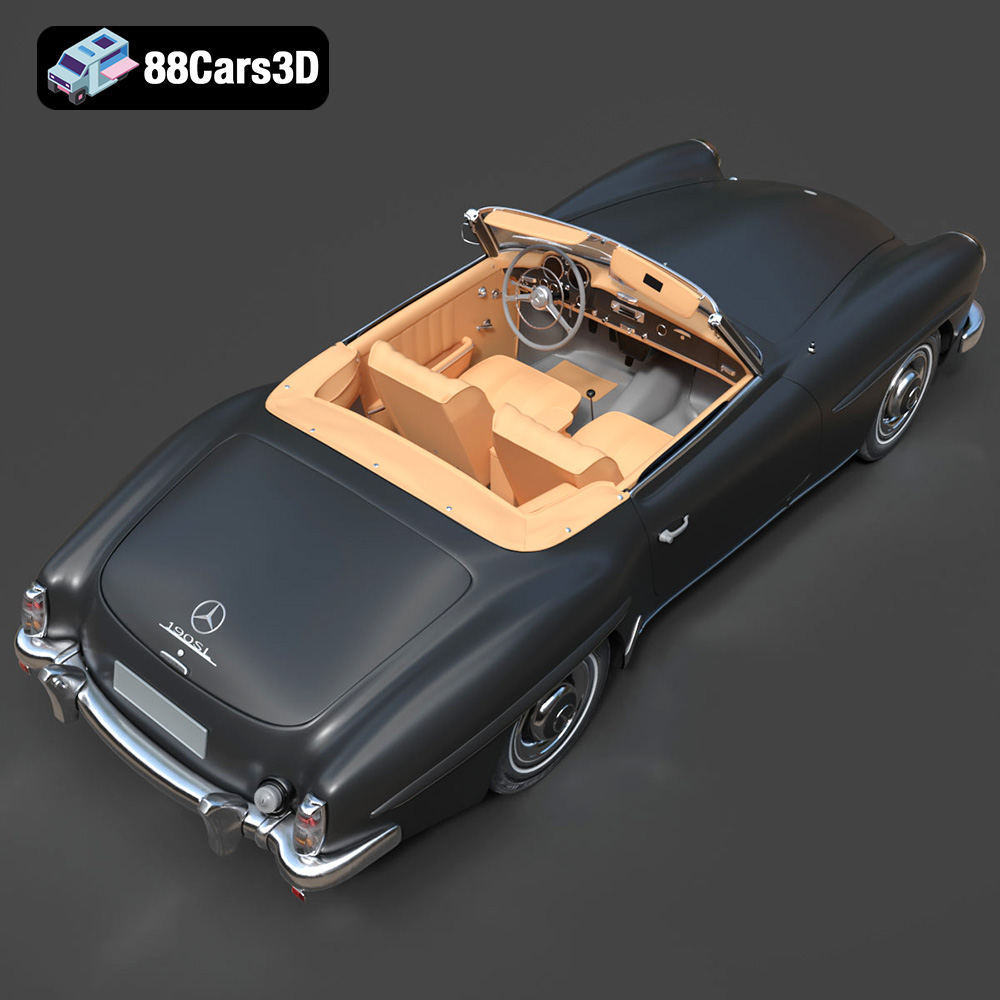
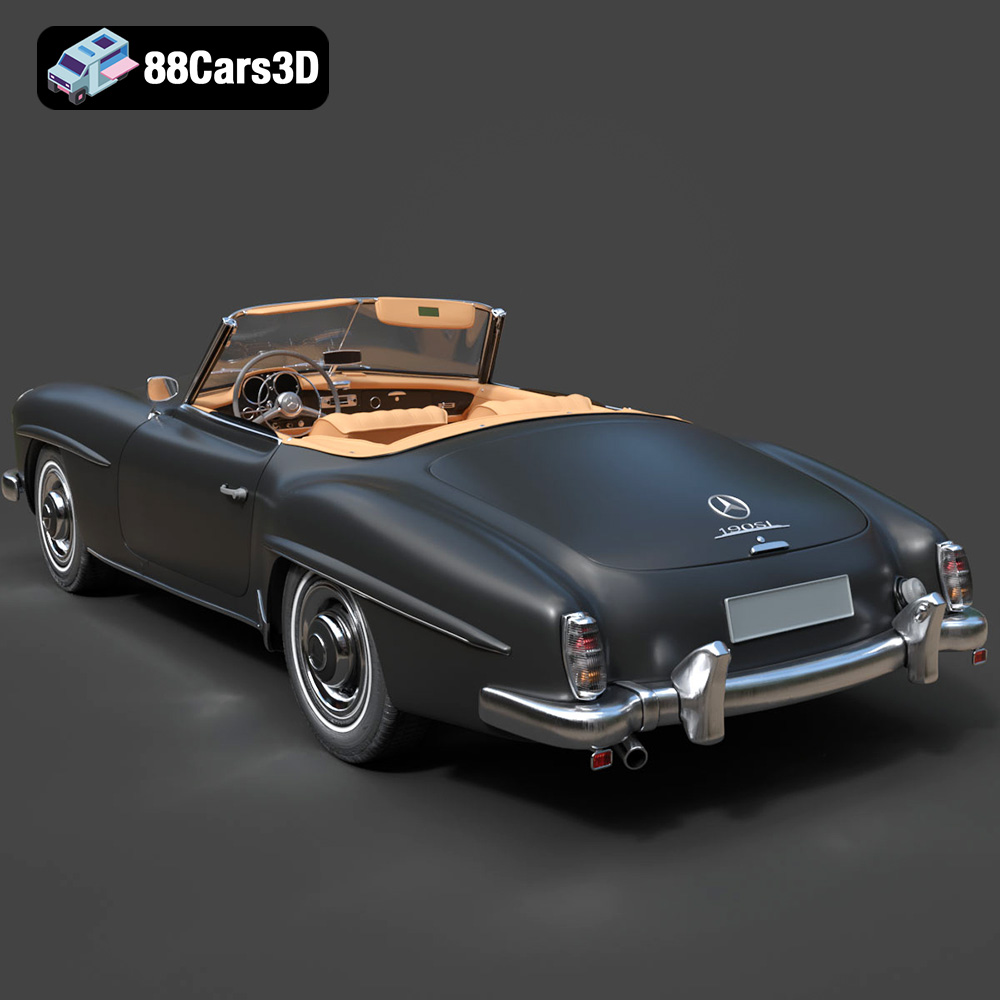
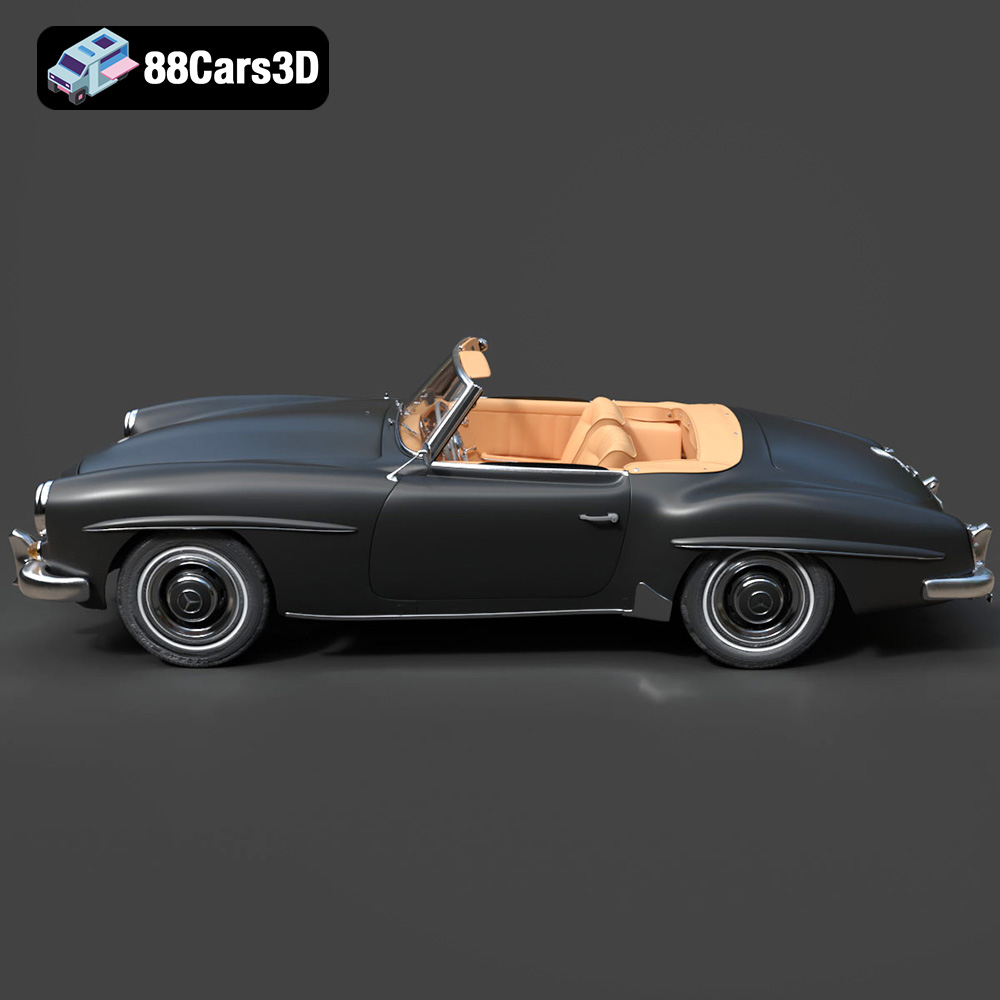
A truly exceptional 3D model doesn’t merely replicate geometry; it captures the essence and spirit of its subject. The Mercedes Benz 190 SL 3D Model achieves this by meticulously reproducing every iconic feature. From the precise frame geometry and proportions that define its silhouette to the distinctive round headlights and classic taillight assemblies, every element is faithfully rendered. Even the period-correct spoked wheels with classic hubcaps and whitewall tires are given the attention they deserve, ensuring the digital rendition exudes the same vintage charm as its real-world counterpart. This level of accuracy is critical for any project aiming for authenticity, whether it’s a historical simulation or a high-end visual advertisement.
The availability of such a detailed 3D car model opens up a world of possibilities for modern visualization. Imagine the 190 SL cruising through a contemporary city in a cinematic animation, or being showcased in a virtual museum where users can explore its intricate details from every angle. This model allows designers, artists, and developers to bring the prestige of this classic car into contexts never before possible. It transforms a historical artifact into a flexible, interactive element within modern digital narratives, allowing new generations to appreciate its beauty and engineering without the limitations of physical access.
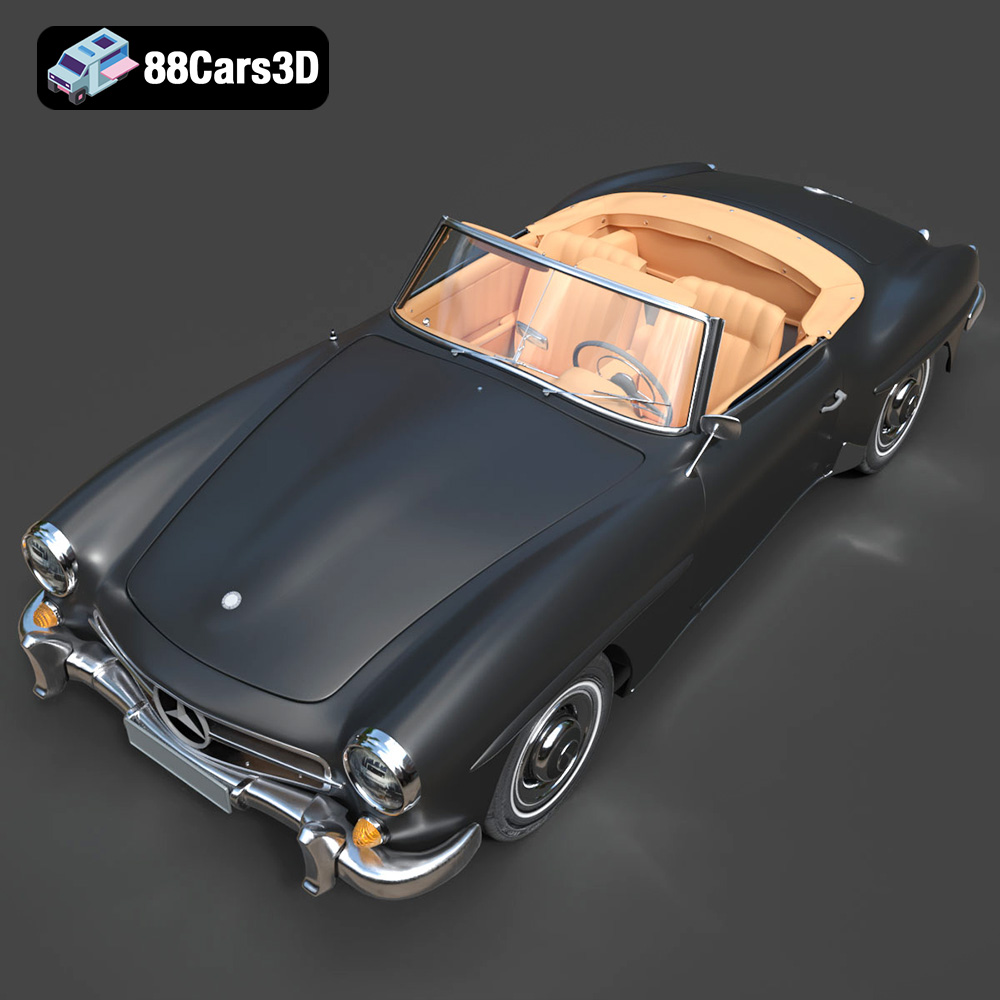
Beyond the exterior, the interior and engine block details are equally crucial for a comprehensive model. The Mercedes Benz 190 SL 3D Model includes a detailed engine block matching the classic 1.9L inline-four and an authentic vintage single exhaust system. Inside, the luxurious vintage leather-style bucket seats, the classic large-diameter steering wheel with its chrome horn ring, and the detailed analog instrument cluster with an authentic dashboard styling are all meticulously replicated. Even the period-correct manual shifter and pedal assembly are present. This exhaustive attention to both macroscopic form and microscopic detail ensures the model’s versatility, making it suitable for close-up renders, first-person cockpit views in games, or even educational visualizations of its mechanics.
One of the most critical aspects of working with 3D car models, or any 3D asset, is understanding the various file formats available. Each format serves a specific purpose, offering different levels of compatibility, data retention, and optimization for particular workflows. The Mercedes Benz 190 SL 3D Model from 88cars3d.com is provided in a wide array of formats, ensuring maximum flexibility for professionals. Let’s delve into these essential formats and their optimal use cases.
The .blend file is Blender’s native format, designed to store an entire Blender scene. This includes not just the mesh geometry, but also materials, textures, lighting, cameras, animations, rigging, physics simulations, and even custom scripts. For artists and studios primarily using Blender, the .blend file offers the most comprehensive and editable version of the model. It allows full access to the original creation process, enabling seamless modifications, scene composition, and advanced rendering within Blender’s powerful Cycles or Eevee engines. It’s the go-to format for anyone looking to deeply customize or integrate the 190 SL into a Blender-centric pipeline.
.fbx (Filmbox) is an Autodesk-developed proprietary file format widely recognized as the industry standard for 3D data exchange. It’s invaluable for transferring models between different 3D software applications and, critically, for integrating assets into real-time game engines like Unreal Engine and Unity. FBX excels at supporting complex data, including mesh geometry, materials (often PBR setups), textures, animations, skinning, and rigging. Its binary nature makes it efficient for storage and loading. When importing the 190 SL into Unreal or Unity, the .fbx format ensures that the model’s structure, pivots, and basic material assignments are preserved, forming an excellent foundation for engine-specific setup.
.obj (Wavefront Object) is a universal, text-based format primarily used for transferring static 3D geometry between applications. It’s highly compatible and can be read by almost any 3D software. An .obj file typically stores vertex positions, UV coordinates, normals, and face information, often accompanied by a separate .mtl (material) file for basic material properties and texture references. While it doesn’t support advanced features like animations or rigging directly within the file itself, it’s an incredibly robust and reliable choice for clean mesh transfer. For simple cross-software compatibility or when only the raw mesh data of the 190 SL is needed, .obj is an excellent choice.
.glb (GL Transmission Format Binary) is a modern, royalty-free format specifically designed for efficient transmission and loading of 3D scenes and models in web browsers, augmented reality (AR), and virtual reality (VR) applications. It’s a single-file format that bundles geometry, materials, textures, and animations into a highly optimized package. GLB files are renowned for their small file sizes and quick loading times, making them ideal for interactive 3D viewers on websites, mobile AR experiences of the 190 SL, or virtual showrooms where performance is paramount. It’s fast becoming the standard for delivering interactive 3D content across the web.
.stl (Stereolithography) is perhaps the most recognized file format for 3D printing. It represents the surface geometry of a 3D object using a collection of interconnected triangles, creating a faceted approximation of the model. STL files contain no color, texture, or material information, focusing purely on the physical form. When preparing the 190 SL for 3D printing, the .stl format is essential for sending the design to a slicer software that will generate toolpaths for the 3D printer. Its simplicity and precision in describing surface geometry make it the cornerstone for converting digital models into tangible objects.
.ply (Polygon File Format) is another format for storing 3D data, particularly useful for high-resolution scanned data and scientific or engineering applications. It can store not only vertex and face information but also properties like color, transparency, normals, texture coordinates, and even material properties. PLY is often chosen for its ability to handle complex and dense meshes, offering a more comprehensive description of geometry than STL, making it suitable for precision CAD work, reverse engineering, or detailed analysis of the 190 SL’s structure.
The term .unreal doesn’t refer to a distinct file format in the same way .fbx or .obj does, but rather signifies an asset that has been specifically prepared and configured for direct import and optimal performance within Unreal Engine. This often means the included .fbx file has been exported with Unreal-specific settings, includes proper pivot points, possibly pre-defined LODs (Levels of Detail), and a suitable material setup (PBR textures with correct naming conventions) that can be easily re-linked within the engine. For a game developer, an “Unreal-ready” 190 SL model means less setup time and a smoother integration process into their project.
Finally, the .max file is the native project file for Autodesk 3ds Max, a leading software for 3D modeling, animation, and rendering. Similar to Blender’s .blend file, a .max file contains the complete scene data, including all geometry, materials, lighting, cameras, animations, and any specific modifiers or plugins used. For professionals working within a 3ds Max pipeline, this format provides full editability and access to the original scene, allowing for advanced rendering with engines like V-Ray or Corona, complex rigging, and sophisticated animation sequences of the Mercedes Benz 190 SL.
By offering this extensive range of formats, the Mercedes Benz 190 SL 3D Model ensures that users can select the most appropriate file for their specific software, project requirements, and desired output, highlighting its truly versatile nature.
The true value of a high-quality 3D car model lies in its adaptability across various professional applications. The Mercedes Benz 190 SL 3D Model, with its optimized geometry and comprehensive file format support, is engineered to slot seamlessly into numerous production pipelines, from real-time interactive experiences to static photorealistic renders.
For game developers, performance is paramount. The 190 SL model is explicitly designed with “game-ready” topology, boasting roughly 200,000 triangles. This polycount strikes an ideal balance, providing high visual fidelity without overtaxing real-time engines like Unreal Engine and Unity. When integrating into these engines, developers typically import the .fbx file, which intelligently transfers mesh data, UVs, and often initial material assignments. From there, artists establish advanced PBR (Physically Based Rendering) material setups, applying textures for body paint, chrome, glass, and tires to achieve stunning realism. Crucially, the model features separate components for wheels, suspension, and steering, along with proper pivot points. This ensures it’s animation-ready, allowing for realistic driving mechanics, suspension travel, and steering animations. Its optimized geometry is also excellent for first-person POV in racing titles, open-world adventures, or dedicated classic car simulators, providing an immersive experience without performance bottlenecks.
In the world of automotive rendering and visualization, the goal is often photorealism, where every reflection, every surface nuance, must be perfect. Professionals using software like 3ds Max (with the .max file) or Blender (with the .blend file) can leverage this model for breathtaking results. Workflows typically involve importing the model, setting up sophisticated studio lighting environments, and utilizing advanced renderers such as V-Ray, Corona Renderer, or Blender’s Cycles. The high-resolution material setups included with the model serve as an excellent starting point, allowing artists to fine-tune reflections, refractions, and surface imperfections. Customization options, such as changing body colors to authentic factory hues, adjusting metallic finishes, or modifying tire textures, allow for endless creative expression in lifestyle scenes, luxury brand campaigns, or even integrating the car into architectural visualization projects for a touch of class and sophistication.
The burgeoning fields of Augmented Reality (AR) and Virtual Reality (VR) demand models that are both visually appealing and highly optimized for interactive, real-time display. The .glb format is tailor-made for these applications, providing a lightweight, single-file solution that bundles geometry, materials, and textures for efficient loading on web platforms or mobile devices. Imagine a virtual showroom where prospective buyers can interact with the 190 SL in full 3D, changing colors, opening doors, and examining the interior in a truly immersive environment. The model’s real-world scale accuracy is particularly beneficial here, contributing to a believable and engaging user experience when overlaid onto real-world scenes via AR or explored within a VR headset.
The quality of a 3D car model isn’t just about how it looks; it’s fundamentally about its underlying technical construction. The Mercedes Benz 190 SL 3D Model excels in this regard, offering a suite of specifications designed for professional use and peak performance.
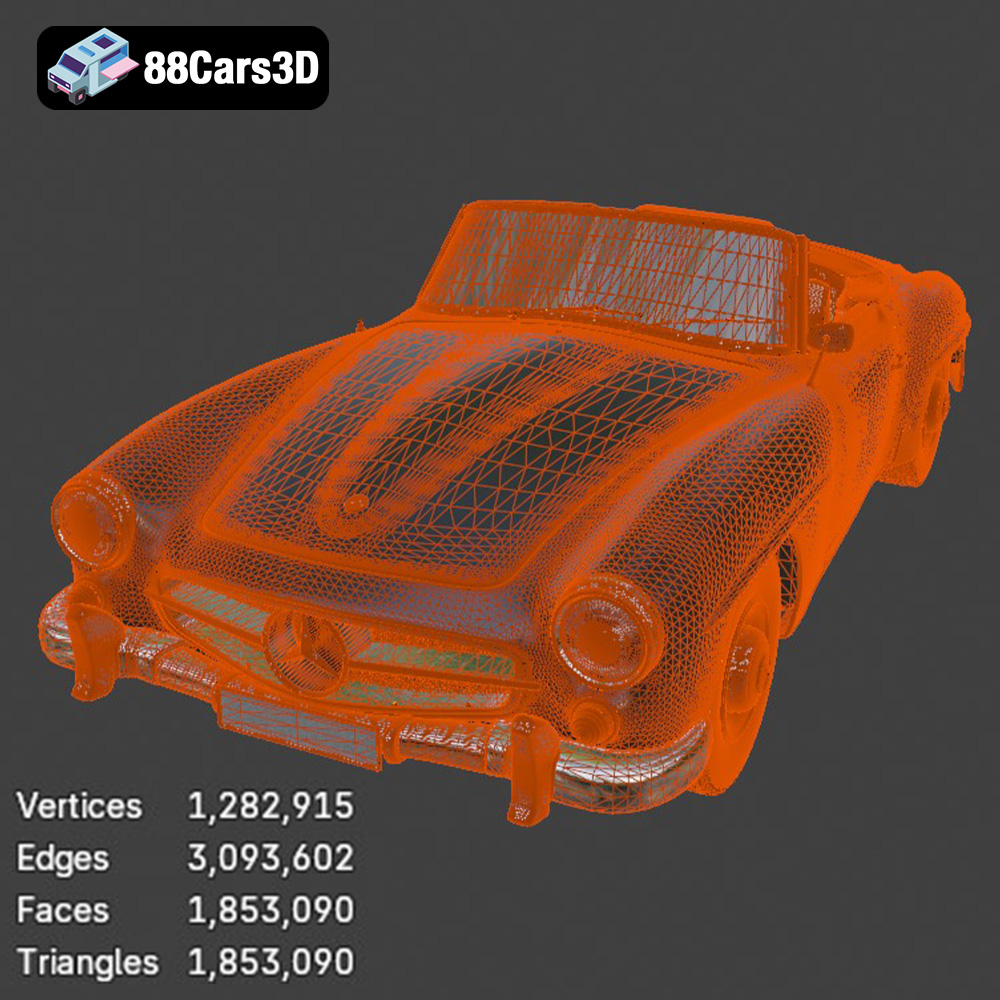
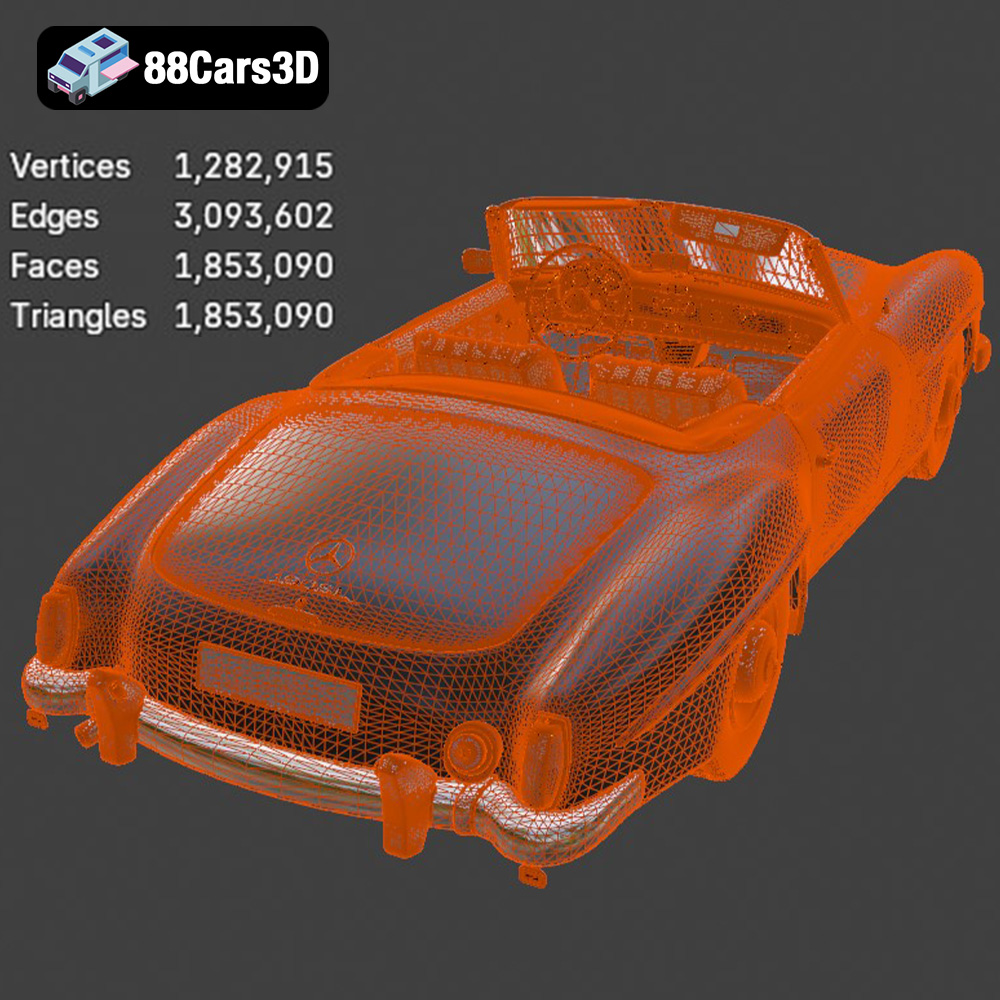
At approximately 200,000 triangles, the 190 SL model strikes a critical balance. For real-time applications, this polycount is optimized to render smoothly across various hardware configurations without sacrificing too much detail. In offline rendering, this dense-enough mesh allows for crisp contours and accurate reflections, even under close scrutiny. The model’s clean, game-ready topology is crucial, meaning the polygon distribution is efficient and orderly, which prevents shading artifacts, facilitates smooth deformations if animated, and allows for efficient UV mapping. Furthermore, its real-world scale accuracy, based on actual vehicle chassis dimensions, ensures that it fits perfectly into any scene, whether for architectural visualization or realistic game environments.
High-end visual realism in 3D depends heavily on advanced material and texture setups. This model is engineered with high-resolution material configurations, typically leveraging PBR (Physically Based Rendering) workflows. PBR materials accurately simulate how light interacts with surfaces in the real world, providing realistic reflections, refractions, and surface properties such across a range of lighting conditions. The customization options are extensive: users can easily modify body and tank colors to match authentic factory finishes or experiment with custom hues. Tire textures can be swapped between street and off-road variants, and material finishes can be adjusted between matte, gloss, and metallic. This flexibility allows artists to tailor the model’s appearance precisely to their project’s aesthetic demands, whether for a pristine studio render or a weathered vintage look.
A static model can be beautiful, but an animatable model is dynamic and immensely useful. The 190 SL model’s technical advantage lies in its component separation: wheels, suspension, and steering components are all distinct meshes. Coupled with proper pivot setups for steering, wheel rotation, and suspension travel, this model is inherently animation-ready. In game development, these separated parts are vital for integrating vehicle physics and realistic driving mechanics. For cinematic animations, artists can easily rig the components to create intricate sequences like opening doors, bonnet reveals, or a smooth drive cycle. This foundational work significantly reduces the time and effort required for artists to prepare the model for complex animated scenarios, allowing them to focus on creative direction rather than tedious setup.
Beyond the digital screen, the Mercedes Benz 190 SL 3D Model also offers an exciting pathway to a tangible, physical manifestation through 3D printing. This capability extends its utility from virtual environments into the realm of hobbyists, collectors, and prototyping.
The inclusion of the .stl format is specifically for this purpose. The journey from a digital 3D mesh to a solid, displayable model involves preparing the digital file for a 3D printer. This typically means ensuring the mesh is “watertight” – meaning it has no holes or non-manifold geometry that would confuse the printing process. While the digital model is optimized for visual fidelity, the .stl conversion focuses on the geometric integrity required for physical fabrication. This allows enthusiasts to create their own miniature replicas, bringing a piece of classic automotive design into their physical collection.
To achieve the best possible results when 3D printing the 190 SL, specific settings are recommended. A scale of 1:12, 1:18, or 1:24 is suggested to capture sufficient detail while remaining manageable. For optimal fidelity, resin printing is highly recommended over FDM (Fused Deposition Modeling) due to its ability to produce much finer details, crucial for delicate parts like the grille, mirrors, and interior elements. Layer heights between 0.04–0.12 mm are ideal for achieving smooth surfaces and intricate features. Wall thickness of 1.2–2.0 mm ensures structural integrity, while an infill of 20–30% provides strength without excessive material use. Supports are required for overhangs and delicate components like the exhaust system, mirrors, and steering wheel. Careful print orientation, such as printing the frame angled for structural strength and wheels separately, further optimizes the output. Post-processing, including sanding, priming, and painting with authentic factory colors and metallic finishes, transforms a raw print into a museum-quality display piece.
One of the joys of 3D printing is the ability to customize. Before printing, hobbyists can leverage the model’s flexibility to personalize their 190 SL. This might involve subtly modifying body proportions (though careful consideration is advised to maintain accuracy), engraving custom details, or preparing multiple versions with different wheel styles or convertible top configurations. The ability to iterate and produce multiple physical models, each with a unique flair, adds an immense layer of creative freedom for collectors who want to go beyond off-the-shelf models, allowing them to truly own a personalized piece of automotive history, conceived digitally and brought to life physically.
In today’s competitive digital landscape, efficiency, quality, and adaptability are paramount. For professionals in game development, advertising, architecture, and design, the ability to source high-quality, pre-optimized 3D car models like the Mercedes Benz 190 SL from 88cars3d.com is not merely a convenience—it’s a strategic advantage.
Creating a highly detailed, game-ready 3D car model from scratch is a labor-intensive and time-consuming process, often requiring hundreds of hours of expert modeling, UV mapping, texturing, and optimization. By utilizing a meticulously prepared asset such as the 190 SL, studios and individual artists can dramatically cut down on production time and costs. This allows teams to allocate their valuable resources to other critical aspects of a project, such as innovative gameplay mechanics, immersive environmental design, or complex animation sequences, rather than reinventing the wheel (literally).
A reputable marketplace like 88cars3d.com provides professional-grade assets that adhere to high standards of quality and technical specifications. This means developers and artists can rely on the model’s clean topology, accurate scale, and optimized material setups. Using pre-vetted assets helps maintain a consistent level of quality across a project, reducing the risk of technical issues, performance bottlenecks, or visual inconsistencies that can arise from poorly constructed models. The 190 SL model, with its rigorous attention to detail and multiple optimized formats, ensures that projects incorporating it will benefit from a robust and visually stunning asset.
With the fundamental asset creation handled, creatives are freed up to explore more innovative and ambitious ideas. Instead of spending time on basic modeling, a game developer can focus on how the 190 SL interacts with its environment, designing unique racing tracks, or crafting engaging storylines around the classic car. An architectural visualizer can experiment with different lighting scenarios and environmental backdrops to showcase a property. The presence of a high-fidelity model like this empowers artists to push the boundaries of their creativity, transforming their visions into compelling digital realities without the overhead of starting from zero. It’s a tool that amplifies potential, allowing professionals to deliver truly exceptional results.
The Mercedes Benz 190 SL is a vehicle that commands respect and admiration, both in the physical world and now, with exquisite detail, in the digital one. The Mercedes Benz 190 SL 3D Model stands as a testament to the power of digital asset creation, bridging the gap between historical automotive excellence and cutting-edge visualization technologies. From its meticulously recreated exterior and interior features to its game-ready topology and extensive file format support, this model is a versatile asset for any professional toolkit.
Whether you are developing the next generation of racing games, crafting photorealistic automotive rendering for a luxury brand, building immersive AR/VR experiences, or bringing a classic to life through 3D printing, this model provides the technical foundation for success. Its optimization for real-time engines, comprehensive detail for high-fidelity renders, and adaptability across various software platforms make it an invaluable resource. By offering such a robust and flexible asset, 88cars3d.com continues to empower creators to achieve their artistic and technical ambitions. Incorporating this exceptional 3D car model into your projects isn’t just an investment in an asset; it’s an investment in quality, efficiency, and boundless creative potential.
The Mercedes Benz 190 SL is a masterpiece of 1950s automotive design, revered for its sweeping curves, elegant proportions, and luxurious open-top roadster experience. Sharing styling cues with the legendary 300 SL, this iconic vehicle features a prominent front grille with the classic three-pointed star, distinctive round headlights, and elegant chrome bumpers. Our 3D model meticulously captures the vintage charm and prestige of the 190 SL, bringing its timeless aesthetic into the digital realm. Engineered with game-ready topology at roughly 200,000 triangles, this model strikes an ideal balance between high-end visual fidelity and real-time performance optimization. The precise geometry and high-resolution material setups make it incredibly versatile for demanding virtual environments, from interactive gaming to photorealistic architectural visualization. Perfect for classic car simulators, luxury lifestyle renders, cinematic animations, and virtual reality showrooms.
$19.99
.blend
.fbx
.glb
.max
.obj
.ply
.rendering
.stl
.unreal
190-sl
car-3d-model
classic-car
game asset
game-ready
low-poly
luxury-roadster
mercedes-benz
optimized
vintage-car
VR/AR