Get 20% OFF All Premium 3D & STL Models!

In the rapidly evolving landscape of digital content creation, the demand for high-fidelity 3D assets is more critical than ever. From blockbuster game titles and immersive virtual reality experiences to photorealistic marketing campaigns and architectural visualizations, the quality of a 3D model can make or break a project. Automotive design, in particular, thrives on precision, realism, and aesthetic appeal, requiring assets that capture every curve, reflection, and intricate detail.
Today, we’re diving deep into the world of professional 3D car models, exploring how meticulously crafted assets empower creators across various industries. We’ll examine the technical intricacies, workflow advantages, and diverse applications of premium digital vehicles, using the stunning Audi Q3 Sportback 2024 3D Model available on 88cars3d.com as our prime example. This dynamic compact luxury crossover, renowned for its sleek aesthetics and versatile utility, exemplifies the pinnacle of modern automotive design, and its digital counterpart sets a high bar for 3D realism and performance.
The choice of file format is a foundational decision in any 3D project, dictating compatibility, feature support, and overall workflow efficiency. A high-quality 3D car model, such as the Audi Q3 Sportback 2024 from 88cars3d.com, is often offered in a variety of formats to ensure maximum versatility across different software and pipelines. Understanding these formats is crucial for optimizing your projects, whether you’re working in game development, rendering, AR/VR, or 3D printing.
The `.blend` file is Blender’s native format, encapsulating an entire scene with all its components: meshes, materials, textures, lighting, cameras, animations, rigging, and even physics simulations. This format is ideal for users deeply integrated into the Blender ecosystem, providing a fully editable and self-contained project file. When you acquire a `.blend` file, you gain access to the complete setup, allowing for extensive customization, modification of topology, adjustments to PBR materials, and re-exporting in other formats as needed. It’s the go-to for continued development and iteration within a Blender-centric workflow, offering unparalleled flexibility.
Autodesk’s `.fbx` (Filmbox) format is arguably the most widely adopted interchange format in 3D production, especially within game development and animation pipelines. It excels at transferring comprehensive scene data, including geometry, UVs, materials, textures (often embedded or referenced), bones, skinning, and animation data, between different digital content creation (DCC) applications like Maya, 3ds Max, Blender, and game engines like Unreal Engine and Unity. For real-time applications, `.fbx` is often the preferred choice due to its robust support for animation and skeletal data, making it ideal for importing animated vehicles or assets with complex hierarchies into your project.
The `.obj` (Wavefront OBJ) format is a highly universal and widely supported format primarily focused on storing geometric data – vertices, normals, UV coordinates, and faces. While it can reference external `.mtl` (Material Template Library) files for basic material properties and texture paths, `.obj` itself does not embed complex material networks or animation. Its strength lies in its simplicity and broad compatibility, making it an excellent choice for straightforward mesh exchange between virtually any 3D software. For static models or when you prefer to build your materials from scratch in your target application, `.obj` offers a clean and reliable foundation.
`.glb` (GL Transmission Format Binary) is a relatively newer, but rapidly growing format designed specifically for the efficient transmission and loading of 3D scenes and models in web, AR, and VR environments. Unlike `.obj` which often requires separate material and texture files, `.glb` is a self-contained binary format that embeds all necessary data – geometry, materials, textures, and animations – into a single file. This makes it incredibly efficient for streaming and display, reducing load times and simplifying asset management for interactive experiences, virtual showrooms, and mobile AR applications.
`.stl` (Stereolithography) is the standard file format for 3D printing. It represents the surface geometry of a 3D model using a tessellated mesh of triangles, without any color, texture, or material information. When a 3D model like the Audi Q3 Sportback needs to be materialized into a physical object, it’s typically converted to `.stl`. The resolution of the `.stl` mesh (i.e., the number of triangles) directly impacts the smoothness and detail of the final print. This format is purely about the physical form, crucial for hobbyists and professionals looking to create display-scale models.
The `.ply` (Polygon File Format) is another robust format for storing 3D data, often used in scientific computing, 3D scanning, and CAD applications. It can store a wider range of properties than `.obj` or `.stl`, including color per vertex, normal vectors, and even properties like transparency and confidence values, making it particularly useful for models derived from 3D scanning or for precise engineering analysis. While less common for general 3D model exchange in entertainment, its precision and ability to store diverse data make it valuable for specific technical workflows.
While `.unreal` isn’t a singular file extension in the same way as `.fbx` or `.obj`, it signifies an asset that has been meticulously prepared and often pre-configured for direct import and optimal performance within Unreal Engine. This typically means the model (often an `.fbx`) comes with PBR materials already set up, collision meshes generated, LODs (Levels of Detail) configured, and possibly even Blueprints for interactive elements. An “Unreal-ready” asset minimizes the setup time for developers, providing a plug-and-play solution that adheres to engine best practices, ensuring visual fidelity and frame rate stability in real-time environments.
The `.max` file is the native project format for Autodesk 3ds Max, one of the leading DCC applications for 3D modeling, animation, and rendering. Similar to `.blend` for Blender, a `.max` file contains the complete scene, including geometry, modifiers, materials, textures, lights, cameras, and animation data. It offers full editability within 3ds Max, making it essential for projects where 3ds Max is the primary authoring tool or for further modification and rendering using advanced features like V-Ray or Corona Renderer. For professionals who rely on 3ds Max for their architectural visualization or automotive rendering needs, the `.max` format provides the most comprehensive and flexible starting point.
The art of creating a convincing 3D car model goes far beyond basic geometry. It involves a meticulous blend of artistic interpretation and technical precision. The Audi Q3 Sportback 2024 3D Model from 88cars3d.com exemplifies this dedication, offering a highly detailed and optimized digital asset tailored for diverse professional needs.
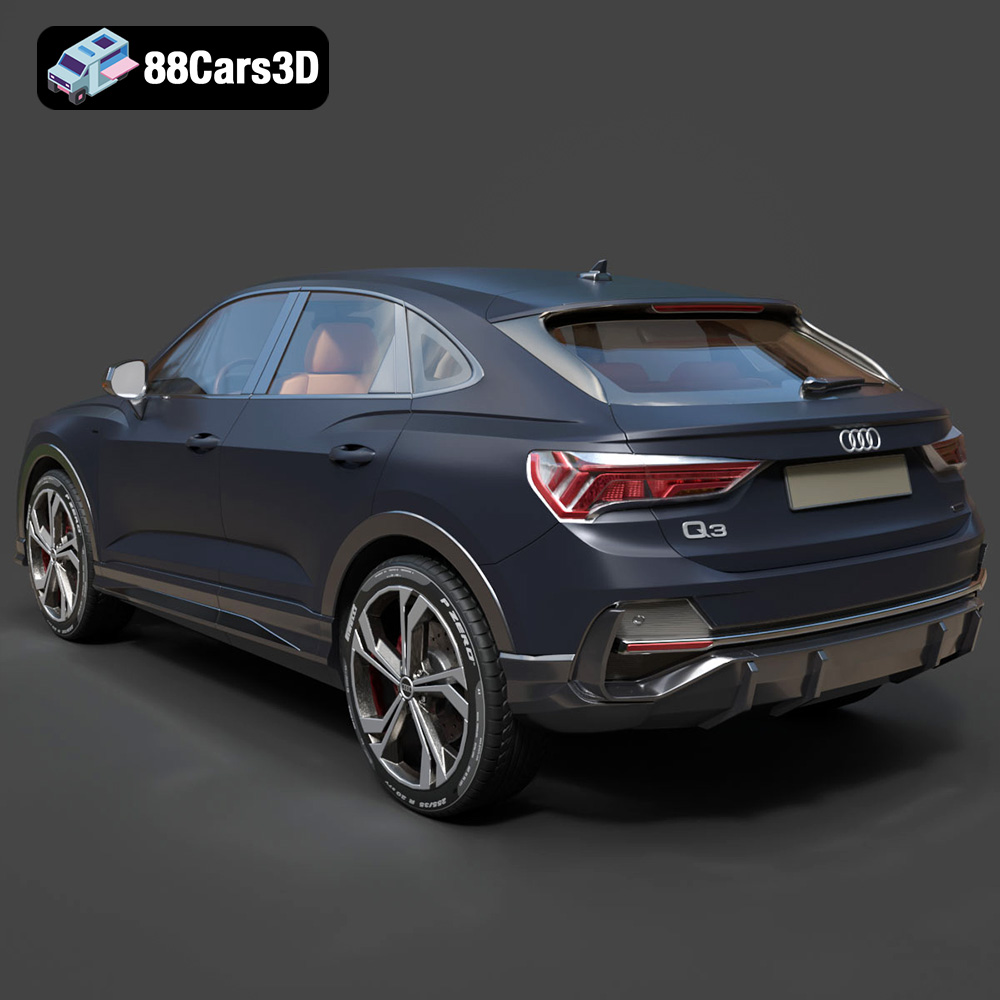
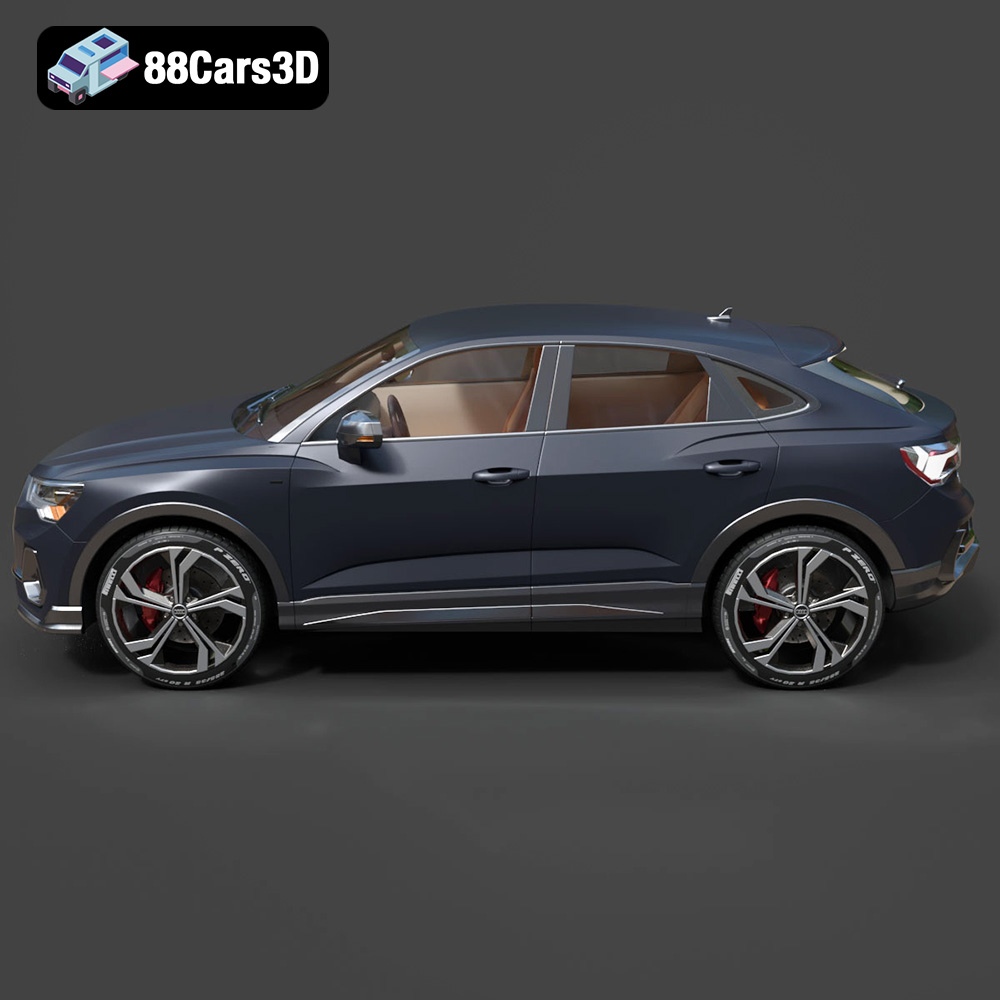
The Audi Q3 Sportback is defined by its distinctive coupe-SUV proportions, a sweeping roofline, and an assertive stance. This 3D model accurately captures these defining characteristics, from the iconic octagonal Singleframe grille with its intricate honeycomb pattern to the sporty rear diffuser and integrated exhaust surrounds. Every curve, panel gap, and aerodynamic contour is faithfully reproduced, ensuring that the digital model evokes the same sense of premium craftsmanship as its real-world counterpart.
For many applications, especially AR/VR configurators, simulators, and first-person game perspectives, the interior of a vehicle is just as important as the exterior. The Audi Q3 Sportback 2024 model delivers a highly detailed cockpit, making it suitable for immersive experiences.
The real value of a premium 3D car model lies in its seamless integration into various professional pipelines. Whether for automotive rendering, game development, or interactive experiences, the technical specifications of an asset like the Audi Q3 Sportback 2024 3D Model are designed to facilitate efficient and high-quality production.
For marketing campaigns, architectural visualizations, and product showcases, photorealistic rendering is paramount. The Audi Q3 Sportback 3D model, with its precise UV mapping and high-resolution material separation, provides an excellent foundation. Artists can easily apply physically-based rendering (PBR) materials, adjusting metallic, roughness, and normal maps to achieve stunning visual fidelity under various lighting conditions.
The demands of game development differ significantly from offline rendering, prioritizing optimization and performance. The Audi Q3 Sportback 2024 3D Model is game-ready, boasting approximately 150,000 triangles. This polycount strikes an exceptional balance, offering striking visual fidelity without compromising real-time performance, making it ideal for engines like Unreal Engine and Unity.
The versatility of a well-crafted 3D model extends into emerging technologies, offering new avenues for interaction and physical manifestation. The Audi Q3 Sportback 2024 3D Model is designed to excel in these frontiers as well.
Augmented Reality (AR) and Virtual Reality (VR) are transforming how consumers interact with products. For car configurators, virtual showrooms, and mobile AR experiences, the Audi Q3 Sportback 3D model is a perfect fit. The `.glb` format, specifically, is optimized for these platforms, offering a compact, self-contained file for efficient loading and display.
For hobbyists, collectors, or designers looking for physical prototypes, the ability to 3D print a digital asset is invaluable. The Audi Q3 Sportback 2024 3D Model, convertible to the `.stl` format, offers this capability. The provided 3D print settings are a testament to the model’s design for physical output.
In the realm of real-time graphics, every polygon, texture, and shader contributes to the overall performance and visual quality. The Audi Q3 Sportback 2024 3D Model is engineered to provide an optimal balance, ensuring stunning visuals without bogging down the frame rate.
With approximately 150,000 triangles, the Audi Q3 Sportback model hits a sweet spot for modern real-time applications. This polygon count is substantial enough to capture the intricate curves and details of the vehicle, eliminating blocky appearances even at close distances. Simultaneously, it remains within a manageable range for game engines to render multiple instances of the car efficiently, making it perfect for open-world games, racing titles, and urban simulators.
Beyond static representation, vehicles in interactive experiences often need to move. The Audi Q3 Sportback 2024 3D Model is built with animation in mind.
A premium 3D asset should offer long-term value, adapting to evolving project needs and creative visions. The Audi Q3 Sportback 2024 3D Model from 88cars3d.com provides extensive customization options, ensuring its relevance across multiple projects and years.
The ability to customize a 3D model is a significant advantage, reducing the need for extensive re-modeling or purchasing multiple variants. This model offers several key customization avenues:
Investing in high-quality 3D car models is a strategic decision. An asset like the Audi Q3 Sportback 2024, provided in multiple industry-standard formats, ensures compatibility with future software versions and emerging technologies. Its optimized nature means it performs well today and will continue to be a valuable asset as hardware and real-time rendering capabilities advance.
The digital realm is an increasingly visual space, and for automotive enthusiasts, designers, game developers, and visualization artists, the quality of 3D car models is non-negotiable. Assets like the Audi Q3 Sportback 2024 3D Model from 88cars3d.com represent the pinnacle of digital craftsmanship, offering an unparalleled blend of aesthetic fidelity, technical precision, and workflow optimization.
From its meticulously replicated exterior and detailed interior to its game-ready topology and extensive file format support, this model is a testament to the power of a well-engineered 3D asset. It streamlines workflows, enables stunning visualizations, and paves the way for immersive interactive experiences across game development, AR/VR, and even 3D printing. By choosing premium 3D car models, creators can elevate their projects, achieve unprecedented levels of realism, and truly bring their automotive visions to life.
Explore this exceptional Audi Q3 Sportback 2024 3D Model and many other high-quality automotive assets at 88cars3d.com, your premier destination for professional 3D car models.
The Audi Q3 Sportback is a dynamic compact luxury crossover that beautifully blends the versatile utility of an SUV with the emotional and sleek aesthetics of a coupe. Renowned for its sweeping roofline, aggressive Singleframe honeycomb grille, and prominent wheel arches, the Q3 Sportback stands out in modern urban environments. Our 3D model meticulously captures its sporty silhouette, featuring highly accurate exterior styling cues, meticulously crafted Matrix LED lighting units, and a precisely modeled stance that mirrors the real-world vehicle. This premium 3D model is built with optimized, game-ready topology at approximately 150,000 triangles, guaranteeing striking visual fidelity without compromising real-time performance. Designed for seamless integration into game engines like Unreal Engine and Unity, it also serves as an outstanding asset for high-end offline rendering. Its precise UV mapping and high-resolution material separation make it an incredibly versatile digital asset. Perfect for urban driving simulators, modern architectural visualizations, immersive AR/VR car configurators, and lifestyle commercial renderings.
$19.99
.2024
.audi
.blend
.crossover
.fbx
.glb
.luxury suv
.max
.obj
.ply
.rendering
.stl
.unreal
car-3d-model
compact-suv
game asset
game-ready
low-poly
optimized
q3-sportback
SUV
VR/AR