Get 20% OFF All Premium 3D & STL Models!

The allure of classic automobiles transcends generations, captivating enthusiasts with their timeless design, engineering marvel, and the stories they tell. For 3D artists, game developers, architects, and product visualizers, bringing these iconic machines into the digital realm presents a unique blend of technical challenge and creative opportunity. It demands not just an eye for detail, but a deep understanding of geometry, materials, and digital workflows to achieve true-to-life representation.
Imagine recreating the roaring twenties or the opulent thirties in a cinematic production, an immersive game, or a virtual showroom. The vehicles that populate these digital landscapes are crucial for authenticity. One such magnificent example is the 1933 Cadillac V16 452-C Town Car, an undisputed masterpiece of pre-war American luxury. Its colossal 16-cylinder engine and distinctive open-chauffeur body style make it a challenging yet rewarding subject to model. Thankfully, artists and developers no longer need to start from scratch. High-quality, pre-built 3D car models, like the exceptional rendition of the Cadillac V16 452-C available at 88cars3d.com, offer a powerful shortcut, providing unparalleled detail and versatility for a myriad of applications.
This article delves into the intricate world of premium 3D car models, exploring their technical specifications, diverse applications, and the professional workflows they enable. We’ll examine how these digital assets bridge the gap between historical accuracy and modern technology, focusing on the sophisticated requirements of today’s creative industries.
Creating a truly exceptional 3D car model is a meticulous process, combining artistic vision with rigorous technical execution. It begins with comprehensive research, involving historical blueprints, photographic references, and a keen understanding of automotive design principles. This foundational stage ensures that every curve, every chrome accent, and every mechanical component is accurately translated into the digital mesh.
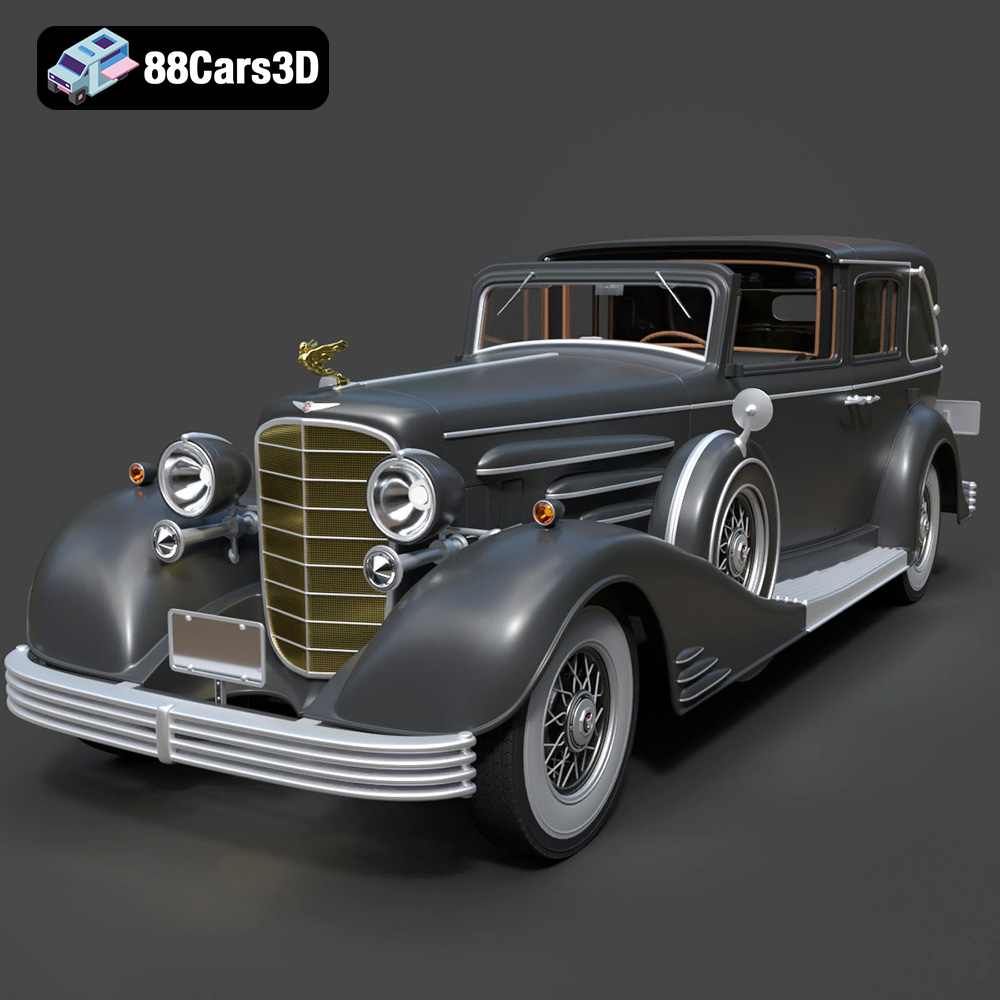
For a vehicle like the 1933 Cadillac V16 452-C Town Car, this means meticulously replicating its sweeping pontoon fenders, the iconic Goddess hood ornament, the majestic chrome V-shaped grille, and the period-correct dual side-mount spare tires. The challenge lies in translating these complex shapes into a clean, optimized mesh without sacrificing aesthetic integrity. A premium 3D model, such as the one found on 88cars3d.com, achieves this by balancing geometric complexity with intelligent topology. It’s about more than just recreating the exterior; it’s about capturing the essence of the vehicle’s era and its engineering philosophy. The detailed engine block enclosures, showcasing the legendary 452 cubic-inch V16 layout, and the authentic dual exhaust system and undercarriage details, elevate the model beyond a mere shell to a comprehensive digital twin.
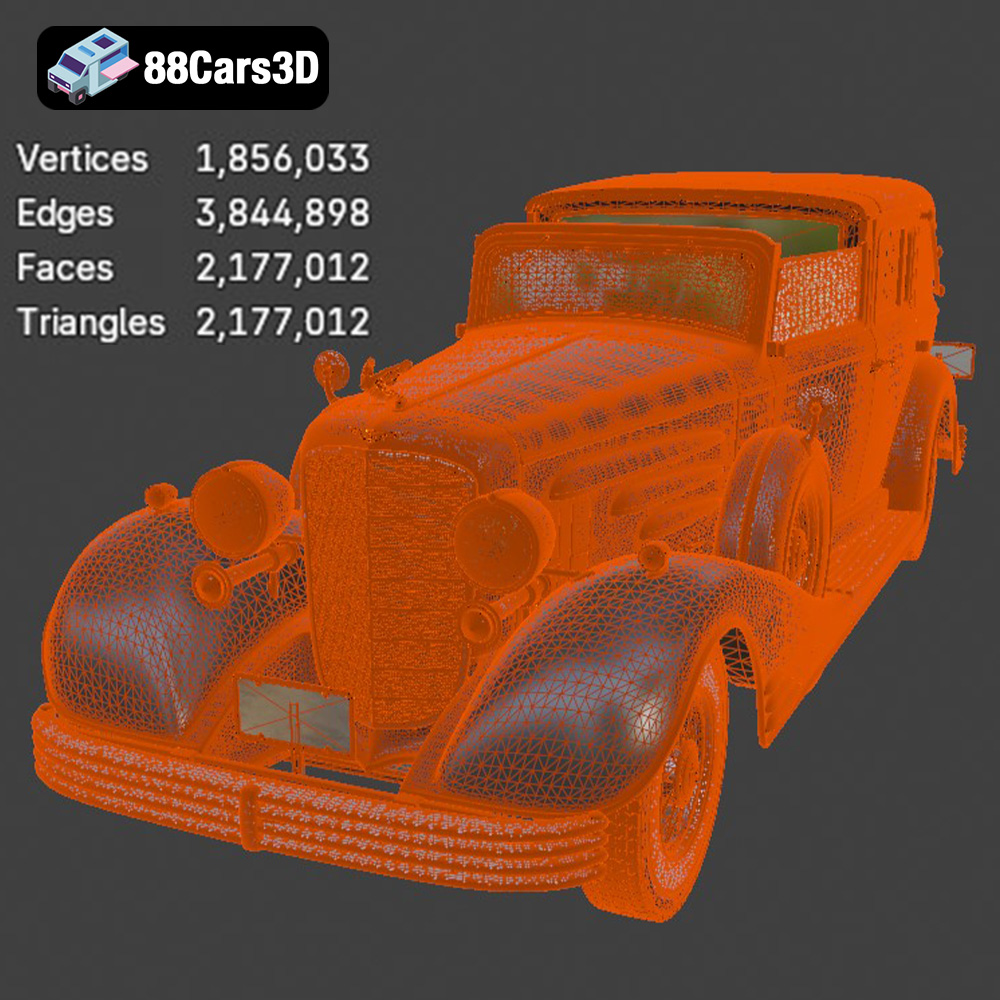
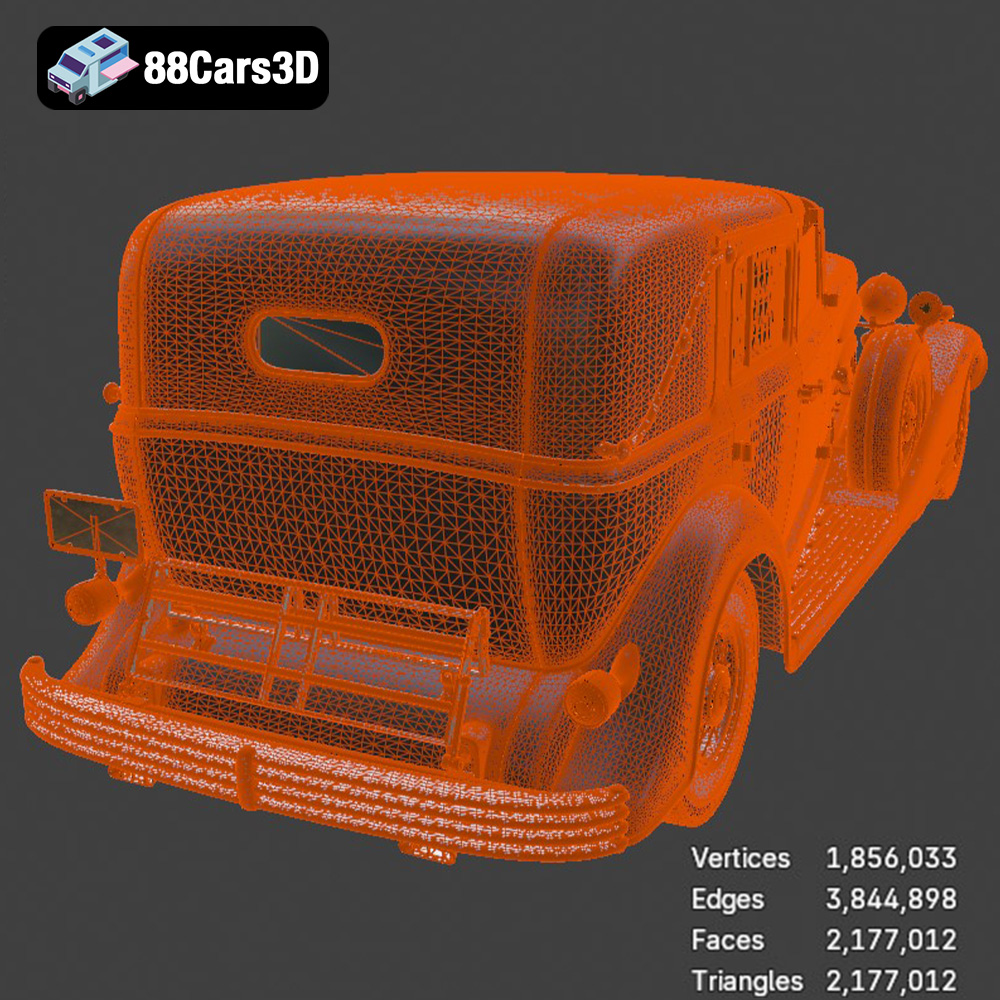
The core of a high-quality 3D model lies in its topology – the arrangement of vertices, edges, and faces that form its surface. For the 1933 Cadillac V16 452-C Town Car model, an extraordinary level of visual fidelity is achieved with a detailed topology of 2,177,012 triangles. This poly count strikes an impressive balance: it’s high enough to capture every nuanced curve and intricate detail for stunning photorealism, yet intelligently structured to remain versatile for high-end digital applications, including real-time engines. This optimization ensures that while the model looks breathtaking, it also performs efficiently, which is critical for demanding game development, AR/VR experiences, and fluid rendering pipelines. Clean topology also facilitates UV mapping, texturing, and potential future modifications, making the asset truly professional-grade.
Navigating the world of 3D assets requires a solid grasp of the various file formats available. Each format serves a specific purpose, offering unique advantages for different stages of the 3D pipeline, from initial modeling to final rendering, real-time deployment, or physical production. Understanding when and why to use a particular format is crucial for efficient workflow and project success. The 1933 Cadillac V16 452-C Town Car model from 88cars3d.com exemplifies this versatility by offering a comprehensive suite of file formats.
The .blend format is native to Blender, the popular open-source 3D creation suite. It encapsulates an entire Blender scene, including the 3D model, materials, textures, lighting, cameras, animations, and even physics simulations. This makes it an incredibly powerful and flexible format for users who work predominantly within Blender. Artists can fully edit every aspect of the Cadillac V16 model, modify its mesh, adjust materials, or re-rig it for custom animations. Its self-contained nature ensures that all scene data is preserved, offering maximum creative control and facilitating complex project setups.
.fbx (Filmbox) is arguably the most widely adopted proprietary file format for 3D data exchange, particularly prevalent in the game development and animation industries. Developed by Autodesk, FBX supports geometry, materials (with PBR extensions), textures, animations, skeletons, and blend shapes. It’s ideal for transferring complex assets like 3D car models between different 3D software (e.g., 3ds Max, Maya, Blender) and directly into real-time engines like Unreal Engine and Unity. For the Cadillac V16 model, the .fbx file ensures that the optimized geometry, proper pivot setup for animation, and material assignments are readily consumable by game engines, making it a true game-ready asset.
The .obj (Wavefront OBJ) format is a universal, open-standard file format primarily used for exchanging 3D geometry data. It stores vertex positions, UV coordinates, normals, and face information. While it doesn’t typically store animation or rigging data, it’s excellent for static mesh transfers and ensuring broad compatibility across virtually all 3D software applications. The .obj version of the 1933 Cadillac V16 ensures that the core mesh data is accessible to any artist, regardless of their primary software, serving as a reliable fallback for cross-software compatibility. Materials are often defined in an accompanying .mtl (material template library) file.
.glb (GLB format for GL Transmission Format) is an increasingly vital format, especially for web-based 3D, augmented reality (AR), and virtual reality (VR) applications. It’s a binary form of glTF, designed for efficient transmission and loading of 3D scenes and models. GLB bundles the 3D model, textures, and animations into a single file, making it incredibly lightweight and easy to integrate into browsers, mobile AR apps, and VR experiences. The .glb version of the Cadillac V16 is optimized for these immersive platforms, enabling its seamless display in virtual showrooms or interactive web configurators.
The .stl (STereoLithography) format is synonymous with 3D printing. It represents 3D surfaces as a series of connected triangles, forming a tessellated model. While it lacks color, texture, or material information, its simplicity makes it the go-to format for additive manufacturing. The .stl variant of the Cadillac V16 452-C Town Car allows hobbyists and professionals to physically print a display-scale model, transforming the digital asset into a tangible collectible. The product description provides specific recommendations for scale, layer height, and supports, highlighting its readiness for physical output.
The .ply (Polygon File Format, or Stanford Triangle Format) is another format for storing 3D data, particularly point clouds and polygon meshes. It can store various properties beyond just geometry, such as color, transparency, normals, texture coordinates, and confidence values. PLY is often used in scientific, engineering, and CAD applications where precise mesh data with additional attributes is required for analysis or specialized rendering. Its inclusion for the Cadillac V16 model caters to users needing a robust, precision mesh for CAD integration or detailed technical evaluations.
The .unreal designation implies an asset specifically prepared or packaged for direct import and optimal performance within Unreal Engine. This often means pre-configured materials using Unreal’s PBR workflow, optimized mesh LODs (Levels of Detail), and potentially collision meshes. This format ensures that the Cadillac V16 model is truly “engine-ready,” minimizing setup time for developers and maximizing visual quality within the powerful real-time environment of Unreal Engine.
Finally, the .max format is the native file format for Autodesk 3ds Max, a leading software in architectural visualization, animation, and high-end rendering. Similar to .blend, it saves the entire scene, including all modeling, texturing, lighting, and animation data specific to 3ds Max. The .max file for the Cadillac V16 model allows professional artists working in 3ds Max to leverage their familiar tools for further customization, high-resolution rendering, and integration into complex architectural or cinematic scenes, ensuring seamless integration into studio pipelines.
The availability of highly detailed and optimized 3D car models fundamentally transforms professional workflows across various industries. Instead of dedicating hundreds of hours to modeling complex vehicles from scratch, studios and artists can leverage assets from marketplaces like 88cars3d.com, focusing their efforts on creativity, scene assembly, and rendering optimization. The 1933 Cadillac V16 452-C Town Car model is a prime example of how such an asset empowers diverse projects.
For high-end cinematic productions, advertising campaigns, or architectural visualizations, photorealism is paramount. Artists often rely on software like 3ds Max or Blender, paired with advanced renderers such as V-Ray, Corona, Octane, or Cycles. A model like the Cadillac V16, with its high polygon count and intelligently structured geometry, serves as an ideal base. In a 3ds Max workflow, the .max file allows artists to meticulously set up studio lighting, adjust PBR (Physically Based Rendering) materials for gloss paint, polished chrome, and rich woodwork, and create dynamic camera animations. For architectural visualizations, the Cadillac V16 can be placed within a sprawling historical street scene or parked elegantly in front of a grand manor, instantly adding a layer of period authenticity and luxury. The level of detail, down to the intricate wire wheels and leaf spring suspension, ensures that even close-up shots hold up to scrutiny.
The demanding nature of game development and real-time environments requires a delicate balance between visual fidelity and performance. Game-ready assets must have optimized geometry, efficient UV layouts, and PBR materials suitable for engines like Unreal Engine and Unity. The 1933 Cadillac V16 model, with its 2,177,012 triangle count, is designed with this in mind. Its .fbx and .unreal file formats are perfect for direct integration. Developers can utilize its separate wheels, suspension, and steering components for animation, enabling realistic driving mechanics in open-world games, racing titles, or historical simulators. The optimized geometry ensures smooth frame rates, even when multiple instances of the vehicle are present, while the detailed exterior and interior features, including the opulent rear passenger compartment and classic Art Deco instrument cluster, provide an immersive experience for players, whether in third-person view or a first-person POV in a VR driving simulator.
Augmented Reality (AR) and Virtual Reality (VR) are transforming how we interact with digital content, offering immersive experiences for training, education, and commerce. For virtual showrooms or interactive configurators, a high-quality 3D car model is essential. The .glb format of the Cadillac V16 452-C is specifically optimized for these applications, allowing for quick loading and smooth interaction on various devices, including mobile. Imagine a luxury virtual showroom where potential buyers can explore the Cadillac V16 from every angle, step inside the exposed driver’s open-air cockpit, and even customize its two-tone 1930s factory finishes in real-time. This level of immersive detail enhances user engagement and provides a powerful tool for marketing and education, allowing virtual visitors to appreciate the grandeur of this classic vehicle without physical limitations.
A true premium 3D model goes beyond mere visual appeal; it’s engineered for performance and versatility. The 1933 Cadillac V16 452-C Town Car 3D model exemplifies this by offering a suite of technical advantages that streamline its integration into demanding professional projects.
The model’s meticulous recreation of the Cadillac V16 (452-C) Town Car frame geometry and sweeping 1930s proportions sets a high bar. Every exterior detail, from the period-correct elegant carriage lights and massive bullet-style headlights to the intricate multi-spoke wire wheels fitted with classic wide whitewall tires, has been carefully modeled. The historically accurate leaf spring suspension detailing and visible undercarriage components contribute significantly to its realism. Inside, the distinction between the exposed driver’s open-air cockpit and the opulent rear passenger compartment, complete with tufted seating and rich woodwork, is accurately preserved. The classic Art Deco instrument cluster and detailed gauges, pedals, and gear lever offer a truly authentic feel, crucial for realistic first-person perspectives in games and VR.
One of the model’s significant technical advantages is its readiness for animation. It boasts separate wheels, suspension, and steering components, each with proper pivot setups. This means artists can easily animate realistic steering, wheel rotation, and suspension travel without complex rigging from scratch. This feature is invaluable for cinematic sequences, driving simulators, and interactive presentations. Furthermore, the model adheres to real-world scale accuracy, based on the actual 1933 vehicle chassis and wheelbase. This meticulous attention to scale ensures that the model integrates seamlessly into scenes with other real-world assets or architectural environments without requiring tedious adjustments, maintaining consistency across projects.
While the product description focuses on geometry, the mention of “optimised geometry for first-person POV” and “change body/coachwork colors,” “modify tire textures,” and “adjust material finishes” implies a sophisticated PBR material setup. Premium 3D car models come with high-resolution textures (e.g., albedo, normal, roughness, metallic, ambient occlusion maps) that accurately simulate real-world materials. This allows for stunning photorealistic renders and consistent material behavior across different lighting conditions in real-time engines. The customization options provided – such as classic two-tone 1930s factory finishes, clean vs. weathered whitewall tires, and matte leather/gloss paint/polished chrome adjustments – provide artists with creative freedom to adapt the Cadillac V16 to specific project requirements, extending its utility far beyond a static representation.
The utility of a high-quality 3D model extends beyond digital screens into the physical world through 3D printing. The 1933 Cadillac V16 452-C Town Car model offers an .stl format specifically for this purpose, allowing enthusiasts and professionals to create tangible replicas of this automotive icon.
Converting a detailed digital model into a successful physical print requires careful preparation. The .stl format triangulates the model’s surface, preparing it for slicing software. However, merely converting the file isn’t enough. Considerations like scale are critical; the product recommends 1:12, 1:18, or 1:24 for display-scale hobbyists, indicating a thoughtful approach to print feasibility. Understanding the structural integrity required for physical objects means assessing wall thickness (recommended 1.2–2.0 mm) and planning for necessary supports for intricate details like exhaust pipes, mirrors, steering wheels, and the delicate wire spokes. The print orientation, with the frame angled for structural integrity and wheels printed separately, highlights expert knowledge in preparing the asset for optimal print results, minimizing warping and ensuring strength.
Achieving a high-quality physical print, especially for a detailed classic car, often leans towards specific printing technologies. Resin printing is recommended for its ability to produce fine details at low layer heights (0.04–0.12 mm), perfectly capturing the intricate features of the Cadillac V16. Post-processing is an integral part of the workflow, involving sanding to remove layer lines, applying primer for an even surface, and finally, painting with authentic factory colors and metallic finishes to truly bring the printed model to life. This end-to-end guidance demonstrates the comprehensive nature of the 3D model, ensuring users can achieve impressive results whether they operate in the digital or physical domain.
In a competitive digital landscape, the choice of 3D assets can significantly impact project quality, efficiency, and ultimately, success. Opting for premium 3D car models, such as those found on 88cars3d.com, offers distinct advantages over attempting to create every asset from scratch.
The creation of a highly detailed, game-ready, and animation-friendly 3D car model is an incredibly time-consuming and resource-intensive endeavor. It requires specialized skills in modeling, UV mapping, texturing, and optimization. For a studio, this translates into significant labor costs and extended production schedules. By investing in a pre-made premium asset like the 1933 Cadillac V16 452-C Town Car, artists and studios can save hundreds, if not thousands, of hours of development time. This efficiency allows teams to allocate resources to other critical aspects of their projects, such as artistic direction, interactive design, or complex animation sequences, thereby accelerating project delivery and reducing overall costs while maintaining a high standard of quality.
Premium marketplaces like 88cars3d.com curate models that meet rigorous quality standards. These assets are often created by experienced artists who specialize in automotive modeling, ensuring historical accuracy and technical precision. For historical recreations, brand campaigns, or museum-grade interactive visualizations, authenticity is non-negotiable. The detailed topology, real-world scale, and period-correct features of the Cadillac V16 model guarantee that the final output will be visually convincing and true to the original. This assurance of quality and historical fidelity protects the integrity of a project and enhances its professional appeal, distinguishing it in a crowded market. It’s about delivering not just a 3D model, but a digital representation crafted with expertise and passion.
The journey from a historical masterpiece like the 1933 Cadillac V16 452-C Town Car to a meticulously crafted 3D digital asset is a testament to the sophistication of modern 3D modeling. These premium 3D car models are more than just static objects; they are versatile tools that empower artists, developers, and designers across diverse industries. From populating cinematic period pieces and driving high-performance game simulations to enhancing immersive AR/VR experiences and even producing tangible 3D prints, their utility is boundless.
The Cadillac V16 452-C Town Car 1933 3D Model stands out as a prime example of excellence in this domain. Its exceptional visual fidelity, optimized geometry for real-time performance, and comprehensive array of included file formats (.blend, .fbx, .obj, .glb, .stl, .ply, .unreal, .max) make it an invaluable asset for any professional workflow. By leveraging such high-quality resources from trusted marketplaces like 88cars3d.com, creators can save invaluable time, ensure unparalleled authenticity, and elevate the overall impact of their projects. As digital frontiers continue to expand, the demand for such expertly crafted 3D car models will only grow, solidifying their indispensable role in shaping our visual world.
The 1933 Cadillac V16 (452-C) Town Car is an undisputed masterpiece of American automotive history, representing the absolute pinnacle of pre-war luxury and bespoke coachbuilding. Renowned for its whisper-quiet, colossal 16-cylinder engine and the distinctive open-chauffeur “Town Car” body style, this magnificent vehicle defined 1930s elegance and prestige. Key visual elements include its sweeping pontoon fenders, the iconic Goddess hood ornament, majestic chrome V-shaped grille, and dual side-mount spare tires, all culminating in a breathtakingly regal silhouette. This premium 3D model boasts an extraordinary level of visual fidelity with a detailed topology of 2,177,012 triangles, capturing every nuanced curve and chrome accent of the classic original. Despite its high detail, the geometry is intelligently structured to ensure stunning photorealism while remaining versatile for high-end digital applications. It stands as an exceptional asset for developers and artists demanding true-to-life representation in historical recreations, architectural visualizations, and cinematic productions.
$37.50
.blend
.cadillac
.fbx
.glb
.max
.obj
.ply
.rendering
.stl
.unreal
.v16
1933
452-c
car-3d-model
classic-car
game asset
game-ready
luxury car
optimized
pre-war
town-car
VR/AR