Get 20% OFF All Premium 3D & STL Models!

The automotive world is undergoing a seismic shift, with electric vehicles (EVs) not just pushing the boundaries of performance and sustainability but also redefining modern design aesthetics. This evolution is mirrored in the realm of 3D visualization, where capturing the essence of cutting-edge vehicles has become paramount for game developers, animators, architects, and product designers. From the sleek curves of an aerodynamic body to the intricate details of a digital cockpit, the demand for high-fidelity 3D car models that accurately reflect real-world engineering is higher than ever. These digital assets are the building blocks for immersive experiences, captivating visuals, and interactive applications that transport users into the future of mobility.
Among the vanguard of this electric revolution stands the Porsche Taycan Turbo S, a testament to Stuttgart’s engineering prowess combined with a vision for zero-emission performance. Its distinctive silhouette, aggressive stance, and luxurious, tech-laden interior make it a prime candidate for digital recreation. For professionals seeking to integrate this icon into their projects, a meticulously crafted 3D model is indispensable. The Porsche Taycan Turbo S 3D Model from 88cars3d.com offers an exceptional balance of visual fidelity and technical optimization, making it suitable for a vast array of demanding applications from game development to cinematic rendering and even 3D printing.
This comprehensive article will delve into the technical intricacies, practical applications, and creative potential unlocked by such a premium asset, highlighting how the right 3D car model can elevate your projects to professional standards. We’ll explore the essential file formats, advanced workflows, and the strategic advantages of using pre-optimized, high-quality models in today’s fast-paced digital production environment.
Navigating the world of 3D modeling often begins with understanding the myriad of file formats available, each designed with specific purposes, compatibility, and technical advantages. When acquiring a premium 3D car model like the Porsche Taycan Turbo S, knowing which format to use for your particular workflow is crucial for efficiency and optimal results. The model available on 88cars3d.com includes a robust selection of industry-standard formats, ensuring broad compatibility and flexibility.
The .blend format is the native file type for Blender, the powerful open-source 3D creation suite. When you download a .blend file, you’re not just getting the mesh; you’re getting a fully editable Blender scene. This includes all materials, textures, lighting setups, cameras, and even animations if present. For artists and studios heavily invested in the Blender ecosystem, this format offers unparalleled flexibility for customization, rigging, and rendering. You can easily modify the model’s topology, adjust shaders, add specific lighting environments, or integrate it seamlessly into a larger Blender project without any import/export conversions that might lead to data loss.
.fbx (Filmbox) is arguably one of the most widely supported 3D file formats, making it ideal for pipelines involving multiple software packages, especially for real-time engines like Unreal Engine and Unity. It excels at preserving scene data such as meshes, materials, textures, animations, and even rigging information across different platforms. For game developers and VFX artists, an .fbx file from the Porsche Taycan Turbo S model ensures a relatively smooth transfer into their respective engines, minimizing the need for extensive re-setup. Its robust nature makes it a reliable choice for complex assets that need to move between sculpting, texturing, animation, and engine integration stages.
The .obj (Wavefront OBJ) format is a universal standard for exchanging geometry data. It’s renowned for its simplicity and broad compatibility across virtually every 3D software application. While it primarily stores mesh data (vertices, normals, UVs, faces) and can link to external material (.mtl) files, it typically doesn’t preserve complex scene information like rigging or animation. For basic model transfers, archival purposes, or when working in a highly customized pipeline where you prefer to set up materials and lighting from scratch in your target software, .obj is an excellent, reliable choice. Its widespread adoption ensures that the Taycan Turbo S model can be opened and worked with by almost any 3D artist, regardless of their primary software.
.glb (GL Transmission Format Binary) is an increasingly important format, especially for emerging technologies like Augmented Reality (AR), Virtual Reality (VR), and browser-based 3D applications. It’s a self-contained binary file that encapsulates all 3D model data – geometry, materials, textures, and even animation – into a single, highly optimized file. This makes it incredibly efficient for streaming over the web and loading quickly in real-time environments. For interactive Taycan configurators, mobile AR experiences, or web-based virtual showrooms, the .glb version of the 3D model is the go-to format for maximum performance and ease of deployment.
.stl (Stereolithography) is the de facto standard file format for 3D printing. It represents a 3D model as a series of connected triangles (a tessellated surface) without color, texture, or other CAD attributes. While simple, its universal acceptance by 3D printers and slicing software makes it indispensable for converting digital models into physical objects. The Porsche Taycan Turbo S model’s inclusion of an .stl format means enthusiasts can bring a physical representation of this electric marvel to life, whether for display, prototyping, or hobbyist projects. Specific recommendations for scale, layer height, and support structures are often provided to ensure a successful print.
.ply (Polygon File Format or Stanford Triangle Format) is another format for storing 3D data, particularly useful for scanned data, precision meshes, and scientific applications. It supports a wider range of properties than .stl, including color, transparency, and sometimes even material properties per vertex or face. While less common for general 3D asset exchange than .fbx or .obj, its ability to store detailed geometric and attribute data makes it valuable for specialized workflows, such as reverse engineering, CAD integration, or detailed mesh analysis of the Taycan’s structure.
Beyond a generic .fbx, some premium asset packs like the Porsche Taycan Turbo S model offer a dedicated “.unreal” file or a directly optimized Unreal Engine project file. This signifies an asset that has been specifically prepared, tested, and sometimes even imported directly into an Unreal Engine environment. This could include pre-configured materials, collision meshes, LODs (Levels of Detail), and blueprint setups, saving countless hours of setup time for developers. It ensures that the model is truly “game-ready” for Epic’s powerful real-time renderer, ready to drop into an existing project with minimal fuss.
.max is the native file format for Autodesk 3ds Max, a long-standing industry standard for 3D modeling, animation, and rendering, particularly in architectural visualization and product design. Similar to .blend, a .max file preserves the entire scene, including geometry, materials (especially V-Ray or Corona setups), lighting, cameras, and animation curves. For professionals using 3ds Max as their primary tool, the .max version of the Porsche Taycan Turbo S model offers complete control and flexibility, allowing for deep customization, complex scene integration, and high-end photorealistic rendering directly within their established pipeline.
Achieving photorealistic automotive rendering or truly immersive game experiences hinges on the quality and accuracy of the 3D models used. The Porsche Taycan Turbo S 3D Model exemplifies this commitment to detail, providing an asset that stands up to the closest scrutiny in both static renders and dynamic real-time environments.
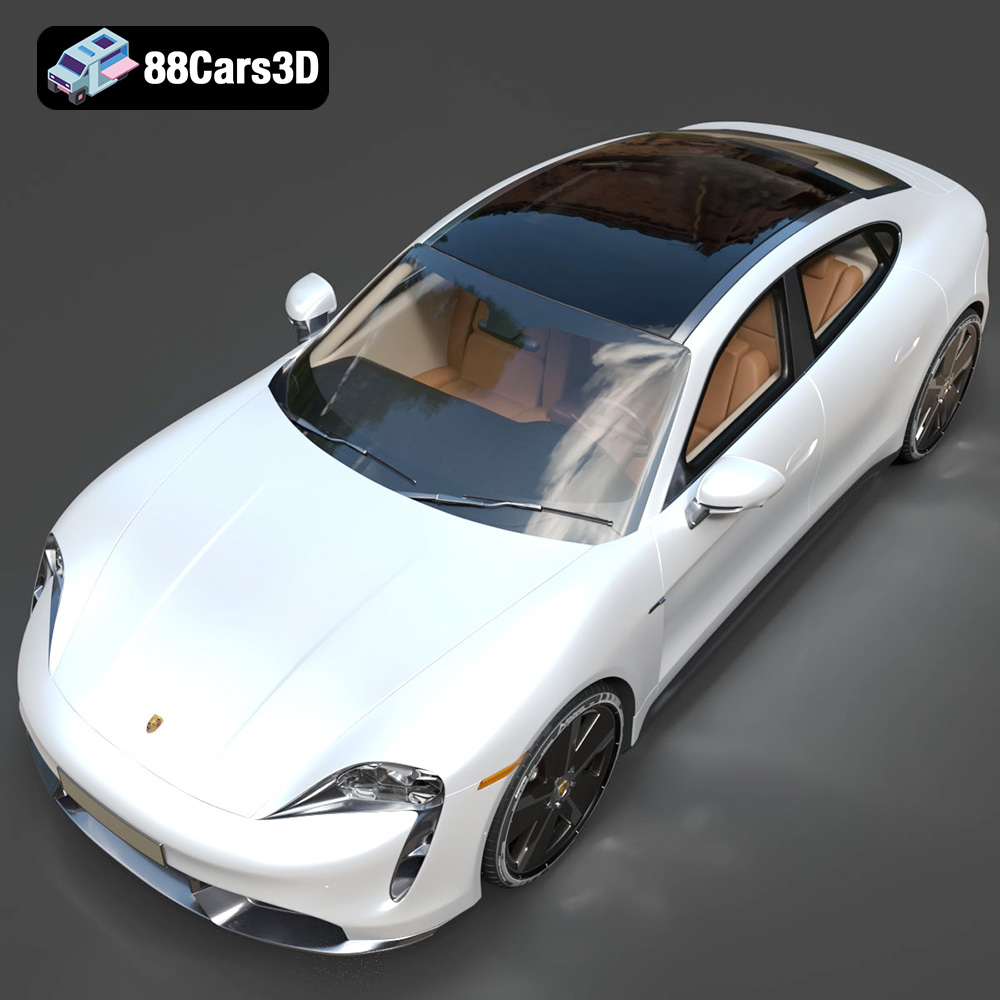
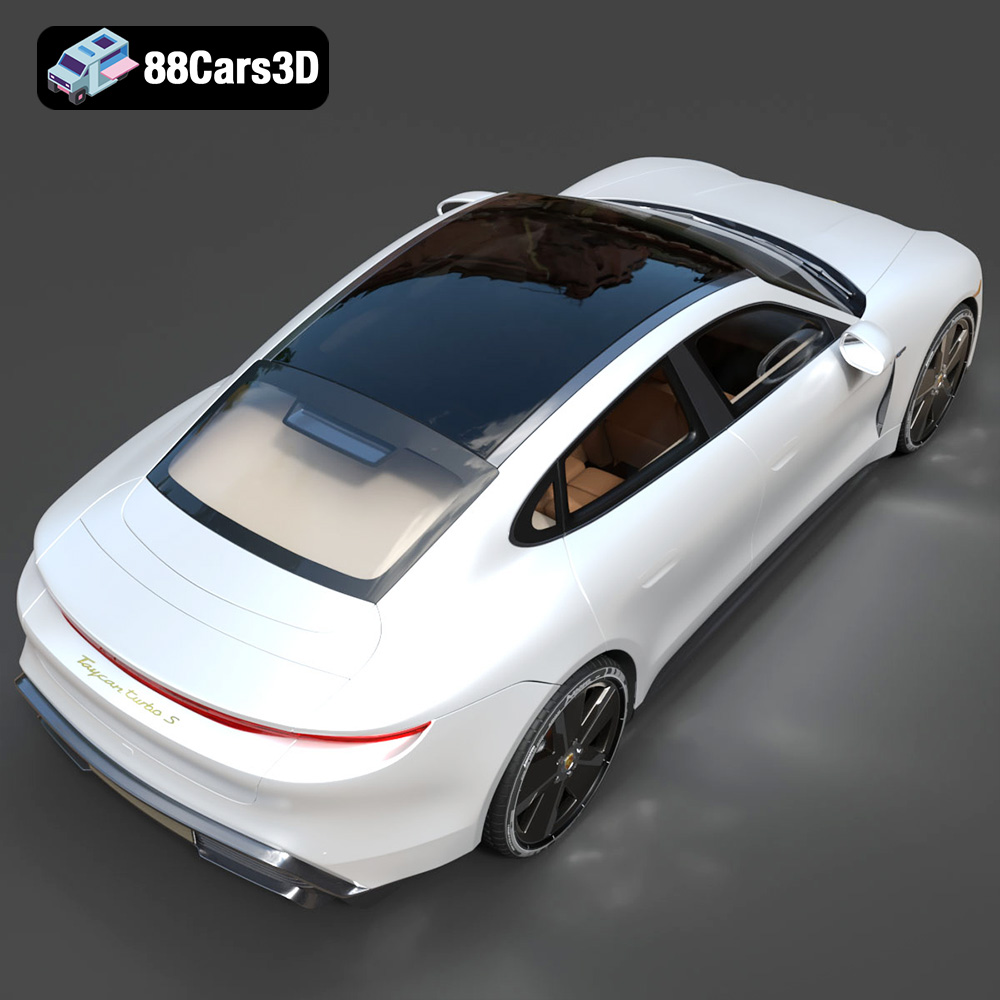
The first impression of any vehicle lies in its exterior, and the Taycan Turbo S is no exception with its distinctive, future-forward design. The 3D model meticulously captures its sleek, aerodynamic silhouette, which is crucial for conveying both its performance credentials and its electric identity. Key features like the striking four-point LED headlights, which are a signature Porsche design element, and the continuous rear light bar, are accurately represented. Even subtle details such as the front trunk seams and charging port covers are included, adding to the model’s authenticity. The aerodynamically optimized lower valance and rear diffuser are rendered with precision, hinting at the car’s performance capabilities. Furthermore, the Mission E style aerodynamic alloy wheels are not merely generic placeholders but are crafted with specific attention to detail, complemented by high-performance tires and massive carbon-ceramic brake discs with detailed calipers. The separated wheels, suspension, and steering components are a vital technical advantage, enabling realistic animation for racing simulations or cinematic sequences.
While the exterior grabs attention, the interior is where the user experience truly comes alive, particularly in gaming or VR applications. The Porsche Taycan Turbo S model doesn’t neglect this crucial aspect. It features sport seats with intricate stitching and ergonomic bolstering, designed to immerse the user in the luxury and performance of the Taycan. The detailed GT multifunction sports steering wheel, a central point of interaction, is accurately modeled, as are the curved digital instrument cluster and the array of dashboard display panels. The accurate center console with its detailed haptic climate control interfaces ensures that the digital cockpit experience mirrors its real-world counterpart. This level of interior detail is optimized for first-person POV in gaming, making it perfect for driving simulators or virtual walkthroughs where the player directly interacts with the vehicle’s interior.
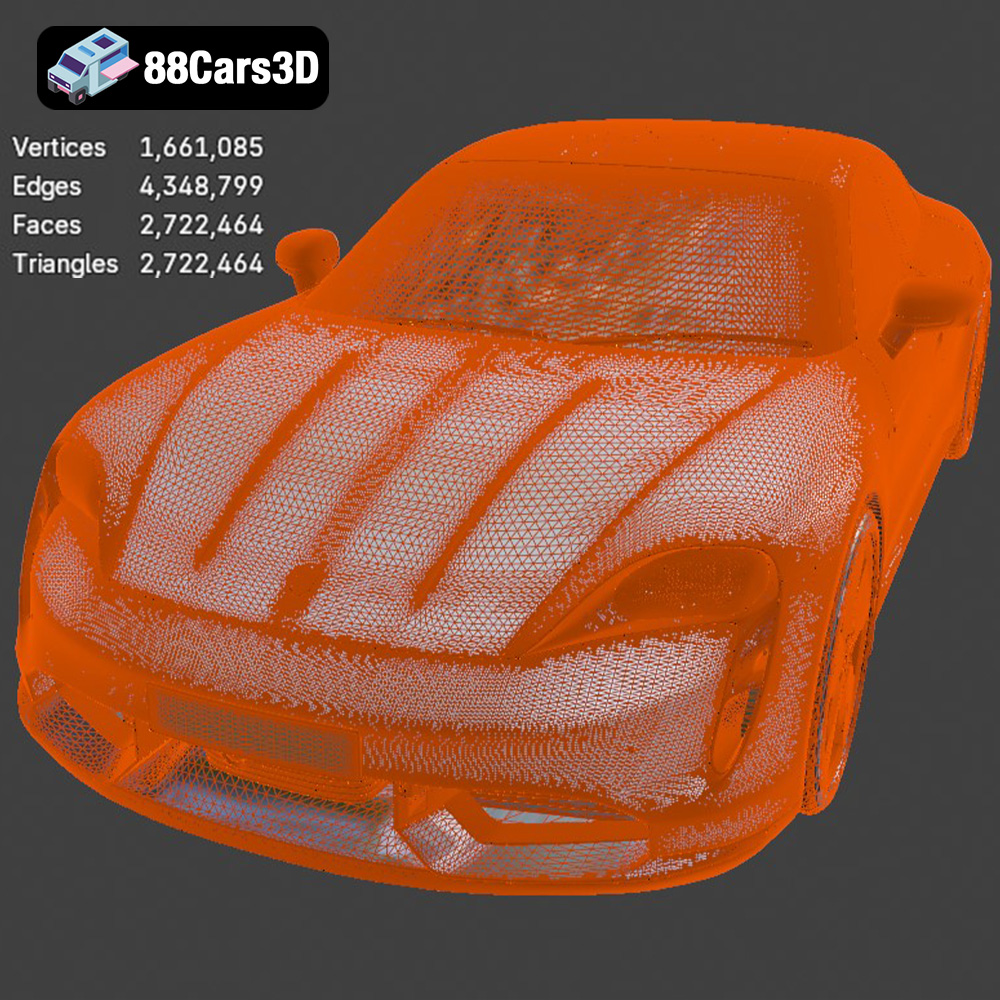
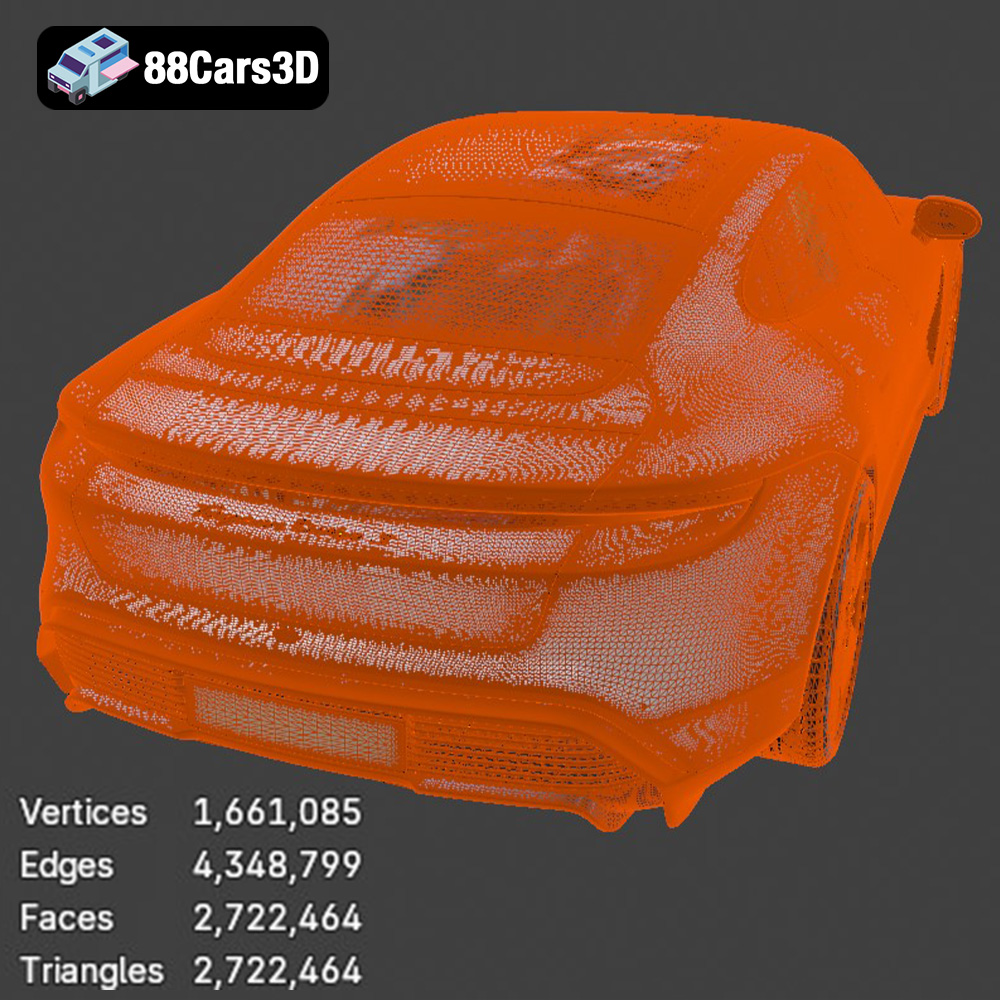
The foundation of any high-quality 3D model lies in its technical specifications. With a topology boasting 2,722,464 triangles, the Taycan Turbo S model strikes a superb balance. This polycount is high enough to deliver unparalleled visual fidelity, capturing every curve and seam without aliasing, yet it remains structured for next-generation real-time applications. This “game-ready & optimized” designation means it can perform efficiently in engines like Unreal or Unity without compromising on visual realism. The model is built to real-world scale accuracy, based on actual vehicle chassis measurements, ensuring it integrates seamlessly into architectural visualization scenes or accurate physics simulations. Crucially, proper pivot setups for steering, wheel rotation, and suspension travel are implemented, making the model ready for dynamic animation without additional rigging work, saving developers significant time and effort.
In the competitive world of game development, especially for racing titles and open-world experiences, the quality of 3D car models can make or break immersion. Leveraging a high-fidelity, optimized asset like the Porsche Taycan Turbo S model provides a significant competitive edge.
The “game-ready” designation of the Taycan Turbo S model is particularly relevant for real-time engines. For an Unreal Engine 5 workflow, the included .fbx or even the dedicated .unreal asset format streamline the import process. Developers can typically drag-and-drop the asset, and thanks to proper pivot points and optimized geometry, it requires minimal setup. The 2,722,464 triangles, while appearing high, are intelligently distributed, allowing for detailed visuals without crippling frame rates when combined with Unreal Engine’s advanced rendering features like Nanite. Implementing LODs (Levels of Detail) would be the next step for extreme optimization, where simpler versions of the model automatically swap in at a distance, ensuring performance scalability across various hardware specifications. Materials, often pre-configured, can be easily adjusted within Unreal’s Material Editor, allowing for real-time shader adjustments, PBR (Physically Based Rendering) texture mapping, and even advanced effects like dynamic dirt or rain accumulation.
Racing simulators demand the highest levels of accuracy, not just visually but also in terms of vehicle physics and animation. The separated wheels, suspension, and steering components, coupled with precise pivot setups, are invaluable here. This allows developers to integrate complex physics systems, accurately simulating tire deformation, suspension compression, and realistic steering input. The model’s real-world scale accuracy ensures that physics calculations, such as downforce or collision detection, behave as expected. With its detailed interior, the Taycan Turbo S model is perfect for first-person cockpit views, where every button and display needs to be clearly visible and potentially interactive, providing an authentic driving experience. The optimized polycount ensures that multiple Taycan models can race on track simultaneously without excessive performance overhead.
Beyond dedicated racing titles, premium 3D car models significantly enhance the visual fidelity and believability of open-world games. Imagine cruising through a sprawling metropolis or a scenic countryside in a highly detailed Porsche Taycan Turbo S. Such a vehicle acts as a focal point, drawing players in and adding a layer of realism to the virtual world. The model’s quality ensures that even as the camera gets close, the car maintains its visual integrity, from the subtle reflections on its paintwork to the intricate design of its headlights. For non-player characters (NPCs) or environmental dressing, even slightly simplified versions of such high-quality assets elevate the overall production value, making the game world feel more alive and less generic.
The versatility of a well-crafted 3D model extends far beyond traditional screens, opening doors to interactive AR/VR experiences and even tangible physical creations through 3D printing.
Augmented Reality (AR) and Virtual Reality (VR) are revolutionizing how consumers interact with products, especially in the automotive sector. The Porsche Taycan Turbo S model is perfectly suited for creating immersive virtual showrooms where potential buyers can explore the car in a 360-degree environment, walk around it, and even “sit” inside. Using the .glb format, this model can be easily integrated into web-based AR configurators, allowing users to project the Taycan into their real-world environment via a smartphone, change colors, or customize wheels in real-time. For VR, the detailed interior and game-ready optimization ensure a smooth, high-fidelity experience, enabling fully immersive test drives or virtual tours that go beyond static images or videos.
The inclusion of the .stl format, alongside detailed 3D print settings, opens up a fascinating avenue for hobbyists, collectors, and designers: 3D printing. The ability to convert the digital Porsche Taycan Turbo S into a physical display model allows for a unique connection to the digital asset. The recommended scales (1:12, 1:18, 1:24) are popular for collectible models, and advice on layer height (0.04–0.12 mm) points towards high-detail resin printing, which is ideal for capturing the fine nuances of the car’s bodywork and interior. Printing suggestions like “frame printed angled for structural integrity” and “wheels printed separately” demonstrate an understanding of practical 3D printing challenges, guiding users to achieve the best possible physical replica. Post-processing steps like sanding, priming, and painting with authentic factory colors, including metallic finishes, further enhance the physical model’s realism, turning a digital file into a miniature masterpiece.
For advertising agencies, automotive brands, and cinematic productions, the visual fidelity of a 3D car model is paramount. The Porsche Taycan Turbo S model provides the canvas for breathtaking photorealistic renders and compelling narratives.
When it comes to generating stunning photorealistic images or animations, software like 3ds Max (using the .max file) or Blender (with the .blend file) are the tools of choice. The high polygon count of the Taycan Turbo S model ensures that even extreme close-ups reveal smooth surfaces and crisp details without faceted edges. Artists can leverage advanced rendering engines like V-Ray, Corona Renderer, or Cycles to simulate real-world light physics, materials, and textures. The accurate geometry means that reflections and refractions behave realistically, making the metallic paintwork, glass, and chrome elements truly pop. The separated components for wheels and suspension also allow for subtle adjustments that convey motion and weight, even in a static image.
A premium 3D model is only as good as its materials and lighting. The Taycan Turbo S model provides a strong foundation. Artists can meticulously craft PBR materials to replicate the exact finish of Porsche’s paints – from deep gloss metallics to matte textures – along with the subtle sheen of leather, the texture of carbon fiber, and the reflective properties of glass and chrome. Leveraging HDRI (High Dynamic Range Image) lighting environments can quickly place the car in a realistic outdoor or studio setting, providing natural reflections and ambient illumination. For studio shots, an intricate setup of area lights, spot lights, and rim lights can highlight the car’s sculpted lines and create dramatic, impactful visuals that are indistinguishable from real photography.
For brand campaigns and lifestyle imagery, the ability to place the Porsche Taycan Turbo S into any conceivable scenario – from an urban cityscape to a winding mountain road, or even a futuristic landscape – offers boundless creative freedom. This flexibility is a significant advantage over traditional photography, which can be costly and logistically challenging. The 3D model allows for the creation of marketing visuals that are perfectly tailored to specific narratives, target audiences, and aesthetic goals. Whether it’s showcasing the car’s elegance, its raw power, or its eco-conscious appeal, the digital model empowers artists to tell compelling stories through hyper-realistic automotive renderings, fulfilling client briefs with unparalleled precision and creative control.
A truly professional 3D asset streamlines workflows and provides ample room for creative customization, features integral to the Porsche Taycan Turbo S 3D Model.
One of the primary advantages of a high-quality 3D car model, especially one offering multiple file formats like .blend, .fbx, .obj, .glb, .stl, .ply, .unreal, and .max, is the seamless integration into diverse professional pipelines. Developers and artists can choose the format best suited for their specific software and project requirements. The “proper pivot setup for steering, wheel rotation, and suspension travel” drastically reduces the time spent on initial rigging and animation preparation, allowing for immediate application in real-time engines or rendering scenes. This readiness for animation is a critical time-saver, preventing tedious adjustments that can often plague lower-quality assets.
While the model arrives with a high level of detail, the ability to customize is key for diverse project needs. The Taycan Turbo S model offers excellent flexibility for personalization:
This level of customization ensures that the premium Porsche Taycan Turbo S model from 88cars3d.com isn’t just a static asset, but a dynamic tool that can be adapted to countless creative visions and technical demands.
The digital landscape of automotive design, gaming, and visualization continues to evolve at a breathtaking pace, demanding ever-higher standards for 3D assets. The Porsche Taycan Turbo S 3D Model is a prime example of a premium asset that meets these demands head-on. With its exceptional detail, game-ready optimization, and broad file format compatibility (including .blend, .fbx, .obj, .glb, .stl, .ply, .unreal, and .max), it empowers professionals across various industries. From creating hyper-realistic automotive renderings and integrating into demanding racing simulators to building immersive AR/VR experiences and even generating physical 3D prints, this model offers unparalleled value.
Its meticulously crafted exterior and interior details, combined with crucial technical advantages like accurate pivot setups and optimized polycount, ensure that your projects achieve a professional polish without compromising on performance. Investing in such a high-quality asset from reputable marketplaces like 88cars3d.com not only saves precious development time but also elevates the overall fidelity and impact of your work, allowing you to focus on creativity and innovation rather than starting from scratch. Embrace the future of automotive 3D with assets that truly deliver on their promise of realism and versatility.
The Porsche Taycan Turbo S represents the pinnacle of electric performance and modern automotive design. This high-fidelity 3D model captures the sleek, aerodynamic silhouette, the striking four-point LED headlights, and the continuous rear light bar that defines Porsche’s zero-emission flagship. From the aggressive front fascia to the sculpted rear diffuser and signature aerodynamic wheels, every curve has been meticulously modeled to reflect its high-performance heritage. Crafted with exceptional detail and boasting a topology of 2,722,464 triangles, this model delivers unparalleled visual fidelity while remaining structured for next-gen real-time applications. Whether utilizing Unreal Engine 5 or rendering in high-end VFX pipelines, this asset provides a superb balance of mesh density and performance for game development, AR/VR experiences, cinematic animation, and high-end visualization.
$37.50
.blend
.ev
.fbx
.glb
.max
.obj
.ply
.porsche
.rendering
.sports car
.stl
.unreal
car-3d-model
electric-car
game asset
game-ready
high poly
luxury car
optimized
taycan-turbo-s
VR/AR