Get 20% OFF All Premium 3D & STL Models!

There’s an undeniable allure to American muscle cars, a symphony of raw power, distinctive styling, and a bygone era of automotive passion. Among these legends, the 1967 Pontiac Firebird stands as a true icon, a vehicle that perfectly encapsulated the spirit of the late-60s pony car revolution. Its aggressive “Coke-bottle” styling, iconic split-grille, and formidable presence continue to captivate enthusiasts worldwide.
Today, this automotive heritage is being meticulously preserved and reimagined within the digital realm. High-quality 3D car models allow designers, game developers, filmmakers, and enthusiasts to experience and integrate these classic machines into modern projects, from photorealistic cinematic renders to immersive virtual realities. The challenge lies in creating a digital replica that not only looks authentic but is also technically robust and versatile enough for diverse professional workflows. This is precisely where a model like the 1967 Pontiac Firebird 3D model excels, offering unparalleled fidelity and a comprehensive suite of file formats for every need.
Whether you’re crafting an open-world racing game, developing a virtual showroom, or creating a historical visualization, access to accurately detailed 3D car models is paramount. This particular model, available on 88cars3d.com, provides a premium foundation, capturing every nuance from its meticulously recreated V8 engine block to its classic dual exhaust system.
Translating a physical masterpiece like the 1967 Pontiac Firebird into a digital asset requires a profound understanding of both automotive design and 3D modeling principles. It’s more than just scanning a car; it’s about interpreting its soul and ensuring that every curve, every shadow, and every component contributes to an authentic representation.
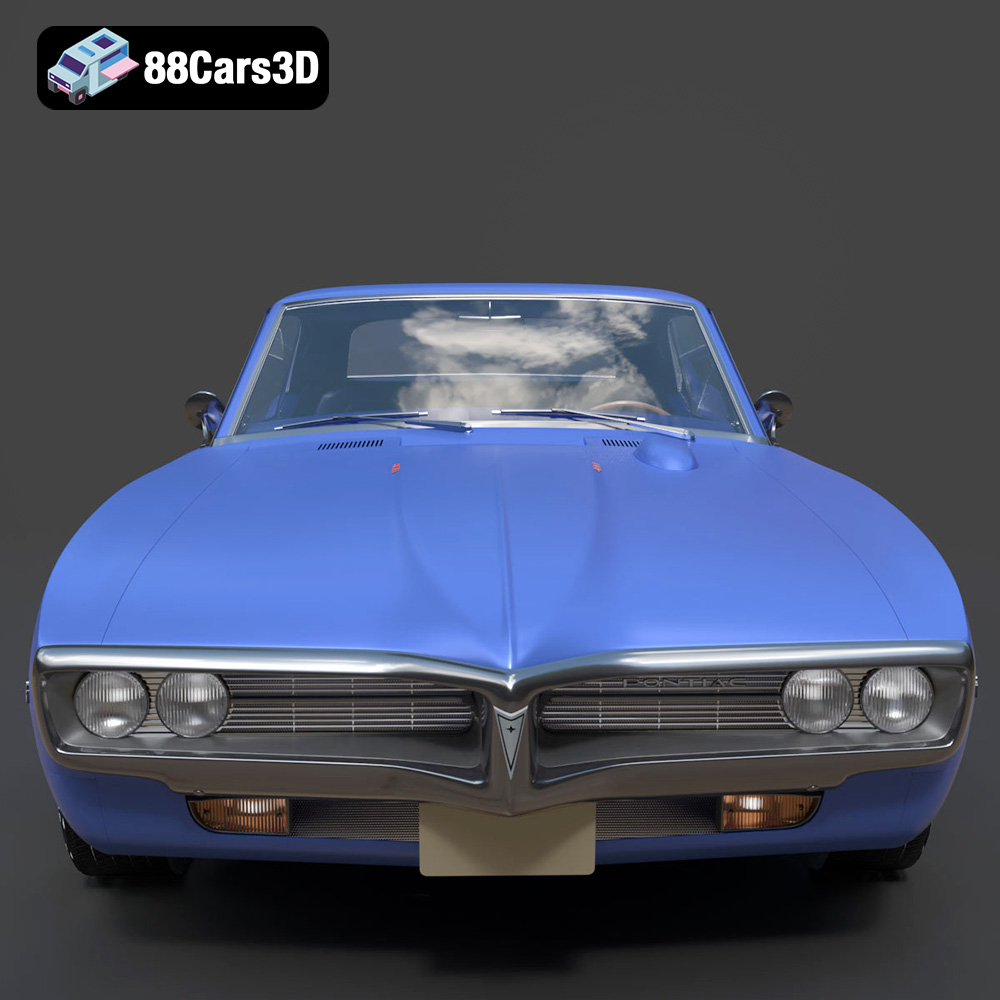
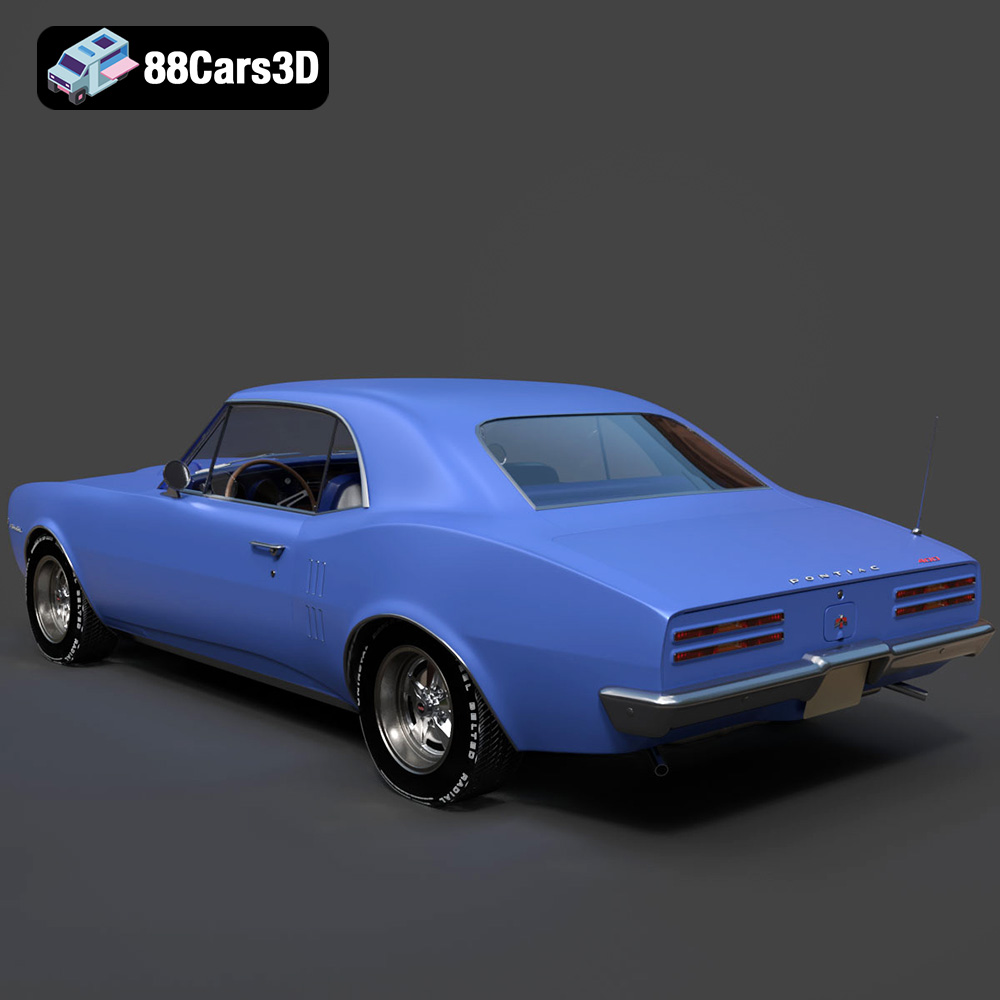
The 1967 Firebird’s visual identity is defined by several key elements. Its “Coke-bottle” profile, characterized by a narrowing waistline that flares out over the wheels, gives it a dynamic, muscular stance. The distinctive front split-grille bumper, housing quad headlights, instantly recognizable from the period, needs to be replicated with exact proportions and material properties. The slotted taillights, rally wheels with period-accurate tire treads, and even the subtle curves of the hood all contribute to its iconic look. For a 3D model to truly stand out, these details cannot be merely suggested; they must be meticulously engineered within the geometry.
The Pontiac Firebird 1967 3D model showcases this dedication to detail, from the accurate frame geometry and proportions to the subtle curves of the bodywork. Exterior features like the polished chrome tips of the dual exhaust system and authentic leaf-spring and independent front suspension details are all individually modeled, adding to the visual richness and providing a solid foundation for animation or detailed close-ups in rendering.
Beyond the exterior, historical accuracy extends to the internal components and the cockpit. A true muscle car enthusiast appreciates the engineering as much as the aesthetics. This 3D model goes beyond mere exterior accuracy, incorporating a detailed V8 engine block, which, while often hidden, adds significant value for projects requiring under-the-hood shots or exploded views for technical demonstrations. Similarly, the interior, with its vintage vinyl-style bucket seats, classic three-spoke wooden steering wheel, and deep-set analog instrument cluster, transports the viewer back to 1967.
The inclusion of separate wheels, suspension, and steering components, along with proper pivot setup, is crucial for professionals. This allows for realistic animation of steering, wheel rotation, and suspension travel, making the model ideal for racing simulators, cinematic sequences, or interactive configurators where dynamic movement is required. Such a level of detail ensures the model is not just a static display piece but a truly functional digital asset ready for complex animations and real-time interaction.
The versatility of a 3D model is often defined by the range and quality of its supported file formats. Each format serves a specific purpose, optimized for different software, engines, or end-use applications. Understanding these distinctions is crucial for any professional working with 3D car models. The Pontiac Firebird 1967 3D model is exceptionally well-equipped in this regard, offering a comprehensive suite of formats.
The .blend format is Blender’s native file type. It encapsulates an entire Blender project, including all mesh data, materials, textures, lighting setups, cameras, animation data, and even modifiers. For users entrenched in the Blender ecosystem, this is the most convenient and powerful format. It allows for full editability, enabling artists to tweak every aspect of the model, from adjusting shaders to modifying geometry or adding custom animations without any data loss during import/export. This native format is perfect for artists who want to delve deep into the model’s construction or adapt it extensively for unique projects.
The .fbx (Filmbox) format is an industry-standard proprietary file format developed by Autodesk, widely adopted for its excellent support of animation, skeletal information, and hierarchical structures. It’s the go-to format for transferring 3D assets between different software packages and, critically, into game engines like Unreal Engine and Unity. FBX files maintain material assignments, UV mapping, and often basic animation data, making them incredibly efficient for game asset pipelines. When importing into Unreal or Unity, an FBX model can often be set up with collision meshes, LODs (Levels of Detail), and physics assets, making it truly “game-ready.” Its robust nature ensures consistent translation across platforms.
The .obj (Wavefront OBJ) format is one of the oldest and most universally supported 3D file formats. It’s a simple, text-based format that primarily stores geometric data (vertices, normals, texture coordinates, and faces). While it doesn’t typically store animation or rigging data, it’s an incredibly reliable format for exchanging mesh data between virtually any 3D software application. Coupled with an associated .mtl (material library) file, it can also define basic material properties like color and diffuse textures. For artists who need to import the Firebird model into various sculpting, modeling, or rendering software without complex animation requirements, OBJ offers maximum compatibility and robustness.
The .glb (GL Transmission Format Binary) is an increasingly important format, especially for web-based 3D, Augmented Reality (AR), and Virtual Reality (VR) applications. It’s a binary version of glTF (GL Transmission Format), designed to be a compact, efficient, and runtime-friendly format for transmitting 3D scenes and models. A single .glb file can embed all necessary data, including mesh, materials, textures, animations, and cameras, making it highly portable and easy to deploy on websites or into AR/VR viewers. For developers aiming to integrate the Firebird into a mobile AR experience or a browser-based virtual showroom, GLB is the optimal choice due to its optimization for performance and ease of use in web environments.
The .stl (Stereolithography) format is the standard file type for 3D printing. It represents a 3D model as a series of connected triangles, describing only the surface geometry of an object without color, texture, or other CAD attributes. While it lacks visual information, its simplicity makes it ideal for additive manufacturing processes. When preparing the Pontiac Firebird for 3D printing, the .stl format ensures that the printer receives a clear, unambiguous representation of the physical shape, allowing hobbyists and professionals to bring the digital model into the tangible world.
The .ply (Polygon File Format or Stanford Triangle Format) is another format for storing 3D data, particularly useful for scanned data, point clouds, and high-precision meshes. It can store a wider range of properties than OBJ or STL, including color, transparency, normals, texture coordinates, and even data about faces and edges. While not as universally adopted as OBJ for general exchange, it’s highly valued in scientific, engineering, and CAD applications where preserving detailed mesh attributes and accuracy is paramount. For analytical work or integrating the Firebird into a more technical simulation, PLY can be advantageous.
The .unreal format, or more accurately, the specific asset structure and pipeline for Unreal Engine, implies a model that has been prepared and optimized directly for this engine. While there isn’t a single “.unreal” file format that encompasses all assets, having a model delivered “unreal-ready” means it has been carefully tested for optimal performance, potentially including pre-built material setups, LODs, and collision geometry, streamlining the integration process significantly. This designation signifies that the model is designed for seamless drag-and-drop integration into an Unreal project, minimizing setup time for game developers and real-time visualization artists.
The .max format is Autodesk 3ds Max’s native file type, similar to Blender’s .blend. It contains all scene information, including geometry, materials, lighting, cameras, animations, and render settings. For artists and studios working primarily with 3ds Max, this format provides the most complete and editable version of the model. It allows for advanced rendering setups, complex animation sequences, and integration with 3ds Max’s extensive plugin ecosystem. The inclusion of a .max file ensures that users of this powerful software have the full flexibility to manipulate and render the Firebird model to their exact specifications.
For game developers, integrating a detailed vehicle like the 1967 Pontiac Firebird requires a delicate balance between visual fidelity and real-time performance. Game assets need to be optimized, robust, and ready for dynamic interaction within a simulated environment.
The Pontiac Firebird 3D model boasts an exceptional topology of 3,853,174 triangles. This figure strikes a critical balance: it’s high enough to deliver unparalleled visual fidelity for close-up shots and cinematic sequences, capturing every detail of the classic muscle car without compromise. Yet, it remains versatile enough for high-end real-time applications, particularly in modern game engines like Unreal Engine and Unity. This “game-ready & optimized” claim is backed by a polycount that is suitable for current-generation titles, where intricate vehicle models are expected to withstand intense scrutiny while maintaining smooth framerates.
The optimization extends beyond raw polycount. Efficient UV mapping, clean geometry, and logical material breakdowns ensure that the model can be textured and shaded effectively without excessive draw calls or complex material graphs that could hinder performance. This makes the Firebird an excellent choice for open-world games, racing titles, and simulators where multiple highly detailed vehicles might be present on screen simultaneously.
Integrating a 3D car model into game engines like Unreal or Unity typically involves several steps. Using the provided .fbx or .unreal formats significantly streamlines this process. In Unreal Engine, for example, the FBX can be imported directly, bringing in the mesh, materials, and UVs. Artists would then set up advanced materials using Unreal’s robust material editor, creating physically based rendering (PBR) shaders for the paint, chrome, glass, and rubber components. Collision meshes are often generated or provided, and the proper pivot setup for steering, wheel rotation, and suspension travel simplifies blueprint scripting for vehicle physics. The same principles apply to Unity, where importing the FBX allows for rapid setup of components, materials, and physics. The pre-optimized nature of the 88cars3d.com model means less time spent cleaning up geometry or fixing normals, and more time on game logic and visual polish.
A static car model, however beautiful, falls short in a dynamic game environment. The Pontiac Firebird 3D model addresses this by providing separate wheels, suspension, and steering components. This modularity is vital for animation. With proper pivot points established for each component, developers can easily script realistic wheel rotation, independent suspension travel over uneven terrain, and responsive steering movements. This enables the creation of highly convincing driving experiences, where the car reacts authentically to the environment and player input. For cinematic cutscenes or in-game events, this allows for dynamic camera angles that showcase the intricate workings of the vehicle, adding significant realism and immersion to any project.
Beyond interactive entertainment, high-quality 3D car models like the 1967 Pontiac Firebird are indispensable tools for photorealistic rendering and visualization across various industries. From advertising campaigns to virtual showrooms, the ability to generate stunning, lifelike imagery is paramount.
For automotive rendering, the Firebird model’s exceptional detail and clean topology provide a perfect canvas. In software like 3ds Max (using the provided .max file) or Blender (with the .blend file), artists can leverage advanced rendering engines such as V-Ray, Corona Renderer, Octane, or Cycles. The focus shifts to crafting cinematic lighting setups – from dramatic studio lighting that highlights every curve to natural outdoor environments with realistic sun and sky systems. Material creation is equally critical: applying physically accurate shaders for metallic paint with clear coats, reflective chrome, realistic glass, and textured rubber or vinyl. The model’s detailed engine block and interior allow for close-up “beauty shots” that showcase the intricate engineering and craftsmanship, making it ideal for high-end brand campaigns and lifestyle scenes.
The transition from traditional rendering to immersive experiences like AR/VR is seamless with a well-optimized model. The 1967 Pontiac Firebird is perfect for virtual showrooms, where potential buyers or enthusiasts can explore the vehicle in 3D, customize colors and finishes, and view it from every angle, as if standing right next to it. For AR applications, the .glb format becomes invaluable, allowing users to place a virtual Firebird in their real-world environment via a smartphone or tablet. Imagine seeing the iconic muscle car parked in your driveway or sitting on your desk, an immersive experience that blurs the line between digital and physical. These applications are transformative for automotive marketing, education, and pure enthusiast enjoyment.
Consider an automotive advertising agency tasked with promoting a new line of classic car restoration services. Instead of relying on expensive and time-consuming physical photoshoots, they could license a 3D model like the 1967 Pontiac Firebird from 88cars3d.com. This allows them to generate a diverse range of high-resolution images and animations, showcasing different paint schemes, interior options, and environments – all within a fraction of the time and cost. For historical documentaries or period films, accurate 3D car models can fill out background scenes, provide digital doubles for stunts, or even animate intricate mechanical diagrams, offering a level of control and fidelity impossible with traditional methods.
The tactile satisfaction of holding a physical model of a classic car is unparalleled. Thanks to advances in 3D printing technology, the digital 1967 Pontiac Firebird can be brought into the real world, becoming a tangible collectible, display piece, or a component for a custom project.
The inclusion of the .stl format specifically caters to 3D printing enthusiasts. Before printing, careful preparation is key. The recommended scales (1:12, 1:18, 1:24) are popular for hobbyists, striking a balance between detail and manageable size. Scaling the model correctly in the slicer software is the first step. Next, understanding the model’s geometry dictates the need for supports. Detailed parts like the exhaust system, mirrors, and even parts of the suspension will likely require strategically placed supports to prevent sagging during printing. The print orientation is also critical: printing the frame angled for structural integrity and printing wheels separately are excellent practices for achieving optimal results and minimizing support material. This modular approach ensures that even intricate components can be reproduced with high fidelity.
For a model as detailed as the 1967 Firebird, the choice of 3D printing material and technology makes a significant difference. Resin printing (SLA/DLP) is highly recommended for its ability to achieve layer heights as fine as 0.04–0.12 mm, preserving the model’s fine details, sharp edges, and smooth surfaces. FDM (Fused Deposition Modeling) printers, while more common, might struggle with the intricate details unless using very fine nozzles and settings. Post-processing is where the model truly comes to life: careful removal of supports, sanding to smooth out layer lines, priming to prepare the surface, and finally, painting with authentic factory colors, often with metallic finishes, will transform the raw print into a museum-quality miniature. This hands-on process allows enthusiasts to connect with the Firebird on a whole new level.
In today’s fast-paced digital content creation landscape, the demand for high-quality 3D assets is greater than ever. Investing in premium 3D car models offers significant advantages for professionals across various industries.
Developing a highly detailed 3D car model from scratch is an incredibly time-consuming and expensive endeavor, often requiring hundreds of hours from skilled 3D artists. By purchasing a pre-made, professionally crafted asset like the 1967 Pontiac Firebird 3D model, studios and independent creators can save immense amounts of development time and reduce project costs. This efficiency allows teams to focus their resources on other critical aspects of their project, such as game mechanics, environmental design, or animation, rather than reinventing the wheel (literally). The cost-effectiveness makes high-end realism accessible even for smaller studios or personal projects.
When selecting 3D assets, quality, accuracy, and versatility are paramount. Marketplaces like 88cars3d.com specialize in providing high-fidelity 3D car models that meet professional standards. The 1967 Pontiac Firebird model exemplifies this commitment:
This dedication to quality ensures that when you download a model from 88cars3d.com, you are acquiring a robust, production-ready asset that will elevate your projects and stand the test of professional scrutiny.
The enduring legacy of the 1967 Pontiac Firebird is a testament to timeless automotive design and engineering. In the digital age, this legacy thrives through meticulously crafted 3D models that bring its iconic presence to life across diverse applications. From the high-stakes world of game development and immersive AR/VR experiences to the nuanced artistry of photorealistic rendering and the tangible satisfaction of 3D printing, a well-executed 3D car model is an invaluable asset.
The Pontiac Firebird 1967 3D model, available on 88cars3d.com, is more than just a digital replica; it’s a versatile toolkit for creators. Its exceptional detail, balanced polycount, and comprehensive range of included file formats – from .blend and .max for native software workflows to .fbx and .unreal for real-time engines, and .stl for physical fabrication – make it a premier choice for any professional or enthusiast looking to integrate this muscle car legend into their projects. It embodies the perfect blend of historical accuracy, technical robustness, and creative flexibility, ensuring that the roar of the ’67 Firebird continues to resonate in the digital domain.
The 1967 Pontiac Firebird stands as a true American muscle car legend, introduced to dominate the late-60s pony car era. This digital replica captures its aggressive Coke-bottle styling, distinctive front split-grille bumper design, and iconic quad headlights. Every detail, from the meticulously recreated V8 engine block to the classic dual exhaust system, reflects the raw power and heritage of this historic vehicle. Featuring an exceptional topology of 3,853,174 triangles, this 3D model delivers unparalleled visual fidelity for close-up shots while remaining versatile enough for high-end real-time applications. Whether used in game development, AR/VR environments, detailed animation, or photorealistic visualization, it provides a premium foundation for any digital automotive project.
$37.50
.1967
.blend
.fbx
.firebird
.glb
.max
.obj
.ply
.pontiac
.rendering
.stl
.unreal
car-3d-model
classic-car
game asset
game-ready
high poly
muscle-car
optimized
pony-car
VR/AR