Get 20% OFF All Premium 3D & STL Models!

In the demanding world of 3D visualization, game development, and professional rendering, the quality of your digital assets can make or break a project. Whether you’re crafting an immersive combat simulation, designing a cinematic sequence, or developing an AR/VR training environment, authentic and meticulously detailed models are paramount. This is especially true for specialized subjects like military vehicles, where accuracy and technical precision are not just desired, but critical.
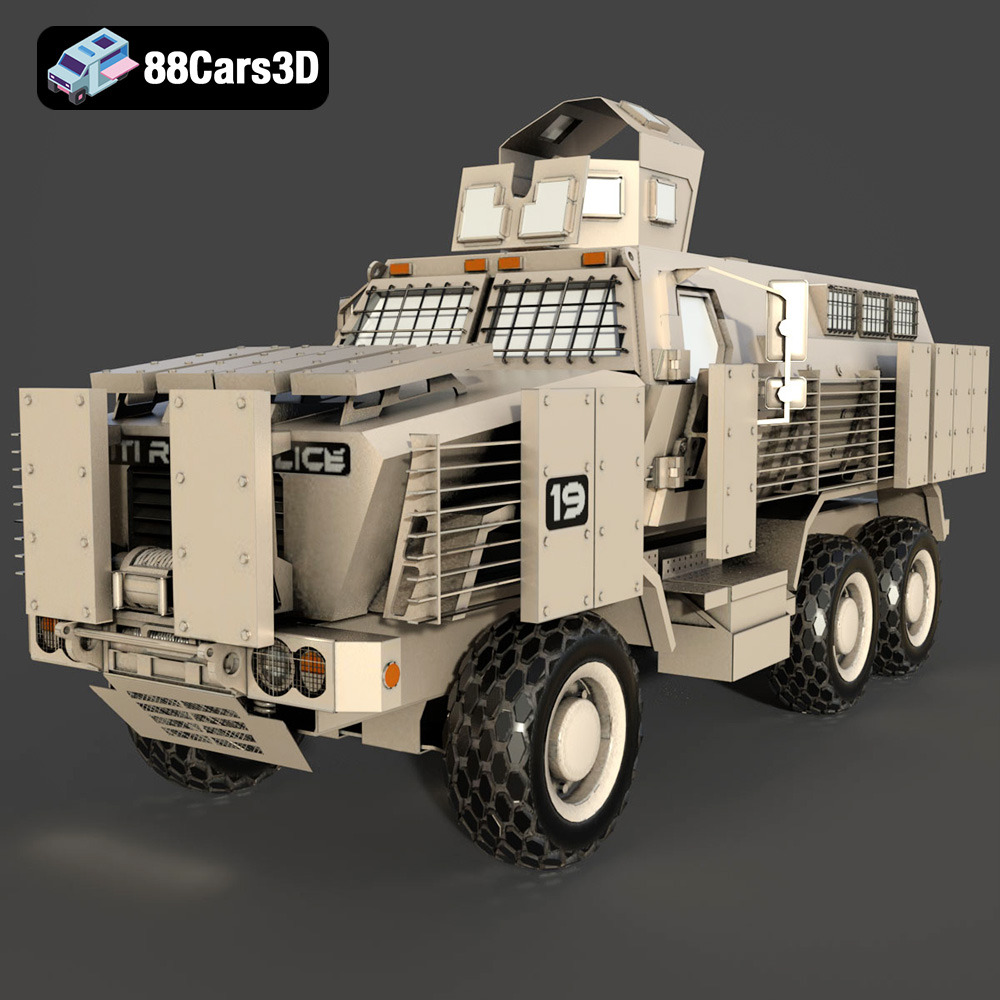
Today, we’re taking a closer look at an exemplary asset that stands out in this regard: the Caiman MRAP (Mine-Resistant Ambush Protected) 2008 3D Model. This isn’t just another vehicle model; it’s a testament to digital craftsmanship, designed from the ground up to meet the rigorous demands of various professional pipelines. From its iconic V-hull design to its intricate interior details, this model, available on 88cars3d.com, encapsulates the rugged tactical aesthetic and unparalleled survivability of its real-world counterpart, making it an invaluable addition to any digital arsenal.
Throughout this comprehensive guide, we’ll explore the technical intricacies of this 3D car model, its wide array of applications, and how professionals can leverage its robust features to achieve stunning results across game development, cinematic rendering, virtual reality, and even 3D printing. We’ll also delve into the critical importance of file formats, ensuring you understand how to harness the full potential of such a versatile asset in your projects.
The versatility of a 3D model isn’t just about its polygon count or texture resolution; it’s fundamentally about its compatibility and the rich data it carries across different software ecosystems. When acquiring a high-quality asset like the Caiman MRAP 2008 3D Model, understanding the various included file formats is crucial for seamless integration into your specific workflow. The Caiman model thoughtfully provides a comprehensive suite of formats, each serving a unique purpose, ensuring maximum utility for designers, game developers, and visualization specialists.
The .blend file is Blender’s native format, encapsulating an entire scene, including mesh data, materials, textures, lighting, cameras, animations, and even physics simulations. For Blender artists, this format offers unparalleled editability. You gain access to all the original modifiers, node-based material setups, rigging, and scene organization as intended by the creator. It’s ideal for deep customization, tweaking geometry, re-texturing, or integrating the model into a larger Blender project with full control over every parameter.
Autodesk’s .fbx (Filmbox) format is arguably the most widely adopted 3D interchange format in the industry. Its strength lies in its ability to store not just geometry but also complex scene data like animation, cameras, lights, and material properties (though material fidelity can vary between software). For game development, particularly with Unreal Engine and Unity, .fbx is the go-to. It efficiently transfers animated meshes with rigs, ensuring character hierarchies and blend shapes translate correctly. The Caiman MRAP’s .fbx ensures its separate animated components (wheels, suspension, turret) are pipeline-ready for real-time engines.
The .obj (Wavefront OBJ) format is a universal geometry definition format, widely supported by virtually every 3D application. It’s excellent for exchanging static mesh data, including vertices, faces, normals, and UV coordinates. While it doesn’t typically store animation or complex material node networks, it’s incredibly robust for basic model transfer. If you need a clean mesh that you can then re-texture and set up materials for from scratch in your preferred software, .obj is often the most reliable choice for cross-software compatibility.
.glb (GL Transmission Format Binary) is a binary version of glTF, specifically designed for efficient transmission and loading of 3D scenes and models on the web and in AR/VR applications. It packages all necessary assets – geometry, textures, materials, and even animations – into a single, compact file. This optimization makes it perfect for immersive web experiences, AR filters, mobile VR, and browser-based 3D viewers, offering a streamlined workflow for developers targeting these platforms. Its efficiency is a major advantage for real-time and mobile environments.
The .stl (Stereolithography) format represents a 3D model as a raw, unstructured triangular mesh. It contains only surface geometry, without any color, texture, or material information. This simplicity makes it the de facto standard for 3D printing. For the Caiman MRAP, an .stl file allows hobbyists and defense industry professionals alike to physically fabricate scaled-down versions of the vehicle. Preparing an .stl for print involves ensuring the mesh is “manifold” (watertight) and appropriately scaled for the chosen printer and material.
The .ply (Polygon File Format) is another format for storing 3D data, often used with 3D scanners and in scientific computing. It can store a wide range of properties, including color per vertex, surface normals, texture coordinates, and material properties, making it more comprehensive than .obj in some respects. While less common for general asset exchange than .fbx, it’s valuable for applications requiring precise mesh data, often in CAD, reverse engineering, or computational analysis where detailed point cloud or polygonal data is essential.
The .unreal designation typically refers to an asset that is not just compatible, but specifically prepared and optimized for direct integration into Unreal Engine projects. This often means an .fbx file that has been exported with specific Unreal Engine settings, perhaps bundled with pre-configured materials, textures, and even blueprints. The benefit here is a reduced setup time: artists and developers can drop the asset directly into their Unreal project with minimal tweaking, knowing it conforms to engine best practices for materials, collision, and scale. This ensures peak performance and visual quality straight out of the box for projects demanding high-fidelity real-time graphics.
The .max file is the proprietary format for Autodesk 3ds Max, one of the leading software packages for 3D modeling, animation, and rendering. Similar to .blend, it stores an entire 3ds Max scene, including geometry, modifiers, materials, lighting, cameras, animation, and plug-in data. For users working within the 3ds Max ecosystem, the .max file provides the most comprehensive and editable version of the model, allowing for complete control over all aspects of the asset for high-end rendering and complex animation tasks.
By offering this exhaustive range of formats, 88cars3d.com ensures that the Caiman MRAP 3D Model is not just a high-quality asset, but a highly adaptable one, ready for any professional pipeline you might encounter.
The strength of any premium 3D model lies in its ability to accurately translate real-world complexity into a digital format while maintaining optimal performance. The Caiman MRAP 2008 3D Model excels in this balance, showcasing a meticulous attention to detail that makes it suitable for demanding professional use cases. Every curve, panel, and component of this legendary military vehicle has been recreated with precision, offering an asset that is both visually stunning and technically sound.
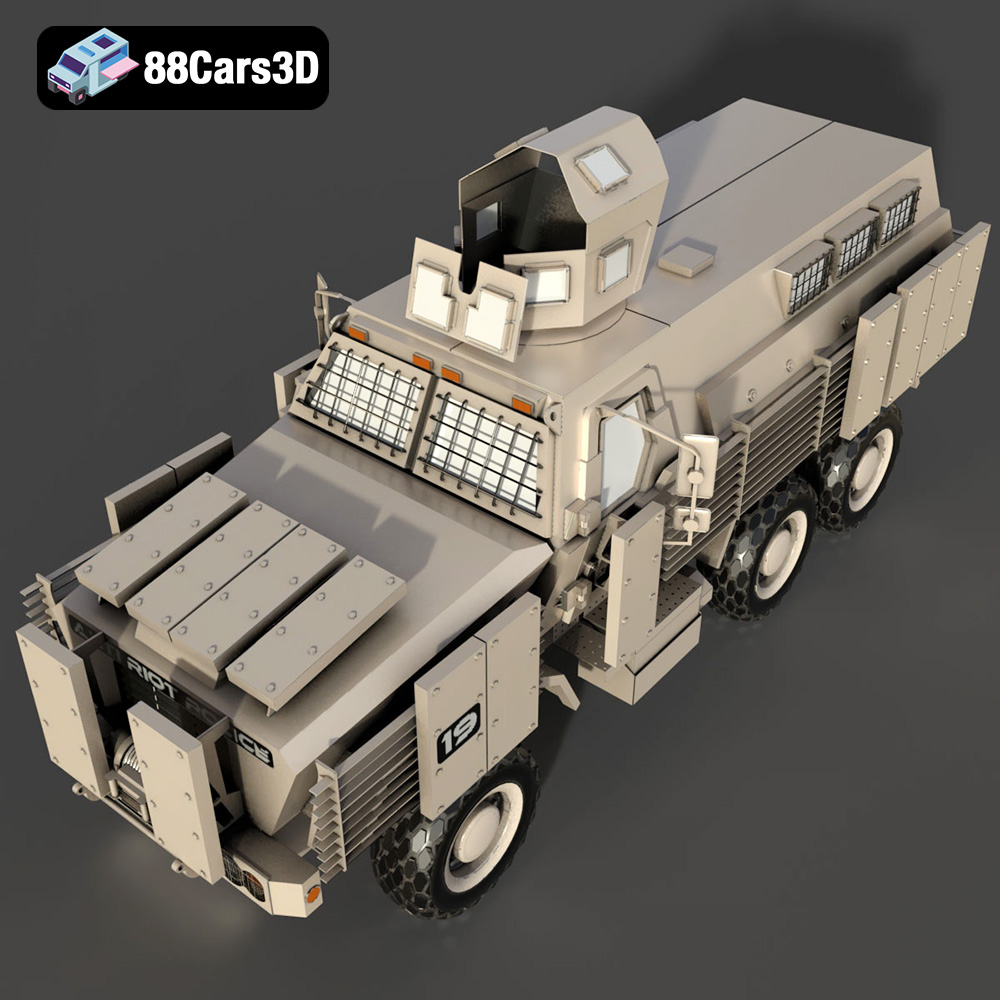
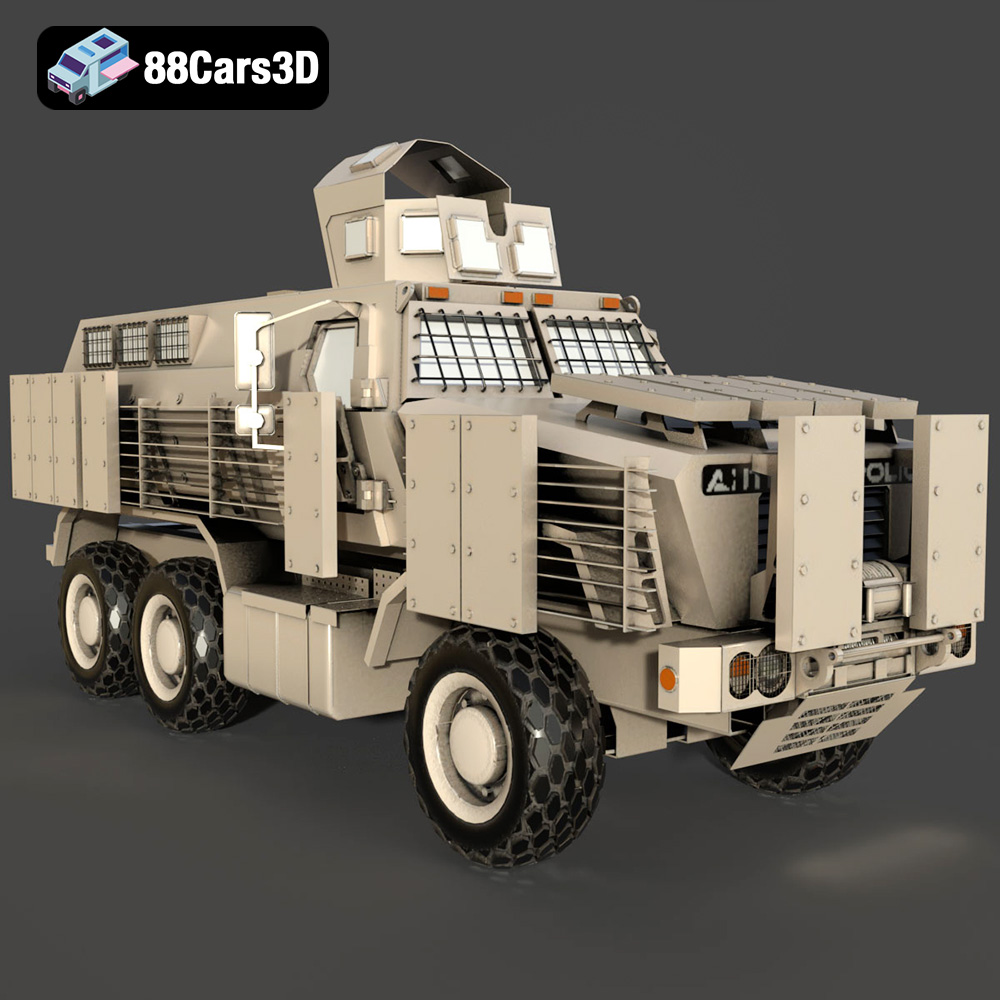
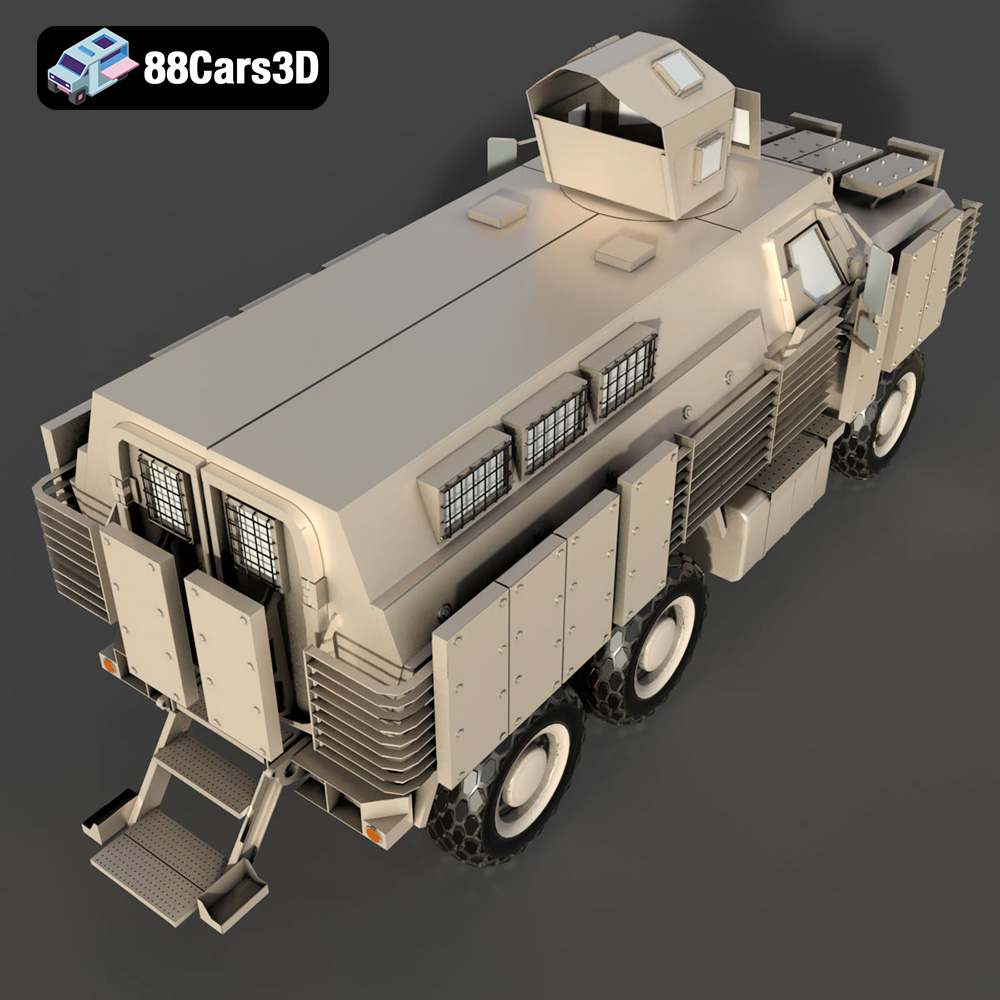
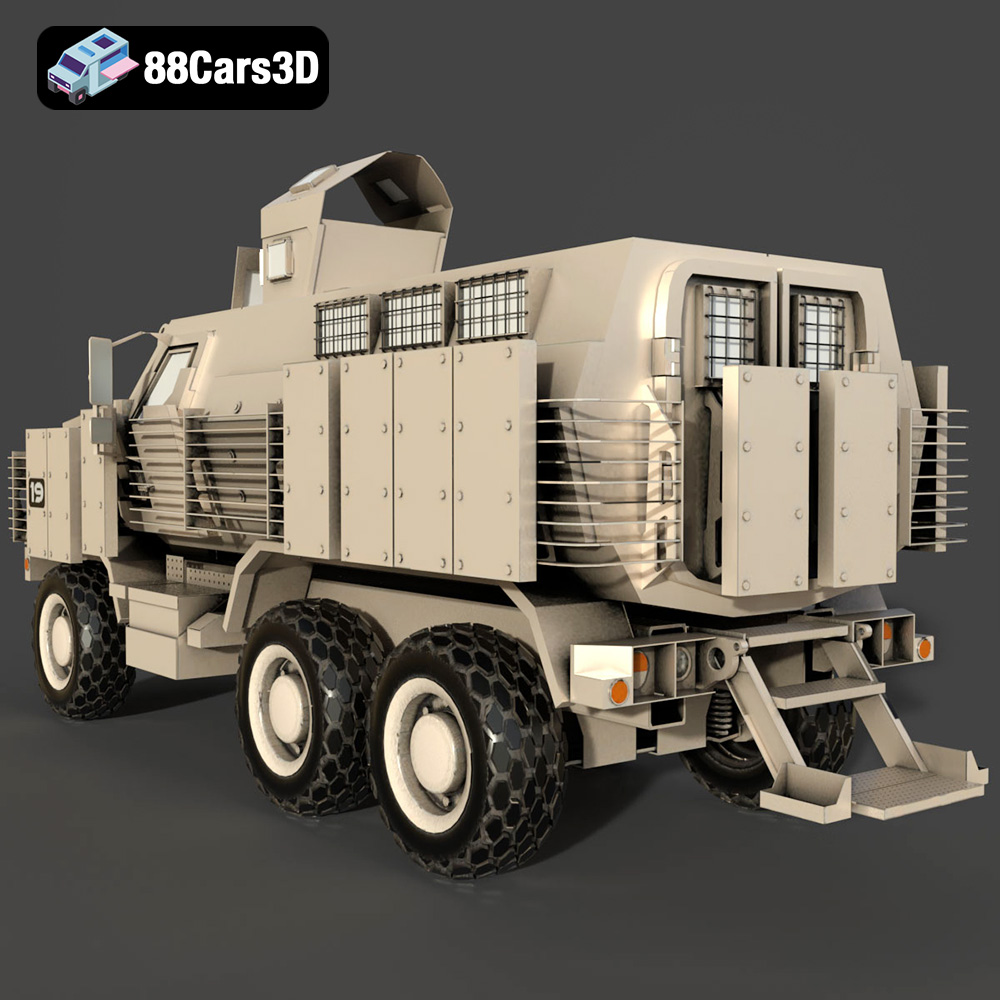
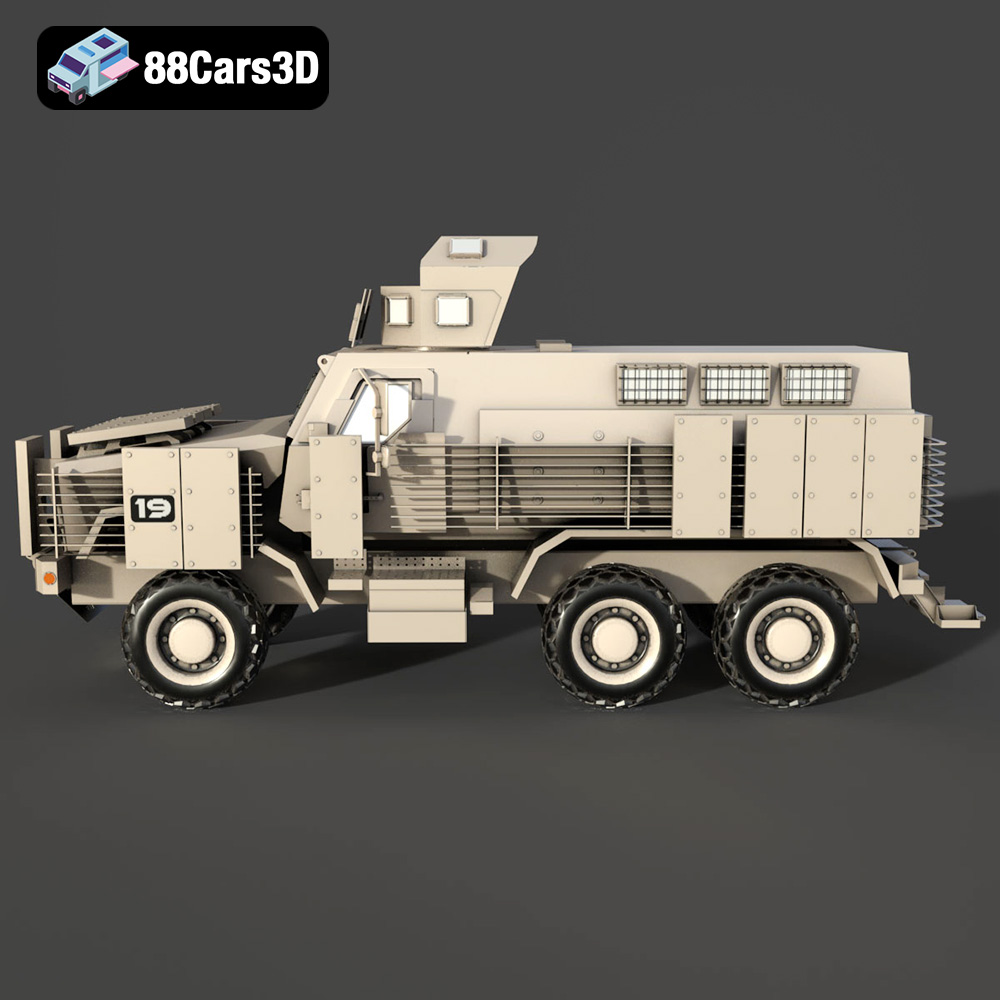
The Caiman MRAP is immediately recognizable by its formidable presence, and this 3D model captures that essence flawlessly. The core of its survivability, the signature V-hull design, is accurately represented, offering the distinct silhouette that deflects blast forces. Heavy-duty armor plating and the imposing, high-clearance stance are meticulously modeled, reinforcing the vehicle’s rugged tactical aesthetic. Details extend to the robust diesel engine enclosure and reinforced exhaust system, typically designed for high-clearance operations and tough terrain. Tactical lighting, searchlights, and standard tactical headlights are all present, adding to the visual authenticity.
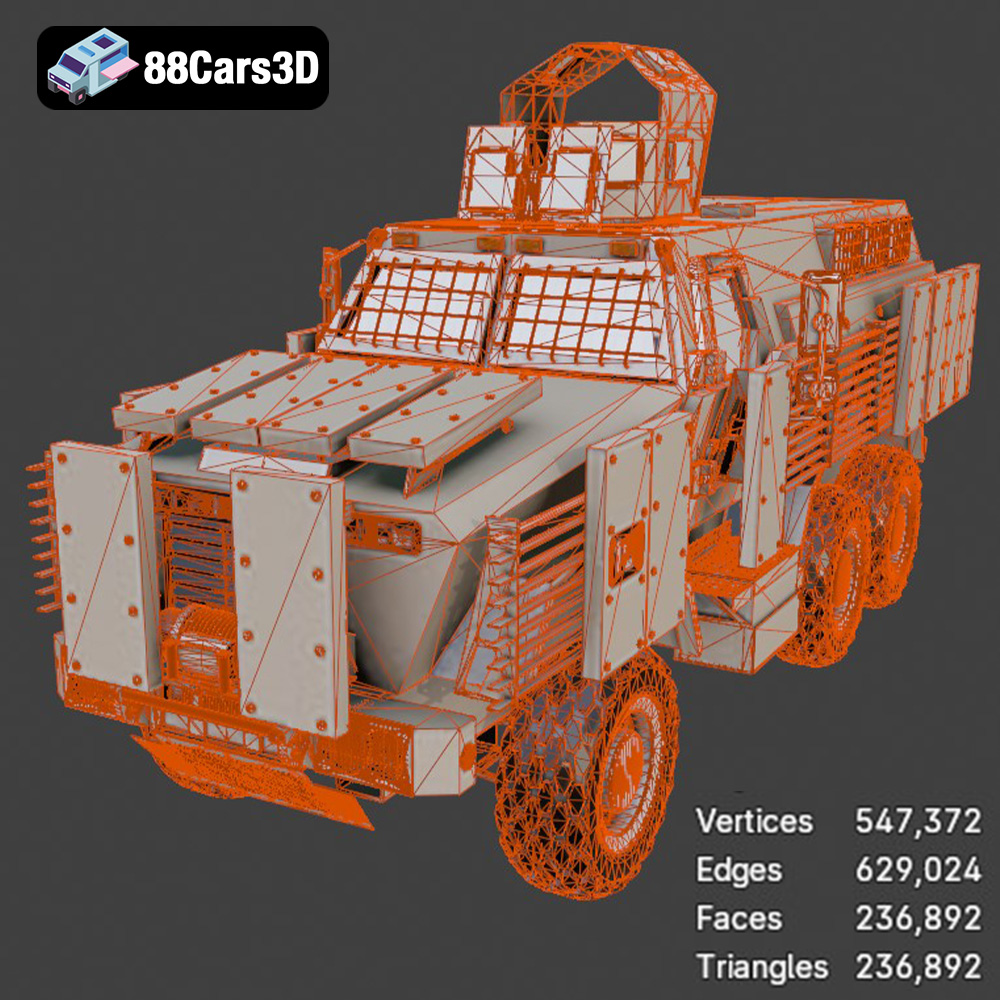
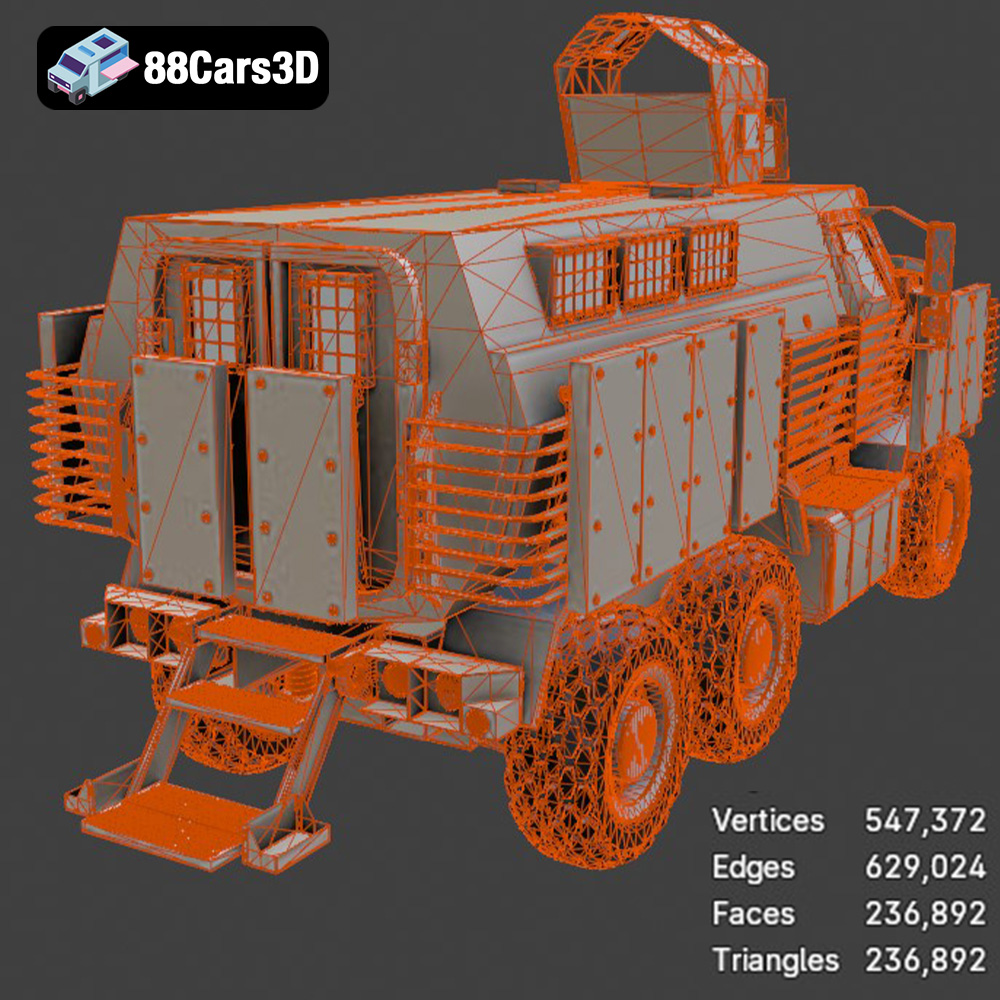
From a technical standpoint, the model boasts a triangle count of 236,892. This figure is a carefully chosen sweet spot, striking an ideal balance between high-end visual fidelity – ensuring intricate details are crisply rendered – and game-ready optimization. This means the model delivers stunning realism without excessively burdening real-time engines like Unreal or Unity, making it perfect for demanding simulations and fast-paced games. The geometry is clean, well-optimized, and built to real-world scale accuracy, a crucial factor for believable simulations and precise visualizations. Furthermore, the massive run-flat tactical wheels with deep, aggressive off-road treads are precisely modeled, alongside reinforced heavy-duty leaf springs and solid axle suspension details, enhancing both visual integrity and potential for realistic animation.
The Caiman MRAP 3D model doesn’t stop at external realism; it extends its detailed approach to the often-overlooked interior. Crucial elements for troop safety and operational command are meticulously crafted. The blast-mitigating troop seats and commander station details are accurately represented, reflecting the vehicle’s primary purpose. A heavy-duty tactical steering wheel and reinforced column, military-grade instrument cluster, and digital comms displays are all present, adding depth and realism to any interior shot or first-person perspective. Reinforced control details, including robust pedals, levers, and the transmission shifter, complete the functional cockpit environment. This optimized interior geometry is especially valuable for first-person POV in tactical gaming, allowing players to feel truly immersed within the vehicle.
A significant advantage for animators and game developers is the intelligent separation of components. The wheels, suspension, turret, and steering are all distinct, animatable elements. This proper pivot setup facilitates realistic wheel rotation, suspension travel, and turret articulation, saving countless hours in rigging and animation workflows. Whether you’re simulating complex off-road maneuvers or tactical engagements, the model is built to move authentically.
Beyond its inherent detail, the Caiman MRAP 3D model offers extensive customization options, allowing artists to tailor its appearance to specific scenarios. Users can easily change body and armor colors to reflect different operational environments – from classic desert tan and woodland camo to urban grey variants. Modifying tire textures to show heavy mud or dry dirt variants can further enhance realism for specific scenes. The ability to adjust material finishes, such as creating matte military-spec surfaces, weathered paint, or even battle-damaged textures, adds another layer of authenticity, reflecting the rigors of combat. Furthermore, adapting lighting for daytime patrols or night-vision environments can dramatically alter the vehicle’s mood and integration into various scenes, providing unparalleled flexibility for automotive rendering and visualization specialists.
The true value of a high-quality 3D asset like the Caiman MRAP 2008 model lies in its seamless integration into diverse professional workflows. Designed with flexibility and performance in mind, this 3D car model from 88cars3d.com empowers creators across a spectrum of industries, from the high-octane world of game development to the precise demands of defense visualization.
For game developers, the Caiman MRAP is a goldmine. Its “game-ready & optimized” status, characterized by a well-balanced 236,892 triangle count, makes it ideal for real-time engines like Unreal Engine and Unity. The included .fbx and .unreal formats are specifically tailored for these environments. Developers can efficiently import the model, leverage its proper pivot setup for animating wheels, suspension, and the turret, and integrate it into complex game mechanics. For instance, in an open-world combat game, the Caiman can serve as a primary player vehicle, an AI-controlled asset, or an environmental prop. Its optimized geometry ensures smooth framerates even when multiple vehicles are present, while the detailed exterior and interior support immersive first-person tactical shooter perspectives. Creating material instances for rapid color changes (desert, woodland, urban) or weathering effects allows for dynamic appearance shifts based on gameplay, enhancing the realism of military simulators.
When it comes to creating high-fidelity still renders or cinematic sequences, the Caiman MRAP truly shines. Professionals using 3ds Max can utilize the native .max file, while Blender users can leverage the .blend file, both offering full scene control. This allows artists to dive deep into advanced material creation, leveraging physically based rendering (PBR) workflows with rendering engines like V-Ray or Corona in 3ds Max, or Cycles and Eevee in Blender. The detailed geometry, from the armored chassis to the intricate engine block and suspension, provides an excellent foundation for close-up shots and dramatic lighting setups. Imagine a defense industry campaign showcasing the vehicle’s capabilities, or a cinematic action scene depicting the MRAP navigating a war-torn landscape. The model’s accuracy and detail significantly reduce the time spent on modeling, allowing artists to focus on storytelling, lighting, and advanced compositing. It’s a complete package for stunning automotive rendering.
The Caiman MRAP 3D model is perfectly suited for immersive AR/VR applications, particularly for military training and tactical configurators. The optimized polycount is crucial for maintaining performance in VR headsets and on mobile AR devices, where computational resources are often limited. The .glb format, in particular, is an excellent choice for web-based AR experiences and virtual showrooms, allowing users to interact with the vehicle in real-time. Imagine a virtual training environment where soldiers can familiarize themselves with the Caiman’s interior layout, practice maintenance procedures, or simulate tactical deployments. The model’s real-world scale accuracy and detailed cockpit features make these simulations incredibly effective, providing a cost-efficient and safe alternative to physical training with actual vehicles. Its versatility makes it a valuable game asset for interactive and educational experiences.
While the Caiman MRAP 2008 3D Model excels in digital domains, its utility extends into the physical world through 3D printing. The inclusion of the .stl format opens up exciting possibilities for hobbyists, collectors, and even defense industry professionals who require physical prototypes or display models. This bridge between the digital and tangible realms adds another layer of value to this exceptional asset.
3D printing requires specific preparation to ensure a successful output. The .stl file, a standard for additive manufacturing, represents the model as a watertight, triangulated mesh. For the Caiman MRAP, the model is inherently structured for high-quality conversion. When preparing for print, users should consider the recommended scales: 1:35, 1:24, or 1:18, which are common for military vehicle models and dioramas. These scales allow for a good balance between manageable print size and visible detail. Resin printing is highly recommended, especially for capturing the fine tactical details like grab handles, communication antennas, and the intricate turret mechanism, as FDM printers might struggle with such precision.
Key print settings include a layer height of 0.04–0.12 mm for optimal detail, and a wall thickness of 1.2–2.0 mm to ensure structural integrity. An infill of 20–30% provides sufficient strength without excessive material use. Supports will be required for overhangs and detailed parts such as the exhaust system, mirrors, antennas, and the turret assembly. Strategic print orientation is also vital; printing the armored frame angled can enhance structural integrity, while wheels are often best printed separately to preserve their circular shape and tread details.
Once printed, the physical Caiman MRAP model can be transformed into a stunning display piece through careful post-processing. This typically involves sanding to smooth out any layer lines or support marks, followed by priming to create an even surface for painting. For an authentic military finish, applying CARC (Chemical Agent Resistant Coating) military paints can replicate the texture and color of real vehicles. The separate components, like wheels and turret, can be assembled after painting, allowing for easier detailing. Hobbyists can then integrate these highly detailed models into elaborate military dioramas, recreating historical or fictional combat scenes. The Caiman MRAP 3D Model, therefore, serves not only as a powerful digital asset but also as a foundation for tangible, collectible works of art, showcasing the versatility of high-quality automotive rendering assets from 88cars3d.com.
In today’s fast-paced creative industries, efficiency and quality are paramount. Acquiring pre-made, high-quality 3D assets like the Caiman MRAP 2008 from 88cars3d.com offers significant advantages that can drastically improve project timelines and final output quality. These benefits extend beyond just saving time, impacting cost-efficiency, project consistency, and the sheer versatility of your creative toolkit.
One of the most immediate and profound benefits of using expertly crafted 3D car models is the immense time savings. Creating a highly detailed vehicle like the Caiman MRAP from scratch requires hundreds, if not thousands, of hours from skilled 3D artists – involving modeling, UV mapping, texturing, rigging, and optimization. By purchasing a ready-to-use asset, teams can bypass this entire labor-intensive phase, redirecting valuable artistic and development resources to other critical aspects of their project, such as scene composition, animation, or gameplay mechanics. This translates directly into cost savings, as fewer man-hours are needed for asset creation, allowing projects to stay within budget and meet tight deadlines, whether for game assets or automotive rendering.
When you choose models from a reputable source like 88cars3d.com, you are investing in quality assurance. The Caiman MRAP 3D Model exemplifies this, offering accurate topology, real-world scale, and optimized geometry designed for professional pipelines. This means fewer headaches with messy geometry, incorrect scaling, or poorly organized files. Such assets typically come with clean UVs (though not explicitly stated for this product, it’s standard for professional models), proper material groups, and often pre-configured setups for popular engines or software, ensuring a smooth import process and consistent visual results. This level of professional detail is crucial for projects where visual fidelity and technical stability are non-negotiable.
The inherent versatility of models like the Caiman MRAP makes them incredibly valuable across a multitude of industries. A single purchase can serve purposes in video game development, film production, architectural visualization (perhaps as context for a defense facility), engineering simulations, educational content, and even product design or marketing campaigns. The multi-format support ensures that the model is accessible and functional in virtually any 3D environment, maximizing its return on investment. This flexibility makes high-quality 3D car models a strategic asset for any creative studio or individual professional looking to enhance their project capabilities without reinventing the wheel.
The Caiman MRAP 2008 3D Model stands as a prime example of a meticulously crafted digital asset, designed to meet and exceed the demands of modern professional workflows. Its unparalleled detail, game-ready optimization, and extensive file format support make it an indispensable tool for anyone involved in game development, cinematic rendering, AR/VR experiences, or even 3D printing.
From its faithfully recreated V-hull design and intricate interior to its adaptable materials and animation-ready components, this 3D car model offers a robust foundation for a myriad of projects. The flexibility provided by formats like .blend, .fbx, .obj, .glb, .stl, .ply, .unreal, and .max ensures seamless integration into virtually any software environment, empowering artists and developers to focus on creativity rather than asset creation.
Whether you’re building a hyper-realistic military simulator, producing a blockbuster action sequence, or creating an interactive training module, the Caiman MRAP 3D Model delivers the quality, performance, and versatility you need to achieve stunning results. Explore this exceptional game asset and many more high-quality 3D car models at 88cars3d.com, and elevate your digital creations to the next level.
The Caiman MRAP (Mine-Resistant Ambush Protected) is a legendary military vehicle renowned for its unparalleled survivability and rugged tactical aesthetic. Designed to withstand explosive devices and ambushes in hostile territories, it features a signature V-hull design, heavy-duty armor plating, and an imposing, high-clearance stance. This digital replica captures its iconic features meticulously, from the robust diesel engine enclosure and reinforced exhaust system to the intricate rooftop turret, grab handles, and communication antennas. Boasting a highly accurate topology with a triangle count of 236,892, this model achieves the perfect balance between high-end visual fidelity and game-ready optimization. Whether deployed in a modern combat simulator or a cinematic war sequence, the geometry is carefully structured to deliver peak performance and stunning realism across game development, AR/VR training environments, animation, and professional defense visualization. Perfect for military combat simulations, first-person tactical shooters, VR military training applications, and cinematic war zone renderings.
$14.99
.blend
.fbx
.glb
.max
.obj
.ply
.rendering
.stl
.tactical
.unreal
armored-vehicle
caiman
car-3d-model
game asset
game-ready
low-poly
military-vehicle
mrap
mrap-2008
optimized
VR/AR