Get 20% OFF All Premium 3D & STL Models!

In the vast landscape of 3D visualization and simulation, the demand for highly detailed and technically accurate models of heavy machinery is ever-growing. From powering realistic mining simulators to driving immersive AR/VR training experiences and creating compelling cinematic renders, industrial vehicles represent a significant challenge and opportunity for 3D artists and developers. Capturing the sheer scale, robust engineering, and intricate mechanics of these colossal machines requires a meticulous approach to modeling, texturing, and optimization.
Today, we delve into the world of industrial giants with a focus on the Off-Highway Truck, a true behemoth designed to conquer the harshest environments on Earth. This isn’t just any truck; it’s a symbol of immense power, engineered for large-scale mining operations and extreme construction. The challenge for 3D artists is to translate this real-world presence into a digital asset that performs flawlessly across diverse platforms. Fortunately, high-quality 3D car models, such as the Off-Highway Truck 3D Model available at 88cars3d.com, are specifically designed to meet these exacting standards, offering both visual fidelity and practical utility for a multitude of professional applications.
The creation of compelling visual content, whether for games, films, or interactive training, hinges on the quality of its core assets. For heavy machinery like the Off-Highway Truck, this means going beyond mere aesthetics to capture functional realism. A truly professional-grade model provides not just an accurate representation but also the underlying technical structure that enables animation, interaction, and efficient rendering. This Off-Highway Truck 3D model exemplifies this philosophy, providing a robust foundation for any project.
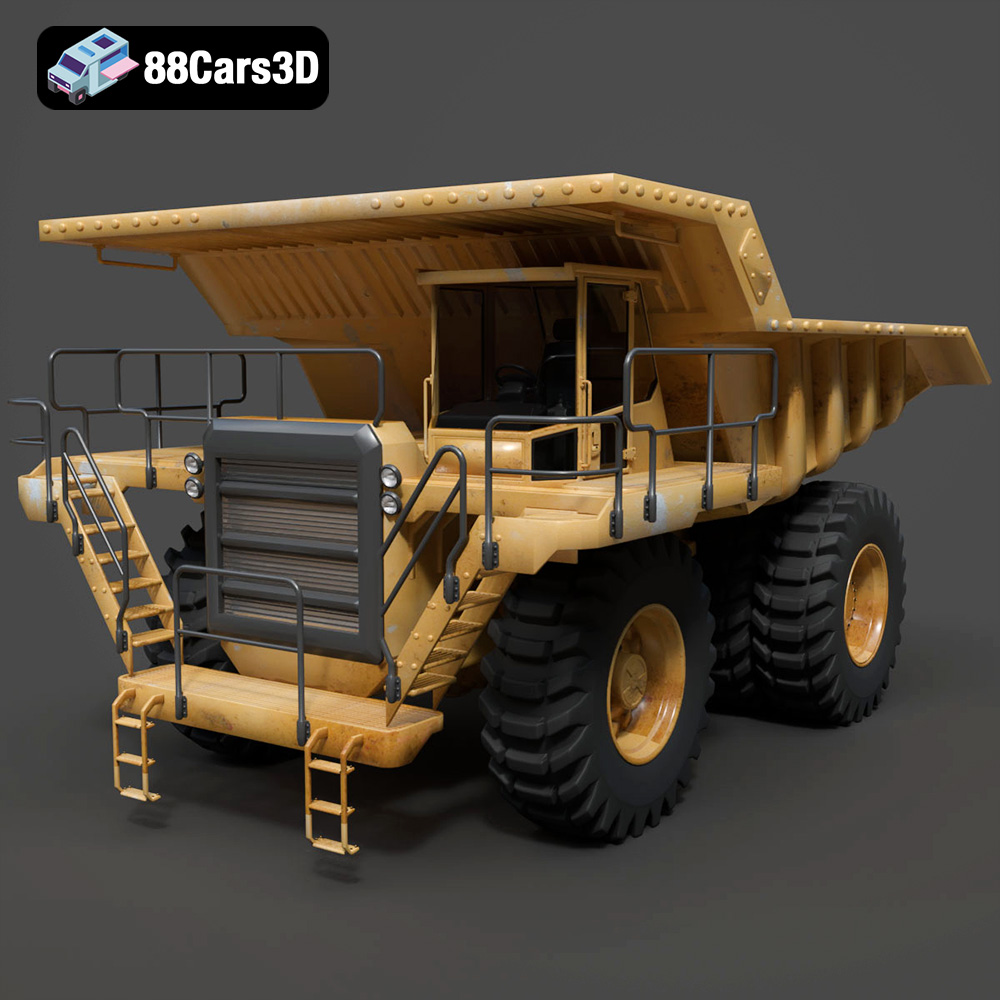
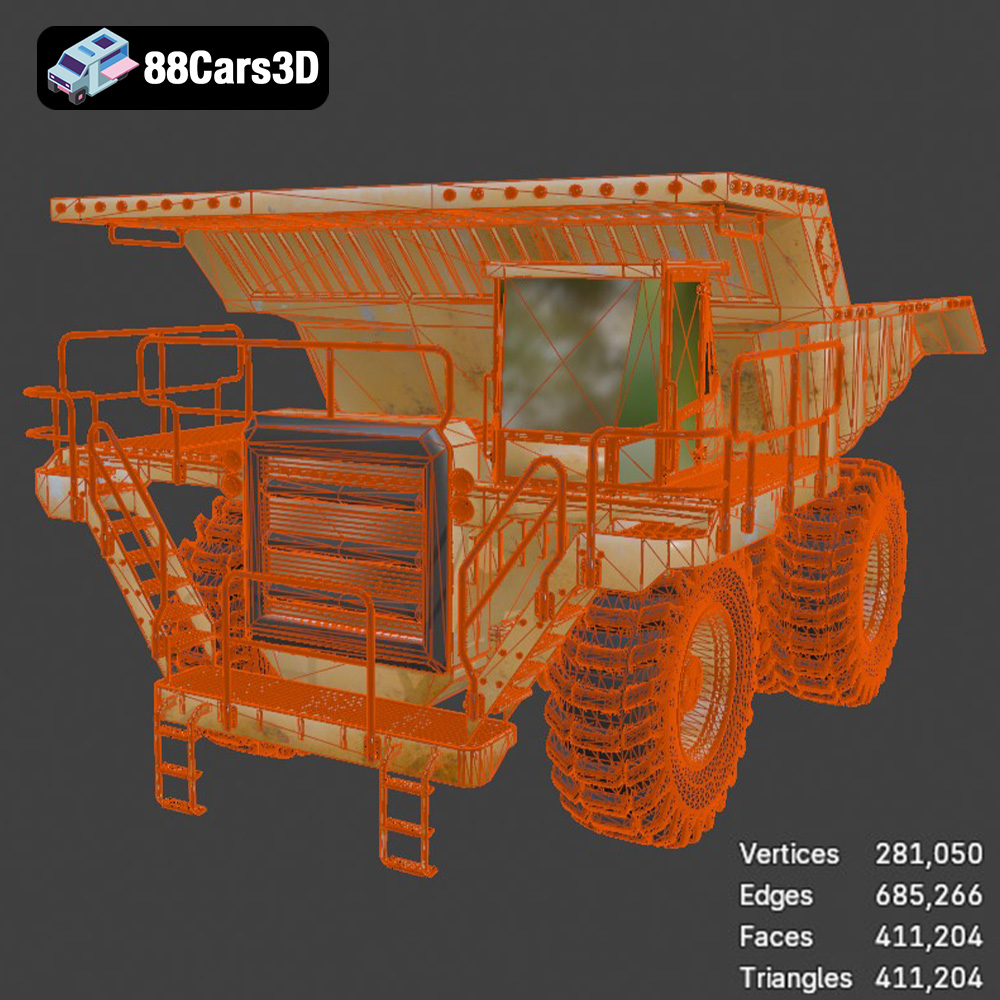
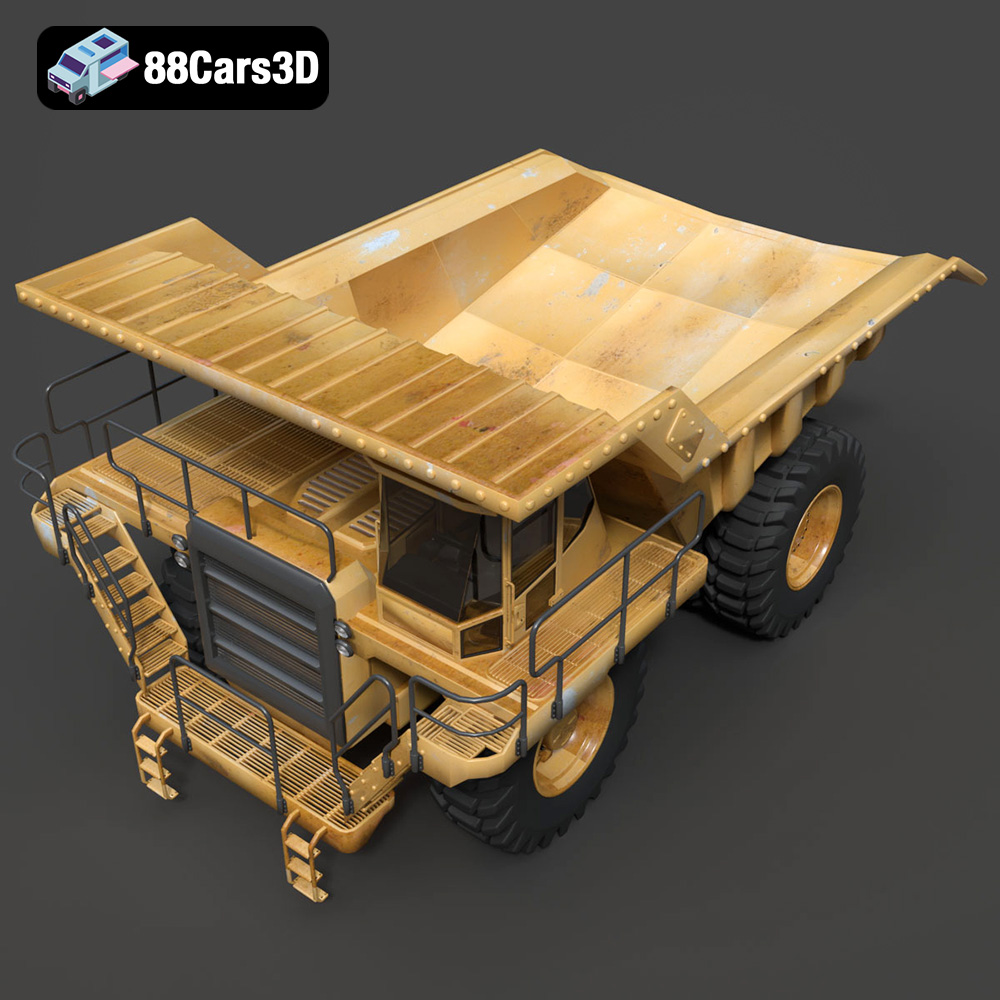
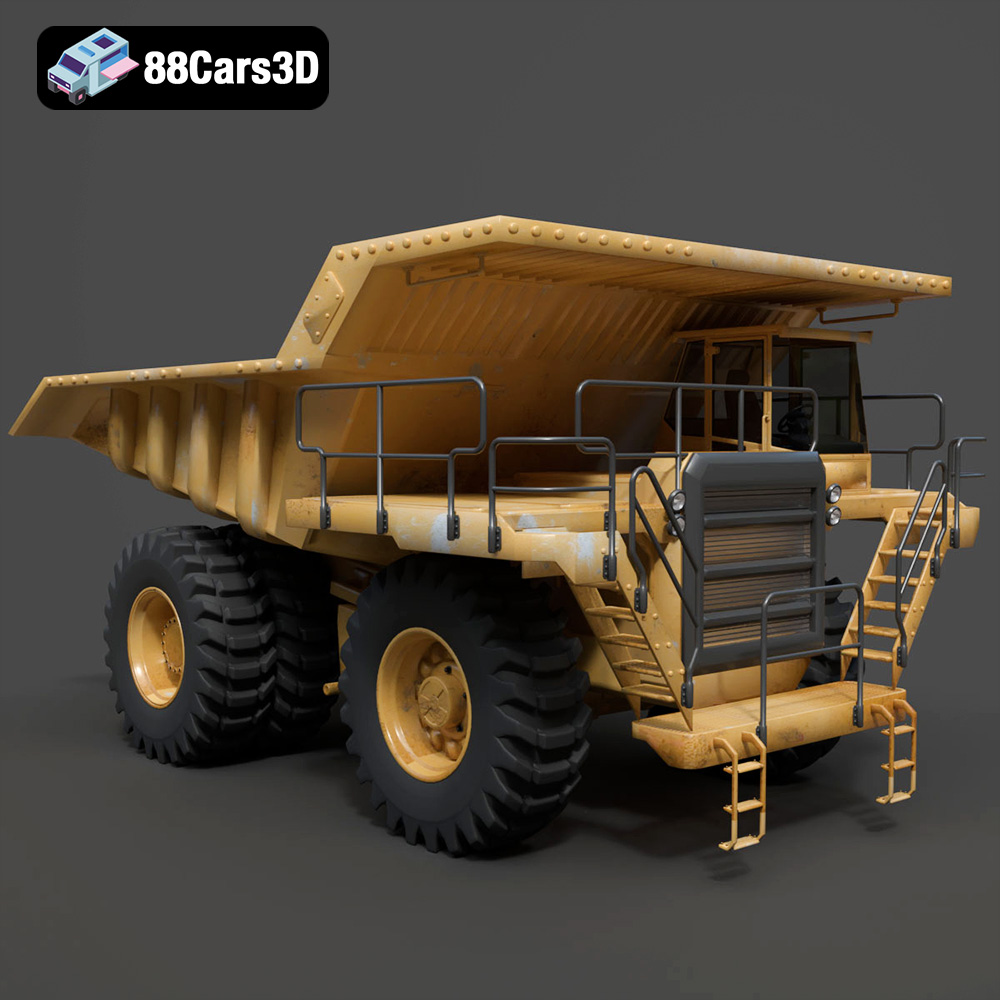
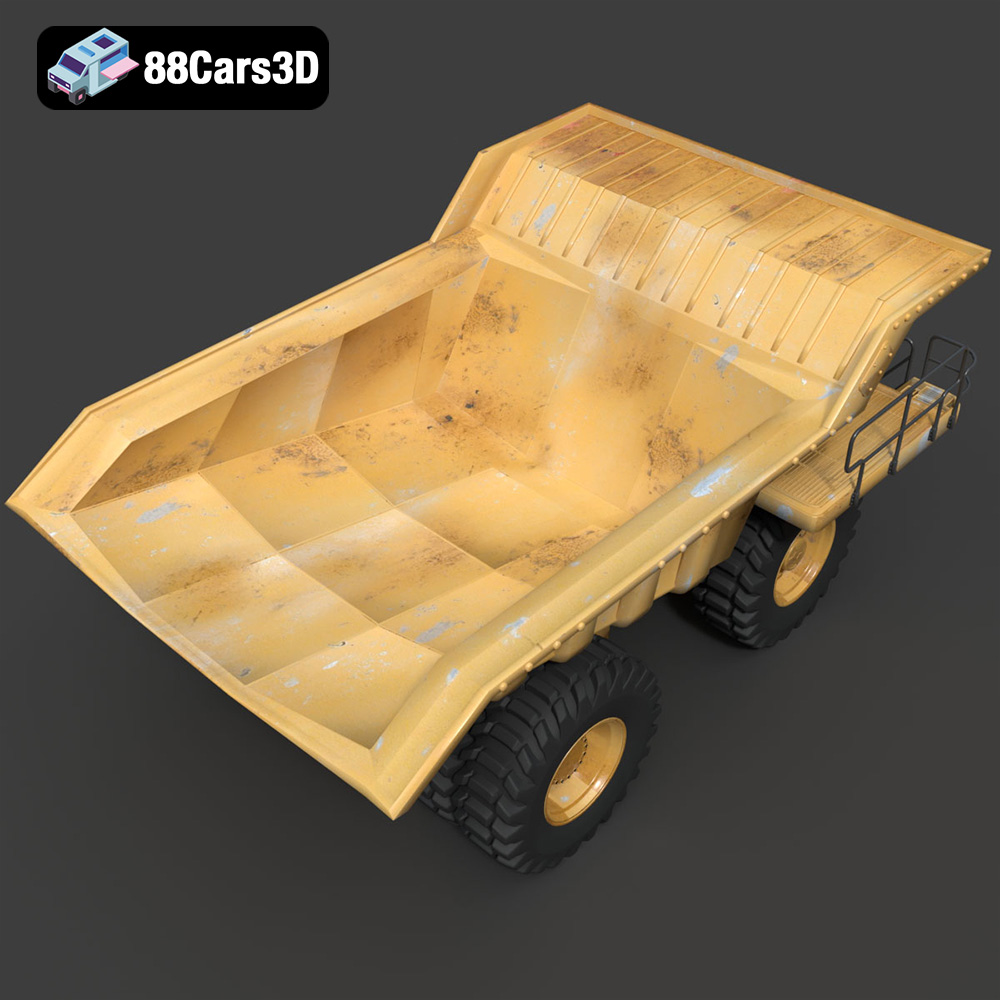
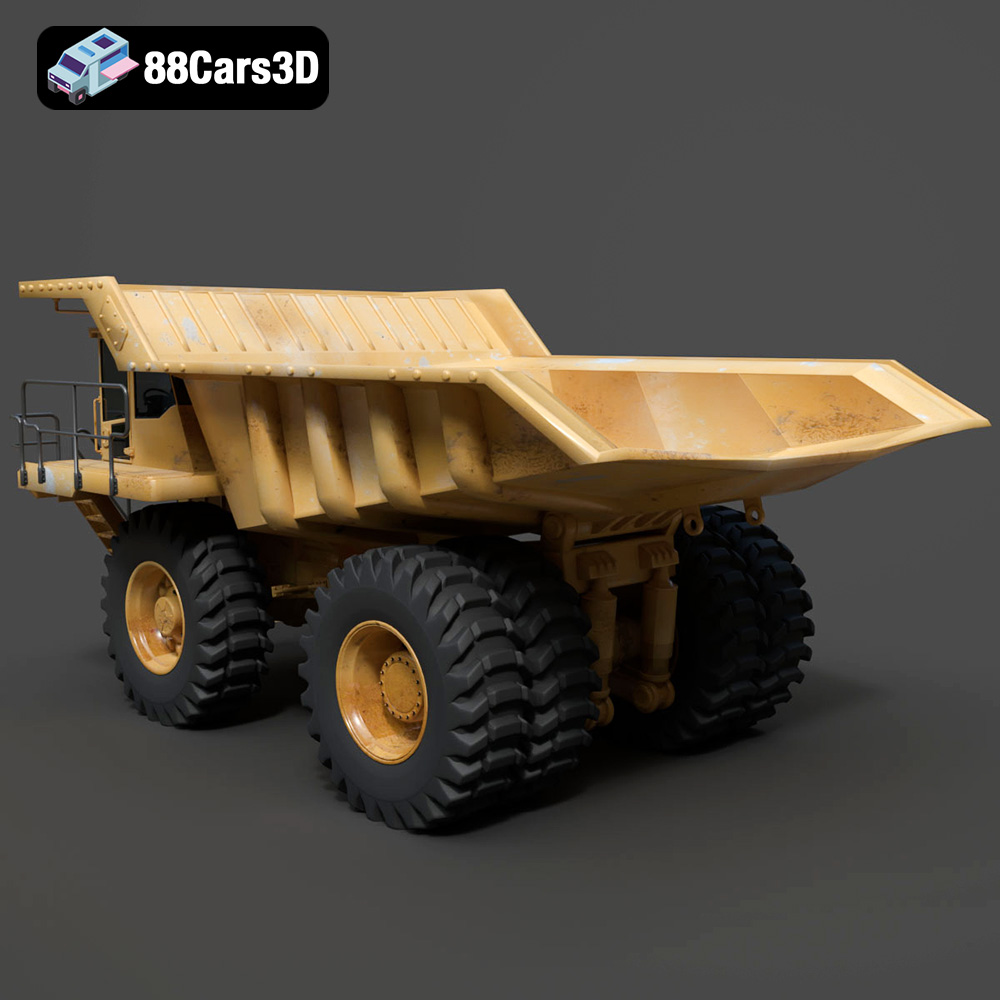
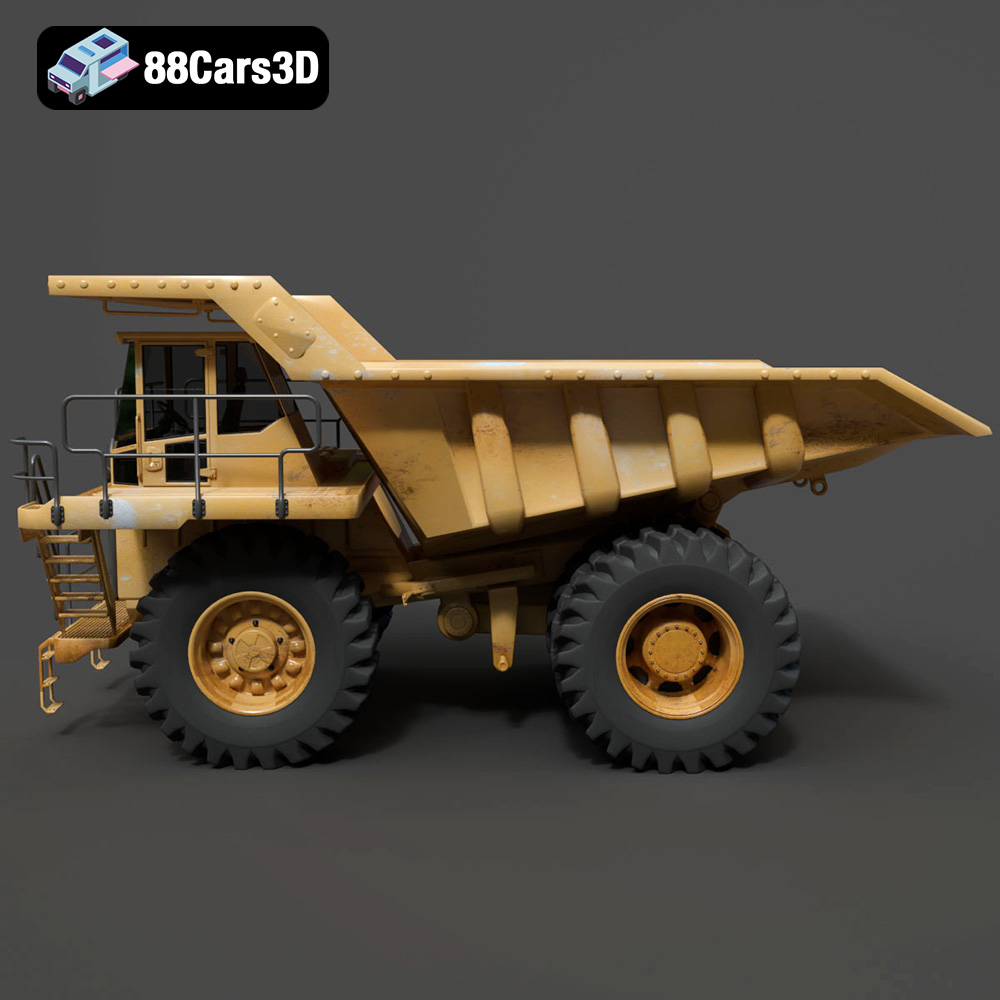
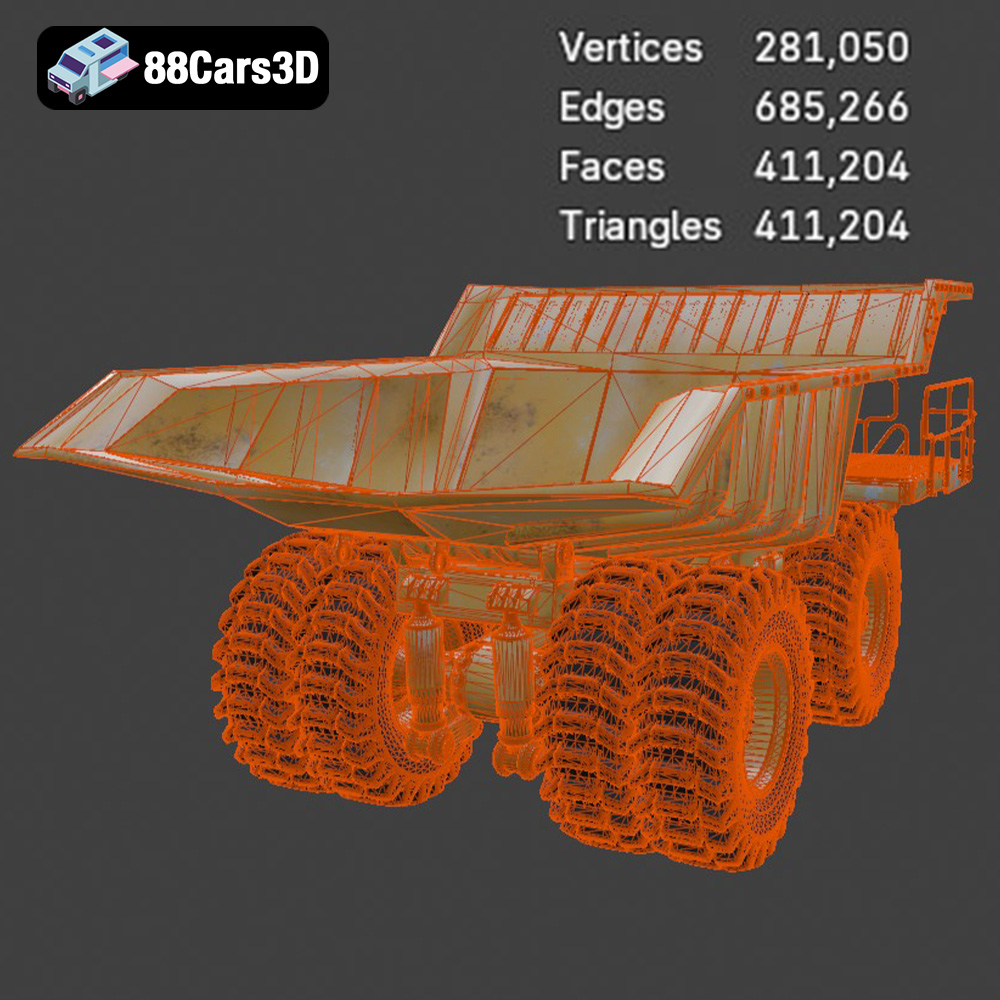
This particular Off-Highway Truck 3D model is a testament to precision engineering in the digital realm. Every structural element, from its reinforced dump bed to the heavy-duty suspension and safety railings, has been meticulously recreated. The colossal off-road mining tires, complete with deep, aggressive tread patterns, speak volumes about the vehicle’s intended purpose. With 411,204 triangles, the model strikes an excellent balance, offering intricate mechanical realism without becoming overly burdensome for real-time applications. This makes it a perfect candidate for detailed close-up shots in marketing materials or highly performant game assets within a complex virtual environment. The accurate frame geometry, load-bearing proportions, and fully modeled engine block contribute to an unparalleled sense of authenticity that is critical for any serious visualization or simulation project.
One of the significant advantages of leveraging pre-made, high-quality 3D car models like this Off-Highway Truck is the dramatic acceleration of workflow. Instead of investing hundreds of hours in modeling complex industrial machinery from scratch, artists and developers can integrate a ready-to-use asset, allowing them to focus on scene composition, environmental details, and interactive elements. The included features, such as separate wheels, a dump bed, and steering components configured for mechanical animation, are not just aesthetic details; they are crucial functional elements that enable dynamic interaction. This thoughtful design bridges the gap between static representation and dynamic simulation, making the model versatile for everything from cinematic automotive rendering to interactive heavy equipment training modules.
Choosing the right file format is as crucial as selecting the right 3D model itself. Each format serves specific purposes, excelling in certain workflows while potentially posing challenges in others. Understanding their technical nuances and ideal applications is fundamental for any professional working with 3D assets. The Off-Highway Truck 3D model conveniently comes in a comprehensive suite of formats, ensuring maximum compatibility and utility across diverse pipelines.
The .blend format is native to Blender, an open-source 3D content creation suite that has become a powerhouse in the industry. A .blend file offers a fully editable Blender scene, preserving all aspects of the model including mesh data, materials, textures, lighting, cameras, animation data, and even modifiers. This format is ideal for artists who primarily work within Blender and need to make extensive modifications, re-rig the model, create custom animations, or completely overhaul the material setup. It grants the highest level of control and flexibility, allowing users to delve into every component of the Off-Highway Truck model and tailor it precisely to their needs.
Similarly, the .max format is the native scene file for Autodesk 3ds Max, a long-standing industry standard for architectural visualization, automotive rendering, and game development. Like .blend, a .max file stores all scene information relevant to 3ds Max, from geometry and materials to animation and rendering settings. For studios and artists deeply entrenched in the 3ds Max ecosystem, the .max file provides unparalleled access to the model’s original construction. This is especially useful for complex animation sequences, detailed material creation with V-Ray or Corona renderers, or integrating the Off-Highway Truck into larger, existing 3ds Max projects without any data loss or conversion artifacts.
The .fbx (Filmbox) format is arguably the most widely used proprietary 3D exchange format, developed by Autodesk. It’s a robust format that can store not only geometry but also materials, textures, bones, skinning, and animation data. This makes it ideal for transferring animated models between different 3D software packages and, crucially, into game engines like Unreal Engine and Unity. For a complex asset like the Off-Highway Truck, an .fbx file ensures that all its movable parts (wheels, dump bed, steering components) retain their pivot points and animation readiness. It’s the go-to format for real-time pipelines due to its comprehensive data storage and widespread support.
The .obj (Wavefront OBJ) format is a much simpler, universal exchange format, often considered the lingua franca of 3D modeling. It primarily stores geometry (vertices, normals, texture coordinates, and faces) and references to external material files (.mtl). While it doesn’t support animation or rigging directly, its simplicity makes it incredibly compatible across virtually all 3D software. For the Off-Highway Truck, the .obj version is perfect for users who need a clean mesh for sculpting, retopology, or integrating into older software where .fbx might not be fully supported. It’s a reliable fallback for cross-software compatibility, ensuring the core geometry is always accessible.
The .ply (Polygon File Format) is another precision mesh format, often used in applications requiring high fidelity and accuracy, particularly from 3D scanners or for CAD/analysis. It can store various properties beyond just geometry, such as color per vertex, normal information, and even material properties. While less common for everyday artistic exchange than .fbx or .obj, it’s valuable for specific engineering, scientific visualization, or scenarios where the highest mesh integrity is paramount for the Off-Highway Truck model. It’s often favored in academic and research settings for its explicit data representation.
The .glb (GLB Transmission Format) is the binary version of glTF (Graphics Language Transmission Format), designed for efficient transmission and loading of 3D scenes and models. It packages all assets (model, textures, animations) into a single file, making it highly optimized for AR, VR, and browser-based display. For showcasing the Off-Highway Truck in an interactive web viewer, an AR experience on a mobile device, or a lightweight VR demonstration, .glb is the superior choice. Its compact size and ease of integration make it a modern standard for delivering 3D content on the web and in immersive experiences.
The .stl (Stereolithography) format is the industry standard for 3D printing. It represents a 3D model as a collection of unconnected triangular facets, without color, texture, or other CAD attributes. While it lacks visual data, its simplicity is exactly what makes it perfect for additive manufacturing. The Off-Highway Truck in .stl format can be directly imported into slicing software for 3D printing. The provided model is convertible to .stl, enabling hobbyists and professionals alike to bring this mechanical giant into the physical world, creating tangible display pieces or functional prototypes. The explicit 3D print settings provided with the model further enhance its utility in this domain.
Finally, the .unreal format refers to assets specifically packaged or directly imported for Unreal Engine. While not a standalone file extension in the same sense as .fbx, it signifies an engine-ready asset. This typically means an .fbx file that has been imported and configured within Unreal Engine, with materials set up, proper collision geometry generated, and often pre-optimized for Unreal’s rendering pipeline. This “engine-ready” state is invaluable, as it bypasses much of the initial setup work, allowing developers to immediately deploy the Off-Highway Truck into their real-time environments, saving crucial development time and ensuring consistent performance.
The demand for realism in game development and interactive simulations continues to push boundaries. Developers are constantly seeking high-quality, optimized assets that can enhance immersion without crippling performance. The Off-Highway Truck 3D model, with its game-ready specifications, is an exemplary asset for such purposes, particularly within leading engines like Unreal and Unity.
Integrating the Off-Highway Truck into Unreal Engine begins most effectively with the .fbx or the provided .unreal asset. The .fbx format is a robust choice, ensuring that all individual components—like the separate wheels, dump bed, and steering mechanisms—are imported with their correct pivot points. This is paramount for setting up physics-based animations or interactive controls. Once imported, the model’s 411,204 triangles are well within the optimized range for many modern game environments, especially for a hero asset. Developers can then leverage Unreal Engine’s powerful material editor to create physically based rendering (PBR) materials, adding realistic dirt, mud, and wear layers that react dynamically to lighting. Implementing vehicle physics, defining collision meshes, and scripting interactive elements such as hydraulic dump bed elevation and steering are straightforward tasks, turning a static model into a fully functional, immersive experience. For heavy machinery VR training, the optimized geometry also ensures smooth frame rates, crucial for preventing motion sickness and maintaining a sense of presence.
Beyond highly specialized simulators, the Off-Highway Truck model enriches open-world construction games, industrial strategy titles, and even cinematic sequences within games. Imagine a vast open-pit mine in a game, teeming with these mechanical giants, transporting virtual ore. The model’s real-world scale accuracy and detailed exterior features lend themselves perfectly to believable environments. Artists can utilize Unreal’s instance rendering for multiple trucks, and apply customization options like changing chassis colors or adding procedural weathering directly within the engine, making each truck feel unique. This level of detail elevates the visual fidelity of any game, pushing the boundaries of what players expect from their virtual experiences. The attention to interior details, including the cockpit, further supports immersive first-person perspectives, essential for player engagement in operator-focused gameplay.
For advertising, film, and architectural visualization, photorealism is not just a goal; it’s a necessity. High-fidelity 3D car models are central to achieving this, and the Off-Highway Truck model provides an excellent foundation for creating breathtaking industrial visuals. Leveraging professional rendering software like 3ds Max and Blender, artists can transform this digital asset into truly lifelike imagery.
The availability of the Off-Highway Truck model in both .max and .blend formats provides incredible flexibility for professional render artists. In 3ds Max, artists can import the .max file directly, preserving all scene data. This allows for seamless integration with powerful renderers like V-Ray or Corona Renderer. The model’s high geometric detail (411,204 triangles) ensures that even in extreme close-ups, surfaces remain smooth and intricate. Artists can apply advanced shaders to mimic weathered steel, grimy plastic, and the unique textures of colossal mining tires. Similarly, Blender users can open the .blend file, tapping into Blender’s Cycles or Eevee render engines. The separate, animatable components—wheels, dump bed, steering—allow for the creation of dynamic poses or short animation loops, bringing the truck to life in a still image or a short commercial. The industrial-grade lighting systems on the model, including powerful floodlights, can be accurately replicated with 3D light sources, creating dramatic night-time mining scenes.
Achieving photorealism extends beyond just the model; it critically involves lighting and materials. For the Off-Highway Truck, artists can employ HDRI (High Dynamic Range Image) environments to provide realistic global illumination from real-world industrial settings. Complementing this with targeted area lights, spot lights, and volumetric fog can dramatically enhance the atmosphere of an industrial scene. Material artists can utilize intricate PBR workflows, creating layers of grunge, dust, and scratches using Substance Painter or directly within their chosen 3D software. For instance, simulating the abrasive effects of rock dust on the dump bed or the wear patterns on the colossal tires requires finely tuned roughness and normal maps. The ability to customize chassis colors and apply procedural weathering further empowers artists to create bespoke renders that resonate with specific project requirements, ensuring the Off-Highway Truck looks perfectly at home, whether brand new or heavily used in a harsh environment.
The versatility of high-quality 3D assets extends far beyond traditional screens. Immersive technologies like Augmented Reality (AR) and Virtual Reality (VR), along with additive manufacturing (3D printing), are opening up new frontiers for industrial visualization and training. The Off-Highway Truck 3D model is exceptionally well-suited for these cutting-edge applications.
VR training offers a safe, cost-effective, and highly engaging alternative to real-world instruction, especially for operating complex and dangerous heavy machinery. With the Off-Highway Truck 3D model, companies can develop highly realistic VR training simulations for aspiring operators. The accurately scaled operator cabin, complete with detailed steering, ergonomic controls, and industrial digital instrument clusters, provides an immersive first-person POV. Trainees can practice maneuvers, learn safety protocols, and experience emergency scenarios in a consequence-free virtual environment. The optimized geometry ensures smooth performance, which is vital for maintaining immersion and preventing VR sickness. In AR, the model can be used to overlay a digital Off-Highway Truck onto a real-world environment, allowing engineers or maintenance teams to visualize its scale, components, or even animate its functions in context, facilitating planning or diagnostics. The .glb format is particularly beneficial here, offering a lightweight and efficient package for AR and VR deployments.
The ability to convert the Off-Highway Truck 3D model to an .stl format opens up exciting possibilities for 3D printing. Industrial hobbyists, engineering students, or even companies looking for physical prototypes or display models can bring this digital giant into the tangible world. While the real-world scale is massive, the model can be accurately scaled down, with recommendations for 1:50 or 1:64 provided. The detailed instructions for 3D printing, including recommended layer height (0.04–0.12 mm, with resin printing suggested for fine details), wall thickness, infill, and support requirements, are invaluable. Printing separate components like the frame, massive wheels, and dump bed allows for optimal print orientation and structural integrity. Post-processing, involving sanding, priming, and painting with authentic industrial colors and weathering effects, can result in a stunningly realistic physical replica that showcases the engineering marvel of these vehicles. This fusion of digital design and physical manufacturing adds another layer of utility to high-quality 3D car models.
The lifecycle of a 3D asset in a professional pipeline can be extensive, often requiring adaptations for new projects, updated rendering techniques, or different platform requirements. A truly valuable 3D model, like the Off-Highway Truck from 88cars3d.com, is built with customization and longevity in mind, ensuring it remains a relevant and powerful tool for years to come.
One of the core strengths of this Off-Highway Truck 3D model lies in its adaptability. Artists and developers are not limited to a single aesthetic or configuration. The product description explicitly highlights customization options that are critical for diverse projects. For example, changing the chassis and dump bed colors allows for seamless integration into a company’s specific branding or to represent different fleet vehicles within a simulation. Applying procedural weathering, such as dirt, mud, rock dust, and scratches, ensures the truck can be depicted in various stages of operation or wear, from pristine showroom condition to battle-hardened mining workhorse. Adjusting material finishes from matte to rugged metal or worn steel further enhances this versatility. Moreover, the ability to adapt work-light setups is crucial for scenarios depicting night-time mining environments, where effective illumination is both a functional and an atmospheric element. This level of intrinsic customizability directly translates into time savings and greater creative control for the user.
Investing in high-quality 3D assets is an investment in the future of your projects. Low-quality models often lead to technical debt, requiring extensive rework, optimization, or even complete replacement as project demands evolve. Conversely, models like the Off-Highway Truck, designed with optimization, real-world accuracy, and comprehensive file format support, offer significant long-term value. Their game-ready nature and detailed geometry ensure they are immediately useful across various applications—from cinematic renders and AR/VR experiences to 3D printing. The meticulous attention to detail, from accurate proportions to properly set up pivots for animation, means less time spent fixing issues and more time dedicated to creative endeavors. By providing such a robust and versatile foundation, 88cars3d.com empowers professionals to tackle complex industrial visualization and simulation projects with confidence, knowing they have a reliable, high-performance asset at their disposal that can grow and adapt with their needs.
In conclusion, the journey from concept to fully realized 3D asset is paved with technical considerations and artistic choices. The Off-Highway Truck 3D Model stands out as a prime example of how a meticulously crafted digital asset can serve a multitude of professional needs. Its detailed geometry, game-ready optimization, and extensive file format support make it an indispensable tool for anyone working in automotive rendering, game development, AR/VR, or 3D printing. Whether you’re building an immersive mining simulator in Unreal, rendering a high-impact advertising visual in 3ds Max, or crafting a physical replica, this model provides the quality and flexibility required for success. It’s a testament to the fact that with the right assets, even the most colossal machines can be seamlessly integrated into your creative vision.
Discover the immense power and rugged utility of the Off-Highway Truck, a massive heavy-duty vehicle designed for large-scale mining operations and extreme construction environments. Characterized by its colossal payload capacity, robust dual-axle chassis, and gargantuan off-road tires, this truck is the ultimate symbol of industrial strength and earth-moving capability. Every structural element, from the reinforced dump bed to the heavy-duty suspension and safety railings, has been meticulously recreated to capture the imposing presence of these mechanical giants. This high-fidelity 3D model boasts a detailed geometry of 411,204 triangles, striking an excellent balance between intricate mechanical realism and optimization. Modeled with precision, it offers exceptional visual fidelity for close-up shots while maintaining performance for real-time applications. Whether deployed in an interactive mining simulator, a heavy equipment showcase, or a dramatic cinematic render, this model delivers unparalleled authenticity. Perfect for mining operation simulators, industrial construction visualizations, heavy machinery VR training, and rugged environment game development.
$26.00
.blend
.fbx
.glb
.heavy-equipment
.max
.obj
.ply
.rendering
.stl
.unreal
car-3d-model
game asset
game-ready
low-poly
mining-truck
off-highway-truck
off-highway-truck-08
optimized
VR/AR