Get 20% OFF All Premium 3D & STL Models!

In the annals of automotive history, few vehicles command the same reverence and admiration as the pre-war luxury titans. These magnificent machines weren’t merely modes of transport; they were rolling works of art, symbols of an era’s unparalleled craftsmanship and engineering ambition. Among them, the 1933 Cadillac V16 (452-C) Town Car stands as an undisputed masterpiece, a testament to American opulence and bespoke design. Its colossal 16-cylinder engine, whisper-quiet operation, and distinctive open-chauffeur “Town Car” body style defined the pinnacle of 1930s elegance and prestige.
For today’s digital artists, game developers, architects, and visualization specialists, the challenge lies in faithfully capturing such intricate historical detail in a dynamic, versatile 3D format. The demand for authentic, high-fidelity 3D car models is ever-growing, pushing the boundaries of what’s possible in virtual environments. This is precisely where a meticulously crafted asset like the Cadillac V16 452-C Town Car 1933 3D Model from 88cars3d.com becomes an invaluable resource, serving as a bridge between automotive heritage and cutting-edge digital applications.
This article delves into the technical intricacies, diverse applications, and profound impact of professional-grade 3D car models, using the iconic 1933 Cadillac V16 as our prime example. We’ll explore how such detailed assets empower creators across various industries, from cinematic rendering to immersive real-time experiences and even tangible 3D prints, underscoring the vital role of format versatility and technical precision.
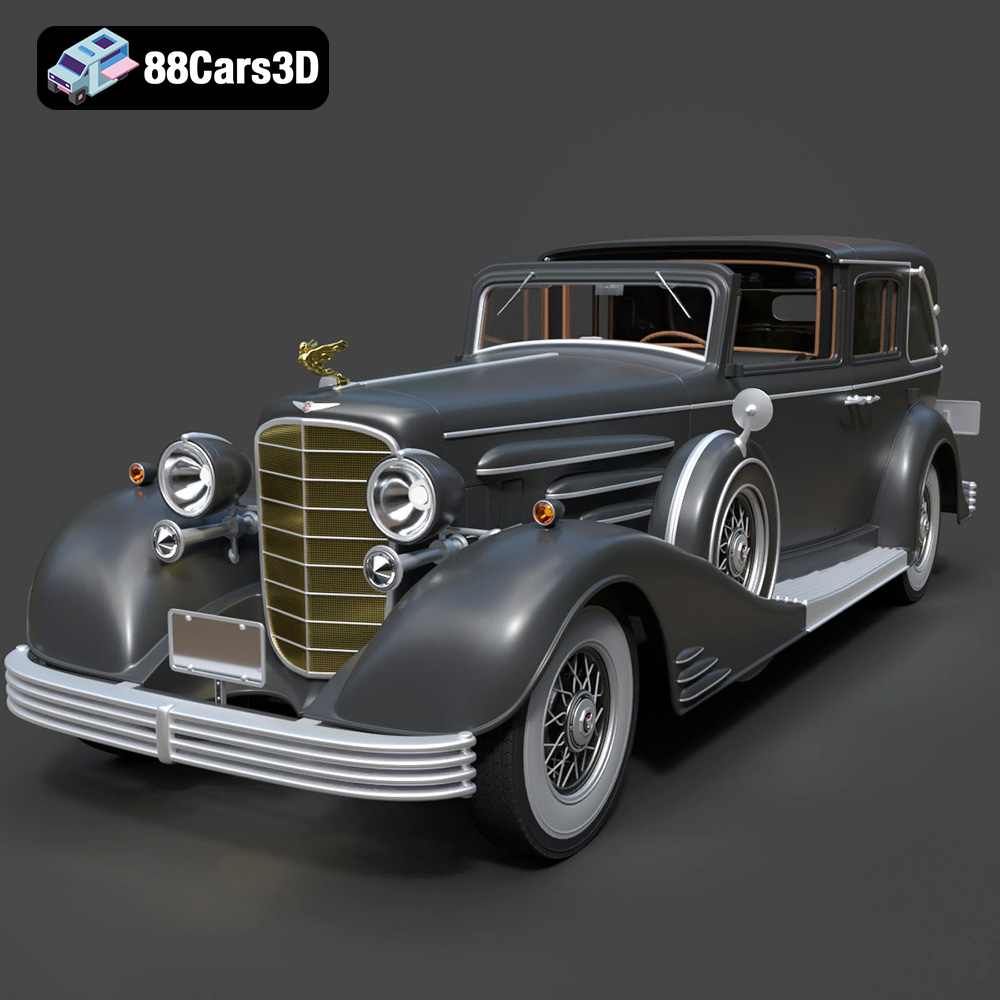
The 1933 Cadillac V16 (452-C) Town Car represents a zenith in automotive design, a period when grandeur and bespoke craftsmanship knew no bounds. Its sweeping pontoon fenders, the iconic Goddess hood ornament, majestic chrome V-shaped grille, and dual side-mount spare tires collectively create a breathtakingly regal silhouette. Recreating such a historically significant vehicle in 3D demands not just artistic skill, but a deep understanding of its engineering and aesthetic principles.
Digital preservation of automotive history is more than just scanning a physical object; it’s about interpreting and rebuilding its essence with precision. For the 1933 Cadillac V16, this means meticulous attention to its unique frame geometry, the elegant curves of its 1930s proportions, and the intricate details that made it a legend. The process involves extensive research, referencing archival blueprints, photographs, and existing examples to ensure every curve, every angle, and every proportion is historically accurate. The challenge is to translate these historical documents into a topologically sound, game-ready, or render-ready 3D model that retains the vehicle’s inherent luxury and power.
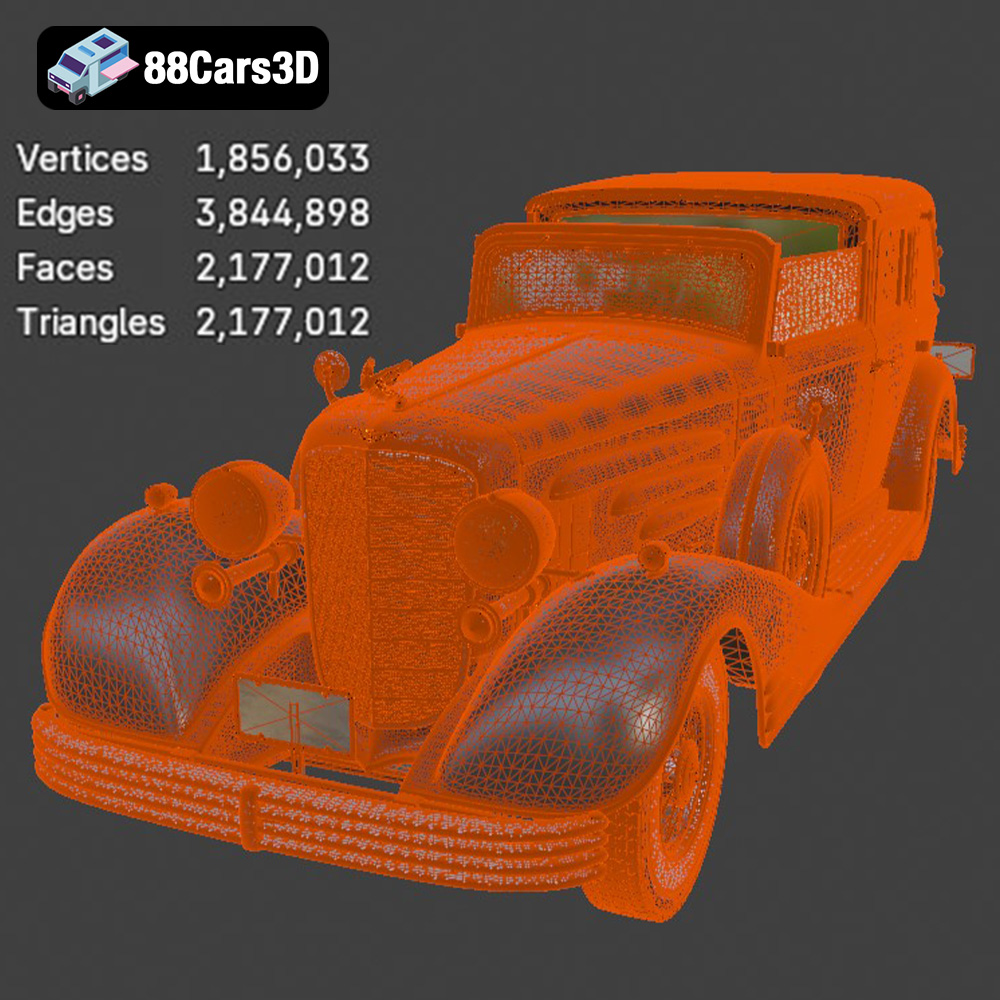
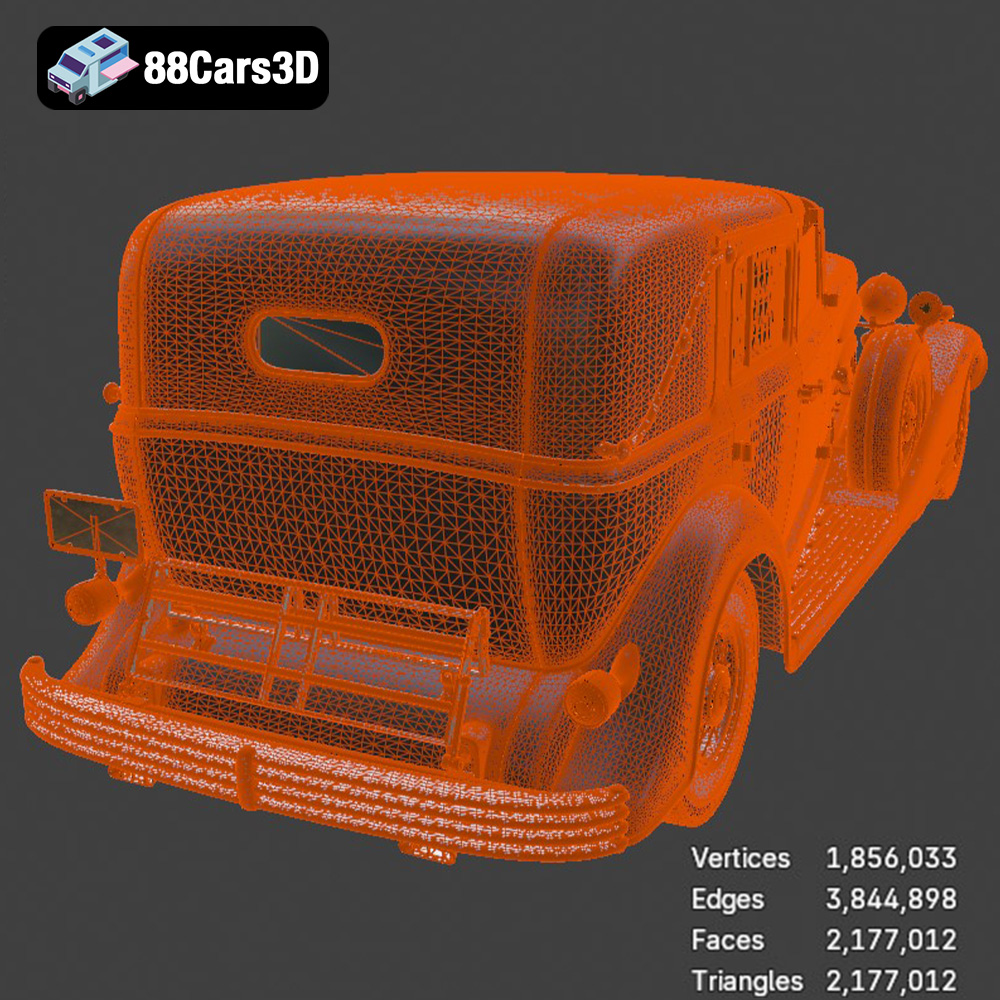
The Cadillac V16 452-C Town Car 1933 3D Model boasts an extraordinary level of visual fidelity, featuring a detailed topology of 2,177,012 triangles. This high poly count is not arbitrary; it’s carefully structured to capture every nuanced curve and chrome accent, from the distinctively open-air driver’s cockpit to the opulent rear passenger compartment with its tufted seating and rich woodwork. The model includes detailed engine block enclosures showcasing the legendary 452 cubic-inch V16 layout, authentic dual exhaust systems, and period-correct lighting, including massive bullet-style headlights and elegant carriage lights. Intricate multi-spoke wire wheels fitted with classic wide whitewall tires and historically accurate leaf spring suspension detailing further elevate its realism. Such precision makes it an exceptional asset for developers and artists demanding true-to-life representation in cinematic productions, historical recreations, architectural visualizations, and luxury virtual showrooms.
The versatility of a premium 3D model like the 1933 Cadillac V16 lies not just in its visual fidelity but also in its compatibility across a myriad of software and platforms. This is achieved through the provision of multiple file formats, each serving specific purposes and workflows. Understanding these formats is crucial for any professional working with 3D car models.
The .blend format is the native file type for Blender, a powerful open-source 3D creation suite. When you download a .blend file, you’re getting a complete Blender scene, often including not just the model’s geometry but also its materials, textures, lighting, cameras, and even animation data. This format is ideal for artists who primarily work in Blender, offering full editability. You can dissect the model, modify its topology, adjust materials, rig components, or integrate it seamlessly into existing Blender projects. It provides the most flexibility for detailed customization and advanced rendering within the Blender ecosystem.
.fbx (Filmbox) is a proprietary file format developed by Autodesk, widely regarded as the industry standard for interoperability between 3D software applications, especially in game development. It’s excellent for transferring 3D models, animation, and scene data between programs like Maya, 3ds Max, Blender, and game engines such as Unreal Engine and Unity. FBX files support geometry, materials, textures, rigging, animation, and even camera data. Its robust support for animation and its widespread adoption make it the go-to format for exporting game assets and character models, ensuring that the 1933 Cadillac V16 can be easily imported and set up for real-time interactivity and cinematic cutscenes within game environments.
The .obj (Object) format is one of the oldest and most universally supported 3D file formats. It’s a simple, text-based format primarily used to store 3D geometry data (vertices, normals, texture coordinates, and faces) and often references an accompanying .mtl (Material Template Library) file for basic material properties. While .obj doesn’t typically support rigging or animation, its widespread compatibility across almost every 3D application makes it an indispensable format for sharing static models. It’s a reliable choice when you need to ensure the core geometry of the Cadillac V16 is accessible in virtually any 3D software, making it perfect for initial imports or when material definitions are handled separately in the target application.
.glb (GLB format, derived from glTF – Graphics Library Transmission Format) is an increasingly popular format optimized for efficient transmission and loading of 3D scenes and models in web and mobile applications. It’s particularly well-suited for Augmented Reality (AR), Virtual Reality (VR), and browser-based 3D viewers because it bundles all assets (geometry, materials, textures, animations) into a single, compact binary file. This self-contained nature and its focus on real-time rendering efficiency make the .glb version of the Cadillac V16 ideal for interactive virtual showrooms, mobile AR experiences, and speedy loading on websites without complex asset management.
.stl (STereoLithography) is the standard file format for 3D printing. It describes only the surface geometry of a 3D object using a collection of interconnected triangles (a triangulated surface mesh). STL files contain no color, texture, or material information, focusing solely on the shape for manufacturing. The .stl version of the Cadillac V16 3D model is crucial for hobbyists, collectors, or designers looking to bring the digital model into the physical world through 3D printing. It requires careful preparation and understanding of printing tolerances, but it’s the direct bridge from screen to tangible replica.
.ply (Polygon File Format or Stanford Triangle Format) is another widely used format for storing 3D data, particularly from 3D scanners. It’s more flexible than .obj and .stl, capable of storing not only geometry but also color, transparency, and various other attributes per vertex or per face. While not as universally used as .obj for general model exchange, .ply is favored in applications requiring high precision, such as scientific visualization, CAD, and point cloud data analysis. Its inclusion ensures that the Cadillac V16 model can be integrated into specialized pipelines where accurate mesh data with additional attributes is critical.
The .unreal format signifies an asset specifically optimized and configured for direct import and use within Unreal Engine. While .fbx is the common conduit, an .unreal file might represent a pre-packaged asset bundle with optimized materials, textures, collision meshes, LODs (Levels of Detail), and blueprint setups ready to be dropped into an Unreal project. This dramatically streamlines the workflow for Unreal developers, reducing setup time and ensuring the Cadillac V16 performs optimally within the engine’s rendering pipeline. It embodies the “game-ready” promise, making immediate deployment a reality.
Similar to .blend for Blender, the .max format is the native file type for Autodesk 3ds Max, a leading software for 3D modeling, animation, and rendering in architectural visualization, product design, and cinematic pre-production. A .max file contains the complete 3ds Max scene, including geometry, materials, textures, lighting, cameras, animation, and any modifiers or procedural effects applied. For professionals working in 3ds Max, this format offers full creative control and the ability to leverage Max’s powerful rendering capabilities (e.g., V-Ray, Corona) for photorealistic automotive rendering and complex animations of the 1933 Cadillac V16.
The availability of multiple file formats for the 1933 Cadillac V16 3D model ensures its seamless integration into diverse professional pipelines, catering to specific industry needs and software preferences. From breathtaking cinematic renders to high-performance real-time applications, this model provides the necessary foundation.
For artists focused on achieving the highest levels of photorealism, the .max and .blend files are indispensable. In 3ds Max, artists can import the V16 model, apply advanced PBR (Physically Based Rendering) materials using render engines like V-Ray or Corona, and set up complex studio lighting environments. This allows for the creation of stunning marketing stills, detailed architectural visualizations featuring the car, or even short animated sequences. Similarly, Blender users can leverage its powerful Cycles or Eevee renderers with the .blend file, customizing every aspect from the reflectivity of the chrome accents to the subtle patina on the paintwork. This level of control is crucial for projects requiring precise atmospheric conditions, specific camera angles, and intricate visual storytelling, making it a prime asset for automotive rendering.
The “game-ready & optimized” nature of the Cadillac V16 3D model, boasting a 2,177,012 triangle count, positions it perfectly for integration into real-time engines like Unreal Engine and Unity. The .fbx and dedicated .unreal formats are key here. Artists and developers can import the model, which often includes proper pivot setups for steering, wheel rotation, and suspension travel, significantly reducing setup time. For gaming, the model is ideal for open-world games, racing titles, and driving simulators, where high visual fidelity is critical but performance optimization cannot be sacrificed. In AR/VR, the model can power immersive virtual showrooms or configurators, allowing users to explore the Cadillac V16 from every angle in a truly interactive 3D environment. Its optimized geometry ensures smooth frame rates and a responsive user experience, even on high-end hardware.
The utility of a comprehensive 3D car model extends beyond digital screens, opening doors to tangible replicas and highly interactive web-based applications. The 1933 Cadillac V16 model exemplifies this versatility.
The inclusion of the .stl format is a game-changer for enthusiasts and designers looking to physically manifest the digital elegance of the Cadillac V16. The product’s detailed 3D print settings provide a clear roadmap: recommended scales (1:12, 1:18, 1:24) cater to various display preferences, while guidelines on layer height (0.04–0.12 mm) emphasize the importance of resin printing for capturing fine details like wire spokes and the Goddess hood ornament. Specific instructions on wall thickness, infill, and the necessity for supports on intricate parts like the exhaust and steering wheel ensure a successful print. Post-processing, involving sanding, primer, and authentic factory colors with metallic finishes, allows for the creation of museum-grade physical models, making this an exciting application for collectible 3D car models.
For modern interactive experiences, the .glb format shines. Optimized for AR, VR, and browser-based display, it allows the 1933 Cadillac V16 to be seamlessly embedded into websites for virtual showrooms or integrated into mobile AR applications. Imagine a potential customer using their smartphone to place a life-sized virtual Cadillac V16 in their driveway, or an automotive historian exploring its intricacies in a VR museum. The single-file, optimized nature of .glb ensures quick loading and smooth interactivity, making it perfect for educational tools, marketing campaigns, and engaging digital presentations that push the boundaries of traditional viewing.
A truly professional 3D asset provides not only accuracy but also the flexibility for artists and developers to adapt it to their unique project requirements. The 1933 Cadillac V16 3D model excels in offering this balance.
The ability to customize a 3D model is crucial for creative expression and project-specific needs. With the Cadillac V16, artists can easily change body/coachwork colors to reflect classic two-tone 1930s factory finishes or experiment with entirely new aesthetics. Modifying tire textures from pristine whitewalls to weathered, aged appearances can alter the narrative of a scene, while adjusting material finishes from matte leather to highly polished chrome or glossy paint dramatically impacts the vehicle’s perceived age and condition. The model’s well-structured UVs (implied by high detail and game-readiness) allow for effortless texture application and material adjustments. Furthermore, adapting lighting for different environments—be it a sun-drenched historical street or a moody cinematic interior—can be achieved with ease, ensuring the model perfectly fits any visual context.
The technical specifications of the Cadillac V16 model underscore its “game-ready” advantage. With 2,177,012 triangles, it strikes an optimal balance between breathtaking visual realism and performance efficiency for high-end real-time engines. Crucially, its real-world scale accuracy, based on the actual 1933 vehicle chassis and wheelbase, ensures believable physics and proportions within any virtual environment. Proper pivot setups for steering, wheel rotation, and suspension travel are pre-configured, saving valuable development time. While designed for high-end applications, experienced artists can also implement techniques like LODs (Levels of Detail) or mesh decimation to adapt the model for lower-spec hardware or specific performance targets, making it a scalable solution for a wide range of projects demanding top-tier 3D car models and game assets.
The 1933 Cadillac V16 (452-C) Town Car 3D Model is more than just a digital replica; it’s a meticulously crafted asset that embodies the fusion of historical reverence and modern technological capability. Its extraordinary visual fidelity, coupled with unparalleled format versatility, makes it an indispensable tool for a vast array of creative and professional applications. From enriching game development with authentic classic cars to creating stunning automotive rendering visualizations, from enabling immersive AR/VR experiences to producing high-quality 3D printed collectibles, this model serves as a cornerstone for projects demanding excellence.
For artists, developers, and enthusiasts, the ability to access such a detailed and adaptable piece of automotive history streamlines workflows and elevates the quality of their output. Whether your goal is a cinematic masterpiece, a compelling interactive experience, or a tangible model, the Cadillac V16 452-C Town Car 1933 3D Model from 88cars3d.com provides the robust foundation needed to bring your vision to life. It stands as a prime example of the exceptional quality and versatility available when choosing premium 3D assets for any project.
The 1933 Cadillac V16 (452-C) Town Car is an undisputed masterpiece of American automotive history, representing the absolute pinnacle of pre-war luxury and bespoke coachbuilding. Renowned for its whisper-quiet, colossal 16-cylinder engine and the distinctive open-chauffeur “Town Car” body style, this magnificent vehicle defined 1930s elegance and prestige. Key visual elements include its sweeping pontoon fenders, the iconic Goddess hood ornament, majestic chrome V-shaped grille, and dual side-mount spare tires, all culminating in a breathtakingly regal silhouette. This premium 3D model boasts an extraordinary level of visual fidelity with a detailed topology of 2,177,012 triangles, capturing every nuanced curve and chrome accent of the classic original. Despite its high detail, the geometry is intelligently structured to ensure stunning photorealism while remaining versatile for high-end digital applications. It stands as an exceptional asset for developers and artists demanding true-to-life representation in historical recreations, architectural visualizations, and cinematic productions.
$37.50
.blend
.cadillac
.fbx
.glb
.max
.obj
.ply
.rendering
.stl
.unreal
.v16
1933
452-c
car-3d-model
classic-car
game asset
game-ready
luxury car
optimized
pre-war
town-car
VR/AR