Get 20% OFF All Premium 3D & STL Models!

In the expansive and ever-evolving world of 3D modeling, the demand for exceptionally crafted, historically accurate, and versatile digital assets is paramount. Artists, developers, and visualization specialists constantly seek models that not only look stunning but are also engineered for seamless integration into diverse professional pipelines. Among the myriad of digital assets, classic 3D car models hold a special allure, bridging the gap between historical elegance and cutting-edge technology. They are not merely objects; they are vessels of history, design, and engineering, meticulously recreated to inspire new generations.
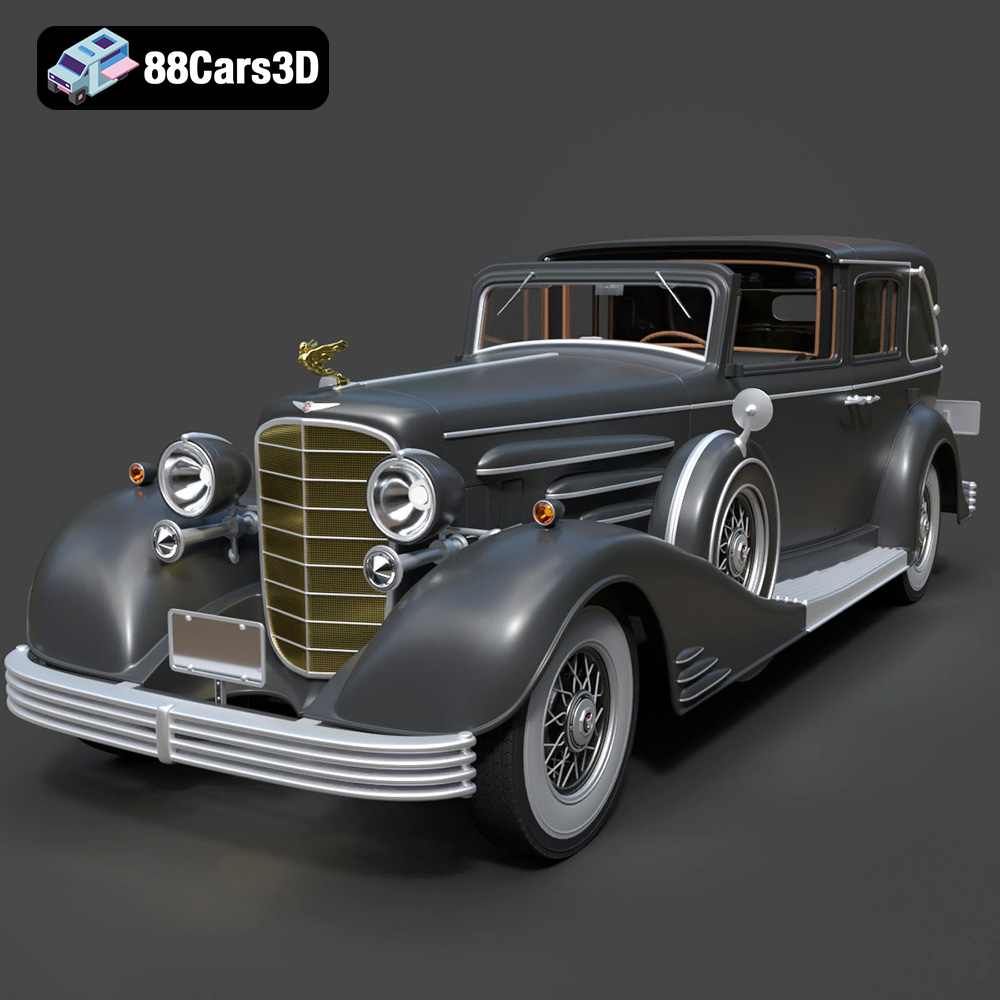
Today, we delve into a masterpiece of automotive history – the 1933 Cadillac V16 (452-C) Town Car. This isn’t just any classic; it represents the zenith of pre-war luxury, boasting a colossal 16-cylinder engine and a distinctive open-chauffeur body style that defined an era of unparalleled prestige. Its sweeping pontoon fenders, iconic Goddess hood ornament, majestic chrome V-shaped grille, and dual side-mount spare tires collectively create a breathtakingly regal silhouette. Now, imagine capturing this grandeur in a digital form, ready for high-fidelity rendering, immersive game environments, or even precise 3D printing. That’s precisely what the premium 3D model of the 1933 Cadillac V16 452-C Town Car offers, available for download on 88cars3d.com, making it an invaluable asset for any creative endeavor requiring historical accuracy and visual excellence.
The versatility of a 3D model often hinges on the file formats it supports. Each format is designed with specific applications and compatibility in mind, influencing how effectively an asset can be utilized across different software and platforms. For a complex asset like the 1933 Cadillac V16 452-C Town Car, understanding these distinctions is crucial for maximizing its potential in automotive rendering, game development, and more. The Cadillac model from 88cars3d.com is provided in a comprehensive array of formats, ensuring broad compatibility for virtually any project.
The .blend file format is the native format for Blender, the powerful open-source 3D creation suite. When you download a .blend file, you’re not just getting the raw mesh; you’re receiving a fully editable Blender scene. This includes all the mesh data, materials, textures (often packed within the file or linked), lighting setups, camera positions, animations, and even scene configurations. For the Cadillac V16 model, the .blend file provides a complete, ready-to-render scene, allowing artists intimately familiar with Blender to immediately dive in, tweak materials, adjust lighting, or integrate it into their existing Blender projects with maximum flexibility. It’s the go-to for artists who want full control over every aspect of the asset within a Blender-centric workflow.
FBX (Filmbox) is arguably the most widely used proprietary 3D file format for exchanging 3D data between different software applications. Developed by Autodesk, .fbx files are ideal for pipelines involving game engines like Unreal Engine and Unity, as well as various 3D modeling and animation software. It supports geometry, materials, textures, bones, skinning, camera animation, and more. For game assets and real-time environments, .fbx is critical due to its robust support for animation and hierarchy. The Cadillac V16 model in .fbx format ensures that all its detailed geometry, the separate wheels, suspension, and steering components are preserved and ready for import into an engine or another 3D package, making it a cornerstone for game developers and animators.
.obj (or Wavefront OBJ) is a nearly universal and one of the oldest 3D model formats. It’s primarily used for static mesh data, defining geometry through vertices, normals, UV coordinates, and faces. While it doesn’t store animation or advanced material properties directly, it references an associated .mtl (material) file for basic material definitions. Its simplicity and widespread support make it excellent for cross-software compatibility, especially when you need to import the core mesh into virtually any 3D application for further processing or rendering. For the Cadillac, the .obj provides a clean, foundational mesh that can be easily picked up by any 3D artist, regardless of their primary software.
.glb (GLB, or GL Transmission Format Binary) is the binary version of glTF (GL Transmission Format). It’s an API-neutral runtime asset delivery format, meaning it’s highly optimized for efficient transmission and loading of 3D scenes and models in web browsers, augmented reality (AR), and virtual reality (VR) applications. A .glb file contains all necessary data—geometry, materials, textures, animations—in a single, self-contained file, making it incredibly convenient for quick deployment. For displaying the 1933 Cadillac V16 in a virtual showroom on a website, integrating it into a mobile AR experience, or developing lightweight VR scenes, the .glb format is the undisputed champion.
.stl (STereoLithography) is the de facto standard file format for 3D printing. It represents 3D surfaces as a collection of unconnected triangular facets, without color, texture, or other CAD attributes. While simple, its ubiquity in the additive manufacturing world is unmatched. When you need to bring the Cadillac V16 model into the physical realm, the .stl file is what you’ll feed into your slicing software. The model’s optimized geometry and the specific 3D print settings provided (scale, layer height, supports) indicate that this format has been carefully prepared to ensure a successful physical rendition of this classic car.
.ply (Polygon File Format, or Stanford Triangle Format) is another format for storing 3D data, often used in applications involving 3D scanning, scientific visualization, and CAD. Unlike .stl, .ply can store a wider range of properties for each vertex and face, including color, transparency, surface normals, and texture coordinates. This makes it a more versatile option for applications requiring precision and additional data per mesh element, potentially useful for engineering analysis or highly specific visualization needs beyond simple mesh exchange.
The inclusion of a .unreal file indicates a truly engine-ready asset specifically tailored for Unreal Engine. This often means the model has been exported or packaged with specific Unreal Engine considerations in mind, potentially including optimized meshes, collision setups, and material instances that leverage Unreal’s physically based rendering (PBR) system. For developers building games, simulations, or cinematic experiences within Unreal Engine, this format streamlines the import process, minimizes conversion issues, and ensures the Cadillac V16 is ready to be dropped directly into a scene with minimal setup, maximizing efficiency for real-time applications.
.max is the native file format for Autodesk 3ds Max, a powerful software package widely used in architectural visualization, game development, and film production. Similar to the .blend file for Blender, the .max file provides a complete scene with all geometry, materials, textures, lighting, cameras, and animation data. For professionals whose primary workflow revolves around 3ds Max, this format offers the highest degree of editability and allows for sophisticated animation, complex rigging, and advanced rendering setups using engines like V-Ray or Corona Renderer. The Cadillac V16 provided in .max format ensures that 3ds Max users have full native access to the model’s intricate details and structure.
By offering the 1933 Cadillac V16 452-C Town Car in such a comprehensive suite of file formats, 88cars3d.com demonstrates a deep understanding of professional workflows and the diverse needs of 3D artists and developers. This multi-format approach ensures that this exquisite 3D car model is not only accessible but also highly adaptable to virtually any project requirement, from high-end cinematic rendering to interactive game experiences and even physical reproductions.
The creation and utilization of a premium 3D car model like the 1933 Cadillac V16 452-C Town Car involve a sophisticated workflow, spanning from initial conceptualization to the final, photorealistic render. This process demands attention to detail, technical proficiency, and an understanding of how to leverage such an asset across different stages of production. The Cadillac model, with its extraordinary visual fidelity and intelligently structured geometry, is built to fit seamlessly into these high-end pipelines.
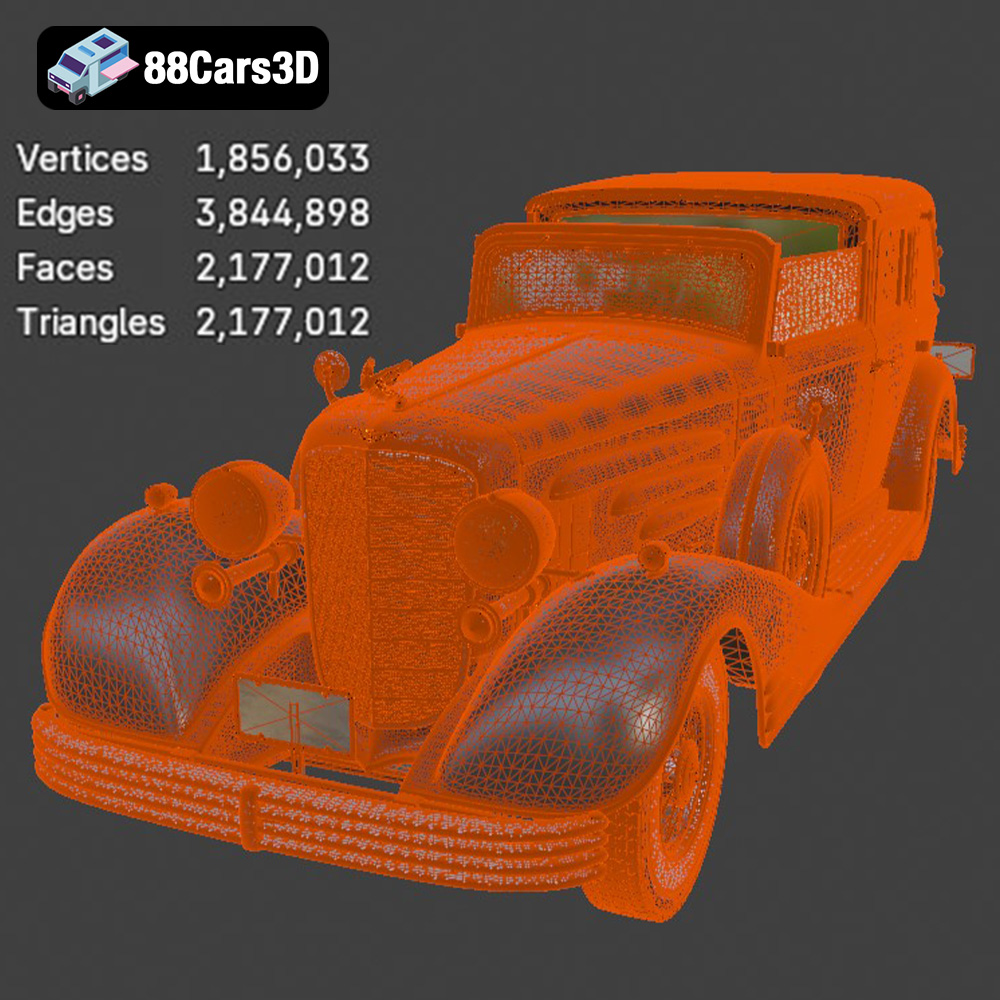
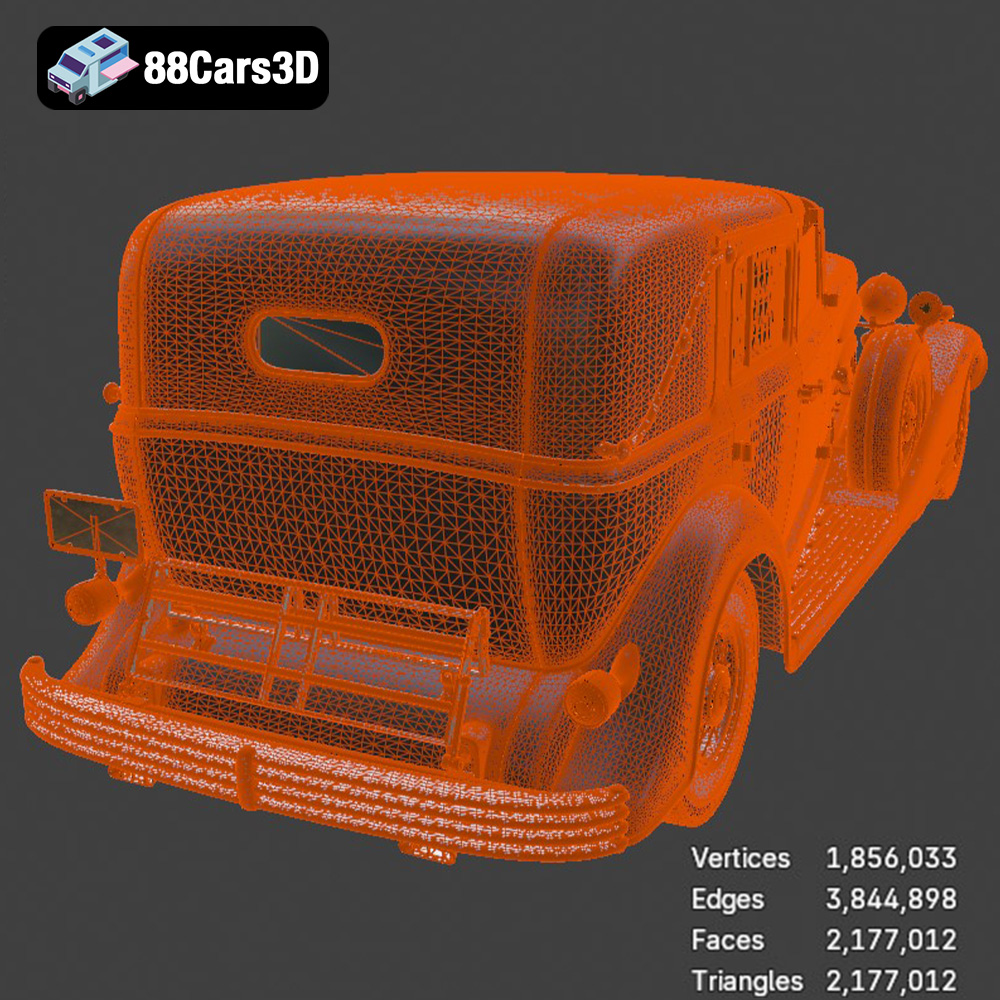
Achieving photorealism in 3D automotive rendering begins with an impeccably modeled base. The 1933 Cadillac V16 model boasts a detailed topology of 2,177,012 triangles. This high poly count is critical for capturing the nuanced curves, sharp creases, and subtle reflections characteristic of a vintage luxury vehicle. Every element, from the sweeping pontoon fenders to the intricate multi-spoke wire wheels, is meticulously recreated. The engine block enclosures, the authentic dual exhaust system, and even the leaf spring suspension detailing contribute to an unparalleled level of visual authenticity. Beyond the raw geometry, the model’s materials and textures are designed to emulate real-world finishes—polished chrome, rich woodwork, and opulent tufted seating—essential for that breathtaking, true-to-life representation.
For artists working in industry-standard software such as 3ds Max or Blender, the Cadillac V16 model provides an exceptional starting point. In 3ds Max (using the .max file), artists can access the full project, including potential scene setups, lighting, and cameras. This allows for immediate rendering using powerful engines like V-Ray or Corona, fine-tuning the global illumination, reflections, and refractions to achieve cinematic quality. For Blender users (utilizing the .blend file), the native scene allows for similar flexibility. Artists can experiment with Blender’s Cycles or Eevee renderers, create elaborate studio lighting setups, and even add subtle environmental effects like dust or imperfections to further enhance realism. The separate components for wheels, suspension, and steering also mean advanced animation rigs can be built, allowing for realistic driving sequences or interactive model showcases.
The utility of such a high-quality 3D car model extends across multiple professional domains. In architectural visualization (ArchViz), placing the 1933 Cadillac V16 in a period-correct street scene or a grand estate driveway can instantly elevate the realism and narrative of a rendering. For film and cinematic productions, this model serves as a perfect asset for historical recreations, period dramas, or even concept art for alternate history narratives. Its attention to detail ensures it holds up under close-up shots. In automotive advertising and marketing, even for modern vehicles, a classic like the V16 can be used for contextualization, showing the lineage of luxury or the enduring appeal of craftsmanship. Imagine a modern luxury car ad featuring the Cadillac V16 subtly in the background, drawing a connection to heritage. The potential for visual storytelling is immense, offering a distinctive edge in competitive markets.
The landscape of interactive experiences, from blockbuster video games to cutting-edge AR/VR simulations, increasingly relies on high-quality, optimized 3D assets. The 1933 Cadillac V16 452-C Town Car 3D model is designed not just for static renders but also as a “game-ready” asset, perfectly suited for integration into real-time engines like Unreal Engine and Unity. This capability opens doors for immersive classic car driving simulators, virtual showrooms, and dynamic interactive environments.
One of the perennial challenges in real-time graphics is balancing visual fidelity with performance. The 1933 Cadillac V16 model strikes an impressive balance with its 2,177,012 triangle count. While this is a high polygon count, it is intelligently structured. For high-end PC games, console titles, or VR experiences, this level of detail can be directly utilized for stunning realism without crippling frame rates, especially when combined with modern rendering techniques like Level of Detail (LOD) systems. LODs allow the engine to automatically switch to lower-polygon versions of the model when it’s further away from the camera, optimizing performance without sacrificing perceived detail up close. The model’s inherent optimization means developers can spend less time cleaning up geometry and more time on gameplay and interactive elements.
For game developers, the availability of the Cadillac V16 model with proper pivot setups for steering, wheel rotation, and suspension travel is a significant advantage. In Unreal Engine, this allows for the creation of sophisticated vehicle Blueprints. Artists can easily link the model’s components to a physics system, enabling realistic driving dynamics. Imagine integrating the V16 into a racing game or an open-world historical simulation, where players can experience the authentic feel of piloting this magnificent machine. The separate components also facilitate complex animation sequences, from opening doors to detailed engine bay reveals, crucial for cinematics within games or interactive demonstrations. For Unity users, similar scripting and physics implementations can bring the Cadillac to life with comparable ease.
The demand for immersive AR/VR content is skyrocketing, particularly in sectors like automotive sales, education, and heritage preservation. The 1933 Cadillac V16 model is an ideal candidate for such applications. Its high fidelity makes it perfect for virtual showrooms, where potential buyers or enthusiasts can explore every detail of the car in a 1:1 scale virtual environment. With the .glb format, the model is highly optimized for web-based AR/VR, allowing it to be easily displayed in browser-based configurators or mobile AR apps. Imagine holding your phone up and seeing a full-size, historically accurate Cadillac V16 parked in your driveway, or stepping into a VR museum where you can walk around, open the doors, and inspect the opulent rear passenger compartment and Art Deco instrument cluster. These interactive experiences offer a new dimension to appreciating classic cars, far beyond static images or videos.
Beyond digital rendering and real-time interaction, the 1933 Cadillac V16 452-C Town Car 3D model offers a unique opportunity for physical preservation and display through 3D printing. The ability to transform a digital asset into a tangible object adds another layer of versatility, catering to hobbyists, collectors, and educational institutions looking to create display-scale replicas of automotive legends. The inclusion of the .stl format and detailed printing guidelines underscores this capability.
The .stl file format, specifically designed for additive manufacturing, is the gateway to 3D printing the Cadillac V16. While the digital model boasts over 2 million triangles, careful conversion and optimization ensure that the intricate details translate accurately to the physical print. The recommended scales (1:12, 1:18, 1:24) are crucial for balancing detail retention with printability and material costs. Resin printing, with its ability to achieve finer layer heights (0.04–0.12 mm), is explicitly recommended for capturing the subtle curves, delicate wire spokes, and precise detailing of the original car. Preparing the model for printing involves orienting parts correctly (e.g., printing the frame angled for structural integrity, wheels separately) and judiciously adding supports, especially for overhangs and intricate components like the exhaust system, mirrors, and the steering wheel, to prevent warping and ensure fidelity.
Once the 3D printer has completed its work, the journey from raw print to display-worthy model is far from over. Post-processing is a critical step that significantly elevates the final appearance. This typically involves removing supports, sanding down any visible layer lines or blemishes, and applying a primer to create a smooth, uniform surface for painting. For a classic like the Cadillac V16, the choice of paint and finish is paramount. Authentic factory colors, perhaps even recreating classic two-tone 1930s finishes, coupled with metallic paints for chrome accents and a glossy clear coat, will bring the model to life. Detailed hand-painting of interior elements, tiny gauges, and even creating weathered appearances for tires can further enhance the realism, transforming a plastic print into a miniature work of art. This blend of digital precision and traditional craftsmanship allows enthusiasts to own a piece of automotive history in a truly unique way.
In today’s fast-paced digital creative industries, efficiency and quality are non-negotiable. Sourcing premium 3D car models, such as the 1933 Cadillac V16 452-C Town Car from 88cars3d.com, is a strategic decision that offers profound advantages for artists, developers, and businesses aiming to produce visually compelling and technically robust projects. These assets are not merely conveniences; they are catalysts for innovation and quality.
Creating a 3D model of the complexity and fidelity of the Cadillac V16 from scratch is an incredibly time-consuming and resource-intensive endeavor. It requires extensive research, blueprint analysis, meticulous modeling, UV mapping, texturing, and optimization. By leveraging a pre-made, high-quality asset, studios and individual artists can significantly cut down on production timelines and reallocate valuable resources to other critical aspects of their projects, such as animation, environment design, or interactive logic. Furthermore, purchasing from a reputable source like 88cars3d.com provides an assurance of quality. These models are typically created by expert modelers who adhere to industry best practices, ensuring clean topology, accurate scale, and robust file structures. This eliminates the uncertainty and potential rework associated with lower-quality or unverified assets, guaranteeing a professional outcome from the outset.
The visual impact of a project often dictates its success. Whether it’s a cinematic sequence, a game environment, an architectural visualization, or a product configurator, the quality of 3D assets directly contributes to the overall aesthetic and immersion. A historically accurate and beautifully rendered 1933 Cadillac V16 can instantly elevate the visual storytelling of a project, lending it a sense of authenticity, luxury, and historical depth that generic assets simply cannot provide. For brands, especially in the luxury or automotive sectors, using such exquisite 3D car models can significantly enhance their digital presence. Virtual showrooms, interactive marketing campaigns, and high-fidelity product showcases featuring iconic vehicles can create a memorable and engaging experience for customers, reinforcing brand values of quality, heritage, and innovation. The ability to customize the model, changing body colors, tire textures, or material finishes, further allows for brand-specific adaptations, making the asset incredibly versatile for diverse marketing narratives.
The digital realm offers unprecedented opportunities to recreate, preserve, and interact with the masterpieces of human ingenuity. The 1933 Cadillac V16 452-C Town Car stands as a testament to pre-war American luxury and engineering, and its digital counterpart is equally impressive. This premium 3D model, available on 88cars3d.com, is far more than just a collection of polygons; it is a meticulously crafted asset ready to empower a diverse range of creative projects.
From providing the bedrock for stunning automotive rendering in 3ds Max and Blender to serving as a high-fidelity game asset in Unreal Engine, or even bridging the gap to the physical world through detailed 3D printing, the Cadillac V16 model offers unparalleled versatility. Its intelligent geometry, accurate detailing, and comprehensive file format support (including .blend, .fbx, .obj, .glb, .stl, .ply, .unreal, and .max) ensure seamless integration into virtually any professional workflow. Whether you’re a film director crafting a period piece, a game developer building an immersive simulator, an architect visualizing a grand estate, or an enthusiast seeking to print a historical replica, this 3D car model provides the foundation for exceptional results. It exemplifies how carefully curated 3D car models can save valuable production time, ensure superior quality, and ultimately elevate the visual impact and storytelling potential of any project. Embrace the fusion of history and technology with this magnificent digital classic from 88cars3d.com.
The 1933 Cadillac V16 (452-C) Town Car is an undisputed masterpiece of American automotive history, representing the absolute pinnacle of pre-war luxury and bespoke coachbuilding. Renowned for its whisper-quiet, colossal 16-cylinder engine and the distinctive open-chauffeur “Town Car” body style, this magnificent vehicle defined 1930s elegance and prestige. Key visual elements include its sweeping pontoon fenders, the iconic Goddess hood ornament, majestic chrome V-shaped grille, and dual side-mount spare tires, all culminating in a breathtakingly regal silhouette. This premium 3D model boasts an extraordinary level of visual fidelity with a detailed topology of 2,177,012 triangles, capturing every nuanced curve and chrome accent of the classic original. Despite its high detail, the geometry is intelligently structured to ensure stunning photorealism while remaining versatile for high-end digital applications. It stands as an exceptional asset for developers and artists demanding true-to-life representation in historical recreations, architectural visualizations, and cinematic productions. Perfect for cinematic period pieces, classic car driving simulators, luxury virtual showrooms, and museum-grade interactive visualizations.
$37.50
.blend
.cadillac
.fbx
.glb
.max
.obj
.ply
.rendering
.stl
.unreal
.v16
1933
452-c
car-3d-model
classic-car
game asset
game-ready
luxury car
optimized
pre-war
town-car
VR/AR