Get 20% OFF All Premium 3D & STL Models!

In the vast and ever-expanding digital landscape, the demand for highly detailed and technically accurate 3D models spans industries from cutting-edge game development to sophisticated architectural visualization and immersive virtual reality training. While the spotlight often shines on sleek 3D car models, the unsung heroes of digital environments are often the robust, complex machines that shape our physical world. These industrial workhorses, such as excavators, bulldozers, and backhoe loaders, provide an unparalleled level of realism and functional complexity crucial for a multitude of professional applications.
Imagine constructing a virtual city, developing an advanced heavy machinery simulator, or crafting a photorealistic rendering for an industrial client. The success of such projects hinges on the quality and fidelity of your assets. This is where a meticulously crafted model like the Backhoe Loader 3D Model truly shines. This isn’t just a static representation; it’s a fully realized digital twin, engineered for performance across the most demanding platforms and workflows. Its versatility, detailed construction, and optimized topology make it an indispensable asset for professionals aiming for the pinnacle of digital realism.
The world of 3D modeling is incredibly diverse, not just in terms of software and artistic styles, but also in the array of file formats used to store and transfer models. Understanding these formats is critical for any professional working with 3D assets, ensuring compatibility, preserving data integrity, and optimizing workflows for specific applications. The Backhoe Loader 3D Model comes packaged with a comprehensive selection of formats, each serving distinct purposes.
The `.blend` file format is native to Blender, a powerful and increasingly popular open-source 3D creation suite. When you download a `.blend` file, you’re getting a fully editable Blender scene, complete with the model’s geometry, materials, textures, lighting, cameras, animations, and even physics simulations. This format is ideal for users who operate within the Blender ecosystem, offering the most flexibility for customization, rigging adjustments, material tweaks using Blender’s node-based shader editor, and animation setup. It ensures that all original scene data, including modifiers and non-destructive workflows, is preserved, allowing for deeper manipulation than more universal exchange formats.
Autodesk’s `.fbx` (Filmbox) format has become an industry standard for exchanging 3D data between various software applications and game engines. It’s incredibly versatile, capable of storing not just mesh data, but also complex animation, rigging, materials (though often simplified), lights, and cameras. For this Backhoe Loader model, `.fbx` is your go-to for integration into game engines like Unreal Engine and Unity, or for seamless transfer to 3ds Max, Maya, or Cinema 4D. Its robustness and widespread support make it ideal for real-time pipelines, ensuring that pivot points, bone structures, and basic material assignments are accurately conveyed, streamlining the process of bringing the model to life in an interactive environment.
The `.obj` (Wavefront OBJ) format is one of the oldest and most widely supported 3D file formats, renowned for its universality. It primarily stores geometric data – vertices, normals, UV coordinates, and faces – making it an excellent choice for cross-software compatibility. While it doesn’t typically embed animations or complex material networks (materials are usually defined in an accompanying `.mtl` file), its simplicity ensures that the core mesh information of the Backhoe Loader is preserved and can be imported into virtually any 3D software without issues. It’s often used for static renders, modeling base meshes, or when a clean, geometry-focused transfer is needed.
Standing for GL Transmission Format Binary, `.glb` is the binary version of `.gltf`. This format is a modern, efficient, and increasingly popular choice, particularly optimized for real-time applications, AR/VR experiences, and browser-based 3D viewing. It packs all necessary data – mesh, materials, textures, animations – into a single file, making it incredibly easy to share and load. For deploying the Backhoe Loader into a mobile AR app, a web configurator, or a lightweight VR experience, `.glb` offers excellent performance and ease of integration, ensuring quick loading times and consistent visual quality across platforms.
The `.stl` (Stereolithography) format is synonymous with 3D printing. It describes only the surface geometry of a 3D object using a collection of interconnected triangles. While it lacks color, texture, or material information, its simplicity makes it universally compatible with 3D printers and slicing software. The Backhoe Loader’s `.stl` variant is perfect for those looking to bring the digital model into the physical world, whether for creating display-scale models, rapid prototyping, or hobbyist projects. It provides a clean, watertight mesh essential for successful print preparation.
The `.ply` (Polygon File Format or Stanford Triangle Format) is another format primarily focused on storing 3D geometry, often with additional attributes like color, transparency, and normal vectors per vertex or face. It’s frequently used in scientific applications, 3D scanning, CAD software, and other areas where precise mesh information and additional data attributes are crucial. For engineers or researchers using the Backhoe Loader model for analysis or reverse engineering in specific CAD environments, the `.ply` format offers a robust and detailed representation of the mesh.
While not a standard exchange format in the same way as `.fbx` or `.obj`, a `.unreal` file typically implies an asset specifically prepared and exported for direct import into Unreal Engine projects, often containing optimized geometry, materials (using Unreal’s shader system), textures, and sometimes even pre-configured blueprints or skeletal meshes. This format indicates that the Backhoe Loader model is truly “game-ready,” saving developers significant time on asset preparation and optimization, allowing for immediate integration into real-time environments with minimal post-import work.
Similar to `.blend` for Blender, the `.max` file is the native project format for Autodesk 3ds Max, a leading software for 3D modeling, animation, and rendering. A `.max` file contains the complete scene data, including all geometry, modifiers, materials (V-Ray, Corona, Physical Renderer, etc.), lights, cameras, animation timelines, and scene settings. For 3ds Max users, this format provides the most flexibility for detailed automotive rendering, intricate animation setups, and further modification within a familiar and powerful environment. It ensures all the high-fidelity details and setup of the Backhoe Loader are readily accessible for professional visualization and animation studios.
By offering such a comprehensive suite of file formats, the Backhoe Loader 3D Model from 88cars3d.com ensures that it can seamlessly integrate into virtually any professional 3D pipeline, maximizing its value and utility across diverse projects.
The true value of a professional 3D model lies not just in its visual appeal, but in its underlying technical craftsmanship. The Backhoe Loader 3D Model exemplifies this, boasting specifications and features designed for peak performance and realism across a spectrum of demanding applications, from cinematic rendering to interactive simulations.
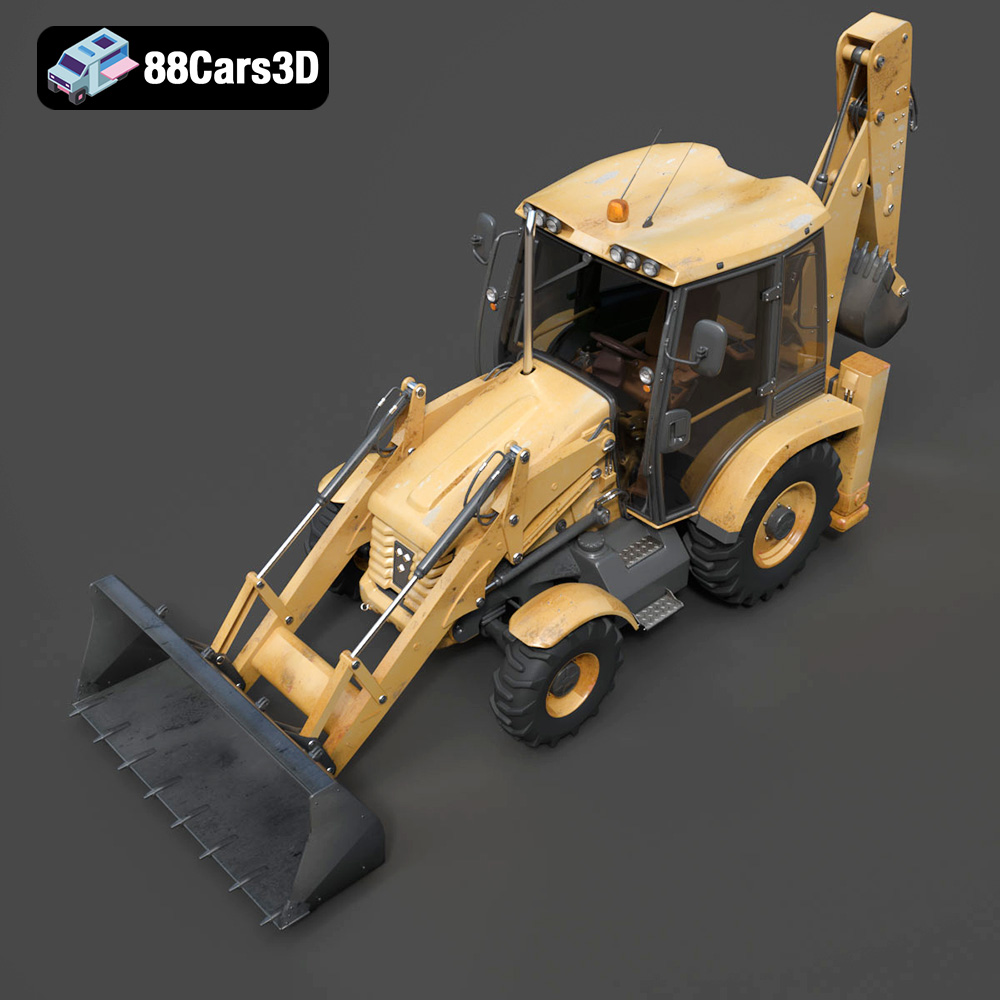
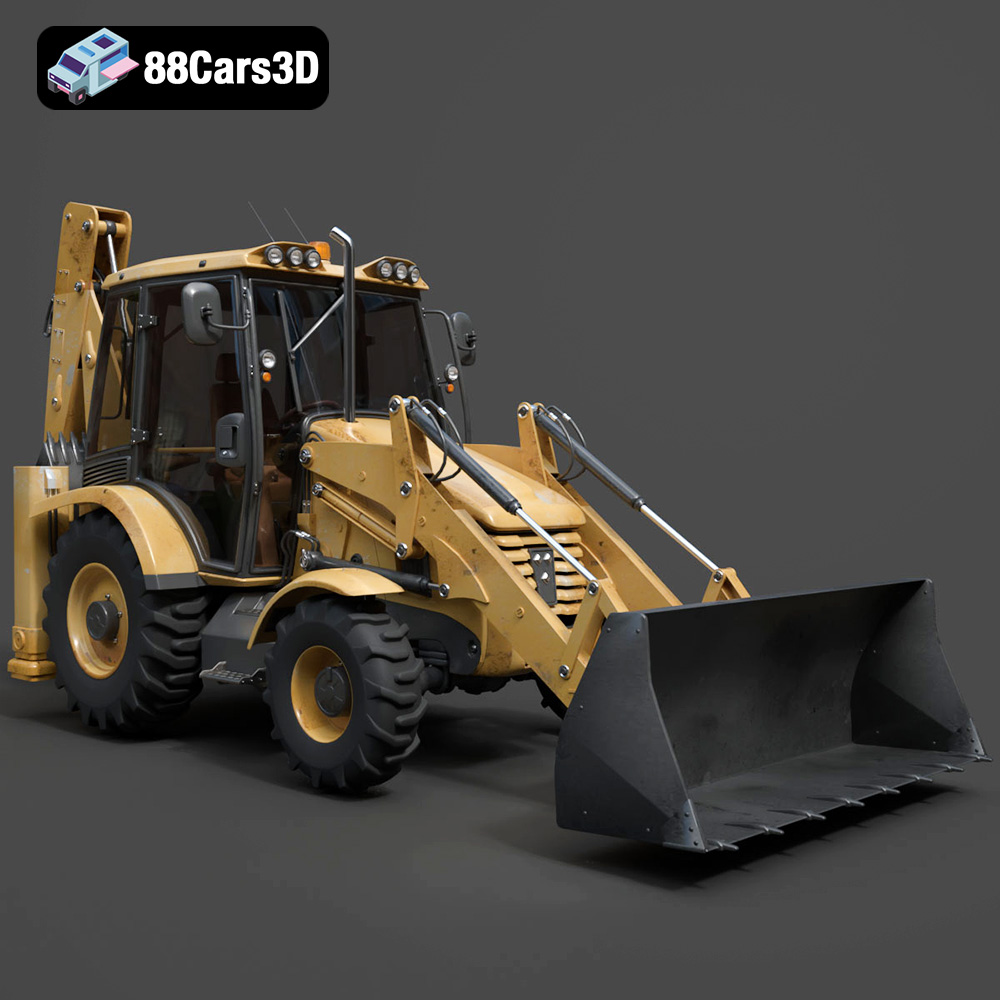
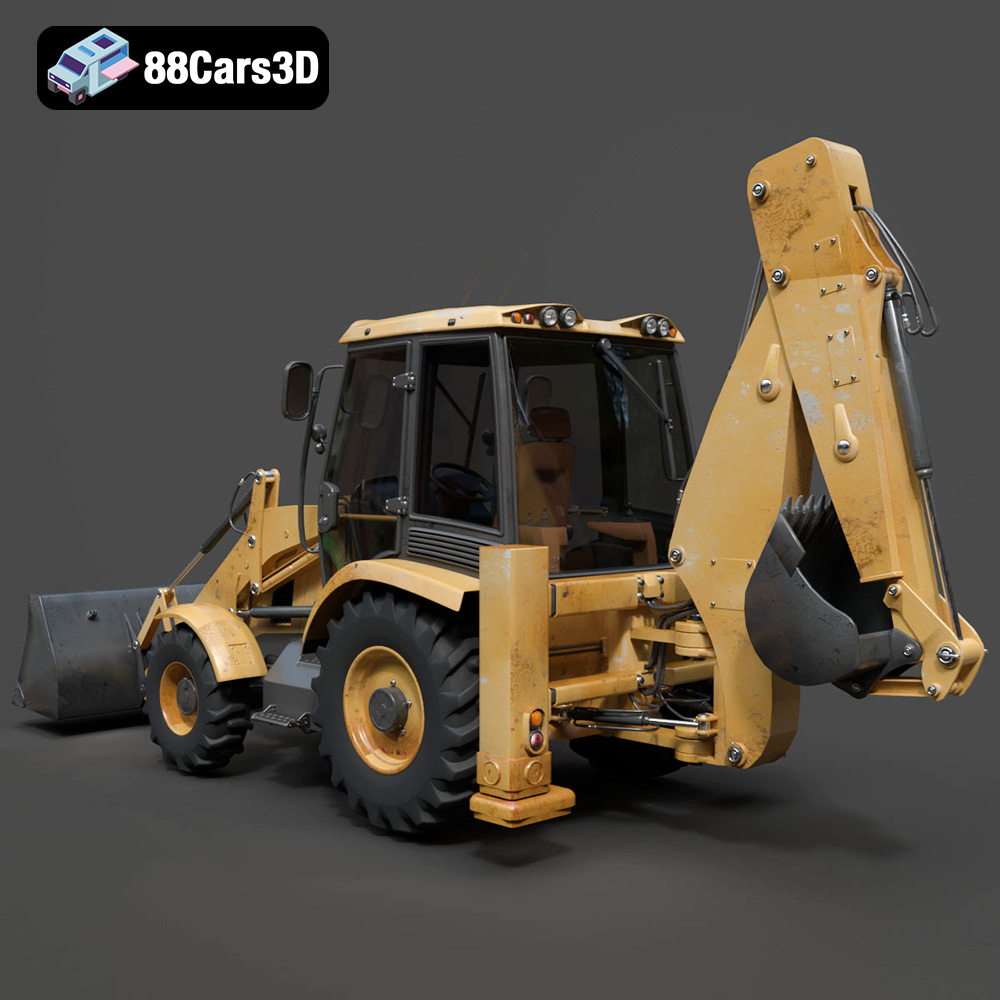
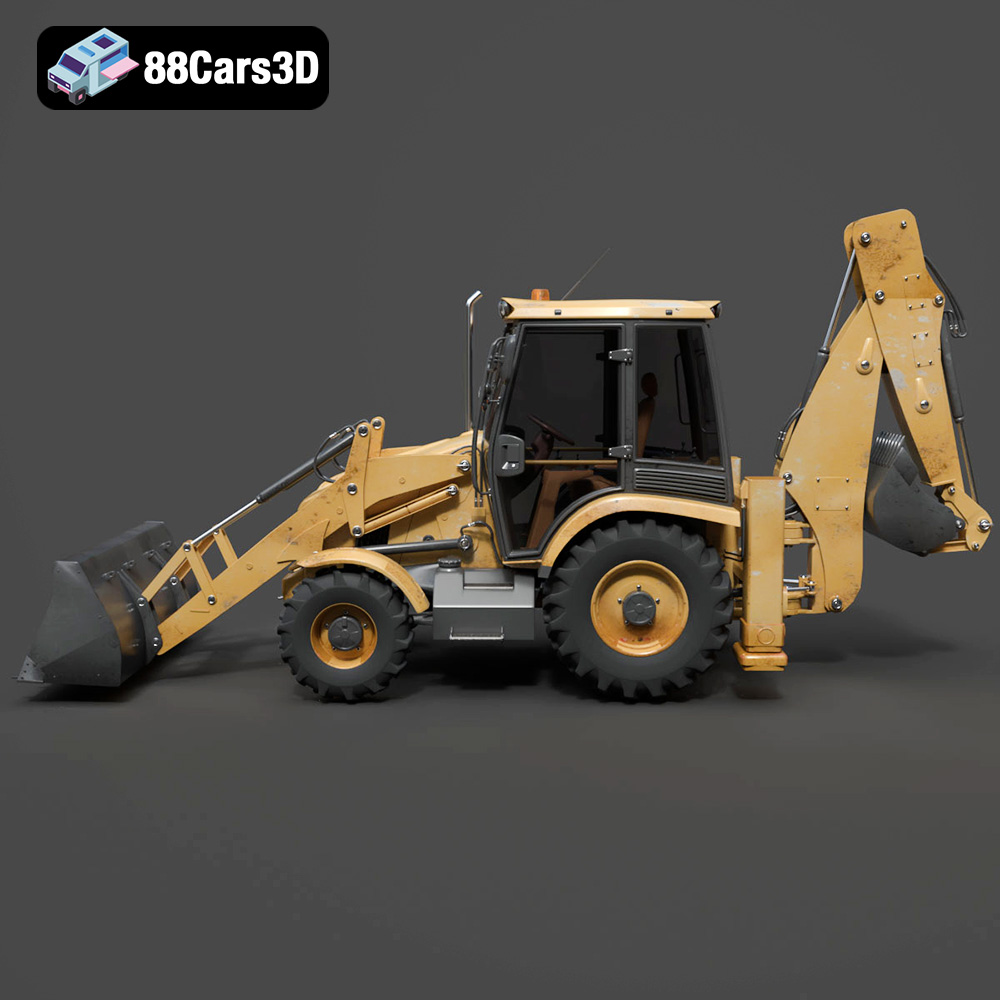
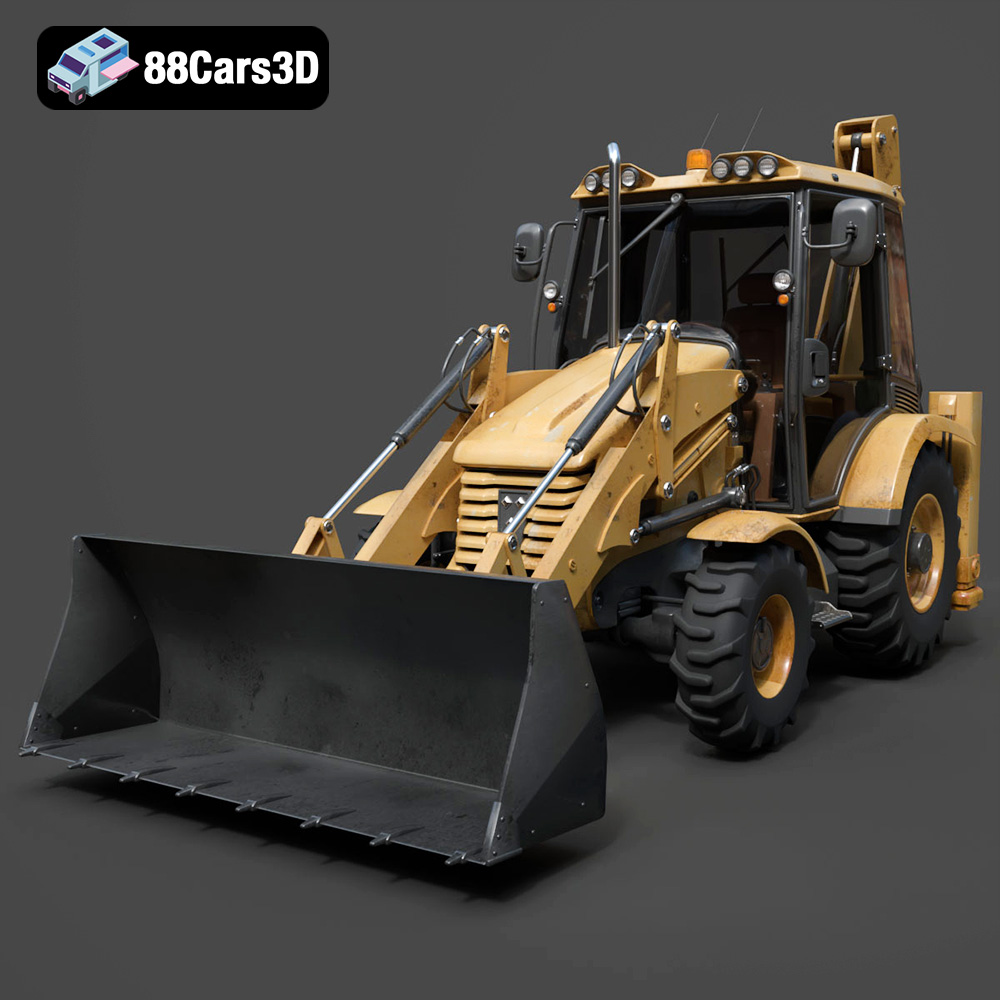
A key aspect of this model’s superiority is its exceptional attention to detail, meticulously replicating the real-world counterpart. The exterior showcases an accurate heavy-duty frame, industrial proportions, and intricate exposed engine components, complete with hydraulic line routing that faithfully mimics actual heavy equipment. Features like the authentic vertical exhaust stack, air intake systems, and realistic industrial lighting setup (roof beacons, work lights, taillights) contribute significantly to its photorealism. Deep-tread heavy equipment tires with rugged wheel hubs further enhance its authenticity, crucial for any game assets requiring a high degree of visual fidelity.
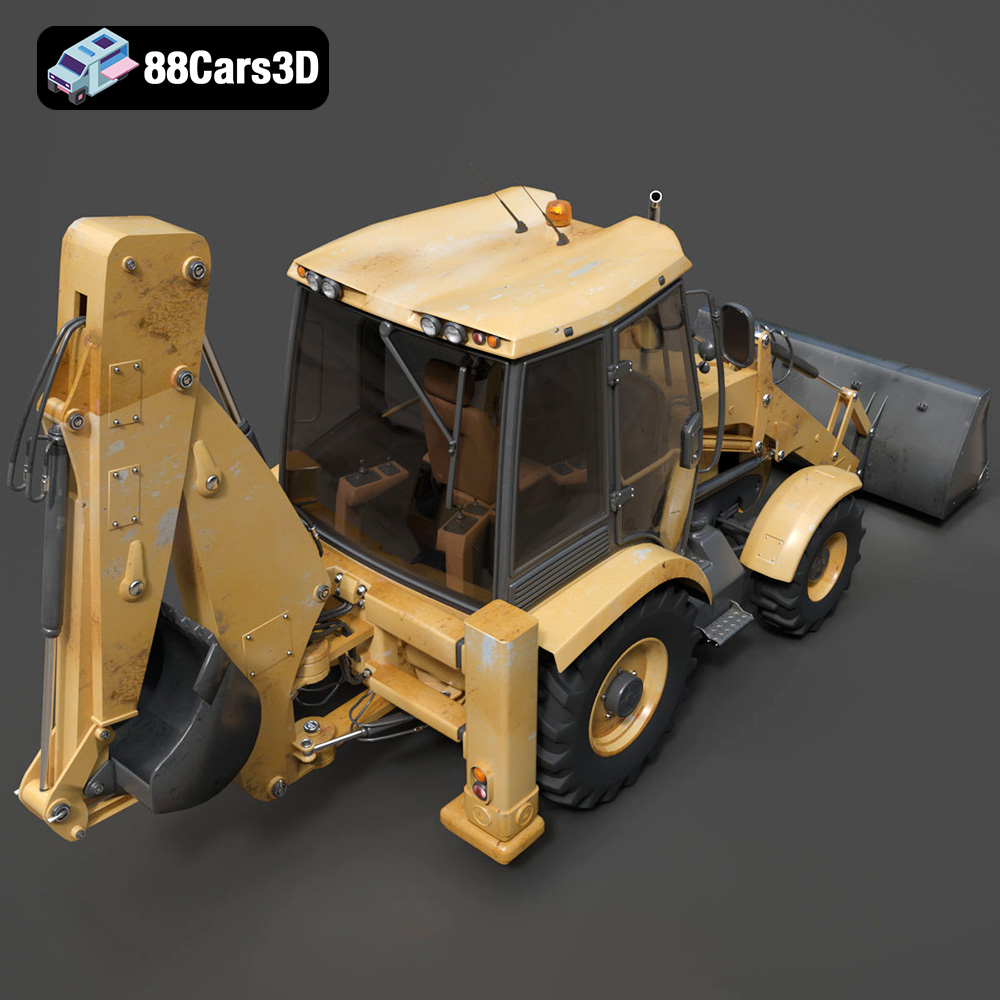
The dedication to detail extends to the cockpit and interior, a critical area for simulation and first-person perspectives. A detailed operator cabin features a structural roll-over protection system (ROPS), a swivel operator seat for dual-control functionality, and a comprehensive industrial instrument cluster with digital displays. Authentic joystick controls, a steering wheel, levers, and foot pedals are all present, making it ideal for immersive operator training modules or in-depth construction simulators where realism is paramount. This level of interior fidelity is rare and highly prized in professional environments.
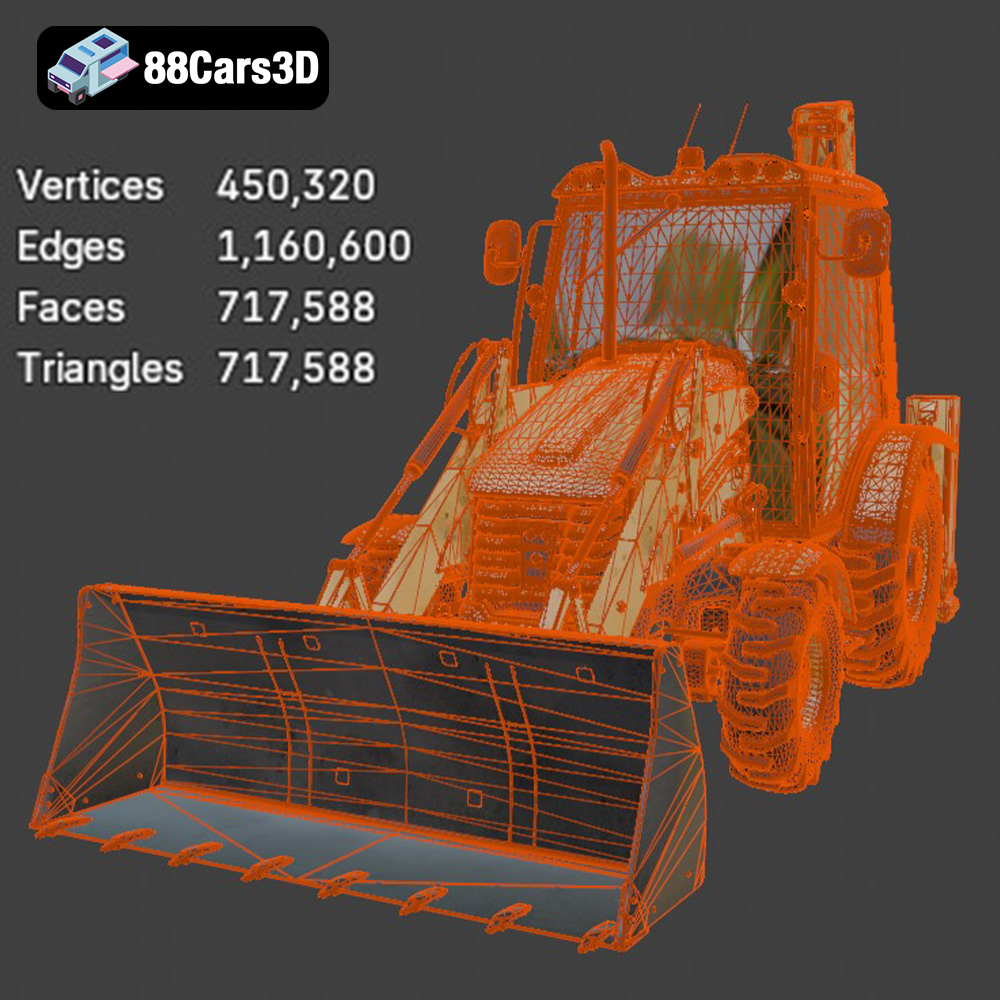
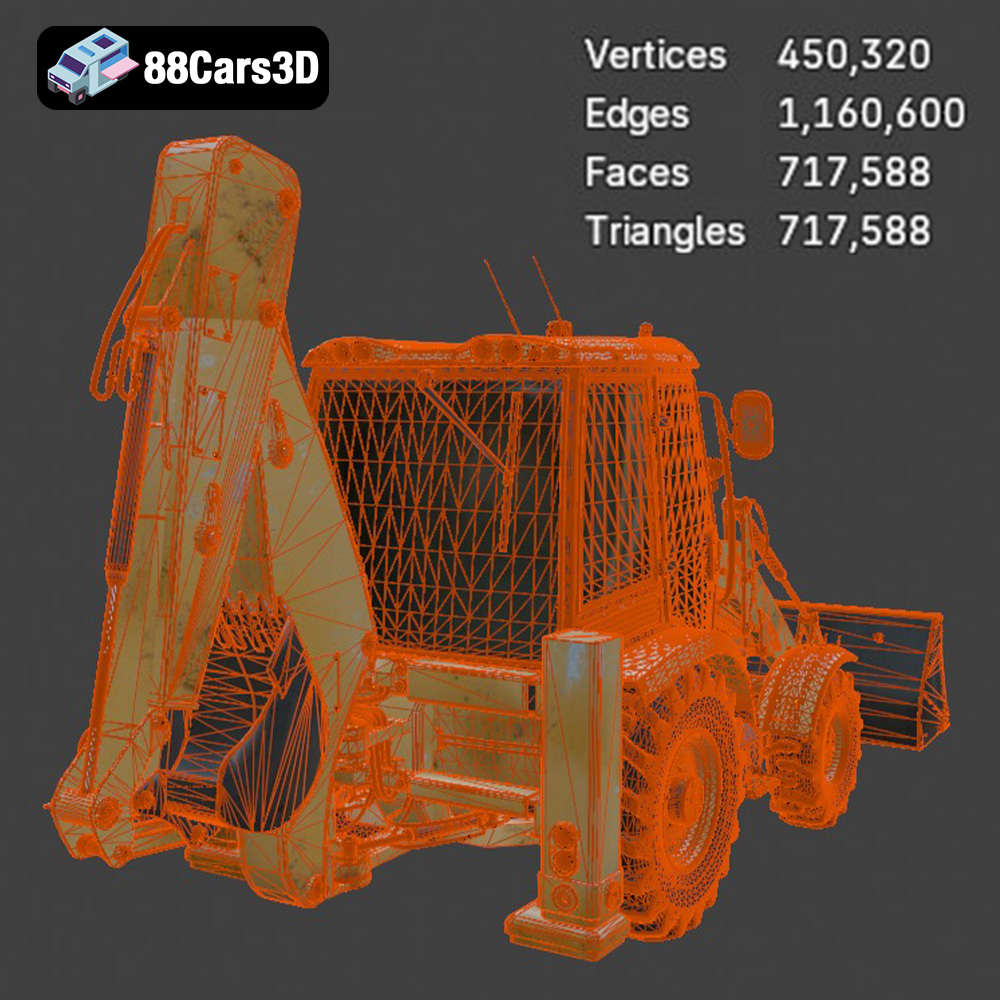
With an impressive 717,588 triangles, this high-fidelity 3D model strikes a crucial balance. It provides unparalleled visual detail without becoming overly cumbersome for real-time applications. The topology is meticulously designed to ensure realistic reflections and structural accuracy, which is vital for automotive rendering or industrial visualization where every surface characteristic is scrutinized. Beyond static appeal, the model is structured for seamless rigging and complex mechanical animations.
The technical specifications highlight features like real-world scale accuracy and proper pivot setup for accurate steering, wheel rotation, bucket tilting, and backhoe articulation. These are not trivial details; they are fundamental for creating believable animations and interactive experiences. Whether you need to simulate earthmoving, demonstrate operational procedures in VR, or integrate it into a physics-driven game environment, the pre-configured pivots and clean hierarchy save countless hours in the animation and integration phases.
The versatility of the Backhoe Loader 3D Model makes it a powerful asset across various professional domains. Its design and included file formats ensure it can be seamlessly integrated into diverse workflows, enhancing project efficiency and visual output.
For game developers, especially those working on construction simulators, open-world environments, or industrial sandbox games, the “game-ready” optimization of this model is a significant advantage. The 717,588 triangle count is carefully chosen to deliver photorealistic quality without crippling real-time performance, making it an excellent candidate for high-end engines like Unreal Engine and Unity. The inclusion of the `.unreal` format means it’s pre-prepared for direct import, often with materials set up to leverage the engine’s rendering capabilities. Developers can focus on gameplay mechanics and environmental design, rather than spending time optimizing or re-rigging assets. Its proper pivot setup ensures that animations for digging, steering, and maneuvering are straightforward to implement, creating a highly interactive and believable user experience.
Architectural visualization studios and industrial marketing agencies will find the Backhoe Loader indispensable for automotive rendering and site visualizations. With `.max` and `.blend` files included, artists have full access to the model within their preferred software. This allows for complete control over materials, lighting, and camera setups. Imagine rendering this backhoe in a construction site simulation, showcasing its intricate hydraulic systems under dramatic studio lighting, or integrating it into a large-scale infrastructure project visualization. The high fidelity ensures that even close-up shots will hold up to scrutiny, providing clients with stunning, hyper-realistic imagery that truly sells the vision.
The ability to customize industrial paint colors, modify tire textures for dirt and wear, and adjust material finishes (matte industrial paint, glossy cabs, metallic hydraulics) empowers artists to tailor the model precisely to specific project needs. This level of customization is crucial for achieving brand consistency or simulating various environmental conditions, from pristine showroom renders to gritty, weathered on-site scenarios.
Augmented Reality (AR) and Virtual Reality (VR) are transforming training and sales, offering immersive experiences that were once impossible. This Backhoe Loader model is perfectly suited for such innovations. Its optimized geometry and inclusion of the `.glb` format make it ideal for AR/VR applications, including immersive operator training modules where new recruits can safely learn machine controls and procedures in a risk-free virtual environment. Virtual showrooms can allow potential clients to interact with the machine in 3D, exploring its features and specifications in an engaging way. Mobile AR experiences can bring the backhoe to life in any physical space, providing interactive demonstrations for marketing or educational purposes, all thanks to its robust technical foundation.
The utility of a high-quality 3D model extends far beyond digital screens. The Backhoe Loader model offers exciting possibilities for physical fabrication and extensive customization, serving hobbyists and professionals alike.
For enthusiasts of heavy machinery and scale models, the inclusion of the `.stl` format is a significant bonus. This allows for the precise 3D printing of the Backhoe Loader, transforming it from a digital asset into a tangible display piece. The recommended scale (1:35 / 1:48 / 1:50) and detailed print settings (layer height, wall thickness, infill, support requirements) provide a clear roadmap for successful printing. Whether you’re a hobbyist creating a miniature construction fleet or an engineer needing a physical prototype, the `.stl` file ensures a high-resolution print that captures the model’s intricate details, such as hydraulic lines, the exhaust stack, and the unique cabin structure. Post-processing suggestions, including sanding, priming, and applying authentic industrial colors with weathering effects, guide users toward achieving a truly professional finish, demonstrating the versatile nature of 3D car models and heavy machinery assets.
Beyond its default appearance, the Backhoe Loader 3D Model offers extensive customization options, critical for integration into diverse projects. The ability to change industrial paint colors is fundamental for matching corporate branding or simulating different fleet vehicles. Modifying tire textures to include dirt, mud, or wear patterns allows artists to tell a story about the machine’s usage and environment, adding layers of realism. Adjusting material finishes—from matte industrial paint to glossy cabs and metallic hydraulics—provides fine-grained control over its visual presence. Furthermore, adapting lighting for day, night, or active construction site environments ensures the model can seamlessly blend into any scene, enhancing narrative and visual impact. This flexibility ensures that the model can be a unique, tailored asset rather than a generic placeholder.
In the demanding world of 3D production, whether for games, visualizations, or interactive experiences, the quality of your assets dictates the quality of your output. The Backhoe Loader 3D Model stands out as a prime example of a meticulously crafted, technically superior asset. From its highly detailed exterior and interior to its optimized topology and game-ready status, it is built to deliver unparalleled realism and performance across a multitude of professional applications.
Its comprehensive file format support ensures seamless integration into virtually any pipeline, from Blender and 3ds Max for high-end rendering to Unreal Engine and Unity for real-time interactivity. The inclusion of formats like .stl even extends its utility into the physical realm of 3D printing. For professionals seeking to elevate their construction simulations, industrial visualizations, AR/VR training modules, or game assets, investing in such a high-fidelity model is not just an aesthetic choice, but a strategic one. Explore this and other exceptional 3D car models and industrial assets at 88cars3d.com and empower your projects with precision and performance.
Experience the rugged utility of the iconic Backhoe Loader, a staple of modern construction and earthmoving equipment. This highly detailed 3D model captures the imposing industrial design of the versatile heavy-duty machine, featuring an articulated front loader bucket, a complex rear backhoe digging arm, sturdy stabilizer legs, and a fully realized heavy equipment chassis. Crafted with an impressive 717,588 triangles, this high-fidelity 3D model offers unparalleled visual detail while remaining structured for optimal use in high-end game development, virtual reality (VR), augmented reality (AR), and professional CGI animation. The topology is meticulously designed to ensure realistic reflections, structural accuracy, and seamless rigging for complex mechanical animations. Perfect for construction site simulations, industrial environments, heavy machinery configurators, and hyper-realistic rendering projects.
$48.99
.blend
.fbx
.glb
.max
.obj
.ply
.rendering
.stl
.tractor
.unreal
backhoe-loader
construction-equipment
game asset
game-ready
heavy-machinery
high poly
industrial-vehicle
optimized
vehicle-3d-model
VR/AR