Get 20% OFF All Premium 3D & STL Models!

In the expansive realm of 3D modeling, where photorealism meets performance, the demand for exceptionally crafted assets is ever-growing. For automotive enthusiasts, game developers, visual effects artists, and architects alike, the allure of classic vehicles transcends time, offering a rich canvas for digital creation. Among these legendary machines, few command as much respect and admiration as the pre-war titans of luxury, epitomized by the magnificent 1933 Cadillac V16 452-C Town Car. This isn’t just a car; it’s a statement of unparalleled engineering and design, a whisper of a bygone era of bespoke craftsmanship.
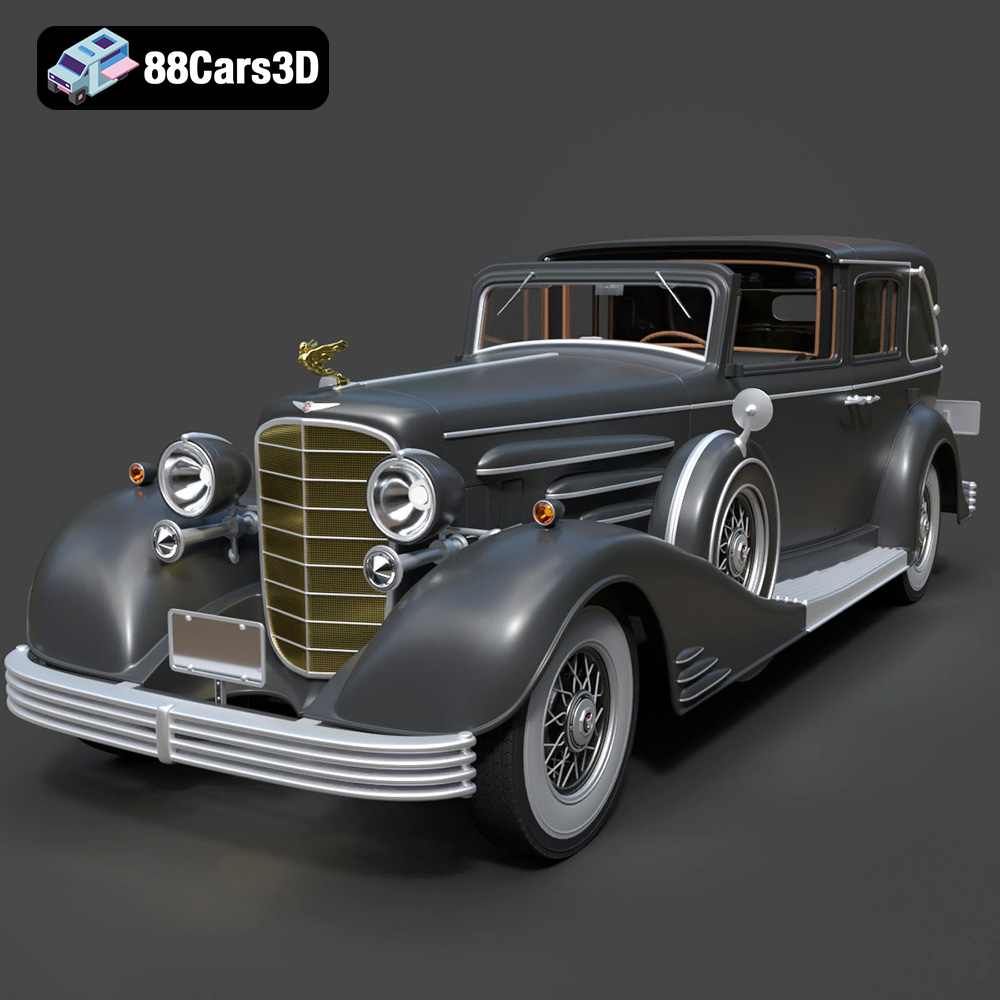
Bringing such an iconic piece of history into the digital age requires a level of detail and technical precision that can only be achieved by skilled artists. It’s about capturing not just the form, but the very essence of the vehicle – from its sweeping pontoon fenders and majestic chrome V-shaped grille to the intricate wire wheels and the opulent rear passenger compartment. A truly exceptional 3D model of the 1933 Cadillac V16 452-C Town Car serves as more than just a visual prop; it becomes a cornerstone for high-fidelity simulations, cinematic sequences, immersive virtual experiences, and even tangible 3D prints. For professionals seeking an asset that combines historical accuracy with cutting-edge technical optimization, the exquisite 1933 Cadillac V16 452-C Town Car 3D model available on 88cars3d.com stands as a testament to what’s possible in premium 3D content creation.
The versatility of any professional 3D asset hinges significantly on the file formats it supports. Different stages of a project, from initial modeling and texturing to real-time rendering and physical production, often require specific formats tailored to their unique demands. Understanding these distinctions is crucial for seamless integration into various pipelines. The 1933 Cadillac V16 452-C Town Car 3D model, for instance, offers a comprehensive suite of formats, ensuring its adaptability across virtually any professional application.
The .blend format is the native file type for Blender, the powerful open-source 3D creation suite. When you acquire a .blend file, you’re getting a fully editable scene, complete with the model’s geometry, materials, textures, lighting setups, camera positions, and even animation data if present. For artists working primarily in Blender, this format offers the most flexibility for customization. You can easily dissect the model, modify materials, adjust UVs, or even re-rig components. Its comprehensive nature makes it ideal for iterative design and deep dives into the model’s construction, offering full control over every aspect of the 1933 Cadillac V16.
.fbx (Filmbox) is arguably the most widely adopted proprietary 3D file format for interchange between various 3D software applications and game engines. Developed by Autodesk, FBX excels at preserving a wide range of data, including models, materials, textures, animations, and skeletal structures. It’s the go-to format for exporting assets from modeling software like 3ds Max or Blender into game engines such as Unreal Engine and Unity. For the Cadillac V16, an .fbx file ensures that all its intricate details, from the sweeping chassis to the pivot setups for animation, are seamlessly transferred, making it an essential asset for game developers and real-time visualization specialists.
The .obj (Wavefront Object) format is a universal standard, prized for its simplicity and wide compatibility. It primarily stores geometric data (vertices, normals, texture coordinates, and faces) and can reference external material files (.mtl). While it doesn’t support animation or rigging, its widespread support across virtually all 3D applications makes it an indispensable “lowest common denominator” for cross-software compatibility. If you need to import the Cadillac V16 into obscure or highly specialized software, or simply want the raw mesh data, .obj is often the most reliable choice.
.glb (GLB format for GL Transmission Format) is a binary file format that encapsulates 3D models, textures, and animations into a single, self-contained file. It’s built upon the glTF standard, which is specifically designed for efficient transmission and loading of 3D scenes and models in web, augmented reality (AR), and virtual reality (VR) applications. Its optimization for real-time delivery makes it perfect for displaying the 1933 Cadillac V16 in a browser-based configurator, a mobile AR app, or an interactive VR showroom without extensive loading times.
.stl (STereoLithography) is the most common file format for 3D printing. It represents a 3D model as a series of connected triangles (a tessellation) that define the surface geometry. While it lacks color or texture information, its simplicity makes it universally compatible with 3D printers and slicing software. The Cadillac V16, provided in .stl, allows hobbyists and professionals to physically manifest this classic car, bringing it off the screen and into the real world. Precise recommendations for scale, layer height, and support structures are vital for a successful print, especially for a model of this complexity.
The .ply (Polygon File Format) is another popular format for storing 3D data, particularly useful for scanned data, CAD applications, and scientific visualization. It can store a wider range of properties than .obj, including color, transparency, and normal vectors for each vertex or face. While not as universally used for game development, its precision and ability to carry detailed attribute data make it valuable for specific engineering, analysis, or highly detailed archival purposes of the Cadillac V16 model.
The .unreal format, or more accurately, an asset specifically structured and optimized for Unreal Engine, implies that the model has been prepared with the engine’s specifications in mind. This often means optimized polycount, correct material setup (PBR workflows), proper UV mapping for lightmaps, collision meshes, and sometimes even pre-configured blueprints or animation sequences. For projects targeting Unreal Engine, such as a historical driving simulator or a cinematic real-time experience featuring the Cadillac V16, this “engine-ready” asset significantly reduces import and setup time, allowing developers to jump straight into integrating it into their scenes.
Similar to .blend for Blender, .max is the native file format for Autodesk 3ds Max, a leading software for 3D modeling, animation, rendering, and visualization. A .max file contains the complete 3ds Max scene, including geometry, materials, textures, lighting, cameras, animation keyframes, and plugins. For professionals whose pipelines are centered around 3ds Max, having the Cadillac V16 in this format provides the highest level of editable control, enabling complex scene integration, sophisticated rendering setups with V-Ray or Corona, and advanced animation tasks.
The availability of such a diverse range of formats for the 1933 Cadillac V16 452-C Town Car 3D model ensures that artists and developers, regardless of their preferred software or target application, can integrate this premium asset seamlessly into their workflow. This foresight in providing comprehensive file support is a hallmark of high-quality 3D car models.
Automotive rendering is a specialized discipline within 3D visualization, demanding meticulous attention to detail, lighting, and material properties to achieve photographic realism. When dealing with a classic like the 1933 Cadillac V16 452-C Town Car, the stakes are even higher, as artists strive to evoke the nostalgic elegance and craftsmanship of a bygone era. High-quality 3D car models are the foundation upon which stunning renders are built.
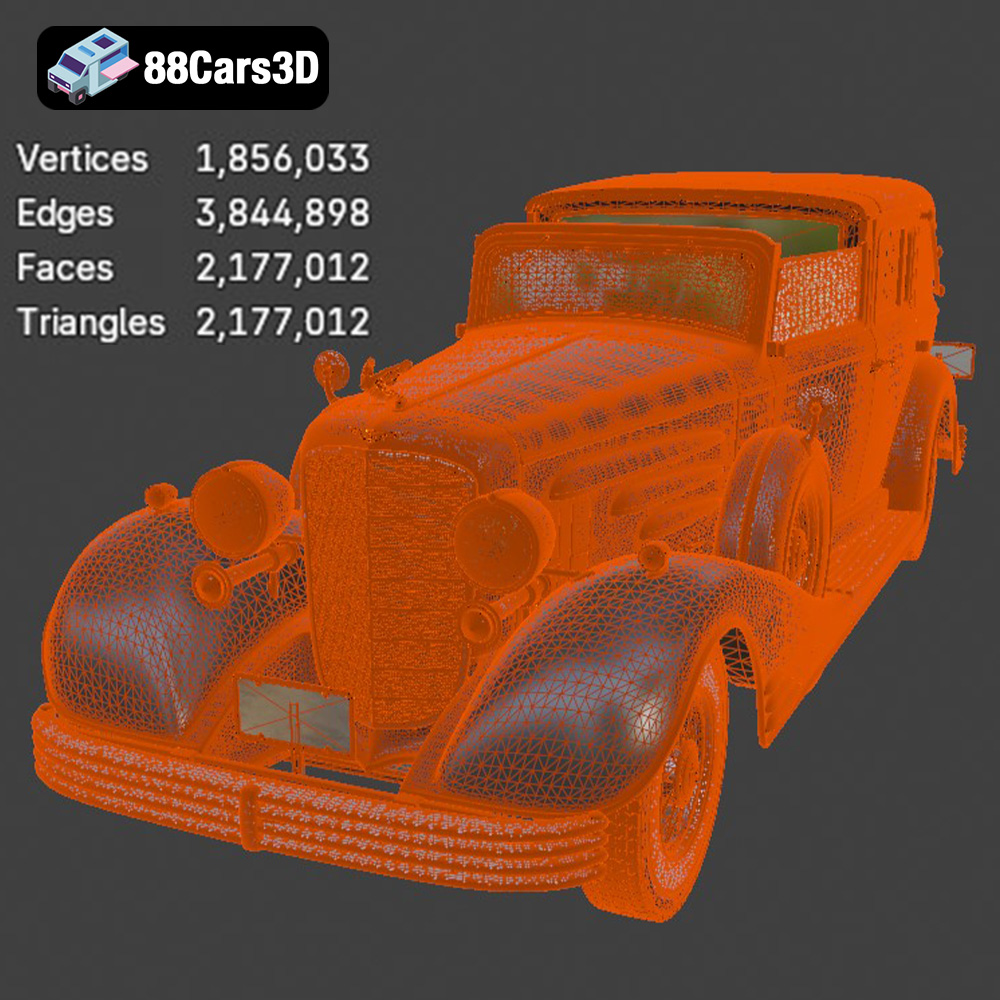
Achieving photorealism begins with expertly crafted materials. The Cadillac V16 3D model, with its robust topology of 2,177,012 triangles, provides ample geometric detail to support complex material assignments. Imagine the polished gleam of its chrome V-shaped grille, reflecting the studio lights with subtle imperfections that hint at its age. The deep, rich lacquer of its bodywork, perhaps a classic two-tone finish, would require carefully calibrated metallic paint shaders. Inside, the opulent rear passenger compartment demands realistic tufted leather and polished wood textures, while the open-air driver’s cockpit would showcase worn, supple materials. Artists using renderers like V-Ray or Corona in 3ds Max, or Cycles/Eevee in Blender, leverage Physically Based Rendering (PBR) workflows to accurately simulate how light interacts with these surfaces, transforming raw geometry into a breathtaking visual experience. The ability to customize these material finishes – from changing body colors to adjusting the luster of the chrome – offers boundless creative freedom.
Beyond materials, lighting is paramount. A classic car like the Cadillac V16 truly shines when lit strategically. A studio setup might employ softbox lights to highlight its sweeping pontoon fenders and elegant silhouette, emphasizing its majestic proportions. Alternatively, placing it in a period-correct environment – a cobblestone street in a bustling 1930s city, or the grand entrance of a stately mansion – would involve integrating the car into an HDR (High Dynamic Range) image-based lighting setup, combined with area lights to simulate natural sunlight or artificial streetlamps. For cinematic productions or brand campaigns, the lighting can be designed to tell a story, perhaps focusing on the iconic Goddess hood ornament as the sun sets, or using dramatic shadows to emphasize the vehicle’s powerful presence. The detailed period-correct lighting, including its elegant carriage lights and massive bullet-style headlights, can be animated and illuminated, adding another layer of realism to any scene.
Integrating high-fidelity classic cars into game environments presents a unique challenge: balancing visual authenticity with real-time performance. Game developers need assets that not only look incredible but are also optimized to run smoothly within complex interactive worlds. The 1933 Cadillac V16 452-C Town Car 3D model is designed with these considerations at its core, making it an ideal game asset.
The stated 2,177,012 triangle count for the Cadillac V16 strikes a crucial balance. While this is considered high for some low-poly game assets, it’s perfectly optimized for high-end real-time engines like Unreal Engine and Unity, especially for vehicles that will be viewed up close or as central features in a scene. For open-world games or racing titles where a high level of detail is paramount, this polycount allows for breathtaking visual realism without crippling frame rates. The intelligently structured geometry ensures that every curve, every chrome accent, and every intricate wire wheel is accurately represented, even at 4K resolutions or in VR. Furthermore, the model’s “game-ready” status implies proper UV mapping for textures and lightmaps, ensuring efficient rendering and realistic global illumination within the engine.
A static model, no matter how beautiful, has limited utility in game development. The Cadillac V16 3D model goes beyond static representation by including separate wheels, suspension, and steering components, along with proper pivot setups for steering, wheel rotation, and suspension travel. This is a critical advantage for game developers:
This level of modularity and preparation significantly reduces the workload for development teams, allowing them to integrate the Cadillac V16 swiftly into their game logic and animation systems, rather than spending valuable time preparing the asset for interaction.
The versatility of a well-engineered 3D model extends far beyond traditional rendering and game development. With the rise of augmented reality (AR), virtual reality (VR), and accessible 3D printing, high-quality assets like the 1933 Cadillac V16 452-C Town Car 3D model are finding innovative applications in new and exciting mediums.
AR and VR offer unprecedented opportunities for interaction and immersion, particularly in showcasing complex objects like vintage cars. Imagine stepping into a virtual showroom where the Cadillac V16 sits center stage, allowing users to walk around it, open its doors, and even sit inside the opulent rear compartment. Using the .glb format, optimized for real-time web and mobile applications, the model can be seamlessly integrated into AR apps that project the car into a real-world environment, allowing potential buyers or enthusiasts to visualize it in their driveway. For VR, the detailed interior and exterior, combined with real-world scale accuracy, create a truly immersive experience, perfect for museum-grade interactive visualizations, virtual automotive tours, or even educational simulations of automotive history. The Cadillac V16’s optimized geometry ensures that these experiences remain smooth and engaging, preventing motion sickness and maintaining a high level of visual fidelity even on standalone VR headsets.
The conversion of a digital asset into a tangible object through 3D printing is a fascinating application. The 1933 Cadillac V16 452-C Town Car 3D model, available in .stl format, allows for hobbyists and professionals to create physical replicas. However, success in 3D printing requires careful consideration of the model’s design and print settings. The detailed geometry, including intricate wire wheels and delicate exhaust systems, necessitates a high-resolution printing method, with resin printing often recommended for fine details. Recommendations for optimal layer height (0.04–0.12 mm), wall thickness (1.2–2.0 mm), and infill (20–30%) are crucial for structural integrity and detail preservation. Furthermore, strategic print orientation and the use of supports for complex parts ensure that the final physical model accurately reflects its digital counterpart. Post-processing, including sanding, priming, and applying authentic factory colors with metallic finishes, elevates a raw print into a display-worthy masterpiece. This application transforms a digital file into a collectible, a prototype, or a unique display piece, showcasing the versatility of high-quality 3D car models.
A truly premium 3D model is defined by its meticulous construction and adherence to technical best practices. The 1933 Cadillac V16 452-C Town Car 3D model from 88cars3d.com exemplifies this, offering a wealth of features that distinguish it as a professional-grade asset.
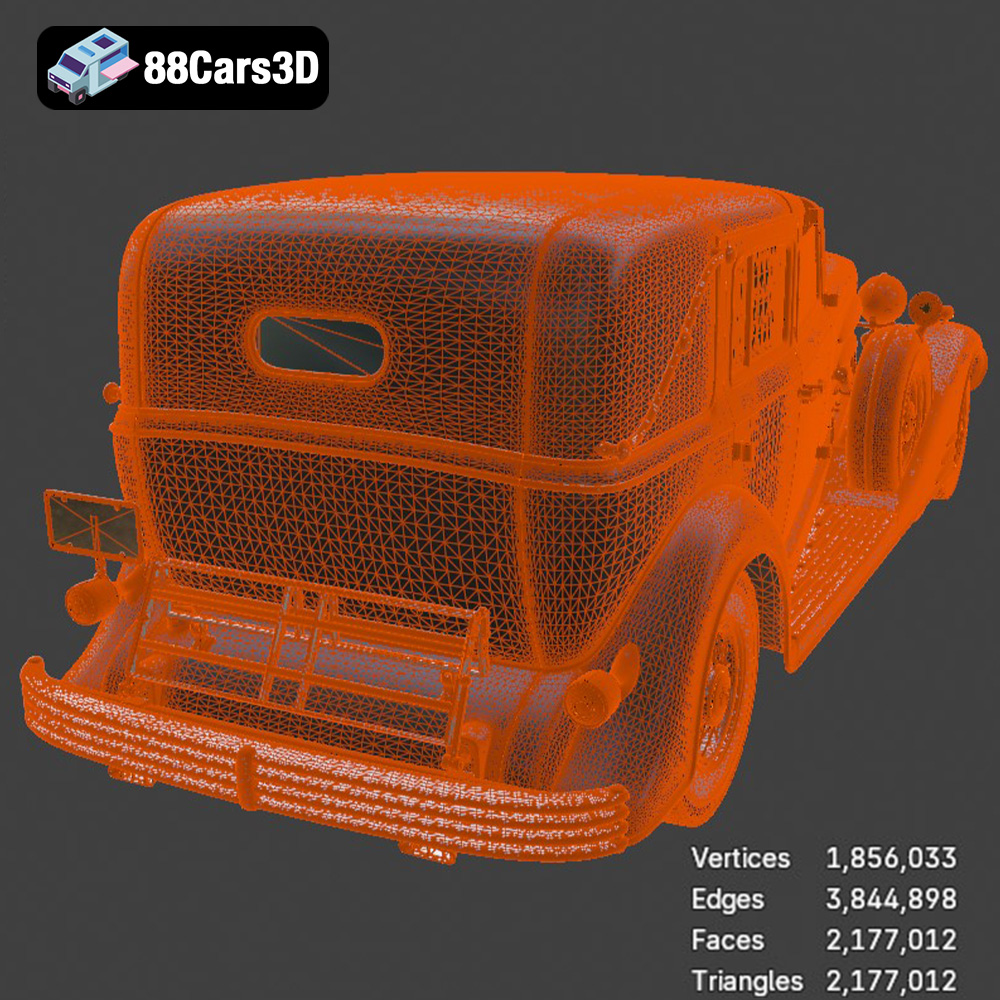
The core of any high-quality 3D model is its geometry. With a detailed topology of 2,177,012 triangles, the Cadillac V16 model captures an extraordinary level of visual fidelity. This polycount allows for the smooth, nuanced curves of the sweeping pontoon fenders, the sharp edges of the chrome accents, and the intricate spokes of the wire wheels to be rendered without noticeable faceting. More importantly, the description highlights “intelligently structured” geometry. This means that while the model is highly detailed, its polygons are likely optimized for efficient rendering, avoiding unnecessary density in flat areas while concentrating detail where it matters most, such as around the grille, lighting elements, and interior components. Such clean topology is essential for smooth deformations during animation and efficient UV unwrapping, which is critical for realistic texturing and lighting.
Beyond raw polygon count, the model’s value lies in its adherence to historical accuracy and functional design.
These technical specifications underscore the commitment to delivering a truly exceptional and versatile 3D car model.
In today’s fast-paced digital production environment, time is a precious commodity. Artists, developers, and designers are constantly seeking ways to enhance their output while streamlining their workflows. This is where high-quality 3D car models like the 1933 Cadillac V16 452-C Town Car prove invaluable, acting as critical accelerators for a multitude of professional projects.
Creating a detailed 3D model from scratch, especially one as historically intricate and mechanically complex as the 1933 Cadillac V16, is a monumental task. It involves extensive research, CAD blueprint translation, precise modeling, meticulous UV mapping, texturing, and often rigging for animation. This process can consume hundreds, if not thousands, of hours for a skilled artist. By investing in a pre-built, high-quality asset like the one offered at 88cars3d.com, professionals can bypass this labor-intensive initial phase entirely. This translates directly into significant cost savings, faster project turnaround times, and the ability to allocate creative resources to other critical aspects of their production, such as scene composition, animation, or interactive logic development.
Premium 3D models come with a guarantee of quality and consistency. They are typically created by expert artists who adhere to industry-standard best practices, ensuring clean topology, accurate scale, well-organized UVs, and optimized materials. This level of craftsmanship ensures that the asset will perform reliably across different software platforms and rendering engines, minimizing unexpected issues during integration. For studios working on large-scale projects, consistency across assets is paramount for a cohesive visual style. The 1933 Cadillac V16 3D model provides a benchmark of excellence, elevating the overall production value of any project it becomes a part of, whether it’s a period drama visualization, a cutting-edge racing game, or an interactive AR experience. Its readiness for various applications, from rendering to 3D printing, further cements its value as a truly versatile and indispensable professional tool.
The journey from historical blueprint to photorealistic digital asset is a demanding one, requiring a blend of artistic vision and technical prowess. The 1933 Cadillac V16 452-C Town Car stands as an icon of automotive luxury, and its digital counterpart, the 3D model available on 88cars3d.com, perfectly captures that essence. This isn’t merely a static object; it’s a meticulously engineered asset, boasting an extraordinary level of detail and optimization for a wide array of professional applications.
From the nuanced curves of its sweeping fenders and the intricate details of its legendary V16 engine to the opulent interior ready for first-person exploration, this model provides unparalleled visual fidelity. Its comprehensive support for various file formats – including .blend, .fbx, .obj, .glb, .stl, .ply, .unreal, and .max – ensures seamless integration into virtually any modern 3D pipeline, be it for high-end automotive rendering in 3ds Max, optimized game development in Unreal Engine, immersive AR/VR experiences, or even detailed 3D prints. For professionals in visualization, game development, film, or interactive media, acquiring such a robust and versatile 3D car model is a strategic decision that saves time, elevates quality, and opens up new creative possibilities. The 1933 Cadillac V16 452-C Town Car 3D model is more than an asset; it’s a gateway to bringing history to life with stunning realism and performance.
The 1933 Cadillac V16 (452-C) Town Car is an undisputed masterpiece of American automotive history, representing the absolute pinnacle of pre-war luxury and bespoke coachbuilding. Renowned for its whisper-quiet, colossal 16-cylinder engine and the distinctive open-chauffeur “Town Car” body style, this magnificent vehicle defined 1930s elegance and prestige. Key visual elements include its sweeping pontoon fenders, the iconic Goddess hood ornament, majestic chrome V-shaped grille, and dual side-mount spare tires, all culminating in a breathtakingly regal silhouette. This premium 3D model boasts an extraordinary level of visual fidelity with a detailed topology of 2,177,012 triangles, capturing every nuanced curve and chrome accent of the classic original. Despite its high detail, the geometry is intelligently structured to ensure stunning photorealism while remaining versatile for high-end digital applications. It stands as an exceptional asset for developers and artists demanding true-to-life representation in historical recreations, architectural visualizations, and cinematic productions.
$37.50
.blend
.cadillac
.fbx
.glb
.max
.obj
.ply
.rendering
.stl
.unreal
.v16
1933
452-c
car-3d-model
classic-car
game asset
game-ready
luxury car
optimized
pre-war
town-car
VR/AR